
Top OEMs for Strainers
Introduction
In the hydraulic architecture of municipal and industrial water systems, strainers function as the primary defensive barrier for critical downstream assets. While often overshadowed by dynamic components such as pumps and control valves, the strainer is the sentinel that prevents catastrophic failure caused by entrained solids, scale, biofilm, and debris. For consulting engineers, plant managers, and utility operators, the specification of strainers is not merely an accessory decision; it is a fundamental aspect of system reliability, hydraulic efficiency, and lifecycle asset management.
Strainers are deployed across the entire spectrum of the water cycle. In raw water intake systems, they protect low-lift pumps from large particulates. In potable water distribution, they shield sensitive pressure reducing valves (PRVs), flow meters, and backflow preventers from line scale and construction debris. In wastewater treatment plants (WWTPs), they are essential for protecting wash water systems, seal water lines, and chemical feed pumps from clogging. The failure of a strainer—whether through screen burst, body rupture, or excessive head loss—can lead to unplanned plant shutdowns, pump cavitation, or the fouling of expensive instrumentation.
The selection of an Original Equipment Manufacturer (OEM) for strainers carries significant weight. Unlike generic pipe fittings, high-quality strainers require precise engineering regarding open area ratios, pressure drop characteristics, casting integrity, and screen metallurgy. Regulatory pressure on energy efficiency also dictates that engineers must select units that minimize parasitic head loss while maximizing solids retention. Furthermore, the long-term maintainability of these units—specifically the ease of access for screen cleaning and the availability of replacement baskets or gaskets—is directly tied to the operational expenditure (OPEX) of the utility.
This article provides an in-depth, technical analysis of strainer technology, selection criteria, and a specification-safe review of four prominent OEMs: Singer Valve, Eaton (Hayward Flow Control), Mueller Steam Specialty, and Watts. The objective is to equip engineering professionals with the data required to make informed, defensible decisions for critical infrastructure projects.
How to Select This Valve Type
Selecting the appropriate strainer for water and wastewater applications requires a rigorous evaluation of hydraulic conditions, media characteristics, and operational constraints. Engineers must move beyond simple line-size matching and consider the strainer as a dynamic component that affects the system curve. The following criteria define the engineering best practices for strainer specification.
1. Valve Function and Duty Cycle
The primary function of the strainer dictates its configuration. Engineers must determine if the process flow is continuous or intermittent.
- Simplex Strainers (Y-Type and Basket): Suitable for applications where the line can be isolated for cleaning without disrupting the overall process, or where batch operations allow for scheduled maintenance.
- Duplex (Twin) Basket Strainers: Mandatory for continuous flow applications where shutdown is not permissible (e.g., cooling loops, critical process water). These units feature a diverter valve that shifts flow to a standby chamber, allowing the operator to service the dirty basket while the system remains live.
- Automatic Self-Cleaning Strainers: While this article focuses on static OEMs, it is worth noting that high-solids loading applications may require automated backwashing capabilities to prevent operator fatigue and excessive downtime.
2. Pressure and Flow Conditions
Hydraulic modeling is essential. The strainer introduces a pressure drop (Delta P) that increases as the screen captures debris.
- Cv Factors: Manufacturers publish flow coefficients (Cv) for their strainers. Engineers must calculate the clean pressure drop and ensure it is negligible (typically < 1-2 PSI).
- Dirty Delta P: The system must safeguard against the “burst pressure” of the screen. Specifications should define the maximum allowable pressure drop before cleaning is required (often 5–10 PSI).
- Velocity Limits: High fluid velocities can cause screen erosion or vibration. Standard water velocities (5–10 ft/s) are generally acceptable, but higher velocities require reinforced heavy-duty screens.
3. Materials of Construction
Material compatibility ensures the longevity of the pressure boundary and the internal screen.
- Body Material:
- Cast Iron (ASTM A126 Class B): Standard for general water service, cost-effective, typically rated to 200 PSI.
- Ductile Iron (ASTM A536): Preferred for municipal specs due to higher tensile strength and resistance to thermal/mechanical shock.
- Stainless Steel (304/316): Required for corrosive environments, wastewater applications with high H2S presence, or chemical feed systems.
- Bronze: Common in seawater or brackish applications to resist biofouling and corrosion.
- Thermoplastics (PVC/CPVC/GFPP): Essential for corrosive chemical dosing lines (e.g., ferric chloride, sodium hypochlorite).
- Screen Material: Type 304 Stainless Steel is standard. Type 316 is specified for higher corrosion resistance. Monel or Hastelloy may be required for extreme chemical service.
4. Screening Element Design
The geometry of the screening element is the most critical process variable.
- Perforated Plate vs. Wire Mesh: Coarse straining utilizes perforated metal sheets. Fine straining requires wire mesh lined inside a perforated support structure.
- Mesh vs. Micron: Engineers must strictly define retention requirements. “20 Mesh” means 20 openings per linear inch. A micron rating describes the particle size diameter. Confusion here leads to clogging or pass-through of damaging solids.
- Open Area Ratio (OAR): This is the ratio of the total open area of the screen to the cross-sectional area of the inlet pipe. A low OAR leads to rapid clogging and high pressure drop. Municipal specifications should target an OAR of at least 3:1 or 4:1 to extend cleaning intervals.
5. Installation Environment
Physical constraints often dictate strainer type.
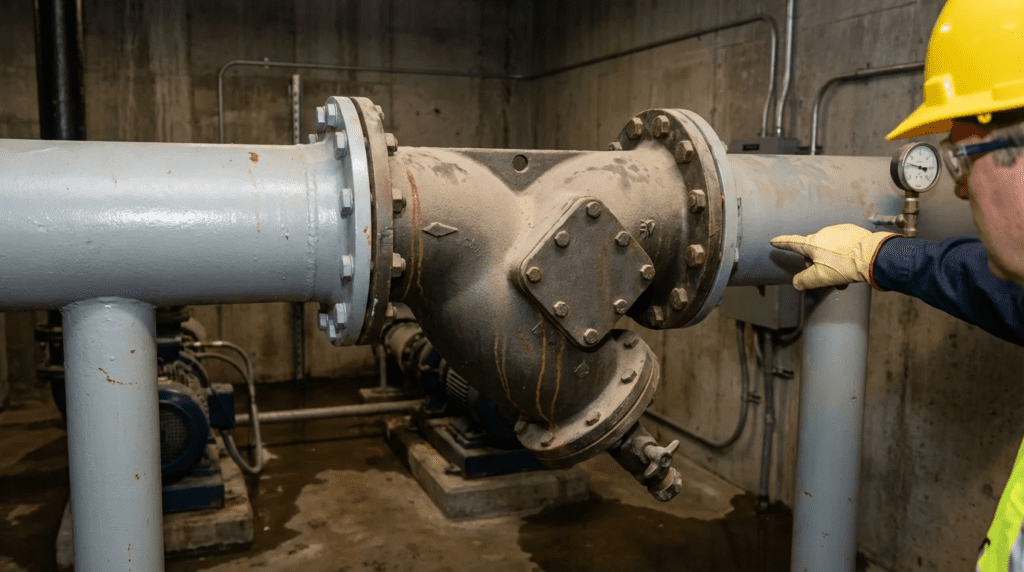
- Y-Strainers: versatile and compact but have lower dirt-holding capacity. They can be installed horizontally or vertically (downward flow).
- Basket Strainers: Must be installed horizontally. They offer superior dirt-holding capacity and are easier to service (top removal) but require a larger footprint and vertical clearance for basket removal.
- Buried Service: Strainers are rarely buried directly. They are typically housed in vaults. If burial is necessary, access risers or extension stems for blowdown valves are required.
6. Sealing and Maintenance Mechanisms
Operator safety and ease of maintenance are paramount.
- Cover Type: Bolted covers are standard for high pressure. Quick-release (clamp or knob) covers are preferred for frequent cleaning but have lower pressure ratings.
- Blowdown Valves: Y-strainers should be specified with a ball valve on the blowdown port to allow flushing of loose debris without shutting down the system.
- Gaskets: Gasket material (EPDM, Buna-N, PTFE) must be compatible with the fluid. A common failure mode is gasket blowout during reassembly; confined gasket designs are preferred.
Comparison Table
The following table provides a technical comparison of the four designated OEMs. This data is intended to assist engineers in aligning specific manufacturer capabilities with project requirements. It is not a ranking system, but rather a guide to the “sweet spot” applications for each manufacturer based on their portfolio focus, material availability, and engineering heritage.
| OEM Name | Core Strainer Types | Typical Applications | Key Engineering Strengths | Operational Considerations |
|---|---|---|---|---|
| Singer Valve | Y-Strainers, Z-Strainers, Pilot System Strainers | Control Valve Protection, PRV Stations, Municipal Distribution | Specialized protection for automatic control valves; high-quality pilot strainers; integrated anti-cavitation designs. | Focus is niche to control valve protection rather than general plant-wide bulk straining. |
| Eaton (Hayward Flow Control) | Basket (Simplex/Duplex), Y-Strainers, Plastic & Metal | Industrial Process, Chemical Feed, Wastewater, Corrosive Media | Extensive thermoplastic options (Hayward) for chemical resistance; massive range of industrial filtration baskets; duplex experts. | Material selection is critical; distinguish between their industrial metal line and thermoplastic line based on pressure. |
| Mueller Steam Specialty | Y-Strainers, Basket Strainers, T-Strainers, Suction Diffusers | HVAC, Industrial Plant, Raw Water Intake, High Pressure Steam/Water | The heavy-duty “workhorse” standard; vast catalog of castings (Iron, Bronze, Carbon Steel); high pressure/temperature ratings. | Heavy castings require proper pipe support; immense variety requires careful specification of screen type. |
| Watts | Y-Strainers, T-Strainers, Basket Strainers | Commercial Plumbing, Potable Water, Backflow Protection, Fire Protection | Lead-free compliance expertise; integration with backflow prevention assemblies; broad commercial availability. | Primary focus is on commercial/municipal building services and small-to-medium bore piping rather than large raw water intakes. |
Top OEM Manufacturers
The following section details the specific engineering capabilities and product focus of the four required OEMs. This analysis is based on technical specifications, market application history, and performance in water and wastewater environments.
Singer Valve
Singer Valve, a brand synonymous with automatic control valves, approaches strainer design from the perspective of asset protection for sensitive hydraulic pilots. In municipal water distribution, the reliability of a Pressure Reducing Valve (PRV) or Altitude Valve is entirely dependent on the cleanliness of the water entering the pilot control loop.
Technical Focus:
Singer’s strainer portfolio is heavily integrated into their control valve ecosystem. Their “Z-pattern” and Y-pattern strainers are designed to minimize turbulence ahead of control valves, ensuring stable pilot sensing. A standout component in their lineup is the pilot strainer itself, which uses micro-filtration to protect the tiny orifices within the pilot system.
Key Features:
- Material Quality: Typically Ductile Iron bodies with fusion-bonded epoxy coating to match the lifespan of their control valves.
- Screen Design: Singer screens are specifically engineered to catch particulates that are large enough to foul a pilot but small enough to pass through main distribution lines.
- Serviceability: Designed for vault installations where space is at a premium. Flush ports are standard to allow for preventive maintenance without disassembly.
Eaton (Hayward Flow Control)
Eaton represents a powerhouse in industrial filtration. Under the umbrella that includes the Hayward Flow Control line, this OEM covers a vast spectrum of material capabilities, ranging from heavy industrial metals to advanced thermoplastics. For the water and wastewater engineer, Eaton is a go-to solution for basket strainers and chemically resistant applications.
Technical Focus:
Eaton excels in Simplex and Duplex basket strainers. Their Duplex designs are critical for wastewater treatment plants where continuous flow is mandatory. The Hayward Flow Control division specializes in non-metallic strainers (PVC, CPVC, PPL), which are indispensable for handling aggressive coagulants (Alum, Ferric Chloride) and disinfection chemicals (Sodium Hypochlorite) where metal strainers would suffer rapid corrosion.
Key Features:
- Duplex Technology: Their continuous flow designs feature integral diverter plug valves that allow switching flow from one basket chamber to the other, facilitating safe cleaning without process interruption.
- Chemical Resistance: The Hayward line offers thermoplastic strainers with FPM or EPDM seals, providing total immunity to rust and galvanic corrosion in chemical feed rooms.
- Ergonomics: Many Eaton designs feature “easy-open” covers that do not require tools, encouraging operators to perform regular screen inspections.
Mueller Steam Specialty
Despite the name, Mueller Steam Specialty is a dominant force in water and wastewater liquid applications. They are widely considered the benchmark for heavy-duty Y-strainers and basket strainers in North America. Their lineage in steam systems translates to water products that are over-engineered regarding wall thickness and pressure containment.
Technical Focus:
Mueller Steam Specialty provides an exhaustive range of body materials and pressure classes (ANSI Class 125 through 2500). For municipal engineers, their large-bore basket strainers and suction diffusers (which combine a strainer and flow straightener for pump suction) are standard specifications. They offer robust cast iron and ductile iron solutions that provide long service life in abrasive raw water applications.
Key Features:
- Suction Diffusers: These units mount directly to the suction side of centrifugal pumps, replacing the need for a separate long-radius elbow and strainer, thereby saving significant floor space in pump stations.
- Screen Integrity: Their screens often feature substantial stiffening rings and spot welding to prevent collapse under high differential pressures.
- Large Capacity: They offer some of the largest capacity basket strainers in the market, suitable for main plant intakes.
Watts
Watts is a omnipresent name in the water industry, bridging the gap between municipal infrastructure and commercial/industrial plumbing systems. Their strainer offerings are highly standardized, code-compliant, and optimized for potable water applications.
Technical Focus:
Watts focuses heavily on regulatory compliance, particularly regarding Lead-Free (LF) legislation. Their product line is optimized for clean water services, protecting backflow preventers, pressure regulators, and meters. While they offer large flanged units, their strength lies in the threaded and soldered connection sizes used in facility water services and booster stations.
Key Features:
- Lead-Free Brass/Bronze: Watts was an early adopter of lead-free alloys, making them the safe specification for drinking water applications within treatment plants and distribution networks.
- System Integration: Their strainers are often designed to have identical face-to-face dimensions or compatible connection points with their extensive line of backflow preventers and control valves.
- Accessibility: Due to their massive distribution network, replacement screens and gaskets for Watts strainers are often available off-the-shelf at local supply houses, minimizing downtime for smaller lines.
Application Fit Guidance
Matching the OEM to the application is critical for system performance. Based on the technical profiles above, the following guidance helps engineers categorize where each manufacturer provides the best fit.
Municipal Water Distribution
Primary Choice: Singer Valve & Mueller Steam Specialty.
For main distribution lines and PRV vaults, Singer is the preferred choice for protecting control valves due to their integrated design philosophy. Mueller Steam Specialty is the standard for general line straining and pump protection due to their robust iron castings and high pressure ratings.
Municipal Wastewater (Liquid Stream)
Primary Choice: Eaton & Mueller Steam Specialty.
Wastewater applications require large dirt-holding capacities. Eaton’s Duplex basket strainers are ideal for seal water lines and wash-down systems where 24/7 operation is required. Mueller’s heavy-duty basket strainers are well-suited for raw sewage (post-screening) or sludge applications where ruggedness is non-negotiable.
Chemical Feed Systems
Primary Choice: Eaton (Hayward Flow Control).
For dosing acids, caustics, and polymers, metal strainers are often unsuitable. The Hayward thermoplastic line (PVC, CPVC) is the industry standard for these corrosive environments, ensuring zero metal contamination and long service life.
Commercial/Facility Water Services
Primary Choice: Watts.
For the potable water lines serving plant buildings, laboratories, and booster stations, Watts provides the necessary lead-free compliance and ease of replacement. Their interplay with backflow prevention devices makes them a logical choice for facility plumbing.
Engineer & Operator Considerations
Beyond OEM selection, successful strainer implementation depends on installation details and maintenance protocols. The following points represent lessons learned from the field.
Installation Best Practices
- Orientation Matters: Y-strainers in horizontal lines must be installed with the “leg” pointing down or to the side (never up) to ensure debris is trapped in the screen. In vertical lines, flow must be downward to trap debris in the pocket.
- Clearance for Removal: A common design error is locating a strainer too close to the floor or a wall, making it impossible to remove the screen or basket. Engineers must model the “basket removal clearance” dimension provided in OEM submittals.
- Support: Large strainers, especially iron basket strainers filled with water, are heavy. They should not be supported solely by the piping; dedicated pipe stands or equipment pads are often necessary to prevent stress on flanges.
Maintenance and Reliability
- Differential Pressure (DP) Monitoring: Relying on a schedule to clean strainers is inefficient. Engineers should specify DP gauges across the inlet and outlet. A rise in DP is the only accurate indicator of screen loading.
- Spare Parts Strategy: Operators should maintain a “rotational spare” strategy. A clean screen and new gasket should be on the shelf. When a strainer is opened, the dirty screen is swapped for the clean one immediately, minimizing downtime. The dirty screen can then be cleaned at leisure.
- Gasket Management: Strainer gaskets are often destroyed upon opening. Reusing a compressed gasket is a primary cause of leaks. Specifications should require spare gasket kits at commissioning.
Common Specification Mistakes
- Overspecifying Mesh: Specifying a screen that is too fine for the application (e.g., 100 mesh on a raw water pump suction) will cause rapid clogging and potentially starve the pump (cavitation). Engineers should specify the largest opening that still protects the downstream equipment.
- Ignoring Open Area Ratio: Cheap strainers often have low open area ratios. This saves manufacturing cost but increases energy consumption (head loss) and cleaning frequency. Always verify the OAR is sufficient.
Conclusion
The humble strainer plays a disproportionately large role in the safety and efficiency of water and wastewater systems. It acts as the sacrificial barrier that preserves pumps, valves, and instrumentation from damage. While the operating principle is simple, the engineering behind it involves complex considerations of metallurgy, flow dynamics, and maintenance logistics.
When selecting among top OEMs like Singer Valve, Eaton (Hayward), Mueller Steam Specialty, and Watts, engineers are not just buying a casting; they are buying a specific protection philosophy. Singer offers precision protection for control valves; Eaton provides industrial flexibility and chemical resistance; Mueller delivers heavy-duty hydraulic robustness; and Watts ensures regulatory compliance for potable systems. By understanding these distinct strengths and adhering to rigorous installation and maintenance standards, utilities can ensure their systems remain clean, efficient, and operational for decades.