
Kaeser vs Gardner Denver Nash for Aeration: Pros/Cons & Best-Fit Applications
Introduction
Aeration systems represent the single largest energy consumer in biological wastewater treatment, typically accounting for 50% to 75% of a facility’s total electrical demand. For decades, the industry relied on robust but inefficient positive displacement (PD) lobe blowers or uncontrolled multistage centrifugal systems. However, the modern regulatory environment, characterized by strict nutrient limits and rising energy costs, has forced a paradigm shift toward high-efficiency technologies.
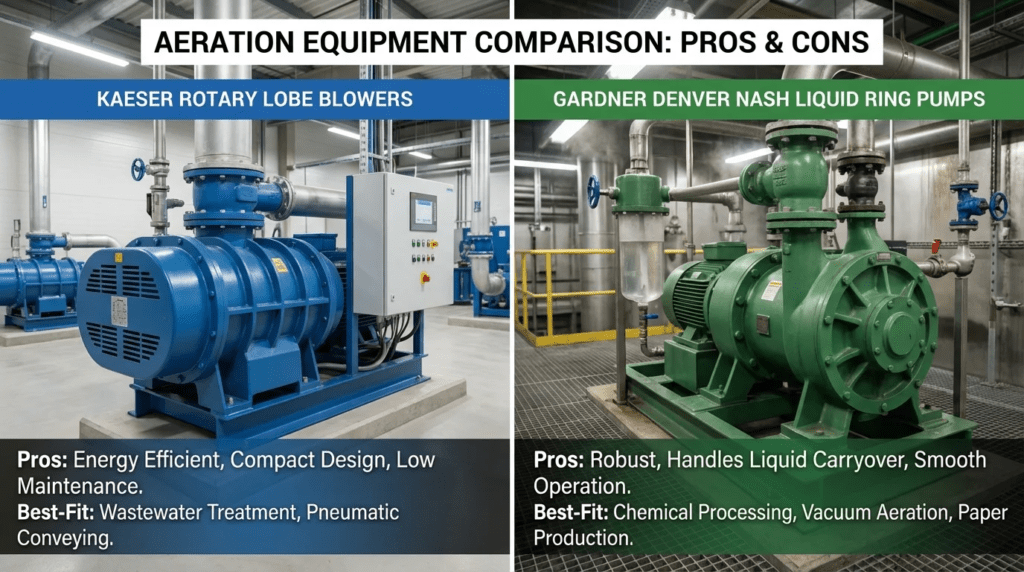
Engineers today are frequently tasked with evaluating complex technology tradeoffs. A common and critical evaluation point involves comparing integrated rotary screw packages against heavy-duty liquid ring or multistage centrifugal options. This often manifests as an evaluation of Kaeser vs Gardner Denver Nash for Aeration: Pros/Cons & Best-Fit Applications. While Kaeser is widely recognized for pioneering the “sigma profile” rotary screw blower package, Gardner Denver Nash (part of the broader Ingersoll Rand/Gardner Denver portfolio) represents a legacy of liquid ring technology and, through its sister brands like Hoffman and Lamson, multistage centrifugal solutions.
The stakes of this selection are high. An improper specification can lead to a system that struggles to meet dissolved oxygen (DO) setpoints during peak diurnal loading or, conversely, surges and overheats during low-flow conditions. Furthermore, the thermodynamic differences between screw compression (adiabatic) and liquid ring compression (isothermal) create vastly different heat rejection profiles and ancillary utility requirements.
This article aims to provide a rigorous, unbiased engineering analysis. We will strip away marketing claims to focus on the mechanical and hydraulic realities of these technologies. By understanding the distinct operating envelopes, efficiency curves, and maintenance profiles of Kaeser’s screw packages versus Gardner Denver Nash’s liquid ring and centrifugal offerings, consulting engineers and plant directors can make data-driven decisions that optimize lifecycle costs and process stability.
How to Select / Specify
Selecting the correct aeration technology requires a granular analysis of the process duty cycle and the physical constraints of the plant. When evaluating Kaeser vs Gardner Denver Nash for Aeration: Pros/Cons & Best-Fit Applications, engineers must look beyond the nameplate horsepower and focus on the “wire-to-air” performance across the entire operating range.
Duty Conditions & Operating Envelope
The first step in specification is defining the air demand profile. Biological processes are rarely static; they fluctuate based on diurnal influent flow, BOD loading, and seasonal temperature changes.
Turndown Ratio: This is the ratio of maximum to minimum airflow the machine can deliver without venting or surging.
- Rotary Screw (Kaeser): Typically offers a 4:1 or 5:1 turndown ratio when paired with an integrated VFD. This makes them highly effective for plants with wide swings in demand, such as SBRs (Sequencing Batch Reactors) or plants with significant storm flow infiltration.
- Liquid Ring (Nash): While liquid ring pumps can be VFD driven, their efficiency drops significantly at lower speeds due to the mechanics of the liquid ring formation. They are better suited for baseload applications or specific gas handling (like digester gas) rather than highly variable aeration trimming.
- Multistage Centrifugal (Gardner Denver Hoffman/Lamson): Traditionally offers limited turndown (approx. 45-30% of design flow) before hitting the surge line. Modern VFD applications have improved this, but they still lack the deep turndown capability of a positive displacement screw machine.
Pressure Capability:
Most aeration basins operate between 6 to 10 psig. Both technologies can meet this. However, if the application is a deep tank (e.g., >25 ft depth requiring >12 psig), screw blowers generally maintain efficiency better than single-stage centrifugals. Liquid ring compressors can handle higher pressures but at a steep energy penalty for standard air service.
Materials & Compatibility
The composition of the gas and the installation environment dictates material selection. Standard aeration involves ambient air, but industrial wastewater or digester gas applications introduce corrosives.
- Rotary Screw: The rotors in Kaeser units are typically coated (e.g., Teflon or similar proprietary coatings) to maintain tight clearances and resist corrosion. However, the clearances are extremely tight. Particulate ingestion can be catastrophic.
- Liquid Ring (Nash): This is the dominant technology for dirty, wet, or corrosive gases. The liquid ring acts as a scrubber, removing particulates and absorbing heat. If the “aeration” application involves wet oxidation, ozone off-gas, or digester gas mixing, Nash’s stainless steel or lined liquid ring pumps are superior due to their tolerance for liquid carryover and solids.
Hydraulics & Process Performance
Engineers must analyze the efficiency curves—specifically “Wire-to-Air” efficiency, which accounts for motor losses, VFD losses, inlet filter losses, and transmission losses.
Positive Displacement (Screw): The efficiency curve is relatively flat across the speed range. This means a Kaeser screw blower maintains high efficiency even when turned down to 50% capacity. This is ideal for DO control loops where the blower constantly chases a setpoint.
Dynamic (Centrifugal): Efficiency peaks at the design point and falls off as you move away from it. Throttling via inlet butterfly valves is highly inefficient. VFD control is better, but the operating window is bounded by the surge line (instability) and the choke stone (maximum flow).
Installation Environment & Constructability
Heat Rejection:
Conversely, Nash liquid ring pumps operate isothermally if the seal water is cool. The heat of compression is absorbed by the seal water, which is then discharged or recirculated through a heat exchanger. This shifts the cooling burden from the HVAC system to the plant water or cooling water system.
Footprint and Integration:
Kaeser specializes in “packaged” units where the blower, motor, oil system, controls, and sound enclosure are pre-assembled. This minimizes site work. Gardner Denver Nash liquid ring systems often require external seal water piping, separators, and heat exchangers, leading to a more complex mechanical installation.
Reliability, Redundancy & Failure Modes
Rotary Screw: Primary failure modes include airend bearing failure or coating wear. Because screw blowers run at high speeds/internal compression, oil maintenance is critical. MTBF is generally high, but an airend failure usually requires a factory exchange rather than a field rebuild.
Liquid Ring: Extremely robust. The only moving part is the rotor, and there is no metal-to-metal contact. They can run for decades. However, they are dependent on a constant supply of clean, cool seal water. Loss of seal water leads to immediate loss of compression.
Lifecycle Cost Drivers
When analyzing Kaeser vs Gardner Denver Nash for Aeration: Pros/Cons & Best-Fit Applications regarding cost:
- CAPEX: Screw packages (Kaeser) typically have a higher initial hardware cost than simple lobe blowers but are competitive with multistage centrifugals. Liquid ring systems (Nash) often have high CAPEX due to materials (stainless) and auxiliary systems.
- Energy (OPEX): For standard clean water aeration, Screw technology is significantly more efficient (15-25% savings) compared to Liquid Ring or Lobe. Liquid ring pumps lose energy to hydraulic drag (fluid friction) inside the casing.
- Maintenance (OPEX): Screw blowers require routine oil changes, filter changes, and eventual belt/coupling maintenance. Liquid ring pumps require seal water management and eventually bearing replacement, but have fewer wear parts.
Comparison Tables
The following tables provide a direct comparison to assist engineers in matching the technology to the application. Table 1 focuses on the technological differences, while Table 2 provides an application fit matrix.
| Feature | Kaeser (Rotary Screw Package) | Gardner Denver Nash (Liquid Ring) | Gardner Denver Hoffman (Multistage Centrifugal) |
|---|---|---|---|
| Primary Compression Principle | Positive Displacement, Internal Compression (Adiabatic) | Liquid Ring, Isothermal Compression | Dynamic, Kinetic Energy conversion |
| Typical Efficiency (Wire-to-Air) | High (75-80% isentropic typical) | Low to Moderate (45-55% typical due to fluid friction) | Moderate to High (65-75% depending on duty point) |
| Turndown Capability | Excellent (4:1 typical via VFD) | Limited (Efficiency drops rapidly with speed) | Moderate (Limited by Surge line, approx 30-45%) |
| Tolerance to Dirty Gas/Liquid | Low (Tight clearances, requires clean inlet) | Excellent (Handles slugs of water and particulates) | Low to Moderate (Impeller erosion risks) |
| Noise Level | Low (Standard enclosures 70-75 dBA) | Moderate (Hydraulic noise, often requires silencers) | High (High frequency whine, requires heavy lagging/enclosure) |
| Cooling Requirement | Air-cooled (High HVAC load in room) | Water-cooled (Requires seal water supply/chiller) | Air-cooled (Bearing housings may need water) |
| Application Scenario | Best Fit Technology | Engineering Rationale |
|---|---|---|
| Municipal Activated Sludge (Baseload) | Rotary Screw (Kaeser) or Turbo | Highest energy efficiency for continuous duty; quick ROI on energy savings. |
| SBR or Digester Cyclic Aeration | Rotary Screw (Kaeser) | Requires frequent starts/stops and deep turndown capabilities which PD screws handle best. |
| Digester Gas Mixing / Recirculation | Liquid Ring (Nash) | Gas is wet, dirty, and potentially explosive. Liquid ring provides intrinsic safety (cool running) and handles condensate. |
| Industrial High-Temp Influent | Liquid Ring (Nash) | Isothermal compression prevents discharge temperatures from exceeding auto-ignition or material limits. |
| Filter Backwash Scour | PD Lobe or Screw (Kaeser) | Intermittent duty requires instant pressure; efficiency is less critical than reliability and start-up speed. |
Engineer & Operator Field Notes
Beyond the catalog data, real-world performance is dictated by installation details and maintenance discipline. Here are observations from the field regarding Kaeser vs Gardner Denver Nash for Aeration: Pros/Cons & Best-Fit Applications.
Commissioning & Acceptance Testing
Factory Acceptance Testing (FAT):
For Kaeser screw units, insist on a wire-to-air performance test according to ISO 1217 Annex C or E. Standard “bare shaft” data is misleading because it ignores the losses from the package’s cooling fan, inlet filter, and discharge silencer. For Nash liquid ring pumps, verify the capacity at the specific seal water temperature available at your site. Warmer seal water significantly reduces capacity (cfm) and vacuum capability.
Bump Testing:
Rotary screw blowers are uni-directional. Running them in reverse, even for a second during rotation checks, can cause immediate oil pump failure or rotor crash. Always decouple or verify phase rotation electrically before applying power.
Common Specification Mistakes
A common error in RFP documents is specifying airflow in SCFM (Standard Cubic Feet per Minute) without defining the site ambient conditions (elevation, max summer temperature, Relative Humidity). A blower sized for 1000 SCFM at sea level will be undersized for a plant at 5000 ft elevation. Always specify ICFM (Inlet Cubic Feet per Minute) or specify the site conditions clearly (T_inlet, P_inlet, RH).
The “Surge” Oversight:
When specifying Gardner Denver Hoffman (centrifugal) units as an alternative to Kaeser, engineers often forget to analyze the system curve against the blower’s surge line. If the plant operates at low flow but high static head (e.g., deep tanks with fine pore diffusers that foul over time), a centrifugal blower may be forced into surge, causing catastrophic vibration. Screw blowers (Kaeser) are positive displacement and do not surge; they simply push against the backpressure until the relief valve opens or the motor overloads.
O&M Burden & Strategy
Kaeser (Screw):
Maintenance is primarily focused on the oil system and belt tension (if belt-driven). The oil is synthetic and expensive but has long change intervals. The most critical maintenance item is the inlet filter. Screw rotors have tight tolerances; dust ingestion acts as a grinding compound, stripping the efficiency-boosting coatings from the rotors.
Nash (Liquid Ring):
The operator burden here is seal water management. If the seal water supply line clogs, or if the solenoid valve fails, the pump fails. In hard water areas, scale buildup inside the pump can reduce capacity over time. Operators must monitor seal water pressure and temperature differentials daily.
Design Details / Calculations
Correctly integrating these technologies requires specific calculations regarding pressure drops and thermodynamics.
Sizing Logic & Methodology
To compare Kaeser vs Gardner Denver Nash for Aeration: Pros/Cons & Best-Fit Applications, one must normalize the air demand.
- Determine Oxygen Demand (AOR): Calculate the Actual Oxygen Requirement (lb O2/day) based on BOD/TKN loading.
- Convert to Airflow (SOR to SCFM): Apply the Alpha factor, Beta factor, and Site elevation to convert Standard Oxygen Requirement (SOR) to standard airflow.
- Convert to Inlet Volume (ICFM):
ICFM = SCFM * (14.7 / P_site) * ((T_site + 460) / 528)
(Simplified ideal gas approximation) - Calculate Discharge Pressure:
P_discharge = Static Head (water depth) + Friction Losses (piping) + Diffuser Dynamic Wet Pressure - Calculate Brake Horsepower (BHP):
For Screw (Adiabatic):Power ~ (Mass Flow) * (T_inlet) * [(P_out/P_in)^((k-1)/k) - 1]
For Liquid Ring (Isothermal): The calculation is more complex due to fluid friction losses and seal water temperature variables.
Standards & Compliance
Specifications should reference:
- ASME PTC 9: Displacement Compressors, Vacuum Pumps, and Blowers (Performance Test Codes).
- ASME PTC 10: Compressors and Exhausters (for Centrifugal comparisons).
- ISO 8573: Compressed Air Purity (relevant for Class 0 oil-free requirements in aeration to prevent diffuser fouling).
- NFPA 820: Standard for Fire Protection in Wastewater Treatment and Collection Facilities (Crucial when selecting Nash for digester gas applications—explosion proofing).
FAQ Section
What is the main difference between Kaeser screw blowers and Gardner Denver Nash liquid ring pumps?
The fundamental difference is the compression method. Kaeser uses rotary screw technology (positive displacement) which compresses air between intermeshing rotors, offering high electrical efficiency for clean air applications. Gardner Denver Nash uses a liquid ring (water piston) to compress gas. Nash is less energy-efficient for general aeration but is vastly superior for handling wet, dirty, or explosive gases (like digester gas) where reliability and safety outweigh electrical efficiency.
When should I choose a Gardner Denver Nash system over a Kaeser package?
Choose Gardner Denver Nash liquid ring technology when the process gas is not standard ambient air. If you are compressing digester gas, ozone off-gas, or handling vacuum filtration where liquid carryover is expected, Nash is the correct choice. For standard activated sludge aeration where energy cost is the primary driver, Kaeser screw packages are generally the better fit.
How does temperature affect the selection of Kaeser vs Gardner Denver Nash?
Temperature impacts them differently. High ambient air temperature reduces the mass of oxygen delivered by a Kaeser air-cooled blower, requiring larger sizing. For Nash, the critical factor is seal water temperature. As seal water gets hotter, the capacity of a liquid ring pump drops significantly, and it may cavitate. In hot climates, Nash systems often require dedicated chillers or cooling towers for the seal water, adding to CAPEX.
Are Kaeser blowers oil-free?
Yes, for aeration applications, Kaeser specifies “oil-free compression.” The compression chamber is dry; oil is used only for lubricating the timing gears and bearings, which are sealed off from the airflow. This is critical to prevent oil mist from coating fine-pore diffusers, which would destroy oxygen transfer efficiency. Always specify Class 0 oil-free compliance.
What is the typical maintenance interval for these technologies?
Kaeser screw blowers typically require oil changes every 4,000 to 8,000 hours (depending on oil type) and inlet filter changes semi-annually. Gardner Denver Nash liquid ring pumps have no oil in the compression chamber; maintenance involves checking packing/mechanical seals and cleaning strainers. Bearings are usually greased every 3-6 months. The Nash pump itself often has a longer interval between major overhauls (10+ years) compared to the screw airend (5-7 years typical).
Can Gardner Denver provide screw blowers like Kaeser?
Yes. The prompt focuses on “Nash” (liquid ring), but Gardner Denver owns the Robuschi brand, which manufactures rotary screw blowers that compete directly with Kaeser. If you are looking for a direct equivalent to a Kaeser screw package within the Gardner Denver family, you should investigate the Robuschi Robox Screw unit rather than a Nash liquid ring pump.
Conclusion
Key Takeaways
- Efficiency Rule: For standard clean-water aeration, Kaeser rotary screw packages generally offer 15-20% better wire-to-air efficiency than liquid ring technology.
- Application Split: Use Screw (Kaeser) for Aeration Basins, SBRs, and Digester Aerobic zones. Use Liquid Ring (Nash) for Digester Gas Mixing, Wet Oxidation, and Vacuum Priming.
- Thermal Management: Kaeser units reject heat into the air (HVAC impact). Nash units reject heat into the seal water (Plumbing/Chiller impact).
- Turndown: Kaeser units with VFDs offer superior turndown (4:1) compared to centrifugals or liquid ring pumps, making them ideal for DO control strategies.
- Specification: Always specify “Wire-to-Air” efficiency at maximum, average, and minimum conditions, not just bare-shaft efficiency.
The comparison of Kaeser vs Gardner Denver Nash for Aeration: Pros/Cons & Best-Fit Applications ultimately reveals that these are complementary, rather than purely competitive, technologies within the context of a total wastewater treatment plant.
Kaeser has optimized the rotary screw package to serve as the workhorse for biological treatment, delivering high efficiency in a compact, operator-friendly footprint. This makes it the default choice for secondary treatment aeration where electrical costs are the primary concern.
Gardner Denver Nash, while capable of aeration, finds its true “best-fit” in the severe-duty corners of the plant—handling explosive digester gas, wet heavy gases, and vacuum applications where screw blowers would fail catastrophically. Furthermore, engineers looking for a direct aeration competitor to Kaeser within the Gardner Denver portfolio should broaden their scope to include Gardner Denver’s Robuschi (Screw) and Hoffman (Centrifugal) lines.
For the design engineer, the path forward is clear: define the gas composition and the variability of the load. If the gas is clean air and the load varies, specify Rotary Screw. If the gas is dirty, wet, or hazardous, specify Liquid Ring.