
Top OEMs for MBR Systems
Introduction
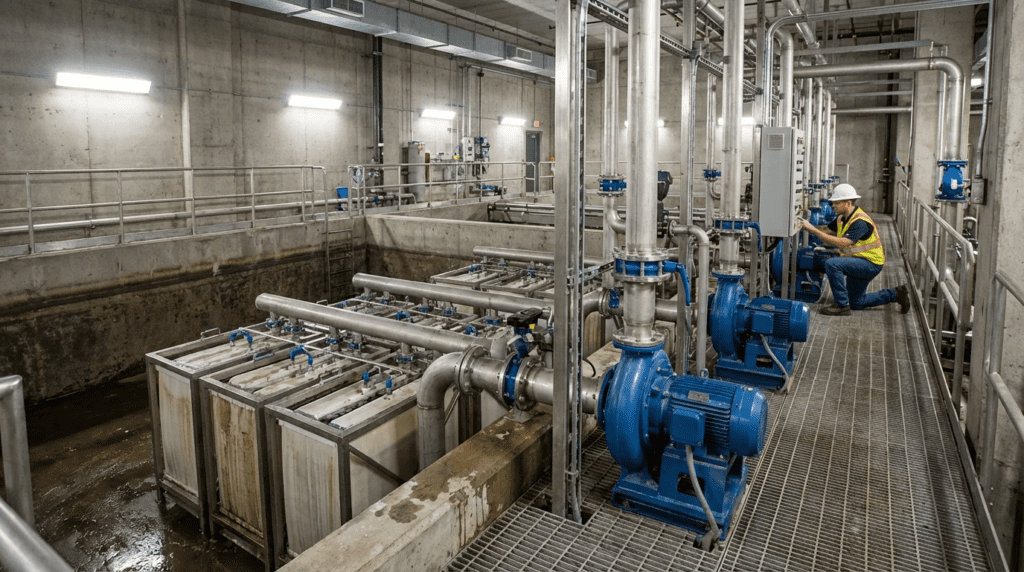
Membrane Bioreactor (MBR) systems represent a definitive convergence of biological wastewater treatment and advanced membrane filtration. In the landscape of municipal and industrial wastewater management, MBR technology has transitioned from a niche solution for difficult-to-treat effluents to a standard unit process for facilities requiring high-quality effluent, water reuse capabilities, or significant footprint reductions.
At its core, an MBR replaces the secondary clarifiers and tertiary filtration steps of a conventional activated sludge (CAS) system with low-pressure membranes—either microfiltration (MF) or ultrafiltration (UF). This substitution allows for the complete separation of hydraulic retention time (HRT) and solids retention time (SRT), enabling operators to run mixed liquor suspended solids (MLSS) concentrations anywhere from 8,000 to 12,000 mg/L, and occasionally higher. The result is a process that occupies a fraction of the land required for conventional treatment while producing permeate free of suspended solids and significantly reduced pathogen counts.
The application range for MBR systems is broad. In municipal sectors, they are the technology of choice for satellite water reclamation plants, facilities in sensitive watersheds with strict nutrient limits (TN and TP), and urban plants with zero available land for expansion. Industrially, MBRs are heavily utilized in food and beverage, pharmaceutical, leachate, and petrochemical applications where variable organic loads and the need for process water recovery drive design decisions.
However, the selection of an Original Equipment Manufacturer (OEM) for MBR systems is far more critical than for static equipment like tanks or pipes. An MBR system is not a commodity; it is a proprietary marriage of membrane chemistry, module geometry, aeration strategies, and hydraulic integration. Each OEM utilizes distinct materials (PVDF, PE, PES), configurations (Hollow Fiber, Flat Sheet, Flat Plate), and cleaning protocols. Consequently, the choice of OEM dictates the facility’s physical layout, energy consumption profile (specifically air scour), chemical consumption, and long-term operational complexity. For the consulting engineer and plant manager, understanding the nuanced engineering differences between these providers is essential to mitigating lifecycle risks.
How to Select MBR Process Equipment
Selecting an MBR system requires a departure from standard equipment specification practices. Engineers cannot simply specify a “membrane tank” without defining the specific hydraulic and biological parameters that influence membrane performance. The selection process must balance capital constraints with long-term operational realities, specifically focusing on flux rates, fouling management, and energy efficiency.
Process Function and Performance Requirements
The fundamental function of the MBR is to separate the biomass from the treated water. The critical design parameter here is flux, typically measured in Liters per Square Meter per Hour (lmh) or Gallons per Square Foot per Day (gfd). Engineers must evaluate OEMs based on their sustainable average flux and peak flux capabilities. A system designed with an overly aggressive flux rate to reduce capital costs (fewer modules) will inevitably suffer from rapid fouling, frequent chemical cleaning, and reduced membrane life. Performance requirements must also stipulate log reduction credits for pathogens if water reuse is the goal, as different pore sizes (0.04 micron vs 0.4 micron) and membrane integrity assurance methods vary by manufacturer.
Hydraulic and Process Loading Considerations
MBR systems are sensitive to hydraulic peaking factors. Unlike clarifiers, which have some buffering capacity, membranes are absolute barriers. If the hydraulic load exceeds the peak flux capacity of the membrane surface area, the system cannot process the flow, leading to potential overflows or the need for large upstream equalization basins. Engineers must evaluate how each OEM handles peaking conditions. Some utilize “relaxation” periods (stopping permeation to allow scouring), while others rely on backpulsing. The duration and frequency of these cycles affect the net hydraulic production. Furthermore, the MLSS concentration affects viscosity; as MLSS rises, oxygen transfer efficiency in the biological tank decreases, and the energy required to scour the membranes may increase.
Materials of Construction and Membrane Chemistry
The physical durability and chemical tolerance of the membrane material are paramount. The most common materials are Polyvinylidene Fluoride (PVDF), Polyethylene (PE), and Polyethersulfone (PES). PVDF is widely favored for its high resistance to oxidants like chlorine, which is essential for cleaning cycles. PE is known for high strength and flexibility, particularly in hollow fiber configurations. Engineers must assess the material’s compatibility with the specific industrial influent or municipal sewage characteristics. Additionally, the potting material (where fibers or sheets attach to the header) is a common failure point; superior OEMs use robust potting resins that prevent fiber pull-out or delamination.
Integration with Upstream and Downstream Processes
The success of an MBR is almost entirely dependent on the quality of the headworks. Fine screening is non-negotiable. Most Hollow Fiber (HF) systems require screening down to 1mm or 2mm to prevent “ragging” or hair accumulation at the top of the cassettes. Flat Sheet (FS) systems are generally more forgiving, often tolerating 3mm screening, but are still susceptible to sludge accumulation between plates. Engineers must verify that the OEM’s warranty explicitly states the required screening aperture and capture ratio. Downstream, the permeate is typically high quality, but if Reverse Osmosis (RO) is to follow (for potable reuse), the MBR OEM must demonstrate compatible silt density index (SDI) values.
Footprint and Layout Constraints
Module geometry dictates tank sizing. Hollow fiber modules generally offer the highest packing density (surface area per unit volume), making them ideal for large-scale plants or retrofits where tank space is premium. Flat sheet or flat plate systems typically have lower packing densities and require larger tanks, but they often offer simpler hydraulics and easier physical inspection. Engineers must model the tank dimensions based on the specific cassette sizes of the shortlisted OEMs, as they are rarely interchangeable without significant civil modifications.
Energy Efficiency and Operating Cost
The largest operational cost in an MBR system is aeration—specifically, the air scour required to keep the membranes clean. This is distinct from the biological process air. Engineers should compare OEMs based on Specific Aeration Demand (SADp or SADm), measured in Nm³/h of air per m³ of permeate or per m² of membrane area. Innovations such as cyclic aeration, pulse aeration, and intermittent scouring have drastically reduced energy consumption in modern systems. A Lifecycle Cost (LCC) analysis must weigh the energy savings of these features against the potential complexity of the associated valves and controls.
Operations and Maintenance Impacts
Operator accessibility is a major design consideration. How are the membranes removed? Does the facility require an overhead crane or monorail system? HF modules can often be lifted as individual cassettes, whereas some FS systems require lifting heavy, integrated stacks. Chemical cleaning (CIP) is another major factor. OEMs dictate the frequency of maintenance cleans (weekly/monthly) and recovery cleans (biannually). The consumption of Sodium Hypochlorite and Citric Acid, and the logistics of storing and dosing these chemicals, must be factored into the O&M plan.
Common Failure Modes and Lifecycle Considerations
Membrane life is finite. Most municipal membranes last between 8 to 12 years depending on operation. Common failure modes include fiber breakage (leading to turbidity spikes), irreversible fouling (loss of permeability), and header seal failures. Engineers should review the warranty terms carefully: is it a full replacement warranty for the first few years, or is it prorated from day one? Furthermore, consider the risk of proprietary lock-in. Once a tank is built for a specific OEM’s cassette dimensions and piping interface, switching to a different manufacturer in the future can be capital-intensive.
Comparison Table
The following table compares leading MBR OEMs based on their primary membrane configurations and engineering characteristics. Engineers should use this data to align project-specific constraints—such as available footprint, energy goals, and influent quality—with the most appropriate technology platform.
| OEM Name | Configuration | Typical Applications | Engineering Strengths | Limitations | Best-Fit Scenarios |
|---|---|---|---|---|---|
| Veolia (Suez/Zenon) | Hollow Fiber (Reinforced PVDF) | Large Municipal, Industrial, Reuse | High packing density; LEAP aeration reduces energy; immense install base (ZeeWeed). | Requires strict 1-2mm screening; fiber repair requires tank draining or cassette removal. | Large-scale municipal plants requiring minimal footprint and high throughput. |
| Kubota | Flat Sheet / Flat Plate (PE/Chlorinated PE) | Small to Mid Municipal, Decentralized, Industrial | Simple hydraulics; gravity flow capable; robust against ragging; easy visual inspection. | Lower packing density (larger tanks); higher SADm in older models compared to HF. | Decentralized plants, simple operation requirements, difficult industrial wastewaters. |
| DuPont (Memcor) | Hollow Fiber (PVDF) | Municipal, Industrial, Containerized | Modular rack design (B310/IntegraPac); pulse aeration efficiency; easy retrofit. | Requires rigorous screening; reliance on specific backwash/air pulse sequences. | Retrofits into existing basins; projects requiring modular, scalable expansion. |
| Koch Separation Solutions | Hollow Fiber (Single Header, Braided) | Municipal, Industrial Reuse | Single header design allows free fiber movement (less sludging); central aeration tube. | Tall modules require deep tanks; specific hydraulic profile needs careful basin design. | Facilities with deep tanks seeking robust fiber integrity and reduced sludging risk. |
| Toray | Flat Sheet & Hollow Fiber (PVDF) | Global Municipal & Industrial | Offers both FS and HF; highly durable PVDF chemistry; non-clogging FS design. | Supply chain logistics (depending on region); FS requires larger footprint than HF. | Projects where membrane durability and chemical resistance are the primary drivers. |
| Fibracast | Hybrid (Hollow Fiber/Plate) | Municipal Retrofits, Greenfield | Combines HF packing density with FS flow path; ultra-low footprint; horizontal orientation. | Newer technology with smaller install base than legacy giants; unique tank geometry. | Severely space-constrained sites requiring maximum active area per tank volume. |
Top OEM Manufacturers
Veolia (Suez Water Technologies & Solutions)
Veolia (integrating the legacy Zenon and Suez technologies) is arguably the market leader in MBR installations globally, primarily driven by the ZeeWeed 500 series. The core of their technology is a reinforced hollow fiber membrane. Unlike early generation fibers that were prone to snapping under aeration stress, the ZeeWeed fiber has a composite structure with an internal support braid, making it extremely tensile-resistant.
From an engineering perspective, Veolia’s differentiation lies in its “LEAP” operating protocols. LEAPmbr is designed to reduce energy costs associated with air scouring—historically the Achilles’ heel of MBRs. By using larger, intermittent bubbles rather than continuous fine or coarse bubbles, the system generates sufficient shear force to clean fibers with significantly less blower energy. Veolia systems are highly modular, utilizing cassettes that stack into skids. This makes them highly scalable for massive municipal plants (100+ MGD). However, the dense packing of fibers necessitates rigorous prescreening (typically 2mm or tighter) to prevent trash from bridging the gap between fibers, which causes “sludging” at the cassette base.
Kubota Membrane USA
Kubota pioneered the submerged flat sheet MBR technology. In contrast to hollow fibers, Kubota’s system uses rigid flat plates covered with a membrane sheet (typically Chlorinated Polyethylene or PVDF). The plates are spaced out within a cassette, creating clear vertical channels for mixed liquor and air scour to rise. This geometry makes Kubota systems inherently more resistant to ragging and clogging than hollow fiber systems.
Engineers often specify Kubota for small-to-medium municipal plants and difficult industrial applications where operational simplicity is preferred over minimizing footprint. Because the plates are rigid and the spacing is generous, the system can often operate with gravity flow (given sufficient hydraulic head), eliminating the need for permeate pumps in some designs. The trade-off is packing density; a Kubota system will typically require a larger biological tank footprint than a comparable hollow fiber system. However, the simplicity of maintenance—individual cartridges can be inspected or replaced without lifting the entire heavy skid—is a significant advantage for operators with limited maintenance crews.
DuPont (Memcor)
The DuPont MBR portfolio, largely built upon the acquisition of Evoqua’s Memcor division (and previously Siemens/USFilter), is a stalwart in the MBR space. Their flagship product lines, such as the Memcor B310 and IntegraPac, utilize PVDF hollow fiber membranes. A key engineering feature of the Memcor design is the focus on modularity and integrated distinct air scour mechanisms.
The IntegraPac system is designed as a pre-engineered, skid-mounted unit that drops into the tank, minimizing field assembly. This appeals to engineers working on retrofits or tight construction schedules. DuPont utilizes a pulse aeration strategy that delivers bursts of air to scour the fibers, optimizing energy usage. The fibers are potted in a way that allows for some movement, reducing stress concentration. DuPont’s systems are versatile, fitting well in both municipal reuse applications and industrial pre-treatment. Like other HF systems, they demand high-quality screening, and the controls logic for the backwash and air pulse sequence is critical to maintaining permeability.
Koch Separation Solutions (KSS)
Koch Separation Solutions markets the PURON MBR system, which features a unique “single header” hollow fiber design. Unlike traditional hollow fiber modules that are potted at both the top and bottom (or loose at the top), the PURON fiber is potted only at the bottom and reinforced. The upper ends are sealed individually but allowed to float freely. This design is intended to mitigate the “sludging” issue common in double-header designs where solids get trapped in the upper potting.
The central aeration tube is another distinguishing feature. Air is introduced in the center of the fiber bundle at the bottom, creating an airlift pump effect that draws mixed liquor into the bundle and pushes it upward and outward. This ensures uniform scouring across the entire fiber length. Engineers typically specify KSS for applications where minimizing fiber breakage and preventing solids accumulation within the bundle are high priorities. The single-header design allows for vigorous movement of the fibers, mechanically shaking off solids. The system is robust but requires deep tanks to accommodate the module height.
Toray
Toray is a major chemical and materials conglomerate that offers both flat sheet and hollow fiber MBR technologies, though they are particularly renowned for their PVDF flat sheet/plate products. Toray’s flat sheet membranes are cast directly onto a support layer, providing high physical strength. The surface chemistry of Toray membranes is engineered to be highly hydrophilic, which naturally resists fouling by organic foulants.
For engineers, Toray offers a middle ground between the extreme density of hollow fibers and the robustness of traditional flat plates. Their modules are designed to be non-clogging, allowing for operation in high MLSS environments with slightly less stringent screening requirements than some HF competitors. Toray has also advanced the use of PVDF in hollow fiber configurations for larger plants, boasting high tensile strength fibers. Their “NHP” series modules are designed to reduce the volume of chemical cleaning required, addressing a key O&M concern regarding chemical handling and disposal.
Fibracast
Fibracast represents a newer evolution in MBR morphology, marketed as the “FibrePlate.” This hybrid technology attempts to merge the packing density advantages of hollow fiber with the hydraulic advantages of flat sheet systems. The Fibracast module uses two sheets of membrane bonded together to form a rigid vertical plate that is actually flexible, essentially creating a flat sheet that behaves somewhat like a constrained hollow fiber bundle.
The engineering breakthrough here is the horizontal packing capability and the distinct hydrodynamic flow path. The modules are designed to prevent the accumulation of solids (sludging) that plagues dense HF bundles. Fibracast systems often boast an extremely low footprint, making them highly attractive for upgrading existing CAS plants to MBR without building new tanks. The “motionless” header design simplifies the mechanical aspect of the tank internals. While the install base is smaller compared to Veolia or Kubota, the technology is gaining traction in municipal retrofits where space is the absolute limiting factor.
Application Fit Guidance
Matching the OEM to the application is an exercise in risk management and resource allocation. No single OEM is superior across all domains.
Municipal Water (Reuse focus)
For municipal facilities with strict Title 22 (California) or equivalent reuse mandates, Veolia and DuPont are often preferred. Their hollow fiber chemistries and module integrity testing capabilities are well-proven for pathogen rejection. The high packing density allows for the massive surface area required to treat large municipal flows economically.
Municipal Wastewater (General)
For general municipal treatment where ease of operation is a priority over absolute minimum footprint, Kubota and Toray (Flat Sheet) are strong contenders. The operational simplicity of flat plates allows smaller municipal staffs to manage the plant without the constant anxiety of fiber sludging or breakage. However, for large metropolises, the footprint advantage of HF systems (Veolia, KSS) usually dictates the spec.
Industrial Wastewater
Industrial streams are variable and often aggressive. Kubota and Koch (KSS) excel here. The robust nature of the Kubota plate handles high strength waste and potential scaling well. The KSS single-header design is forgiving of the sticky, viscous sludges often found in food and beverage applications.
Small vs. Large Facilities
For small, decentralized plants (e.g., < 0.5 MGD), flat sheet systems or modular package plants using DuPont or Toray components are ideal due to lower cleaning complexity. For mega-plants (> 10 MGD), the civil work savings provided by the high density of Veolia or Fibracast systems generally outweigh the increased operational complexity.
Retrofit vs. Greenfield
In Greenfields, the civil design can be tailored to the membrane. In retrofits, the membrane must fit the tank. Fibracast and DuPont (IntegraPac) are often highlighted for retrofits because their modular geometry can be adapted to fit into existing rectangular aeration basins, maximizing the capacity increase within the existing concrete shell.
Engineer & Operator Considerations
Installation and Commissioning
Commissioning an MBR is biological, not just mechanical. Engineers must account for the “seeding” phase. Membranes cannot be subjected to peak flux immediately; they require a conditioning period where a protective dynamic layer forms. OEMs differ in their startup protocols. Some require clean water testing for permeability baselines, while others allow immediate mixed liquor introduction. Ensuring the lifting gear (cranes/hoists) is specified with the correct reach and capacity for the specific OEM’s wet cassette weight is a common oversight.
Maintenance Access
The “dip clean” vs. “clean in place” debate is critical. Most modern systems rely on automated in-tank CIP (Chemically Enhanced Backwash). However, eventually, a recovery clean is needed. Engineers must design the facility with tank drainage capabilities or transfer tanks to allow for deep cleaning. If modules must be removed, the overhead clearance must be calculated accurately—hollow fiber cassettes can be very tall.
Spare Parts and Supply Chain
Membranes are proprietary. Unlike a centrifugal pump where you might swap a motor, you cannot put a Kubota cartridge in a Veolia rack. Utilities must carry a strategic spare inventory (typically 1-2% of total cassettes). Engineers should evaluate the local support network of the OEM. How quickly can replacement modules be shipped? Are the diffusers and air piping standard headers or proprietary designs?
Operational Lessons Learned
The most frequent operational complaint is screening failure. If the 2mm screen is bypassed or fails, the MBR will clog rapidly. Engineers should design redundancy into the headworks, not just the membrane trains. Another lesson is “permeability recovery.” Over time, some fouling becomes irreversible. Operators must track permeability decay curves, not just TMP, to predict end-of-life. Finally, foaming can be problematic in MBRs due to the high surfactant retention; surface wasting and spray systems are essential design components.
Long-Term Reliability Risks
Plastic headers and permeate adaptors become brittle over time due to constant exposure to Sodium Hypochlorite. Engineers should ask OEMs about the expected lifespan of the frame and manifold, not just the membrane. A 10-year membrane life is useless if the plastic manifold cracks in year 5.
Conclusion
Selecting an OEM for an MBR system is a strategic decision that locks a utility into a specific operational philosophy for decades. There is no generic “best” MBR; there is only the best fit for the specific hydraulic profile, effluent targets, and staffing capabilities of the facility.
For high-density, large-scale municipal reuse, the reinforced hollow fiber systems from Veolia and DuPont offer the necessary throughput and pathogen barriers. For industrial robustness and operational simplicity, the flat sheet/plate designs from Kubota and Toray provide a forgiving, albeit larger, solution. Innovations from Koch and Fibracast offer unique hybrids that solve specific hydraulic challenges like sludging and tank geometry constraints.
Engineers must move beyond simple capital cost comparisons. A rigorous evaluation of specific aeration demand, screening requirements, chemical consumption, and replacement complexity will reveal the true lifecycle cost of the system. The successful MBR project is one where the headworks protection is robust, the flux rates are conservative, and the OEM platform matches the operator’s ability to maintain it.