
Diaphragm Pump Curve Reading for Operators (BEP Runout Shutoff and Control)
INTRODUCTION
One of the most persistent errors in municipal and industrial fluid handling involves applying centrifugal pump logic to positive displacement equipment. Engineers often approach pump curves expecting a single line intersecting a system curve, but when faced with an Air-Operated Double Diaphragm (AODD) performance chart, they encounter a complex grid of air pressures, air consumption rates, and flow capacities. This confusion frequently leads to pumps that are grossly oversized, incredibly inefficient regarding compressed air usage, or prone to premature diaphragm failure.
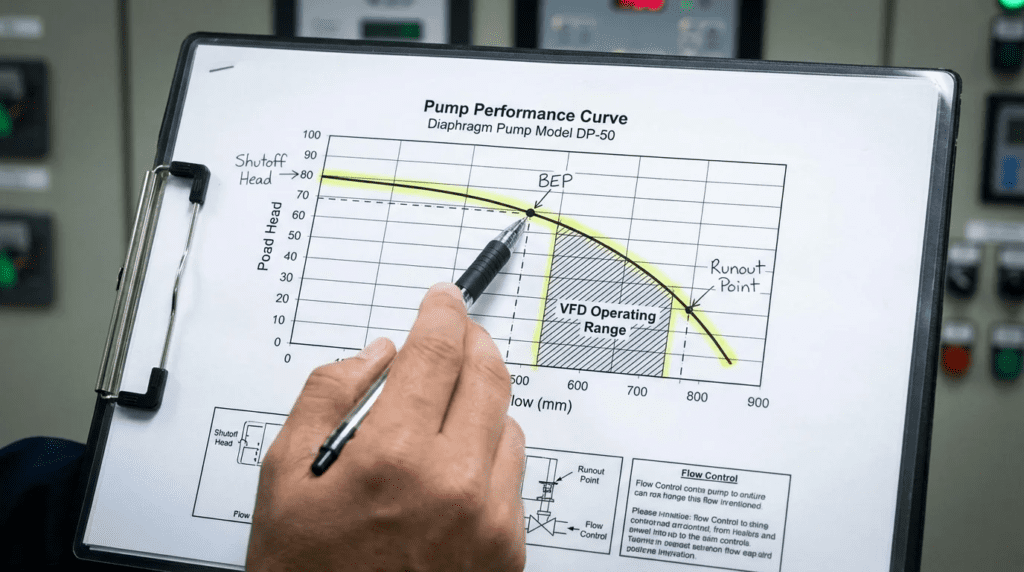
In the water and wastewater sectors, diaphragm pumps are the workhorses for difficult applications: lime slurry transfer, polymer dosing, hypochlorite injection, and filter press feeding. Yet, true proficiency in Diaphragm Pump Curve Reading for Operators (BEP Runout Shutoff and Control) is rare. Unlike centrifugal pumps, where the Best Efficiency Point (BEP) is a clear hydraulic apex, diaphragm pumps have efficiency “zones” defined by air consumption per gallon pumped. “Runout” in a diaphragm context implies exceeding the stroke rate limit, leading to cavitation, while “shutoff” is a functional state of stall-out rather than a zero-flow recirculation hazard.
This article serves as a definitive technical guide for engineers and superintendents. It moves beyond basic selection to explore the nuances of reading performance curves for both AODD and mechanical metering pumps. We will analyze how to determine the true operating envelope, calculate total lifecycle costs based on air energy, and specify controls that prevent common failure modes. By mastering these curves, utilities can reduce compressed air energy costs by 20-30% and significantly extend Mean Time Between Failures (MTBF) for wetted components.
HOW TO SELECT / SPECIFY
Selecting a diaphragm pump requires a fundamental shift in thinking from kinetic (centrifugal) energy to positive displacement mechanics. The specification process must account for the unique way these pumps generate pressure and flow, particularly how they interact with system backpressure and viscosity.
Duty Conditions & Operating Envelope
When analyzing Diaphragm Pump Curve Reading for Operators (BEP Runout Shutoff and Control), the operating envelope is defined by the intersection of required discharge pressure and desired flow rate, overlaid with available air supply. Unlike centrifugal pumps, AODD pumps are “stall-capable,” meaning the dead-head pressure is directly proportional to the inlet air pressure.
Engineers must specify:
- Continuous vs. Intermittent Duty: AODD pumps are generally not designed for 24/7 continuous duty at maximum stroke rates due to diaphragm fatigue and potential icing of the air valve. Continuous applications should be sized to run at 50-60% of maximum capacity.
- Suction Lift Requirements: Diaphragm pumps are excellent at self-priming. However, the curve must be de-rated for high suction lifts (above 10-15 ft dry), as the volumetric efficiency decreases.
- Viscosity Corrections: Standard curves are based on water (1 cP). As viscosity increases (e.g., polymer or sludge), the maximum flow rate drops, and the required inlet pressure to fill the chamber increases.
Materials & Compatibility
The “wet end” and the “air end” require distinct material considerations. In wastewater treatment, the variety of fluids dictates a rigorous compatibility check.
- Diaphragms: These are the highest wear items. PTFE (Teflon) offers the best chemical resistance but is less flexible, reducing flow capacity by roughly 20% compared to rubber. Santoprene or Buna-N are standard for neutral sludges but offer lower chemical resistance.
- Valve Balls and Seats: Must match the diaphragm material in wear characteristics. For abrasive slurries (lime), weighted balls or heavy-duty seats may be required to ensure proper checking.
- Air Section: In corrosive atmospheres (like chlorine rooms), aluminum air centers will corrode. Polypropylene or stainless steel air sections are necessary specifications for longevity.
Hydraulics & Process Performance
Interpreting the hydraulics involves understanding “slip” and volumetric efficiency. In a diaphragm pump, flow is pulsating. The curve represents an average flow.
NPSH (Net Positive Suction Head): While less critical than in centrifugal pumps, NPSHR (Required) still exists. If the pump is starved on the suction side, the diaphragm will not fully retract or fill, causing cavitation that creates a distinct “popping” sound and destroys diaphragms rapidly. This is often misdiagnosed as a mechanical failure rather than a hydraulic limitation.
Installation Environment & Constructability
Physical installation dramatically affects curve performance. A common error is undersizing the air supply line. If the curve requires 100 SCFM at 80 PSI, but the air drop is undersized, the pressure at the pump inlet will drop dramatically during the suction stroke, shifting the pump’s operation to a less efficient point on the curve.
Vibration and Pulsation: Diaphragm pumps create significant pipe vibration. Specifications must include flexible connectors on both suction and discharge. Rigid piping connected directly to the pump housing will eventually crack the manifold or the pipe itself.
Reliability, Redundancy & Failure Modes
Reliability in diaphragm pumps is a function of stroke count. The finite life of a diaphragm is measured in millions of cycles. Therefore, a larger pump running slower is almost always more reliable than a small pump running fast.
- Failure Mode – Runout: If a discharge line breaks, an AODD pump will “run out” to its maximum stroke rate. This rapid cycling can destroy the pump in minutes.
- Failure Mode – Dead-heading: Closing a discharge valve stops the pump (Shutoff). While this doesn’t damage the pump immediately, prolonged pressure on the diaphragms can cause “creep” in plastic housings.
Controls & Automation Interfaces
Controlling a diaphragm pump offers different challenges than centrifugal pumps.
- Open Loop: Manual regulation of air pressure via a filter-regulator-lubricator (FRL) adjusts speed.
- Closed Loop (Solenoid): Modern systems use cycle counting (solenoid on/off) for precise dosing. This effectively turns an AODD into a metering pump.
- Level Control: simple float switches can turn the air supply solenoid on/off for sump applications.
Lifecycle Cost Drivers
The elephant in the room for AODD pumps is energy efficiency. Compressed air is one of the most expensive utility mediums in a plant. A pump operating at the “far right” of its curve (high flow, high air consumption) can cost 3-4 times more to operate than an electric motor-driven pump of equivalent hydraulic power. Engineers must calculate the “SCFM per Gallon” cost when selecting these pumps for continuous service.
COMPARISON TABLES
The following tables assist engineers in differentiating between pump technologies and determining the correct application fit. Table 1 compares the fundamental physics and operation of different positive displacement types, while Table 2 provides a selection matrix based on common treatment plant applications.
| Technology Type | Operation Principle | Best-Fit Applications | Limitations / Considerations | Curve Characteristic |
|---|---|---|---|---|
| AODD (Air-Operated Double Diaphragm) | Compressed air acts directly on diaphragms; 1:1 pressure ratio (typical). | Sludge transfer, filter press feed, unloading trucks, sumps, hazardous fluids. | High energy cost (air); pulsating flow; noisy; potential for air valve icing. | Multi-variable grid: Air Pressure, Flow, and Air Consumption. Stall-capable. |
| Mechanically Actuated (Motor Driven) | Electric motor drives a cam/eccentric shaft to push diaphragm. | Chemical metering (Hypo, Alum), precise dosing applications. | Cannot handle large solids; damage if dead-headed (needs relief valve); lower flow limits. | Linear flow vs. speed. Turndown ratio is key metric. |
| Hydraulic Diaphragm Metering | Plunger pushes oil, oil pushes diaphragm. Balanced pressure. | High-pressure chemical injection; applications requiring API 675 accuracy. | Higher complexity and CAPEX; oil maintenance required. | Highly linear; extremely stiff curve (flow strictly independent of pressure). |
| Peristaltic (Hose Pump) | Rollers compress a hose (technically not a diaphragm, but a competitor). | Lime slurry, high-solids sludge, shear-sensitive fluids. | Hose life is the primary maintenance cost; footprint can be large. | Linear flow vs. speed. 100% volumetric efficiency until hose failure. |
| Application | Fluid Characteristics | Preferred Technology | Critical Selection Constraint | Operator Impact |
|---|---|---|---|---|
| Sodium Hypochlorite Feed | Gassing, corrosive | Motor/Hydraulic Diaphragm | Vapor handling (degassing head) | High: Needs regular calibration column checks. |
| Filter Press Feed | High solids, variable pressure | AODD (High Pressure variants) | Curve reading: Must handle low flow at high pressure (end of cycle). | Low: Pump self-regulates as press fills (stalls out). |
| Lime Slurry Transfer | Abrasive, settling | AODD or Peristaltic | Velocity to prevent settling; abrasion resistance. | Medium: Valve balls need regular inspection for wear. |
| Polymer Activation | High viscosity, shear sensitive | Progressive Cavity or Diaphragm | Shear capability (AODD can shear polymer if velocity is too high). | Medium: Viscosity correction on curve is critical. |
ENGINEER & OPERATOR FIELD NOTES
Bridging the gap between the specification sheet and the plant floor requires practical knowledge. The following sections outline critical field practices for ensuring performance matches the design curve.
Commissioning & Acceptance Testing
When commissioning a diaphragm pump, the Site Acceptance Test (SAT) differs from centrifugal protocols.
- Drawdown Calibration: For metering pumps, a drawdown calibration column is mandatory. Verify linearity at 10%, 50%, and 100% stroke. The flow rate should match the curve within ±2% (API 675 standards) or manufacturer specs.
- Air Supply Verification: For AODDs, place a pressure gauge at the pump inlet, not just at the wall regulator. Observe the gauge while the pump is running at full speed. If the pressure drops significantly (e.g., from 90 psi to 60 psi) during the stroke, the air line is undersized or restricted, and the pump will not meet its curve.
- Dead-Head Test (AODD): Slowly close the discharge valve. The pump should slow down and stop (stall) completely without air leakage. If it continues to cycle rapidly (“racing”), there is a check valve failure or priming issue. If it hisses continuously, the air valve seals are compromised.
Common Specification Mistakes
Engineers often size an AODD pump for the maximum flow required. However, AODD pumps are least efficient and loudest at their maximum flow (Runout).
Correction: Select a pump size where the desired flow requires only 50-60% of the maximum capacity. This reduces noise, air consumption, and diaphragm flex-fatigue.
Another frequent error is ignoring pulsation dampening. Diaphragm pumps produce flow in “slugs.” Without a dampener, the acceleration head losses can trigger relief valves or shake pipe supports loose. The specification should always require a dampener sized for 95-97% pulsation removal, installed within 10 pipe diameters of the discharge.
O&M Burden & Strategy
Maintenance strategies should focus on the air quality and the “wet end” soft parts.
- Air Quality: Dirty, wet air is the enemy of AODD air valves. Install point-of-use dryers or coalescing filters.
- Torque Specs: Plastic pumps (Polypropylene/PVDF) are subject to cold flow (creep). Retorquing housing bolts should be a monthly PM task, especially after temperature fluctuations.
- Mufflers: The expanding air freezes moisture, clogging mufflers. Operators often remove them to keep pumps running, creating hearing hazards. The correct fix is drier air or anti-ice mufflers, not removal.
Troubleshooting Guide
Symptom: Pump cycles but no flow.
Root Cause: Suction side air leak or stuck check balls. Diaphragm pumps cannot prime if they cannot create a vacuum. Check suction piping for loose clamps.
Symptom: Pump runs fast (runout) but flow is low.
Root Cause: Cavitation or high viscosity. The pump is stroking, but the chambers aren’t filling. Reduce stroke speed or increase suction head.
Symptom: Uneven cycling (limping).
Root Cause: One diaphragm or check valve side is compromised, or the air distribution spool is sticking.
DESIGN DETAILS / CALCULATIONS
Properly utilizing Diaphragm Pump Curve Reading for Operators (BEP Runout Shutoff and Control) requires understanding the anatomy of the performance chart.
Sizing Logic & Methodology
A typical AODD curve contains three variables: Head (Pressure), Flow, and Air Consumption. Here is the step-by-step logic for reading it:
- Locate Discharge Pressure: Find the required discharge pressure (in PSI or Bar) on the vertical axis (y-axis). Note: This includes static head + friction losses.
- Locate Desired Flow: Find the flow rate (GPM or LPM) on the horizontal axis (x-axis).
- Find the Intersection Point: Trace lines from both axes. Where they intersect represents the operating point.
- Read Air Pressure: Look for the solid curved lines running across the chart. These represent the required inlet air pressure to achieve that duty point. Interpolate if necessary (e.g., between the 40 psi and 60 psi curves).
- Read Air Consumption: Look for the dashed/dotted diagonal lines. These represent the air volume required (SCFM). This is critical for sizing the compressor.
Always add a 15-20% safety factor to the required air pressure. If the curve says you need 80 psi to move the fluid, but your plant air header fluctuates between 75 and 85 psi, the pump will stall during low-pressure events.
Specification Checklist
To ensure the equipment meets the rigorous demands of water treatment, specifications should include:
- Standards Compliance: ANSI/HI 10.6 (Air-Operated Pumps) or API 675 (Controlled Volume Pumps) for metering.
- Elastomer Certification: FDA compliance if used in potable water contact (e.g., lime slurry for pH adjustment).
- Air Distribution System (ADS): Specify “non-stalling” and “lube-free” air valves. Older designs required inline oilers, which contaminate the air exhaust and are a maintenance headache.
- Leak Detection: For critical chemicals, specify dual-diaphragm containment with leak detection sensors (conductivity or optical) wired to SCADA.
FAQ SECTION
What does “Runout” mean on a diaphragm pump curve?
Runout on a diaphragm pump refers to the state where the pump operates at its maximum uncontrolled cycle rate, typically because there is zero backpressure (e.g., a broken discharge line). Unlike centrifugal runout, which overloads the motor, AODD runout leads to extreme mechanical wear, high noise, and potential cavitation because the pump strokes faster than the fluid can fill the chambers. Diaphragm Pump Curve Reading for Operators (BEP Runout Shutoff and Control) requires identifying this zone to prevent rapid failure.
How do you find the BEP (Best Efficiency Point) for an AODD pump?
An AODD pump does not have a hydraulic BEP like a centrifugal pump. Instead, efficiency is measured in “SCFM of air per Gallon of fluid moved.” Generally, the most efficient operation occurs at higher air pressures but slower stroke rates (high displacement per stroke). Operating at the far right of the curve (high frequency, low pressure) is typically the least efficient zone.
Can you dead-head or operate a diaphragm pump at shutoff?
Yes, AODD pumps can be dead-headed indefinitely without immediate damage. The pump will simply build pressure until the liquid pressure equals the air pressure acting on the diaphragm, at which point it stalls (Shutoff). However, motor-driven metering pumps cannot be dead-headed; doing so will damage the drive mechanism or burst the piping. Motor-driven units require external pressure relief valves.
How does viscosity affect diaphragm pump curve reading?
Standard curves are based on water (1 cP). As viscosity increases, the pump’s ability to fill the chamber decreases. To correct for this, you must de-rate the maximum flow capacity. For example, a fluid with 1000 cP might reduce the pump’s maximum capacity by 10-20%. Operators must run the pump slower to allow time for the viscous fluid to enter the suction chamber, avoiding cavitation.
What is the typical turndown ratio for diaphragm pumps?
AODD pumps have excellent turndown capabilities, often exceeding 10:1 or 20:1, as they can run as slowly as 1-2 strokes per minute. Motor-driven metering pumps typically offer 10:1 turndown via stroke length adjustment and up to 100:1 with Variable Frequency Drives (VFDs). High-end hydraulic diaphragm pumps can achieve 1000:1 turndown with precise stepper motor control.
CONCLUSION
KEY TAKEAWAYS
- Different Physics: Do not apply centrifugal rules to diaphragm pumps. BEP is about air efficiency, not hydraulic geometry.
- Safety Margins: Size AODD pumps to run at 50-60% of capacity for continuous duty to maximize diaphragm life and reduce noise.
- Air is Expensive: Calculate the cost of compressed air (SCFM) over the pump’s life. A cheap pump that consumes excessive air will cost thousands more in OPEX.
- Watch the Stall Point: Ensure available plant air pressure exceeds the required discharge pressure by at least 10-15 PSI.
- Protection: Always specify pulsation dampeners and pressure relief valves (for motor-driven units) to protect the piping infrastructure.
- Material Compatibility: Verify chemical compatibility for both the wetted side and the air side (corrosive environments).
Mastering Diaphragm Pump Curve Reading for Operators (BEP Runout Shutoff and Control) is a critical skill for optimizing plant performance and reducing lifecycle costs. While these pumps are often treated as “commodity” items—thrown into sumps or skid-mounted with little thought—they are sophisticated machines that interact dynamically with both the hydraulic and pneumatic systems of a plant.
Engineers must look beyond the initial purchase price and consider the total cost of ownership, driven primarily by compressed air consumption and spare parts frequency. By properly identifying the operating envelope, avoiding runout conditions, and understanding the implications of shutoff/stall behaviors, utilities can transform their diaphragm pumps from maintenance headaches into reliable, efficient assets. When uncertain, requiring a detailed selection report from the manufacturer that includes air consumption data and viscosity corrections is the safest path to a robust design.