
Anti-Cavitation for Slurry and High-Solids Service: What Works and What Fails
INTRODUCTION
One of the most destructive forces in municipal and industrial fluid handling is the rapid formation and collapse of vapor bubbles within a liquid stream. When evaluating Anti-Cavitation for Slurry and High-Solids Service: What Works and What Fails is a critical distinction that dictates the lifecycle of pumping and valving infrastructure. Standard clear-water cavitation is highly destructive on its own, generating localized shockwaves exceeding 100,000 PSI and micro-jets that pit and fatigue metal surfaces. However, when these extreme dynamic forces are combined with abrasive particulate matter in a high-solids environment, the destruction mechanism shifts from simple fatigue to a synergistic erosion-cavitation loop.
Most engineers and system designers initially approach cavitation mitigation in slurry systems using the same tools they use for clear water applications: standard multi-stage tortuous-path valve trims, pump inducers, or simple elastomeric linings. This is a profound specification mistake. In high-solids services—such as primary sludge, grit removal, lime slurry, mining tailings, or industrial wastewater bottoms—standard clear-water anti-cavitation devices fail catastrophically. Tortuous path trims clog within hours; delicate pump inducers are abraded into uselessness; and elastomers suffer rapid tearing due to the hysteresis localized heat generated by bubble implosions.
The applications for specialized slurry anti-cavitation strategies span municipal wastewater treatment plants (WWTPs), heavy industrial processing facilities, and utility-scale power generation (e.g., flue gas desulfurization). Operating environments typically feature non-Newtonian fluids, specific gravities ranging from 1.05 to 1.60, and solids concentrations varying from 5% to over 60% by weight. Poor choices in these environments lead to catastrophic equipment failure, unacceptably low Mean Time Between Failures (MTBF), and severe operational downtime.
This technical article provides a comprehensive, unbiased, and engineer-focused examination of slurry cavitation dynamics. By breaking down the thermodynamic realities, fluid mechanics, and metallurgical requirements, this guide will help engineers, operators, and plant managers successfully specify and maintain equipment that survives severe-service environments. You will learn how to balance pressure drops, select the right severe-service geometries, and avoid the traditional clear-water solutions that guarantee failure in the presence of solids.
HOW TO SELECT / SPECIFY
Selecting equipment for Anti-Cavitation for Slurry and High-Solids Service: What Works and What Fails requires a paradigm shift. Engineers must abandon the reliance on highly restrictive, small-clearance pressure-drop staging, and instead focus on managing fluid velocity, controlling the location of the vena contracta, and selecting appropriate material hardness. The following criteria form the foundation of a robust severe-service specification.
Duty Conditions & Operating Envelope
The first step in mitigating cavitation in slurries is defining the exact physical nature of the fluid across all operating states. Slurries rarely operate at a steady state; variations in solids concentration dynamically alter the fluid’s rheology, vapor pressure, and specific gravity.
- Flow Rates and Pressures: Determine the absolute maximum and minimum flow rates alongside their corresponding inlet ($P_1$) and outlet ($P_2$) pressures. Cavitation potential is highest at maximum pressure drops ($Delta P$), which often occur at minimum flow conditions.
- Specific Gravity and Density: The mass of the slurry heavily influences dynamic head losses. Higher specific gravities increase the kinetic energy of the fluid, making the physical impact of cavitation shockwaves more destructive to surrounding metals.
- Vapor Pressure Modifications: High concentrations of dissolved solids, entrained gases, or volatile organics (common in municipal sludges) can artificially raise the vapor pressure of the fluid, triggering cavitation at higher-than-expected absolute pressures.
- Operating Modes: Continuous throttling requires vastly different equipment than intermittent on/off service. Control applications operating continuously near the cavitation index threshold require the highest grade of severe-service design.
Materials & Compatibility
In the context of Anti-Cavitation for Slurry and High-Solids Service: What Works and What Fails, material selection is where many standard specifications break down. The synergistic effect of cavitation and abrasion means that materials must withstand both mechanical shock and particle gouging.
- Elastomers (Natural Rubber, Polyurethane): While excellent for pure abrasion, elastomers fail rapidly under cavitation. The micro-jets from collapsing bubbles penetrate the elastomer, creating localized high temperatures and tearing the polymer chains. Elastomers should be avoided if active cavitation cannot be entirely suppressed.
- High-Chrome White Iron (e.g., ASTM A532): Offering hardness ratings of 600-700+ Brinell (HBW), high-chrome iron is a staple for slurry pumps. However, standard cavitation can chip the brittle carbides. Superior formulations with refined grain structures are required for combined cavitation/abrasion service.
- Tungsten Carbide and Ceramics: Solid tungsten carbide or advanced technical ceramics (like partially stabilized zirconia or silicon carbide) offer exceptional resistance to both mechanisms. However, they are highly sensitive to thermal shock and macroscopic mechanical impact (e.g., tramp metal in the fluid).
- Surface Coatings: HVOF (High-Velocity Oxygen Fuel) coatings can improve the surface hardness of softer substrates like 316 Stainless Steel, but if cavitation is severe enough to breach the coating layer, the substrate will wash out rapidly, causing the coating to flake off in large sheets.
Hydraulics & Process Performance
To accurately specify equipment, engineers must analyze the system’s hydraulic limitations and the liquid pressure recovery factor ($F_L$) of the chosen valves or the Net Positive Suction Head ($NPSH$) margins of the pumps.
- Liquid Pressure Recovery Factor ($F_L$): This dimensionless coefficient describes how much pressure recovers after the fluid passes through the vena contracta (the narrowest point of flow). Standard ball and butterfly valves have low $F_L$ values (high recovery), meaning the pressure drops sharply and recovers quickly—a prime recipe for cavitation. Slurry-capable control valves must possess high $F_L$ values (low recovery) to prevent the internal pressure from dipping below the vapor pressure.
- NPSH Margins: In clear water, an $NPSHa$ (available) to $NPSHr$ (required) margin of 1.0m to 1.5m (3 to 5 ft) is often sufficient. In slurry service, due to localized density variations and potential non-Newtonian flow behaviors, a margin of at least 1.5x to 2.0x the $NPSHr$ is recommended to prevent incipient cavitation.
- Choked Flow: If the pressure drop across a valve increases to the point where fluid flashes into vapor and restricts further flow increases, the system has choked. In slurry, operating near choked flow guarantees rapid internal destruction.
Installation Environment & Constructability
The physical geometry of the piping system plays a massive role in whether a pump or valve will cavitate.
- Suction Piping Geometry: The golden rule of slurry pumping is to provide a minimum of 10 pipe diameters (10D) of straight, uninterrupted pipe immediately upstream of the pump suction. Elbows, tees, or standard reducers placed too close to the inlet cause asymmetric velocity profiles, leading to localized pressure drops and premature cavitation at the impeller eye.
- Eccentric vs. Concentric Reducers: Always use eccentric reducers installed flat-side-up on horizontal suction lines to prevent the accumulation of entrained air, which can mimic or exacerbate cavitation symptoms.
- Discharge Geometry: For severe service control valves dropping high pressure, ensure adequate straight pipe downstream (minimum 5D-10D) to allow the flow profile to stabilize and pressure to fully recover before encountering elbows.
Reliability, Redundancy & Failure Modes
Understanding how slurry equipment dies is vital to writing an effective specification.
- The Synergy of Destruction: In standard applications, metals work-harden under abrasive impact, slowing wear. Cavitation shockwaves blast away this work-hardened layer, exposing fresh, soft metal to the abrasive slurry. This results in wear rates that can be 10x faster than abrasion or cavitation alone.
- Redundancy Requirements: For highly critical, continuous-duty slurry throttling stations (e.g., mine tailings discharge or WWTP primary sludge pressure letdown), an installed spare (N+1 configuration) is mandatory, as MTBF can sometimes be measured in months rather than years.
- Spool Pieces: Always specify hardened, easily replaceable spool pieces immediately downstream of severe service control valves. If cavitation bubbles do form, you want them collapsing in an inexpensive, easily replaced pipe spool rather than inside the expensive valve body.
Controls & Automation Interfaces
Modern slurry systems utilize automation to predict and avoid cavitation envelopes entirely.
- VFD Integration: The most effective anti-cavitation strategy for pumping is often eliminating the control valve entirely. By using Variable Frequency Drives (VFDs) to alter pump speed, system resistance is met without artificial throttling, drastically reducing $Delta P$ and cavitation risk.
- Vibration Monitoring: Advanced SCADA systems should integrate continuous vibration monitoring (typically utilizing 4-20mA or IO-Link accelerometers). A sudden spike in high-frequency broadband vibration is an immediate indicator of incipient cavitation.
Maintainability, Safety & Access
Given the severe nature of high-solids applications, frequent maintenance is an operational reality. Specifications must reflect this.
- In-Line Repairability: Specify valves that allow top-entry or split-body designs so internals can be replaced without cutting the valve out of the pipe network.
- Lifting Lugs: Slurry equipment is universally heavier due to thick-walled construction. All specified equipment over 50 lbs (approx. 22 kg) must include engineered lifting lugs.
- Flushing Ports: Specify integrated flushing ports to safely clear solid packings before maintenance personnel break flange seals.
Lifecycle Cost Drivers
Evaluating Total Cost of Ownership (TCO) is paramount. A cheap standard valve may cost $3,000 but fail every three months, incurring massive labor and downtime costs. A specialized severe-service slurry valve might cost $15,000 but last three years.
- CAPEX vs. OPEX: Do not use low-bid procurement for severe-service slurry applications. The OPEX (maintenance labor, lost production, replacement parts) will invariably dwarf the CAPEX savings within the first year.
- Energy Consumption: Throttling valves waste immense amounts of energy. VFD-driven systems, while carrying higher initial costs and harmonic mitigation requirements, drastically reduce energy consumption while simultaneously lowering cavitation risk.
COMPARISON TABLES
The following tables provide an unbiased engineering breakdown of technologies and application fits. Table 1 outlines the dominant valving and pressure-management technologies used in the industry, comparing their features and limitations in high-solids environments. Table 2 provides a decision matrix to help engineers match the right anti-cavitation strategy to specific facility profiles and constraints.
| Technology / Equipment Type | Key Features & Design Logic | Best-Fit Applications | Critical Limitations | Typical Maintenance Profile |
|---|---|---|---|---|
| Pinch Valves (Heavy Duty) | Elastomer sleeve compressed by mechanical bars. 100% full port, zero dead space. High $F_L$ at low throttling. | Lime slurry, thickened sludge, abrasive mining tailings (low to moderate $Delta P$). | Poor high-pressure drop capability. Severe cavitation will shred the elastomer sleeve rapidly. | Sleeve replacement every 1-3 years depending on duty cycle and $Delta P$. |
| Eccentric Plug Valves (Hardened) | Off-center plug rotates into seat. Open flow path resists clogging. Can be lined with ceramics/carbides. | Municipal primary sludge, grit lines, moderate pressure letdown. | Moderate recovery characteristics. Not suitable for extreme pressure drops. | Seat adjustment, occasional plug re-coating or replacement. |
| Axial Flow / Expanding Nozzle Severe Service Valves | Directs flow through expanding geometries to drop pressure dynamically without tight cages. Often solid carbide internals. | High pressure drop slurry lines, severe cavitation potential, choke flow prevention. | Highest CAPEX. Large footprint. Lead times can be extensive (custom engineering). | Low frequency. Internals generally last 3-5 years even in severe erosive/cavitating service. |
| Variable Frequency Drives (VFDs) on Pumps | Eliminates the control valve entirely by altering pump RPM to match system curve demand. | Continuous process control, level control, flow matching without pressure dropping. | Pump minimum speeds must be maintained to keep solids in suspension (velocity > settling velocity). | Electrical PM, drive cooling fan replacement. Minimal mechanical wear. |
| Tortuous Path / Drilled Cage Trims | Uses labyrinth disks or tiny drilled holes to break pressure drop into 4-20 small stages. | CLEAR WATER ONLY. Boiler feedwater, steam pressure letdown. | FAILS IN SLURRY. Will plug immediately upon encountering solids > 1mm. | Frequent un-plugging if misapplied. Complete replacement if jammed. |
| Application Scenario | Plant Size / Type | Key Constraints | Operator Skill Impact | Recommended Approach | Relative CAPEX |
|---|---|---|---|---|---|
| Grit / Primary Sludge Transfer | Municipal WWTP | High abrasion, fluctuating solids, tramp material. | Low. Needs robust, set-and-forget equipment. | VFD on hard-metal centrifugal slurry pump. No control valves. | Moderate |
| Lime Slurry Dosing | Water Treatment / Industrial | Scale buildup, low flow rates, particle settling. | Medium. Requires regular flushing protocols. | Heavy-duty pinch valve or ceramic-lined ball valve. | Low |
| High $Delta P$ Tailings Letdown | Mining / Heavy Industrial | Extreme pressure drop, massive cavitation potential, high specific gravity. | High. Requires strict adherence to operating curves. | Axial flow severe service control valve with solid tungsten carbide trim. | Very High |
| Centrate / Filtrate Control | Municipal Dewatering | Fine suspended solids, corrosive dissolved gases. | Low. | Eccentric plug valve or v-port ball valve. | Low to Moderate |
ENGINEER & OPERATOR FIELD NOTES
Theoretical sizing only goes so far. When investigating Anti-Cavitation for Slurry and High-Solids Service: What Works and What Fails, the stark realities of field execution often dictate success. The following field notes bridge the gap between specification and successful operation.
Commissioning & Acceptance Testing
Proper commissioning establishes the baseline for equipment health and validates the engineering calculations against real-world conditions.
- Factory Acceptance Test (FAT) Checkpoints: For severe service slurry valves, demand a documented hydro-test to ensure body integrity, but understand that clear-water flow testing will not replicate slurry rheology. Check material certifications (e.g., MTRs) to verify exact alloy compositions for high-chrome parts.
- Site Acceptance Test (SAT) Procedures: During start-up, slowly ramp up the flow. Do not shock the system. Gradually close control valves to the lowest expected operating point to verify whether choked flow or cavitation occurs at the fringes of the operating envelope.
- Vibration Baselining: Use a high-quality vibration analyzer to take baseline readings on pump bearing housings and valve bodies during the SAT. Cavitation presents as a distinct high-frequency, broadband “hiss” or “crackling” on a vibration spectrum, usually starting above 5,000 Hz.
- Punch List Common Items: Missing flush port connections, improper installation of eccentric reducers on pump suctions (flat side down instead of up), and missing protective spool pieces downstream of control valves.
Common Specification Mistakes
Even seasoned engineers can fall into traps when specifying high-solids fluid handling equipment.
- Ignoring Specific Gravity in NPSH Calculations: Dynamic head losses (friction) increase with fluid density. If an engineer sizes a pump suction line assuming a clear water specific gravity of 1.0, but the slurry is 1.4, the friction losses will be significantly higher, effectively starving the pump and dropping the $NPSHa$ into a cavitation zone.
- Over-Specification of Clear-Water Solutions: Blindly copying standard “anti-cavitation trim” boilerplate text into a slurry valve specification guarantees you will receive a multi-stage drilled cage that will plug immediately.
- Failing to Check Velocity Limits: Slurries have a critical settling velocity. If a pump is operated too slowly via VFD to avoid cavitation, the flow velocity in the pipe may drop below the critical settling velocity, causing solids to drop out and plug the pipe. This is a delicate balancing act.
O&M Burden & Strategy
Maintaining high-solids equipment requires proactive, rather than reactive, maintenance strategies.
- Routine Inspection Intervals: For severe slurry applications, initial internal inspections of pump impellers and valve trims should occur at 3 months, 6 months, and 12 months. This establishes a wear-rate curve specific to your fluid, allowing you to optimize future PM intervals.
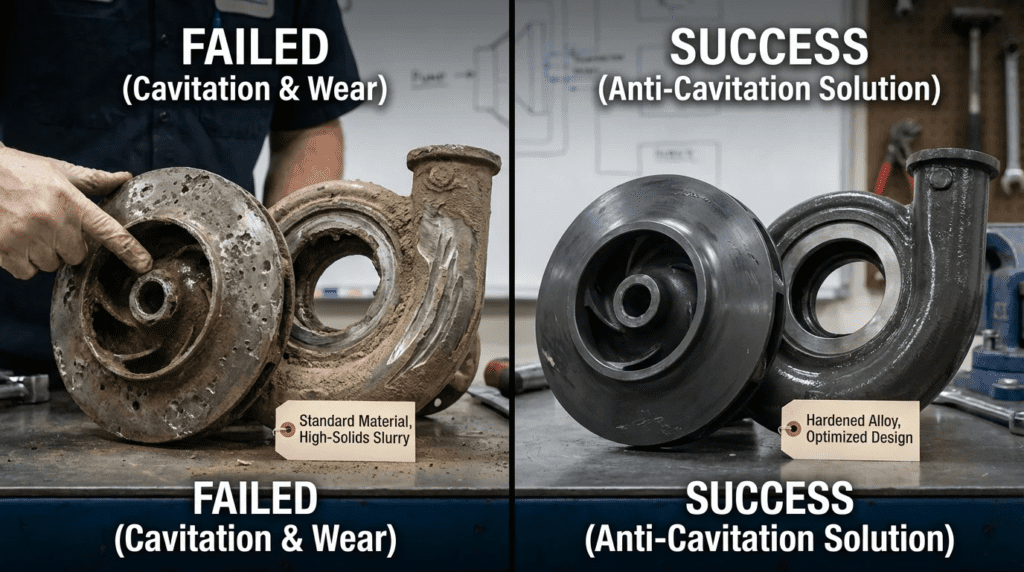
- Differentiating Wear Types: Operators must learn to read wear patterns. Abrasion looks like smooth, polished gouges or wavy, “riverbed” tracking. Cavitation looks like severe pitting, as if the metal was struck repeatedly with a tiny ball-peen hammer, creating a rough, sponge-like surface.
- Critical Spare Parts Inventory: Always maintain 100% spares for wet-end wear parts (impellers, suction liners, valve seats/plugs, and elastomers). Lead times for specialized hard-metal alloys can routinely exceed 16-24 weeks.
Troubleshooting Guide
When failure occurs, identifying the root cause prevents replacing broken equipment with equipment destined to fail the exact same way.
- Symptom: Rapid loss of head/flow in a pump.
Root Cause: Cavitation has eroded the leading edges of the impeller vanes, destroying the hydraulic profile.
Solution: Verify $NPSHa$. If adequate, check for entrained air from the wet well or suction tank. Increase pipe diameter or lower pump speed. - Symptom: Valve stops controlling, stays fixed in one position.
Root Cause: Slurry has dewatered and packed solidly into the valve body or the anti-cavitation trim is plugged.
Solution: Flush the line. Replace the valve with an open-architecture, low-recovery design suited for slurries. - Symptom: Pinhole leaks forming immediately downstream of a control valve.
Root Cause: The valve is cavitating, but the vapor bubbles are not collapsing inside the valve body; they are being swept downstream and imploding against the pipe wall.
Solution: Install a localized orifice plate or hardened spool piece downstream to provide backpressure ($P_2$), forcing the bubbles to collapse sooner or preventing them from forming entirely.
DESIGN DETAILS / CALCULATIONS
Executing an effective system design requires rigorous fluid mechanics calculations. Relying solely on vendor selection software without understanding the underlying math often leads to poor application fits.
Sizing Logic & Methodology
When selecting a control valve or pump, understanding the physical relationship between pressure drop and vapor pressure is mandatory.
- Calculating NPSHa for Slurry Pumps:
The standard formula is:NPSHa = Ha - Hvpa - Hst - Hfs
Where:Ha= Absolute pressure on the surface of the liquid.Hvpa= Vapor pressure of the liquid at operating temperature.Hst= Static elevation of the liquid above the pump centerline.Hfs= Friction head losses in the suction piping.
Slurry Correction: Both
HstandHfsmust be calculated using the specific gravity and viscosity of the slurry. Slurries with Bingham Plastic or Pseudo-plastic behaviors will have drastically higher friction losses than water, reducing $NPSHa$ and pushing the pump into cavitation. - The Incipient Cavitation Index ($sigma_c$):
To determine if a control valve will cavitate, calculate the system’s cavitation index ($sigma$):sigma = (P1 - Pv) / (P1 - P2)
WhereP1is absolute inlet pressure,P2is absolute outlet pressure, andPvis fluid vapor pressure. If the system $sigma$ is lower than the valve’s tested $sigma_c$ rating, cavitation will occur. In slurry, due to particle impact accelerating damage, you must maintain a higher safety margin above $sigma_c$ than you would with clean water.
Specification Checklist
Ensure your procurement documents contain these non-negotiable items for high-solids service:
- Max allowable pressure drop ($Delta P$) limits clearly defined for all operating cases.
- Liquid Pressure Recovery Factor ($F_L$) minimum thresholds stipulated to mandate low-recovery designs.
- Material Hardness specifications (e.g., Minimum 600 Brinell for wet-end wear parts).
- Prohibition Clause: Explicitly forbid the use of tortuous path, multi-stage labyrinth, or micro-drilled cage trims.
- Velocity Constraints: Clearly state the minimum pipeline velocity required to prevent solid drop-out (settling velocity), and maximum velocity to limit abrasive wear.
Standards & Compliance
Aligning designs with established industry standards ensures a baseline of quality and safety.
- ISA 75.23: The standard for evaluating cavitation in control valves. While primarily developed for clear fluids, its methodologies for calculating $F_L$ and $sigma$ remain structurally vital for severe service design.
- ANSI/HI (Hydraulic Institute) Standards: Specifically, HI 12.1-12.6 (Rotodynamic Centrifugal Slurry Pumps) dictates acceptable operating regions, NPSH margins, and wear considerations for pumps handling solids.
- ASTM A532: Standard Specification for Abrasion-Resistant Cast Irons. Ensure manufacturers specify the exact Class and Type (e.g., Class III, Type A) to guarantee the correct metallurgical properties for combined erosion-cavitation resistance.
FAQ SECTION
What is cavitation in a slurry pumping system?
Cavitation occurs when the localized fluid pressure drops below its vapor pressure, causing vapor bubbles to form. As pressure recovers downstream, these bubbles implode with immense force. In slurry applications, this is particularly destructive because the implosions strip away the metal’s work-hardened outer layer, exposing soft material to the abrasive solids, leading to incredibly rapid, synergistic equipment failure.
How does specific gravity affect cavitation risk?
Specific gravity alters both the dynamic head losses and the kinetic energy of the fluid. Higher specific gravity increases friction losses in suction piping, which lowers the Net Positive Suction Head available ($NPSHa$), making pumps more likely to cavitate. Furthermore, the higher mass of the fluid intensifies the physical impact of cavitation shockwaves on surrounding metals.
Why do standard anti-cavitation control valves fail in high-solids service?
Standard anti-cavitation valves use “tortuous path” designs—multiple stages of tiny, drilled holes or labyrinth channels designed to break down pressure in small increments. In high-solids or slurry applications, these microscopic passages act as mechanical filters, plugging almost instantly and rendering the valve entirely inoperable.
What is the typical lifespan of a slurry pump impeller under cavitating conditions?
A properly sized, high-chrome slurry pump impeller operating in its best efficiency point without cavitation can last 2 to 5 years depending on the abrasiveness of the slurry. However, if chronic cavitation is introduced, that same impeller can be destroyed in 3 to 6 months due to the synergistic effects of shockwave pitting and abrasive scouring. See the [[O&M Burden & Strategy]] section for inspection intervals.
How do you select the right valve for high-pressure slurry letdown?
For high-pressure drops in slurry, you must select valves with a high liquid pressure recovery factor ($F_L$) that utilize an open flow path, such as an expanding nozzle axial-flow valve or a specially designed sweeping-angle globe valve with solid tungsten carbide internals. Pinch valves are generally unsuitable for extreme pressure drops due to the potential for elastomer failure.
Can Variable Frequency Drives (VFDs) prevent cavitation?
Yes. By utilizing a VFD to slow down a pump rather than throttling a control valve to restrict flow, you eliminate the artificial pressure drop that causes cavitation in the valve. Additionally, operating pumps at lower RPMs reduces their $NPSHr$, which helps prevent cavitation at the pump impeller. However, minimum speeds must be maintained to keep solids in suspension.
CONCLUSION
KEY TAKEAWAYS
- Avoid Tortuous Paths: Never specify multi-stage drilled-cage trims for slurry service; they will plug immediately.
- Understand the Synergy: Cavitation strips away hardened metal surfaces, allowing abrasive slurries to wear equipment at up to 10x the normal rate.
- Focus on $F_L$ and Open Architecture: Use valves with high liquid pressure recovery factors and open, sweeping flow paths (like severe service axial valves or hardened eccentric plugs).
- Manage NPSH Margins: Maintain an $NPSHa$ margin of at least 1.5x to 2.0x the pump’s $NPSHr$ to account for fluid density variations and non-Newtonian rheology.
- VFDs Reduce Risk: Utilizing VFDs to match system curves often eliminates the need for destructive throttling control valves altogether.
- Material Matters: Specify high-chrome white iron (e.g., ASTM A532) or solid tungsten carbide for extreme services. Avoid elastomers if active cavitation is unavoidable.
When engineers dissect the complexities of Anti-Cavitation for Slurry and High-Solids Service: What Works and What Fails, it becomes evident that traditional clear-water hydraulics cannot simply be scaled up or ruggedized to handle municipal and industrial slurries. The fundamental fluid mechanics change when suspended solids are introduced. The rheological shifts impact friction losses, alter vapor pressures, and create a synergistic loop of mechanical destruction that turns minor pitting into catastrophic washouts.
Selecting and specifying the correct equipment requires a holistic view of the system. Engineers must accurately calculate slurry-adjusted $NPSHa$, recognize the physical limitations of elastomers and brittle carbides under thermal and mechanical shock, and rigorously forbid the use of tight-clearance pressure letdown devices. Operators and maintenance supervisors must be equipped with baseline vibration data and a comprehensive understanding of how to differentiate cavitation pitting from abrasive scouring.
Ultimately, successfully managing pressure drops and preventing cavitation in high-solids environments comes down to controlling fluid velocity and maintaining open flow architectures. By prioritizing low-recovery valve designs, robust suction piping geometry, and intelligent automation through VFDs, facilities can drastically extend equipment MTBF, lower their total cost of ownership, and ensure reliable continuous operation in even the most severe fluid handling applications.