
Mixers Troubleshooting: Low DO
INTRODUCTION
You crank up the blowers to maximum capacity, adjust the air control valves, and calibrate the sensors, but the dissolved oxygen (DO) readings still flatline. Often, design engineers and operators instinctively blame the aeration system—suspecting fouled diffusers or underperforming blowers—missing the actual hydrodynamic culprit: inadequate bulk fluid mixing. When tackling Mixers Troubleshooting: Low DO events in aeration basins, swing zones, and oxidation ditches, engineers must understand that oxygen mass transfer is inextricably linked to mixing energy.
If bulk fluid velocity drops below critical suspension thresholds (typically 1.0 ft/s or 0.3 m/s), mixed liquor suspended solids (MLSS) begin to settle. This settling creates localized anaerobic zones, reduces the effective volume of the biological reactor, and allows fine air bubbles to coalesce into larger bubbles. Coalescence drastically reduces the interfacial surface area between the gas and liquid phases, causing the alpha oxygen transfer efficiency (α-OTE) to plummet. The result is a persistent low DO condition that cannot be solved simply by pushing more air into the tank.
Biological Nutrient Removal (BNR) processes, intermittent aeration systems, and highly loaded industrial wastewater treatment plants rely on mechanical mixers to decouple aeration from mixing. In anoxic and anaerobic zones, mixers maintain suspension without introducing oxygen. In aerobic or swing zones, mixers assist aeration systems by establishing cross-flow velocities that sheer bubbles and increase residence time. When this mechanical mixing fails, the entire biological process is jeopardized, leading to permit violations, toxic shock to the biomass, and exorbitant energy waste as blowers operate outside their best efficiency points (BEP) trying to compensate.
This comprehensive technical article provides municipal consulting engineers, plant superintendents, and operators with a rigorous framework for specifying, evaluating, and diagnosing biological process mixers. By understanding the intersection of fluid mechanics, rheology, and oxygen mass transfer, utility decision-makers can properly size mixing equipment, prevent premature electromechanical failures, and execute effective troubleshooting procedures when low DO conditions arise.
HOW TO SELECT / SPECIFY
Specifying mixing equipment to prevent or resolve DO deficiencies requires moving beyond simple horsepower-to-volume ratios. Engineers must evaluate the process environment, fluid rheology, and the complex interactions between mechanical thrust and diffuser-induced airlift. The following criteria govern robust mixer specification.
Duty Conditions & Operating Envelope
The operating envelope of a biological process mixer is defined by the fluid’s physical characteristics and the hydraulic geometry of the basin. Mixed liquor is a non-Newtonian, pseudoplastic fluid; its apparent viscosity increases as the shear rate decreases. Therefore, specifying engineers must account for the maximum anticipated MLSS concentrations.
A mixer sized for a conventional activated sludge plant operating at 3,000 mg/L MLSS will likely fail to maintain suspension—leading to low DO—if the plant is upgraded to a Membrane Bioreactor (MBR) process running at 10,000 mg/L MLSS. Specifications must outline continuous versus intermittent duty cycles. In swing zones (alternating between anoxic and aerobic states), mixers must operate continuously. The specification should require the mixer to generate a specific bulk fluid velocity (typically 0.8 to 1.2 ft/s) throughout the entire basin volume under maximum viscosity conditions.
Materials & Compatibility
Wastewater mixing environments are highly corrosive and abrasive. Degradation of the mixer impeller or propeller geometry directly reduces hydraulic thrust, which slowly deteriorates tank mixing and manifests as a creeping low DO problem over months or years. Specifications must mandate highly durable materials.
For municipal wastewater, 316 stainless steel (or duplex stainless steel for high-chloride industrial applications) is the standard for propellers, shafts, and lifting davits. Submersible mixer motor housings are frequently specified in cast iron (e.g., ASTM A48 Class 35B) coated with two-part epoxy (minimum 12-16 mils dry film thickness). For highly abrasive environments containing excessive grit, polyurethane-coated propellers or hardened high-chrome iron should be considered to maintain blade profile and thrust efficiency.
Hydraulics & Process Performance
Mixers must be specified based on thrust (measured in Newtons or pounds-force), not just motor horsepower. Thrust is the primary metric of a mixer’s ability to impart momentum into the fluid. The interaction between mechanical mixing and aeration hydraulics is critical.
In aerated zones, the rising plume of air from fine-bubble diffusers creates powerful vertical air-lift currents. If a submersible horizontal mixer is placed improperly, its thrust can be completely negated by the vertical air curtain, or worse, it can sweep fine bubbles together, causing coalescence. The specification should require the manufacturer to provide Computational Fluid Dynamics (CFD) modeling showing the interaction between the mixer’s primary flow vector and the diffuser grid, ensuring that the combined hydraulic pattern enhances, rather than degrades, oxygen transfer.
Installation Environment & Constructability
Tank geometry heavily influences mixer selection. Long, narrow plug-flow reactors require different mixing strategies than circular oxidation ditches or square completely mixed basins. Baffle walls, structural columns, and aeration piping can act as hydraulic obstructions, creating downstream dead zones where solids settle and exert a high localized oxygen demand.
Constructability considerations must include guide rail systems for submersible mixers, allowing operators to raise and lower the equipment without draining the tank. The location of the guide rail must be structurally robust to handle the continuous reactionary thrust of the mixer, which can exceed 2,000 Newtons for large units. Failure to properly anchor the mast will lead to vibration, premature seal failure, and eventual mixer loss.
Reliability, Redundancy & Failure Modes
When a mixer fails in a deep biological reactor, stratification happens rapidly. Redundancy is often difficult to achieve because running multiple mixers in a small basin can create destructive intersecting flow patterns. Therefore, reliability (Mean Time Between Failures – MTBF) is paramount.
Common failure modes include mechanical seal breach (leading to water ingress and motor shorting), stator winding burnout, and gearbox failure due to ragging. Specifications must require dual mechanical seals (typically silicon carbide on silicon carbide) with an intermediate oil chamber. Furthermore, seal leak detection sensors and motor thermal switches (thermistors or bimetallic switches) must be mandated to shut down the unit before catastrophic failure occurs.
Controls & Automation Interfaces
Modern mixing systems should integrate tightly with plant SCADA systems. While anoxic mixers often run at a constant speed, mixers deployed in aeration assist or swing zones benefit from Variable Frequency Drive (VFD) control. VFDs allow operators to adjust thrust as MLSS concentrations change seasonally.
Advanced control strategies link mixer VFDs to DO and ORP (Oxidation-Reduction Potential) probes. In a low DO troubleshooting scenario, the control system can automatically increase mixer speed to enhance bubble shearing and tank turnover before signaling the blowers to increase output. Required instrumentation includes continuous power monitoring, vibration sensors on large vertical shafts, and stator temperature feedback.
Maintainability, Safety & Access
If a mixer is difficult to access, preventive maintenance will be deferred. For submersible units, the specification must include heavy-duty stainless steel lifting davits with dual-speed winches rated for at least 150% of the mixer’s wet weight. Cable management is a critical safety and reliability factor; unsupported power cables can be drawn into the propeller.
Top-entry vertical shaft mixers and hyperboloid mixers keep the motor and gearbox above the water line, drastically improving operator access for oil changes and motor inspections without requiring confined space entry or specialized lifting equipment. Lockout/tagout (LOTO) disconnects must be located within line-of-sight of the mixer mounting location.
Lifecycle Cost Drivers
Engineers must perform a Total Cost of Ownership (TCO) analysis balancing Capital Expenditure (CAPEX) with Operating Expenditure (OPEX). High-speed, direct-drive submersible mixers have a lower CAPEX but a smaller area of influence, requiring more units per tank and consuming more energy (higher OPEX).
Conversely, slow-speed, large-diameter submersible or hyperboloid mixers require a larger upfront investment but utilize large gearboxes to turn massive propellers (up to 2.5 meters in diameter) at low RPMs (20-50 RPM). This generates massive thrust with minimal energy consumption. When evaluating OPEX, engineers must factor in the energy savings achieved by improving the aeration system’s alpha factor, as proper mixing can reduce required blower power by 10-20%.
COMPARISON TABLES
The following tables provide an objective framework for comparing biological process mixing technologies and their application suitability. Table 1 breaks down the mechanical and performance characteristics of common mixer types. Table 2 provides a decision matrix to help engineers align specific plant conditions with the optimal mixing strategy to prevent low DO and settling issues.
| Technology / Type | Primary Features & Hydrodynamics | Best-Fit Applications | Limitations & Considerations | Typical Maintenance Profile |
|---|---|---|---|---|
| High-Speed Submersible (Direct Drive) | Small diameter propeller (0.3-0.8m), high RPM (400-900+). Generates a tight, high-velocity jet. | Small tanks, wet wells, localized mixing in complex geometries, high-shear applications. | High power consumption per unit volume. Small area of influence. Prone to ragging. Not suitable for large aeration basins. | Requires removal for all maintenance. Seal checks, oil changes every 6-12 months. Wear on small impellers is rapid if abrasive. |
| Low-Speed Submersible (Geared) | Large diameter propeller (1.2-2.5m), low RPM (20-50). High thrust-to-power ratio. Creates massive bulk flow. | Oxidation ditches, large BNR anoxic zones, large swing zones. | High initial CAPEX. Requires robust structural mast due to high reactionary forces. Can interfere with diffuser grids if placed improperly. | Retrieval required. Gearbox oil changes critical (typically 4,000-8,000 hours). Propeller blade inspection for rag buildup. |
| Hyperboloid / Bottom-Resting | FRP or stainless hyperboloid shape near tank floor. Motor/gearbox mounted above water. Creates radial outward flow across floor. | Deep aeration basins, simultaneous nitrification/denitrification (SND), swing zones. | Requires flat tank bottom. Cannot be easily retrofitted into tanks with complex floor geometries or existing dense diffuser grids. | Excellent access. Motor/gearbox accessible on walkway. No mechanical seals submerged. Oil changes fast and easy. |
| Top-Entry Vertical Shaft (Foil Impeller) | Bridge-mounted motor/gearbox driving a long vertical shaft with axial flow hydrofoil impellers. | Deep cylindrical tanks, aerobic digesters, highly loaded industrial biological reactors. | Requires heavy bridge superstructure. Long shafts subject to critical speed vibrations and bending moments. High CAPEX. | Motor/gearbox highly accessible. Shaft alignment and bearing maintenance critical. Wet-end maintenance requires tank drainage. |
| Process Scenario | Plant Size / Constraint | Best-Fit Mixer Type | Key DO & Aeration Interface Considerations | Relative Cost Impact |
|---|---|---|---|---|
| Oxidation Ditch (Race-track) | Medium/Large (Requires high linear velocity) | Low-Speed Submersible | Mixer must maintain >1.0 ft/s channel velocity to prevent settling between aeration rotors/grids. | Moderate CAPEX / Low OPEX |
| Deep Aeration Basin (>20 ft) | Large / Retrofit of overloaded plant | Hyperboloid or Top-Entry | Radial floor flow prevents sludge banking beneath diffusers. Increases bubble retention time, boosting alpha-OTE. | High CAPEX / Low OPEX |
| Swing Zone (Anoxic to Aerobic) | Small/Medium (Tight spatial constraints) | Low-Speed Submersible | Must run during aeration without sweeping fine bubbles away. Positioning relative to diffusers is strictly critical. | Moderate CAPEX / Moderate OPEX |
| Aerobic Digester (Thickened Sludge) | Any (High MLSS, non-Newtonian) | Top-Entry Vertical Shaft | Extreme viscosity requires massive torque. Submersibles often fail due to ragging and heat buildup in thick sludge. | High CAPEX / High OPEX |
ENGINEER & OPERATOR FIELD NOTES
Theoretical sizing only goes so far. Real-world wastewater environments introduce unpredictable variables like fibrous ragging, varying sludge volume indexes (SVI), and shifting hydraulic boundary conditions. The following field notes guide engineers and operators through practical deployment and diagnostic strategies.
Commissioning & Acceptance Testing
Proper commissioning prevents systemic failures before the plant is handed over to the municipality. A Factory Acceptance Test (FAT) should be specified for large mixers, verifying motor efficiency, seal integrity, and vibration tolerances under load. However, the Site Acceptance Test (SAT) is where mixing performance is truly validated.
During the SAT, engineers should mandate velocity profiling. Using Acoustic Doppler Velocimetry (ADV) or electromagnetic flow meters mounted to extension poles, technicians must map the bulk fluid velocity at multiple depths and coordinates within the basin using clean water. The specification should demand a minimum velocity (e.g., 0.3 m/s) at 90% of the tested grid points. If dead zones are identified during clean water testing, they will inevitably become anaerobic sludge banks during biological operation, leading directly to low DO complaints.
Common Specification Mistakes
A frequent error in bid documents is underspecifying the reactionary thrust forces. Consulting engineers sometimes copy-paste boilerplate pump specifications for mixers. However, unlike a pump that transfers fluid through a pipe, a submersible mixer pushes against the open bulk fluid, transferring all reactionary force to its guide mast. If the mast is undersized or inadequately anchored to the tank floor, the vibration will destroy the mixer’s bearings within months.
Another common mistake is ignoring the clearance between the mixer propeller and the aeration grid. If a low-speed mixer is placed too close to the floor without a flow-deflecting baffle, its suction can rip fine-bubble diffuser membranes off their pipes. Conversely, if placed too high, it may shear the air bubbles effectively but leave the bottom 2 feet of the tank stagnant.
Engineers often size mixing systems based on a rule of thumb of “X horsepower per 1,000 gallons.” This is fundamentally flawed. A 5 HP high-speed mixer and a 5 HP low-speed mixer consume the same power, but the low-speed unit may generate 3 to 4 times more hydraulic thrust. Always specify mixing requirements in terms of required thrust (Newtons) or bulk velocity, not motor horsepower.
O&M Burden & Strategy
Mixers in biological reactors are out of sight, which often means out of mind until the DO drops. Routine predictive maintenance is essential. For submersible units, operators must perform stator insulation resistance (Megger) testing and check seal moisture sensors bi-annually. Gearbox oil should be sampled and analyzed for water content and metal shavings; a sudden increase in bronze or steel particulates indicates impending bearing failure.
Ragging—the accumulation of fibrous materials (flushable wipes, hair) on the propeller—is the silent killer of mixing efficiency. A ragged impeller loses its hydrodynamic profile, causing thrust to drop by up to 50%. The motor will still draw normal or slightly elevated amps, masking the problem, but the bulk fluid velocity will collapse. Regular visual inspections (retrieving the mixer or draining the tank) and installing VFDs with anti-ragging reversal routines are highly recommended.
Step-by-Step Mixers Troubleshooting: Low DO Guide
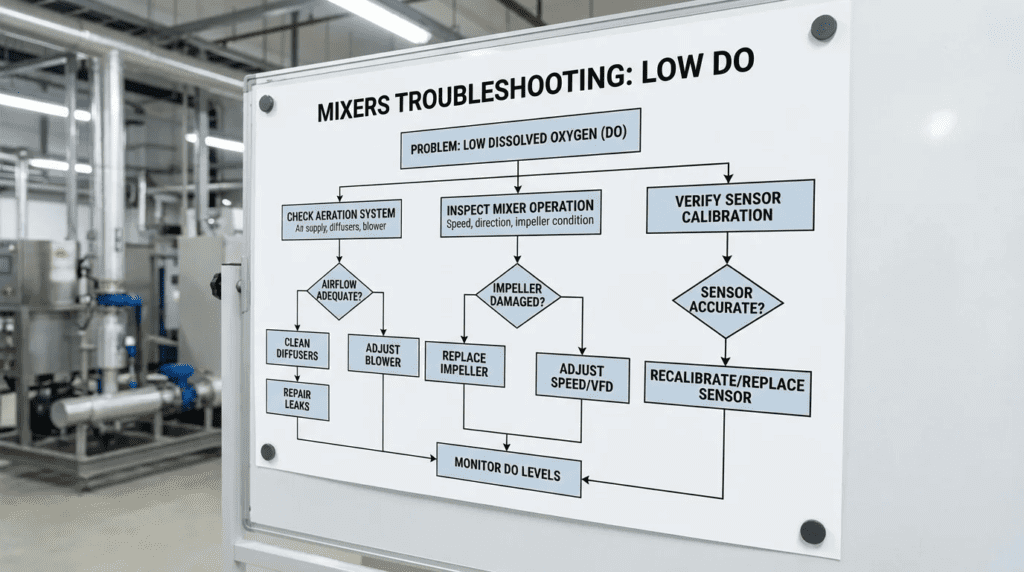
When an aeration basin experiences a sudden or chronic inability to maintain DO setpoints, operators must isolate whether the issue is aeration-side, biological, or mixing-related. A critical step in Mixers Troubleshooting: Low DO scenarios is isolating the hydrodynamic profile of the tank. Follow this diagnostic procedure:
- Verify Blower and Valve Operation: First, ensure blowers are delivering required SCFM (Standard Cubic Feet per Minute) and modulating valves are open. If air delivery is verified but DO is low, proceed to biological/mixing diagnostics.
- Perform a Tank Profile: Use a portable DO probe on a long pole to measure DO at various depths and locations.
- Symptom: High DO directly above diffuser grids, zero DO at the walls or tank corners.
- Diagnosis: Short-circuiting and poor bulk mixing. The mixer is failing to distribute the oxygenated water.
- Check Surface Patterns: Look at the surface of the aeration basin.
- Symptom: Large “boils” of air breaking the surface, while other areas are completely placid.
- Diagnosis: Fine bubbles are coalescing into coarse bubbles because the mixer is not generating enough cross-flow velocity to shear them. This ruins mass transfer.
- Evaluate MLSS Concentration (Rheology check): Has the MLSS concentration crept up significantly (e.g., from 3,500 to 6,000 mg/L)? As viscosity increases exponentially, a fixed-speed mixer’s area of influence shrinks, causing peripheral settling and low DO.
- Inspect the Mixer: If mixing is suspected, check the VFD output. Is the mixer pulling lower amps than baseline? This indicates a broken propeller blade or sheared shaft. Is it pulling higher amps? It is likely heavily ragged. Hoist the mixer for visual inspection.
DESIGN DETAILS / CALCULATIONS
Quantifying mixer performance requires rigorous calculation and adherence to hydraulic standards. Engineers must move from qualitative descriptions to verifiable physical parameters.
Sizing Logic & Methodology
The core principle of mixer sizing is establishing a sufficient thrust-to-volume ratio or power density to overcome the yield stress of the sludge. The primary sizing parameter is Thrust ($F_N$), calculated derived from the momentum equation:
$F = Q times rho times Delta v$
Where $Q$ is the pumped flow rate, $rho$ is fluid density, and $Delta v$ is the change in velocity. Since manufacturers test thrust empirically, engineers typically rely on the required thrust density per unit volume ($N/m^3$).
- Rule of Thumb (Clean water / Light Anoxic): 1.5 to 2.5 $N/m^3$
- Rule of Thumb (Standard MLSS 3,000 mg/L): 3.0 to 4.5 $N/m^3$
- Rule of Thumb (Thickened Sludge > 2%): 8.0 to 12.0+ $N/m^3$
*Note: These are typical/approximate ranges. Tank geometry heavily skews these numbers. A perfectly hydraulic race-track ditch requires less thrust density than a square tank with multiple baffle columns.
Specification Checklist
To ensure a robust, specification-safe procurement process, include the following mandatory deliverables in your bid documents:
- Thrust Certification: Manufacturer must provide certified thrust testing data in accordance with ISO 21630.
- CFD Modeling: Required for tanks larger than 100,000 gallons or complex geometries, demonstrating velocity contours and diffuser interaction.
- Motor Protection: Minimum of two thermal switches (one per phase for 3-phase) and a leakage sensor in the stator/oil chamber.
- Service Factor: Minimum motor service factor of 1.15 for continuous submerged duty.
- Lifting System: 316SS mast, davit, and winch rated for wet weight + friction factor.
Standards & Compliance
Specifications should enforce relevant industry standards to ensure equipment longevity and safety. Mechanical design should reference ANSI/AGMA (American Gear Manufacturers Association) standards for gearbox service factors—typically demanding a minimum service factor of 1.5 to 2.0 based on 24/7 continuous operation in heavy fluid.
Electrical components must comply with NEMA (National Electrical Manufacturers Association) or IEC standards. Submersible motors must be rated IP68 (continuous submersion) and ideally feature Class H (180°C) insulation with a Class B (80°C) temperature rise, ensuring the motor runs exceptionally cool, which drastically extends stator life. Thrust testing must adhere to ISO 21630 (Pumps, mixers and mixing installations for wastewater treatment).
Submersible mixer cables are highly susceptible to fatigue from continuous vibration and flow turbulence. Specify custom cable grips (Kellem grips) and stainless steel strain relief brackets attached to the mast. A loose cable will inevitably be drawn into the propeller, causing a catastrophic short circuit and bringing the mixing process to an immediate halt.
FAQ SECTION
What is the relationship between mixing and dissolved oxygen?
Mixing dictates how well dissolved oxygen is dispersed throughout a biological reactor. Proper mixing shears fine air bubbles (increasing their surface area), increases the bubbles’ residence time in the fluid, and prevents mixed liquor suspended solids (MLSS) from settling. If bulk velocity drops, solids settle, creating localized anaerobic zones that aggressively consume DO, leading to chronically low DO readings despite maximum blower output.
How do you perform Mixers Troubleshooting: Low DO in an oxidation ditch?
In an oxidation ditch, Mixers Troubleshooting: Low DO starts with profiling the channel velocity. Use a portable velocity meter to ensure flow is maintaining at least 1.0 ft/s (0.3 m/s) throughout the entire circuit. If velocity drops below this ahead of the aeration rotors/grids, solids will settle. Check submersible directional mixers for ragging on the impellers, which drastically cuts thrust, or verify that VFDs have not been incorrectly dialed down by operators saving energy.
What is the typical bulk velocity required to prevent settling in aeration basins?
The typical bulk fluid velocity required to keep conventional activated sludge in complete suspension is approximately 0.8 to 1.0 ft/s (0.25 to 0.3 m/s). For heavier fluids, like those found in aerobic digesters or systems with high grit accumulation, velocities of 1.2 to 1.5 ft/s may be required. These are typical/approximate ranges and depend heavily on the specific gravity and viscosity of the sludge.
How does ragging affect mixer performance and DO?
Ragging (the buildup of fibrous wipes and hair) destroys the hydrodynamic profile of the mixer’s propeller. This reduces the thrust output and pumping capacity of the unit, often by more than 50%. As thrust drops, the tank’s bulk velocity slows, leading to sludge settling and bubble coalescence. The loss of oxygen mass transfer efficiency immediately manifests as a low DO condition in the basin.
What is the difference between mixing and aeration?
Aeration is the process of introducing a gas (typically ambient air or pure oxygen) into a liquid to facilitate biological respiration. Mixing is the mechanical impartation of momentum (thrust) to move the bulk fluid. While aeration systems (like diffusers or surface aerators) provide some mixing energy, advanced wastewater processes decouple the two, using dedicated mechanical mixers to maintain suspension in anoxic zones or to assist oxygen transfer in deep aeration basins.
What is the typical lifespan of a biological process mixer?
In municipal wastewater, heavy-duty mixers typically operate for 10 to 15 years. However, wet-end wear parts, such as mechanical seals and bearings, generally require replacement or major servicing every 3 to 5 years depending on the abrasiveness of the fluid and duty cycle. Gearboxes on low-speed mixers require oil changes every 4,000 to 8,000 operating hours to maintain expected lifespans.
CONCLUSION
KEY TAKEAWAYS
- Thrust, not Horsepower: Always size and evaluate mixers based on their thrust output (Newtons) and the resulting bulk fluid velocity, not strictly by motor horsepower.
- Mixing Drives Alpha-OTE: Poor mixing leads to bubble coalescence and sludge settling, crashing the tank’s oxygen transfer efficiency and causing intractable low DO.
- Rheology Matters: Mixer specifications must account for the maximum operating MLSS concentration; high viscosity drastically shrinks a mixer’s area of influence.
- CFD Modeling is Essential: For large tanks, mandate CFD analysis to ensure mechanical mixing vectors complement, rather than disrupt, aeration grid plumes.
- Check for Ragging First: When troubleshooting low DO, before replacing diffusers or blowers, hoist the mixer and inspect for fibrous ragging, which silently destroys hydraulic thrust.
Resolving complex hydrodynamic challenges in wastewater treatment requires a holistic view of the biological reactor. Engineers and operators must recognize that Mixers Troubleshooting: Low DO events are rarely caused by a single equipment failure, but rather a breakdown in the symbiotic relationship between mechanical thrust, fluid rheology, and aeration kinetics. When bulk fluid velocity falls below the critical suspension threshold, no amount of supplemental blower air will correct the resulting localized anaerobic zones and compromised mass transfer.
By specifying mixers based on rigorous thrust-to-volume calculations, mandating durable materials, and demanding proof of performance through CFD and site velocity testing, design engineers can protect utilities from chronic biological process failures. Operators must commit to proactive maintenance regimes—monitoring vibration, checking gearbox oil, and clearing ragged impellers—to ensure that design thrust is continuously delivered to the bulk fluid.
Ultimately, balancing the CAPEX of robust, low-speed mixing equipment against the OPEX of energy-intensive blowers yields the lowest Total Cost of Ownership. When faced with persistently low DO readings, engineers should step back from the blowers, profile the tank velocity, and let fluid mechanics guide their troubleshooting methodology.