
Top Disinfection Equipment Manufacturers for Water Treatment
Introduction
One of the most delicate balancing acts in municipal and industrial engineering is achieving required pathogen log-inactivation without exceeding stringent Disinfection Byproduct (DBP) maximum contaminant levels. Navigating the landscape of the Top Disinfection Equipment Manufacturers for Water Treatment is critical to resolving this tension. A specification error here does not just impact the capital expenditure (CAPEX); it dictates a facility’s operational expenditure (OPEX), site safety profile, and regulatory compliance for the next 20 to 30 years.
This pillar article serves as a comprehensive technical guide to the major disinfection methodologies and the original equipment manufacturers (OEMs) that dominate them. The topic encompasses a broad array of subcategories ranging from traditional gas chlorination components to advanced UV and ozone generation technologies. Understanding the fundamental differences in equipment variants, proprietary OEM designs, and application-specific constraints is essential for water and wastewater engineers, public works directors, and plant operators looking to optimize their treatment trains.
Subcategory Landscape — Types, Technologies & Approaches
The landscape of Top Disinfection Equipment Manufacturers for Water Treatment is segmented primarily by the physical or chemical mechanism used to inactivate pathogens. Engineers must navigate legacy chemical systems, next-generation electrolytic generators, and physical disinfection methods. The following subsections detail the major technology branches, the equipment components involved, and the primary manufacturers leading each sector. Understanding these variants helps engineers avoid specifying a technology that cannot meet the unique site constraints, water quality parameters, or operational realities of a specific plant.
UV Disinfection System Manufacturers
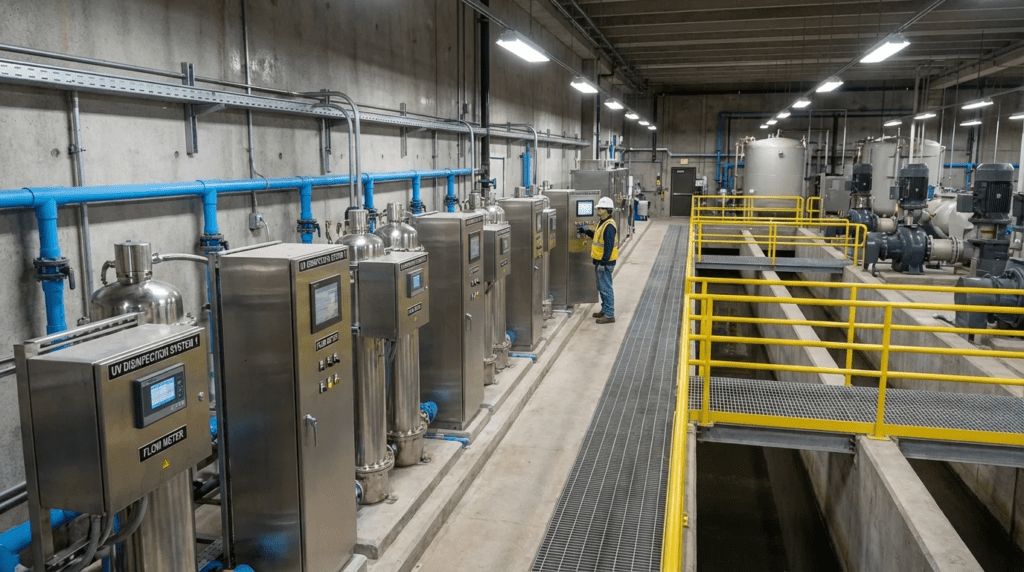
Ultraviolet (UV) irradiation disrupts the DNA and RNA of pathogens, rendering them incapable of replication. Systems primarily utilize either Low-Pressure High-Output (LPHO) or Medium-Pressure (MP) lamps housed in quartz sleeves. UV disinfection system manufacturers design equipment ranging from closed-vessel systems for pressurized drinking water pipes to open-channel gravity flow systems for wastewater effluent. Crucial engineering considerations include the fluid’s UV Transmittance (UVT), required dose (typically 30–40 mJ/cm² for municipal drinking water), and hydraulic head loss across the reactor.
Major OEMs in this space, such as Trojan Technologies, Xylem (Wedeco), Calgon Carbon, and Aquionics, differentiate themselves through proprietary ballast technologies, computational fluid dynamics (CFD) validated reactor designs, and automated sleeve-wiping mechanisms. Engineers specify UV when chemical DBPs (like trihalomethanes or haloacetic acids) are a limiting factor, or when targeting chlorine-resistant pathogens such as Cryptosporidium and Giardia. Limitations include zero residual disinfection (requiring a secondary chemical residual for distribution) and severe susceptibility to iron, hardness, and suspended solids fouling the quartz sleeves.
Ozone Generation Equipment Manufacturers
Ozone (O₃) is an extremely powerful oxidant generated on-site by passing a high-voltage alternating current across a dielectric discharge gap (corona discharge) injected with either Liquid Oxygen (LOX) or purified air. Ozone generation equipment manufacturers provide complex, multi-component systems that include feed gas preparation, the generator skids, contact basins with fine bubble diffusers or side-stream injection networks, and ozone destruct units for off-gas. Ozone is heavily utilized in large-scale drinking water plants for taste and odor control, color removal, iron/manganese oxidation, and primary pathogen inactivation.
Leading OEMs like Veolia (Ozonia), Xylem (Wedeco), De Nora, and Primozone compete on dielectric efficiency, power density, and generator turndown capabilities. Because ozone generation is highly energy-intensive (requiring approximately 3 to 6 kWh per pound of ozone generated), specifying high-efficiency dielectric materials is critical. The primary constraint is capital cost and complexity; these systems demand highly skilled operators. Furthermore, ozone reacts with naturally occurring bromide to form bromate (a regulated DBP), which strictly limits its application in certain high-bromide source waters.
Gas Chlorination System Manufacturers
Despite safety concerns, chlorine gas (Cl₂) remains one of the most cost-effective and reliable disinfection methods for both primary and secondary disinfection. Systems operate under vacuum for safety; gas is drawn from pressurized cylinders, ton containers, or rail cars through a vacuum regulator, metered via a rotameter, and injected into the water stream via an ejector which creates the necessary vacuum. Gas chlorination system manufacturers focus heavily on fail-safe components, precision V-notch control valves, and automatic switchover manifolds.
Manufacturers such as De Nora (Wallace & Tiernan), Hydro Instruments, Evoqua, and Severn Trent Services provide the heavy-duty regulators and vaporizers required for these installations. Gas chlorination provides excellent CT (Concentration x Time) values, is highly stable, and offers the lowest chemical operational cost. However, because of the stringent Risk Management Plan (RMP) requirements mandated by the EPA/OSHA for hazardous gas storage, many municipalities are actively phasing out gas systems. Where retained, modern specifications heavily emphasize automated feed pacing and integrated scrubber systems.
On-Site Hypochlorite Generation (OSHG) Manufacturers
OSHG systems utilize electrolysis to convert a simple brine solution (salt and water) into a dilute, 0.8% sodium hypochlorite solution. By remaining below the 1% hazardous threshold, this solution requires no complex hazardous chemical reporting and does not significantly degrade over time. On-site hypochlorite generation (OSHG) manufacturers supply the electrolytic cells, brine tanks, water softeners, hydrogen dilution blowers, and storage tanks that comprise the total packaged skid.
Dominant OEMs include De Nora (ClorTec), Evoqua (OSEC), MIOX, and PSI Water Technologies. The key differentiator among these manufacturers is the proprietary coating applied to the titanium electrodes (typically mixed metal oxides like ruthenium or iridium), which dictates the cell’s lifespan and energy/salt efficiency. Typically, OSHG requires 3.0 to 3.5 lbs of salt and 2.0 to 2.5 kWh of power to produce one pound of free available chlorine (FAC). OSHG is ideal for mid-to-large municipalities seeking to eliminate hazardous gas or bulk liquid hypo delivery risks, though it requires a high initial CAPEX and routine acid washing to remove cell scaling.
Chlorine Dioxide System Manufacturers
Chlorine dioxide (ClO₂) is a highly effective, selective oxidant that does not form THMs or HAAs, making it highly valuable in water sources with high organic precursors. Because ClO₂ is unstable and explosive under pressure, it cannot be transported and must be generated on-site using precursor chemicals (typically sodium chlorite reacting with chlorine gas or hydrochloric acid). Chlorine dioxide system manufacturers supply precision generation skids that must safely and efficiently mix these precursors under strict ratio control to maximize yield and minimize unreacted chlorite.
Major manufacturers such as ProMinent, Evoqua, and Grundfos specialize in two-chemical or three-chemical generator variants. These systems are frequently deployed in industrial cooling towers for Legionella control, and in municipal plants for primary disinfection or pre-oxidation of iron and manganese. The primary engineering challenge is managing the regulatory limit on the maximum dose; the EPA limits chlorite (the primary degradation byproduct of ClO₂) to 1.0 mg/L in drinking water, which restricts the allowable applied dose of chlorine dioxide.
Bulk Sodium Hypochlorite Feed System Manufacturers
Many plants opt for commercial-grade bulk sodium hypochlorite (typically 12.5% to 15% concentration) to balance CAPEX and safety. The equipment focus shifts from generation to precise dosing and storage. Bulk sodium hypochlorite feed system manufacturers produce the chemical metering pumps, pulsation dampeners, backpressure valves, and skid-mounted control architectures necessary for reliable injection.
Leading OEMs like ProMinent, Watson-Marlow, LMI, and Blue-White Industries offer advanced peristaltic and digitally controlled stepper-motor diaphragm pumps. Sodium hypochlorite is notorious for off-gassing (releasing oxygen bubbles as it degrades), which causes traditional diaphragm pumps to vapor-lock. Consequently, engineers must specify pumps with auto-degassing liquid ends or opt for peristaltic technologies. Another critical limitation is the rapid degradation of bulk 12.5% solution, which loses strength and forms perchlorate and chlorate over time, particularly in warm environments.
Advanced Oxidation Process (AOP) Equipment Manufacturers
When recalcitrant compounds (like 1,4-dioxane, PFAS precursors, endocrine disruptors, or complex pharmaceuticals) bypass standard treatment, AOP is deployed. AOP involves combining two technologies—such as UV irradiation with hydrogen peroxide (H₂O₂), or ozone with H₂O₂—to generate hydroxyl radicals (•OH), which are non-selective oxidants with the highest oxidation potential available in water treatment. Advanced oxidation process (AOP) equipment manufacturers design complex integrated reactors and control algorithms to manage the precise dosing ratios required for this synergy.
Firms like Trojan Technologies (TrojanUVSigna/Phox), Xylem (Wedeco MiPRO), and USP Technologies lead this highly specialized sector. AOP is primarily applied in direct/indirect potable reuse (DPR/IPR) wastewater effluent, groundwater remediation, and highly challenging industrial effluents. Sizing requires extensive pilot testing because the background water matrix (alkalinity, TOC) heavily scavenges hydroxyl radicals, fundamentally altering required equipment sizing and OPEX.
Peracetic Acid (PAA) Dosing System Manufacturers
Peracetic acid (PAA) is an emerging liquid chemical disinfectant, primarily replacing chlorine in wastewater effluent channels to eliminate the need for dechlorination (using sulfur dioxide or sodium bisulfite). It leaves no harmful residuals or chlorinated DBPs. Peracetic acid (PAA) dosing system manufacturers provide the specialized chemical feed skids, inherently safe containment, and residual analyzers required to handle this highly reactive chemical.
OEMs like ProMinent, Grundfos, and Watson-Marlow provide the metering infrastructure. PAA is highly corrosive and off-gasses vigorously; therefore, wetted materials must be meticulously specified (e.g., PTFE, specific grades of stainless steel, no natural rubbers). PAA requires minimal contact time compared to chlorine, allowing plants to repurpose existing, undersized chlorine contact chambers. However, the chemical itself is significantly more expensive per gallon than hypochlorite, making lifecycle OPEX a critical evaluation metric.
Selection & Specification Framework
Choosing among the Top Disinfection Equipment Manufacturers for Water Treatment requires a rigorous decision tree balancing capital budgets, operational capabilities, footprint, and water chemistry.
- CAPEX vs. OPEX: Physical systems (UV, Ozone) and generation systems (OSHG) have a high initial CAPEX but often lower recurring operational and liability costs. Bulk chemical systems (gas, 12.5% hypo) have low CAPEX but expose the plant to ongoing supply chain volatility, chemical costs, and hazard liabilities.
- Regulatory DBP Constraints: If a municipality is repeatedly violating Stage 2 D/DBPR limits for THMs and HAAs, moving away from primary chlorination is required. The decision tree typically points to UV for primary disinfection (coupled with a low-dose chloramine residual) or Ozone (if color/odor is also an issue and bromide is low).
- Footprint and Hydraulic Profile: Gravity open-channel UV requires specific hydraulic profiles to maintain water levels over the lamps. Ozone requires massive contact basins. OSHG requires significant indoor footprint for brine tanks, cells, and bulk storage.
- Primary vs. Secondary Disinfection: UV, AOP, and Ozone provide zero residual. They can only be used for primary disinfection (inactivation at the plant). A chlorine-based system (Gas, Bulk Hypo, OSHG, or Chloramines) MUST be specified alongside them to maintain a residual in the distribution network.
Engineers often specify bulk 12.5% sodium hypochlorite for its low initial equipment cost. However, they frequently fail to account for the HVAC costs required to cool the chemical room to prevent rapid degradation and chlorate formation. When lifecycle cooling and frequent pump replacements due to off-gassing are calculated, OSHG often presents a superior 20-year net present value (NPV).
Comparison Tables
The following tables provide a high-level engineering reference for comparing major equipment variants and the predominant original equipment manufacturers within the disinfection sector.
Table 1: Top Disinfection OEM Comparison
| Manufacturer | Primary Tech Focus | Typical Applications | Limitations | Maintenance Profile |
|---|---|---|---|---|
| De Nora (ClorTec, W&T, Capital Controls) | OSHG, Gas Chlorination, Ozone | Municipal DW, WW, large-scale primary & secondary | Premium pricing; complex OSHG skids require footprint | High (OSHG cell acid washing); Low (Gas systems) |
| Xylem (Wedeco) | UV, Ozone, AOP | Large municipal DW, high-flow WW effluent, Reuse | High energy consumption; strict water quality (UVT) limits | Moderate (UV quartz wiping/replacement) |
| Trojan Technologies | UV, AOP | Municipal WW channels, DW closed vessel, Reuse | Solely focused on UV/AOP; no chemical residual | Moderate (Routine lamp changes every 9k-12k hours) |
| Evoqua (OSEC, Wallace & Tiernan legacy) | OSHG, Gas Chlorination, ClO₂ | Mid/Large DW, WW, Industrial Cooling Water | Varying support dependent on regional rep networks | Moderate to High (OSHG and ClO₂ generation) |
| ProMinent | Chemical Dosing, ClO₂, Ozone | Industrial process, Food & Beverage, small/mid DW | Less focus on massive-scale municipal civil works | Low (Metering pumps easily replaced) |
| Veolia (Ozonia) | Ozone Generation | Massive DW plants, Taste & Odor, complex organics | Extremely high CAPEX; requires LOX infrastructure | High (Dielectric tube maintenance, tuning) |
| Hydro Instruments | Gas Chlorination | Municipal DW & WW, rural water systems | Limited to gas/liquid feed tech | Low (Robust, simple mechanical diaphragms) |
| Watson-Marlow | Peristaltic Dosing (Hypo, PAA) | Highly off-gassing chemicals, precise low-flow dosing | Hose degradation requires strict PM schedules | Moderate (Routine hose replacement strictly required) |
Table 2: Application Fit Matrix
| Application Scenario | Best-Fit Technology Subcategory | Key Engineering Constraints | Relative Lifecycle Cost |
|---|---|---|---|
| Small DW System (<1 MGD), Remote | bulk sodium hypochlorite feed system manufacturers | Chemical degradation; requires auto-degassing pumps | Low CAPEX / High Chem OPEX |
| Large DW Plant (10+ MGD), High Organics | ozone generation equipment manufacturers | High Bromide in source water; space for contact basins | High CAPEX / Mod OPEX |
| WWTP Effluent (Replacing Gas Cl₂) | UV disinfection system manufacturers | Effluent UVT limits; suspended solids fouling | Mod CAPEX / Mod Power OPEX |
| Mid-to-Large DW, Eliminating Gas Risk | on-site hypochlorite generation (OSHG) manufacturers | Reliable soft water & premium salt supply required | High CAPEX / Low OPEX |
| Direct Potable Reuse (DPR) | advanced oxidation process (AOP) equipment manufacturers | Complex control loops; radical scavenging by background water | High CAPEX / High OPEX |
| WWTP Effluent (High TSS, poor UVT) | peracetic acid (PAA) dosing system manufacturers | Chemical handling safety; high per-gallon cost | Low CAPEX / High Chem OPEX |
Engineer & Operator Field Notes
Commissioning Considerations That Vary by Subcategory
Commissioning differs drastically across disinfection methodologies. For ozone generation equipment manufacturers, commissioning involves rigorous testing of the ambient ozone destruct units and leak detection sensors, as a 0.1 ppm exposure limit is strictly enforced. Furthermore, dielectric tuning is required to match gas flow with power application. Conversely, commissioning systems from UV disinfection system manufacturers revolves around hydraulic validation—ensuring water levels in open channels remain above the lamps under all flow conditions to prevent overheating, while verifying the output of the UV intensity sensors against a certified reference sensor.
Common Specification Mistakes
A frequent error occurs when engineers copy/paste specifications across subcategories. For example, specifying a standard motor-driven diaphragm pump from bulk sodium hypochlorite feed system manufacturers for a PAA application. PAA off-gasses aggressively and will vapor-lock standard diaphragm pumps; specialized auto-degassing liquid ends or peristaltic pumps are mandatory. Similarly, engineers often oversize equipment from on-site hypochlorite generation (OSHG) manufacturers to match the peak hour flow of a plant, failing to realize that OSHG systems are designed to run 24/7 at a continuous rate, storing the generated 0.8% solution in a bulk tank to handle hydraulic peaks.
O&M Comparison Across Subcategories
Operational realities dictate long-term success. The subcategories require vastly different maintenance mindsets:
- Daily Operator Attention: Chlorine dioxide system manufacturers and Ozone systems require high-level daily attention. Operators must verify precursor ratios, check vacuum limits, monitor ambient safety alarms, and log complex SCADA data. These demand a Grade III/IV operator.
- Maintenance Intervals: Equipment from UV disinfection system manufacturers operates smoothly but requires labor-intensive seasonal maintenance. Wiper rings typically require replacement every 12 months, and lamps must be replaced at 9,000 to 12,000 hours.
- Consumables: OSHG relies strictly on high-purity salt and softened water. If operators fail to maintain the upstream water softener, calcium scales the electrolytic cells within days, leading to catastrophic failure and expensive cell replacement. Gas chlorination system manufacturers boast the lowest consumable maintenance—mostly replacing lead gaskets during cylinder switchovers and rebuilding regulators every 2–5 years.
- Hands-Off Operations: Modern peristaltic pumps from bulk sodium hypochlorite feed system manufacturers are mostly hands-off, requiring only a simple 5-minute hose change every 3,000 to 6,000 hours.
Troubleshooting Overview
When troubleshooting, start with the subcategory-specific failure modes. For UV, if log reduction is failing, check the UV Transmittance (UVT) analyzer; if background UVT drops due to a storm event, the lamps cannot penetrate the water, regardless of output. For OSHG, a drop in production capacity usually points to voltage issues across the cell caused by scaling or degraded electrode coatings (requiring a mild hydrochloric acid wash). For gas chlorination system manufacturers, a loss of feed is almost always traced to a loss of vacuum caused by a fouled ejector nozzle, not the gas regulator itself.
Electrolysis naturally produces hydrogen gas as a byproduct. OSHG specifications must include active (blower-driven) ventilation of the bulk storage tanks to dilute the hydrogen below its lower explosive limit (LEL). Failing to specify redundant blowers or adequate roof ventilation has resulted in catastrophic tank explosions in municipal plants.
Design Details & Standards
Sizing Methodology Overview Applicable Across Subcategories
While the actual equipment varies, the regulatory target is constant: pathogenic log-inactivation. For chemical methods (Gas, Bulk Hypo, ClO₂, Ozone, Chloramines), sizing is governed by the CT Concept (Concentration × Time). Engineers must calculate the required chemical dose (mg/L) and multiply it by the baffling factor (T10) of the contact basin at peak hourly flow. For physical methods like UV, sizing uses IT (Intensity × Time), expressed as a dose in mJ/cm². Equipment must be sized to deliver the required CT or UV dose under the worst-case scenario: peak flow, lowest water temperature, highest pH, and lowest UVT.
Key Design Parameters That Differ by Subcategory
If an engineer selects on-site hypochlorite generation (OSHG) manufacturers, the design parameters revolve around brine tank sizing (typically sized for 15-30 days of salt storage) and generation capacity (lbs/day). However, if switching to UV disinfection system manufacturers, the entire design vocabulary shifts to hydraulic head loss, lamp arrays, channel dimensions, and power quality (requiring robust UPS systems, as a 2-second voltage sag can extinguish UV lamps, causing a 10-minute warm-up period where untreated water passes).
Applicable Standards & Compliance
Compliance dictates equipment specifications. Key standards include:
- AWWA B300 / B304: Covers liquid sodium hypochlorite and liquid chlorine.
- USEPA UVDGM (UV Disinfection Guidance Manual): The holy grail for specifying UV reactors. Reactors must undergo third-party validation (e.g., using MS2 phage) to prove they deliver the claimed dose. Never specify an unvalidated reactor for municipal drinking water.
- Ten States Standards: Dictates that all municipal disinfection systems must have redundancy. If the peak flow requires one generator, two must be specified (N+1 redundancy).
- NSF/ANSI 61: All wetted components in drinking water systems across all subcategories must hold this certification to prove they do not leach toxins into the supply.
Specification Checklist
When evaluating the Top Disinfection Equipment Manufacturers for Water Treatment, your specification package should include:
- Max/Min/Average Flow Rates and Design Temperatures.
- Worst-case water quality parameters (UVT, pH, Alkalinity, Bromide, Iron/Manganese).
- Redundancy requirements (N+1 vs N+2).
- Telemetry integration protocols (Modbus TCP/IP, Ethernet/IP, Profibus).
- Wetted materials compatibility (e.g., specifying Titanium for OSHG, PTFE for PAA).
- Specific OEM vendor service network requirements (max response time in hours).
FAQ Section
What are the different types of disinfection equipment manufacturers?
The industry is segmented by technology. The primary categories include UV disinfection system manufacturers (using light irradiation), ozone generation equipment manufacturers (using high-voltage gas oxidation), and traditional chemical feeders like gas chlorination system manufacturers and bulk sodium hypochlorite feed system manufacturers. Advanced plants also utilize on-site hypochlorite generation (OSHG) manufacturers, chlorine dioxide system manufacturers, advanced oxidation process (AOP) equipment manufacturers, and peracetic acid (PAA) dosing system manufacturers.
How do you choose between UV and Ozone disinfection?
Choosing between UV disinfection system manufacturers and ozone generation equipment manufacturers largely depends on secondary goals. Both provide excellent primary pathogen inactivation without forming chlorinated DBPs. However, Ozone also destroys taste and odor compounds, removes color, and oxidizes iron/manganese. If those are not issues, UV is generally preferred as it has a smaller footprint, lower CAPEX, and does not form bromate (a regulated DBP caused by ozone reacting with bromide).
What is the most cost-effective disinfection equipment for small plants?
For small, remote plants (under 1 MGD), specifying equipment from bulk sodium hypochlorite feed system manufacturers is typically the most cost-effective. The CAPEX involves inexpensive metering pumps and small day tanks. While on-site hypochlorite generation (OSHG) manufacturers offer lower chemical costs over time, the high initial capital cost and complex maintenance of OSHG are usually prohibitive for small tax bases or highly remote locations lacking technical operator support.
Why are plants moving away from gas chlorination?
While equipment from gas chlorination system manufacturers is incredibly reliable and cost-effective, chlorine gas is extremely hazardous. A 1-ton cylinder leak can force the evacuation of surrounding neighborhoods. Consequently, the EPA mandates rigorous Risk Management Plans (RMPs) and OSHA requires Process Safety Management (PSM). The administrative burden and liability of these regulations drive municipalities to specify safer alternatives like OSHG or UV.
How often do UV lamps need to be replaced?
Depending on the specific UV disinfection system manufacturers, Low-Pressure High-Output (LPHO) lamps typically require replacement between 9,000 and 12,000 operating hours. Medium-Pressure (MP) lamps, which burn much hotter and consume more energy, generally last between 4,000 and 8,000 hours. The quartz sleeves protecting the lamps do not need replacement this frequently unless physically damaged, but must be chemically or mechanically wiped regularly.
What maintenance does an OSHG system require?
Systems from on-site hypochlorite generation (OSHG) manufacturers demand strict maintenance of the upstream water softeners. If hard water enters the electrolytic cell, calcium/magnesium scale forms immediately. Routine maintenance involves a mild acid wash (using hydrochloric acid) of the cell every 3 to 6 months. Additionally, brine tanks must be cleaned annually to remove sludge and impurities brought in by the bulk salt delivery.
Conclusion
- Selection is Site-Specific: Never copy/paste a disinfection spec; UV relies on UVT, Ozone relies on low Bromide, and OSHG relies on soft water.
- Understand DBP Tradeoffs: Chemical chlorination causes THMs/HAAs. Moving to UV disinfection system manufacturers or ozone generation equipment manufacturers solves this but eliminates residual distribution protection.
- Factor in Safety Costs: Gas chlorination system manufacturers offer the cheapest CAPEX, but Risk Management Plans (RMP) add immense hidden compliance costs.
- AOP is for Extremes: Specify advanced oxidation process (AOP) equipment manufacturers only for recalcitrant compounds (1,4-Dioxane, PFAS, DPR) due to immense energy and CAPEX requirements.
- Pump Selection Matters: When buying from bulk sodium hypochlorite feed system manufacturers or peracetic acid (PAA) dosing system manufacturers, specify auto-degassing or peristaltic pumps to combat vapor lock.
Specifying the right equipment from the Top Disinfection Equipment Manufacturers for Water Treatment is the most critical safety and compliance decision an engineer will make for a facility. The methodology requires a holistic view of the plant’s lifecycle: balancing the immediate capital constraints with 20 years of operational burdens, chemical costs, and shifting regulatory landscapes. A thorough decision methodology evaluates not just the technology itself, but the specific OEM’s track record, regional service availability, and proprietary component longevity.
When navigating between legacy gas systems, modern electrolytic generation, and advanced physical disinfection like UV and Ozone, involving specialists early in the preliminary design phase—particularly for pilot testing AOP or Ozone matrices—is vital. Ultimately, an optimized disinfection train relies on matching the right technology to the operator skill level, the source water chemistry, and the community’s long-term budget.