
AI and Data Analytics in Water Treatment: Smart Solutions Guide
INTRODUCTION
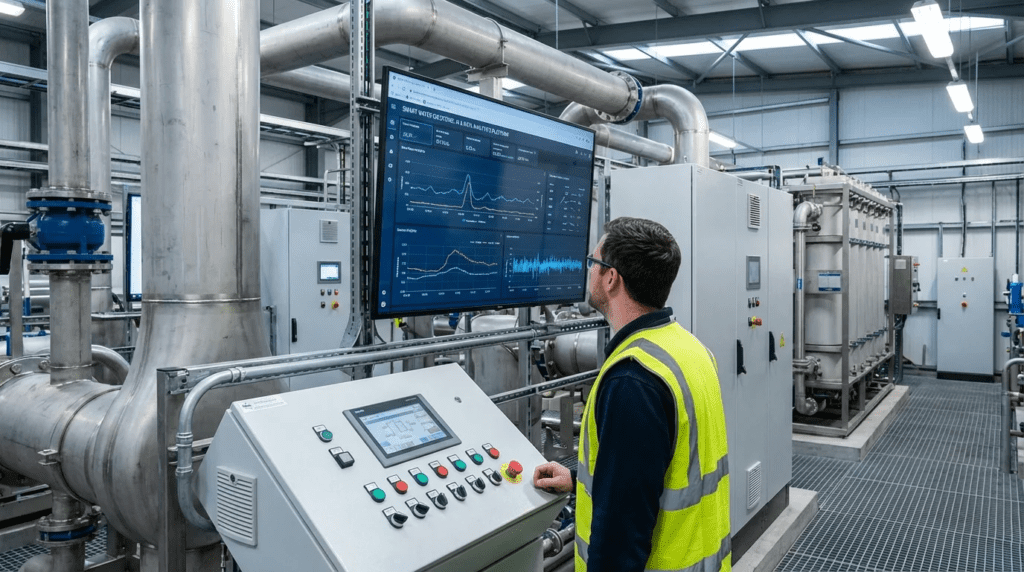
Historically, municipal and industrial water treatment facilities have operated on reactive control philosophies. Operators manually adjust Dissolved Oxygen (DO) setpoints based on grab samples, or run pumps to failure based on arbitrary maintenance schedules. This reactive approach leads to staggering inefficiencies: aeration alone consumes 50-60% of a typical wastewater treatment plant’s electrical budget, while chemical over-dosing accounts for up to 30% of OPEX in drinking water plants. The transition from reactive SCADA alarms to proactive, autonomous operation is the core focus of this AI and Data Analytics in Water Treatment: Smart Solutions Guide. Modern facilities are rapidly adopting algorithmic control layers that sit above traditional PLCs, translating billions of historical data points into real-time optimization.
The application of artificial intelligence (AI), machine learning (ML), and advanced data analytics in the water sector encompasses a wide array of specialized sub-disciplines. These range from asset-level vibration analytics to plant-wide biological digital twins. For consulting engineers, plant directors, and control system integrators, understanding this landscape is critical. Specifying an AI solution is fundamentally different from specifying a physical pump or blower; it requires rigorous data readiness assessments, cybersecurity architecture, and a deep understanding of algorithm lifecycle management. This pillar article maps the complete technological landscape, detailing the various subtypes of AI systems, their application fits, engineering specification requirements, and long-term O&M implications.
SUBCATEGORY LANDSCAPE — TYPES, TECHNOLOGIES & APPROACHES
The umbrella of “smart water solutions” includes diverse mathematical models and hardware architectures. Engineers must differentiate between analytical solutions (which simply provide dashboards and alerts) and prescriptive/autonomous solutions (which write setpoints directly back to the PLC). The following subsections detail the primary categories of AI and data analytics currently deployed in modern water and wastewater engineering.
Predictive Maintenance Analytics
Predictive maintenance analytics utilize machine learning algorithms to process high-frequency data from equipment sensors—such as vibration monitors, acoustic emissions sensors, and motor current signature analysis (MCSA) relays. By establishing a baseline of normal operation, these models detect micro-anomalies indicative of impending bearing failure, impeller imbalance, or cavitation long before SCADA thresholds alarm. Typically applied to large capital equipment like influent pumps, multi-stage centrifugal blowers, and decanter centrifuges, this technology shifts O&M from preventive (calendar-based) to predictive (condition-based). The key advantage is the drastic reduction in unplanned downtime and the extension of asset lifespan. However, limitations include the high cost of high-frequency sensor installation and the requirement for robust baseline data. Engineers specifying these systems must account for the required bandwidth, as vibration sensors can generate gigabytes of data per day.
Aeration Optimization AI Algorithms
Biological treatment requires precise oxygen transfer, but influent biological oxygen demand (BOD) and ammonia loads fluctuate wildly. Aeration optimization AI algorithms ingest real-time influent flow, ammonia, suspended solids, and historical diurnal patterns to dynamically predict the required oxygen demand hours in advance. Instead of traditional Proportional-Integral-Derivative (PID) loops reacting to a sudden DO drop, feed-forward AI writes optimized DO and blower pressure setpoints to the PLC in real time. Deployed in conventional activated sludge (CAS), membrane bioreactors (MBR), and sequencing batch reactors (SBR), these algorithms can reduce aeration energy consumption by 15-25%. The primary limitation is their heavy reliance on accurate, well-maintained nutrient sensors (like ion-selective ammonia probes). If the sensors drift, the AI model’s recommendations will drift accordingly.
Digital Twin Technology
Digital twin technology represents the pinnacle of holistic plant analytics. It pairs a continuously running, physics-based or biological simulation model (using equations analogous to ASM1/ASM2d) with real-time SCADA data. This creates a virtual replica of the plant that updates continuously. Digital twins are primarily used for scenario testing (“what-if” analytics), operator training, and holistic process optimization. For example, operators can simulate the impact of taking a clarifier offline during a forecasted storm event without risking actual plant compliance. While highly powerful, digital twins require significant upfront CAPEX for model calibration and continuous computational power. Specification must rigorously define the model’s update frequency and the synchronization mechanisms between the physical SCADA historian and the cloud-based twin.
Chemical Dosing AI Control Systems
In both drinking water coagulation and wastewater phosphorus removal, chemical dosing is often manually set based on worst-case scenarios, leading to massive chemical waste. Chemical dosing AI control systems utilize feed-forward neural networks that analyze raw water parameters (turbidity, UV254, pH, temperature, flow) to predict the exact coagulant or polymer dose required to meet target effluent limits. Used extensively in surface water treatment plants and sludge dewatering facilities, these systems ensure compliance while cutting chemical costs by 10-20%. A critical selection factor is the latency of the system; the AI must compute and execute the dosing change faster than the hydraulic retention time between the dosing point and the rapid mix chamber. These systems require tight integration with high-accuracy metering pumps.
Membrane Fouling Prediction Models
Membrane systems (RO, UF, MBR) degrade over time due to organic and inorganic fouling, resulting in increased transmembrane pressure (TMP) and higher pumping energy. Membrane fouling prediction models analyze flux rates, TMP, temperature, and influent water quality to forecast the fouling trajectory. By doing so, the AI prescribes the exact optimal time for backwashing or Clean-in-Place (CIP) procedures, rather than relying on static timer-based or fixed-TMP setpoints. Applied in desalination, advanced water purification, and industrial reuse, this approach extends membrane lifespan and minimizes the use of harsh cleaning chemicals. The main challenge is accounting for seasonal temperature variations that affect fluid viscosity and naturally alter TMP.
Collection System Overflow Prediction
Combined Sewer Overflows (CSOs) and Sanitary Sewer Overflows (SSOs) represent massive regulatory liabilities. Collection system overflow prediction networks integrate municipal SCADA data (lift station levels, pump runtimes) with external API data such as high-resolution Doppler radar and soil moisture indexes. Machine learning models predict exactly which manholes or interceptors will surcharge under specific storm profiles, giving operators 12-24 hours of lead time to optimize inline storage or maximize pump-station throughput. This is strictly a municipal application. The advantage is massive regulatory cost avoidance (mitigating EPA consent decrees), but the effectiveness is entirely bound to the accuracy of the hydraulic model and the density of the remote level sensors deployed in the field.
Non-Revenue Water Detection Analytics
For municipal distribution networks, losing treated water to undetected leaks is a critical financial drain. Non-revenue water detection analytics utilize data from District Metered Areas (DMAs), acoustic leak loggers, and smart advanced metering infrastructure (AMI) to pinpoint leaks. Machine learning models analyze minimum night flow (MNF) and acoustic signatures to differentiate between actual pipe bursts and normal usage variations. This technology is vital for aging urban infrastructure. The primary limitation is the initial CAPEX required to install sufficient acoustic loggers and pressure transient sensors to provide the AI with enough geographic data resolution.
Edge Computing AI Controllers
The hardware architecture executing the AI is as important as the algorithm itself. Edge computing AI controllers are robust, industrial PCs (often DIN-rail mounted in the main control panel) that execute machine learning models directly on-site, next to the PLC. They are used for ultra-low-latency applications, such as chemical dosing or high-speed pump vibration analysis, and for facilities with strict air-gapped cybersecurity requirements. Edge controllers do not require continuous internet access to operate, ensuring the plant remains autonomous during network outages. The limitation is finite local computing power and storage, meaning complex model retraining must usually be done offline.
Cloud-Based Treatment Analytics
In contrast to edge computing, cloud-based treatment analytics push SCADA data via secure IoT gateways to centralized cloud servers (AWS, Azure) where practically infinite computing power can be applied. Cloud systems are ideal for digital twins, fleet-wide analytics (comparing multiple plants), and complex historical pattern recognition. They allow OEM vendors to continuously update algorithms without sending technicians to the site. However, they introduce latency (making them unsuitable for split-second control) and require rigorous cybersecurity protocols, such as unidirectional data diodes or strict VPN tunneling, to prevent unauthorized remote access to the plant PLC.
Smart Sensor IoT Networks
AI models are useless without high-fidelity data. Smart sensor IoT networks comprise wireless, battery-operated sensors (measuring level, pressure, water quality) that communicate via LoRaWAN, NB-IoT, or cellular networks. These networks bypass traditional wired SCADA to feed data directly into data lakes for AI analysis. They are heavily utilized in remote collection systems and distribution networks where running conduit is economically unfeasible. Engineers must specify these networks based on battery life (typically 5-10 years), transmission range, and resistance to harsh, corrosive H2S environments commonly found in wastewater.
SELECTION & SPECIFICATION FRAMEWORK
Specifying AI and data analytics requires a paradigm shift for traditional water engineers. Instead of specifying flow rates and head pressures, engineers must specify data throughput, API availability, and cybersecurity standards. Selecting the right combination of the subcategories above relies on a strict decision framework.
Step 1: The Data Readiness Assessment
Before selecting aeration optimization AI algorithms or digital twin technology, engineers must audit the plant’s data infrastructure. Are the PLCs modern enough to support OPC UA communication? Is there a historical database (historian) with at least 1-2 years of clean, high-resolution data? If sensors are frequently out of calibration or data is locked in proprietary OEM silos, no AI will function correctly. Upgrading instrumentation and historians is always step one.
Step 2: Choosing the Control Philosophy (Advisory vs. Autonomous)
For plants with lower operator skill levels or high risk (e.g., direct potable reuse), analytics should remain Advisory. Systems like membrane fouling prediction models or predictive maintenance analytics generate dashboards and alarms, but a human must execute the action. For well-instrumented, stable plants, Autonomous control (where the AI writes setpoints directly to the PLC) provides the highest ROI, utilizing edge computing AI controllers to ensure local safety overrides remain active.
Step 3: Edge vs. Cloud Architecture
Latency and security dictate this choice. If the application requires sub-second reaction times (e.g., UV dosing based on rapid transmittance changes), specify edge computing AI controllers. If the goal is long-term planning, such as collection system overflow prediction mapping out a 48-hour storm event, specify cloud-based treatment analytics. Often, a hybrid approach is specified: edge devices execute the real-time control, while sending aggregated data to the cloud for heavy model retraining.
Lifecycle Cost Tradeoffs
CAPEX for AI solutions is generally lower than physical infrastructure, but OPEX involves annual Software-as-a-Service (SaaS) licensing, cloud hosting fees, and sensor calibration labor. A common specification pitfall is treating software as a one-time capital purchase. Engineers must write specifications that include 3-5 years of algorithm tuning, maintenance, and API support. Ignoring the cost of maintaining smart sensor IoT networks (battery replacements, cellular fees) can lead to stalled deployments.
COMPARISON TABLES
The following tables provide a quick-reference engineering matrix for evaluating the various AI and data analytics subcategories. Table 1 details the technical constraints and costs of each technology, while Table 2 maps these solutions to specific application scenarios.
Table 1: AI and Analytics Subcategory Comparison
| Type / Technology | Key Features / Mechanism | Best-Fit Applications | Engineering Limitations | Relative Cost | Maintenance Profile |
|---|---|---|---|---|---|
| Predictive maintenance analytics | High-frequency vibration/MCSA monitoring | Large pumps, blowers, centrifuges | Requires massive data bandwidth; high hardware cost | High (CAPEX) | Sensor calibration, baseline retraining |
| Aeration optimization AI algorithms | Feed-forward load prediction to DO/pressure setpoints | Activated sludge, MBR, SBR | Requires highly accurate NH3/DO sensors | Medium (SaaS) | Heavy reliance on probe cleaning/calibration |
| Digital twin technology | Physics/biology-based virtual plant replica | Whole-plant optimization, operator training | Requires complex calibration to match reality | Very High | Continuous model tuning against lab data |
| Chemical dosing AI control systems | Raw water analysis predicting coagulant demand | Surface water plants, sludge dewatering | Latency between sensor and injection point | Medium | Regular analyzer calibration (turbidity, UV) |
| Membrane fouling prediction models | TMP and flux trajectory forecasting | Desalination, advanced reuse, UF systems | Temperature normalization is mathematically complex | Low-Medium | Low software maintenance; high hardware ROI |
| Collection system overflow prediction | Integration of weather APIs and sewer SCADA | Municipal combined/sanitary sewers | Accuracy depends on sensor density and radar resolution | Medium | High field-maintenance for sewer level sensors |
| Non-revenue water detection analytics | Acoustic & MNF analysis in distribution grids | Municipal water distribution networks | Difficulty pinpointing leaks in plastic (PVC/HDPE) pipe | High | Battery replacement for acoustic loggers |
| Edge computing AI controllers | Local industrial PC executing ML models | Low-latency, air-gapped critical processes | Finite processing power; local hardware limits | Medium | Hardware lifecycle management, OS updates |
| Cloud-based treatment analytics | Centralized server data lakes and heavy compute | Multi-plant fleets, deep historical analytics | Strict cybersecurity requirements; internet reliant | Low CAPEX, High OPEX | Network troubleshooting, firewall management |
Table 2: Application Fit Matrix
| Application Scenario | Best-Fit Analytics Solution | Key Constraints & Requirements | Operator Skill Impact |
|---|---|---|---|
| Large Municipal WWTP (>50 MGD) with High Energy Costs | Aeration optimization AI algorithms & Digital twin technology | Requires mature SCADA, historian, and reliable NH3/TSS probes | High: Operators must trust autonomous adjustments within bounds |
| Remote Lift Stations Prone to Flooding | Collection system overflow prediction via Smart sensor IoT networks | Cellular/LoRaWAN coverage; battery lifecycle limits | Low: Generates easy-to-read predictive alarms |
| Surface WTP with Flashy Raw Water (Storms) | Chemical dosing AI control systems on Edge computing AI controllers | Sub-minute latency required; high-quality inline analyzers | Medium: Requires understanding of feed-forward vs feedback logic |
| Desalination Facility (RO) | Membrane fouling prediction models | Must integrate smoothly with OEM membrane skids | Low: Provides recommended CIP schedules |
| Aging Urban Distribution Grid | Non-revenue water detection analytics | High capital required for DMA valving and loggers | Medium: GIS integration skills required |
ENGINEER & OPERATOR FIELD NOTES
Implementing artificial intelligence is rarely a plug-and-play endeavor. The intersection of software engineering and physical water chemistry creates unique challenges during commissioning and long-term operation.
Commissioning Considerations
Commissioning AI differs drastically depending on the subcategory. For cloud-based treatment analytics, commissioning involves configuring VPN tunnels, establishing OPC UA connections, and mapping thousands of SCADA tags (standardizing nomenclature so the AI knows “PMP-101-SPD” means Pump 101 Speed). Conversely, commissioning predictive maintenance analytics requires mechanically running the equipment through its full operational envelope to establish a clean “vibration baseline” before the ML algorithm can detect anomalies. A critical step for aeration optimization AI algorithms is the “shadow mode” phase: the AI runs for 30-60 days outputting recommended setpoints, but writing them to a dashboard rather than the PLC. Engineers and operators compare the AI’s logic against traditional control to build trust before flipping the switch to autonomous control.
No amount of advanced machine learning can fix broken sensor data. Before integrating digital twin technology or autonomous AI, allocate budget to replace aging DO probes with optical sensors, upgrade flow meters, and ensure all analyzer calibration SOPs are strictly enforced. The AI will blindly optimize based on the data it receives.
Common Specification Mistakes
A frequent error by consulting engineers is confusing the requirements for different architectures. Specifying a complex, multi-variable digital twin technology but requiring it to run on local edge computing AI controllers will result in system crashes due to insufficient RAM and processing power. Another major pitfall is failing to specify fallback logic. If an aeration optimization AI algorithm loses connection to the server or a critical sensor fails, the PLC code MUST be programmed to gracefully default to a standard, conservative PID loop. Failing to specify watchdog timers between the AI and the PLC can leave a blower stuck at 100% speed or shut down entirely.
O&M Comparison Across Subcategories
The operational burden shifts when adopting smart solutions. While physical labor decreases, instrument maintenance and IT collaboration increase.
- Daily Operator Attention: Chemical dosing AI control systems and aeration AI require minimal daily interaction once trusted, operating autonomously in the background. In contrast, digital twin technology often requires an active “process engineer” to run simulations and input offline lab data to keep the biological model trued up.
- Maintenance Intervals: The software models themselves experience “drift.” Biological conditions change seasonally, and pumps degrade. Membrane fouling prediction models and aeration algorithms typically require a formal retraining/recalibration every 6-12 months by the software provider. Hardware maintenance is focused almost entirely on the sensors feeding the AI.
- Consumables: AI systems eliminate process consumables (saving chemicals and electricity) but introduce IT consumables: cellular data plans for smart sensor IoT networks, annual SaaS cloud hosting fees, and edge controller OS updates.
- Operator Skill Levels: Advanced systems necessitate a shift from purely mechanical skills to basic data literacy. Operators must learn to troubleshoot network switches and understand the difference between a sensor failure and a PLC failure.
Troubleshooting Overview
When an AI system makes erratic recommendations, troubleshooting must follow a specific hierarchy. For aeration optimization AI algorithms or chemical dosing AI control systems, Step 1 is always verifying the field sensor (e.g., is the ammonia analyzer clogged with rags?). Step 2 is checking the network latency (are data packets arriving out of order?). Step 3 is checking for “Model Drift”—has the plant’s fundamental chemistry changed (e.g., a new industrial discharger introduced toxic load) making the historical training data irrelevant? In predictive maintenance analytics, false positives are common initially; operators must mathematically teach the system that a temporary vibration spike during pump startup is normal, not a bearing failure.
Leaving the municipal IT department out of the loop until the day of commissioning is a recipe for disaster. Cloud-based treatment analytics require traversing the plant firewalls. IT will block unauthorized MQTT or outbound API traffic. Involve IT during the 30% design phase to establish secure DMZ architectures and unidirectional data pathways.
DESIGN DETAILS & STANDARDS
Engineering the architecture for AI deployment requires specifying data flow, compute power, and rigorous cybersecurity standards.
Sizing Methodology Overview
Sizing an AI solution is an exercise in data architecture. Sizing parameters are dictated by:
1) Tag Count (how many individual data points are monitored).
2) Polling Rate (how often data is collected).
For example, a plant with 5,000 SCADA tags polling at 1-second intervals generates over 432 million data points per day. This necessitates sizing the local historian or cloud-based treatment analytics data lake to handle terabytes of storage annually. Edge computing AI controllers must be sized based on RAM and CPU cores (typically requiring modern multi-core industrial processors and solid-state drives) to process algorithms locally without buffering issues.
Key Design Parameters by Subcategory
Design parameters shift based on the selected solution:
- Predictive Maintenance Analytics: Requires high-speed data acquisition (DAQ) cards. Vibration sensors may need to be polled at 10,000 Hz for short bursts to capture harmonic signatures. This requires dedicated, hardwired Ethernet networks, separate from standard SCADA traffic.
- Smart Sensor IoT Networks: Sizing requires a topological RF survey. Engineers must calculate signal attenuation through concrete pump station walls to ensure LoRaWAN or cellular radios can reliably transmit.
- Digital Twin Technology: Requires defining the “hydraulic step size” (e.g., simulating reality in 1-minute vs 15-minute increments). Finer steps require exponentially more processing power.
Applicable Standards & Compliance
Integrating AI into critical infrastructure is heavily regulated.
ISA/IEC 62443: This is the gold standard for Industrial Automation and Control Systems (IACS) security. Any AI controller writing setpoints to a PLC must comply with these cybersecurity standards, employing zone/conduit models and strict role-based access control.
AWWA Cybersecurity Guidance: The American Water Works Association provides strict frameworks for air-gapping and protecting drinking water systems when deploying cloud-based treatment analytics.
UL 508A / NEMA 4X: If deploying edge computing AI controllers in the field, the enclosures must meet NEMA 4X standards for corrosion resistance (H2S exposure) and UL standards for industrial control panels.
Specification Checklist
When drafting an AI integration specification, ensure the following are clearly defined:
- Data ownership (The municipality/plant must explicitly own all raw and processed data, not the SaaS vendor).
- API accessibility (REST API, GraphQL) and communication protocols (OPC UA, MQTT, Modbus TCP).
- Fallback control philosophy (Watchdog timers and hardwired PID fail-safes).
- Model retraining frequency (Included hours of data-scientist labor per year).
- Service Level Agreements (SLAs) for cloud uptime (e.g., 99.9% availability).
FAQ SECTION
What are the different types of AI in water treatment?
The AI landscape includes predictive maintenance analytics for equipment health, aeration optimization AI algorithms and chemical dosing AI control systems for process efficiency, and digital twin technology for holistic plant simulation. Outside the plant, collection system overflow prediction and non-revenue water detection analytics manage municipal networks. Hardware approaches include local edge computing AI controllers versus centralized cloud-based treatment analytics fed by smart sensor IoT networks.
How do you choose between edge computing and cloud analytics?
The choice depends on latency and security. If the process requires split-second reactions (like rapid mix coagulation) or if the plant prohibits external internet connections for security, specify edge computing AI controllers. If the goal is historical trending, fleet-wide benchmarking across multiple plants, or computationally heavy modeling like digital twin technology, specify cloud-based treatment analytics.
What is the most cost-effective AI solution for small plants?
For small-to-medium plants lacking extensive capital, aeration optimization AI algorithms deployed as a SaaS model offer the fastest ROI (often under 18 months). By utilizing existing DO and ammonia sensors and processing the data in the cloud, small plants can drastically cut their blower energy usage without purchasing expensive on-premise servers.
How do you ensure data security when using cloud analytics?
Security requires a layered “defense-in-depth” approach compliant with IEC 62443. This involves installing hardware firewalls, setting up segmented DMZs (Demilitarized Zones), and frequently utilizing unidirectional data diodes that physically allow data out to the cloud-based treatment analytics server but make it impossible for external signals to write back to the plant network without authorized, secure VPN tunneling.
How long does it take an AI model to learn the plant’s process?
Most machine learning models require substantial historical data. For membrane fouling prediction models or biological processes, algorithms typically need 1 to 2 years of clean historical historian data to capture seasonal temperature and influent variations. If historical data is poor, the system must run in a “shadow mode” data-collection phase for 3 to 6 months before providing reliable autonomous control.
What happens if a sensor fails while the AI is in control?
Properly engineered AI systems include “confidence intervals” and data validation layers. If an AI detects a frozen value, erratic spiking, or a signal loss from a sensor, it will reject the data and automatically disengage. The system must immediately alert operators and revert the PLC to a safe, pre-programmed PID fallback state or a conservative fixed setpoint.
CONCLUSION
- Fix the Data First: AI cannot outsmart bad sensors. Ensure field instrumentation is highly accurate before deploying aeration optimization AI algorithms or chemical dosing AI control systems.
- Match Architecture to Latency: Use edge computing AI controllers for real-time, critical control and cloud-based treatment analytics for long-term modeling.
- Require Fallbacks: Never specify an autonomous AI system without hard-coded PLC watchdog timers and PID fail-safes.
- Budget for OPEX: AI is not a set-it-and-forget-it tool. Budget for SaaS fees, algorithm retraining, and smart sensor IoT networks maintenance.
- Embrace Digital Twins for Complexity: For holistic, plant-wide scenario testing without risking compliance, digital twin technology provides unparalleled predictive power.
The integration of AI and data analytics into water and wastewater treatment represents a permanent shift from reactive troubleshooting to proactive, autonomous optimization. Navigating this transition requires a meticulous engineering approach. Whether reducing energy via aeration optimization AI algorithms, mitigating risk with predictive maintenance analytics, or stopping leaks with non-revenue water detection analytics, the success of the project relies on the foundation of clean data and robust control system architecture. By understanding the distinct subcategories, balancing edge versus cloud processing, and adhering to strict cybersecurity standards, engineers can design smart water facilities that drastically reduce lifecycle OPEX while maintaining strict regulatory compliance. As IT (Information Technology) and OT (Operational Technology) continue to converge, mastery of these smart solutions will be a mandatory skillset for the modern water engineering professional.