
Water Treatment Instrumentation & Controls: SCADA Sensors & Automation
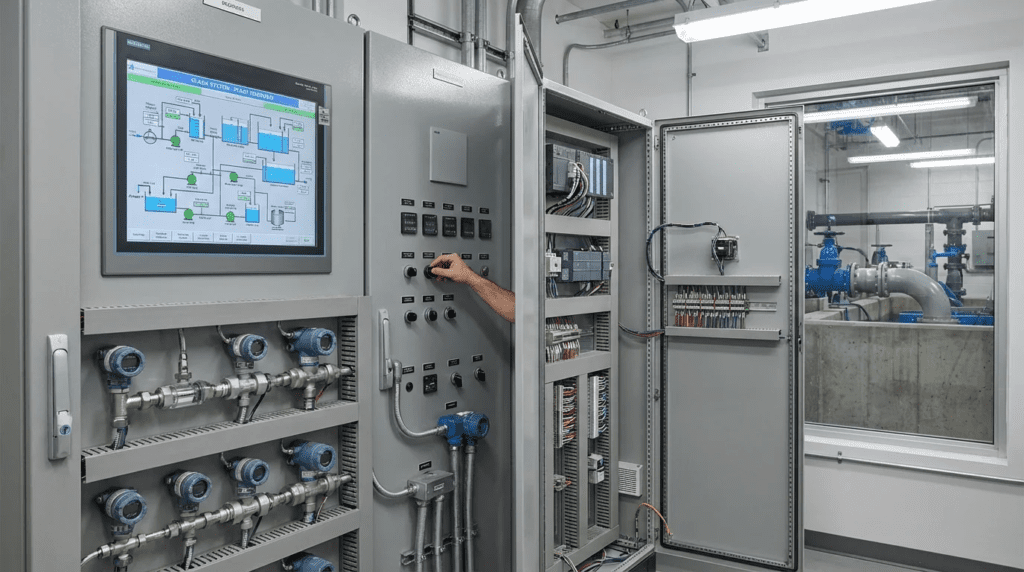
Introduction to Water Treatment Instrumentation & Controls: SCADA Sensors & Automation
One of the most frequent and costly failures in modern water infrastructure is not structural or mechanical—it is a failure of visibility. When an aeration blower consumes 40% more energy than required because a dissolved oxygen sensor has drifted, or when a remote lift station overflows because an aging radio telemetry link dropped a critical level alarm, the physical treatment processes remain sound, but the “nervous system” of the plant has failed. The integration of Water Treatment Instrumentation & Controls: SCADA Sensors & Automation is what transforms a collection of concrete tanks, pipes, and pumps into an intelligent, optimized, and compliant treatment facility.
This pillar page covers the vast and complex landscape of Water Treatment Instrumentation & Controls: SCADA Sensors & Automation. In municipal and industrial water and wastewater contexts, this discipline bridges multiple engineering fields—process, electrical, and systems engineering. The breadth of subtopics is immense, encompassing everything from primary sensing elements submerged in raw wastewater to the cloud-based historians tracking compliance data across a wide area network.
Proper understanding of this ecosystem matters because control system lifecycle costs are heavily weighted toward operations and maintenance (O&M). Specifying the wrong fieldbus protocol or applying the wrong sensing technology for highly fouling environments guarantees years of reactive troubleshooting. This article breaks down the major subcategories, equipment variants, control architectures, selection frameworks, and design standards required to specify, operate, and maintain robust water automation systems.
Subcategory Landscape — Types, Technologies & Approaches
The field of Water Treatment Instrumentation & Controls: SCADA Sensors & Automation can be conceptualized in layers. At the foundational layer are the analytical and physical sensors that measure process variables. These instruments feed data to the local control hardware (the “brains”), which actuate field devices (the “muscle”). Overseeing this entire process is the SCADA software and networking infrastructure. Engineers must navigate dozens of variants within these layers to build a cohesive automation strategy. The following subsections detail the critical subcategories that form this ecosystem.
Analytical Instruments: The Process “Eyes”
pH and ORP Sensors
pH and ORP Sensors are essential analytical instruments used to measure the acidity/alkalinity and the oxidation-reduction potential of water, respectively. They work by utilizing a glass measuring electrode and a reference electrode to detect the millivolt potential generated by hydrogen ion activity. These sensors are ubiquitous in applications ranging from industrial neutralization systems to municipal chlorination and odor control scrubbers. The key advantage of modern digital pH and ORP Sensors is their ability to store calibration data onboard and transmit diagnostics, though they are limited by the physical degradation of the glass bulb and reference junction over time. Engineers must carefully specify reference junction types (e.g., PTFE, ceramic) based on the presence of sulfides or heavy metals that can poison the sensor.
Dissolved Oxygen (DO) Sensors
Dissolved Oxygen (DO) Sensors measure the concentration of oxygen gas dissolved in water, a critical parameter for biological wastewater treatment (e.g., activated sludge) and environmental monitoring. Modern applications almost exclusively use luminescent optical DO technology, which measures the quenching effect of oxygen on a fluorescent dye, largely replacing older galvanic/polarographic sensors. Optical Dissolved Oxygen (DO) Sensors provide the massive advantage of not requiring flow past the sensor head and requiring vastly less maintenance (no membranes or electrolyte fluid to replace). However, they are sensitive to scratching and photobleaching over long periods. Accurate specification involves selecting appropriate mounting hardware—such as air-blast cleaning assemblies—for highly fouling biological environments.
Turbidity and Suspended Solids Monitors
Turbidity and Suspended Solids Monitors quantify water clarity and particle concentration by measuring the scattering or attenuation of light passed through a sample. Turbidimeters typically use 90-degree scatter (nephelometric) techniques for clean water applications like filter effluent, while total suspended solids (TSS) monitors use backscatter or transmission techniques for thick wastewater sludges. Turbidity and Suspended Solids Monitors are mandated by the EPA/AWWA for municipal drinking water compliance. The primary selection factor is the measuring range (typically 0-100 NTU for drinking water, up to 50,000 mg/L for sludge). They require routine calibration with primary standards (like Formazin) and are highly sensitive to air bubbles, necessitating bubble-trap assemblies in sample lines.
Chlorine and Residual Disinfectant Analyzers
Chlorine and Residual Disinfectant Analyzers continuously monitor the concentration of free or total chlorine, ozone, or chlorine dioxide in treated water to ensure biological safety and regulatory compliance. They primarily utilize either colorimetric (DPD reagent) methods or amperometric (membrane-covered electrode) technologies. DPD-based Chlorine and Residual Disinfectant Analyzers are highly accurate and EPA-approved for reporting but require consumable reagents and moving parts (pumps/valves). Amperometric sensors offer lower OPEX and faster response times but are highly dependent on stable pH and sample flow rates. Engineers must match the technology to the application: amperometric for real-time control loops, and DPD for final effluent compliance reporting.
Physical Measurement Transmitters
Magnetic Flow Meters
Magnetic Flow Meters (Magmeters) operate on Faraday’s Law of Electromagnetic Induction, measuring the velocity of a conductive fluid passing through a magnetic field. Because they feature a completely unobstructed flow tube, Magnetic Flow Meters are the industry standard for raw wastewater, primary sludge, and large-diameter municipal water mains. They offer extreme accuracy (typical ±0.2% to 0.5% of rate) and are unaffected by fluid density or viscosity. However, they are strictly limited to conductive fluids (typically >5 µS/cm) and cannot measure reverse osmosis (RO) permeate or hydrocarbon-based fluids. Specification requires careful selection of liner materials (e.g., PTFE, hard rubber) and electrode materials (e.g., Hastelloy, Titanium) to match fluid abrasiveness and corrosivity.
Ultrasonic and Coriolis Flow Meters
When magmeters are unsuitable, engineers turn to Ultrasonic and Coriolis Flow Meters. Ultrasonic meters (transit-time or Doppler) use sound waves to measure velocity and are frequently used as non-intrusive, clamp-on solutions for existing pipes or very large aqueducts. Coriolis meters measure true mass flow by detecting the microscopic twisting of a vibrating tube caused by the fluid’s inertia. While Ultrasonic and Coriolis Flow Meters serve different niches—ultrasonic for retrofits and large clean-water pipes, Coriolis for ultra-precise chemical dosing (e.g., polymer or sodium hypochlorite)—both offer solutions where conductivity is absent. Coriolis meters are expensive and limited in pipe size, while ultrasonic meters are highly sensitive to pipe wall condition and flow profile disturbances.
Ultrasonic and Radar Level Transmitters
Ultrasonic and Radar Level Transmitters provide non-contact continuous level measurement for tanks, wet wells, and open channels. Ultrasonic transmitters bounce high-frequency sound waves off the liquid surface, while radar transmitters use microwave pulses. Ultrasonic and Radar Level Transmitters are preferred for highly corrosive or fouling applications (like raw sewage wet wells) where contacting sensors would quickly fail. Radar is rapidly replacing ultrasonic technology because it is unaffected by temperature stratification, foam, wind, or heavy vapors, whereas ultrasonic signals can be absorbed or deflected by these conditions. Engineers must specify the correct beam angle and frequency (e.g., 80 GHz radar) to avoid false echoes from tank ladders or submersible pump cables.
Hydrostatic Pressure Transmitters
Hydrostatic Pressure Transmitters measure liquid level or line pressure by sensing the physical force exerted by the fluid on a sensing diaphragm (typically piezoresistive or capacitance-based). In water and wastewater, submersible Hydrostatic Pressure Transmitters are often dropped into boreholes, reservoirs, or lift stations as reliable, highly cost-effective level sensors. They are ideal for applications where foaming or heavy surface turbulence defeats non-contact radar/ultrasonic methods. The main limitation is that they contact the process fluid; therefore, in wastewater sludge or chemical tanks, they require large, flush-mounted isolation diaphragms (diaphragm seals) to prevent clogging. Proper specification includes defining the overpressure rating and the specific gravity of the fluid for accurate level calculation.
Control Hardware: The Process “Brains”
Programmable Logic Controllers (PLCs)
Programmable Logic Controllers (PLCs) are the robust, high-speed industrial computers that execute the real-time control logic in water treatment plants. They read inputs from sensors, execute algorithms (like PID loops), and drive outputs to actuators. Programmable Logic Controllers (PLCs) are used in virtually every unit process, from local pump skids to entire filtration galleries. They offer unparalleled modularity, processing speed (scan times in milliseconds), and the ability to handle thousands of I/O points. However, they require specialized programming (IEC 61131-3 languages like Ladder Logic) and are typically installed in environmentally controlled cabinets. Engineers must carefully size memory, I/O count, and processor speed while leaving a typical 20% spare capacity for future expansion.
Remote Terminal Units (RTUs)
Remote Terminal Units (RTUs) are specialized microprocessors designed specifically for remote, wide-area telemetry applications like municipal lift stations, elevated storage tanks, or well fields. Unlike PLCs, which are optimized for high-speed local control, Remote Terminal Units (RTUs) are optimized for harsh environments, low power consumption (often solar or battery-powered), and complex telecommunications (buffering data during network outages). They excel in DNP3 or Modbus telemetry networks over radio or cellular architectures. While blurring lines exist between modern PLCs and RTUs, traditional RTUs still hold a distinct advantage in remote, power-constrained locations, though they often lack the massive I/O handling capability of rack-based PLCs.
Distributed Control Systems (DCS)
Distributed Control Systems (DCS) offer a holistic, integrated architecture where the controller hardware, SCADA software, and network configuration are developed as a single unified system. Large-scale municipal water treatment plants and complex industrial wastewater facilities sometimes utilize Distributed Control Systems (DCS) instead of a piecemeal PLC/SCADA integration. The primary advantage is a single global database—when an engineer creates a pump object in the controller, it automatically populates in the HMI and historian. This drastically reduces integration engineering time and improves system-wide reliability. However, DCS architectures represent a high initial CAPEX and lock the facility into a single manufacturer’s ecosystem, reducing future competitive bidding options.
Edge Computing Devices
Edge Computing Devices represent the latest evolution in control architecture, bringing high-level data processing, analytics, and machine learning directly to the local control panel rather than sending raw data to a centralized server. In modern water systems, Edge Computing Devices are deployed to run predictive maintenance algorithms on critical assets—such as analyzing VFD harmonic signatures or pump vibration data—and only transmitting actionable insights to the central SCADA. This drastically reduces cellular bandwidth costs and latency. While powerful for advanced analytics and IoT integration, edge devices are not typically used for mission-critical deterministic control, which remains the domain of PLCs.
SCADA Software & Networking: The Process “Nervous System”
On-Premise SCADA Systems
On-Premise SCADA Systems consist of centralized servers located physically within the water treatment facility, running supervisory control and data acquisition software. This is the traditional model for municipal plants, offering total ownership and direct, hardwired control over the network infrastructure. On-Premise SCADA Systems provide maximum security against external internet-based threats by utilizing strict air-gaps or demilitarized zones (DMZs). The main drawback is the heavy IT burden on the municipality—requiring dedicated staff to manage server hardware lifecycles, Windows OS updates, database maintenance, and disaster recovery backups. Specifications must account for redundant server pairs (hot-standby configurations) for high availability.
Cloud-Based SCADA Architecture
Cloud-Based SCADA Architecture (or SCADA-as-a-Service) moves the supervisory servers and historians to off-site, vendor-managed data centers (e.g., AWS, Azure). This approach is rapidly gaining market share for distributed utilities, rural water districts, and industrial OEMs managing remote fleets. Cloud-Based SCADA Architecture eliminates the need for expensive on-site server rooms and shifts CAPEX to predictable OPEX subscriptions. It allows operators to securely view plant status on smartphones from anywhere. However, it requires a highly reliable internet connection; a loss of WAN connection means a loss of system visibility (though local PLCs maintain physical control). Cybersecurity in cloud SCADA relies heavily on encrypted VPN tunnels and MQTT protocols.
Human-Machine Interfaces (HMIs)
Human-Machine Interfaces (HMIs) are the physical screens and graphical user interface software that operators use to interact with the control system. They range from local 6-inch touchscreens on a UV disinfection skid to multi-monitor control room displays. Modern Human-Machine Interfaces (HMIs) in water treatment are shifting toward “High-Performance HMI” design standards (ISA-101), which utilize greyscale graphics and contextual analog indicators rather than distracting, brightly colored piping diagrams. The goal is situational awareness—allowing an operator to recognize an abnormal situation in seconds. When specifying HMIs for the plant floor, environmental ratings (NEMA 4X for washdown/corrosive areas) and sunlight readability are critical factors.
Historians and Data Logging Systems
Historians and Data Logging Systems are specialized, time-series databases optimized to ingest, compress, and store massive amounts of process data over decades. While standard relational databases (like SQL) struggle with millisecond-resolution process data, Historians and Data Logging Systems are built for exactly this purpose. They are critical for EPA/state regulatory reporting (e.g., proving that chlorine residual never dropped below limits), process optimization, and forensic troubleshooting after an upset. Key specification criteria include tag counts (how many individual data points are recorded), data compression algorithms (to save disk space), and integration capabilities with external reporting software.
Communication & Networking
Industrial Ethernet Architectures
Industrial Ethernet Architectures form the high-speed backbone of modern treatment plants, connecting PLCs, HMIs, and intelligent motor control centers using protocols like EtherNet/IP, PROFINET, or Modbus TCP. Unlike office networks, Industrial Ethernet Architectures utilize ruggedized switches, fiber-optic rings for electromagnetic immunity, and protocols that ensure deterministic (predictable) data delivery. Ring topologies, utilizing protocols like DLR (Device Level Ring) or RSTP (Rapid Spanning Tree Protocol), are universally specified to ensure network survival if a single fiber cable is severed. Careful management of network traffic (segmentation via VLANs) is required to prevent broadcast storms from crashing plant controls.
Wireless Telemetry Systems (Radio, Cellular, Satellite)
Wireless Telemetry Systems (Radio, Cellular, Satellite) connect remote infrastructure—lift stations, booster pumps, wellheads—to the central plant. Licensed UHF/VHF or 900MHz spread-spectrum radios provide owner-operated, OPEX-free communications but require clear line-of-sight and antenna masts. Cellular telemetry uses 4G/5G public networks, drastically reducing installation costs and overcoming line-of-sight issues, but introduces monthly data fees and carrier obsolescence risks (e.g., the 3G sunset). Satellite is reserved for the most remote, off-grid locations. Specifying Wireless Telemetry Systems (Radio, Cellular, Satellite) requires rigorous site path studies and understanding the required polling rates; radio supports sub-minute polling, while cellular may be tuned to slower intervals to save data costs.
Fieldbus Protocols (Modbus, Profibus, DNP3)
Fieldbus Protocols (Modbus, Profibus, DNP3) are the specific languages devices use to format and transmit data over a physical network. Modbus (RTU and TCP) remains the most common protocol due to its simplicity and universal vendor support, though it lacks built-in security. Profibus is frequently seen in legacy systems or European-designed equipment. DNP3 is the gold standard for water distribution telemetry because it features time-stamped, event-driven data buffering; if a remote site loses communication, the RTU stores data locally and uploads the exact history when the connection restores. Understanding the nuances of these Fieldbus Protocols (Modbus, Profibus, DNP3) is essential to prevent costly integration bottlenecks between mismatched vendors.
Actuation & Security
Variable Frequency Drives (VFDs)
Variable Frequency Drives (VFDs) are power electronics devices that control the speed and torque of AC electric motors by varying the input frequency and voltage. In water treatment, Variable Frequency Drives (VFDs) are essential for optimizing energy consumption in large centrifugal pumps and aeration blowers, often yielding 20-40% energy savings compared to throttling valves. Modern VFDs function as smart field devices, communicating comprehensive diagnostics (motor current, thermal load, fault codes) back to the PLC via industrial Ethernet. Specification must account for harmonic mitigation (e.g., 18-pulse drives or active front ends) to prevent power quality issues on the utility grid, as well as proper cooling in high-ambient-temperature electrical rooms.
Automated Valve Actuators
Automated Valve Actuators convert control signals into physical motion to open, close, or modulate valves. Electric actuators utilize motorized gearing and are ubiquitous for isolating large filter galleries and distribution mains, offering deep integration via fieldbus networks. Pneumatic actuators use compressed air and excel in rapid-acting applications or environments where fail-safe spring-return action is mandatory (e.g., chemical shutoff valves). Automated Valve Actuators require careful sizing based on valve torque requirements, breakaway friction, and duty cycle (modulating vs. strictly open/close). Incorporating absolute position encoders ensures the SCADA system knows the exact valve position even after a power failure.
Industrial Cybersecurity Solutions (OT Security)
Industrial Cybersecurity Solutions (OT Security) focus on protecting Operational Technology networks from cyber threats. Unlike IT security—which prioritizes data confidentiality—OT security prioritizes operational availability and process safety. With water infrastructure heavily targeted by threat actors, Industrial Cybersecurity Solutions (OT Security) utilize hardware firewalls, network segmentation (Purdue Model), asset inventory monitoring, and unidirectional gateways (data diodes). Compliance with AWWA guidelines and IEC 62443 standards is rapidly transitioning from best practice to regulatory mandate. Implementation requires careful balancing to ensure security measures do not impede emergency operational responses.
Selection & Specification Framework
Specifying Water Treatment Instrumentation & Controls: SCADA Sensors & Automation requires balancing lifecycle costs, operating environments, and the facility’s available technical skill. A poorly specified, overly complex system in a small rural plant can be just as problematic as an under-specified system in a major metropolitan facility.
Decision Logic and Sizing Criteria:
- Sensing Environment: For highly fouling wastewater environments, prioritize non-contact measurements (Ultrasonic and Radar Level Transmitters) and sensors without moving parts or membranes (optical Dissolved Oxygen (DO) Sensors). For clean, highly treated drinking water, more delicate technologies like Turbidity and Suspended Solids Monitors or DPD-based Chlorine and Residual Disinfectant Analyzers are appropriate.
- Flow Measurement Limitations: If the fluid is conductive and the pipe is full, Magnetic Flow Meters are the default choice. If retrofitting a large main without process shutdown is required, clamp-on Ultrasonic and Coriolis Flow Meters (specifically transit-time ultrasonic) provide the best path, assuming adequate straight-pipe runs exist.
- Control Architecture (Centralized vs. Distributed): For localized skids or single unit processes, Programmable Logic Controllers (PLCs) are standard. For geographically dispersed remote lift stations or wellfields, prioritize Remote Terminal Units (RTUs) combined with Wireless Telemetry Systems (Radio, Cellular, Satellite) running Fieldbus Protocols (Modbus, Profibus, DNP3) to ensure data integrity during communication drops. Large, Greenfield mega-plants may justify the heavy initial engineering of a unified Distributed Control Systems (DCS).
CAPEX vs. OPEX Tradeoffs:
Analytical instrumentation often dictates OPEX. An amperometric chlorine sensor may have a slightly higher CAPEX but drastically lower OPEX compared to a DPD analyzer that requires constant reagent replacement. Similarly, migrating to a Cloud-Based SCADA Architecture reduces initial IT hardware CAPEX but commits the facility to perpetual monthly subscription OPEX. Plant directors must align these costs with their funding models (e.g., capital grants vs. municipal operating budgets).
Common Specification Pitfalls:
A common engineer mistake is confusing the capabilities of IT network switches with industrial OT switches in Industrial Ethernet Architectures, leading to non-deterministic communication drops during broadcast storms. Another is failing to specify required chemical cleaning intervals or automated air-blast systems for sensors in raw sewage, leading to rapid baseline drift and lost operator trust.
Comparison Tables
The following tables provide an engineer-focused, quick-reference comparison across the diverse landscape of SCADA, instrumentation, and automation technologies. Table 1 maps out the primary subcategories, while Table 2 provides a matrix matching applications to the most appropriate technology.
Table 1: Subcategory Technology Comparison
| Type / Subcategory | Key Features | Best-Fit Applications | Limitations | Relative Cost | Maintenance Profile |
|---|---|---|---|---|---|
| pH and ORP Sensors | Millivolt potential measurement via glass electrode | Chemical dosing, scrubber control, pH neutralization | Glass bulb degrades; sensitive to coating | Low to Medium | High (frequent cleaning/calibration) |
| Dissolved Oxygen (DO) Sensors | Optical luminescent quenching technology | Aeration basins, activated sludge, effluent monitoring | Photobleaching over extended periods | Medium | Low (optical cap replacement ~1-2 yrs) |
| Magnetic Flow Meters | Faraday’s Law, unobstructed flow tube | Raw sewage, primary sludge, distribution mains | Requires conductive fluid (>5 µS/cm) | Medium to High | Very Low (no moving parts) |
| Ultrasonic and Radar Level Transmitters | Non-contact acoustic or microwave pulses | Wet wells, chemical tanks, clarifiers | Ultrasonic fails in heavy foam/vapor (use radar instead) | Medium | Low |
| Programmable Logic Controllers (PLCs) | High-speed, modular industrial computers | Plant-level control, complex unit processes, pump stations | Requires environmentally controlled cabinets | Medium to High | Low (firmware updates, battery checks) |
| Remote Terminal Units (RTUs) | Rugged, low-power telemetry controllers | Remote lift stations, off-grid wellheads | Lower I/O density than PLCs | Medium | Low |
| Cloud-Based SCADA Architecture | Off-site hosted servers and historians | Distributed rural districts, OEM skid fleets | Requires uninterrupted internet connection | Low CAPEX, High OPEX | Low IT burden on facility |
| Variable Frequency Drives (VFDs) | Controls AC motor speed/torque | Pumps, aeration blowers, centrifuges | Generates grid harmonics and heat | High | Medium (cooling fan/capacitor replacement) |
Table 2: Application Fit Matrix
| Application Scenario | Primary Subcategory Fit | Key Constraints & Dependencies | Operator Skill Requirement |
|---|---|---|---|
| Remote Off-Grid Lift Station | Remote Terminal Units (RTUs) & Wireless Telemetry Systems (Radio, Cellular, Satellite) | Power budget (solar), cellular coverage or radio Line-of-Sight | Basic mechanical, medium networking |
| Greenfield Mega-Plant (>100 MGD) | Distributed Control Systems (DCS) & On-Premise SCADA Systems | Massive initial capital; vendor lock-in; requires dedicated IT/OT staff | High (Dedicated Control Engineers) |
| Wastewater Aeration Control | Optical Dissolved Oxygen (DO) Sensors & Variable Frequency Drives (VFDs) | Requires air-blast cleaning assemblies for sensor heads to prevent bio-fouling | Medium process knowledge |
| Finished Water Compliance Reporting | DPD Chlorine and Residual Disinfectant Analyzers & Historians and Data Logging Systems | Strict EPA reporting formats; zero tolerance for data loss | High instrument maintenance skill |
| Large Diameter Main Retrofit | Clamp-on Ultrasonic and Coriolis Flow Meters | Requires adequate straight pipe (10D/5D); pipe lining must be sound | Medium (Acoustic coupling validation) |
Engineer & Operator Field Notes
Commissioning Considerations
Commissioning Water Treatment Instrumentation & Controls: SCADA Sensors & Automation is an iterative process requiring rigorous documentation. Across all instruments, “loop checks” are mandatory. A loop check verifies that a 4mA signal physically forced at the transmitter registers exactly as the zero-scale value on the Human-Machine Interfaces (HMIs), and 20mA registers as full scale. For analytical instruments like pH and ORP Sensors or Turbidity and Suspended Solids Monitors, wet commissioning must utilize certified primary buffer solutions or Formazin standards, rather than relying solely on electronic dry simulations. For communications, networks utilizing Industrial Ethernet Architectures must undergo stress-testing (packet storm simulation) to verify ring recovery times (typically sub-50 milliseconds for modern protocols) before the plant goes live.
Common Specification Mistakes
Engineers frequently over-specify accuracy while under-specifying repeatability and environmental robustness. A common error is specifying highly sensitive Hydrostatic Pressure Transmitters in raw sludge lines without specifying a large, flush-faced diaphragm seal, resulting in immediate clogging. In communications, a critical error is specifying raw Fieldbus Protocols (Modbus, Profibus, DNP3) for telemetry links without encrypting the radio or cellular layer, leaving the plant exposed to cyber threats. Additionally, failing to match the polling rate of On-Premise SCADA Systems to the bandwidth limits of remote Wireless Telemetry Systems (Radio, Cellular, Satellite) leads to network saturation and dropped alarms.
When specifying Programmable Logic Controllers (PLCs) and control panels, always mandate 20% spare, fully wired terminal blocks and 20% spare processor memory/I/O capacity. Treatment processes constantly evolve, and the cost of adding a single field device later is exponentially higher if a new PLC rack or larger cabinet is required.
O&M Comparison Across Subcategories
The operational burden varies wildly depending on the subcategory chosen. Magnetic Flow Meters and optical Dissolved Oxygen (DO) Sensors require virtually zero daily operator attention—an annual verification or cap replacement is typically sufficient. In contrast, wet-chemistry systems like DPD Chlorine and Residual Disinfectant Analyzers require monthly reagent replenishment and weekly calibration checks, demanding high operator discipline and significant consumable budgets.
From a systems perspective, traditional On-Premise SCADA Systems demand constant IT patching, database management, and antivirus updates, which often overwhelms smaller municipalities. Migrating to Cloud-Based SCADA Architecture shifts this maintenance burden to the software vendor. Mechanical components like Variable Frequency Drives (VFDs) and Automated Valve Actuators sit in the middle; they require scheduled preventative maintenance (greasing stems, changing VFD cooling fans every 3-5 years) but generally run unattended day-to-day.
The #1 cause of analog signal drift in water treatment is poor grounding. Tying the shields of 4-20mA instrumentation loops to ground at BOTH ends (the field device and the PLC panel) creates a ground loop. Shields must only be grounded at one end (typically the PLC panel) to prevent circulating currents from skewing the data.
Troubleshooting Overview
When investigating process anomalies, operators must distinguish between process failures and instrumentation failures. If a clarifier blanket level reads zero via Ultrasonic and Radar Level Transmitters, inspect for heavy surface foam (which absorbs ultrasonic waves) before replacing the sensor—switching to 80GHz radar often cures this permanently. If Human-Machine Interfaces (HMIs) report “Loss of Comms” for an entire remote wellfield, troubleshoot the master antenna alignment or cellular gateway of the Wireless Telemetry Systems (Radio, Cellular, Satellite) before assuming local controller failure. When dealing with variable frequency control, if a motor mysteriously trips on overvoltage, investigate the regenerative energy deceleration parameters in the Variable Frequency Drives (VFDs) rather than dismantling the motor.
Design Details & Standards
Sizing Methodology Overview
Sizing instrumentation and controls involves more than measuring pipe diameters. Flow measurement devices must be sized for velocity, not pipe size. For example, Magnetic Flow Meters should be sized so that normal operating flow creates a velocity between 3 to 10 feet per second (1 to 3 m/s). Sizing below 1 ft/s degrades accuracy significantly, while sizing above 15 ft/s causes premature liner wear. When sizing Automated Valve Actuators, the design engineer must calculate the maximum differential pressure across the valve to determine the “breakaway torque,” and specify an actuator with a safety factor of at least 1.25.
Key Design Parameters Dictated by Subcategory
The choice of control hardware fundamentally alters the electrical design. If specifying Remote Terminal Units (RTUs) at a solar-powered site, the entire loop power design must typically be engineered for 12VDC or 24VDC with micro-amp sleep modes. Conversely, if utilizing plant-wide Programmable Logic Controllers (PLCs), 120VAC power distribution to standard 24VDC bulk power supplies is the norm. Furthermore, when using Edge Computing Devices, local network bandwidth parameters at the panel level must be vastly increased (Gigabit speeds) compared to older serial networks.
Applicable Standards & Compliance
The design and specification of Water Treatment Instrumentation & Controls: SCADA Sensors & Automation is governed by several critical industry standards:
- ISA-101: Defines the standard for high-performance Human-Machine Interfaces (HMIs).
- IEC 62443 / ISA-99: The international gold standard for implementing Industrial Cybersecurity Solutions (OT Security) in control networks.
- UL 508A: The standard for the construction of industrial control panels housing PLCs and motor controls.
- AWWA Standards: Multiple standards govern water telemetry and instrumentation (e.g., AWWA C750 for transit-time flowmeters).
Specification Checklist
- Define fluid characteristics (temperature, pressure, conductivity, solids %).
- Identify the communication standard (e.g., Modbus TCP, EtherNet/IP) and ensure native support in both the instrument and the PLC.
- Specify the required hazardous area classifications (Class I, Div 1/2) for equipment in wastewater headworks or digesters.
- Detail the required data polling rates and historian archiving duration.
- Require factory acceptance testing (FAT) for all major control panels and software before site delivery.
Frequently Asked Questions (FAQ)
What are the different types of water treatment instrumentation and controls?
The main types include analytical instruments (pH and ORP Sensors, Dissolved Oxygen (DO) Sensors, Turbidity and Suspended Solids Monitors, Chlorine and Residual Disinfectant Analyzers), physical transmitters (Magnetic Flow Meters, Ultrasonic and Radar Level Transmitters, Hydrostatic Pressure Transmitters), and control hardware like Programmable Logic Controllers (PLCs) and Remote Terminal Units (RTUs). This entire ecosystem is managed by On-Premise SCADA Systems or Cloud-Based SCADA Architecture, utilizing Human-Machine Interfaces (HMIs) for visualization.
How do you choose between an RTU and a PLC for a pump station?
Choose Programmable Logic Controllers (PLCs) for local, high-speed control (e.g., multi-pump staging with VFDs) where power and environmental control are reliable. Choose Remote Terminal Units (RTUs) for remote sites with poor power reliability, solar installations, or where communication via Wireless Telemetry Systems (Radio, Cellular, Satellite) is intermittent, as RTUs excel at buffering data using Fieldbus Protocols (Modbus, Profibus, DNP3) like DNP3.
What is the most cost-effective SCADA solution for small municipal water plants?
For small, resource-constrained plants, a Cloud-Based SCADA Architecture is typically the most cost-effective. It drastically lowers upfront IT hardware CAPEX, removes the need to maintain on-site servers, and provides secure remote access out of the box. The trade-off is an ongoing subscription cost (OPEX) and a reliance on internet connectivity.
Why is radar level measurement replacing ultrasonic in wastewater?
Ultrasonic and Radar Level Transmitters both provide non-contact measurement, but radar (especially 80 GHz radar) is unaffected by temperature fluctuations, heavy condensation, wind, or the thick foam frequently found in wastewater wet wells. Ultrasonic signals are often absorbed or scattered by foam and vapor, leading to false level readings and potential pump station overflows.
How do Variable Frequency Drives (VFDs) save energy in water treatment?
Variable Frequency Drives (VFDs) save energy by slowing down the motor of a centrifugal pump or blower rather than running it at full speed and throttling the output with a valve. According to the affinity laws, reducing a pump’s speed by 20% can reduce its energy consumption by nearly 50%, resulting in massive OPEX savings over the equipment’s lifecycle.
How do you prevent cyber attacks on municipal water SCADA systems?
Securing infrastructure requires dedicated Industrial Cybersecurity Solutions (OT Security). This includes air-gapping or physically isolating control networks from enterprise IT networks via hardware firewalls (the Purdue Model), disabling unused ports on network switches within Industrial Ethernet Architectures, removing default passwords, and implementing continuous asset monitoring.
Conclusion
KEY TAKEAWAYS
- Physical sensors dictate process success. Match the technology to the fluid: use Magnetic Flow Meters for dirty, conductive wastewater, and Ultrasonic and Radar Level Transmitters for non-contact measurement.
- Control architecture dictates reliability. Use Programmable Logic Controllers (PLCs) for centralized, high-speed processing, and Remote Terminal Units (RTUs) for robust, wide-area telemetry.
- Software model dictates IT burden. On-Premise SCADA Systems offer total control but high IT maintenance; Cloud-Based SCADA Architecture shifts CAPEX to OPEX and simplifies remote access.
- Communication standards are critical. Verify compatibility between Fieldbus Protocols (Modbus, Profibus, DNP3) and the plant’s Industrial Ethernet Architectures early in the design phase.
- Never neglect security. Modern control systems mandate integrated Industrial Cybersecurity Solutions (OT Security) adhering to IEC 62443.
The vast landscape of Water Treatment Instrumentation & Controls: SCADA Sensors & Automation forms the intelligence of any modern water facility. Specifying this equipment requires a systematic approach that balances capital costs, operating expenses, environmental realities, and the technical aptitude of the operations staff. From the fundamental millivolt readings of a submerged pH sensor to the encrypted data packets traversing a cellular telemetry network, every component must operate in harmony to ensure continuous compliance and process efficiency.
Decision methodologies must center on standardizing technologies wherever possible to reduce spare parts inventory and operator training burdens. While foundational mechanical designs may last 50 years, automation life cycles are typically 10 to 15 years. Therefore, engaging specialized systems integrators during the conceptual design phase is crucial. By designing with open communication protocols, scalable architectures, and rigorous operational technology security, engineers can build resilient automation systems that safeguard public health and the environment for decades to come.