
Blowers Energy Optimization: Control Strategies That Reduce kWh Without Risk
INTRODUCTION
In municipal and industrial wastewater treatment, aeration accounts for an staggering 50% to 60% of total plant energy consumption. Despite this massive operational expenditure, many engineering designs still treat aeration as a brute-force process—over-supplying air to guarantee compliance with biological oxygen demand (BOD) and ammonia removal permits. The critical challenge engineers face today is bridging the gap between absolute process reliability and energy efficiency. Implementing Blowers Energy Optimization: Control Strategies That Reduce kWh Without Risk is not merely a sustainability initiative; it is a financial and operational imperative.
A surprising reality in the water sector is that upgrading to high-efficiency turbo blowers or variable frequency drives (VFDs) without addressing the overarching control logic often yields disappointing results. Engineers frequently specify premium-efficiency blowers, only to have operators run them in “Hand” mode or at artificially high constant pressure setpoints because the automated dissolved oxygen (DO) control loops are hunting, oscillating, or failing to respond to dynamic plant loads. When control strategies fail, operators intuitively—and correctly—prioritize effluent quality over energy savings, resulting in millions of wasted kilowatt-hours (kWh) over the equipment’s lifecycle.
This article provides a rigorous, specification-safe framework for municipal consulting engineers, utility decision-makers, and plant operators. We will detail how to integrate advanced process control—such as Most-Open-Valve (MOV) logic, cascade control, and feedforward ammonia-based aeration control (ABAC)—with modern blower technologies. By focusing on system curve dynamics, valve authority, instrumentation reliability, and precise tuning, this guide will help engineers specify and implement aeration control systems that guarantee permit compliance while mathematically minimizing the energy footprint.
HOW TO SELECT / SPECIFY
Specifying an aeration blower control system requires evaluating the entire pneumatic and biological ecosystem. Blowers Energy Optimization: Control Strategies That Reduce kWh Without Risk depends heavily on understanding the interactions between the blower performance map, the piping system resistance, the biological oxygen uptake rate (OUR), and the mechanical response of the flow control valves.
Duty Conditions & Operating Envelope
The foundation of any control strategy is defining the correct minimum, average, and peak aerodynamic duty conditions. Unlike pumps moving incompressible fluids, blowers move a compressible gas whose density changes radically with ambient temperature, barometric pressure, and relative humidity. Engineers must clearly delineate Standard Cubic Feet per Minute (SCFM) from Actual Cubic Feet per Minute (ACFM) or Inlet Cubic Feet per Minute (ICFM).
- Flow Rates: Define the biological air demand for the 10-year or 20-year design horizon, but critically evaluate the Day 1 minimum flow. High-efficiency centrifugal blowers typically have a turndown ratio of only 40% to 50% from their design point before hitting the surge limit line.
- Pressures: Discharge pressure consists of static head (diffuser submergence) plus dynamic friction losses (piping, valves, and diffusers). Remember that diffuser fouling over time increases dynamic pressure, shifting the system curve upward.
- Operating Modes: Determine if the system is continuous (typical activated sludge) or intermittent (Sequencing Batch Reactors). Intermittent processes require control strategies that can handle rapid, massive swings in air demand without causing blower surge or header pressure collapse.
Materials & Compatibility
While blowers handle atmospheric air, the environmental conditions and system interfaces dictate strict material specifications. Upstream of the blower, intake filters must be robust enough to handle local particulate loads (e.g., agricultural dust, industrial emissions). Downstream, the heat of compression demands careful material selection. Typical discharge temperatures can exceed 200°F (93°C) depending on the compression ratio. Therefore, thermal mass flow meters, DO sensors, and process control valves must be rated for the operating environment. Control valve seats and seals (often EPDM or specialized elastomers) must withstand continuous high temperatures without degrading or causing valve stiction, which ruins precise control.
Hydraulics & Process Performance
The success of automated control relies entirely on the intersection of the blower performance curve and the system resistance curve. For dynamic blowers (centrifugal, turbo, integrally geared), the pressure-flow curve is relatively flat. A small change in header pressure requires a massive change in air flow. Control strategies must account for:
- Surge Limits: The minimum flow point at a given pressure where aerodynamic stall occurs. Operating below this risks catastrophic mechanical failure.
- Choke Limits: The maximum flow the blower can produce at a given speed.
- Wire-to-Air Efficiency: True efficiency must be measured from the electrical power input to the VFD, through the motor, and into the air stream (often verified via ASME PTC 13 standards).
Installation Environment & Constructability
Precision control requires precision measurement. Thermal mass flow meters, standard in aeration header control, require specific upstream and downstream straight-pipe diameters to ensure laminar flow. Specifying a state-of-the-art MOV control logic will fail if the flow meters are installed immediately downstream of a 90-degree elbow, leading to noisy, inaccurate feedback to the PLC. Additionally, electrical harmonics from high-speed VFDs must be mitigated via line reactors or active harmonic filters to ensure clean power to sensitive SCADA instrumentation.
Reliability, Redundancy & Failure Modes
When engineering Blowers Energy Optimization: Control Strategies That Reduce kWh Without Risk, the “Without Risk” mandate requires comprehensive failure mode analysis. If a DO sensor fouls, the control loop must have a “fallback” strategy—typically defaulting to a predefined conservative airflow rate rather than shutting off air entirely. Redundancy typically follows an N+1 or N+2 configuration for blowers. However, control system redundancy is equally critical. Specify hardwired safeties for critical faults (high vibration, high temperature, surge) that bypass the PLC, ensuring the blower protects itself independently of network health.
When multiple centrifugal blowers discharge into a common header without a master control panel (MCP) properly sequencing them, they can “fight” each other. If Blower A ramps up, it increases header pressure, which can push Blower B toward its surge line. Specifications must mandate a centralized Master Control Panel that coordinates speed and starts/stops based on total system demand.
Controls & Automation Interfaces
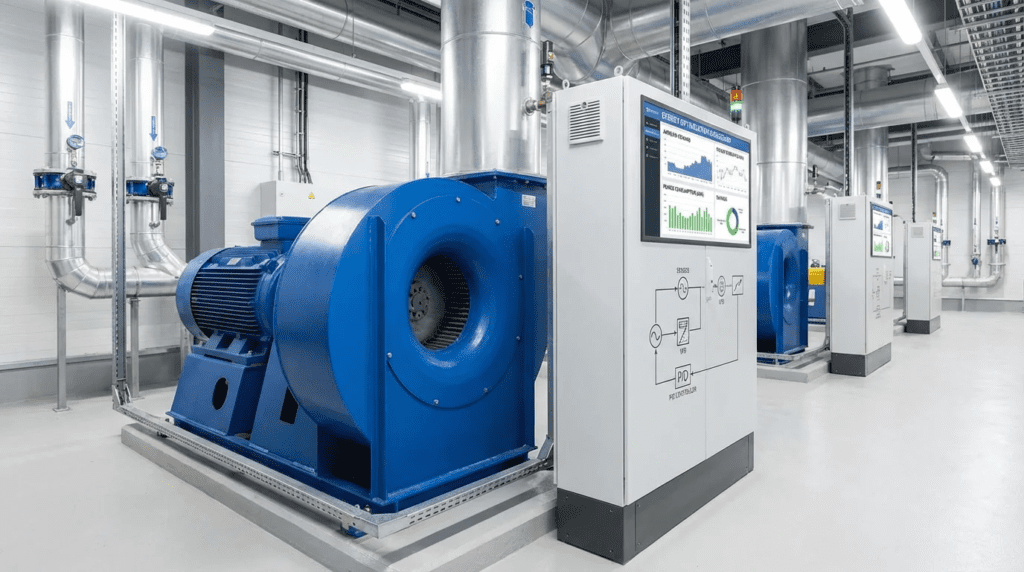
The cornerstone of energy optimization is the control architecture. The industry standard has evolved to a Cascade Control Loop:
- Process Loop: Compares the DO setpoint to the actual DO measurement in the basin, outputting an Airflow Setpoint (SCFM).
- Airflow Loop: Compares the Airflow Setpoint to the actual airflow meter reading, adjusting the position of the basin control valve.
- Header Pressure Loop: As valves open or close, header pressure fluctuates. The Master Control Panel monitors header pressure and adjusts blower speed (via VFD) or inlet guide vanes (IGVs) to maintain the required pressure.
To truly minimize kWh, the Header Pressure Loop is dynamic, utilizing Most-Open-Valve (MOV) logic (detailed further in the Design section) rather than a fixed setpoint.
Maintainability, Safety & Access
Control systems degrade without maintenance. Optical DO sensors require regular wiping (or automated air-blast cleaning) and calibration checks. Control valves require actuator inspection to prevent stiction. Specifications should ensure that all instrumentation is easily accessible via catwalks or handrails. Pulling a DO probe from a 20-foot deep aeration basin should not require a harness and a crane. If it is difficult to maintain, operators will bypass the automated control, destroying the energy optimization strategy.
Lifecycle Cost Drivers
A Total Cost of Ownership (TCO) analysis over a typical 20-year lifecycle reveals that capital expense (CAPEX) for blowers and control panels represents only 10% to 15% of the total cost. Energy consumption (OPEX) represents 75% to 85%. Therefore, investing heavily upfront in premium control architectures, characterized flow valves, and redundant optical DO sensors yields a massive Return on Investment (ROI). Saving just 1 psi (approx. 6.89 kPa) of unnecessary header pressure can reduce blower energy consumption by 4% to 8% depending on the specific machine’s adiabatic efficiency.
COMPARISON TABLES
The following tables provide an objective, manufacturer-agnostic comparison of common aeration control strategies and an application fit matrix to assist engineers in selecting the optimal control architecture based on plant constraints.
| Control Strategy | Operational Logic / Features | Best-Fit Applications | Limitations / Risks | Energy Efficiency Potential |
|---|---|---|---|---|
| Manual Constant Speed | Operators manually adjust blower inlet valves or discharge blowoff to manage air. | Very small package plants, lagoons without strict DO limits. | Severely over-aerates during low-load periods. High risk of permit violation if loads spike. | Poor (Baseline) |
| Constant Header Pressure | PID loop maintains a fixed static pressure in the main air header (e.g., 7.5 psig). Basin valves open/close based on DO. | Mid-sized plants, retrofits where PLC capabilities are limited. | Forces blowers to maintain artificially high pressure even when demand is low, wasting energy across throttled valves. | Fair (10-15% savings vs manual) |
| Most-Open-Valve (MOV) Logic | Dynamic header pressure. PLC monitors all basin valves and lowers header pressure until at least one valve is 85-95% open. | Large municipal BNR facilities, systems with highly variable diurnal loads. | Requires precise valve authority (linear flow characteristics) and highly tuned PID loops to prevent oscillation. | Excellent (20-30% savings vs manual) |
| Ammonia-Based Aeration Control (ABAC) | Feedforward/Feedback logic. Adjusts the DO setpoint dynamically based on influent/effluent NH4 levels, then uses MOV logic. | Strict total nitrogen limit plants, advanced nutrient removal facilities. | Requires robust, expensive Ion Selective Electrode (ISE) or optical nutrient sensors. High maintenance burden for sensors. | Maximum (30-45% savings vs manual) |
| Plant Scenario | Recommended Blower Type | Optimal Control Strategy | Key Constraint / Decision Factor | Relative CAPEX |
|---|---|---|---|---|
| < 1 MGD Municipal (Low Skill) | Positive Displacement (Rotary Lobe or Screw) | Simple DO-to-Speed Control (No header valves) | Operator bandwidth is low. Complex PID loops will likely be bypassed. Keep it simple and robust. | Low |
| 1 – 10 MGD Municipal BNR | High-Speed Turbo or Integrally Geared Centrifugal | Cascade DO with MOV Logic | Energy savings justify the complexity. Requires master control panel to manage surge lines and staging. | Medium-High |
| > 20 MGD Advanced Facility | High-Speed Turbo (Multiple sizes for turndown) | ABAC + MOV Logic + Peak Shaving | Stringent nutrient limits require real-time NH4 tracking. Full SCADA integration required. | High |
| Industrial (High BOD Swings) | Variable Speed Rotary Screw | Direct Flow Control (Constant DO is secondary) | Extreme load swings can surge dynamic blowers. Positive displacement ensures flow regardless of pressure changes. | Medium |
ENGINEER & OPERATOR FIELD NOTES
Implementing advanced blower optimization looks perfect on an engineering P&ID, but field execution is where energy savings are actually realized or lost. Operators and commissioning engineers must focus on tuning, mechanical realities, and continuous maintenance to sustain performance.
Commissioning & Acceptance Testing
Commissioning an advanced aeration control system is not a single-day event; it is an iterative process. Critical checkpoints include:
- Factory Acceptance Testing (FAT): Require a simulated FAT where the Master Control Panel is connected to a PLC simulator. Inject false DO and airflow values to verify the MOV logic reacts correctly. Verify that blower staging (turning Blower 2 on, slowing Blower 1 down) occurs smoothly without pressure spikes.
- Site Acceptance Testing (SAT): In the field, test the surge protection. While operating at minimum design flow, slowly close a manual discharge valve to force a pressure rise. Ensure the blower’s internal control panel senses the impending surge, opens the blow-off valve, and alarms the SCADA system.
- Valve Stroke Timing: Control loops will hunt if a valve takes 2 minutes to open but the PID loop expects a response in 30 seconds. Actuator speeds must be matched to the tuning parameters.
Common Specification Mistakes
One of the most frequent errors in bidding documents is completely ignoring valve authority. Engineers often specify standard butterfly valves sizing them to the exact diameter of the air header (e.g., 12-inch header, 12-inch valve). A standard butterfly valve passes roughly 70-80% of its total flow capacity in the first 30 to 40 degrees of its 90-degree travel. This non-linear Cv curve means that when the PLC asks for a 5% increase in air, the valve opens slightly and delivers a 25% increase. The DO spikes, the valve slams shut, and the blower surges. Always specify characterized valves (iris, V-port, or specialized butterfly designs) sized specifically for the flow rate, not the pipe diameter, to ensure linear control.
O&M Burden & Strategy
To maintain the benefits of Blowers Energy Optimization: Control Strategies That Reduce kWh Without Risk, the instrumentation must be pristine.
- DO Sensors: Luminescent/Optical DO sensors are industry standard, but they still experience biological fouling. Establish a weekly or bi-weekly PM to physically wipe the sensors, or specify automated air-blast cleaning systems.
- Filter Maintenance: Blower inlet filters create pressure drops. A fouled filter shifts the blower’s operating point, forcing the motor to work harder. Monitor differential pressure across the inlet filter and replace at the manufacturer’s recommended WC (inches of water column) limit.
- Actuator Health: Perform quarterly visual inspections of valve actuators to ensure they are not hunting (constantly micro-adjusting), which burns out actuator motors.
If operators are constantly placing the blowers in “Hand” (manual) mode, do not blame the operators. This is the primary symptom of a poorly tuned PID loop or a failing DO sensor. Operators bypass automation when it threatens process stability. Investigate sensor drift, valve stiction, and loop tuning parameters before assuming operator error.
Troubleshooting Guide
When the control system becomes unstable, follow a systemic diagnostic approach:
- Symptom: Header pressure oscillates wildly.
Root Cause: PID loops for the basin flow valves and the blower header pressure are fighting.
Fix: Decouple the tuning. The blower pressure loop should be tuned fast (respond in seconds), while the basin DO/flow loops should be tuned slow (respond in minutes). - Symptom: Blower frequently goes into blow-off or surges at night.
Root Cause: Plant biological load drops off, and minimum required airflow is below the blower’s minimum turndown capability.
Fix: If you lack a smaller “pony” blower, you must artificially increase demand or allow the DO setpoint to rise slightly during low-flow periods, acknowledging some energy waste to protect the equipment.
DESIGN DETAILS / CALCULATIONS
Rigorous engineering design is required to translate theoretical energy savings into a functional system. The following details govern the sizing logic and specification of modern aeration control.
Sizing Logic & Methodology
The calculation of blower power highlights exactly why Most-Open-Valve (MOV) logic saves so much energy. The adiabatic power required by a blower can be approximated by:
Power (HP) ∝ (Inlet Flow × Inlet Pressure) × [ (Discharge Pressure / Inlet Pressure)^0.283 – 1 ] / Efficiency
Because Discharge Pressure is raised to a power, reducing it yields disproportionate energy savings. If a system requires 7.0 psi to overcome static head and diffuser friction, but the header pressure is artificially maintained at 8.5 psi to ensure adequate valve differential, 1.5 psi is wasted continuously.
Step-by-Step MOV Implementation Logic:
- The PLC continuous polls the position feedback (0-100% open) of all basin control valves.
- The logic identifies the valve with the highest percentage open (the “Most Open Valve”).
- If the MOV is less than 85% open, the header pressure setpoint is decremented by a small amount (e.g., 0.1 psi) after a time delay. This forces the valves to open wider to maintain their required flow.
- If the MOV exceeds 95% open, the header pressure setpoint is incremented by a small amount (e.g., 0.15 psi) to ensure the valve does not lose control authority (starve for air).
- Critical Safety Factor: Establish hard upper and lower limits for the header pressure setpoint (e.g., Min 6.8 psi, Max 8.5 psi) to prevent the logic from crashing the system.
Specification Checklist
To ensure a watertight bidding process, incorporate these mandatory items into the project specifications (typically Division 40 Process Integration or Division 43 Gas Handling Equipment):
- Performance Guarantees: Demand wire-to-air efficiency guarantees per ASME PTC 13. Do not accept bare-shaft or aerodynamic-only efficiency claims.
- Open Architecture: Require all PLCs and Master Control Panels to use open-source, non-proprietary programming (e.g., standard IEC 61131-3 languages) accessible to the municipality. Require open communication protocols like Modbus TCP/IP or EtherNet/IP.
- Instrumentation Spacing: Explicitly specify the required upstream and downstream straight-pipe diameters for flow meters on the P&ID and mechanical drawings.
- Valve Flow Coefficients (Cv): Require submittals for control valves to include Cv curves demonstrating linear flow response from 20% to 80% of travel.
Standards & Compliance
Engineers must ensure compliance with relevant industry standards. ASME PTC 13 (Wire-to-Air Performance Test Code for Blower Systems) is the gold standard for verifying actual energy consumption. It accounts for all losses: VFD harmonics, motor inefficiency, mechanical transmission, and aerodynamic compression. Additionally, refer to WEF Manual of Practice (MOP) 32: Energy Conservation in Water and Wastewater Facilities for consensus best practices on DO control and aeration system design. Electrical enclosures should meet NEMA 4X for corrosive environments (e.g., hydrogen sulfide exposure) or NEMA 12 for clean, climate-controlled electrical rooms.
FAQ SECTION
What is the typical turndown ratio for a centrifugal aeration blower?
High-efficiency turbo and integrally geared centrifugal blowers typically offer a turndown ratio of 40% to 50% from their design operating point before hitting the surge limit. For example, a blower rated for 2,000 SCFM can usually turn down to roughly 1,000 to 1,200 SCFM. Plant designs requiring wider flow variations must use multiple blowers of varying sizes (e.g., a “pony” blower) to handle low-demand periods efficiently.
How does Most-Open-Valve (MOV) logic actually save energy?
MOV logic saves energy by continuously minimizing the discharge pressure the blower must produce. Instead of forcing the blower to maintain a high, fixed header pressure (which causes the basin valves to throttle and waste energy via pressure drop), MOV logic lowers the header pressure until the most demanding basin valve is nearly wide open (typically 85-95%). By reducing the discharge pressure (often by 0.5 to 1.5 psi), the blower’s motor draws significantly less amperage, reducing kWh without impacting biological treatment.
What is the difference between SCFM, ACFM, and ICFM when specifying blowers?
SCFM (Standard Cubic Feet per Minute) refers to air mass normalized to standard conditions (typically 68°F, 14.7 psia, 36% relative humidity). ACFM (Actual CFM) or ICFM (Inlet CFM) refers to the actual volume of air entering the blower at site-specific conditions. Because air expands when hot or at high elevations, 1,000 SCFM of biological oxygen demand might require the blower to move 1,150 ICFM on a hot summer day in Denver. Engineers must specify both to ensure proper aerodynamic sizing.
Why do automated DO control loops frequently “hunt” or oscillate?
Hunting usually occurs due to one of three reasons: 1) Over-sized standard butterfly valves that lack linear control (valve authority), causing massive flow changes with tiny actuator movements; 2) Overlapping PID tuning where the blower pressure loop and the basin flow loop react at the same speed and fight each other; or 3) Physical delays in the system, such as placing the DO sensor in a zone with poor mixing, resulting in a delayed feedback signal to the PLC.
What are the critical maintenance tasks for an aeration control system?
The control system’s accuracy relies entirely on clean instrumentation. Typical maintenance includes wiping optical DO sensors every 1-2 weeks (if not equipped with auto-cleaners), validating thermal mass flow meters against portable pitot tubes annually, monitoring and replacing blower inlet air filters based on differential pressure, and visually inspecting control valve actuators quarterly to ensure smooth, non-jerky movement.
Is it worth implementing Ammonia-Based Aeration Control (ABAC)?
ABAC is highly recommended for mid-to-large facilities facing strict total nitrogen limits or highly variable influent nitrogen loads. By using ammonia sensors to trim the DO setpoint, ABAC prevents over-aeration during low-load periods while guaranteeing nitrification during peaks. However, it requires a higher capital investment and stricter maintenance protocols for the ion-selective or optical ammonia sensors compared to standard DO control.
CONCLUSION
- System over Equipment: Buying a high-efficiency turbo blower without a dynamic control strategy (like MOV) will waste significant energy across throttled valves.
- Valve Authority is Critical: Never specify standard butterfly valves sized to the header diameter for DO flow control. Use characterized valves (iris, V-port) sized for the specific flow range to ensure linear response.
- Decouple Tuning Loops: To prevent system oscillation, tune the blower header pressure loop to react quickly, and the basin DO/flow loops to react slowly.
- Demand PTC 13 Verification: Always specify wire-to-air efficiency guarantees per ASME PTC 13 to capture the true total power consumption (VFD, motor, and blower).
- Design for Extremes: Size the aerodynamics (ICFM) for the hottest, highest-humidity summer day, but ensure the turndown logic can handle cold winter nights at low loads without surging.
When applying Blowers Energy Optimization: Control Strategies That Reduce kWh Without Risk, engineers and plant managers must view the aeration process as a highly interdependent, dynamic ecosystem. The days of simply dropping a high-efficiency blower into an existing constant-pressure network and expecting miraculous energy reductions are over. True optimization requires a meticulous alignment of aerodynamic limitations, mechanical valve characteristics, biological process times, and advanced algorithmic control.
To successfully reduce kWh without introducing process risk, the design framework must prioritize robust instrumentation and graceful failure modes. Utilizing Cascade Control combined with Most-Open-Valve logic represents the current industry best practice, offering 20% to 30% energy savings over legacy manual or constant-pressure systems. However, these systems demand precise factory and site acceptance testing, as well as an ongoing commitment from operations staff to maintain sensor cleanliness and actuator health.
Ultimately, balancing these competing requirements—capital cost, control complexity, operational bandwidth, and energy savings—dictates the success of the project. For straightforward retrofits, cascade DO control may suffice. For massive municipal BNR facilities, integrating feedforward ammonia algorithms offers the highest operational ceiling. By standardizing on open communication protocols, linear control valves, and wire-to-air efficiency testing, engineers can confidently design aeration systems that relentlessly drive down energy costs while maintaining unbreakable compliance.