
Evoqua vs ClearStream Environmental for Clarification: Pros/Cons & Best-Fit Applications
Introduction
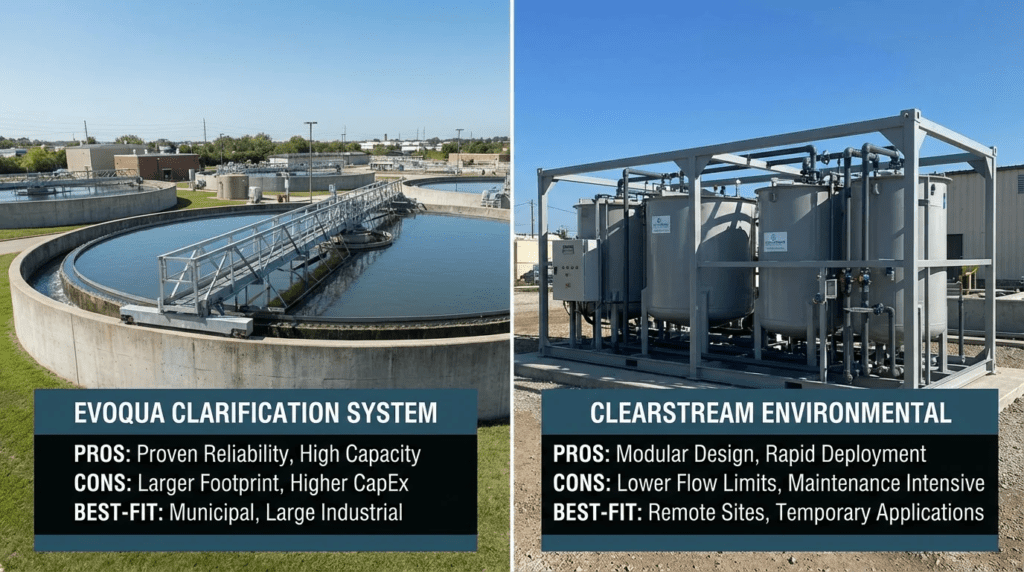
Clarification remains the ubiquitous workhorse of municipal and industrial wastewater treatment, yet the specification of clarifier mechanisms is frequently reduced to a “copy-paste” exercise from previous projects. This oversight often leads to substantial long-term consequences: hydraulic instability, premature drive failure, and chronic solids carryover that threatens permit compliance. In the United States market, two names frequently appear in competitive bids: Evoqua (now part of Xylem) and ClearStream Environmental. While both manufacturers provide functional equipment, they represent distinct engineering philosophies regarding structural robustness, hydraulic design, and drive train configuration.
Evoqua, inheriting the legacy of Envirex, Rex Chainbelt, and Link-Belt, commands a massive installed base and proprietary technologies like the Tow-Bro® hydraulic suction system. Conversely, ClearStream Environmental has carved a significant market share by addressing common operator complaints regarding legacy designs—specifically targeting heavier steel fabrication, simplified maintenance access, and robust drive integration. For the consulting engineer or plant director, the choice between Evoqua vs ClearStream Environmental for Clarification: Pros/Cons & Best-Fit Applications is not merely about brand preference but about aligning equipment characteristics with specific process risks and lifecycle goals.
This article provides an objective, technical analysis of these two manufacturers. It dissects their approaches to primary and secondary clarification, explores the nuances of drive torque specifications, and offers a decision framework for engineers tasked with selecting the optimal mechanism for their specific hydraulic and solids loading conditions.
How to Select / Specify
When evaluating clarifier mechanisms, the “or equal” clause in a specification can be a source of significant risk. To effectively compare Evoqua and ClearStream, engineers must move beyond the brochure and evaluate the equipment against rigorous performance criteria. The following selection parameters are critical for defining the operating envelope.
Duty Conditions & Operating Envelope
The first step in differentiation is defining the hydraulic and solids loading regimes. Primary clarifiers typically handle heavier, inorganic solids requiring high torque capabilities to prevent mechanism stalling during storm flows or sludge blanket spikes. Secondary clarifiers, particularly in biological nutrient removal (BNR) processes, handle lighter, flocculent solids where hydraulic quiescence is paramount to prevent shearing.
Engineers must specify the peak instantaneous flow and the maximum solids loading rate (SLR). Evoqua’s legacy designs often utilize standardized sizing charts based on decades of empirical data, which can be advantageous for standard municipal applications. ClearStream typically emphasizes custom fabrication capabilities, allowing for heavier plow designs or larger suction headers in high-solids applications. If the facility anticipates significant fluctuations in Mixed Liquor Suspended Solids (MLSS), the mechanism’s ability to clear a rapid blanket rise without short-circuiting is the deciding factor.
Materials & Compatibility
Corrosion is the primary enemy of clarifier longevity. While 304 or 316 stainless steel is increasingly common for wetted parts, many projects still rely on coated carbon steel due to budget constraints. The specification must explicitly detail the coating systems and surface preparation (SP-10 near-white metal blast) if carbon steel is used.
A key differentiator in Evoqua vs ClearStream Environmental for Clarification: Pros/Cons & Best-Fit Applications lies in the structural member sizing. ClearStream often markets the use of heavier wall thicknesses and larger structural shapes as a standard, aiming to reduce deflection and extend coating life by minimizing flexure-induced cracking. Evoqua’s designs are highly engineered to meet stress requirements efficiently; however, this “efficiency” can sometimes result in lighter structural members that, while structurally sound, may offer less corrosion allowance over a 30-year lifecycle. Engineers should specify minimum member thicknesses and section moduli to level the playing field.
Hydraulics & Process Performance
The efficiency of a clarifier is determined by its ability to dissipate inlet energy and remove sludge uniformly. This involves two critical components: the Energy Dissipating Inlet (EDI) and the sludge removal mechanism (scraper vs. suction).
- Inlet Dynamics: Both manufacturers offer flocculating wells and EDIs. Evoqua utilizes the FEDWA baffle system in many designs to optimize flow distribution. ClearStream offers similar baffled inlets but often provides larger, deeper floc wells as standard to maximize flocculation time.
- Sludge Removal: For secondary clarification, rapid sludge removal is critical to prevent denitrification (rising sludge). Evoqua’s Tow-Bro® is the industry benchmark for hydraulic suction, using a unitary header. ClearStream’s equivalent hydraulic suction headers are designed with distinct orifice sizing strategies. The engineer must evaluate the head loss curves provided by each manufacturer to ensure the return activated sludge (RAS) pumps can maintain desired withdrawal rates at low tank levels.
Installation Environment & Constructability
Retrofit applications present unique challenges regarding existing concrete geometry. If the existing tank has a steep floor slope (e.g., 1:12) or an unusual center pier configuration, constructability becomes a major differentiator. ClearStream has built a reputation on flexibility in retrofit fabrication, often customizing the center cage and drive mount to accommodate existing anchor bolt patterns or varying pier heights without extensive concrete demolition.
Evoqua generally relies on standard product lines. While they can customize, their strength lies in new construction where standard civil dimensions are used. For installation, engineers should evaluate the shipping splits. Mechanisms that require extensive field welding versus bolted field splices will have different installation costs and quality control requirements.
Reliability, Redundancy & Failure Modes
The drive unit is the most critical mechanical component. Specifications must define the AGMA (American Gear Manufacturers Association) service factor and the specific torque rating—Continuous Running Torque, Alarm Torque, and Cut-out Torque.
Pro Tip: Do not simply specify “heavy duty.” Specify a minimum L10 bearing life (e.g., 100,000 hours) and a worm gear service factor of 1.25 or 1.5. ClearStream frequently highlights their use of cast iron housings and precision bearing arrangements as superior to some lighter-duty options. Evoqua offers a range of drives, from standard duty to severe duty; ensuring the spec calls for the correct tier is essential to avoid under-sizing.
Controls & Automation Interfaces
Modern clarification requires integration with SCADA for torque monitoring and RAS flow pacing. Both vendors provide local control panels. The differentiation lies in the torque protection mechanism. Traditional shear pins offer physical protection but require manual replacement. Electronic load monitoring is now standard. Engineers should verify that the supplied control panel provides a 4-20mA output for torque, allowing operators to see trending drag loads before a high-torque alarm trips.
Lifecycle Cost Drivers
The Total Cost of Ownership (TCO) analysis must include energy (minimal for clarifier drives), maintenance labor, and replacement parts. Evoqua, being a large OEM, has an extensive parts network but is often associated with higher proprietary part costs. ClearStream uses many COTS (Commercial Off-The-Shelf) components for bearings and seals where possible, which can lower long-term O&M costs. However, Evoqua’s process guarantees and widespread service tech availability can offset this premium for risk-averse utilities.
Comparison Tables
The following tables provide a direct comparison to assist engineers in evaluating Evoqua vs ClearStream Environmental for Clarification: Pros/Cons & Best-Fit Applications. Table 1 focuses on the manufacturer attributes, while Table 2 provides a matrix for application suitability.
Table 1: Manufacturer & Technology Comparison
| Feature / Attribute | Evoqua (Xylem) | ClearStream Environmental | Engineer’s Notes |
|---|---|---|---|
| Primary Mechanism Technology | Tow-Bro® (Suction), RIM-FLO, Standard Scrapers | Hydra-Logic (Suction), Heavy Duty Scrapers, Warm-Wall | Evoqua holds the legacy patent lineage; ClearStream focuses on structural reinforcement of similar concepts. |
| Drive Unit Construction | Varied ranges (Light to Severe Duty); Cast iron and fabricated steel options. | Standardizes on heavy-duty cast iron housings; often uses solid alloy gears. | ClearStream drives often exceed minimum AGMA specs in standard bids; Evoqua must be spec’d carefully to ensure heavy-duty selection. |
| Sludge Removal (Secondary) | Unitary header (Tow-Bro) is the industry standard for rapid removal. | Tapered header designs with variable orifice sizing for balanced withdrawal. | Both effective; check head loss calculations for RAS pump compatibility. |
| Retrofit Capability | Good, but often prefers standard civil modifications. | Excellent; specializes in “drop-in” replacements for odd geometries. | ClearStream is often preferred for complex rehabs with non-standard tank dimensions. |
| Maintenance Philosophy | OEM parts focus; extensive service network. | Focus on accessible components and standard industrial parts where possible. | Consider supply chain preference; Evoqua has global reach, ClearStream has simpler sourcing. |
| Center Column/Pier | Structural steel or concrete pier designs. | Often uses drill-pipe shaft construction for high torque rigidity. | Drill pipe center shafts (ClearStream) offer high resistance to twisting in high-torque events. |
Table 2: Application Fit Matrix
| Application Scenario | Recommended Manufacturer/Approach | Key Decision Factors |
|---|---|---|
| Large Metro Secondary Treatment (>50 MGD) | Evoqua (Tow-Bro) | Proven track record at massive scale; hydraulic modeling database supports performance guarantees for critical permits. |
| Primary Clarification (High Grit/Loading) | ClearStream or Evoqua Heavy Duty | Requires massive torque. ClearStream’s standard heavy structural design is advantageous for handling grit spikes. |
| Cold Climate / Freezing Issues | ClearStream (Warm-Wall) | ClearStream markets a specific “Warm-Wall” clarifier design to prevent peripheral icing, a distinct advantage in northern tiers. |
| Clarifier Retrofit (Existing Tanks) | ClearStream | Flexibility in fabrication allows for adaptation to out-of-square tanks or non-standard floor slopes without major civil work. |
| Industrial Wastewater (Variable Loading) | Either (Spec Driven) | Focus on metallurgy (316SS) and skimmer robustness rather than brand. Industrial users often prefer ClearStream for robustness. |
Engineer & Operator Field Notes
Beyond the catalog data, real-world performance is dictated by installation quality and operational strategy. The following notes are compiled from field experiences with both Evoqua and ClearStream installations.
Commissioning & Acceptance Testing
Commissioning a clarifier mechanism involves more than bumping the motor. A critical, often overlooked step is the dry run torque test. Before filling the tank, the mechanism should be operated to verify concentricity and clearances.
- Leveling the Weir: Regardless of the mechanism manufacturer, if the effluent weirs are not level (typically within ±1/8 inch), the hydraulic distribution will fail. This is a civil/install issue, not a mechanism issue, but the mechanism supplier should check this during SAT (Site Acceptance Testing).
- Floor Clearance: For scraper mechanisms, verifying the squeegee clearance is vital. A floor that is out of level requires the squeegees to be adjusted to the high point, potentially leaving sludge layers in low spots that go septic.
- Seal Integrity: For suction header designs, the seal between the rotating manifold and the stationary center column is a common failure point. During commissioning, this seal must be inspected for proper compression. A leaking seal short-circuits the RAS suction, pulling water from the center column rather than the tank floor.
Never assume the concrete tank is perfectly round or the floor slope is uniform. Require a 3D laser scan or rigorous survey of existing tanks before fabrication begins. ClearStream typically requests this data to customize the sweep arm length; ensure Evoqua (or any vendor) does the same to avoid field-cutting scraper arms.
Common Specification Mistakes
The most frequent error in specifying Evoqua vs ClearStream Environmental for Clarification: Pros/Cons & Best-Fit Applications is ambiguity in torque requirements. Engineers often specify a “nominal” torque without defining the cutoff threshold.
- Mistake: Specifying horsepower instead of torque. A 1HP motor can produce vastly different torque outputs depending on the gear reduction ratio. Always specify torque in ft-lbs at the center shaft.
- Mistake: Ignoring surface finish on the walkway. While not the mechanism itself, the access bridge is part of the package. Specifying galvanized grating vs. aluminum or FRP significantly impacts maintenance.
- Mistake: Undefined coating specs. “Standard manufacturer’s coating” is insufficient. Specify a generic high-solids epoxy system (e.g., Tnemec or Sherwin-Williams equivalents) with strict DFT (Dry Film Thickness) requirements.
O&M Burden & Strategy
Maintenance teams generally report that Evoqua’s Tow-Bro requires attention to the header orifices, which can clog with rags if preliminary screening is poor. ClearStream’s suction headers face similar risks, but their cleanout ports are often cited as being more accessible depending on the specific model configured.
Lubrication: Both systems require rigorous drive maintenance. The main gear oil should be sampled annually for metal shavings (wear analysis). Condensate draining from the main bearing housing is critical; water accumulation leads to catastrophic bearing failure.
Troubleshooting Guide
Symptom: High Torque Alarm (No apparent obstruction)
Potential Cause: Ice buildup on the center column or bridge (in winter), or “ragging” on the scraper arms. It can also indicate a failing center bearing.
Action: check amp draw. If amps are normal but torque reading is high, it may be a calibration issue with the load cell. If amps are high, drain the tank and inspect.
Symptom: Rising Sludge (Secondary Clarifier)
Potential Cause: Denitrification due to long sludge retention time.
Action: Increase RAS rate. If using a suction header (Evoqua/ClearStream), verify the header speed match the sludge generation rate. If the drive speed is fixed, install a VFD to optimize rotation speed relative to hydraulic loading.
Design Details / Calculations
Sizing Logic & Methodology
Proper selection involves three main calculations: Surface Overflow Rate (SOR), Solids Loading Rate (SLR), and Weir Overflow Rate (WOR).
1. Solids Loading Rate (SLR):
$$SLR = frac{(Q + Q_{RAS}) times MLSS}{Area}$$
Where:
Q = Influent Flow (MGD)
Q_RAS = Return Activated Sludge Flow (MGD)
MLSS = Mixed Liquor Suspended Solids (mg/L)
Area = Surface Area of Clarifier (sq ft)
Typical Limit: For secondary clarifiers, peak SLR should generally not exceed 30-35 lb/day/sq ft for conventional activated sludge, or 25 lb/day/sq ft for extended aeration.
Specification Checklist
When writing the Division 46 specification, ensure the following are explicitly defined:
- Drive Torque: Define Continuous, Momentary Peak, and Stall torque in ft-lbs.
- Bearing Life: Specify L10 life (min 100,000 hours).
- Material Thickness: Minimum 1/4″ or 5/16″ for submerged steel; do not accept 3/16″ unless stainless steel.
- Anchor Bolts: Always 316SS.
- Walkway Design: L/360 deflection criteria for live loads (typically 50 psf).
- Welding Standards: AWS D1.1 structural welding code compliance.
Standards & Compliance
Both Evoqua and ClearStream design to relevant standards, but the engineer must enforce them. ANSI/AGMA 9000-D11 is the governing standard for Flexible Couplings, and ANSI/AGMA 6013 applies to Enclosed Gear Drives. For the tank structure itself (if steel), AWWA D100 applies. Electrical components should meet NEMA 4X ratings for outdoor, corrosive environments.
FAQ Section
What is the difference between Evoqua’s Tow-Bro and a standard scraper?
A standard scraper pushes sludge across the floor to a central hopper, which can take 30-60 minutes, risking denitrification (rising sludge) in biological systems. Evoqua’s Tow-Bro is a hydraulic suction device that vacuums sludge directly from the floor across the entire radius, reducing residence time to mere minutes. This is critical for Biological Nutrient Removal (BNR) plants. ClearStream offers similar suction header technology.
How do I choose between a bridge-supported and center-pier supported clarifier?
Bridge-supported mechanisms are typically cost-effective for tank diameters up to 40-50 feet. Beyond this, the structural steel required to span the tank becomes prohibitively expensive and heavy. For tanks larger than 50 feet, a center-pier supported mechanism (where the bridge only reaches halfway) is the standard engineering choice for both Evoqua and ClearStream designs.
Is Evoqua or ClearStream better for retrofitting existing tanks?
While both can perform retrofits, ClearStream Environmental often emphasizes their custom fabrication capabilities, making them highly effective for “difficult” retrofits where existing concrete dimensions are irregular or non-standard. Evoqua has excellent retrofit capabilities as well, particularly for upgrading older Rex or Link-Belt units where they hold the original OEM drawings.
What is the typical lifespan of a clarifier drive unit?
A properly maintained clarifier drive operating within its torque rating should last 20 to 30 years. The sacrificial components are the main bearings and the oil seals. Failure usually occurs due to water intrusion or lack of oil changes, not gear fatigue. Both Evoqua and ClearStream offer robust drives, provided the specifying engineer dictates the correct service factors.
How does the “Warm Wall” technology work?
ClearStream’s “Warm Wall” design allows biological heat from the mixed liquor to circulate near the periphery of the clarifier wall. This prevents the formation of ice rings that can damage skimmer mechanisms and degrade concrete in freezing climates. This is a specific structural/hydraulic design choice relevant for northern climates.
Why is torque rating so important for clarifiers?
Torque is the rotational force available to move the sludge. If the sludge blanket becomes too deep (during a storm event or process upset), the drag on the arms increases. If the drive lacks sufficient torque, it will trip out (stop) to protect itself, causing the clarifier to fail exactly when it is needed most. Engineers should specify torque based on “stalled” or “heavy blanket” conditions, not just normal operation.
Conclusion
Key Takeaways
- Hydraulics First: For BNR plants, suction headers (Tow-Bro or equivalent) are superior to scrapers to prevent denitrification.
- Define “Heavy Duty”: Don’t rely on marketing terms. Specify AGMA service factors, L10 bearing life, and minimum steel thickness.
- Retrofit Advantage: ClearStream often excels in custom fit-up for existing, irregular tanks; Evoqua excels in replacing their own legacy installed base (Rex/Envirex).
- Drive Specs: The drive unit is the heart of the system. Ensure the spec requires a cast iron housing and precision gearing, regardless of the manufacturer.
- Verify Levels: The best mechanism will fail in a tank with unlevel weirs. Make weir leveling a critical hold point in the installation process.
Selecting between Evoqua vs ClearStream Environmental for Clarification: Pros/Cons & Best-Fit Applications is a nuanced decision that balances process history with mechanical robustness. Evoqua (Xylem) provides the security of the extensive Tow-Bro installed base and deep process knowledge, making them a safe, reliable choice for large-scale municipal BNR facilities. ClearStream Environmental challenges the status quo with highly robust structural designs, drill-pipe center shafts, and innovative solutions for cold-weather operation, making them a strong contender for industrial applications, retrofits, and utilities prioritizing mechanical longevity.
Ultimately, the “best” choice is dictated by the specification. A loose specification will result in a race to the bottom for both manufacturers. A rigorous specification that defines torque, materials, and hydraulic constraints will force both vendors to offer their premium solutions, ensuring the utility receives a reliable, long-lasting asset regardless of the nameplate on the bridge.