
How to Size Blowers for Peak Load
INTRODUCTION
Aeration typically accounts for 50% to 70% of a wastewater treatment plant’s total energy consumption. For design engineers and plant superintendents, specifying the aeration system presents a notoriously difficult balancing act. On one hand, failure to deliver sufficient dissolved oxygen (DO) during maximum biological loading results in permit violations, process upsets, and potential fines. On the other hand, conservatively oversizing equipment without considering the full operating envelope leads to severe mechanical and financial consequences: continuous operation near the surge line, excessive blower cycling, and catastrophically low operating efficiencies.
The core challenge lies in understanding exactly How to Size Blowers for Peak Load without destroying the efficiency and operability of the system during average or minimum daily flows. Peak loads—whether driven by diurnal municipal patterns, seasonal infiltration, tourist influxes, or industrial shock loadings—often require 200% to 300% more air than the average daily demand. Most specification errors occur when engineers calculate maximum airflow requirements for a theoretical 20-year future peak condition, select a blower that hits that point at maximum speed, and completely overlook the machine’s ability to turn down for tonight’s minimum flow.
Aeration blowers operate in harsh, continuous-duty environments, ranging from humid coastal municipal facilities to highly corrosive industrial wastewater plants. Selecting the wrong technology or sizing methodology results in equipment that either throttles inefficiently, vents expensive compressed air to the atmosphere to prevent surge, or fails prematurely due to excessive vibration and thermal stress.
This technical article provides a rigorous, specification-safe framework for sizing and selecting aeration blowers. It will help municipal consultants, utility engineers, and plant operators navigate duty conditions, hydraulic limitations, lifecycle costs, and the exact engineering calculations required to match blower performance curves to dynamic biological oxygen demands.
HOW TO SELECT / SPECIFY
Specifying aeration blowers requires evaluating a complex, multi-variable matrix of biological, mechanical, and thermodynamic constraints. The following criteria represent the fundamental engineering considerations required to accurately specify a system.
Duty Conditions & Operating Envelope
The fundamental requirement of any blower sizing exercise is establishing a highly accurate operating envelope. A blower does not operate at a single point; it operates across a dynamic range of flow rates, pressures, and ambient temperatures. Engineers must define:
- Maximum Peak Airflow: The volumetric flow required at maximum biological load, highest ambient temperature (lowest air density), and highest mixed liquor temperature (lowest oxygen transfer efficiency).
- Average Airflow: The typical daily requirement under current operating conditions.
- Minimum Airflow: The lowest expected flow, usually occurring at night during winter months (highest air density, highest transfer efficiency).
- Discharge Pressure: Determined by the static head (submergence of diffusers) plus dynamic friction losses in the piping and diffuser membranes. Peak flow generates peak friction loss.
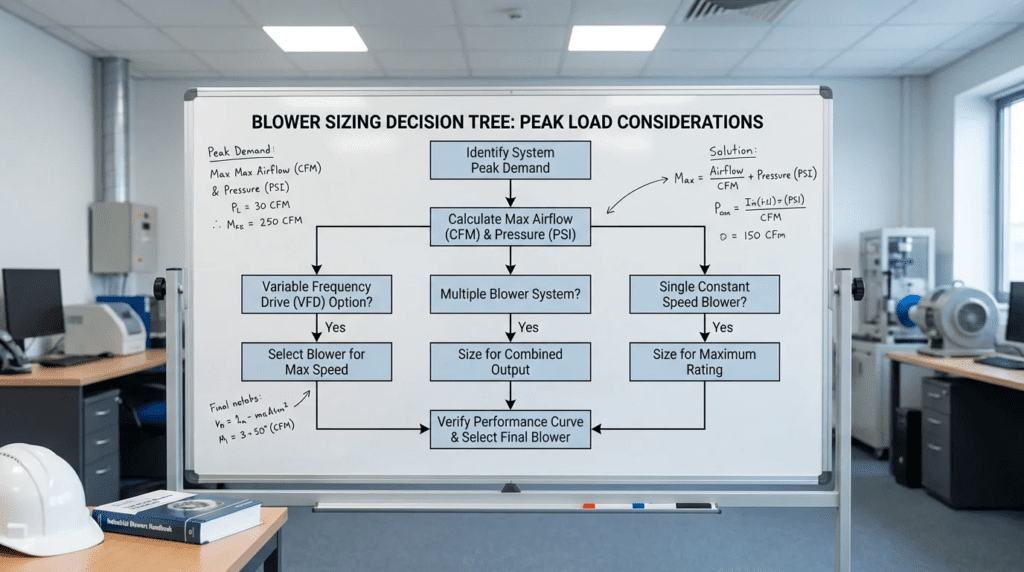
Understanding How to Size Blowers for Peak Load requires analyzing the “turndown ratio.” If a peak load requires 10,000 scfm and the minimum load requires 3,000 scfm, the system needs a turndown ratio of at least 3.3:1. Since a single centrifugal blower typically offers only 40% to 50% turndown (2:1 ratio), a multiple-blower strategy or hybrid technology approach is mandatory.
Materials & Compatibility
Wastewater treatment plants present highly corrosive environments. Blower materials must be specified to withstand both the ambient atmospheric conditions and the process requirements.
- Impellers and Rotors: High-speed centrifugal impellers are typically milled from forged aluminum, titanium, or 17-4 PH stainless steel. Positive displacement (PD) rotors are commonly cast iron or ductile iron.
- Casings: Cast iron or cast aluminum are standard. In industrial settings with high hydrogen sulfide (H2S) or coastal areas with high salinity, special epoxy or PTFE coatings may be required on the inlet and volute.
- Piping and Valving: Discharge piping immediately downstream of the blower must withstand high temperatures (often exceeding 250°F / 120°C). Carbon steel or 316SS are typical, while PVC/CPVC must never be used near the blower discharge due to thermal limits.
Hydraulics & Process Performance
The aerodynamic performance of a blower is dictated by its operating curve, which plots discharge pressure (head) against inlet flow rate. Engineers must strictly evaluate:
- Surge Line: The point at low flow and high pressure where aerodynamic stability breaks down, causing flow reversal, severe vibration, and potential catastrophic failure. Sizing exclusively for extreme peak loads often pushes normal operations dangerously close to the surge line.
- Choke Point (Stonewall): The maximum volumetric limit where air velocity reaches Mach 1 somewhere in the machine, preventing any further increase in flow regardless of power input.
- Wire-to-Air Efficiency: True efficiency must account for losses in the variable frequency drive (VFD), motor, gearing/bearings, and the blower air end. This is formalized in ASME PTC 13.
Installation Environment & Constructability
Blower rooms are often spatially constrained, noisy, and thermally challenging. Specification considerations include:
- Space and Access: High-speed turbo blowers feature a compact footprint but require specific clearance for enclosure ventilation and filter replacement.
- Cooling Requirements: Motors and VFDs generate significant heat. Specifications must detail whether the equipment utilizes forced air cooling (requiring HVAC exhaust routing) or closed-loop liquid cooling (requiring a separate glycol/water loop).
- Acoustics: Typical unattenuated blowers exceed 100 dBA. Specifications typically require sound enclosures to limit noise to 75 to 85 dBA at 1 meter in free field conditions.
Reliability, Redundancy & Failure Modes
Aeration is a critical, life-support system for the biomass. Failure to supply air for even a few hours can devastate a biological nutrient removal (BNR) process. Therefore, N+1 redundancy (firm capacity) is an absolute standard. The system must meet the peak load with the largest single blower out of service.
Evaluate bearing technologies closely:
- Air Foil Bearings (AFB): Non-contact, lubricated by air pressure. High reliability, but sensitive to frequent start/stop cycling and airborne particulates.
- Active Magnetic Bearings (AMB): Non-contact, levitated by electromagnets. Excellent monitoring capabilities and unlimited start/stop cycles, but complex and sensitive to power quality.
- Roller/Journal Bearings: Standard in PD and multistage centrifugal blowers. Require routine oil changes and vibration monitoring.
Controls & Automation Interfaces
Peak load management relies heavily on the master control panel (MCP). Modern systems utilize Dissolved Oxygen (DO) probes in the aeration basins tied to a PID loop. The most efficient strategy is often Most-Open Valve (MOV) logic.
In MOV logic, the blower control system monitors the position of all basin flow control valves. It slows down the blower to lower the header pressure until at least one valve is nearly 100% open. This minimizes the static pressure the blower must overcome, drastically reducing energy consumption while still satisfying peak demand.
Maintainability, Safety & Access
Designs must prioritize operator ergonomics and safety. Intake filters must be accessible without ladders if possible. Heavy acoustic enclosure doors should have robust hinges and safety latches. The system must include clear Lockout/Tagout (LOTO) points for electrical isolation and mechanical isolation (discharge check valves and isolation butterfly valves) to prevent back-spinning when multiple blowers share a common header.
Lifecycle Cost Drivers
When analyzing How to Size Blowers for Peak Load, capital expenditure (CAPEX) represents only 10% to 20% of the total cost of ownership (TCO) over a 20-year lifespan. Energy consumption (OPEX) accounts for 70% to 80%.
However, evaluating efficiency at the peak load point is a common mistake. If the plant only hits peak load 5% of the year, optimizing for that point guarantees poor lifecycle costs. Efficiency must be weighted based on the anticipated time spent at minimum, average, and peak flows. Maintenance costs (oil changes, filter replacements, bearing overhauls) make up the remaining 5-10% of the TCO.
COMPARISON TABLES
The following tables provide an objective framework for comparing blower technologies and selecting the appropriate sizing strategy based on specific facility constraints and load profiles. Use these matrices during the preliminary engineering phase to narrow down technology choices before requesting manufacturer curves.
| Technology Type | Features & Efficiency | Best-Fit Applications | Limitations & Peak Sizing Considerations | Typical Maintenance Profile |
|---|---|---|---|---|
| High-Speed Turbo (Air/Magnetic Bearing) | Highest wire-to-air efficiency (up to 80-85%). Direct drive, integrated VFD, compact footprint, oil-free. | Medium to large WWTPs. Continuous base-load operation with moderate diurnal variation. | Limited turndown (typically 40-50%). Very sensitive to surge. If oversized for peak, it will surge during minimum loads. | Intake filter changes, cooling fan inspection. No oil changes. Complex electronics require specialized support. |
| Integrally Geared Centrifugal (IGC) | Very high efficiency. Utilizes inlet guide vanes (IGVs) and variable diffuser vanes (VDVs) for excellent turndown. | Large municipal plants (>20 MGD). Complex, deep tank applications requiring high flow at constant pressure. | High CAPEX. Complex mechanical assembly. Requires massive footprint. Better turndown than turbo, but high initial cost. | Lube oil system maintenance, oil cooler checks, mechanical seal inspection, vibration monitoring. |
| Rotary Screw (Positive Displacement) | Internal compression yields higher efficiency than traditional lobes. Excellent turndown (up to 4:1 with VFD). | Small to medium plants, industrial applications, or as “swing blowers” to handle extreme peaks and deep minimums. | Efficiency drops at very low pressures. Higher noise levels require heavy acoustic enclosures. | Oil changes, belt/coupling tensioning, air filter replacement. Highly maintainable by typical plant staff. |
| Multistage Centrifugal (MSC) | Simple, rugged, high tolerance for dirty environments. Direct coupled, standard induction motors. | Industrial WWTPs, digester gas applications, grit chambers, or plants with minimal skilled maintenance staff. | Lower wire-to-air efficiency (60-70%). Flat curve means small pressure changes cause large flow variations. | Bearing greasing, motor maintenance, filter cleaning. Extremely robust with 20+ year lifespans common. |
| Rotary Lobe (Roots-type PD) | Constant volume, external compression. Very wide turndown capability via VFD. Lowest CAPEX. | Small package plants, shallow tanks (<12 ft), channel aeration, filter backwash. | Lowest operating efficiency. High pulsation and noise. Generates high discharge temperatures at higher pressures. | Frequent oil changes, belt replacements, silencer inspections. Very simple mechanical design. |
| Load Scenario | Plant Characteristics | Recommended Sizing Strategy | Operator Skill Impact | Relative Lifecycle Cost |
|---|---|---|---|---|
| Extreme Seasonal Peak (e.g., Resort Town, Canning Plant) |
High peak-to-average ratio (3:1 or greater). Long periods of low flow. | Hybrid System: Turbo blowers for low/average base load; Rotary Screw or MSC for seasonal peak trimming. | Requires advanced Master Control Panel (MCP) to sequence different technologies safely. | Medium CAPEX / Lowest OPEX (prevents running large blowers inefficiently). |
| High Diurnal Variation (Typical Municipal) |
Predictable daily peaks (morning/evening) with deep night minimums. Turndown 2.5:1. | Multiple Equal Sized Units: e.g., Three 50% Turbo units. 2 run at peak, 1 runs at minimum flow. | Low. Standard DO/pressure control logic handles sequencing easily. | High CAPEX / Low OPEX. Best overall reliability due to standardized parts. |
| Industrial Shock Loading (Food & Beverage WWTP) |
Unpredictable, rapid spikes in BOD. Requires fast response to maintain DO. | VFD-driven Screw Blowers: Positive displacement offers instant flow response and massive turndown without surge risk. | Low. Operators can manually override without fear of aerodynamic instability. | Low CAPEX / Medium OPEX. Slightly higher energy use offset by process stability. |
| Future Expansion Design (New Green-field Plant) |
Current load is 30% of design. Peak load won’t be realized for 10+ years. | Phased Implementation: Install smaller blowers now. Leave concrete pads and pipe tees for future larger blowers. | Moderate. Operators must adapt control strategies as plant capacity scales up. | Lowest initial CAPEX. Prevents 10 years of inefficient, surged operation. |
ENGINEER & OPERATOR FIELD NOTES
Theoretical sizing on paper often conflicts with real-world operating conditions. The following field notes highlight critical practical considerations for commissioning, avoiding specification errors, and managing ongoing operations.
Commissioning & Acceptance Testing
Performance verification is non-negotiable. Before a blower leaves the factory, it should undergo a Factory Acceptance Test (FAT).
- PTC 10 vs. PTC 13: Historically, ASME PTC 10 was used to test the aerodynamic performance of the bare blower. However, modern turbo and screw blowers are packaged systems with integrated VFDs and motors. You must specify testing in accordance with ASME PTC 13 (Wire-to-Air Performance Test Code for Blower Systems). This guarantees the efficiency of the entire package, not just the air end.
- Surge Verification: During the Site Acceptance Test (SAT), the commissioning engineer must physically induce surge (under controlled conditions) to verify that the blower’s control system accurately detects the surge boundary, opens the blow-off valve, and protects the machine.
- Vibration Baselines: Record baseline vibration data across the entire speed range. Some VFD/motor combinations exhibit harmonic resonance at specific frequencies, requiring those speed bands to be locked out in the control software.
A blower that delivers 5,000 scfm at sea level on a 60°F day will deliver significantly less mass flow on a 100°F day in Denver, Colorado. Always provide the manufacturer with the highest expected ambient temperature and maximum site elevation when defining the worst-case peak load condition.
Common Specification Mistakes
When engineering teams struggle with How to Size Blowers for Peak Load, the root cause is usually found in ambiguous or contradictory bid documents.
- Mixing SCFM, ICFM, and Nm³/hr: Standard cubic feet per minute (scfm) measures mass flow (actual oxygen molecules available for the bugs). Inlet cubic feet per minute (icfm) measures volumetric flow at the blower inlet. Sizing a blower using scfm numbers but labeling them as icfm will result in a severely undersized machine.
- The “Max/Max” Trap: Specifying the system to evaluate power consumption at the absolute maximum pressure and absolute maximum flow. In reality, maximum flow often occurs at a lower-than-maximum pressure because water levels in the aeration basin may drop, or diffuser membranes are heavily expanded. Evaluated power should be weighted across an expected operational profile (e.g., 10% peak, 60% average, 30% minimum).
- Ignoring Filter Degradation: Clean intake filters have a pressure drop of ~1-2 inches of water. Dirty filters can drop 10-15 inches. The blower must be sized to meet the peak load with a dirty inlet filter, otherwise it will fall short of design capacity right before a maintenance cycle.
O&M Burden & Strategy
Even the most perfectly sized system requires a realistic operations and maintenance strategy.
- Intake Air Quality: If the blower intake is near a biosolids loading area or a dusty road, the filters will blind rapidly. Specify pre-filters or extended-surface-area housings to reduce maintenance intervals.
- Cooling Loops: Water-cooled turbo blowers require closed-loop cooling to prevent scaling in the motor jacket. Using raw plant water directly will destroy the cooling jacket within a year. A dedicated chiller or liquid-to-liquid heat exchanger is required.
- Preventive Maintenance (PM): For oil-lubricated machines (IGC, multistage, PD), oil sampling should be conducted quarterly. Synthetic lubricants typical of high-speed gearboxes require strict adherence to replacement intervals (usually 4,000 to 8,000 hours).
Troubleshooting Guide
When blowers struggle to meet peak demand or operate erratically, check these common root causes:
- High Discharge Temperature: Usually caused by operating at a higher pressure ratio than designed, a blinded inlet filter, or a failing cooling system. If the discharge temp exceeds the high-limit trip (often 250°F-300°F), the blower will shut down.
- Continuous Blow-Off Valve Operation: If the system is venting air to the room, the blower is oversized for the current load and is riding the surge line, or the DO setpoint is too low, forcing the blower below its minimum turndown capability.
- Failure to Reach Target Flow: If the VFD is at 100% but flow is low, suspect a severe restriction (fouled diffusers raising backpressure beyond the blower’s capability) or a massive air leak in the distribution header.
DESIGN DETAILS / CALCULATIONS
Mastering How to Size Blowers for Peak Load requires moving beyond “rules of thumb” and executing rigorous process and thermodynamic calculations. This section outlines the engineering methodology.
Sizing Logic & Methodology
Step 1: Calculate Actual Oxygen Requirement (AOR)
Determine the mass of oxygen required by the biology based on influent BOD, TKN (ammonia), and desired solids retention time. This is strictly a process engineering calculation, typically output in lbs O2 / day.
Step 2: Convert AOR to Standard Oxygen Requirement (SOR)
AOR represents oxygen needed in the dirty wastewater at site conditions. SOR translates this to clean water under standard conditions (20°C, 1 atm, zero DO). This requires applying correction factors:
SOR = AOR / [ α * ( (β * C*∞,20 – C) / C*∞,20 ) * θ(T-20) ]
- Alpha (α): Ratio of transfer efficiency in wastewater vs clean water (typically 0.4 to 0.75 depending on diffusers and MLSS).
- Beta (β): Salinity/TDS correction factor (typically 0.95 to 0.98).
- Theta (θ): Temperature correction factor (typically 1.024).
- C: Target operating Dissolved Oxygen concentration (typically 1.5 – 2.0 mg/L).
Step 3: Calculate Airflow Requirements (SCFM)
Convert the SOR (mass of oxygen) into a volumetric flow of standard air.
Airflow (scfm) = (SOR * 106) / (SOTE * 0.232 * ρ * 60)
- SOTE: Standard Oxygen Transfer Efficiency of the diffusers at the design submergence depth (typically 1.5% to 2.0% per foot of submergence).
- 0.232: Mass fraction of oxygen in air.
- ρ (rho): Density of standard air (0.075 lbs/ft³).
Step 4: Adjust for Site Conditions to Determine Peak
To find the absolute peak load, calculate the scfm required using the highest expected ambient air temperature, highest wastewater temperature, highest relative humidity, and minimum alpha factor. This exact scenario defines the maximum aerodynamic capacity the blower must meet.
Specification Checklist
A robust procurement specification for aeration blowers must explicitly include:
- Site Elevation and Barometric Pressure: Critical for air density calculations.
- Temperature Ranges: Max/min ambient air temp, max/min relative humidity.
- Friction Losses: Clearly define the calculated pressure drop through piping, valves, and clean vs. fouled diffusers.
- Turndown Requirement: Explicitly state the minimum required flow rate at the minimum expected discharge pressure.
- Testing Standard: “Performance testing shall be conducted in accordance with ASME PTC 13, incorporating the VFD, motor, and internal cooling systems.”
- Harmonic Mitigation: Require IEEE 519 compliance for VFD harmonics at the point of common coupling.
Standards & Compliance
Engineers must align designs with prevailing industry standards to ensure safety, reliability, and objective performance verification.
- ASME PTC 13: The definitive standard for wire-to-air performance testing of packaged blower systems. Replaces the outdated PTC 10 for integrated units.
- UL/CSA Listings: Ensure the entire packaged blower control panel and VFD are UL 508A listed, not just individual components.
- ISO 1940: Defines balancing grades for high-speed rotating impellers (typically G2.5 or better for turbo blowers).
- AGMA Standards: For integrally geared blowers, specify AGMA gear quality levels to ensure low vibration and long bearing life.
FAQ SECTION
What is the difference between SCFM and ICFM when sizing blowers?
SCFM (Standard Cubic Feet per Minute) measures the mass flow of air normalized to standard conditions (14.7 psia, 68°F, 0% RH). It dictates how many oxygen molecules are delivered to the biology. ICFM (Inlet Cubic Feet per Minute) measures the actual volume of air entering the blower at local site conditions. Blowers are aerodynamic machines sized by actual volume (ICFM), but process requirements demand mass (SCFM). Accurate conversion between the two based on site temperature and elevation is critical for peak load sizing.
How do you select the right blower technology for a plant with huge seasonal variations?
Understanding How to Size Blowers for Peak Load in highly seasonal plants usually points away from using a few massive turbo blowers, as they will surge during off-season minimums. Best practice involves a hybrid system or asymmetric sizing. For example, installing two smaller high-efficiency turbo blowers to handle the baseline winter load, and utilizing VFD-driven positive displacement screw blowers as “swing” units that activate only to handle extreme summer peaks.
What is blower surge and why is it dangerous?
Surge is an aerodynamic stall within a centrifugal blower. It occurs when the system backpressure exceeds the pressure the blower can generate at a given flow rate, causing air to violently reverse direction back through the impeller. This repetitive flow reversal causes severe vibration, rapid temperature spikes, and can destroy high-speed bearings in seconds. Oversizing a blower for a future peak load practically guarantees it will operate dangerously close to its surge line during normal conditions.
How much turndown can I expect from an aeration blower?
Turndown capabilities vary strictly by technology. Direct-drive high-speed turbo blowers typically offer 40% to 50% turndown (a 2:1 ratio). Integrally geared centrifugal blowers with variable inlet/diffuser vanes can achieve 50% to 60%. Positive displacement blowers (rotary screw or lobe) equipped with VFDs can often achieve up to 75% turndown (a 4:1 ratio) because their flow is directly proportional to speed and largely independent of discharge pressure.
What is Most-Open Valve (MOV) control logic?
MOV logic is an advanced aeration control strategy designed to minimize blower energy consumption. Instead of maintaining a fixed, artificially high pressure in the air distribution header, the Master Control Panel constantly adjusts the blower speed so that the most demanding basin’s flow control valve is kept at 85-95% open. This ensures the blower generates only the exact minimum pressure required to overcome static head and system friction, saving thousands of dollars in OPEX annually.
How much does a typical high-speed turbo blower cost?
Capital costs depend heavily on horsepower, controls integration, and cooling requirements. Generally, a 100 HP to 200 HP high-speed turbo blower package typically costs between $60,000 and $120,000 USD. However, CAPEX is only a fraction of the lifecycle cost. A 100 HP blower running continuously will consume approximately $50,000 to $70,000 in electricity annually (assuming $0.10/kWh). Therefore, evaluating wire-to-air efficiency via ASME PTC 13 is far more critical than upfront capital cost.
CONCLUSION
KEY TAKEAWAYS
- Analyze the Full Envelope: Successfully determining How to Size Blowers for Peak Load requires equal attention to the minimum load. A blower that cannot turn down to nighttime flows without surging is improperly sized.
- Use ASME PTC 13: Always specify wire-to-air efficiency testing. Evaluating the air-end efficiency alone ignores significant losses from the VFD, motor, and cooling systems.
- Beware the SOTE Drop: Remember that diffuser efficiency (SOTE) decreases at peak airflow due to larger bubble formation. Peak load requires disproportionately more air.
- Mass vs. Volume: Biological demand dictates oxygen mass (scfm), but blowers compress volume (icfm). Site elevation and summer temperatures drastically increase the icfm required to deliver the necessary scfm.
- Hybrid Solutions Work: For extreme peak-to-average variations (e.g., >3:1), combine baseline high-speed turbos with wide-turndown positive displacement (screw) swing blowers.
Specifying an aeration system is one of the most consequential decisions an engineering team will make during a wastewater treatment plant upgrade. The energy implications dictate utility budgets for decades, and the process implications dictate environmental compliance. By understanding the rigorous thermodynamics of How to Size Blowers for Peak Load, engineers can avoid the common trap of blindly specifying for a hypothetical 20-year maximum design condition while ignoring the reality of day-to-day operations.
The optimal selection methodology requires a holistic approach. It begins with precise process modeling to establish realistic Actual Oxygen Requirements (AOR) across diurnal and seasonal profiles. It demands a firm grasp of site ambient conditions to convert mass flow into actual volumetric intake. Finally, it requires objectively evaluating the hydraulic curves, turndown limitations, and wire-to-air efficiencies of various technologies—whether high-speed turbo, integrally geared, or advanced rotary screw.
When in doubt regarding complex load profiles or severe temperature/elevation combinations, consult closely with technology specialists and demand transparent, multi-point performance curves. Balancing the competing requirements of peak capacity, wide turndown, mechanical reliability, and lifecycle energy efficiency is challenging, but applying these structured, specification-safe engineering principles ensures a resilient and cost-effective aeration process.