
How to Specify Check Valves for Wastewater Service (Materials Coatings and Standards)
INTRODUCTION
Water and wastewater pump station failures, pipe ruptures, and operator injuries often trace back to a seemingly simple, yet notoriously misapplied component: the check valve. An incorrect valve selection at the pump discharge can lead to destructive water hammer, severe valve slam, chronic ragging, and premature mechanical failure. For consulting and utility engineers, understanding the exact nuances of How to Specify Check Valves for Wastewater Service (Materials Coatings and Standards) is arguably one of the most critical elements in designing resilient lift stations, treatment plant process piping, and heavy sludge transfer systems.
Check valves operate autonomously, reacting entirely to system hydraulics. In municipal and industrial wastewater environments, these valves are subjected to raw sewage, abrasive grit, high concentrations of fats, oils, and grease (FOG), stringy materials (flushable wipes), and highly corrosive hydrogen sulfide (H2S) gases. While a clean-water pumping system might forgive a generic valve specification, applying that same specification to a raw wastewater lift station or primary sludge gallery inevitably results in clogging, seat failure, or catastrophic hinge pin blowouts.
Proper selection and specification dictate the lifecycle cost, hydraulic efficiency, and safety of the entire pumping system. Conversely, poor choices lead to high head loss (wasting significant pumping energy), repeated operator interventions to clear clogs, and transient surges that can fatigue piping restraints and crack concrete wet well structures. This comprehensive guide provides municipal consulting engineers, plant directors, and operators with technical, unbiased criteria for specifying check valves tailored specifically for the harsh realities of wastewater service.
HOW TO SELECT / SPECIFY
Because check valves are flow-actuated, selecting the right valve goes far beyond matching the flange diameter to the pipe. Engineers must rigorously evaluate the hydraulic operating envelope, the fluid composition, and the physical constraints of the installation. The following criteria provide a framework for How to Specify Check Valves for Wastewater Service (Materials Coatings and Standards) with engineering precision.
Duty Conditions & Operating Envelope
The foremost specification criteria revolve around the duty conditions of the pumping system. Check valves must be matched to specific flow rates, operating pressures, and fluid velocities. Unlike isolation valves, check valves perform optimally only within a specific velocity range. A typical/approximate design velocity for wastewater check valves is 4 to 8 feet per second (ft/s).
- Flow Rates and Velocities: If the velocity is too low, the valve disc will not fully open. This causes the disc to “flutter” in the flow stream, leading to rapid wear of the hinge mechanism and significantly increasing head loss. If the velocity is too high, the resulting deceleration during pump shutdown can cause severe valve slam.
- System Pressures: Engineers must account for both static head and dynamic friction losses, but more importantly, the transient pressure spikes (surge) that occur during sudden power loss. Valve pressure ratings (e.g., Class 125, Class 250) must exceed the maximum anticipated transient pressure, not just the steady-state operating pressure.
- Operating Modes: Pumping systems controlled by Variable Frequency Drives (VFDs) present unique challenges. Because VFDs alter the flow rate, the check valve must be capable of stable operation at both the minimum and maximum pump speeds without chatter.
Materials & Compatibility
Wastewater is a complex, aggressive fluid. The choice of body, trim, and seating materials dictates the valve’s service life.
- Body Materials: Ductile iron (ASTM A536, typically Grade 65-45-12) has largely replaced cast iron (ASTM A126) in wastewater specifications due to its superior tensile strength and resistance to cracking under transient pressure surges.
- Trim and Internals: Moving parts, hinge pins, and springs must be highly corrosion-resistant. Type 316 stainless steel is the standard minimum for shafts and hardware in wastewater. For highly corrosive industrial wastewater or high-chloride environments, duplex stainless steels or 17-4 PH stainless steel (for high strength shafts) are required.
- Elastomers and Seating: Seat material must handle the fluid’s chemical makeup. Buna-N (Nitrile) is typical for general wastewater due to its resistance to hydrocarbons, fats, oils, and grease. EPDM is an alternative for elevated temperatures or specific industrial chemicals but breaks down quickly in the presence of heavy petroleum oils.
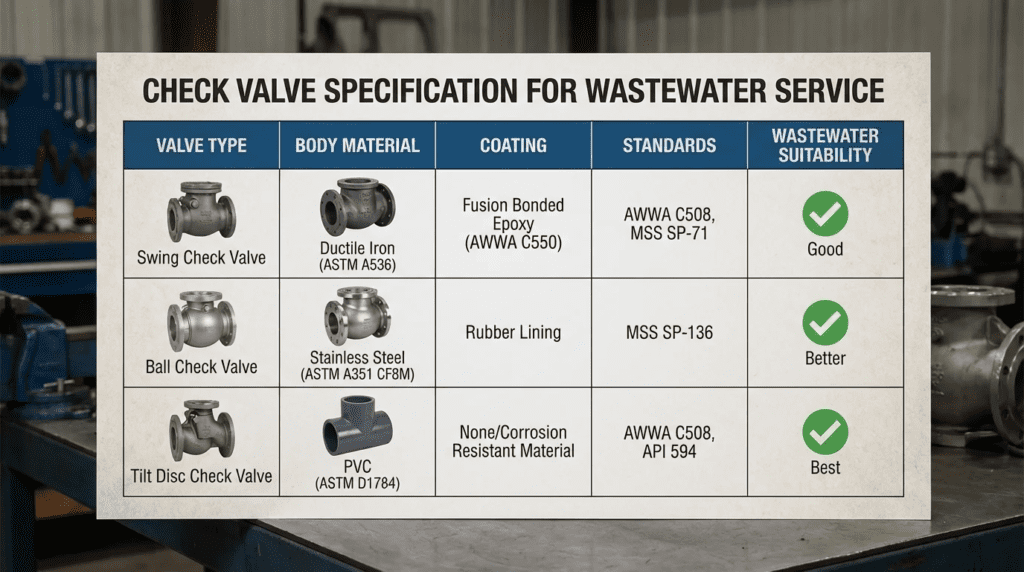
- Coatings: Uncoated or poorly coated iron will rapidly corrode in H2S environments. Fusion Bonded Epoxy (FBE) applied to both the interior and exterior of the valve per AWWA C550 standards (typically 8-12 mils dry film thickness) is mandatory for municipal wastewater service.
Hydraulics & Process Performance
The hydraulic performance of a check valve directly impacts the system’s energy consumption. Every check valve introduces friction loss, defined by its flow coefficient (Cv) or head loss curve.
- Head Loss Characteristics: A traditional swing check valve with the disc resting in the flow stream causes higher head loss compared to a full-port design (where the disc swings entirely out of the flow path). Over a 20-year lifecycle, the energy cost of pumping against a high-head-loss valve often exceeds the capital cost of the valve itself.
- Slam Mitigation: Valve slam occurs when the fluid reverses direction before the check valve has completely closed. The reversing fluid catches the disc and slams it into the seat, generating a damaging pressure wave. To prevent this, engineers must specify valves with low inertia and short stroke lengths (like slanting disc or rubber flapper valves), or add controlled-closing accessories (like air or oil dashpots) to traditional swing checks.
Installation Environment & Constructability
Check valves are highly sensitive to installation geometry and upstream/downstream flow disturbances.
- Orientation: Check valves must be installed with careful attention to gravity. Most traditional swing check valves and rubber flapper valves perform well in horizontal pipes. They can also be installed in vertical pipes only if the flow is upward. Installing a check valve in vertical downward flow will prevent the valve from closing and is a critical design error.
- Straight Pipe Requirements: To prevent turbulence from prematurely wearing the hinge pins or causing disc flutter, standard engineering practice dictates a minimum of 3 to 5 pipe diameters of straight, unobstructed pipe upstream of the check valve. Placing a check valve bolted directly to the discharge flange of a centrifugal pump or immediately after a short-radius elbow will severely degrade its lifespan.
- Space Constraints: In crowded dry-pit lift stations, the face-to-face dimensions of the valve matter. Some non-slam valves have longer lay lengths than standard AWWA C508 swing checks, requiring careful piping layout adjustments.
Reliability, Redundancy & Failure Modes
In raw sewage applications, the primary failure mode of a check valve is “ragging”—where stringy materials wrap around internal hinge pins, causing the valve to stick partially open. When the pump cycles off, the stuck valve allows raw sewage to flow backward through the pump, potentially causing the pump to spin in reverse. If the pump is called to start while spinning backward, the resulting torque can shear the pump shaft.
To maximize reliability, engineers specify “clear waterway” or “full port” valves for raw sewage. Valves with internal springs, center-guided stems, or dual plates in the flow path are generally unacceptable for raw municipal wastewater due to inevitable clogging. Redundancy is typically handled at the pump level (e.g., a duplex pump station), but each pump must have its own dedicated, highly reliable check valve.
Maintainability, Safety & Access
Wastewater valves will eventually require maintenance. The ease with which operators can access and clear the valve is a major specification factor.
- Top Entry Design: Specify valves with large, bolted top-access covers. This allows maintenance crews to inspect the seat, replace the flapper or disc, and clear debris without removing the heavy valve body from the pipeline.
- Position Indicators: For standard swing checks, an external lever and weight or spring provides a visual indication of the valve disc position. This helps operators troubleshoot whether the valve is stuck open or closed.
- Lifting Provisions: For valves larger than 8 inches, specify cast or tapped lifting lugs. Iron valves are exceptionally heavy, and maintenance crews require safe rigging points.
Lifecycle Cost Drivers
The Total Cost of Ownership (TCO) for a wastewater check valve consists of Capital Expenditure (CAPEX), Operational Expenditure (OPEX – primarily pumping energy), and Maintenance.
While a basic, import-cast swing check valve represents the lowest CAPEX, it often features higher head loss and requires more frequent maintenance to replace worn shaft packings and seats. A premium rubber flapper check valve or slanting disc check valve carries a higher initial cost but offers significantly lower head loss (saving electricity) and fewer moving parts (reducing maintenance labor). Utility engineers must perform a lifecycle cost analysis over a typical 20-year horizon, factoring in local power rates ($/kWh), to justify premium valve specifications.
COMPARISON TABLES
The following tables provide a technical comparison of common check valve technologies and their appropriate application within wastewater treatment plants and collection systems. Use these matrices to align valve technology with specific process constraints and operator capabilities.
Table 1: Wastewater Check Valve Technology Comparison
| Technology / Type | Design Features | Best-Fit Applications | Limitations / Constraints | Typical Maintenance |
|---|---|---|---|---|
| Traditional Swing Check (AWWA C508) | Metal disc hinged on a shaft. Often equipped with external lever and weight/spring. | General wastewater, treated effluent, low-head lift stations. | High potential for valve slam. Moving parts can foul with heavy rags. Packing glands can leak. | Repacking the shaft. Replacing seat rings and hinge pins every 5-10 years. |
| Rubber Flapper Check | Single-piece elastomer disc reinforced with steel. No external shafts or packing. Full port. | Raw sewage lift stations, primary sludge, heavily rag-laden flows. | Slightly higher head loss than some swing checks. Elastomer can degrade in heavy chemical/FOG environments. | Extremely low. Flapper replacement required only if elastomer degrades (typically 10-15+ years). |
| Slanting Disc Check | Pivot point is offset; short stroke length. Highly aerodynamic profile. | Large diameter transmission mains, high-head pump stations where severe slam is a risk. | High capital cost. Pivot pins are in the flow stream, making them unsuitable for heavy raw sewage with rags. | Inspection of pivot pins. High reliability, but complex repair if needed. |
| Ball Check Valve | Heavy, coated ball lifts into a chamber out of the flow path. | Small diameter (<4 inch) submersible pump stations, viscous sludge. | High head loss. Not suitable for large pipe diameters due to ball weight and inertia. | Ball replacement if surface becomes worn or gouged by grit. |
| Dual Plate / Wafer Check | Two spring-loaded plates fold inward on a center hinge. Compact face-to-face. | Clean water, cooling water, highly treated plant effluent. | Do not use in raw wastewater. Center pin will catch rags and fail immediately. | Spring replacement. High failure rate in dirty water applications. |
Table 2: Application Fit Matrix
| Application Scenario | Service Type / Fluid | Key Engineering Constraints | Recommended Valve Type | Relative CAPEX |
|---|---|---|---|---|
| Municipal Lift Station | Raw Sewage (Wipes, Rags, Grit) | Clog prevention, small vault footprint, vertical upflow capability. | Rubber Flapper Check | Moderate |
| Primary Clarifier Gallery | Primary Sludge (High solids, grit) | Abrasive wear on seats, heavy solids settling in valve body. | Rubber Flapper or Ball Check | Low to Moderate |
| High-Head Force Main | Screened Wastewater | Severe water hammer, high transient pressure, continuous pumping. | Swing Check with Air/Oil Dashpot Cushion | High |
| Plant Effluent Outfall | Treated Final Effluent | Large diameter, low head loss required, clean fluid. | AWWA Swing Check or Slanting Disc | Moderate to High |
| Chemical Feed Skid | Sodium Hypochlorite / Ferric | High corrosion, small diameter, low flow. | PVC/CPVC Ball Check with Viton O-rings | Low |
ENGINEER & OPERATOR FIELD NOTES
Translating a theoretically perfect specification into a successfully installed and operating system requires rigorous quality control during procurement and a proactive approach to operations and maintenance. These field notes bridge the gap between design theory and operational reality.
Commissioning & Acceptance Testing
Proper commissioning ensures the valve meets the hydraulic and mechanical requirements of the specification before it goes into permanent service.
- Factory Acceptance Test (FAT): Specifications should mandate that the manufacturer hydrostatically test the valve body to 1.5 times the rated working pressure. Furthermore, a functional seat leakage test must be performed. Under AWWA C508, the allowable leakage rate is typically 1 fluid ounce per inch of nominal valve diameter per hour. However, for rubber-seated valves, zero leakage is a common and achievable specification requirement.
- Site Acceptance Test (SAT): Once installed, the contractor and engineer must observe the valve during a full pump cycle. The critical moment is pump shutdown. The engineer must listen for the distinct sound of a “slam.” A loud bang accompanied by pipe shaking indicates a transient surge issue that was either miscalculated in design or requires field adjustment of the valve’s external spring or dashpot.
- Punch List Items: Verify that the valve was installed in the correct flow direction (indicated by an arrow cast into the body). Ensure top access covers have sufficient clearance from vault ceilings to be completely removed.
Key Criteria in How to Specify Check Valves for Wastewater Service (Materials Coatings and Standards)
Avoiding common specification errors is crucial when learning How to Specify Check Valves for Wastewater Service (Materials Coatings and Standards). Many failures stem from “cut-and-paste” engineering, where clean water specs are applied to wastewater projects.
- The Clean Water Trap: Specifying bronze trim or standard stainless steel dual-plate checks for wastewater because they worked well on a potable water booster station. Rags will destroy dual-plate center pins within days.
- Ignoring External Lever Hazards: Specifying external levers and weights in deep, confined-space lift stations. While they provide visual position indication, an exposed, rapidly dropping heavy weight is an OSHA strike hazard for operators standing in a tight vault. Consider spring-closures enclosed in safety guards.
- Un-Encapsulated Shafts: Failing to specify that the hinge shaft must not penetrate the valve body, or failing to require an engineered stuffing box. Shafts that penetrate the body with cheap O-ring seals will eventually leak raw sewage into the dry vault.
O&M Burden & Strategy
Check valves are generally low-maintenance, but they are not zero-maintenance. A proactive O&M strategy prevents catastrophic failures.
- Routine Inspections (Semi-Annual): Operators should visually inspect exterior linkages, springs, and dashpot fluid levels. Listen to the valve during pump shutdown for changes in closing characteristics. Inspect external hinge penetrations for sewage leakage.
- Preventive Maintenance (Every 2-5 Years): Schedule a shutdown to isolate the valve, remove the top cover, and inspect the internal seating surfaces. Grit flowing at high velocities will eventually score rubber seats or erode epoxy coatings.
- Critical Spare Parts: Plants should inventory at least one replacement flapper/disc assembly and cover gasket for every size and type of check valve in the critical process path. Dashpot seal kits should also be kept in stock.
Troubleshooting Guide
When check valves malfunction, rapid diagnosis is necessary to protect the pumps.
- Symptom: Continuous loud chatter during pumping.
Root Cause: Flow velocity is too low to keep the disc fully pinned open against its stop. The disc is fluttering in the flow stream.
Fix: Verify pump output. If the pump is oversized, or if a VFD is running too slow, adjust the pump controls to achieve minimum velocity. - Symptom: Pump shuts off, but the impeller spins backward.
Root Cause: The check valve is stuck open, allowing reverse flow.
Fix: Isolate the valve. The most likely culprit in wastewater is a “rag rope” wrapped around the hinge pin or seat. Remove the top cover and clear the debris. - Symptom: Heavy slam on shutdown.
Root Cause: The valve is closing too slowly, allowing the fluid column to reverse and slam the disc into the seat.
Fix: Increase spring tension to close the valve faster (before flow reversal), or consult the manufacturer about adding a cushioning dashpot.
DESIGN DETAILS / CALCULATIONS
Specifying the correct valve requires applied hydraulics. This section details the quantitative steps an engineer must take to properly size and document the valve.
Sizing Logic & Methodology
Never assume the check valve should automatically match the pipe diameter. Sizing must be dictated by fluid velocity.
- Calculate Minimum and Maximum Flow: Determine the operating points of the pump (in GPM or MGD).
- Determine Velocity: Use the continuity equation (V = Q / A). Target a typical/approximate velocity of 4 to 8 ft/s.
Rule of Thumb: Velocities below 3 ft/s usually lead to disc flutter and wear. Velocities above 10 ft/s lead to severe abrasive wear from grit and drastically higher head loss. - Consult Manufacturer Full-Open Velocity: Different valve designs require different velocities to hold the disc fully open. A heavily weighted swing check might need 7 ft/s to stay open, while a rubber flapper might only need 4.5 ft/s. Ensure your calculated minimum flow velocity exceeds the manufacturer’s required full-open velocity.
- Calculate Head Loss: Request the valve’s Cv (flow coefficient) or head loss curve from the manufacturer. Calculate the head loss at the design flow rate and add it to the system curve to ensure the pump is sized correctly.
Specification Checklist
A watertight specification prevents contractors from substituting inferior, non-compliant products. A comprehensive spec must include:
- Valve Type & Configuration: (e.g., Rubber Flapper, full port, top entry).
- Body Material: Ductile Iron ASTM A536 Grade 65-45-12.
- Pressure Class: ANSI Class 125 or 250 flanged ends, rated for 250 psi minimum cold working pressure.
- Internal Hardware: 316 Stainless Steel for all internal metallic components.
- Coatings: Fusion Bonded Epoxy (FBE) interior and exterior, minimum 8 mils DFT.
- Testing Requirements: Hydrostatic shell test and seat leakage test per AWWA.
- Submittals: Require head loss curves, Cv values, and a list of materials with ASTM designations.
The Role of Standards in How to Specify Check Valves for Wastewater Service (Materials Coatings and Standards)
Adherence to industry standards protects the municipality and ensures interoperability.
- AWWA C508: This is the American Water Works Association standard for Swing-Check Valves for Waterworks Service. While written primarily for clean water, it is widely adapted for wastewater. It defines minimum body wall thicknesses, flange dimensions, and testing criteria.
- AWWA C550: This standard governs Protective Interior Coatings for Valves and Hydrants. It dictates the surface preparation (e.g., SSPC-SP10 Near-White Blast) and application of epoxies to ensure the valve body survives H2S attack.
- ANSI/ASME B16.1: Governs the dimensions and drilling of cast iron pipe flanges and flanged fittings. Ensures the valve will bolt cleanly to standard piping.
- AIS / Buy America: For federally funded municipal projects (e.g., SRF loans), specifications must clearly state American Iron and Steel (AIS) or Build America, Buy America (BABA) compliance, which requires the ductile iron to be poured and manufactured in the USA.
FAQ SECTION
What is a rubber flapper check valve and why is it used in wastewater?
A rubber flapper check valve is a type of non-slam valve where the closing mechanism is a single piece of steel-reinforced elastomer (rubber) angled across the flow path. It is used extensively in wastewater because it has no internal hinge pins, metal shafts, or springs that can catch stringy rags and flushable wipes. This “clear waterway” design makes it highly resistant to clogging in raw sewage lift stations.
How do you size a check valve for a wastewater pump station?
Check valves are sized based on fluid velocity, not just pipe diameter. Engineers calculate the pump’s flow rate and select a valve diameter that maintains a typical fluid velocity of 4 to 8 feet per second. This ensures the fluid has enough kinetic energy to push the valve disc completely open. Sizing a valve too large results in low velocity, causing the disc to flutter and wear out prematurely.
What is the difference between cast iron and ductile iron check valves?
Cast iron (ASTM A126) is brittle and prone to cracking under severe pressure spikes (water hammer). Ductile iron (ASTM A536) has magnesium added during the pouring process, which alters the graphite structure to make the metal flexible and highly resistant to impact and pressure transients. Ductile iron is the modern standard for wastewater check valves to prevent catastrophic shell fractures.
Why do check valves slam, and how can it be prevented?
Check valve slam occurs when a pump turns off, the upward water column loses momentum, and gravity causes the water to reverse direction. If the valve disc closes after the water has reversed, the reverse flow slams the disc into the seat. It is prevented by selecting valves with a short stroke (like slanting disc valves), adding heavy springs to close the valve faster, or using pneumatic dashpots to cushion the closure.
What type of coating is required for wastewater check valves?
Wastewater generates hydrogen sulfide (H2S) gas, which converts to sulfuric acid and rapidly corrodes bare iron. Check valves in wastewater service require Fusion Bonded Epoxy (FBE) applied to both the interior and exterior surfaces. The coating must comply with the AWWA C550 standard, typically applied at a dry film thickness of 8 to 12 mils over a near-white blasted metal surface.
What is the typical lifespan of a check valve in raw sewage?
In municipal raw sewage applications, a high-quality, properly sized check valve typically lasts 15 to 25 years. However, internal wear components, such as rubber flappers, seat rings, or hinge pin packings, generally require inspection and potential replacement every 5 to 10 years, depending on the volume of abrasive grit and chemical concentrations in the fluid.
Can a check valve be installed vertically?
Yes, but with strict limitations. Standard swing checks and rubber flapper checks can be installed in a vertical pipe only if the flow direction is upward. Gravity works with the valve to close it when flow stops. If installed in a vertical pipe with downward flow, gravity will hold the valve permanently open, rendering it useless. Spring-loaded dual plate valves can handle downward flow, but they are unsuitable for dirty wastewater.
CONCLUSION
KEY TAKEAWAYS
- Velocity is King: Size check valves for a fluid velocity of 4 to 8 ft/s to ensure the disc remains fully open and does not flutter.
- Avoid Rags: For raw sewage and primary sludge, mandate “clear waterway” or full-port designs (like rubber flappers) and avoid dual-plate or center-guided valves that catch debris.
- Material Upgrades: Specify Ductile Iron (ASTM A536) for bodies to resist transient pressure shocks, and minimum 316SS for internal hardware.
- Coating is Non-Negotiable: Require AWWA C550 Fusion Bonded Epoxy (8-12 mils DFT) to combat severe H2S corrosion in wastewater environments.
- Slam Mitigation: Evaluate transient surge potential during design. If slam is a risk, specify short-stroke valves, heavy springs, or dashpots.
Mastering How to Specify Check Valves for Wastewater Service (Materials Coatings and Standards) requires engineers to look beyond basic clean-water hydraulics and account for the harsh, unpredictable nature of municipal and industrial sewage. The intersection of raw fluid dynamics, corrosive chemistry, and relentless physical abrasion means that standard commercial valves will inevitably fail, leading to process downtime and hazardous conditions for operators.
When developing specifications, engineers must prioritize reliability and lifecycle costs over initial capital expenditure. Selecting ductile iron bodies with AWWA C550 fusion bonded epoxy ensures structural longevity, while choosing proper internals—such as 316 stainless steel hardware and chemical-resistant elastomers—protects the valve’s functionality. Furthermore, the hydraulic sizing must strike a careful balance: the velocity must be high enough to keep the valve fully open to minimize wear and head loss, but low enough to prevent destructive water hammer upon pump shutdown.
Ultimately, a successful wastewater pumping system relies on a holistic design approach. By accurately calculating system transients, understanding the physical geometry of the lift station, matching the valve type to the fluid’s solid content, and writing airtight specifications, consulting and utility engineers can deliver infrastructure that operates safely, efficiently, and with minimal maintenance burden for decades to come.