
How to Specify Pressure Relief Valves for Wastewater Service (Materials Coatings and Standards)
INTRODUCTION
Catastrophic force main failures caused by hydraulic transients (water hammer) remain one of the most costly and environmentally damaging events a municipal utility or industrial wastewater plant can experience. When pumps suddenly trip due to power failure, the resulting surge wave can spike system pressures to multiple times their design limit, rupturing pipes, blowing out joints, and resulting in massive sanitary sewer overflows (SSOs). To prevent these transient disasters, engineers rely on surge and pressure relief valves. However, determining How to Specify Pressure Relief Valves for Wastewater Service (Materials Coatings and Standards) is a deeply complex engineering challenge that is fundamentally different from specifying valves for clean water applications.
The critical mistake most design engineers make is specifying standard, off-the-shelf potable water relief valves for raw sewage or sludge applications. Wastewater is an abrasive, corrosive, and highly unpredictable fluid matrix. It carries rags, stringy materials, grit, fats, oils, and greases (FOG), and generates highly corrosive hydrogen sulfide (H2S) gas. A standard pilot-operated valve with small orifices will clog rapidly in raw sewage, rendering the valve completely inoperable exactly when a catastrophic surge event occurs. Consequently, millions of dollars are wasted replacing prematurely failed valves or paying environmental fines for SSO events.
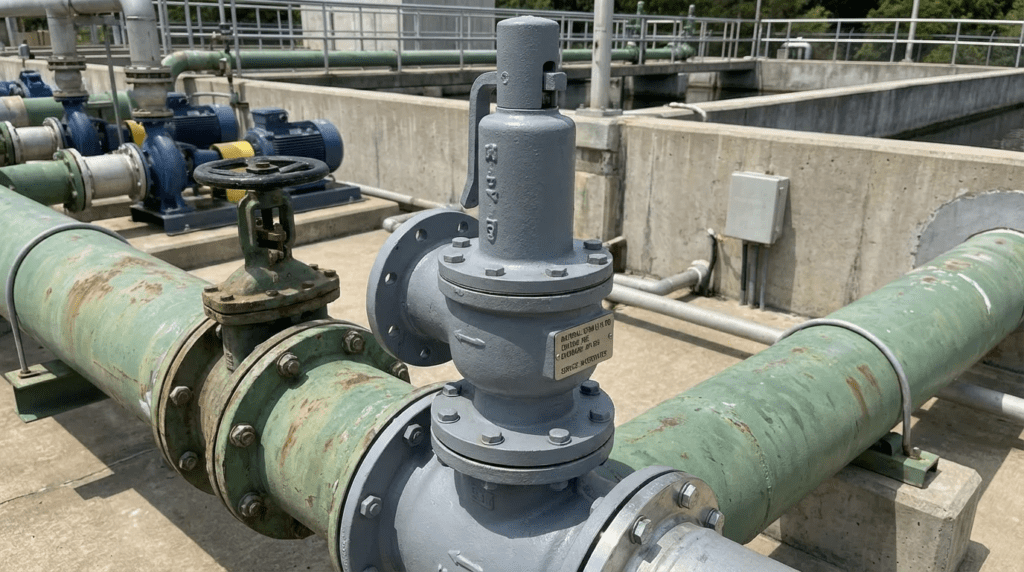
Pressure relief valves (PRVs) and surge relief valves in wastewater systems are typically deployed at pump stations, along long force mains, at treatment plant headworks, and on pressurized sludge transfer lines. Their primary function is to remain tightly closed during normal operation and open rapidly to vent excessive pressure transients, before slowly closing to prevent a secondary surge.
This comprehensive technical guide will detail How to Specify Pressure Relief Valves for Wastewater Service (Materials Coatings and Standards). It will provide municipal consulting engineers, plant directors, and maintenance superintendents with an objective, engineering-focused framework for selecting, sizing, and maintaining wastewater PRVs to ensure maximum reliability, compliance with regulatory standards, and optimization of lifecycle costs.
HOW TO SELECT / SPECIFY
Properly selecting a pressure relief valve for municipal or industrial wastewater requires a holistic evaluation of the operating envelope, process fluid characteristics, and long-term maintenance realities. The following criteria represent the fundamental engineering requirements for specification.
Duty Conditions & Operating Envelope
The first step in specification is defining the precise operating envelope. Engineers must differentiate between steady-state operating pressures, anticipated transient surge pressures, and the required setpoint for valve actuation.
- Steady-State vs. Surge Pressures: Determine the normal dynamic operating pressure (e.g., 60 psi) and the maximum allowable surge pressure of the piping system (e.g., 150 psi). The relief valve setpoint must be sufficiently above the normal operating pressure (typically 10-15 psi higher) to prevent nuisance tripping, but low enough to protect the weakest system component.
- Flow Rates: The required relief flow rate is rarely the full output of the pumping system. Transient analysis must determine the specific volume of fluid that must be evacuated from the pipeline to dampen the surge wave. Typical relief flow rates may range from 20% to 100% of steady-state flow depending on the system profile.
- Operating Modes: Determine if the valve is operating continuously (e.g., a backpressure sustaining valve on a continuously running pump) or intermittently (acting strictly as a surge relief valve that may only open once a year during a power failure). Intermittent surge valves are prone to sticking if not properly specified and exercised.
- Future Capacity Considerations: Force mains are often designed for 20-50 year horizons. As additional pumps are added to a station, the transient profile will change. The PRV sizing must account for ultimate build-out conditions, or the piping manifold should be designed to accommodate future parallel relief valves.
Materials & Compatibility
Wastewater fluid composition dictates stringent material requirements. Selecting improper metallurgies or elastomers is the leading cause of premature PRV failure.
- Body Metallurgy: ASTM A536 Ductile Iron (typically Grade 65-45-12) is the standard for wastewater PRV bodies. Ductile iron provides the necessary tensile strength and impact resistance required to withstand severe hydraulic transients, whereas standard gray cast iron is brittle and prone to catastrophic cracking under surge conditions.
- Internal Trim and Components: All wetted internal moving parts (stems, springs, guides, and seats) must be constructed of high-grade stainless steel. While Type 316 Stainless Steel is the industry standard for general municipal wastewater, industrial wastewater or sludge with high chloride concentrations may require Duplex Stainless Steel (e.g., Alloy 2205) or Super Duplex to prevent chloride-induced stress corrosion cracking and pitting.
- Elastomers (Seals, O-Rings, Diaphragms): The choice of elastomer is critical.
- Buna-N (Nitrile / NBR): Often the best overall choice for municipal wastewater because of its excellent resistance to Fats, Oils, and Grease (FOG) commonly found in raw sewage.
- EPDM: While highly resistant to chloramines and oxidation, EPDM swells and degrades rapidly in the presence of hydrocarbon-based oils and grease. It should generally be avoided in raw wastewater unless strictly handling secondary or tertiary effluent.
- FKM (Viton): Reserved for specific industrial wastewater applications involving harsh chemicals, acids, or elevated temperatures (up to 400°F).
- Microbially Induced Corrosion (MIC): In stagnant zones of the valve, sulfate-reducing bacteria (SRB) can generate concentrated hydrogen sulfide (H2S), leading to severe localized corrosion. High-quality coatings and corrosion-resistant alloys are mandatory to combat MIC.
Hydraulics & Process Performance
The hydraulic performance of a PRV is governed by its flow coefficient (Cv) and its response time.
- Valve Coefficient (Cv): The Cv represents the volume of water (in GPM) that will flow through the fully open valve with a 1 psi pressure drop. Engineers must specify a valve with a high enough Cv to pass the required transient flow without exceeding the maximum allowable accumulation pressure.
- Response Time: A surge relief valve must open incredibly fast (typically under 500 milliseconds) to capture the initial surge wave. It must then close slowly (often 10 to 60+ seconds, adjustable) to prevent generating a secondary water hammer. This independent control of opening and closing speeds is a mandatory specification requirement.
- Head-Capacity Characteristics: For pilot-operated valves, the main valve relies on line pressure to operate. If the pressure drops too low during the transient event (downsurge), the valve may not function correctly. Engineers must verify minimum operating pressure requirements.
Installation Environment & Constructability
Wastewater PRVs are rarely installed in clean, easily accessible locations.
- Vault Configurations: PRVs are frequently installed in underground concrete vaults. These vaults are prone to flooding. Therefore, the valve, including all external pilot controls and position indicators, must be rated for submersible service (IP68), even if not normally submerged.
- Space Constraints: Surge relief valves require clear piping runs. Discharging high-velocity transient flows creates extreme turbulence. The discharge piping must be properly anchored, and the relief valve should discharge into a wet well, holding tank, or back to the pump suction (with caution regarding thermal buildup).
- Orientation: While many valves can technically be installed vertically or horizontally, horizontal installation with the cover facing upward is heavily preferred for wastewater. Vertical installations can allow grit and debris to settle asymmetrically inside the valve body, leading to binding of the internal piston or diaphragm assembly.
Reliability, Redundancy & Failure Modes
Because surge relief valves act as the last line of defense, reliability is non-negotiable.
- Common Failure Modes: The most frequent failure is the clogging of the pilot system or the main valve internals by rags and stringy materials. The second most common failure is diaphragm rupture due to age, chemical degradation, or excessive cycling.
- Redundancy Requirements: For critical force mains, engineers should design an N+1 redundancy strategy. Installing two parallel relief valves, each sized for 50-100% of the surge flow, ensures that if one valve is isolated for maintenance or fails to open, the pipeline remains protected.
- Non-Clog Requirements: When specifying How to Specify Pressure Relief Valves for Wastewater Service (Materials Coatings and Standards), the specification must explicitly forbid standard pilot control systems with small orifices. Wastewater pilots must feature large internal clearances, and ideally, be isolated from the raw sewage entirely using a clean-water or oil-filled interface system.
Controls & Automation Interfaces
Modern wastewater facilities require integration with Supervisory Control and Data Acquisition (SCADA) systems.
- Position Indicators: A visual position indicator should be standard. For SCADA, inductive proximity limit switches (NEMA 4X or 6P rated) should be specified to provide digital confirmation when the valve opens and fully closes.
- Pressure Transducers: Upstream and downstream pressure transducers should be integrated into the control panel to log transient events. If the PRV opens, SCADA should log the event time, duration, and maximum pressure reached.
- Remote Testing: Advanced systems incorporate solenoid override valves in the pilot circuit, allowing operators to trigger a test cycle of the main valve remotely via SCADA to verify functionality without a physical surge event.
Maintainability, Safety & Access
A valve that is impossible to maintain will not be maintained.
- Top-Entry Design: The valve must allow for “in-line” maintenance. Specifications must require a top-entry design where the entire internal operating assembly (diaphragm, piston, spring, and seat) can be removed from the top without unbolting the main valve body from the pipeline.
- Isolation & Lockout/Tagout: Lockable isolation valves (typically resilient seated gate valves or eccentric plug valves) must be installed upstream and downstream of the PRV to allow for safe maintenance.
- Flushing Ports: The valve body must feature tapped and plugged ports to allow operators to connect clean water hoses to flush grit and debris from the lower body and pilot systems before maintenance.
Lifecycle Cost Drivers
Evaluating Total Cost of Ownership (TCO) is critical for municipal budgets.
- CAPEX vs OPEX: A highly engineered, non-clog wastewater PRV with fusion-bonded epoxy and isolation pilot systems will have a significantly higher capital expenditure (CAPEX) than a modified clean-water valve. However, the operational expenditure (OPEX) is drastically lower. The labor costs associated with dispatching a crew to un-clog a cheaper valve in a confined space vault every month quickly eclipses the initial CAPEX savings.
- Spare Parts: Evaluate the cost of elastomeric rebuild kits (diaphragms, O-rings, seat seals). These components generally require replacement every 3 to 5 years. Specify that the OEM must guarantee spare parts availability for a minimum of 20 years.
COMPARISON TABLES
The following tables provide an engineering-level comparison to aid in the selection process. Table 1 compares the primary mechanical technologies used for wastewater pressure relief, while Table 2 provides an application-fit matrix based on specific plant environments.
Table 1: Comparison of Wastewater Relief Valve Technologies
| Technology / Type | Key Features | Best-Fit Applications | Limitations / Considerations | Typical Maintenance |
|---|---|---|---|---|
| Pilot-Operated (Wastewater Trim) | Uses line pressure controlled by a pilot to open/close main valve. Highly accurate setpoints. Adjustable opening/closing speeds. | Pump station force mains, high-pressure raw sewage, large diameter pipelines. | Susceptible to pilot clogging if raw sewage enters the pilot circuit. Requires clean-water isolation or large-orifice pilots. | Annual pilot flushing and calibration. 3-5 year main diaphragm replacement. |
| Spring-Loaded (Direct Acting) | Simple mechanical design. Spring holds disc closed against line pressure. Extremely fast opening. | Sludge lines, small pump stations, systems requiring high reliability with minimal controls. | High blowdown (difference between opening pressure and reseating pressure). Cannot easily control closing speed (risk of secondary surge). | Periodic exercising. Spring tension verification. Seat inspection every 3-5 years. |
| Gas-Loaded (Nitrogen Dome) | Uses compressed nitrogen gas instead of a spring or pilot. Ultra-fast response, excellent for heavy slurries. | Heavy sludge, high-grit environments, critical surge protection on large mains. | High CAPEX. Requires active monitoring of nitrogen pressure. Gas permeation through diaphragm over time. | Monthly check of nitrogen pressure. Diaphragm replacement every 5 years. Refilling gas cylinders. |
| Rupture Discs | One-time use sacrificial membrane. Fails precisely at specified pressure. | Ultimate fail-safe backup to mechanical valves. Positive displacement pump protection. | Once blown, the system dumps fluid continuously until pumps are stopped and disc is replaced. Extensive downtime. | None until failure. Complete replacement required post-event. |
Table 2: Wastewater Application Fit Matrix
| Application Scenario | Recommended Valve Type | Key Constraints / Challenges | Elastomer / Material Focus | Relative Cost |
|---|---|---|---|---|
| Raw Sewage Force Main (Large) | Pilot-Operated with Clean Water Isolation | High surge volumes, severe ragging, FOG buildup. | Buna-N (NBR), FBE Coating, 316SS Trim | $$$$ |
| Primary Sludge Transfer | Gas-Loaded or Direct Spring | High viscosity, heavy grit abrasion, H2S generation. | Buna-N, Ceramic Epoxy inside body, Duplex SS Trim | $$$ |
| Secondary / Tertiary Effluent | Standard Pilot-Operated | Relatively clean fluid, potential for biological fouling. | EPDM (if chloramines present) or Buna-N | $$ |
| Industrial Effluent (Chemical) | Spring-Loaded / Specialized Trim | Extreme pH swings, aggressive solvents or elevated temperatures. | FKM (Viton), PTFE Linings, Hastelloy internals | $$$$$ |
ENGINEER & OPERATOR FIELD NOTES
A flawless specification is only effective if the equipment is properly tested, commissioned, and maintained. The following field notes bridge the gap between theoretical engineering and operational reality.
Commissioning & Acceptance Testing
Commissioning a surge relief valve is inherently difficult because it requires intentionally stressing the system. Proper Factory Acceptance Testing (FAT) and Site Acceptance Testing (SAT) are vital.
- Factory Acceptance Test (FAT): Specifications should mandate that the assembled valve be hydrostatically tested to 1.5 times the design working pressure. Additionally, a seat leakage test (in accordance with ANSI/FCI 70-2) must be performed. For critical infrastructure, require a functional FAT where the manufacturer connects the valve to a test loop to verify exact opening pressure setpoints and closing times.
- Site Acceptance Test (SAT): Once installed, the SAT must simulate the failure condition. This typically involves running the pumps at full capacity and executing an intentional emergency power-off (pump trip). Operators must monitor the pressure transducers to verify that the PRV opens at the correct setpoint, discharges the surge, and closes without inducing a secondary pressure spike.
- Documentation: Require the delivery of certified test curves, O&M manuals, and a complete bill of materials with specific elastomer batch numbers prior to commissioning.
Common Specification Mistakes
When drafting How to Specify Pressure Relief Valves for Wastewater Service (Materials Coatings and Standards) documents, engineers frequently fall into several traps.
- Line Sizing vs. Surge Sizing: The most dangerous error is specifying a PRV based purely on the nominal diameter of the pipeline (e.g., “We have a 12-inch force main, so we need a 12-inch PRV”). Surge valves must be sized based on the required discharge coefficient (Cv) to relieve the transient volume. Often, an 8-inch or 6-inch valve is hydraulically adequate to protect a 12-inch main. Oversizing leads to sluggish response and excessive wear.
- Ambiguous Coating Specs: Simply specifying “Epoxy Coated” is insufficient. The specification must explicitly demand “Fusion Bonded Epoxy in accordance with AWWA C550, applied to a minimum Dry Film Thickness (DFT) of 12 mils, with holidays tested per NACE SP0188.”
- Ignoring External Pilot Fluids: Specifying a pilot-operated valve without accounting for the fluid in the pilot circuit. If raw wastewater enters a standard pilot, it will clog in days. Specify isolated pilot blocks or media separation systems.
O&M Burden & Strategy
Wastewater PRVs are often out of sight and out of mind until they fail. Implementing a rigorous O&M strategy is essential.
- Routine Inspection (Monthly): Operators should visually inspect the vault for leaks, check pressure gauge readings against SCADA data, and verify that isolation valves are locked in the open position. Estimate 1 labor hour per month.
- Exercising (Semi-Annually): Valves must be exercised to prevent the diaphragm from taking a “set” and to clear minor debris. This can be done by manually bleeding pressure from the pilot system to force the main valve open for a few seconds. Ensure the discharge path is clear before doing this.
- Preventive Maintenance (3-5 Years): A complete internal inspection and rebuild. This requires isolating the valve, utilizing the top-entry access to remove the cover, cleaning out accumulated grit, and replacing the diaphragm, seat ring, and O-rings. Estimate 4-8 labor hours depending on valve size and vault access.
- Critical Spares: At minimum, a utility should stock one complete elastomeric rebuild kit (diaphragm, seals) and one complete replacement pilot control module for every size and type of PRV in their system.
Never leave the upstream isolation valve of a surge relief system partially closed to “reduce flow.” It must be 100% fully open. Consider using chained and padlocked gate valves to prevent unauthorized operators from isolating the PRV, which would leave the pipeline entirely unprotected from surges.
Troubleshooting Guide
When a wastewater PRV malfunctions, swift diagnosis is required.
- Symptom: Valve Chatters or Bounces: This is often caused by an oversized valve or the setpoint being too close to the normal dynamic operating pressure. The valve opens, pressure drops rapidly, the valve slams shut, pressure spikes again, and the cycle repeats. Fix: Increase the setpoint differential or adjust the closing speed restrictor to dampen the movement.
- Symptom: Continuous Leakage from Discharge: This indicates that the main seat is damaged by grit/debris, or the pilot system is clogged and unable to build sufficient pressure in the cover chamber to force the valve closed. Fix: Flush the pilot system immediately. If leakage persists, isolate and inspect the main elastomeric seat for scoring or embedded rocks.
- Symptom: Valve Fails to Open During Surge: The most critical failure. Usually caused by a ruptured main diaphragm, a completely plugged pilot sensing line, or an isolation valve left closed. Fix: Rebuild main valve; clear all sensing lines.
DESIGN DETAILS / CALCULATIONS
Engineering robust specifications requires a foundation in transient fluid mechanics and a deep understanding of industry manufacturing standards.
Sizing Logic & Methodology
Sizing a pressure relief valve relies on evaluating the magnitude of the transient event. The fundamental physics of water hammer are described by the Joukowsky equation, which calculates the maximum theoretical pressure spike when a fluid column is suddenly decelerated.
- Step 1: Determine Wave Speed (a): The celerity (wave speed) of the transient depends on the bulk modulus of the wastewater, the elasticity of the pipe material, and the wall thickness. In typical ductile iron force mains, wave speeds range from 3,000 to 4,000 ft/s. For HDPE, it is much lower (approx. 1,000 to 1,500 ft/s).
- Step 2: Calculate the Pressure Spike (ΔP): Using Joukowsky ($Delta P = rho cdot a cdot Delta V$), calculate the unmitigated surge pressure based on the instantaneous stoppage of the fluid velocity ($Delta V$).
- Step 3: Establish Allowable Accumulation: Determine the maximum safe pressure for the system (e.g., 110% of the pipe’s pressure rating). The PRV must relieve enough volume so that the pressure never exceeds this accumulation threshold.
- Step 4: Calculate Required Cv: Using transient modeling software (like Bentley HAMMER or InfoSurge), the engineer models the flow required to bleed off the pressure spike. Once the required relief flow (Q) and the allowable pressure drop across the valve ($Delta P$) are known, the required flow coefficient is calculated: $Cv = Q / sqrt{Delta P / SG}$ (where SG is the specific gravity of the wastewater).
- Rule of Thumb: While transient modeling is mandatory, a conservative rule of thumb during preliminary design is to size the relief valve to pass 25% to 50% of the total pumping capacity, assuming a discharge pressure equal to the setpoint. Warning: This is for preliminary footprint sizing only; final sizing must be validated by hydraulic modeling.
Specification Checklist
A rigorous How to Specify Pressure Relief Valves for Wastewater Service (Materials Coatings and Standards) document should include the following mandatory clauses:
- Valve Type: “The valve shall be a pilot-operated, diaphragm-actuated, single-seated globe-pattern valve, specifically designed for non-clog wastewater service.”
- Body Material: “Valve body and cover shall be ductile iron per ASTM A536 Grade 65-45-12.”
- Coatings: “Internal and external surfaces shall be coated with Fusion Bonded Epoxy (FBE) in strict accordance with AWWA C550. Minimum dry film thickness shall be 12 mils. The coating shall be holiday-free.”
- Trim & Internals: “All wetted internal metal components, including the seat ring, stem, and spring, shall be Type 316 Stainless Steel.”
- Elastomers: “The main diaphragm and seat seals shall be heavy-duty Buna-N (NBR), reinforced with nylon fabric, suitable for continuous exposure to fats, oils, and greases.”
- Pilot System: “The pilot control system shall be isolated from the raw wastewater process fluid utilizing a clean media separation device or utilize specialized large-orifice components designed to pass 3/8-inch spherical solids without clogging.”
- Testing: “Valve shall undergo hydrostatic testing and seat leakage testing per ANSI/FCI 70-2 Class VI.”
Standards & Compliance
Adherence to established industry standards ensures a baseline of quality, safety, and interoperability.
- AWWA C530: This standard covers Pilot-Operated Control Valves. While it is heavily oriented toward clean water, its mechanical testing, flange dimensional requirements, and structural guidelines are highly applicable and should be referenced.
- AWWA C550: The definitive standard for Protective Interior Coatings for Valves and Hydrants. Specifying C550 ensures the epoxy applied is a thermosetting material designed to prevent under-creep corrosion and MIC.
- ANSI/ASME B16.42: Ductile Iron Pipe Flanges and Flanged Fittings. This standard dictates the flange dimensions and pressure-temperature ratings (Class 150 or Class 300) to ensure the PRV connects seamlessly to the piping manifold.
- NACE MR0175 / ISO 15156: If the wastewater collection system is known to have extremely high hydrogen sulfide (H2S) levels creating a sour gas environment, NACE standards should be specified to dictate the hardness and specific alloy requirements to prevent sulfide stress cracking.
FAQ SECTION
What is the difference between a pressure relief valve and a surge relief valve in wastewater?
While often used interchangeably, a pressure relief valve typically maintains a constant upstream backpressure and may operate continuously, slowly bleeding off excess pressure. A surge relief valve is specifically designed to remain tightly closed until a sudden hydraulic transient (water hammer) occurs, at which point it opens incredibly fast (milliseconds) to vent the surge wave, and then closes slowly.
How do you select the right elastomer for a wastewater pressure relief valve?
For municipal raw sewage and sludge, Buna-N (NBR) is the typical choice due to its excellent resistance to fats, oils, and grease (FOG). EPDM should be avoided in raw sewage as hydrocarbons cause it to swell and fail. For high-temperature or highly chemical industrial wastewater, FKM (Viton) is specified. See the [[Materials & Compatibility]] section for further details.
Why do clean water pilot-operated valves fail in wastewater service?
Clean water PRVs utilize pilot sensing circuits with very small orifices, needle valves, and strainers (often 1/16-inch openings). In raw sewage, suspended solids, rags, and grease will instantly plug these small passages. Once plugged, the pilot cannot regulate the water pressure above the main diaphragm, causing the valve to lock in the closed position and fail during a surge event.
How often should wastewater pressure relief valves be maintained?
They should be visually inspected monthly, physically exercised semi-annually (to ensure components haven’t seized), and undergo a major preventative maintenance rebuild—including replacement of the diaphragm, seat rings, and pilot soft goods—every 3 to 5 years depending on the abrasiveness of the fluid and cycling frequency.
How much does a wastewater pressure relief valve cost?
Costs vary drastically based on size, pressure class, and technology. A simple 4-inch direct-acting spring valve may cost $3,000 – $6,000. A highly engineered, fully coated 8-inch pilot-operated wastewater surge valve with isolated controls and SCADA limit switches will typically range from $15,000 to $35,000+. Gas-loaded valves for severe sludge can exceed $50,000.
What is the minimum coating requirement for a wastewater PRV?
At an absolute minimum, the internal and external body must be coated with Fusion Bonded Epoxy (FBE) in accordance with AWWA C550, with a minimum dry film thickness (DFT) of 10 to 12 mils. Liquid epoxies are inferior for the severe abrasion and MIC potential found in wastewater applications.
Why shouldn’t you size a surge relief valve based on the pipe diameter?
Sizing to line diameter frequently results in a massively oversized valve. An oversized valve will open too far for a given flow, causing it to chatter, slam shut, and generate secondary water hammer. Valves must be sized based on the required Flow Coefficient (Cv) determined by hydraulic transient modeling (e.g., Joukowsky equation parameters) to pass only the necessary relief volume.
CONCLUSION
KEY TAKEAWAYS
- Never use clean water valves: Standard pilot-operated valves will clog in raw sewage. Explicitly specify non-clog designs or clean-media pilot isolation.
- Materials matter: Mandate ASTM A536 Ductile Iron bodies, 316SS or Duplex internals, and FOG-resistant Buna-N (NBR) elastomers.
- Coatings are critical: Specify AWWA C550 Fusion Bonded Epoxy (minimum 12 mils DFT) to combat Microbially Induced Corrosion (MIC) and abrasion.
- Size by Cv, not line size: Use hydraulic transient modeling to determine the required volume to relieve the surge, and select a valve with the appropriate flow coefficient.
- Control closing speed: The valve must open incredibly fast to catch the initial wave, but close slowly to prevent secondary water hammer.
- Design for maintenance: Ensure vaults have adequate space, specify top-entry valve designs, and install upstream/downstream lockable isolation valves.
Mastering How to Specify Pressure Relief Valves for Wastewater Service (Materials Coatings and Standards) requires a shift away from standard plumbing mindsets into rigorous fluid mechanics, material science, and operational realism. Municipal and industrial wastewater systems present some of the most hostile operating environments for mechanical equipment. A pressure relief valve in these systems acts as the ultimate fail-safe—a silent sentinel that must perform flawlessly in a fraction of a second to prevent catastrophic pipe ruptures, environmental damage, and massive regulatory fines.
Engineers must carefully balance the competing requirements of hydraulic performance, anti-clogging capabilities, and lifecycle costs. Specifying cheap, poorly adapted valves guarantees high operational expenditures as maintenance crews continually battle clogged pilots and torn diaphragms. Conversely, an over-engineered but improperly sized valve will induce chattering and secondary surges. The methodology outlined in this guide—prioritizing appropriate metallurgies (Ductile Iron, 316SS/Duplex), robust elastomers (Buna-N), strictly defined coatings (AWWA C550 FBE), and sizing derived from actual transient modeling—provides a secure framework for specification.
Ultimately, successful implementation demands collaboration. Consulting engineers must involve utility superintendents early in the design phase to understand localized grit profiles and maintenance capabilities. When complex force main geometries exist, bringing in transient hydraulic specialists to run detailed surge models is highly recommended. By treating the pressure relief valve not as a simple pipeline accessory, but as a highly engineered, mission-critical safety asset, engineers can ensure decades of reliable, SSO-free force main operation.