
Krohne vs Hach Anti-Cavitation Equipment: Comparison & Best Fit
Krohne vs Hach Anti-Cavitation Equipment: Comparison & Best Fit
Introduction
Cavitation remains one of the most destructive forces in municipal and industrial fluid handling, capable of destroying impellers, ruining mechanical seals and fracturing piping within weeks. A significant share of centrifugal pumps in wastewater service operate outside their preferred operating region, producing micro-cavitation that goes undetected until catastrophic failure. Engineers typically focus on pump curves and valve selection to mitigate this, but instrumentation — specifically flow and level monitoring — is often the missing link in a robust anti-cavitation strategy.
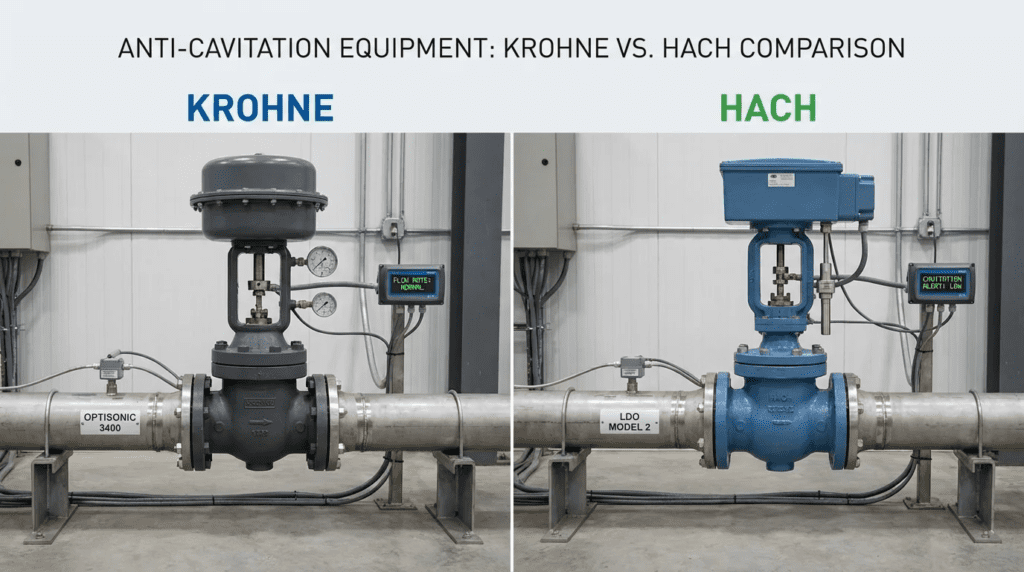
A scope note belongs up front in any Krohne vs Hach Anti-Cavitation Equipment: Comparison & Best Fit evaluation. Neither company manufactures anti-cavitation valves or valve trim. That equipment comes from valve manufacturers — Cla-Val, Val-Matic, Bermad, DeZURIK and similar. Krohne is an independent, family-owned process instrumentation manufacturer known for electromagnetic and Coriolis flow measurement. Hach, now part of Veralto following its separation from Danaher, is a water quality and flow monitoring specialist.
What these two companies actually supply for cavitation management is the precision instrumentation used to detect the onset of cavitation and trigger control action — a variable frequency drive ramp-down or a pump lockout. That is a real and consequential specification decision. If a flow meter’s signal drops out due to the noise generated by cavitation bubbles, the control system goes blind, and it may ramp up pump speed and worsen the damage.
Krohne and Hach represent two distinct sensing philosophies here. Krohne supplies inline process instrumentation for pressurized piping. Hach supplies open-channel and level monitoring that prevents the hydraulic conditions — low submergence, vortexing — that cause cavitation in the first place. Broader supplier positioning is covered in our overview of the top water treatment equipment manufacturers.
How to Select and Specify
Instrumentation that functions as cavitation protection must maintain signal integrity in a multi-phase flow regime — liquid plus vapor bubbles. Standard datasheet accuracy figures assume single-phase liquid and tell you nothing about this.
Duty Conditions & Operating Envelope
- Flow rates and turndown: Cavitation occurs at very low flow (recirculation cavitation) and at very high flow (suction-limited cavitation). The device must hold accuracy across a wide turndown ratio to detect both extremes.
- Gas volume fraction: Vapor bubbles form when a pump cavitates. Standard magnetic flow meters begin hunting or dropping out once entrained gas becomes significant. Coriolis meters with entrained-gas handling algorithms maintain tube oscillation through much higher gas fractions, including slug flow, keeping the control loop alive.
- Pressure transients: Cavitation collapse generates localized shockwaves. Liner and electrode materials must withstand these micro-blasts without pitting or delamination.
Materials & Compatibility
- Liner selection: For magnetic flow meters, PFA liners generally resist the vacuum conditions created by cavitation better than PTFE, which can collapse or buckle under negative pressure.
- Electrode material: In cavitating sludge lines, standard 316L electrodes may suffer signal noise from particle impingement. Hastelloy or titanium electrodes stabilize the reading during cavitation events.
- Abrasion resistance: Where grit is present, collapsing bubbles drive solids into the liner wall. Ceramic liners, or polyurethane for non-corrosive abrasive slurries, may be necessary.
Hydraulics & Process Performance
To prevent cavitation, instrumentation must supply the data needed to calculate net positive suction head available in real time.
- Response time: The instrument needs a rapid step response to catch the sudden drop in flow efficiency that marks cavitation onset.
- Signal damping: Over-damped signals mask the hydraulic noise that serves as early warning. Require adjustable damping so operators can see raw flow volatility during troubleshooting.
- Process constraints: Non-intrusive acoustic and ultrasonic technologies struggle with dense bubble populations during active cavitation. Electromagnetic measurement penetrates the flow profile but requires a conductive fluid.
Installation Environment & Constructability
- Straight run: Magnetic meters typically require several pipe diameters upstream and downstream to read accurately. Reduced-run and zero-diameter models exist for constrained installations but may lack the diagnostic sensitivity cavitation detection needs.
- Vibration immunity: Cavitating pumps generate significant vibration. Remote-mount transmitters are effectively mandatory, and the cable between sensor and transmitter must be shielded against interference from large pump motors.
Reliability & Failure Modes
- Failure behavior: Does the meter hold the last good value, go to zero, or send a fault signal when it detects entrained gas? A meter that holds the last value is dangerous — it tells the drive that flow is normal while the pump is air-locked or cavitating.
- Diagnostics: Conductivity monitoring is a useful secondary indicator. A sudden drop often means gas bubbles are covering the electrodes. Map this diagnostic to SCADA as a distinct cavitation alarm, separate from low-flow.
Controls & Automation
- Protocols: Industrial digital protocols carry secondary variables such as conductivity or signal-to-noise ratio. A hardwired analog signal transmits only flow, so the operator never sees the diagnostic data that predicts cavitation.
- Control strategy: Instrumentation must feed a control loop. When entrained gas is detected, the strategy should shift from flow control to a speed limit mode that protects the pump.
Lifecycle Cost Drivers
- Repair avoidance: Replacing a cavitated impeller on a mid-sized pump costs several times what a capable flow meter costs. In severe service the instrumentation pays for itself quickly, though the payback depends heavily on how often the plant actually experiences cavitation.
- Calibration stability: Drift in flow readings can lead operators to run pumps faster than necessary, pushing them toward cavitation. Long-term stability reduces that risk.
Comparison Tables
| Criteria | Krohne (inline process instrumentation) | Hach, Veralto (open channel and level) |
|---|---|---|
| Primary technology | Electromagnetic flow (OPTIFLUX series) and Coriolis mass flow (OPTIMASS) with entrained gas handling | Non-contact radar area-velocity (Flo-Dar), submerged area-velocity, ultrasonic level |
| Cavitation detection method | Direct: Coriolis units maintain measurement through entrained gas; mag meters flag conductivity shifts and electrode noise | Indirect: Monitors wet well level and channel velocity to prevent the vortexing and low-submergence conditions that cause cavitation |
| Gas tolerance | High on Coriolis with entrained gas management; moderate on mag meters, which flag rather than measure through heavy gas | Not applicable to pressure pipe; high tolerance for surface turbulence in open channels |
| Typical application | Pump discharge piping, return and waste sludge lines, pressurized force mains | Influent channels, wet well level, gravity sewer lines, outfalls |
| Maintenance profile | Low. No moving parts. Electrode coating in fatty fluids may require a cleaning circuit. | Moderate. Submerged sensors need clearing of ragging and grease; radar requires clear line of sight. |
| Limitation | Requires conductive fluid for mag meters; full pipe for best accuracy; intrusive installation | Not suitable for pressurized pump discharge where high-head cavitation occurs |
| Application | Primary Risk | Best Fit | Rationale |
|---|---|---|---|
| Raw sewage lift station | Vortexing at low wet well level | Hach level monitoring plus a standard mag meter | Prevention is the goal. Radar level data unaffected by foam or grease stops pumps before air entrainment occurs. |
| Return activated sludge | Entrained gas from aeration basins; viscous fluid | Krohne mag meter with noise diagnostics | Sludge frequently carries gas bubbles. Diagnostic-capable meters distinguish gas interference from genuine flow change. |
| High-head water booster | Suction head falling below pump requirement | Krohne inline metering | Precise discharge flow measurement compared against the pump curve reveals internal recirculation. |
| Effluent outfall | Gravity flow, partially filled pipe | Hach Flo-Dar | Non-contact area-velocity handles variable levels without the head loss of an inline meter. |
| Chemical or polymer dosing | Off-gassing, pulsating flow | Krohne Coriolis with entrained gas management | Coriolis meters with gas-handling algorithms continue measuring rather than stalling when bubbles dampen tube oscillation. |
Engineer & Operator Field Notes
Commissioning & Acceptance Testing
- The air injection test: Where safe, introduce air on the suction side or lower the wet well level to induce minor vortexing, and watch the SCADA trend. A standard meter shows hash or drops to zero. A gas-tolerant meter should maintain a readable value and set a diagnostic bit.
- Damping adjustment: Factory default damping is often set high to smooth the output. For cavitation detection, lower it during startup to visualize flow instability, then raise it only enough to stabilize control loops.
- Zero point verification: Ensure the pipe is full and flow is genuinely zero before setting the baseline. Zeroing a meter with entrapped air produces a permanent offset error across the entire range.
Common Specification Mistakes
- Over-smoothing the signal: Engineers often specify high damping to get a clean line on the trend screen. This hides the hydraulic instability that destroys pumps.
- Ignoring conductivity changes: In wastewater, conductivity shifts with rain events. Some older mag meters interpret those shifts as flow spikes. Ensure the selected device has filtering that distinguishes chemical change from flow change.
- Material mismatch: Specifying standard PTFE liners for suction-side service. Cavitation creates vacuum conditions that can collapse PTFE. Use PFA or ceramic on any meter located on a pump suction line.
O&M Burden & Strategy
- Cleaning intervals: In sludge service, grease coats mag meter electrodes and insulates them from the fluid. This presents as signal loss, which mimics air entrainment. Scheduled cleaning, or use of built-in electrode cleaning circuits, is what lets you tell a dirty sensor from a cavitating pump.
- Submerged sensor maintenance: For area-velocity probes in the flow stream, ragging is the enemy. They are designed to shed debris, but heavy ragging changes the velocity profile reading. Regular pull-and-clean routines are standard in unscreened raw sewage.
Troubleshooting
- Flow reading erratic, swinging widely. Likely cavitation or air entrainment. Compare against motor amps. If amps oscillate with flow, it is physical cavitation. If amps are steady but flow jumps, suspect electrical noise or electrode fouling.
- Flow reads zero but the pump is running. Likely an empty pipe detection trigger. Heavy gas entrainment trips this alarm on standard meters. Check the empty pipe threshold setting on the transmitter.
Design Details & Calculations
Sizing Methodology
Size the meter to maintain velocity high enough to sweep air bubbles through the sensor, preventing accumulation at the top of the pipe where they blind the electrodes.
- Minimum velocity: Size so that minimum operating flow yields at least 2 to 3 ft/s (0.6 to 0.9 m/s). This is generally enough to keep gas bubbles entrained rather than separating out.
- Suction head monitoring logic: Available suction head equals atmospheric head plus static head, minus friction head and vapor pressure head. Use a level sensor to determine static head from wet well level, and the flow meter to calculate friction loss, which varies with the square of flow. Feed both into the controller to calculate available suction head in real time, and derate drive speed when the margin above the pump’s requirement drops below a defined safety threshold.
Standards
- AWWA M33: Guidelines for flowmeters in water supply practice
- ISO 4064: Water meter accuracy classes
- NEMA 4X / IP68: Required for instrumentation in pump galleries or wet wells given flooding and washdown risk
Frequently Asked Questions
Do Krohne or Hach make anti-cavitation valves?
No. Anti-cavitation trim, multi-stage orifice plates and cavitation-control valve internals come from valve manufacturers such as Cla-Val, Val-Matic, Bermad and DeZURIK. Krohne and Hach supply the instrumentation that detects cavitation conditions and feeds the control system that responds to them. Engineers specifying the valve hardware itself should be working from a valve manufacturer’s sizing tools and cavitation index guidance.
What is the difference between Krohne and Hach for cavitation applications?
Krohne specializes in inline process instrumentation for pressurized piping — electromagnetic and Coriolis flow meters that keep measuring, or at least keep flagging, under difficult multi-phase conditions. Hach specializes in analytical and open-channel flow and level monitoring, which suits wet well level and influent channel work where the goal is preventing the low-submergence conditions that cause cavitation.
Can a flow meter stop pump cavitation?
Not by itself. It provides the data the control system needs to stop it. By detecting flow instability or the entrained-gas signature, the meter lets the controller reduce drive speed or stop the pump before damage accumulates.
Why do standard magnetic flow meters fail during cavitation?
Magnetic flow meters require a continuous conductive path between electrodes. Vapor bubbles passing over the electrodes break that circuit, so the signal drops to zero or spikes wildly. Coriolis meters with entrained gas handling are designed to maintain measurement under these conditions; mag meters generally flag the condition rather than measuring through it.
How does wet well level monitoring prevent cavitation?
Low wet well levels create vortices that draw air into the pump suction. That air behaves much like cavitation bubbles, causing vibration and performance loss. A reliable level sensor setting a hard pump-stop level keeps the pump out of the air-entrainment zone entirely.
Is ultrasonic or electromagnetic better for detecting cavitation?
Electromagnetic meters are generally superior on wastewater pump discharges. Transit-time ultrasonic meters struggle badly with the dense micro-bubbles cavitation generates and often lose signal completely. Mag meters with advanced diagnostics are more robust in multiphase conditions.
Conclusion
Key Takeaways
- Know the scope: Neither company makes anti-cavitation valves. They make the instrumentation that detects the condition and drives the control response.
- Define the goal: Krohne suits process control — measuring through or flagging the bubbles. Hach suits condition prevention — monitoring levels to keep air out.
- The gas problem: Standard flow meters fail when pumps cavitate. Specify entrained-gas handling if cavitation is a genuine risk.
- Liner matters: Use PFA liners for vacuum and suction service to prevent liner collapse during cavitation events.
- Control logic: The hardware is useless without logic. Integrate noise and conductivity diagnostics into SCADA to trigger drive clamp-down modes.
The decision here is not a binary choice between brands but a selection of sensing location and physics. Where the primary risk is internal recirculation or suction-lift cavitation in pressurized piping, Krohne’s inline instrumentation provides the robustness required to keep control loops alive during upset conditions.
Where the risk stems from intake hydraulics, vortexing or wet well management, Hach’s open-channel flow and level portfolio offers the better defense by preventing the conditions that let air into the pump. For critical lift stations, a hybrid approach using level monitoring at the intake and inline metering on the discharge yields the highest reliability. Related evaluations appear in our comparison of Krohne and Thermo Fisher instrumentation for cavitation-prone service, ABB and Emerson instrumentation, and YSI and SCADATA instrumentation.