
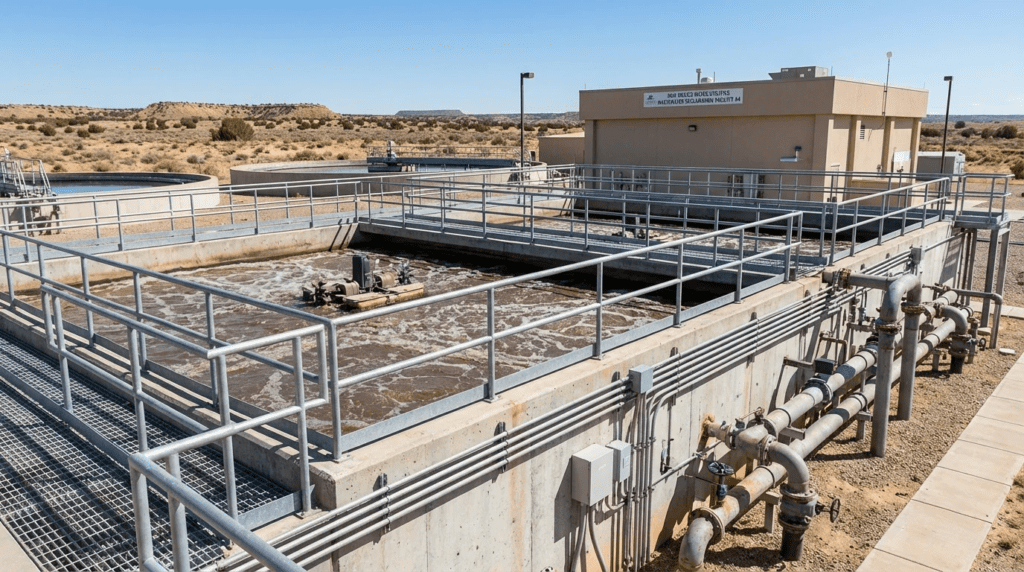
1. Introduction to New Mexico’s Water & Wastewater Infrastructure
New Mexico’s water and wastewater infrastructure operates at the critical intersection of extreme water scarcity, rapid urban population growth, and aging legacy systems. As an arid state heavily reliant on constrained groundwater aquifers and the heavily allocated Rio Grande and Colorado River basins, New Mexico treats wastewater not merely as a disposal challenge, but as a critical component of its statewide water portfolio. The state is home to approximately 140 permitted municipal wastewater treatment facilities, serving a population of roughly 2.1 million residents with a combined statewide design treatment capacity exceeding 200 million gallons per day (MGD).
The regulatory environment in New Mexico is unique. Because New Mexico is one of only three states that does not have National Pollutant Discharge Elimination System (NPDES) primacy, the U.S. EPA Region 6 issues discharge permits, while the New Mexico Environment Department (NMED) provides Section 401 water quality certification. However, a significant percentage of New Mexico’s treatment plants are “zero-discharge” facilities that do not discharge into waters of the U.S. Instead, these facilities operate under Groundwater Discharge Permits (DPs) issued by the NMED Ground Water Quality Bureau, relying on evaporation, agricultural application, or advanced aquifer storage and recovery (ASR).
Today, New Mexico’s water utility engineers and municipal decision-makers are shifting aggressively toward advanced water reuse, potable reuse feasibility, and stringent nutrient removal. With severe drought exacerbating base flow conditions in receiving waters like the Rio Grande, maximizing treatment capacity and effluent quality remains an urgent priority for the state’s engineering and operational workforce.
2. Recent Developments & Infrastructure Projects
Over the last three years, New Mexico has seen a historic influx of capital directed toward water infrastructure modernization, heavily catalyzed by the Bipartisan Infrastructure Law (IIJA) and enhanced Clean Water State Revolving Fund (CWSRF) allocations. In the 2023-2024 funding cycles alone, NMED managed over $120 million in active SRF and grant funding aimed at wastewater treatment plant upgrades, collection system rehabilitations, and climate resilience projects.
One of the most defining recent developments is the state’s aggressive pursuit of water reuse. The Albuquerque Bernalillo County Water Utility Authority (ABCWUA) has been pioneering advanced Aquifer Storage and Recovery (ASR) projects and indirect potable reuse (IPR) strategies. Similarly, the City of Rio Rancho recently initiated expansions to its Pure Water equivalent injection well systems, utilizing advanced membrane bioreactor (MBR) and reverse osmosis (RO) technologies to recharge the depleted Santa Fe Group aquifer.
Innovative technology deployment is accelerating rapidly. State regulators and engineering firms are closely watching the outcomes of the New Mexico Produced Water Research Consortium, a public-private partnership exploring the treatment and reuse of oil and gas wastewater for non-potable applications outside the oilfield. On the municipal side, ultraviolet (UV) disinfection replacements are phasing out legacy chlorine contact basins statewide to meet tighter toxicity limits in EPA Region 6 NPDES permits.
Climate resilience has become a mandatory design parameter. Facilities along the Rio Grande corridor are raising critical electrical infrastructure and headworks above newly established 500-year flood elevations, adapting to the intense, localized flash flooding characteristic of the region’s shifting monsoon season. Furthermore, the push for energy efficiency is driving multi-million-dollar digester gas-to-energy upgrades and solar array installations at facilities in Albuquerque, Santa Fe, and Las Cruces.
3. Top 20 Largest Treatment Plants in New Mexico
The following table represents the 20 largest wastewater treatment plants in New Mexico, ranked by permitted design capacity (MGD). Data is compiled from NMED Ground Water Quality Bureau databases, EPA ECHO, and municipal utility capital improvement plans.
| Rank | Plant Name | City/Location | Design Capacity (MGD) | Population Served | Operating Authority |
|---|---|---|---|---|---|
| 1 | Southside Water Reclamation Plant (SWRP) | Albuquerque | 76.0 MGD | 600,000 | ABCWUA |
| 2 | Jacob A. Hands Wastewater Treatment Facility | Las Cruces | 14.5 MGD | 110,000 | City of Las Cruces |
| 3 | Paseo Real Water Reclamation Facility | Santa Fe | 13.0 MGD | 85,000 | City of Santa Fe |
| 4 | Rio Rancho WWTF #2 (Cabezon) | Rio Rancho | 10.0 MGD | 70,000 | City of Rio Rancho |
| 5 | Farmington Wastewater Treatment Plant | Farmington | 9.0 MGD | 45,000 | City of Farmington |
| 6 | Clovis Wastewater Treatment Plant | Clovis | 8.0 MGD | 38,000 | City of Clovis |
| 7 | Roswell Wastewater Treatment Plant | Roswell | 7.0 MGD | 47,000 | City of Roswell |
| 8 | Carlsbad Wastewater Treatment Plant | Carlsbad | 6.0 MGD | 30,000 | City of Carlsbad |
| 9 | Hobbs Wastewater Reclamation Facility | Hobbs | 6.0 MGD | 40,000 | City of Hobbs |
| 10 | Alamogordo Wastewater Treatment Plant | Alamogordo | 5.5 MGD | 31,000 | City of Alamogordo |
| 11 | Gallup Wastewater Treatment Plant | Gallup | 5.5 MGD | 22,000 | City of Gallup |
| 12 | Los Alamos Wastewater Treatment Plant | Los Alamos | 3.5 MGD | 18,000 | Los Alamos County |
| 13 | Silver City Wastewater Treatment Plant | Silver City | 3.0 MGD | 10,000 | Town of Silver City |
| 14 | Deming Wastewater Treatment Plant | Deming | 3.0 MGD | 14,000 | City of Deming |
| 15 | Las Vegas Wastewater Treatment Plant | Las Vegas | 2.8 MGD | 13,000 | City of Las Vegas |
| 16 | Artesia Wastewater Treatment Plant | Artesia | 2.5 MGD | 12,000 | City of Artesia |
| 17 | Belen Wastewater Treatment Plant | Belen | 2.5 MGD | 7,500 | City of Belen |
| 18 | Portales Wastewater Treatment Plant | Portales | 2.5 MGD | 12,000 | City of Portales |
| 19 | Lovington Wastewater Treatment Plant | Lovington | 2.0 MGD | 11,000 | City of Lovington |
| 20 | Sunland Park Wastewater Treatment Plant | Sunland Park | 2.0 MGD | 17,000 | CRRUA |
Detailed Profiles of the Top 5 Largest Facilities
Southside Water Reclamation Plant (SWRP) – Rank #1
- Location: Albuquerque, Bernalillo County, NM
- Design Capacity: 76.0 MGD
- Current Average Flow: 52.0 MGD
- Population Served: ~600,000 residents
- Operating Authority: Albuquerque Bernalillo County Water Utility Authority (ABCWUA)
- Receiving Water: Rio Grande (NPDES Permit via EPA Region 6)
- Service Area: Albuquerque, parts of Bernalillo County
Treatment Process:
- Preliminary: Mechanical bar screens, aerated grit chambers.
- Primary: Circular primary clarifiers.
- Secondary: Advanced activated sludge with biological nutrient removal (BNR) for nitrogen.
- Tertiary: UV disinfection (recently upgraded from chlorine).
- Advanced: Significant portion diverted to industrial/turf reuse via the North I-25 reclamation pipeline.
Infrastructure:
- Biosolids handling: Anaerobic digestion, centrifuge dewatering. Biosolids are composted and applied beneficially.
- Energy use: Co-generation facility captures biogas (methane) producing over 2 MW of electricity, covering ~30% of plant power demand.
- Odor control: Biofilters and activated carbon scrubbers at headworks.
Recent Upgrades/Notable Features: SWRP recently completed a massive $25M outfall restructuring to improve mixing zones in the Rio Grande, adapting to lower river flows. ABCWUA is currently advancing its WIN (Water INvestment) program to evaluate direct potable reuse (DPR) potential.
Compliance & Performance: Consistently meets stringent EPA Region 6 NPDES limits for BOD, TSS, and ammonia. Recipient of NACWA Peak Performance Awards.
Link: View full SWRP facility page
Jacob A. Hands Wastewater Treatment Facility – Rank #2
- Location: Las Cruces, Doña Ana County, NM
- Design Capacity: 14.5 MGD
- Current Average Flow: 9.2 MGD
- Population Served: 110,000 residents
- Operating Authority: City of Las Cruces Utilities
- Receiving Water: Rio Grande
Treatment Process: Conventional activated sludge upgraded to modified BNR, anoxic zones for denitrification, secondary clarification, and UV disinfection. Generates Class A+ reclaimed water for local parks and golf courses.
Recent Upgrades: A major $15M aeration basin upgrade was recently completed, replacing aging blowers with high-efficiency turbo blowers, reducing energy consumption by 20%.
Paseo Real Water Reclamation Facility – Rank #3
- Location: Santa Fe, Santa Fe County, NM
- Design Capacity: 13.0 MGD
- Current Average Flow: 6.5 MGD
- Population Served: 85,000 residents
- Operating Authority: City of Santa Fe
- Receiving Water: Santa Fe River (effluent dominated) / Ground Water Recharge
Treatment Process: Activated sludge, anaerobic digestion, UV disinfection. The plant is crucial for Santa Fe’s water portfolio, providing reclaimed water for the Municipal Recreation Complex and significant return flow credits.
Recent Upgrades: Completed a comprehensive $18 million anaerobic digester rehabilitation project in 2022, led by Carollo Engineers, improving biosolids stabilization and biogas capture.
Rio Rancho WWTF #2 (Cabezon) – Rank #4
- Location: Rio Rancho, Sandoval County, NM
- Design Capacity: 10.0 MGD
- Current Average Flow: 5.8 MGD
- Population Served: 70,000 residents
- Operating Authority: City of Rio Rancho
- Receiving Water: Zero discharge to surface water; Aquifer Injection / Reuse
Treatment Process: Membrane Bioreactor (MBR) technology, UV disinfection. Produces extremely high-quality effluent required for direct aquifer injection under NMED Discharge Permits.
Recent Upgrades: Rio Rancho is actively expanding its Aquifer Storage and Recovery (ASR) injection well network to bank treated wastewater, buffering against long-term drought.
Farmington Wastewater Treatment Plant – Rank #5
- Location: Farmington, San Juan County, NM
- Design Capacity: 9.0 MGD
- Current Average Flow: 5.0 MGD
- Population Served: 45,000 residents
- Operating Authority: City of Farmington
- Receiving Water: San Juan River
Treatment Process: Orbal oxidation ditches, clarification, and UV disinfection. Features extensive solids handling including belt filter presses.
Recent Upgrades: Recently underwent an $8M headworks and grit removal overhaul, combating high abrasive loads from storm inflow.
Large Regional & Municipal Plants (Rank 6-20)
Large Regional Plants (Rank 6-10)
- Clovis WWTP – Clovis: 8.0 MGD capacity. Operates zero-discharge to playa lakes; expanding agricultural reuse to conserve the Ogallala Aquifer.
- Roswell WWTP – Roswell: 7.0 MGD capacity. Upgraded trickling filter/activated sludge process. Heavy focus on agricultural water reuse.
- Carlsbad WWTP – Carlsbad: 6.0 MGD capacity. Operated by City of Carlsbad. Currently evaluating capacity upgrades due to Permian Basin oil boom population growth.
- Hobbs WRF – Hobbs: 6.0 MGD capacity. Utilizes BNR. Heavily invested in turf irrigation for parks to offset potable groundwater use.
- Alamogordo WWTP – Alamogordo: 5.5 MGD capacity. Operates under an NMED Groundwater Discharge Permit; 100% of effluent used for landscaping/agriculture or evaporation.
Major Municipal Plants (Rank 11-15)
- Gallup WWTP – Gallup: 5.5 MGD capacity. Transitioning to advanced solar drying for biosolids; key node for regional Navajo Nation water planning.
- Los Alamos WWTP – Los Alamos: 3.5 MGD capacity. Highly advanced nutrient removal; provides cooling water for Los Alamos National Laboratory (LANL).
- Silver City WWTP – Silver City: 3.0 MGD capacity. Features extensive constructed wetlands for final effluent polishing.
- Deming WWTP – Deming: 3.0 MGD capacity. Oxidation ditch technology; effluent supports regional agriculture.
- Las Vegas WWTP – Las Vegas: 2.8 MGD capacity. Critical facility recovering from historic Hermits Peak/Calf Canyon wildfire watershed impacts.
Significant Facilities (Rank 16-20)
- Artesia WWTP (2.5 MGD) – Upgrading SCADA and headworks components.
- Belen WWTP (2.5 MGD) – Recently installed advanced UV disinfection.
- Portales WWTP (2.5 MGD) – Exploring MBR tech to combat rapid Ogallala depletion.
- Lovington WWTP (2.0 MGD) – Zero discharge, evaporation and land application.
- Sunland Park WWTP (2.0 MGD) – Operated by Camino Real Regional Utility Authority (CRRUA), bordering Texas/Mexico.
4. Plants with Approved Budgets & Expansion Projects
Driven by population shifts, stringent EPA nutrient requirements, and IIJA infrastructure funding, New Mexico has over $350 million in active or planned wastewater capital improvement projects. Below is a breakdown of the state’s major infrastructure initiatives.
A. MAJOR PROJECTS UNDER CONSTRUCTION (2024-2026)
Albuquerque SWRP – $45 Million Secondary Treatment & Aeration Upgrade
- Location: Albuquerque, Bernalillo County
- Project Scope: Complete replacement of legacy aeration basins, implementation of high-efficiency magnetic bearing turbo blowers, and advanced dissolved oxygen (DO) control integration.
- Total Budget: $45.2 million
- Funding Breakdown:
- 60% Water/Sewer Revenue Bonds ($27.1 million)
- 40% CWSRF Loan ($18.1 million)
- Timeline: Design completed Nov 2023; Construction start Mar 2024; Expected completion Dec 2025.
- Key Contractors: Design Engineer: HDR Inc.; General Contractor: RMCI Inc.
- Project Drivers: Aging infrastructure (30+ year old blowers), energy optimization targets, and stricter ammonia limits in the upcoming EPA NPDES permit cycle.
- Expected Benefits: Guaranteed 25% reduction in aeration energy consumption; saving ABCWUA over $400k annually in power costs.
Santa Fe Paseo Real WRF – $22 Million San Juan-Chama Return Flow Project
- Location: Santa Fe, Santa Fe County
- Project Scope: Construction of a new tertiary membrane filtration train and an 11-mile return flow pipeline to discharge high-quality effluent directly into the Rio Grande.
- Total Budget: $22.5 million
- Funding Breakdown: $12M IIJA Federal Grant, $10.5M Local matching funds/Bonds.
- Timeline: Construction start Aug 2024; Projected in-service date Q2 2026.
- Technology Upgrades: Ultrafiltration (UF) skids, advanced oxidation process (AOP) pilot testing.
- Project Drivers: Securing return flow credits to allow Santa Fe to pump more potable water from its Buckman Direct Diversion wellfields.
B. PROJECTS IN DESIGN/PLANNING PHASE (2025-2027)
- Las Cruces Jacob Hands WWTF – Biosolids Upgrade: Estimated $18 million budget. Funded by pending WIFIA loan and local bonds. Scope includes new anaerobic digester covers, mixing systems, and advanced dewatering centrifuges. Expected construction start: 2025.
- Carlsbad WWTP – Capacity Expansion Phase 1: Estimated $28 million budget. Pending SRF approval. Scope: Expanding design capacity from 6.0 MGD to 8.5 MGD to handle Permian Basin population boom. Expected start: 2026.
- Rio Rancho WWTF #2 – Aquifer Recharge Expansion: Estimated $15 million budget. Secured state legislative appropriations. Scope: Drilling three new deep injection wells and expanding MBR throughput. Expected start: 2025.
- Portales WWTP – Pure Water Feasibility: Estimated $12 million. Planning phase for transitioning from conventional secondary treatment to advanced MBR for IPR/agriculture reuse.
- Gallup WWTP – Solar Farm & Microgrid Integration: Estimated $8 million. Scope: 2 MW solar array with battery storage to run headworks and aeration during grid outages.
C. RECENTLY COMPLETED MAJOR PROJECTS (2022-2024)
- Albuquerque SWRP Outfall Reconstruction: Completed Dec 2023. Investment: $25 million. Redesigned the Rio Grande discharge structure to prevent bank erosion and optimize mixing during historic low river flows.
- Hobbs WRF UV Disinfection Replacement: Completed May 2023. Investment: $4.5 million. Replaced obsolete UV banks with TrojanUV systems, ensuring consistent coliform compliance for turf irrigation.
- Santa Fe Anaerobic Digester Rehab: Completed Q4 2022. Investment: $18 million. Upgraded heating systems and gas capture, recognized by NMWEA for Engineering Excellence.
- Los Alamos WRF BNR Optimization: Completed early 2024. Investment: $6.2 million. Improved denitrification channels to meet newly imposed EPA nitrogen limits.
Summary Statistics: New Mexico Wastewater Capital Investments
- Total Active Capital Investment: ~$350 million currently under construction or in final design.
- Number of Plants with Major Active Projects: 18 facilities statewide.
- Total New Capacity Being Added: ~12 MGD across expanding municipalities (focus on Southeast NM).
- Average Project Size: $14.5 million.
- Primary Project Drivers: Water reuse/ASR integration (40%), Aging infrastructure/energy efficiency (35%), Capacity expansion in oil/gas regions (15%), Regulatory compliance (10%).
- Funding Source Breakdown: Revenue Bonds/Local Funds ($150M), Clean Water SRF ($120M), IIJA Federal Grants/Forgivable Loans ($80M).
Industry Implications: New Mexico represents a highly specialized, growing market for engineering firms and equipment vendors. Because the state prioritizes water reuse and zero-discharge setups over traditional surface water discharge, there is exceptional demand for membrane technologies (UF/RO), advanced UV/AOP disinfection, and aquifer storage injection well engineering. Additionally, with energy costs rising, process automation (SCADA) and high-efficiency blower retrofits are prime procurement targets.
5. Regulatory & Compliance Landscape
Unlike most states, New Mexico does not have primacy over the National Pollutant Discharge Elimination System (NPDES) program. Facilities that discharge to waters of the U.S. (like the Rio Grande or San Juan River) receive their permits directly from EPA Region 6 in Dallas, Texas. The New Mexico Environment Department (NMED) Surface Water Quality Bureau reviews these permits to provide Section 401 certification, ensuring compliance with state water quality standards established by the Water Quality Control Commission (WQCC).
However, the majority of New Mexico’s WWTPs do not discharge to surface waters. Instead, they land-apply effluent, use evaporation ponds, or utilize Aquifer Storage and Recovery (ASR). These facilities are strictly regulated by the NMED Ground Water Quality Bureau under Groundwater Discharge Permits (DPs), which require compliance with standard limits of 10 mg/L for Total Nitrogen to protect the state’s vulnerable aquifers.
Emerging Contaminants (PFAS): NMED is aggressively monitoring PFAS (per- and polyfluoroalkyl substances). While current focus is on groundwater contamination near military bases (Cannon and Holloman AFBs), NMED is working with EPA Region 6 to include PFAS monitoring requirements in upcoming NPDES permit renewals for municipal WWTPs, forcing utilities to begin evaluating advanced RO or Granular Activated Carbon (GAC) treatments.
6. Infrastructure Challenges & Opportunities
Severe Drought and Aquifer Depletion: The primary driver of infrastructure strategy in New Mexico is water scarcity. Decades of drought have significantly reduced Rio Grande surface flows, forcing reliance on groundwater. The opportunity lies in Direct Potable Reuse (DPR) and Indirect Potable Reuse (IPR). Engineering firms capable of designing closed-loop water cycles are in high demand.
Aging Infrastructure in Historic Cities: Cities like Santa Fe and Albuquerque are dealing with collection systems that are 75 to 100+ years old. Infiltration and Inflow (I&I) during intense summer monsoons cause hydraulic overloading at headworks. This necessitates major capital planning for trenchless pipe rehabilitation (CIPP) and robust grit-removal headworks expansions.
Workforce Shortages: Like much of the U.S., New Mexico faces a critical shortage of certified Level 3 and 4 wastewater operators. This gap is accelerating the adoption of advanced SCADA systems, AI-driven process controls, and remote monitoring capabilities to operate plants with leaner staff.
7. Technology Trends in New Mexico
Because every drop of water is highly valued, New Mexico WWTPs deploy some of the most advanced treatment technologies in the Southwest:
- Membrane Bioreactors (MBR): Rapidly replacing conventional activated sludge in medium-sized plants (like Rio Rancho) to produce reuse-quality effluent in a smaller physical footprint.
- Advanced Oxidation Processes (AOP) & RO: As utilities push toward Direct Potable Reuse, AOP and Reverse Osmosis pilots are becoming standard practice for removing trace pharmaceuticals and emerging contaminants.
- Solar & Biogas Optimization: Due to the state’s immense solar potential, plants are installing megawatt-scale solar arrays to offset the high energy costs of aeration. Simultaneously, plants with anaerobic digesters are upgrading to high-efficiency combined heat and power (CHP) engines.
- Water Reuse Networks: “Purple pipe” infrastructure continues to expand, delivering Class A+ reclaimed water to golf courses, public parks, and industrial users (like Intel in Sandoval County) to preserve potable supplies.
8. Complete Directory of Facilities
Browse our comprehensive directory of water and wastewater treatment plants in New Mexico. (Links will direct to individual facility pages)
Major Regional Facilities (>10 MGD)
- Southside Water Reclamation Plant (SWRP) – Albuquerque
- Jacob A. Hands WWTF – Las Cruces
- Paseo Real WRF – Santa Fe
- Rio Rancho WWTF #2 (Cabezon) – Rio Rancho
Large Municipal Plants (5-10 MGD)
- Farmington WWTP
- Clovis WWTP
- Roswell WWTP
- Carlsbad WWTP
- Hobbs WRF
- Alamogordo WWTP
- Gallup WWTP
Medium-Sized Plants (2-5 MGD)
- Los Alamos WWTP
- Silver City WWTP
- Deming WWTP
- Las Vegas WWTP
- Artesia WWTP
- Belen WWTP
- Portales WWTP
- Lovington WWTP
- Sunland Park WWTP
Smaller Community Plants (< 2 MGD)
- Edgewood WWTP
- Taos Regional WWTP
- Truth or Consequences WWTP
- Socorro WWTP
- Ruidoso/Ruidoso Downs Regional WWTP
- View full list of 100+ small municipal facilities…
9. Resources for Engineers & Operators
For professionals managing, designing, or operating wastewater infrastructure in New Mexico, the following resources are essential:
- New Mexico Water Environment Association (NMWEA): The state’s premier organization for water professionals, hosting the annual Rocky Mountain Water Conference.
- New Mexico Environment Department (NMED): The primary state regulatory body. Specifically, the Utility Operator Certification Program handles licensing.
- New Mexico Rural Water Association (NMRWA): Provides critical technical assistance, training, and legislative advocacy for systems serving populations under 10,000.
- Clean Water State Revolving Fund (CWSRF): Managed by the NMED Construction Programs Bureau, offering low-interest loans and principal forgiveness for WWTP capital projects.
10. Frequently Asked Questions
How many wastewater treatment plants are in New Mexico?
There are approximately 140 permitted municipal wastewater treatment facilities in New Mexico. The majority are smaller, zero-discharge facilities, while larger facilities are concentrated along the Rio Grande corridor.
What are the 5 largest treatment facilities in New Mexico?
The top five are the Albuquerque Southside Water Reclamation Plant (76.0 MGD), Las Cruces Jacob A. Hands WWTF (14.5 MGD), Santa Fe Paseo Real WRF (13.0 MGD), Rio Rancho WWTF #2 (10.0 MGD), and Farmington WWTP (9.0 MGD).
Which plants in New Mexico have major expansion projects underway?
Major active projects include Albuquerque SWRP’s $45M aeration upgrade, Santa Fe’s $22M San Juan-Chama Return Flow project, and major biosolid/capacity expansions in Las Cruces and Carlsbad.
What funding is available for treatment plant upgrades in New Mexico?
Municipalities primarily utilize the NMED-administered Clean Water State Revolving Fund (CWSRF), federal grants via the Bipartisan Infrastructure Law (IIJA), WIFIA loans, state legislative capital outlay appropriations, and municipal revenue bonds.
What treatment technologies are most common in New Mexico?
While traditional activated sludge is common, advanced technologies like Membrane Bioreactors (MBR), Ultraviolet (UV) disinfection, and Aquifer Storage and Recovery (ASR) injection systems are rapidly expanding due to the state’s emphasis on water reuse.
How is New Mexico addressing PFAS contamination at WWTPs?
NMED is actively surveying PFAS levels statewide. Through coordination with EPA Region 6, NPDES permits are beginning to require PFAS influent and effluent monitoring. Future capital plans are evaluating RO and GAC filtration for mitigation.
What are the operator certification requirements in New Mexico?
Operators must be certified through the NMED Utility Operator Certification Program, which issues classes of licenses (Small Water/Wastewater, and Levels 1 through 4) based on education, experience, and standardized examination.
Does New Mexico issue its own NPDES permits?
No. New Mexico is one of only three states without NPDES primacy. The U.S. EPA Region 6 (Dallas) drafts and issues surface water discharge permits, while NMED provides Section 401 certification. However, NMED solely issues Groundwater Discharge Permits for zero-discharge and reuse facilities.