
Understanding Nitrification and Denitrification in Wastewater Treatment
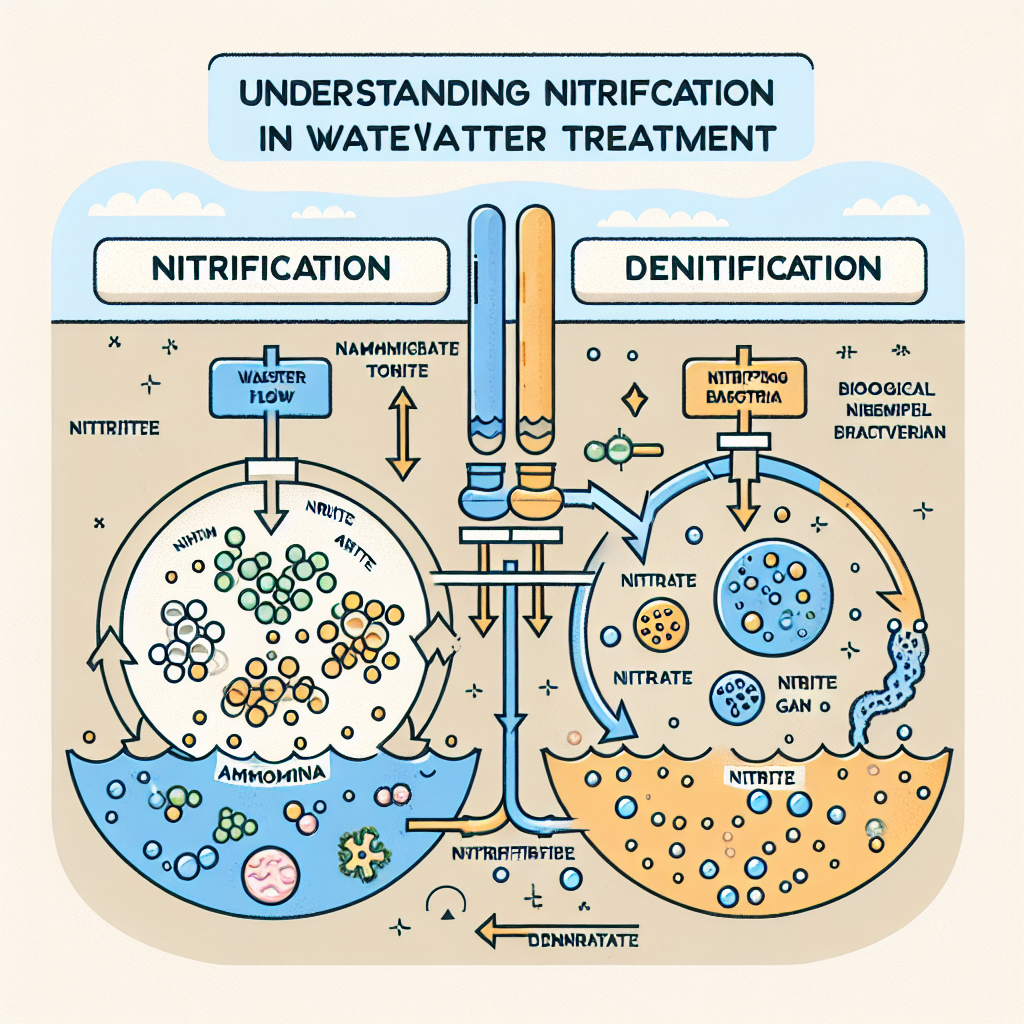
Understanding Nitrification and Denitrification in Wastewater Treatment
Meeting tight effluent nitrogen limits demands a clear grasp of the nitrification denitrification process and how it responds to changing loads, temperature, and carbon availability. This practical guide unpacks the microbial pathways and stoichiometry behind ammonia oxidation and nitrate reduction, provides numeric design and operating ranges for SRT, DO, internal recycle and alkalinity, and lays out monitoring, control and troubleshooting steps operators and engineers can apply in full-scale wastewater treatment.
1. Microbial and Biochemical Fundamentals of Nitrification
Key point: Nitrification is a two step, autotrophic oxidation performed by distinct slow growing microbial guilds; sustaining them in full scale systems requires controlling solids retention time, dissolved oxygen, and alkalinity simultaneously. The two biochemical steps are: ammonia oxidation to nitrite by ammonia oxidizing bacteria and archaea, and nitrite oxidation to nitrate by nitrite oxidizing bacteria.
Pathway and stoichiometry
Stoichiometry: Ammonia oxidation: NH4+ + 1.5 O2 -> NO2- + H2O + 2H+ . Nitrite oxidation: NO2- + 0.5 O2 -> NO3- . Overall: NH4+ + 2.0 O2 -> NO3- + H2O + 2H+. Practical consequence: expect roughly 4.57 g O2 per g NH4-N oxidized and an alkalinity consumption on the order of 7.1 mg as CaCO3 per mg NH4-N oxidized. Calculate alkalinity demand up front and provide chemical dosing if plant alkalinity is marginal.
Environmental sensitivities that matter in operation
- Temperature: Nitrifier growth rates fall quickly with temperature. Design SRT for the lowest expected operating temperature rather than the seasonal average.
- pH and inhibition: Optimal activity is near pH 7.5 to 8.5. Free ammonia and free nitrous acid inhibit nitrifiers; compute FA and FNA from total concentrations and pH before assuming a process change will work.
- Dissolved oxygen: Nitrifiers need stable DO. Target DO setpoints trade off aeration cost versus nitrite accumulation risk.
- SRT sensitivity: Nitrifiers have low yield. Short SRTs wash them out first when load or temperature shifts.
Practical insight: Running low DO to save energy can be effective only if SRT, internal mixing, and monitoring are tightened. In practice low DO favors incomplete oxidation and nitrite buildup if SRT is marginal or internal hydraulics create DO pockets in anoxic zones.
Concrete example: A 10 MGD municipal plant retrofitted with IFAS carriers kept nitrification stable through winter because biofilm attached biomass buffered nitrifiers against washout and temperature stress. After retrofit the plant shortened the mixed liquor SRT for solids handling but maintained nitrification because carriers hosted most of the slow growing nitrifiers. See the IFAS retrofit discussion in our activated sludge process operations guide for similar cases.
When troubleshooting recurring nitrite or failed nitrification first verify SRT and DO stability, then check alkalinity and pH shifts before chasing exotic inhibitors.
2. Denitrification Microbiology and Electron Donors
Core point: Denitrification is a heterotrophic, stepwise reduction of nitrate to N2 driven by bacteria that need a suitable electron donor and true anoxic conditions. Choice and delivery of carbon control not only removal efficiency but the risk of intermediates such as nitrous oxide.
Electron donor selection and practical stoichiometry
Donor range: For conventional heterotrophic denitrification plan on roughly 2.4 to 3.2 mg COD per mg NO3-N removed depending on the carbon source and process losses. Acetate gives the fastest kinetics and clean uptake; methanol is inexpensive and widely used but requires methylotrophic populations and longer contact times; glycerol and fermentation-derived VFAs are flexible intermediates with mixed performance and dosing complications.
- Acetate: Rapid conversion, low residual COD, higher chemical cost—best where kinetics or low N2O risk matter.
- Methanol: Cost-effective for municipal plants with stable operations but needs methylotroph maintenance and careful dosing control.
- Glycerol / Fermentate: Good balance when onsite fermentation is available; variable composition requires online checks for residual COD.
Trade-off that matters: Operators routinely undersize carbon dosing because of cost pressure. Under-dosing commonly produces nitrous oxide and residual nitrate; overdosing wastes chemical dollars and creates downstream oxygen demand and BOD violations. Pick the least expensive donor that reliably meets kinetics under your hydraulic and biomass conditions, not just lowest unit price.
Microbial community and emission consequences
Community effect: Denitrifying genera such as Pseudomonas and Paracoccus vary in whether they complete the full reduction chain to N2 or stop at N2O. A community dominated by organisms lacking the nosZ gene is more likely to emit N2O even with adequate carbon. Managing community composition through carbon quality, SRT, and avoiding toxic shocks pays off more than tweaking DO alone.
Operational control: Maintain well-mixed anoxic zones, avoid oxygen intrusion from poorly sealed mixers or recirculation pumps, and size internal recycle so nitrate mass is delivered at the contact time implied by your chosen donor kinetics (practical internal recycle ratios often fall between 2 and 4 times influent flow in full-scale plants). Use ORP trends to verify active reduction rather than relying on intermittent grab samples.
Concrete example: A 5 MLD plant converted primary sludge fermentation to supply VFAs into their anoxic tanks and replaced most methanol dosing. The plant cut external methanol by about two thirds, improved denitrification rates so anoxic detention could be halved, and saw lower N2O reports during seasonal transitions because VFAs supported faster, more complete reduction.
Select carbon by kinetics and manageability, not price alone. Short contact-time systems need acetate or fermentate; long contact-time systems tolerate methanol but must maintain methylotroph populations.
3. Process Configurations and When to Use Them
Configuration drives which microbial processes are reliable and which operational controls will matter most. Pick a layout to match your hardest constraint: cold temperature, limited footprint, variable flow, or lack of carbon. That choice determines whether you invest in more aeration, more internal recycle plumbing, biofilm carriers, or a sidestream deammonification train.
Practical tradeoff: Compact systems like MBRs and IFAS reduce footprint and secure nitrifier biomass, but they raise energy and maintenance burdens. Conversely, long, staged activated sludge trains with multiple anoxic zones give better nitrogen polishing at lower energy per volume but require larger basins and more complex hydraulics to avoid short circuiting.
How to decide
Match configuration to three questions: what is the effluent TN target, what carbon is available, and which stream is highest ammonia? If you need single digit TN on a constrained site, IFAS or MBR with staged anoxic/aerobic control is realistic. If most ammonia is in a concentrated sidestream, invest in partial nitritation anammox for the sidestream and keep mainstream conventional BNR. See our practical notes on anammox and deammonification for sidestream sizing and limits.
| Configuration | Best use case | Key advantage | Main tradeoff |
|---|---|---|---|
| MLE / Bardenpho / A2O | Municipal plants with predictable flow and moderate footprint | Proven fullstream BNR with excellent effluent TN control | Requires correct internal recycle and careful DO staging to avoid oxygen intrusion |
| SBR | Sites with wide load swings or phased upgrades | Flexible cycle control for integrated nitrification and denitrification | Needs flow equalization and cycle management; continuous influent can complicate timing |
| IFAS / MBBR | Plants needing nitrifier capacity without new tanks | Adds fixed biomass for nitrification while keeping MLSS lower | Carrier maintenance, increased aeration demand, and potential clogging |
| MBR | Tight solids separation and small footprint targets | Decouples SRT and HRT for long nitrifier SRTs in compact footprint | High energy and membrane maintenance costs; fouling risk |
| Sidestream PN-anammox | High strength centrate or digester reject streams | Large savings in oxygen and external carbon demand | Not suitable for cold, dilute mainstream without costly adaptation |
Concrete example: A 6 MGD plant with winter ammonia exceedances added IFAS carriers to an existing aeration basin. The retrofit stabilized nitrification through cold months and avoided building new tanks, but operators saw a 15 to 20 percent rise in blower run time and had to add screens and a periodic carrier inspection protocol. The plant documented the tradeoff in its capital OPEX analysis before committing to the retrofit; see our activated sludge process operations guide for similar retrofit considerations.
Common misjudgment: Teams often assume one configuration will solve all problems. In practice you trade certainty for cost. IFAS prevents washout but does not remove the need for correct internal recycle, alkalinity management, or carbon planning. Sidestream anammox saves oxygen and carbon only when the sidestream is consistently high strength and reasonably stable.
Takeaway: Choose the nitrification denitrification process layout to match the single toughest plant constraint, then optimize controls and monitoring around that choice rather than expecting a layout alone to guarantee low effluent TN.
4. Design Parameters and Calculations
Key design drivers: SRT, dissolved oxygen control, alkalinity management, and internal recycle together set whether nitrification and denitrification perform reliably or fail intermittently. Treat these as a coordinated design problem, not independent setpoints — changing one almost always forces changes to the others.
Sizing SRT and biomass targets by temperature
SRT guidance: Aim SRT to protect the slowest-growing nitrifiers at your lowest design temperature. For planning purposes select a conservative SRT band rather than a single number: colder plants require much longer SRTs. As an engineering rule, design SRTs that increase roughly twofold to threefold from warm to cold operating conditions; document the minimum sludge inventory and disposal impacts before locking the value into the process design.
DO setpoints and the energy-performance tradeoff: For reliable, continuous ammonia oxidation operate the aerobic zone at moderately higher DO than the lowest energy-saving setpoint. Running very low DO reduces blower energy but raises the risk of nitrite accumulation, uneven nitrifier distribution, and N2O spikes. The practical tradeoff: accept modestly higher aeration power to preserve process stability and reduce excursions that are costly to correct.
Alkalinity and chemical dosing — a calculation workflow
How to calculate alkalinity demand: Use stoichiometry to convert the ammonia load to equivalents of acid produced, then convert equivalents to mass of alkalinity chemical required. Step 1: compute moles of NH4-N to be oxidized. Step 2: multiply by the proton equivalents produced per mole nitrified. Step 3: convert equivalents to mg as CaCO3 (50 mg CaCO3 per meq) to size your dosing. Run the same steps for worst-case daily load and compare to measured influent alkalinity; dose only the deficit plus a safety margin.
Mass-balance example: sizing anoxic contact volume and internal recycle
Practical example: A 4 MLD plant has influent ammonia of 35 mg/L and a target effluent total nitrogen of 10 mg/L. Assume mainstream nitrification converts most ammonia to nitrate; design anoxic removal must remove the nitrate mass above the TN target. Convert flows and concentrations to kg N/day, estimate nitrate load produced after nitrification, then size anoxic time so available biodegradable COD (influent plus step-feed or external carbon) and anoxic TKN removal stoichiometry meet that nitrate mass. Finally choose an internal recycle that delivers that nitrate mass to the anoxic reactor without causing DO carryover — check pump horsepower and hydraulic short-circuit risks in the same step.
Key calculation notes: When computing recycle, match nitrate mass flux (Qr * [NO3-N] in recycle) to the denitrification capacity implied by COD mass and reaction stoichiometry. Oversizing Qr wastes energy and risks oxygen intrusion; undersizing allows nitrate breakthrough. Use a conservative hydraulics factor (10 to 20 percent) for short-circuiting and mixing inefficiencies when you convert mass requirements to hydraulic recycle rates.
- Design checks to include: Verify mixed liquor TSS and F/M after changing SRT; confirm blower capacity at new DO setpoints; run alkalinity dose scenarios across peak loads.
- Operational constraint: If you shorten aerobic HRT or lower SRT to save tank volume, expect higher aeration duty and tighter monitoring to avoid nitrite accumulation.
Judgment: In practice, modestly conservative SRT and slightly higher DO reduce upset frequency more cost-effectively than aggressive cost-cutting on aeration that forces repeated operator interventions and chemical dosing fixes.
5. Monitoring, Instrumentation, and Process Control Strategies
You cannot control what you do not measure correctly. In practice the difference between stable compliance and constant firefighting is not strategy alone but the quality, placement, and maintenance of the sensor network feeding your control logic. Poorly sited probes, unvalidated analyzers, or overaggressive smoothing create control lag that amplifies nitrite, ammonia, and N2O excursions rather than preventing them.
Sensor selection, sample conditioning, and placement
Key elements: Deploy online ammonia, DO, nitrate or ORP, and flow measurement as the control backbone, and add periodic COD/TOC or VFA checks where carbon dosing is used. For mainstream ammonium control consider wet-chemistry or ISE analyzers with automatic sample filtration; raw probes in mixed liquor are fine for DO and ORP but expect biofouling. Placement matters: put ammonia probes after clarifiers or in polishing zones where signal reflects effluent compliance, and place nitrate/ORP in the anoxic feed well or recycle stream where control actions will alter load quickly.
- Practical installation tip: Use bypass holders with automatic wipers or air scouring on critical probes to reduce manual cleaning frequency.
- Sample conditioning: For online ammonia, install thermostatic sample lines and particulate filtration to avoid drift from temperature swings and solids.
- Redundancy: Run secondary probes on critical analyzers and automate cross-checks to detect drift before a permit breach.
Control strategies, logic and failure modes
Basic controls that work in real plants: DO-based PID or cascade control tied to blower VFDs is reliable for steady loads. For tight effluent ammonia targets, use ammonia-based feedback (cascade DO setpoint adjusted by online ammonia) to avoid over-aeration. ORP-guided switching for anoxic mixers prevents oxygen intrusion but must be paired with nitrate trending to avoid false positives when carbon quality changes.
Advanced options — and their limits: Model predictive control or adaptive controllers reduce energy and excursions when you have good historic data and stable sensors; they fail fast with intermittent analyzers or unmodeled sidestream shocks. Expect a higher upfront cost in engineering and commissioning, and plan for a manual fallback strategy that automatically engages when sensor health flags appear.
Practical tradeoff: Spending on reliable analyzers and auto-clean systems is often cheaper than chasing savings with aggressive DO setpoints. In my experience, plants that skimp on maintenance end up using chemical corrections and emergency aeration that outweigh initial savings on instrumentation.
Concrete example: A regional plant replaced time-based aeration schedules with an ammonia-feedback loop using a sampled wet-chemistry analyzer and automatic sample heater. Within weeks effluent ammonia excursions became rare and operators reduced average blower speed during nights without risking permit exceedances; the catch was a disciplined maintenance plan for the sample conditioner and weekly cross-checks with manual grabs.
Control systems are only as good as the data feeding them. Invest in probe placement, redundancy, and a defined fallback control mode before deploying advanced controllers.
Next consideration: tie monitoring strategy to operational procedures. Use trending, automated alarms with meaningful actions, and link to a maintenance work order system so sensor failures trigger service rather than silent data gaps. For further practical guidance on instrument selection and SCADA integration see our monitoring notes in Online Monitoring and Control and the EPA nitrogen control resources at EPA Nutrient Policy.
6. Common Operational Problems and Troubleshooting Recipes
Straight answer: most persistent nitrification-denitrification problems come from a small set of operational failures: mismatched biomass retention, unstable oxygen control, inadequate carbon delivery, and unexpected hydraulics or toxic pulses. Identify which of those is limiting performance before you chase obscure inhibitors.
Nitrite accumulation: fast diagnosis and a practical fix
Quick diagnostic pattern: if effluent ammonia falls while nitrite spikes, check for DO oscillation in the aerobic zone, recent reductions in sludge age, and sudden increases in load or temperature drop that slow nitrite oxidizers more than ammonia oxidizers.
- Immediate actions: raise DO setpoint modestly (accepting higher blower draw) and verify aeration distribution so DO pockets are uniform rather than localized.
- Short term: reduce wasting or lengthen sludge age to retain nitrite-oxidizing biomass; confirm no new upstream toxic discharges or high free-ammonia fractions.
- Follow-up: run a time-series of ammonia, nitrite and DO in the basin for 24–72 hours, then restore energy-efficient DO once nitrite is controlled and nitrifier populations rebalance.
Nitrification collapse after cold weather or toxic shock
Reality check: recovery speed depends on temperature, remaining attached biomass, and whether you preserved nitrifier seed. There is no instant fix; expect days to weeks for meaningful recovery and plan interventions accordingly.
- Triage: stop nonessential wasting and conserve MLSS; maintain stable, slightly elevated DO to minimize additional stress.
- Stabilize chemistry: verify alkalinity and buffer pH so surviving nitrifiers are not further inhibited; add alkalinity only if measured deficits exist.
- Re-seed if necessary: if attached growth media or upstream nitrifying sidestreams exist, transfer biomass or increase internal recycle to speed recolonization.
Insufficient denitrification and high effluent nitrate
Key operational tradeoff: adding external carbon fixes nitrate quickly but increases chemical costs and can raise effluent BOD if overdosed. The smarter move is to confirm delivery and contact time first.
- Check hydraulics: confirm internal recycle pumps deliver expected nitrate mass to the anoxic zone and that mixing avoids short-circuit paths.
- Confirm carbon availability: measure readily biodegradable COD or VFAs at anoxic influent; if low, dose external carbon sized to reaction stoichiometry and contact time.
- Tune contact time: if carbon is adequate but nitrate remains, increase anoxic detention or redistribute step-feed to improve utilization.
Elevated nitrous oxide emissions — practical mitigation
What actually reduces N2O: stable aeration staging and consistent carbon supply matter more than occasional low-oxygen experiments. Rapid DO swings and carbon starvation are the most reliable predictors of emission events in full-scale plants.
- Reduce transients: implement smoother DO ramps or shorter control intervals on blowers to avoid sudden oxygen drops.
- Balance carbon: target anoxic carbon so denitrifiers are not starved during peak nitrate delivery; use ORP trends to detect incomplete reduction.
- Monitor selectively: deploy periodic N2O measurements during transitions (seasonal changes, load surges) to validate that control adjustments lower emissions.
Concrete example: A utilities team saw nitrite spikes after a storm surge increased influent strength and temporarily lowered SRT. They halted sludge wasting, increased DO modestly, and staged external acetate dosing into the anoxic zone for 48 hours. Nitrite returned to acceptable levels within a week while operators evaluated long-term SRT changes and hydraulic bypasses to prevent recurrence.
Next consideration: capture a short event log template and pair it to your DCS alarms so every excursion records recent pump states, DO setpoints, wasting actions, and carbon doses; that record is what separates one-off fixes from durable operational changes. For guidance on sensor placement and alarm logic, see our monitoring notes in Online Monitoring and Control and consult EPA resources at EPA Nutrient Policy.
7. Emerging Technologies, Sidestream Options, and Resource Recovery
Direct point: For most utilities the biggest, near-term nitrogen wins come from targeted sidestream treatment and pragmatic recovery, not speculative mainstream anammox rollouts. Sidestreams concentrate ammonia and remove the economic and biological constraints that make full-scale mainstream autotrophic processes fragile.
Deammonification and partial nitritation-anammox in sidestreams
Where it succeeds: Deammonification is proven for concentrated reject streams because it replaces much of the aeration and external carbon demand with autotrophic conversion. The practical limitation is that it requires stable feed quality and a training period for slow-growing anammox biomass; you should treat it as a separate plant with its own PLC and monitoring, not a simple add-on.
Operational tradeoffs are real: lower energy and chemical costs come at the price of additional process control (strict DO and nitrite control), solids handling for biomass retained on carriers or granular sludge, and more sophisticated startup and upset recovery procedures. Sidestream trains tolerate pulses poorly — include buffer or equalization ahead of the sidestream reactor.
Concrete example: A municipal plant routed anaerobic digester centrate to a pilot PN-anammox train. After a lengthy start-up and a short period of nitrite-control tuning, the sidestream unit handled the majority of centrate ammonia load with much lower blower demand than if the centrate had been treated in the mainstream. The operators retained a small parallel conventional sidestream bypass for rapid recovery during disturbances.
Ammonia recovery, circular economy options, and emissions oversight
Recovery options: Air stripping with acid capture, membrane contactors, and ion-exchange are the realistic routes to convert high-ammonia sidestreams into a saleable or reusable product. Each option requires pretreatment (solids removal, iron control, pH adjustment) and creates secondary wastes or regenerant streams that must be managed.
- Air stripping + acid: Generates an ammonium salt suitable for fertilizer markets but needs low suspended solids and a reliable off-taker.
- Membrane contactors: Lower chemical use and compact footprint but sensitive to fouling and require stable temperature and solids control.
- Ion exchange: Flexible and selective but produces a concentrated brine that demands treatment or beneficial reuse.
Emissions and reporting: New nitrogen pathways change greenhouse gas profiles. Partial nitritation steps can produce N2O if nitrite is not tightly controlled, while full deammonification may lower N2O risk but is not emission-free. Quantify emissions with targeted monitoring during commissioning and transitions; consider periodic chamber or online N2O measurements and include results in permitting discussions and sustainability reporting (see IWA anammox reviews and EPA nutrient resources at EPA Nutrient Policy).
Practical judgment: Pilot rather than speculatively scale mainstream anammox. Sidestream deammonification is mature enough to deliver predictable OPEX reductions when coupled to good equalization, robust nitrite control, and a plan for biomass management. Recovery technologies make sense where downstream markets or onsite reuse exist; otherwise the added chemical and disposal burdens can erase the economic case.
Next consideration: evaluate your plant by asking which stream (mainstream or sidestream) consistently contains the highest ammonia mass — solve that stream first with the simplest, measurable technology and pilot any novel mainstream changes before full deployment.
Frequently Asked Questions
Direct point: This FAQ answers the practical, operational questions operators and engineers use to make decisions about the nitrification denitrification process without hours of digging through manuals.
Short, actionable answers
On SRT in cold weather: Design SRT to protect the slowest nitrifiers at your lowest operating temperature, not the seasonal average. If you are uncertain run a sensitivity check in your mass balance to show how nitrifier biomass and sludge production change as SRT increases, then choose the smallest SRT that still leaves a margin for upset events.
Alkalinity planning: Use the stoichiometry from your nitrification mass balance to compute acid equivalents produced and size chemical dosing from that result. Target a stable pH in the neutral to slightly alkaline range for reliable nitrifier activity and include a safety margin for peak daily loads.
When to pick deammonification: Favor PN-anammox for concentrated, predictable sidestreams with low biodegradable COD. For mainstream applications pilot extensively first; mainstream autotrophic routes remain fragile under low temperature and variable loading and require careful risk management.
Fast fixes for nitrite spikes: Treat nitrite as a signal of imbalance. Immediate actions that work in full-scale plants are stabilizing DO distribution, stopping or reducing wasting to raise solids age, and checking for recent toxic discharges or alkalinity loss. If the root cause is hydraulic short-circuiting, correct mixing or recycle plumbing rather than repeatedly increasing aeration.
Choosing a carbon source: Evaluate donor selection on delivered performance, not unit price. Include kinetics, dosing control, storage and safety handling, and residual COD risk in your costing. Bench or pilot dosing to measure actual VFA uptake and nitrate removal rates before committing to a full-scale switch.
Cutting N2O in practice: The most reliable levers are stable aeration staging to avoid rapid DO swings and ensuring continuous carbon availability during high nitrate flux. Expect a tradeoff: smoothing DO transients and maintaining slightly higher baseline aeration can reduce emissions but raise energy use.
Essential sensors and placement: Minimum useful set is reliable online ammonia, DO, and one anoxic signal such as nitrate or ORP. Place ammonia analyzers where the signal maps to the control objective – for permit compliance choose after a polishing channel or clarifier, not in the mixed liquor. Use heated sample loops and filtration for wet-chem analyzers and build automatic fallback logic into your DCS. See practical instrumentation guidance in Online Monitoring and Control and baseline reference material at the EPA Nutrient Policy.
- Immediate actions you can take: Implement ammonia-feedback control on aeration in a conservative mode and validate with manual grabs for two weeks.
- Short term: Run an SRT sensitivity mass balance for your coldest month and update wasting rules accordingly.
- Medium term: Pilot new carbon donors in a side-stream or a single anoxic basin and track nitrate, residual COD, and N2O during the trial.
- Operational habit: Document and automate a sensor health fallback so controls switch to a safe DO-based mode when an analyzer drifts.
Takeaway: Prioritize fixing the single most likely limiter – biomass retention, oxygen control, or carbon delivery – then use targeted pilots and robust sensors to turn that fix into lasting compliance.