
Progressive Cavity Pump Curve Reading for Operators (BEP Runout Shutoff and Control)
Introduction
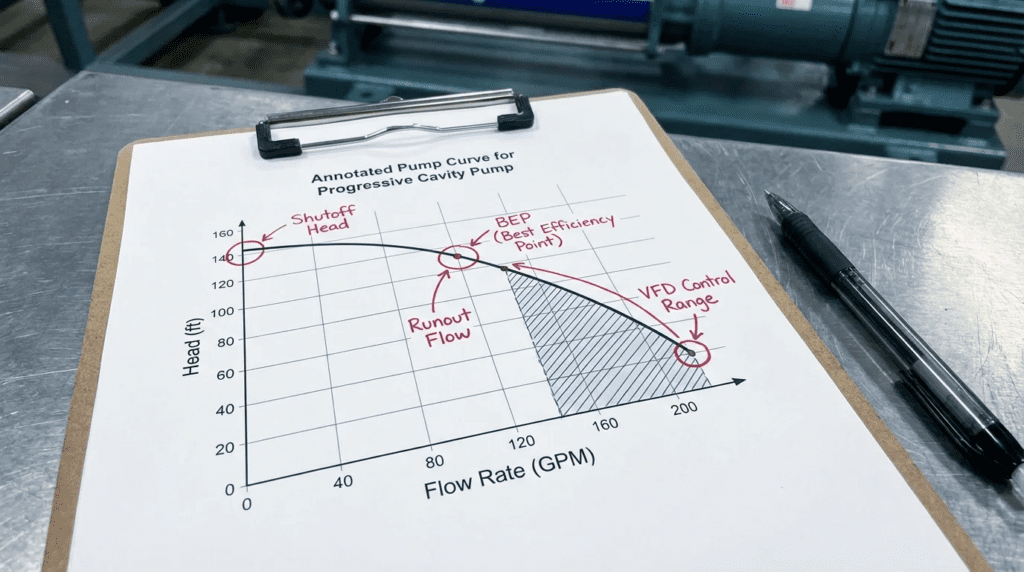
One of the most expensive misunderstandings in wastewater treatment and industrial fluid handling is the assumption that all pumps behave hydraulically like centrifugal pumps. This misconception is particularly dangerous when applied to positive displacement (PD) technology. While a centrifugal pump simply stops flowing when discharge pressure equals its shutoff head, a progressive cavity (PC) pump will continue to build pressure until a catastrophic failure occurs—bursting piping, shearing drive shafts, or burning out motors. For engineers and maintenance supervisors, mastering Progressive Cavity Pump Curve Reading for Operators (BEP Runout Shutoff and Control) is not merely an academic exercise; it is a critical safety and asset management requirement.
Progressive cavity pumps are the workhorses of high-viscosity, abrasive, and shear-sensitive applications. They are ubiquitous in municipal wastewater treatment plants (WWTPs) for primary sludge, thickened waste activated sludge (TWAS), and dewatered cake transfer. In industrial sectors, they handle everything from polymer dosing to food processing pastes. However, the performance curves provided by manufacturers for PC pumps differ radically from the Head-vs-Flow curves standard in centrifugal applications. They often display flow against speed, with multiple lines representing different pressure stages or viscosities.
The consequences of misinterpreting these curves are severe. Specifying a pump at the wrong point on the curve can result in excessive “slip” (internal leakage), leading to premature stator wear—a dominant lifecycle cost driver. Furthermore, failing to understand the torque requirements at the “shutoff” or high-pressure range of the curve can lead to undersized drives or inadequate overload protection. This article aims to bridge the gap between theoretical hydraulics and practical application, helping engineers and operators interpret the nuances of flow, pressure, and efficiency unique to helical rotor technology.
How to Select and Specify Based on Curve Data
Selecting a PC pump requires a shift in mindset from “Head and Flow” to “Pressure and Volume per Revolution.” The curve is not a single line but a relationship between the pump’s geometry, the fluid’s viscosity, and the system’s backpressure. The following criteria outline how to apply Progressive Cavity Pump Curve Reading for Operators (BEP Runout Shutoff and Control) to specification and selection processes.
Duty Conditions & Operating Envelope
Unlike centrifugal pumps, where flow varies significantly with pressure (head), PC pumps are theoretically constant flow devices regardless of pressure. However, in reality, “slip” occurs. When reading the curve, engineers must identify the theoretical flow (a straight diagonal line starting from zero) and the actual flow (which drops below the theoretical line as pressure increases).
The operating envelope must account for:
- Differential Pressure: This dictates the number of “stages” (rotor/stator geometry) required. Typically, one stage is needed for every 75-90 psi (5-6 bar) of pressure capability. Reading the curve incorrectly here leads to “over-pressurizing” a stage, causing extreme heat and rubber hysteresis failure.
- Viscosity Variations: PC pump curves are often published based on water (1 cP). As viscosity increases, slip decreases, making the pump more efficient. Engineers must request derated curves for high-solids sludge to predict actual flow rates accurately.
- Variable Speed Range: The curve should indicate the minimum and maximum RPM. Operating too slow (turndown > 10:1) can cause slip to equal displacement (zero net flow), causing heat buildup. Operating too fast accelerates wear linearly (e.g., doubling speed doubles wear).
Materials & Compatibility
The interaction between the metallic rotor and the elastomeric stator defines the pump’s performance curve. The “tightness” of the interference fit between rotor and stator dictates the volumetric efficiency.
- Elastomer Hardness (Durometer): A harder elastomer allows for higher pressure capabilities (less slip on the curve) but requires higher starting torque. Soft elastomers may show increased slip at high pressures, shifting the operating point on the curve downward.
- Temperature Swell: If the process fluid is hot (e.g., thermal hydrolysis sludge), the stator elastomer will expand. If the curve selection didn’t account for this by undersizing the rotor, the increased interference will spike torque requirements, potentially exceeding the motor’s capability shown on the power curve.
- Abrasion Resistance: High grit content requires lower operating speeds. On the curve, this means selecting a larger pump frame running at the bottom 25-30% of its RPM range rather than a small pump running at 100% RPM.
Hydraulics & Process Performance (BEP and Slip)
In centrifugal pumps, Best Efficiency Point (BEP) is a specific flow/head point. In PC pumps, BEP is less distinct but generally refers to the balance between volumetric efficiency and mechanical longevity.
- Volumetric Efficiency: Defined as $Q_{actual} / Q_{theoretical}$. A healthy PC pump operates with high volumetric efficiency (typically >85%). If the curve shows efficiency dropping below this at the target pressure, the pump is undersized or the fluid is too thin for the pressure demanded.
- NPSH Requirements: PC pumps have excellent suction lift (NPSHr), but the curve must be checked for NPSHr at the specific operating speed. NPSHr rises with speed. High viscosity fluids dramatically increase inlet losses, often requiring an “auger feed” or open hopper design rather than a standard tubular inlet.
Engineering Insight: Never assume the “Shutoff” point on a PC curve is a safe operating limit. It represents a theoretical mechanical limit, typically far beyond the burst pressure of standard piping.
Reliability, Redundancy & Failure Modes
Curve reading directly impacts reliability analysis. A pump operating near the “Runout” of its pressure curve (i.e., maximum rated pressure for the number of stages) will have a significantly shorter Mean Time Between Failures (MTBF) than one operating at 50% of its rated pressure.
- Torque Curves: Manufacturers provide torque vs. pressure curves. Engineers must specify motors with sufficient safety margins (typically 1.15 to 1.25 service factor) above the maximum operating torque shown on the curve, including “breakaway torque” which can be 3-4 times the running torque.
- Dry Run Failure: The curve assumes fluid presence for lubrication. Running dry destroys the stator in seconds. Reliability specifications must include TSE (Temperature Sensor in Elastomer) or flow switch protection, as the curve cannot predict dry run survival.
Controls & Automation Interfaces
PC pumps are ideal for flow control because their performance curve is linear. This simplifies the control loop compared to centrifugal pumps.
- Linearity: $Flow propto Speed$. A VFD signal of 50% roughly equates to 50% flow (minus slip). This allows for precise feed-forward control in dosing applications without complex PID derivative terms.
- Torque Monitoring: Modern VFDs can monitor torque. By correlating the VFD torque reading to the manufacturer’s pressure-torque curve, operators can infer discharge pressure without a pressure gauge, acting as a virtual sensor for pump protection.
Lifecycle Cost Drivers
The initial purchase price of a PC pump is often dwarfed by the cost of stators and rotors over 20 years. Curve selection drives this cost.
- Speed = Wear: Wear in a PC pump is proportional to the speed squared or cubed depending on abrasiveness. Selecting a pump to run at 200 RPM (larger frame) vs. 400 RPM (smaller frame) for the same flow curve will drastically reduce OPEX.
- Energy Efficiency: While PC pumps are generally efficient, operating them at high pressures increases the “friction horsepower” generated by the rotor/stator rubbing. The curve will show Brake Horsepower (BHP). Operating at the lower end of the pressure capability saves energy.
Comparison Frameworks
To effectively utilize Progressive Cavity Pump Curve Reading for Operators (BEP Runout Shutoff and Control) principles, it helps to contrast PC technology with other common pump types and to understand where they fit in the application matrix. The following tables provide a structured comparison for engineers evaluating system designs.
Table 1: Centrifugal vs. Progressive Cavity Curve Characteristics
This table highlights the fundamental differences in how performance data is presented and interpreted between the two most common pump technologies in water infrastructure.
| Characteristic | Centrifugal Pump Curve | Progressive Cavity (PC) Pump Curve |
|---|---|---|
| Primary Plot Axes | Vertical Axis: Head (ft/m) Horizontal Axis: Flow (GPM/m³/h) |
Vertical Axis: Flow (GPM/m³/h) or Power Horizontal Axis: Speed (RPM) |
| Flow Response to Pressure | Variable: Flow decreases significantly as pressure (head) increases. Stops at shutoff head. | Rigid: Flow remains nearly constant as pressure increases, minus a small amount of “slip.” |
| Shutoff Condition | Finite Head: Pump reaches maximum pressure and churns fluid. Dangerous over time (heat), but rarely bursts pipe immediately. | Infinite Pressure: Pump continues to build pressure until torque limit is reached or something breaks (pipe, stator, shaft). Requires Relief Valve. |
| BEP (Best Efficiency Point) | Distinct Peak: A specific flow rate where hydraulic efficiency is highest. Deviation causes vibration/cavitation. | Broad Range: Efficiency is high across most of the curve. “BEP” is often defined by wear rates (low speed) rather than hydraulics. |
| Control Strategy | VFD shifts the entire curve down. Throttling valves move operation along the curve (inefficient). | VFD changes flow linearly. NEVER use a throttling valve. Flow is strictly speed-dependent. |
Table 2: Application Fit Matrix
Use this matrix to determine if a PC pump is the correct selection based on fluid constraints and operational requirements.
| Application Scenario | Viscosity / Solids | Pressure Requirement | Shear Sensitivity | Curve Recommendation |
|---|---|---|---|---|
| Polymer Dosing | High Viscosity / Low Solids | Medium (50-100 psi) | Critical (Polymer chains break easily) | Select for extremely low RPM to minimize shear. Curve must show linear low-flow stability. |
| Primary Sludge / TWAS | Medium Viscosity / High Abrasives | Low to Medium | Low | Select larger frame size to run at <250 RPM. Prioritize wear life over initial efficiency. |
| Dewatered Cake (20%+ Solids) | Extreme Viscosity / Non-Newtonian | High (200-500 psi) | Low | Requires open hopper/auger feed. Curve must account for significant horsepower draw due to friction. |
| Filter Press Feed | Variable | Variable (starts low, ends high) | Low | Complex. Pump must run fast at start (high flow/low pressure) and slow at end (low flow/high pressure). Requires VFD torque control. |
Engineer & Operator Field Notes
Real-world operation often deviates from the clean lines of a manufacturer’s PDF. The following sections provide practical guidance on managing PC pumps in the field, specifically regarding Progressive Cavity Pump Curve Reading for Operators (BEP Runout Shutoff and Control).
Commissioning & Acceptance Testing
During the Site Acceptance Test (SAT), the pump curve serves as the primary validation document. However, verify the following specific points:
- Deadhead Protection Test: Do not test by closing a valve! instead, simulate a high-pressure fault at the pressure switch or transmitter to ensure the VFD trips the pump before the mechanical relief valve opens or the pipe bursts.
- Slip Verification: Run the pump at a fixed speed against an open discharge (low pressure) and record flow. Then, induce backpressure (if possible via a control valve downstream of a relief loop) to rated pressure. Measure flow again. The difference is the slip. If slip is significantly higher than the curve predicts (e.g., >15%), the stator compression may be insufficient, or the fluid viscosity is lower than specified.
- Starting Torque: Measure the amperage draw at startup. PC pumps have high static friction. If the drive trips on “Overcurrent” immediately, check if the “Start Boost” or “IR Compensation” on the VFD is enabled. The curve’s torque value usually represents running torque, not breakaway torque.
Common Specification Mistakes
- Oversizing for Safety: Engineers often apply a 2x safety factor to flow. In a PC pump, running a large pump too slowly (e.g., <50 RPM) can cause "chatter" or stick-slip resonance in the drive train, leading to u-joint failure.
- Ignoring Run-Dry: Failing to specify a dedicated run-dry protection device. The curve assumes the fluid acts as the lubricant/coolant. Without fluid, the stator reaches destruction temperature in minutes.
O&M Burden & Strategy
Maintenance strategies should be linked to curve performance monitoring:
- Efficiency Tracking: Operators should periodically record Speed (Hz/RPM) vs. Flow. If the pump requires 45 Hz today to move the same flow that required 40 Hz last year, the stator is wearing. This “slip increase” is a predictive maintenance indicator.
- Retensioning (if applicable): Some stators are adjustable. As the curve shifts (performance drops), operators can tighten the stator to restore volumetric efficiency. This should be done carefully to avoid excessive torque spikes.
- Lubrication: The U-joints (gear joint or pin joint) are critical weak points. Unlike the hydraulic curve, these have a mechanical fatigue life. Follow strict grease intervals (typically every 2000-4000 hours).
Troubleshooting Guide
- Symptom: No Flow.
Curve Check: Is the pump turning? If yes, is the suction line empty? PC pumps are self-priming but cannot pull a vacuum if the rotor/stator seal is dry (air leakage). - Symptom: Low Flow at Rated Speed.
Curve Check: This indicates excessive slip. The discharge pressure may be higher than the pump’s stage rating, or the stator is worn. Check the discharge pressure gauge against the pump’s rated pressure. - Symptom: Motor Overload/Trip.
Curve Check: Check the system pressure. Is there a blockage? Remember, the PC pump will try to push infinite pressure, drawing infinite current until the VFD trips.
Design Details and Calculations
When engineering a system involving Progressive Cavity Pump Curve Reading for Operators (BEP Runout Shutoff and Control), quantitative analysis is required to ensure the selected equipment matches the hydraulic profile.
Sizing Logic & Methodology
The fundamental equation for PC pump output is:
$$Q_{total} = (V_{cavity} times RPM) – Q_{slip}$$
Where:
- $V_{cavity}$: The theoretical displacement per revolution (based on geometry).
- $Q_{slip}$: Internal leakage, which is a function of $frac{Delta P}{Viscosity}$.
Step 1: Calculate Total Pressure (PSI/Bar).
Sum the static lift and friction losses. Note that friction losses for non-Newtonian fluids (sludge) are significantly higher than water. Use the Bingham Plastic or Power Law model for friction loss calculations if solids > 2%.
Step 2: determine Stages.
Rule of Thumb: Limit pressure to ~75-85 PSI (5-6 Bar) per stage.
Example: If discharge pressure is 150 PSI, specify a 2-stage pump. If you specify a 1-stage pump, the slip will be excessive, and the curve reading will show the pump operating in an inefficient, high-wear zone.
Step 3: Select RPM based on Abrasiveness.
| Fluid Type | Max Recommended Speed |
| Clean Water / Polymer | 350 – 600 RPM |
| Secondary Sludge (WAS) | 250 – 350 RPM |
| Primary Sludge / Grit | 150 – 200 RPM |
Specification Checklist
To ensure specification-safe procurement, include the following requirements:
- Performance Testing: Require a factory test curve showing Flow vs. Speed at 0%, 50%, and 100% rated pressure.
- Overpressure Protection: Specify a diaphragm seal pressure switch or transmitter interlocked to the VFD, plus a mechanical pressure relief valve (PRV) or rupture disk in a bypass loop.
- Stator Material: Explicitly state the chemical and temperature compatibility (e.g., Nitrile vs. Viton vs. EPDM).
- Drive Service Factor: Motor HP must cover the “Runout” of the pressure curve, not just the operating point.
Standards & Compliance
- API 676: The primary standard for Positive Displacement Pumps – Rotary. While heavily Oil & Gas focused, it provides excellent mechanical rigor for shaft deflection and bearing life.
- HI (Hydraulic Institute) Standards: Refer to HI 3.1-3.5 for Rotary Pump nomenclature, testing, and operation.
- ISO 9001: Ensure the manufacturer operates under a quality management system to guarantee rotor/stator tolerance consistency.
Frequently Asked Questions
Below are common queries regarding Progressive Cavity Pump Curve Reading for Operators (BEP Runout Shutoff and Control) and general PC pump operation.
What defines “Runout” on a progressive cavity pump curve?
Unlike centrifugal pumps where runout refers to high flow at low head, “runout” in PC pumps typically refers to exceeding the pressure rating of the elastomeric stages or the mechanical speed limit of the drivetrain. Operating beyond the pressure limit causes the stator rubber to deform excessively, leading to rapid “chunking” of the rubber and potential rotor destruction. It can also refer to the torque limit of the motor.
How do you identify the Best Efficiency Point (BEP) for a PC pump?
PC pumps do not have a single hydraulic BEP like centrifugal pumps. Instead, the “efficiency” is best viewed as Volumetric Efficiency (VE). The optimal operating range is where VE is typically above 85-90%. Mechanically, the “Best” operating point is usually at 50-70% of the pump’s maximum rated speed, balancing output volume against abrasive wear rates.
Why is the “Shutoff” condition so dangerous in PC pumps?
A PC pump is a positive displacement device. Every rotation traps a fixed volume of fluid and forces it downstream. If the discharge is blocked (shutoff), the fluid cannot compress. The pump will continue to build pressure linearly with every fraction of a rotation until the weakest component fails. This pressure can easily exceed 1,000 PSI in a system rated for 150 PSI, leading to pipe bursts or pump explosions. See the [[Reliability, Redundancy & Failure Modes]] section for protection strategies.
How does viscosity affect the pump curve reading?
Standard curves are usually plotted using water (1 cP). As fluid viscosity increases (e.g., thick sludge), the “slip” decreases because thicker fluid doesn’t leak back past the rotor seal as easily. This means at high viscosities, the pump delivers more flow per RPM than on water, closer to the theoretical displacement line. However, line friction losses also increase drastically, requiring higher horsepower.
What is the typical lifespan of a PC pump stator?
Stator life varies wildly based on application. In clean polymer service, a stator may last 5-10 years. In gritty primary sludge or lime slurry, it may last 6-18 months. Life is inversely proportional to speed; doubling the pump speed can reduce stator life by factor of 4. Proper curve selection (choosing a larger pump running slower) is the best way to extend life.
Can I control flow by throttling the discharge valve?
Absolutely not. Never throttle the discharge of a PC pump. Throttling creates artificial backpressure, which increases torque, heat, and wear without reducing flow (until the pressure relief valve opens). Flow control must be achieved solely by varying the pump speed via a Variable Frequency Drive (VFD).
What is the difference between starting torque and running torque?
PC pumps have an interference fit between the metal rotor and rubber stator. Breaking this static friction requires significant force, known as “breakaway” or starting torque, which can be 3-4 times higher than the running torque. Engineers must size the motor and VFD to handle this initial spike, often utilizing NEMA Design C or D motors or sensorless vector control drives.
Conclusion
Key Takeaways: PC Pump Curve Mastery
- Pressure vs. Flow: PC pumps deliver nearly constant flow regardless of pressure. Do not read the curve looking for a flow drop-off to self-regulate pressure.
- Shutoff Risk: There is no hydraulic shutoff limit. You must rely on external relief valves and high-pressure switches to prevent catastrophic failure.
- Slip Interpretation: The gap between the theoretical flow line and the actual flow line is “slip.” Excessive slip generates heat and indicates wear or undersizing.
- Speed Kills: Selecting a pump to run at the far right of the speed curve minimizes CAPEX but maximizes OPEX. Aim for 30-60% of max speed for abrasive fluids.
- Control Linearity: Flow control is simple and linear via VFD. Never throttle valves.
- Torque is King: Ensure motors are sized for the worst-case pressure and starting friction, not just the nominal operating point.
Mastering Progressive Cavity Pump Curve Reading for Operators (BEP Runout Shutoff and Control) is a fundamental skill for ensuring the safety and longevity of water and wastewater systems. While they lack the self-limiting hydraulic characteristics of centrifugal pumps, PC pumps offer unmatched capabilities in handling viscous, abrasive, and shear-sensitive fluids. The key to successful application lies in understanding that the curve represents a mechanical displacement capability rather than a hydraulic energy gradient.
Engineers must specify these pumps with a clear understanding of the interplay between viscosity, speed, and pressure stages. Operators must monitor these parameters to predict stator wear and prevent run-dry or over-pressure events. By respecting the physics of the helical rotor and utilizing the VFD as the primary control element, utilities can transform PC pumps from high-maintenance headaches into reliable, long-term assets. When in doubt regarding a complex sludge profile or a high-pressure application, consulting with the manufacturer for a specific application curve—rather than a generic water curve—is always the prudent engineering decision.