
Propeller Pump Troubleshooting: Symptoms
Introduction
In high-volume municipal flood control, stormwater management, and industrial water transport, the axial flow “propeller” pump is the workhorse of the hydraulic world. However, their unique specific speed characteristics and sensitivity to intake conditions make them prone to issues that differ significantly from standard centrifugal pumps. Engineers and operators frequently overlook the subtle precursors to failure, leading to catastrophic downtime during critical wet-weather events. Propeller Pump Troubleshooting: Symptoms must be understood not just as a reaction to failure, but as a diagnostic framework applied throughout the equipment’s lifecycle.
A surprising number of propeller pump failures—estimated at over 40% in some municipal districts—are not mechanical defects of the pump itself, but rather systemic issues related to intake design (submergence) and system curve mismatching. Unlike radial flow pumps, propeller pumps consume maximum horsepower at shut-off head and minimum horsepower at run-out. This counter-intuitive behavior often leads to motor overloads and shaft failures when operators apply standard centrifugal logic to axial flow troubleshooting.
This article provides a rigorous technical analysis for engineering and maintenance leadership. We will move beyond basic maintenance checklists to explore the root causes of Propeller Pump Troubleshooting: Symptoms, the physics of intake vortexing, and the specification strategies required to design reliability into the system from Day One.
How to Select / Specify for Reliability
The most effective way to eliminate future Propeller Pump Troubleshooting: Symptoms is to enforce strict engineering discipline during the selection and specification phase. Propeller pumps (axial flow) operate in a narrow efficiency band and are unforgiving of off-design operation.
Duty Conditions & Operating Envelope
Defining the operating envelope for a propeller pump requires more than a single duty point. Because the power curve rises steeply as flow decreases (shut-off), the engineer must define the entire range of operation.
- Total Dynamic Head (TDH): Propeller pumps are typically limited to heads under 20-25 feet per stage. Accurate calculation of static lift is critical, as friction losses are often a small percentage of the total head in these large piping systems.
- The “Dip” Region: Most axial flow pumps exhibit a performance curve “dip” or unstable region of operation at approximately 40-60% of the Best Efficiency Point (BEP) flow. Specifying continuous operation in this region results in severe vibration and noise.
- Variable Frequency Drives (VFDs): While VFDs offer flow control, they must be specified with caution. Reducing speed pushes the operating point to the left on the system curve, potentially forcing the pump into the unstable “dip” region or causing static head lock-up.
Materials & Compatibility
Material selection dictates the longevity of the bowl assembly and propeller blades, particularly in abrasive stormwater or corrosive seawater applications.
- Propeller Materials: Aluminum bronze or 316 Stainless Steel are standard for resistance to cavitation damage. For abrasive grit environments (common in stormwater), hard-facing or duplex stainless steels (CD4MCu) should be considered.
- Bowl Assemblies: Cast iron is standard, but in brackish water or industrial effluent, Ni-Resist or epoxy-coated bowls are necessary to prevent galvanic corrosion between the bowl and the liner.
- Shaft Sleeves: In water-lubricated bearing designs, the shaft sleeve material must be harder than the grit likely to be present. Chrome oxide coating or solid tungsten carbide sleeves can extend MTBF significantly.
Hydraulics & Process Performance
The hydraulic design must prioritize Net Positive Suction Head Available (NPSHa). Propeller pumps have high specific speeds ($N_s$), making them highly susceptible to cavitation.
- Submergence: This is the single most critical factor. Insufficient submergence leads to surface vortices, air entrainment, and vibration. Specifications must require compliance with ANSI/HI 9.8 regarding minimum submergence relative to the bell diameter.
- Efficiency Curves: Look for a flat efficiency curve if the head varies (e.g., tidal applications). A pump with a peaked efficiency curve may suffer performance degradation with only minor changes in tailwater elevation.
Installation Environment & Constructability
Propeller pumps are generally vertical column installations. The physical constraints of the site often dictate the pump design.
- Intake Structure: The civil design of the intake bay is part of the pump system. Bad civil design (sharp corners, obstructions) creates pre-swirl entering the propeller, which causes uneven loading and bearing failure.
- Column Length & Critical Speed: Long vertical columns have natural frequencies. The specification must require a critical speed analysis (lateral and torsional) to ensure the operating speed is at least 20% away from any natural frequency (resonance).
Reliability, Redundancy & Failure Modes
Engineering for reliability involves anticipating how the machine will fail.
- Bearing Design: Product-lubricated bearings are common but risky in sandy water. Enclosed line shaft designs with oil or clean water flush systems are preferred for abrasive services to prevent premature journal wear.
- Motor Protection: Because power increases at low flow, motor sizing often requires a service factor of 1.15 or must be non-overloading across the entire curve, including shut-off head.
Controls & Automation Interfaces
Modern troubleshooting relies on data. The specification should include sensors that provide early warning of Propeller Pump Troubleshooting: Symptoms.
- Vibration Monitoring: Accelerometers mounted on the motor and (if possible) the bowl assembly.
- Motor Winding Temperature: RTDs in the windings to detect overload or cooling failure.
- Moisture Detection: Sensors in the oil chamber (for submersible motors) or bearing housing.
Maintainability, Safety & Access
Large propeller pumps are heavy and awkward to remove. Design must facilitate O&M.
- Lifting Provisions: Ensure the pump house crane or davit is sized for the entire assembly weight, including the column filled with water (if check valves prevent draining).
- Split Sole Plates: Facilitate the removal of the pump without dismantling the discharge piping in some configurations.
Lifecycle Cost Drivers
While initial CAPEX is important, the energy cost of moving massive volumes of water dominates the lifecycle cost (LCC).
- Efficiency vs. Solids Handling: A tighter gap between the propeller and liner improves efficiency but increases the risk of jamming with debris.
- Replaceable Wear Liners: Specifying replaceable bowl liners allows operators to restore efficiency without replacing the entire bowl assembly, significantly lowering long-term maintenance costs.
Comparison Tables: Technology and Troubleshooting
The following tables provide a comparative look at troubleshooting symptoms relative to pump type and root causes. These tools assist engineers in distinguishing between hydraulic phenomena and mechanical failures.
| Observed Symptom | Primary Hydraulic Cause | Primary Mechanical Cause | Verification Method |
|---|---|---|---|
| High Motor Amps / Overload | Pump operating too far to the left of the curve (near shut-off). High head, low flow. | Binding impeller, bent shaft, or debris jammed between blade and liner. | Check discharge pressure gauge. If high, it’s hydraulic. If normal/low, check for mechanical drag (hand rotation). |
| Vibration (High Frequency) | Cavitation (popping sound like gravel). | Bad bearings or misalignment. | Vibration spectral analysis. Cavitation shows high-frequency broad band energy. Bearings show specific fault frequencies. |
| Vibration (Low Frequency) | Sub-synchronous whirl, intake vortexing, or operating in the “dip” region. | Unbalance (mass) or structural looseness. | Check intake submergence. Verify operating point on the curve. Perform “bump” test for structural resonance. |
| Reduced Flow / Head | Air entrainment due to vortexing; insufficient NPSHa. | Worn propeller blades or increased tip clearance (liner wear). | Visual inspection of intake for vortices. Measure tip clearance against OEM spec (typically 0.010″-0.020″). |
| Surging / Hunting | Unstable operation in the dip region; periodic air intake. | Loose impeller (rare). | Check if discharge valve is throttled incorrectly. Verify sump level stability. |
| Feature | Propeller (Axial Flow) | Mixed Flow | Centrifugal (Radial Flow) |
|---|---|---|---|
| Typical Specific Speed ($N_s$) | 8,000 – 15,000+ | 4,000 – 8,000 | 500 – 3,000 |
| Head Range | Low (5 – 25 ft) | Medium (20 – 60 ft) | High (50 ft +) |
| Power Characteristic | Decreases as flow increases. Highest power at shut-off. | Relatively flat or slight decrease. | Increases as flow increases. Lowest power at shut-off. |
| Startup Procedure | Start with discharge valve OPEN (to minimize starting torque/load). | Depends on specific design. | Start with discharge valve CLOSED (to minimize starting load). |
| Primary Application | Flood control, irrigation, large stormwater. | Raw water intake, moderate lift wastewater. | Water distribution, high-head lift stations. |
Engineer & Operator Field Notes
Real-world experience often diverges from the theoretical curves found in catalogs. The following sections detail practical strategies for managing Propeller Pump Troubleshooting: Symptoms in the field.
Pro Tip: The Reverse-Flow Hazard
Unlike centrifugal pumps, propeller pumps offer very little resistance to reverse flow when off. If a check valve fails in a multi-pump station, backflow can spin the idle pump in reverse at high speeds. If the motor is started while the pump is windmilling in reverse, the resulting torque spike can snap the shaft instantly. Always specify anti-rotation ratchets or verify zero-speed before starting.
Commissioning & Acceptance Testing
Commissioning is the first defense against long-term issues. Acceptance testing must go beyond simple “bump tests.”
- Vibration Baseline: Establish a spectral vibration baseline (ISO 10816-7 category I or II for wastewater). Capture data at minimum, rated, and maximum water levels.
- Resonance Testing: For variable speed units, perform a sweep to identify critical speeds. Lock out these frequencies in the VFD immediately.
- Submergence Verification: Visually inspect the intake for surface vortices (Type 1 or 2) and dye test for subsurface vortices (Type 3) if performance is below curve.
Common Specification Mistakes
Many Propeller Pump Troubleshooting: Symptoms are baked in during the design phase due to poor specifications.
- Over-Sizing the Driver: Engineers often oversize the motor “to be safe.” However, if the pump operates at run-out (high flow, low head), a propeller pump motor is under-loaded. Conversely, if the system head is higher than calculated, the motor overloads.
- Ignoring Intake Hydraulics: Using a standard “sump” design for a 50,000 GPM propeller pump is a recipe for disaster. The Hydraulic Institute (HI) Standard 9.8 regarding approach velocities must be strictly followed.
- Material Mismatch: Specifying standard stainless steel in brackish water with stray currents leads to crevice corrosion.
O&M Burden & Strategy
Maintenance strategies for axial flow pumps differ from radial pumps.
- Lubrication: For oil-lubricated columns, check solenoid oilers daily. For water-lubricated bearings, ensure the pre-lube system is functional and interlocked with the start command.
- Tip Clearance Adjustment: As the propeller blades and liner wear, the gap increases, causing a drastic drop in efficiency and head. Periodic adjustment (re-shimming or adjusting the adjusting nut on the motor stand) is required to restore performance.
Troubleshooting Guide
When symptoms arise, use this logic flow:
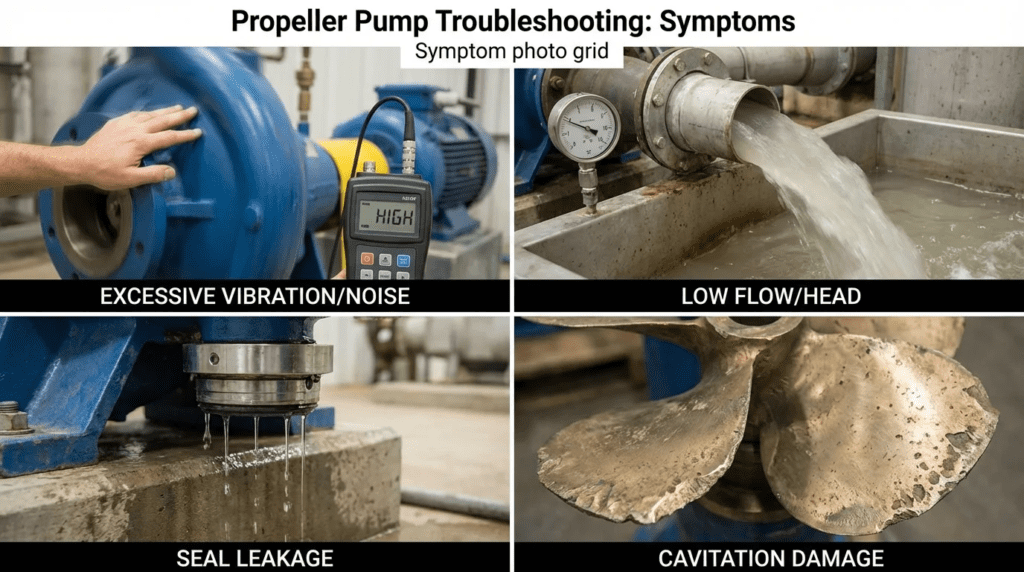
- Symptom: Excessive Noise/Vibration. Check the sump level. Is it below the minimum submergence? If yes, the pump is cavitating or vortexing. Correct the level logic.
- Symptom: High Motor Amps. Check the discharge head. Is there a blockage? Is a flap valve stuck closed? Remember, high head = high amps for these pumps.
- Symptom: Low Flow. Check the impeller tip clearance. If the gap is >0.030″, performance drops rapidly. Also, check for debris wrapped around the blades (ragging).
Design Details & Sizing Logic
To prevent Propeller Pump Troubleshooting: Symptoms related to hydraulic instability, the sizing logic must be precise.
Sizing Logic & Methodology
The selection process should follow a stepwise approach:
- Determine System Curve: Calculate static head accurately. For propeller pumps, static head is often 80-90% of the TDH. Friction losses are secondary.
- Specific Speed Calculation ($N_s$):
$$N_s = frac{N times sqrt{Q}}{H^{0.75}}$$
Where $N$ is RPM, $Q$ is GPM, and $H$ is Head (ft). If $N_s$ is >8,000, you are firmly in the axial flow/propeller domain. - Suction Specific Speed ($N_{ss}$): Check $N_{ss}$ to evaluate cavitation margin.
$$N_{ss} = frac{N times sqrt{Q}}{NPSH_r^{0.75}}$$
Keep $N_{ss}$ below 11,000 for high reliability, although some modern designs allow up to 13,000. - Submergence Calculation: Use the formula $S = D times (1 + 2.3 times F_d)$, where $D$ is bell diameter and $F_d$ is the Froude number, to determine minimum submergence to prevent vortexing. (Refer to HI 9.8).
Common Mistake: Head Calculation Errors
In low-head applications (e.g., 10 ft TDH), a 1-foot error in static head calculation represents a 10% error in system resistance. This can shift the operating point significantly, pushing the pump into an overload or cavitation condition.
Specification Checklist
Ensure your specification document includes:
- Performance Testing: Factory Acceptance Test (FAT) per HI 14.6, Grade 1U (tight tolerances) is recommended for critical large pumps.
- Vibration Limits: Specify limits per HI 9.6.4 or ISO 10816-7.
- Materials: Explicit definition of impeller, bowl, shaft, and sleeve materials based on water chemistry.
- NPSH Margin: Require NPSHa to exceed NPSHr by at least 3-5 feet or a ratio of 1.3, whichever is greater.
Standards & Compliance
- ANSI/HI 9.8: Rotodynamic Pumps for Pump Intake Design (Critical for Propeller Pumps).
- ANSI/HI 14.6: Rotodynamic Pumps for Hydraulic Performance Acceptance Tests.
- AWWA E103: Horizontal and Vertical Line-Shaft Pumps.
Frequently Asked Questions
What is the most common cause of vibration in propeller pumps?
The most common cause of vibration in propeller pumps is insufficient intake submergence leading to vortex formation. When the water level drops below the critical submergence depth, air-entraining vortices form, causing unbalanced loading on the impeller and severe vibration. This is often misdiagnosed as mechanical imbalance. See the [[Introduction]] for more on intake sensitivity.
Why do propeller pump amps increase when the discharge valve is closed?
Unlike centrifugal pumps, propeller (axial flow) pumps have a power curve that rises as flow decreases. They draw maximum power at zero flow (shut-off head). Therefore, starting a propeller pump against a closed valve can trip the motor overload or damage the shaft. They should typically be started with the discharge valve open or timed to open immediately.
How does impeller tip clearance affect Propeller Pump Troubleshooting: Symptoms?
Tip clearance is the gap between the rotating propeller blade and the stationary bowl liner. As this gap increases due to wear, the pump loses the ability to generate pressure, resulting in reduced flow and efficiency. A symptom of excessive clearance is the pump “churning” water without moving it effectively. Clearances should typically be maintained between 0.010″ and 0.020″ depending on the pump size.
What is the “dip” in a propeller pump performance curve?
The “dip” is an unstable operating region, typically occurring between 40% and 60% of the best efficiency flow. In this region, the flow separates from the impeller blades, causing stall, recirculation, high noise, and vibration. Engineers must specify pumps and control logic to prevent continuous operation in this zone.
How often should propeller pumps be pulled for inspection?
Pull intervals depend on the application severity. For clean water flood control, 5-7 years is typical. For abrasive stormwater or grit-heavy wastewater, pumps may need inspection every 2-3 years to check liner wear and bearing clearances. Vibration monitoring trends (predictive maintenance) should drive this schedule rather than arbitrary time intervals.
What is the difference between axial flow and mixed flow pumps?
Axial flow (propeller) pumps push water parallel to the shaft and are best for high flow/low head (under 25 ft). Mixed flow pumps use both lift and centrifugal force, discharging water at an angle, making them suitable for medium heads (20-60 ft). Using a propeller pump in a mixed-flow application usually results in mechanical failure due to excessive head. Refer to [[Table 2]] for a detailed comparison.
Conclusion
Key Takeaways
- Power Curve Inversion: Remember that propeller pumps draw peak power at shut-off head. Never start against a closed valve without a specifically rated motor.
- Intake Design is Critical: 50% of troubleshooting symptoms originate in the civil design (sump), not the pump. Adhere strictly to ANSI/HI 9.8.
- Avoid the Dip: Program SCADA logic to lock out operation in the unstable curve region (typically 40-60% of BEP).
- Submergence is Non-Negotiable: Vortexing kills bearings. Ensure low-level cutouts provide adequate submergence depth.
- Monitor Tip Clearance: Efficiency drops rapidly with liner wear. Make liner replacement a standard part of the 5-10 year O&M budget.
Effective management of Propeller Pump Troubleshooting: Symptoms requires a paradigm shift from reactive repair to proactive engineering. For the municipal consulting engineer or plant superintendent, the reliability of these high-flow machines is determined long before the equipment arrives on site.
By correctly calculating total dynamic head (paying special attention to static lift accuracy), selecting materials appropriate for the abrasion and corrosion environment, and ensuring the intake structure provides uniform, vortex-free flow, engineers can eliminate the vast majority of common failure modes. When symptoms do arise, a structured analysis of vibration signatures, amperage readings relative to head, and physical clearances will quickly distinguish between a system-level hydraulic issue and a mechanical pump defect. In the high-stakes world of flood control and large-scale water transport, precision in specification is the only path to operational peace of mind.