
Retrofit vs Replace: Upgrading BioGas Without Major Civil Work
INTRODUCTION
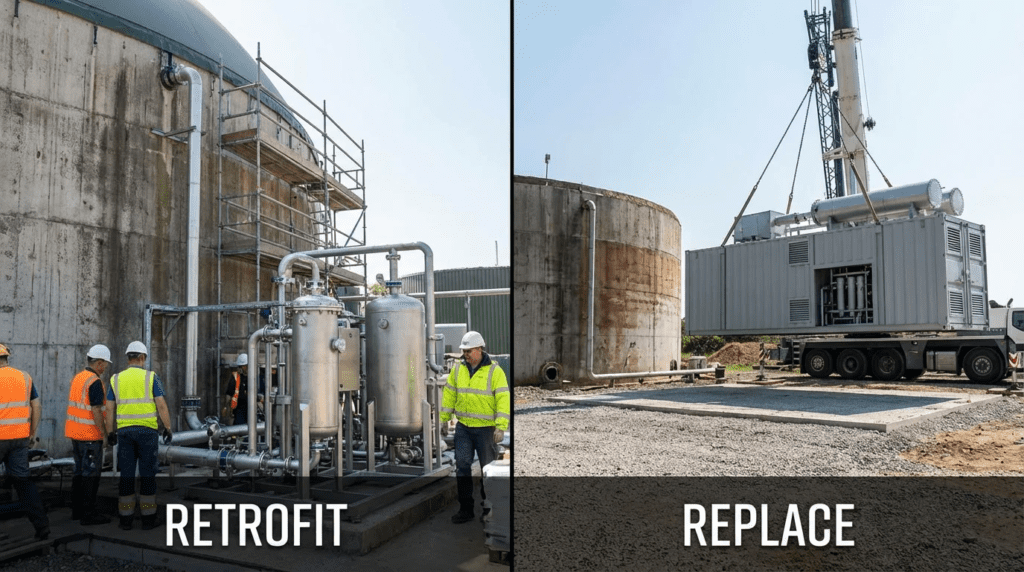
In municipal wastewater treatment plants and industrial anaerobic digestion facilities, aging gas handling infrastructure poses a continuous challenge. As facilities look to transition from simple flaring or aging Combined Heat and Power (CHP) engines to high-value Renewable Natural Gas (RNG) production, engineers face a critical decision threshold. The core engineering dilemma is Retrofit vs Replace: Upgrading BioGas Without Major Civil Work.
Pouring new concrete pads, expanding Class 1 Division 1 hazardous area boundaries, and routing new underground piping can drive up project CAPEX by 30-50%. Major civil works also trigger complex permitting cycles, prolonged geotechnical investigations, and unacceptable process downtime. What most engineers overlook during preliminary design is the feasibility of utilizing modular, high-density, skid-mounted gas conditioning equipment designed specifically to integrate into existing structural footprints.
This technology covers the entire biogas train: moisture removal (chillers/separators), hydrogen sulfide (H2S) scrubbing, volatile organic compound (VOC) and siloxane removal, gas compression, and carbon dioxide (CO2) separation via membranes or Pressure Swing Adsorption (PSA). The applications are typically harsh, characterized by saturated gas, corrosive elements, and fluctuating production rates.
Proper specification of skid-mounted or drop-in upgrading equipment is critical. Poorly selected retrofit packages can lead to severe operational issues, including excessive pressure drops across existing headers, severe vibration when placing high-speed compressors on old hollow-core slabs, or catastrophic media breakthrough due to inadequate residence times. This article provides municipal consulting engineers, plant managers, and operations staff with a comprehensive, unbiased framework for evaluating retrofit scenarios versus complete replacements, focusing on minimizing civil disruption while maximizing process reliability.
HOW TO SELECT / SPECIFY
When approaching the challenge of upgrading a facility’s gas handling system, the selection criteria must bridge process requirements with physical site constraints. The following engineering considerations dictate how to execute a successful biogas upgrade while bypassing the need for new buildings or heavy concrete construction.
Duty Conditions & Operating Envelope
The first step in any biogas upgrade specification is defining the raw gas envelope and the final product gas requirements. Biogas flows are notoriously variable, influenced by seasonal temperature changes and organic loading rates. Engineers must specify equipment that can handle a turndown ratio of at least 30-40% without surging compressors or losing scrubber efficiency.
- Flow rates: Typical municipal flows range from 100 to 2,000+ SCFM. Equipment must be sized for peak instantaneous flow, not just daily averages.
- Pressures: Raw digester gas is typically available at low pressures (10-15 inches WC). Upgrading requires compression up to 100-200 psig for membranes, or 3-10 psig for basic CHP feed.
- Temperatures: Raw gas is saturated at 95°F – 100°F (35°C – 38°C). Upgrading systems must include robust heat exchangers and chillers to drop temperatures to 40°F (4°C) for moisture drop-out.
- Contaminant Loading: H2S can range from 100 ppmv to over 3,000 ppmv. Siloxanes (D4, D5) typically range from 5 to 50 mg/m³.
A critical specification mistake in retrofit scenarios is failing to account for future capacity increases. Modular, parallel skids allow for future expansion without requiring a larger initial footprint or heavier foundation pad.
Materials & Compatibility
Wet biogas containing H2S and CO2 forms highly corrosive sulfuric and carbonic acids when moisture condenses. Because retrofits often reuse existing enclosures where ventilation may be limited, material selection is paramount to prevent premature failure.
- Piping and Vessels: For wet, sour gas, 316L Stainless Steel is the minimum standard. 304 SS will rapidly pit under wet H2S conditions.
- Scrubber Housings: High-density cross-linked polyethylene (HDPE) or Fiberglass Reinforced Plastic (FRP) with premium vinyl ester resins are typical for biological or chemical scrubbers.
- Compressor Internals: Rotary lobe or screw compressors handling wet gas must feature specialized coatings (e.g., Ni-Teflon or phenolic) on the rotors and casing interiors to prevent galling and corrosion.
- Elastomers: Viton or specialized FKM compounds are required where siloxanes and heavy hydrocarbons are present; EPDM will swell and fail.
Hydraulics & Process Performance
When keeping existing piping networks (to avoid civil trenching), pressure drop calculations become the limiting factor. Adding new H2S media beds, siloxane carbon vessels, and membrane stages introduces significant friction losses.
Engineers must calculate the total cumulative pressure drop (often 30-50 inches WC just through the conditioning skids) and verify if existing digester gas covers and primary blowers can overcome this head. In many retrofits, booster blowers must be added. The efficiency curves of these booster blowers must be carefully matched to the variable digester production curve using Variable Frequency Drives (VFDs) to maintain a neutral pressure at the digester cover.
Installation Environment & Constructability
This is the heart of Retrofit vs Replace: Upgrading BioGas Without Major Civil Work. The goal is zero new concrete. To achieve this, engineers must specify:
- Containerized Systems: Many modern RNG upgrading plants are built inside standard 20-foot or 40-foot ISO shipping containers. These require only a level aggregate base or pre-cast concrete piers, eliminating the need for a poured foundation and a new building structure.
- Skid Weight & Dynamic Loading: If placing new compressor skids on existing concrete pads, the static weight and dynamic frequency must be analyzed. Structural engineers must verify that the existing slab will not enter resonance with the new rotating equipment.
- Dimensional Constraints: For indoor retrofits, components must be specified to fit through existing roll-up doors (typically 10’x10′ or 12’x12′). Equipment may need to be shipped in sub-assemblies.
Reliability, Redundancy & Failure Modes
Biogas production cannot be easily stopped; if the upgrading system goes down, the gas must be flared, representing lost revenue and potential emissions violations. Redundancy strategies in a confined footprint require careful planning.
Rather than a traditional 2 x 100% capacity approach (which requires double the footprint), engineers often specify a 3 x 50% or 4 x 33% configuration. This modular approach allows the use of smaller, tighter skids that can fit between existing columns. Common failure modes include blower bearing degradation, VFD faults due to poor cooling, and media fouling. Critical spare parts—especially custom mechanical seals and coated rotors—should be specified for delivery with the main equipment.
Controls & Automation Interfaces
Avoiding civil works also means minimizing new underground electrical conduit runs. Retrofitting often requires utilizing existing Motor Control Centers (MCCs) or running new overhead cable trays.
Modern skid-mounted systems should be specified with on-board PLCs (Programmable Logic Controllers) that act as a single node to the plant’s main SCADA system via Ethernet/IP, Modbus TCP, or Profinet. This “package control” approach means only a single communication cable and a single power feed need to be routed to the skid, drastically reducing electrical installation labor and trenching.
Maintainability, Safety & Access
A frequent pitfall of shoehorning new equipment into existing spaces is the loss of maintenance access. Equipment specifications must dictate minimum clearances.
- Media Changeouts: H2S and siloxane vessels require periodic media replacement. If overhead crane access is blocked by an existing ceiling, the vessels must be specified with side manways or vacuum-extraction ports.
- Area Classifications: Introducing higher pressure gas systems into existing buildings may change the NFPA 820 area classification. Specifying intrinsically safe instrumentation and explosion-proof (Class 1, Div 1/2) motors on the skid prevents the need to upgrade the entire building’s HVAC and lighting systems.
- Lockout/Tagout (LOTO): Double block and bleed valve arrangements must be integrated into the compact skid piping to allow safe maintenance while the rest of the plant operates.
Lifecycle Cost Drivers
The total cost of ownership (TCO) analysis heavily favors the retrofit approach when civil costs are properly accounted for. A complete “replace” strategy might offer slightly better process efficiency due to optimized piping layouts, but the CAPEX of demolition, soil remediation, and new concrete often pushes the payback period from 3-5 years out to 8-12 years.
OPEX drivers in compact retrofit systems include slightly higher energy consumption (due to higher pressure drops through compact heat exchangers and tighter piping radii) and media replacement costs. Solid scavenger H2S media has a higher OPEX than biological scrubbers, but biological scrubbers require massive concrete tanks. Thus, the footprint constraint directly drives the OPEX/CAPEX tradeoff.
COMPARISON TABLES
The following tables provide an objective framework for comparing different gas upgrading approaches and determining the best fit for specific facility constraints. Table 1 compares the process technologies typically evaluated when footprint is severely constrained. Table 2 provides a decision matrix for Retrofit vs Replace scenarios.
| Technology / Equipment Type | Primary Features | Best-Fit Applications | Limitations & Footprint Considerations | Typical Maintenance Profile |
|---|---|---|---|---|
| Solid Scavenger Media (Iron Sponge/Pellets) | High H2S removal efficiency; passive operation; highly compact. | Space-constrained indoor retrofits; low to medium H2S loading (< 500 ppm). | High OPEX for media replacement; spent media requires hazardous/special handling; excellent for tight footprints. | Media changeout every 3-12 months; routine differential pressure monitoring. |
| Biological Trickling Filters | Low OPEX; uses biology to consume H2S; robust against fluctuations. | High flow/high H2S applications; new greenfield installations. | Poor for retrofits. Requires large footprint, deep concrete foundations, and significant water infrastructure. | Nutrient dosing checks; media inspection every 5-10 years; low daily labor. |
| Membrane Separation (RNG Upgrading) | Containerized; scalable; no moving parts in the separation stage. | RNG projects avoiding new buildings; facilities with existing flat concrete areas. | Requires high-pressure compression (100-200 psi) upstream; high parasitic electrical load. | Membrane module replacement every 5-7 years; rigorous pre-filtration maintenance. |
| Pressure Swing Adsorption (PSA) | High methane recovery; operates at lower pressures than membranes. | Large municipal RNG projects; varying feed gas compositions. | Tall vessels may exceed existing building height limits; complex valve sequencing. | Extensive automated valve maintenance; media replacement every 10+ years. |
| Skid-Mounted Screw Compressors | VFD integrated; oil-flooded or dry; compact single-lift frame. | Replacing aging low-pressure blowers for membrane feed. | High dynamic load requires structural slab verification; requires sound enclosures. | Oil changes every 2000-4000 hours; bearing/seal overhauls at 40,000 hours. |
| Scenario / Constraint | Plant Size | Recommended Approach | Key Engineering Justification | Relative CAPEX Impact |
|---|---|---|---|---|
| Existing thick concrete pad available, no building enclosure | Medium to Large (>500 SCFM) | Containerized Retrofit | Containers act as their own weatherproof, Class 1 Div 2 ventilated enclosures. Zero new civil work required. | Low (Avoids building costs) |
| Existing indoor blower room, tight clearances, no overhead crane | Small to Medium (<500 SCFM) | Modular Skid Retrofit | Equipment shipped in sub-assemblies. Use of horizontal solid media vessels to allow manual/vacuum media extraction. | Low to Medium (High installation labor) |
| High structural degradation of existing digester gallery/pads | Any Size | Full Replace | Safety and structural integrity compromise rotating equipment. Attempting a retrofit on failing concrete risks catastrophic vibration failure. | High (Major civil required) |
| Transitioning from simple flare to pipeline-injection RNG | Large (>1000 SCFM) | Hybrid (Retrofit + Pad Extension) | Conditioning fits in existing footprint; high-pressure compressors and gas interconnection require minimal new pre-cast piers. | Medium |
ENGINEER & OPERATOR FIELD NOTES
Theoretical sizing is only the first step. The successful execution of a retrofit project relies heavily on rigorous testing, meticulous specification drafting, and a deep understanding of ongoing operations and maintenance (O&M) realities.
Commissioning & Acceptance Testing
When relying on skid-mounted or containerized systems to bypass civil works, the Factory Acceptance Test (FAT) becomes the most critical quality control gate. Because the unit will be dropped into an existing space with limited maneuvering room, any required modifications must be caught at the factory.
- FAT Critical Checkpoints: Demand a full string test of the compressor/blower, motor, and actual VFD panel. Verify vibration baselines across the full turndown range. Ensure all flanged connections match the dimensional drawings exactly—a pipe misalignment of even a half-inch in a tight existing building can cause days of delay.
- Site Acceptance Test (SAT): Focus on integration. Verify that the skid’s PLC communicates flawlessly with the plant SCADA. Conduct a rigorous leak test using an inert gas (Nitrogen) before introducing biogas, paying special attention to the tie-in points between old existing piping and new skid piping.
- Performance Verification: Run the system under maximum available biogas flow. Verify that the pressure drop through the conditioning media meets the approved submittals. If H2S levels at the outlet exceed guaranteed limits (typically < 4 ppm for RNG or < 100 ppm for CHP), the media bed dynamics must be evaluated.
Common Specification Mistakes
Engineers writing bid documents for biogas retrofits frequently encounter issues due to either over-specification or ambiguous requirements.
- Ambiguous Boundary Limits: A specification must clearly define where the “skid” ends and the “plant” begins. Provide exact battery limits for gas, condensate, electrical, and control connections.
- Over-specifying Internals: Mandating a specific geometry for a heat exchanger or a specific brand of proprietary media can inadvertently disqualify standard, pre-engineered modular skids that would perfectly fit the site constraints. Specify the performance (e.g., “gas shall be cooled to 40°F”) and material limits, but allow OEMs to select the optimal geometry.
- Ignoring Condensate Management: Wet biogas drops massive amounts of water when cooled. Retrofitting a skid without verifying that existing floor drains have the capacity—and the proper liquid traps to prevent gas blow-by—is a frequent and messy oversight.
O&M Burden & Strategy
Skid-mounted systems inherently pack more equipment into a smaller volume. While this satisfies the goal of avoiding civil work, it complicates O&M.
- Routine Inspections: Operators must physically verify differential pressure gauges across moisture separators and media beds daily. Automated SCADA alarms are necessary, but manual verification prevents catastrophic media breakthrough.
- Media Replacement Logistics: For solid media vessels, estimate 16-24 labor hours for a complete changeout. Operators must utilize proper confined space protocols, H2S personal monitors, and spark-proof tools.
- Condensate Traps: Float-style condensate traps are notorious for sticking due to biological slime. Preventative maintenance should include flushing these traps monthly.
- Spare Parts: Maintain a minimum of one complete set of compressor/blower seals, bearings, VFD cooling fans, and primary instrumentation (pressure/temperature transmitters) in on-site inventory. Lead times for specialized biogas-rated sensors can exceed 12 weeks.
Troubleshooting Guide
When retrofitted systems malfunction, the interaction between the old infrastructure and the new equipment is usually the culprit.
- High Moisture Carryover: If liquid water reaches the high-pressure compressors or CHP engine, verify the chiller glycol temperatures. If the temperature is correct but carryover persists, the gas velocity through the coalescing filter may be too high, indicating that the existing piping sizes are bottlenecking the flow and causing turbulent jetting.
- Premature H2S Breakthrough: This is often caused by channeling within the media bed. If operators dump media into the vessel unevenly or fail to properly distribute the gas flow at the inlet header, the gas will find the path of least resistance, bypassing the majority of the chemical treatment.
- Vibration Issues: If a newly installed skid shakes violently, do not immediately blame the compressor. The existing concrete pad may lack the mass to dampen the specific frequency of the new machine. A structural engineer may need to design a localized mass-damping block or specify specialized spring isolators.
DESIGN DETAILS / CALCULATIONS
The technical success of avoiding civil modifications hinges on precise engineering calculations, particularly regarding gas hydraulics and physical loading.
Sizing Logic & Methodology
When retaining existing digester gas headers, calculating the gas velocity is critical to prevent excessive noise, vibration, and static electricity buildup. The rule-of-thumb limit for low-pressure, wet biogas velocity is typically 15 to 30 ft/s (4.5 to 9 m/s).
The velocity ($V$) is calculated as:
$V = frac{Q}{A}$
Where:
– $Q$ = Actual volumetric flow rate (ACFS)
– $A$ = Internal cross-sectional area of the pipe (sq ft)
*Note: Ensure SCFM is converted to ACFM based on the actual operating pressure and temperature using the Ideal Gas Law before calculating velocity.
If retrofitting a higher capacity blower to push more gas through an existing 6-inch header, and the calculation yields a velocity of 45 ft/s, the pressure drop will be immense, and moisture droplets will be sheared and carried past knockout pots. In this scenario, the engineer must either specify a localized pipe enlargement or a higher-pressure booster.
Pressure Drop Safety Margins: Always apply a safety factor of at least 1.5 to calculated frictional pressure drops in existing piping. Decades of biological scaling and condensate pooling significantly increase the roughness factor ($C$-value or equivalent sand roughness) compared to new pipe data.
Specification Checklist
A robust procurement specification for a skid-mounted biogas upgrade should include:
- Performance Guarantees: Maximum allowable pressure drop across the entire skid; guaranteed outlet dew point; guaranteed H2S/Siloxane effluent concentrations.
- Welding Standards: ASME B31.3 Process Piping requirements. 100% visual inspection and a specified percentage (typically 10-20%) of radiographic testing (RT) for high-pressure stainless lines.
- Electrical: Panels must be UL 508A listed. Clearly state if the panel will be mounted locally (Class 1 Div 1/2 compliant, purged panel) or shipped loose for mounting in an existing unclassified electrical room.
- Coating Systems: For carbon steel structural skids, specify high-build epoxy coating systems (e.g., TNEMEC) designed for aggressive wastewater environments.
Standards & Compliance
Upgrading biogas systems triggers a complex web of safety and design standards. Retrofitting into an existing footprint requires careful navigation of these codes to avoid triggering a mandatory facility-wide code upgrade.
- NFPA 820: Standard for Fire Protection in Wastewater Treatment and Collection Facilities. This dictates the hazardous area classification. Adding a higher pressure gas system may change the boundary limits. Using containerized systems with dedicated ventilation (6-12 air changes per hour) can often maintain an unclassified rating outside the container.
- ASME Boiler and Pressure Vessel Code (BPVC) Section VIII: All scrubber vessels, knockout pots, and gas receivers operating over 15 psig must be ASME stamped.
- UL and CSA: Ensure all individual electrical components and the complete assembly carry appropriate North American certifications to satisfy local electrical inspectors.
FAQ SECTION
What is the biggest cost driver when deciding between Retrofit vs Replace: Upgrading BioGas Without Major Civil Work?
The primary cost driver favoring retrofits is the avoidance of civil engineering costs. Tearing down existing concrete, excavating, managing potentially contaminated soils, and pouring new foundations can account for 30-50% of a replacement project’s total CAPEX. Modular retrofits shift capital toward the equipment itself, drastically reducing labor, permitting time, and site preparation costs.
How do you select the right H2S removal technology for a space-constrained retrofit?
For highly constrained footprints, solid scavenger media (iron sponge or engineered synthetic pellets) is typically best. These systems use vertical or compact horizontal vessels that fit easily on existing pads. Biological scrubbers, while having lower OPEX, require massive footprint areas and deep concrete sumps, making them generally unsuitable for retrofits lacking civil expansion capabilities.
Can existing biogas piping be reused when upgrading to a high-pressure RNG system?
Existing low-pressure piping (usually thin-wall stainless or HDPE) can only be reused for the raw gas gathering lines up to the new compressor skid inlet. Once the gas is compressed for membrane or PSA separation (typically 100-200 psig), all new heavy-wall (Schedule 40/80) 316L stainless steel piping designed to ASME B31.3 standards must be utilized.
How do you manage equipment vibration when installing new compressor skids on old concrete?
Before installing high-speed rotary equipment, a structural engineer must perform a dynamic load analysis on the existing slab. If the slab lacks sufficient mass (rule of thumb is foundation mass should be 3-5 times the rotating equipment mass), engineers must specify inertia bases, localized concrete block additions, or advanced spring-based vibration isolators to prevent resonance and structural damage.
What is the typical lifespan of a skid-mounted biogas conditioning system?
With rigorous maintenance, a skid-mounted system typically lasts 15-20 years. However, specific components require earlier overhaul: VFDs and PLCs generally face obsolescence at 10-12 years, compressor air-ends/rotors require rebuilds at approximately 40,000 to 50,000 operating hours (5-6 years), and membrane elements degrade and require replacement every 5-7 years depending on gas cleanliness.
Are containerized biogas upgrading systems considered “temporary” structures?
While they are easily transportable and bypass major civil foundation work, most municipalities and building codes treat permanent containerized systems as fixed equipment enclosures once hard-piped and wired. They offer the structural benefits of a building without the massive site-prep requirements, but must still comply with local wind, seismic, and snow load anchoring requirements.
CONCLUSION
- Civil Avoidance: Utilizing modular, skid-mounted, or containerized equipment is the most effective way to upgrade gas handling systems without triggering 30-50% civil cost adders.
- Hydraulic Limits: Reusing existing piping is cost-effective but requires strict verification that gas velocities remain between 15-30 ft/s to prevent pressure drop and moisture carryover issues.
- Structural Verification: Never place new, heavy, high-speed rotating equipment on aging concrete slabs without a dynamic load and resonance analysis.
- Media Selection Limits Footprint: Solid media scavengers are the go-to for retrofits due to their compact size, whereas biological systems are generally reserved for greenfield projects.
- Boundary Definition: Clearly define battery limits, control handoffs, and NFPA 820 area classifications in your specifications to prevent costly change orders during integration.
Navigating the transition from outdated flaring and CHP systems to modern, high-efficiency gas conditioning or RNG production requires a strategic approach. The core dilemma of Retrofit vs Replace: Upgrading BioGas Without Major Civil Work fundamentally comes down to leveraging modern, high-density modular engineering to overcome physical site constraints. By specifying containerized processing units and tightly integrated skid modules, municipal and industrial wastewater facilities can achieve state-of-the-art emissions compliance and gas monetization without the immense financial and operational burden of major construction.
Engineers must balance the compelling CAPEX savings of the retrofit approach against the hydraulic limitations of existing piping and the OPEX realities of compact media systems. A successful project hinges on meticulous preliminary engineering—specifically pressure drop calculations, structural vibration analysis, and rigorous 3D spatial planning for maintenance access. When executed correctly, a civil-free retrofit provides a rapid, economically viable pathway to modernizing biogas infrastructure, minimizing downtime, and accelerating the facility’s return on investment.