
Sand vs. Multimedia Filtration: Comparative Performance, Cost and When to Upgrade a Filter Media Bed
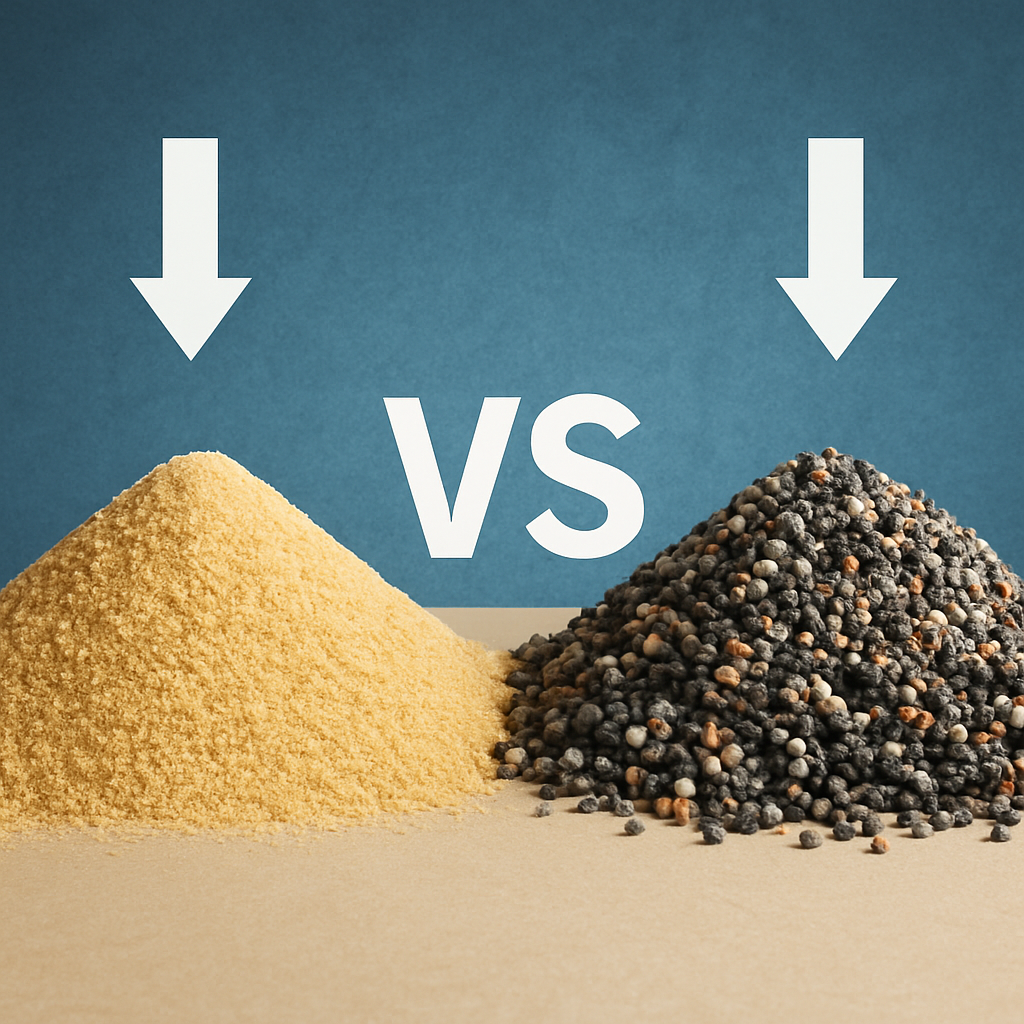
When a plant faces tighter turbidity targets or a constrained footprint, the choice between sand water filtration and multimedia media is one of the most effective levers for improving throughput, lowering backwash costs, and tightening effluent quality. This article compares silica sand mono beds against common multimedia stacks from the municipal operator perspective, focusing on hydraulic behavior, particle removal and turbidity, lifecycle cost, and realistic upgrade triggers. Expect sample calculations, measurable thresholds, and a practical retrofit checklist to decide when to clean, top-up, or convert a filter bed and what backwash and underdrain changes are likely required.
Filter media and mechanisms that determine performance
Direct control of effluent quality in sand water filtration comes from media geometry and density, not marketing claims. Grain size distribution, specific gravity and bed gradation set which mechanisms dominate – straining and surface capture near the top of the bed, depth filtration and pore interception deeper down, and adsorption where carbonaceous media are used.
Common media, properties and how they behave
Typical media examples: Silica sand (commonly 0.45-0.55 mm, SG ~2.65) provides reliable depth filtration; anthracite (0.9-1.7 mm, SG ~1.6) gives a coarse top layer that delays headloss; garnet (0.2-0.6 mm, SG ~4.1) forms the fine bottom polishing layer in triple-media beds. Alternatives such as crushed recycled glass or granular activated carbon (GAC) are useful where chemistry or sustainability goals matter. For design references see the EPA filtration guidance and AWWA resources at AWWA Filtration.
How the stack traps particles. In a properly graded multimedia bed the top layer intercepts coarse particles and accumulates them without rapid headloss, the middle sand layer captures mid-sized particulates, and the fine bottom layer polishes sub-10 micron material. That graded capture comes from a controlled separation zone rather than from the total bed depth alone.
Practical tradeoff to remember. Multimedia beds extend run length and lower backwash frequency when the raw water has a broad particle size distribution. If the source water is dominated by persistent submicron or colloidal solids, multimedia gives less marginal benefit and you should evaluate coagulation or alternative polishing steps first.
- Mechanisms at play: Depth filtration, surface sieving/straining, interception/adhesion, and adsorption where carbon is present
- Design implication: Choose media sizes to create a stable separation zone – mismatched SG or large overlap in size defeats the graded bed
- Operational constraint: Backwash expansion velocities must separate layers without causing attrition or loss; underdrain sizing is non-negotiable
Concrete example: A 5 MGD river-fed municipal plant replaced a legacy mono sand bed with an anthracite-over-sand stack. After conversion the operator observed run lengths roughly double and a consistent drop in treated-line turbidity from ~0.12 NTU to ~0.06 NTU during spring runoff events, allowing backwash cycles to be stretched and saving raw water used for regeneration.
A judgment worth stating plainly: Media choice is a hydraulic decision as much as a filtration one. Picking anthracite because it sounds superior without checking backwash capacity, underdrain nozzle sizing and the influent particle-size spectrum is the most common retrofit mistake I see in the field.
Hydraulic performance: headloss, filtration rate and run length
Clean-bed resistance matters for throughput. For the same superficial velocity a properly graded anthracite-over-sand stack presents substantially lower initial headloss than a mono sand bed, which directly translates to higher usable filtration rates or longer run lengths before headloss reaches your backwash trigger.
Worked example: Kozeny-Carman comparison (clean-bed only)
Assumptions: water viscosity 1e-3 Pa·s, density 1000 kg/m3; mono sand bed depth 0.60 m with effective diameter 0.50 mm and porosity 0.42; multimedia stack = 0.45 m anthracite (1.20 mm, porosity 0.52) over 0.30 m sand (0.55 mm, porosity 0.42). Using the Kozeny-Carman permeability expression k = (ε^3 d^2)/(180(1-ε)^2) and Darcy's law, clean-bed headloss for a mono bed at 4 m/h is ~0.22 m and at 8 m/h ~0.44 m. The anthracite/sand stack under the same conditions gives ~0.10 m at 4 m/h and ~0.20 m at 8 m/h.
Practical interpretation: the multimedia clean-bed headloss is roughly half the mono-sand value in this calculation. That headroom lets you increase design filtration rate or extend run length before hitting headloss alarms — but the Kozeny-Carman result applies only to clean beds and ideal grain shapes.
- Important limitation: Kozeny-Carman ignores particle loading, biofilm and iron fouling dynamics. In practice the fine polishing layer in a multimedia stack will accumulate solids and its resistance grows non-linearly with run time.
- Operational tradeoff: Lower initial headloss for multimedia reduces operating pumps energy at the chosen rate, but achieving the graded bed requires higher backwash flow and often air scour to avoid layer mixing.
- Design consequence: If your underdrain or backwash pumps cannot supply the expansion velocity for anthracite, the theoretical headloss advantage is irrelevant — you will end up with mixed or channeling media and degraded performance.
Concrete example: A 12 MGD treatment plant I audited chose to keep the same number of filter trains but raised the design loading from 4 to 6 m3/m2/h after installing an anthracite-over-sand bed and upgrading backwash pumps. Measured outcomes: average run length increased by 45 percent and backwash frequency dropped enough to save raw water previously used for regeneration, but backwash volume per event rose because of longer air/water scour cycles.
Lower clean-bed headloss is real and measurable, but it is not a free advantage. Check backwash capacity, underdrain hydraulics and expected fouling modes before sizing for higher filtration rates.