
- Home
- Water
- Water Quality: Monitoring, Contaminants & Compliance Standards
- Monitoring: Essential Strategies for Enhanced Data Security
- Contaminants and Contamination: Understanding Their Sources and Impact
- Standards: Elevating Professional and Industry Benchmarks
- FAQs: Comprehensive Answers to Common Questions
- Physical Water Treatment: Modern Techniques and Benefits
- Activated Carbon Filtration in Water: Essential for Clean, Safe Drinking Supplies
- Ultraviolet (UV) Disinfection in Water: Ensuring Safe and Clean Drinking Water
- Sand Filtration in Water: A Comprehensive Guide to Clean Drinking Solutions
- Ceramic Filtration: Effective Solutions for Clean Water
- Gravity-Based Filtration: Enhancing Water Purity with Simple Technology
- Membrane Filtration in Water: Improving Purity and Efficiency
- Sedimentation: Causes, Impacts, and Prevention Strategies
- Chemical Water Treatment: Essential Methods for Safe and Clean Water
- Biological Filtration: Enhancing Water Quality Through Natural Processes
- Water Supply & Distribution: Infrastructure, Source Water & Delivery
- Water Conservation: Strategies for Efficient & Sustainable Use
- Water Management: Strategies for Sustainable Usage
- Water Quality: Monitoring, Contaminants & Compliance Standards
- Wastewater
- Wastewater Treatment
- Preliminary Treatment
- Screening
- Bar Screening
- Band Screen Wastewater Solutions: Effective Fine Screening Techniques
- Basket Screen Wastewater Solutions: Enhancing Treatment Efficiency
- Drum Screening
- Fine Screens in Wastewater Treatment: Enhancing Solid Removal Efficiency
- Microscreens in Wastewater Treatment: Enhancing Filtration Efficiency
- Parabolic Screen in Wastewater Treatment: Enhancing Solid-Liquid Separation Efficiency
- Static Screen in Wastewater Treatment: Efficiency and Application Overview
- Climber Screens in Wastewater Treatment: Enhancing Solid Waste Removal
- Step Screen in Wastewater Treatment: Enhancing Solid-Liquid Separation Efficiency
- Comminution in Wastewater Treatment: Enhancing Efficiency and Process Reliability
- Grit Removal in Wastewater: Essential Processes and Best Practices
- Screening
- Primary Treatment in Wastewater: The First Step in Pollution Control
- Primary Treatment of Wastewater: Sedimentation, Clarification & DAF
- Discrete Settling in Wastewater: Understanding the Separation Process
- Flocculent Settling in Wastewater: Understanding the Process and Benefits
- Zone Settling in Wastewater Treatment Processes: Understanding the Mechanism
- Compression Settling in Wastewater: Fundamental Principles and Management Strategies
- Primary Clarifiers in Wastewater: Understanding Their Role in Treatment Processes
- Circular Primary Clarifier in Wastewater Treatment: Essential Functions and Design Principles
- Parallel Plate Settlers in Wastewater Treatment: Efficiency and Design Principles
- Tube Settlers in Wastewater Treatment: Enhancing Clarification Efficiency
- Offset Clarifiers in Wastewater Treatment: Enhancing Clarity and Efficiency
- Rectangular Primary Clarifier in Wastewater Treatment: Efficiency and Design Principles
- Dissolved Air Flotation (DAF) in Wastewater: Enhancing Treatment Efficiency
- Full Flow DAF Systems: Revolutionizing Wastewater Treatment Efficiency
- Partial Flow DAF Systems: Advancing Wastewater Treatment Efficiency
- Recycle Flow DAF Systems: Enhancing Wastewater Treatment Efficiency
- Packed Column DAF: Advancing Water Treatment Efficiency
- Subsurface Release DAF Systems: Innovations in Wastewater Treatment
- Dispersed Release DAF Technology: Revolutionizing Wastewater Treatment
- Primary Treatment of Wastewater: Sedimentation, Clarification & DAF
- Secondary Treatment in Wastewater: Understanding the Biological Process
- Biological Treatment in Wastewater: Harnessing Microorganisms for Clean Water Solutions
- Rotating Biological Contactors (RBCs) in Wastewater Treatment
- Membrane Bioreactors (MBR): Advancing Wastewater Treatment Technology
- Anaerobic Digestion: Effective Waste Management for Renewable Energy
- Anaerobic Digestion in Wastewater Treatment: Optimizing Energy Recovery
- Lagoons in Wastewater Treatment: Sustainable Natural Solutions
- Constructed Wetlands in Wastewater Treatment: Nature’s Solution for Water Purification
- Activated Sludge Process in Wastewater Treatment: An Efficient Biological Methodology
- Trickling Filters in Wastewater Treatment: An Efficient Biofiltration Solution
- Sequencing Batch Reactors: Advancements in Wastewater Treatment Technology
- Aeration in Wastewater Treatment: Enhancing System Efficiency and Water Quality
- Surface Aerators in Wastewater Treatment: Optimization and Efficiency
- Submerged Diffuser Systems in Wastewater Treatment: Enhancing Effluent Disposal Efficiency
- Vertical Loop Reactors in Wastewater Treatment: Enhancing Efficiency and Sustainability
- Small Bubble Aerators in Wastewater: Enhancing Treatment Efficiency
- Jet Aerators in Wastewater Treatment: Enhancing Efficiency and Aeration Performance
- Cascade Aerators in Wastewater Treatment: Enhancing Oxygenation Efficiency
- Secondary Clarification in Wastewater: Enhancing Effluent Quality
- Circular Clarifiers in Wastewater: Essential Components for Water Treatment Efficiency
- Rectangular Clarifiers in Wastewater Treatment: Efficiency and Design Essentials
- Hopper Bottom Clarifiers in Wastewater Treatment: Efficiency and Design Essentials
- Solids Contact Clarifiers: Enhancing Wastewater Treatment Efficiency
- Lamella Clarifiers in Wastewater Treatment: Efficiency and Design Essentials
- Biological Treatment in Wastewater: Harnessing Microorganisms for Clean Water Solutions
- Tertiary Treatment in Wastewater: Ensuring Water Quality and Environmental Safety
- Advanced Treatment in Wastewater: Emerging Technologies and Methods
- UV Disinfection in Wastewater: Effective Strategies for Pathogen Reduction
- Low Pressure UV Systems in Wastewater Treatment: Efficiency and Advantages
- Medium Pressure (MP) UV Systems in Wastewater Treatment: Efficiency and Applications
- Amalgam UV Systems in Wastewater Treatment: Advancements and Efficiency
- Pulsed UV Systems in Wastewater Treatment: Revolutionizing Disinfection Processes
- Smart UV Control in Wastewater Treatment: Enhancing Efficiency and Safety
- Light-Emitting Diode (LED) UV Systems in Wastewater Treatment: Efficiency and Applications
- Ozonation in Wastewater Treatment: Understanding the Purification Process
- Fixed Bed Ozone Reactors in Wastewater Treatment: Efficiency and Application
- Ozone Retention Tanks in Wastewater Treatment: Enhancing Water Quality and Safety
- Sidestream Ozone Injection in Wastewater: Enhancing Treatment Efficiency and Water Quality
- Ozone Laundry Systems in Wastewater Treatment: Enhancing Efficiency and Sustainability
- Vacuum Degasification in Wastewater Treatment: Principles and Applications
- Bubble Diffuser Contactors in Wastewater Treatment: Efficiency and Application
- Ozone Generators in Wastewater Treatment: Efficiency and Applications
- Advanced Oxidation Processes in Wastewater Treatment: Efficiency and Innovation
- Ozonation in Wastewater Treatment: Efficient Disinfection and Organic Removal
- UV/H2O2 in Wastewater Treatment: Harnessing Advanced Oxidation Processes
- Fenton Process in Wastewater Treatment: Efficiency and Application
- Wet Air Oxidation in Wastewater Treatment: Efficiency and Process Insights
- Photocatalysis in Wastewater Treatment: Innovative Approaches for Purification
- Electron Beam Irradiation in Wastewater Treatment: Unlocking Advanced Purification Methods
- Ultrasonic Irradiation in Wastewater Treatment: Efficiency and Applications
- Ion Exchange: Essential Mechanism for Water Purification
- Cation Exchange in Wastewater Treatment: Principles and Applications
- Anion Exchange in Wastewater Treatment: Understanding the Process for Cleaner Effluents
- Ammonia Exchange in Wastewater: Essential Processes and Technologies
- Boron Selective Resins in Wastewater Treatment: Advances and Applications
- Mixed Bed Ion Exchange in Wastewater Treatment: Efficiency and Application
- Electrochemical Ion Exchange in Wastewater: Enhancing Treatment Efficiency
- UV Disinfection in Wastewater: Effective Strategies for Pathogen Reduction
- Sludge Treatment & Biosolids Management: Thickening, Digestion & Dewatering
- Thickening in Wastewater Treatment: Optimizing Sludge Management
- Gravity Thickeners in Wastewater Treatment: Enhancing Efficiency and Sustainability
- Dissolved Air Flotation (DAF) in Wastewater: Enhancing Treatment Efficiency
- Rotary Drum Thickeners in Wastewater Treatment: Maximizing Efficiency and Cost-Effectiveness
- Gravity Belt Thickeners in Wastewater Treatment: Enhancing Efficiency and Sustainability
- Centrifuges in Wastewater Treatment: Enhancing Efficiency and Purity
- Cloth Media Filters in Wastewater Treatment: Efficiency and Applications
- Screw Presses in Wastewater Treatment: Efficiency and Applications
- Digestion in Wastewater Treatment: Processes and Benefits
- Autothermal Thermophilic Aerobic Digestion (ATAD): Enhancing Wastewater Treatment Efficiency
- Composting in Wastewater Treatment: Enhancing Sustainability Practices
- Alkaline Stabilization in Wastewater Treatment: Enhancing Process Efficiency and Safety
- Thermal Hydrolysis in Wastewater Treatment: Enhancing Sludge Management Efficiency
- Microwave Irradiation in Wastewater Treatment: An Innovative Approach
- Anaerobic Digestion in Wastewater Treatment: Optimizing Energy Recovery
- Aerobic Digestion in Wastewater Treatment: Efficiency and Process Insights
- Dewatering in Wastewater Treatment: Essential Methods and Benefits
- Belt Filter Presses in Wastewater Treatment: Maximizing Efficiency and Performance
- Plate and Frame Presses in Wastewater Treatment: Efficiency and Application
- Rotary Fan Presses in Wastewater Treatment: Efficient Sludge Dewatering Solutions
- Drying Beds in Wastewater Treatment: An Overview of Sludge Management Techniques
- Reed Beds in Wastewater Treatment: Sustainable Purification Methods
- Centrifuges in Wastewater Treatment: Enhancing Efficiency and Purity
- Thickening in Wastewater Treatment: Optimizing Sludge Management
- Water Reuse & Disposal: Recycling Wastewater for a Sustainable Future
- Non-Potable Water in Wastewater: Sources, Risks, and Treatment Methods
- Graywater in Wastewater Treatment: Sustainable Reuse and Management Practices
- Blackwater in Wastewater Treatment: Understanding the Challenges and Solutions
- Stormwater in Wastewater Treatment: Managing Runoff Contamination Risks
- Industrial Wastewater Management: Strategies for Sustainable Treatment and Reuse
- Agricultural Wastewater Treatment: Methods and Best Practices
- Non-Potable Water in Wastewater: Sources, Risks, and Treatment Methods
- Industrial Wastewater Management: Strategies for Sustainable Treatment and Reuse
- Municipal Wastewater Management: Strategies for Sustainable Urban Water Treatment
- Treatment Technologies in Wastewater: Advancements in Modern Medical Therapies
- Preliminary Treatment
- Wastewater Management Strategies for Sustainable Urban Environments
- Wastewater Disposal Strategies: Best Practices for Environmental Safety
- Wastewater Treatment
- US Wastewater Plants
- Online Calculators
- Sodium Hypochlorite Dosing Calculation
- Equalization (EQ) Tank Sizing Calculator
- Contact Time Calculator
- Flow Conversion & Pump Reference Calculator
- Aeration / Energy Estimation Calculator
- Clarifier Surface Loading Calculator
- Sludge Production / Solids Calculator
- Chemical Storage Volume Calculator
- Centrate Sidestream Load Impact Calculator
- Our Services
- Newsletter
- Blog
Sodium Hypochlorite Dosing Calculation
- Disinfection Equipment
-
Feb 02
- Share post
Sodium Hypochlorite Dosing Calculation: A Comprehensive Guide
Sodium hypochlorite dosing is essential for achieving effective disinfection in water and wastewater treatment applications. Proper dosing ensures pathogen control while minimizing chemical waste, operational risks, and regulatory non-compliance.
What Is Sodium Hypochlorite?
Sodium hypochlorite (NaOCl) is a widely used disinfectant in water and wastewater treatment due to its effectiveness, availability, and relatively low cost. It is commonly supplied as a liquid solution and applied to water streams to inactivate bacteria, viruses, and other microorganisms.
Common applications include:
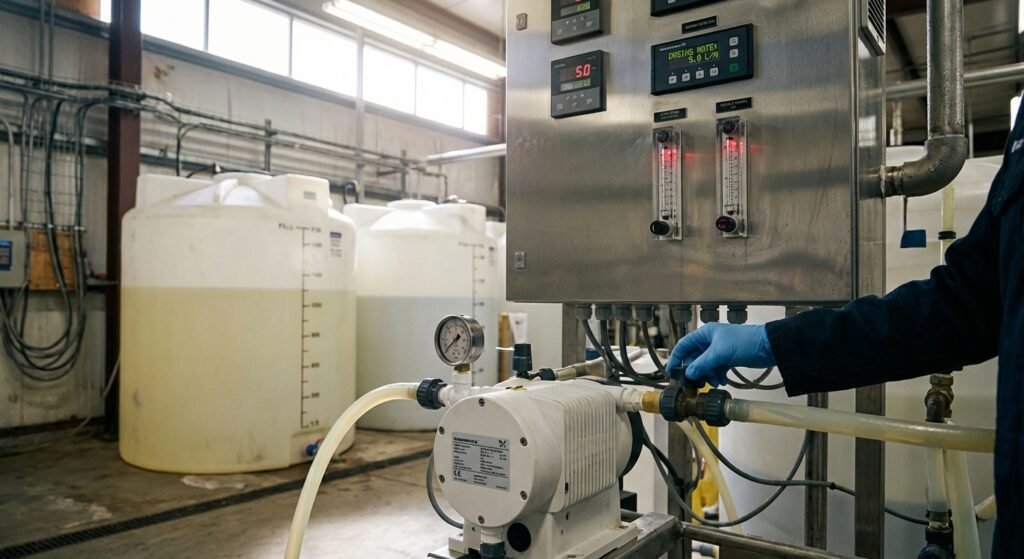
- Water treatment, typically delivered using dedicated chemical feed systems designed for controlled dosing and safe handling
- Wastewater disinfection
- Industrial process water treatment
- Cooling water and utility systems
Why Accurate Dosing Matters
Accurate sodium hypochlorite dosing is critical for maintaining consistent disinfection performance. Under-dosing may lead to insufficient pathogen removal, while over-dosing can result in excessive chlorine residuals, increased chemical costs, and potential formation of disinfection byproducts (DBPs).
Modern treatment facilities increasingly recognize that effective disinfection depends not only on dose concentration, but also on contact time, mixing conditions, and real-time influent quality.
Key Factors That Affect Sodium Hypochlorite Dosing
- Influent flow rate
- Target chlorine residual
- Chlorine demand of the water (organics and ammonia)
- Strength and age of the sodium hypochlorite solution
- Contact time and basin hydraulics
- Mixing intensity
- pH and temperature
Sodium Hypochlorite Dosing Calculation
The basic calculation for sodium hypochlorite dosing is based on achieving a target free available chlorine (FAC) concentration in the treated water while satisfying chlorine demand.
Dose (mg/L as Cl₂) = Target FAC (mg/L) + Chlorine Demand (mg/L)
This applied dose is then converted into a chemical feed rate using plant flow and solution strength.
Target Disinfection Level and CT Concept
Sodium hypochlorite dosing is typically designed around meeting a CT target—the product of disinfectant residual (C, as Cl₂) and contact time (T, in minutes)—rather than achieving a single fixed concentration.
In wastewater applications, CT values in the range of approximately 10–30 mg·min/L are commonly associated with ~3-log bacterial reduction, depending on effluent quality, mixing, and hydraulic conditions.
High-intensity mixing, low turbidity, and stable influent quality can significantly reduce the required CT, while elevated ammonia or organic content increases chlorine demand and required dose.
Typical Sodium Hypochlorite Dose Ranges by Application
| Application / Condition | Typical NaOCl Dose or Residual Target | Design Notes |
|---|---|---|
| Secondary effluent reuse | 1.5–3 mg/L, CT ≈ 10–20 mg·min/L | Targets 3–4 log bacterial reduction with final residual < 1 mg/L |
| MBR municipal effluent | ~2 mg/L with ~1 hour contact time | Achieves ~3 log fecal coliform reduction while controlling THMs and HAAs |
| Municipal WWTP disinfection (CT-based) | CT ≈ 10–30 mg·min/L | CT-based design aligns well with established wastewater disinfection models |
| Drinking water (low turbidity) | 1.9–3.8 mg/L dose | Typically designed to maintain ≥ 0.2 mg/L residual at 24 hours |
| Nematode control in drinking water | ~2 mg/L (with ozone) | High inactivation efficiency when combined with upstream ozonation |
Example Dosing Calculation (US Units)
Sodium hypochlorite dosing calculations are typically performed in two steps: determining the required chlorine dose in the water and converting that dose into a practical chemical feed rate.
Step 1: Determine the Total Chlorine Dose
Total Dose (mg/L as Cl₂) = Target FAC + Chlorine Demand
Example: 2.0 mg/L + 1.0 mg/L = 3.0 mg/L
Step 2: Convert Dose and Flow to Pounds of Chlorine per Day
1 mg/L at 1 MGD = 8.34 lb/day (as chlorine)
3.0 × 5 × 8.34 = ~125 lb/day (as Cl₂)
Step 3: Convert to Sodium Hypochlorite Feed Rate
12.5% NaOCl ≈ 1.25 lb available chlorine per gallon
125 ÷ 1.25 = ~100 gallons per day (gpd)
Step 4: Convert to Pump Units
- ~4.2 gph
- ~0.07 gpm
Sodium Hypochlorite Dosing Calculator
Estimate sodium hypochlorite feed rates based on flow, disinfection targets, and water quality. Calculations follow standard US engineering practice.
Results
Applied Chlorine Dose: mg/L
Chlorine Required: lb/day
Sodium Hypochlorite Feed Rate: gpd
Pump Reference: gph ( gpm)
Required Residual from CT: mg/L (as Cl₂)
CT Achieved: mg·min/L
Operational Considerations
In addition to calculation accuracy, operators must consider storage requirements, material compatibility, safety procedures, solution degradation, and monitoring practices. Sodium hypochlorite decomposes over time, particularly when exposed to heat and sunlight, which can materially affect effective dose delivery.
Conclusion
Effective sodium hypochlorite dosing begins with accurate calculations but must ultimately be designed around CT targets, site-specific chlorine demand, and real-world hydraulic conditions. By combining sound calculation methods with modern monitoring and control strategies, treatment facilities can maintain compliance, limit DBP formation, and optimize chemical usage as part of comprehensive disinfection in wastewater treatment programs.