
Top 10 Training Manufacturers for Water and Wastewater
Introduction
The “Silver Tsunami”—the mass retirement of experienced operators and maintenance technicians—is widely regarded as the single greatest threat to the reliability of municipal water and wastewater infrastructure. While engineers spend thousands of hours designing hydraulic profiles, biological processes, and structural reinforcements, the human element of the control loop is often relegated to a single line item in a specification: “Vendor shall provide training.” This lack of specificity often leads to ineffective knowledge transfer, resulting in process upsets, premature equipment failure, and safety hazards.
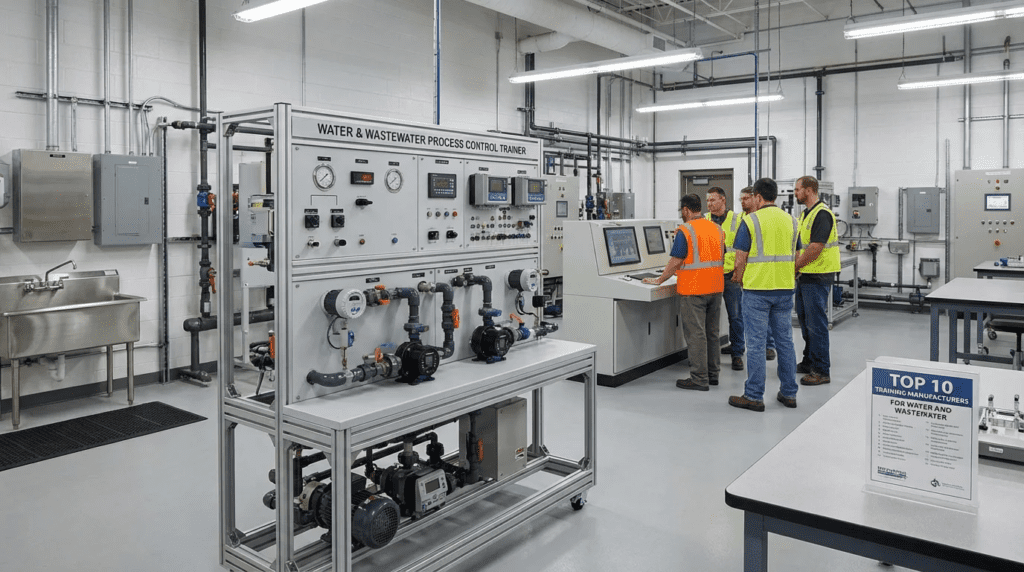
Selecting the Top 10 Training Manufacturers for Water and Wastewater is not about choosing a generic course provider; it is about identifying partners who manufacture the hardware (didactic rigs, cutaways), software (simulators, digital twins), and curriculum architectures necessary to build a resilient workforce. These technologies are used in utility training centers, technical colleges, and onsite commissioning phases to bridge the gap between theoretical engineering design and practical O&M reality.
Typical applications for these training systems range from hands-on mechanical seal replacement on didactic pump skids to high-fidelity SCADA simulations that mimic plant-wide biological upsets. Proper specification of these training assets is critical. A poor choice results in “shelfware”—manuals and software that are never used—while the right selection can reduce operator error rates by over 40% and significantly extend the Mean Time Between Failures (MTBF) of critical rotating assemblies. This article serves as a technical guide for engineers to specify, select, and integrate these training solutions effectively.
How to Select / Specify Top 10 Training Manufacturers for Water and Wastewater
When evaluating manufacturers of training equipment and simulation systems, engineers must apply the same rigor used for selecting process equipment. The “operating envelope” of a training system is defined by its educational efficacy, hardware durability, and software fidelity.
Duty Conditions & Operating Envelope
Unlike pumps or blowers, the “duty condition” for training equipment involves the throughput of personnel and the complexity of skills being transferred. Engineers must quantify the training load.
- Throughput Capacity: Determine the number of students per session. Didactic rigs (e.g., alignment trainers) typically support 2-3 students simultaneously, while software-based simulators may be scalable to hundreds of concurrent users via cloud deployment.
- Skill Complexity Levels: Define if the system targets “Tier 1” awareness (basic component ID), “Tier 2” operational logic (start/stop sequences), or “Tier 3” advanced troubleshooting (diagnosing cavitation, analyzing pump curves, PID loop tuning).
- Frequency of Use: Is the equipment for a one-time commissioning event or a permanent utility training center? Permanent installations require industrial-grade components (NEMA 4X/IP66 enclosures) even in a classroom setting to withstand repeated assembly/disassembly cycles.
Materials & Compatibility
For hardware-based training manufacturers (producing cutaways, alignment rigs, and instrumentation trainers), material selection dictates longevity.
- Industrial Authenticity: The best training manufacturers use standard industrial components (e.g., real ANSI pumps, standard 4-20mA instrumentation, standard PLC racks) rather than proprietary “educational” models. This ensures operators train on the exact equipment they will encounter in the plant.
- Durability for Disassembly: Training equipment undergoes accelerated wear. Bolts, seals, and wiring terminals are loosened and tightened hundreds of times a year. Specifications should require hardened fasteners, reinforced thread inserts, and quick-connect electrical terminals to prevent premature failure of the training rig itself.
- Chemical Simulation: For safety, chemical feed training systems must use water or inert surrogates while maintaining hydraulic realism (viscosity matching) to simulate polymer or coagulant dosing without the EH&S risks.
Hydraulics & Process Performance (Simulators)
For the software side of the Top 10 Training Manufacturers for Water and Wastewater, the “hydraulics” refers to the fidelity of the mathematical modeling.
- Dynamic Modeling vs. Animation: A common specification error is accepting “animations” (scripted videos) instead of “dynamic simulations.” A true simulator calculates hydraulic grade lines, friction losses, and biological kinetics in real-time based on user inputs.
- Process Response Time: The simulator must accurately reflect the time constants of the process. For example, a change in dissolved oxygen setpoint should reflect the lag time of blower ramp-up and oxygen transfer efficiency, not an instantaneous jump.
- Failure Mode Modeling: The software must be capable of generating randomized equipment failures (e.g., “Pump 2 Trip,” “Valve Stuck Open”) to test operator reaction, not just happy-path operations.
Installation Environment & Constructability
Integrating training assets into a facility requires spatial and infrastructure planning.
- Footprint & Utilities: Hands-on training skids often require compressed air (80-100 psi), 3-phase power (480V or stepped down to 240V), and water drainage. Engineers must design the “Training Room” with the same utility drops as a workshop.
- Network Architecture: Digital Twin simulators often require integration with the plant’s historian data or a standalone server. Cybersecurity protocols (IEC 62443) must be established to air-gap training systems from the live SCADA network to prevent accidental control interference.
- Portability: For multi-plant utilities, mobile training trailers are common. Manufacturers should offer ruggedized, castor-mounted rigs capable of withstanding transport vibration.
Reliability, Redundancy & Failure Modes
Reliability in training equipment means the system works when the instructor turns it on. Complex simulators often suffer from software “rot” if not maintained.
- Software Updates: Specifications must define the support lifecycle. Operating system updates (e.g., Windows migration) often break older simulation software. Subscription-based SaaS models generally offer better long-term reliability than perpetual licenses.
- Hardware Robustness: On mechanical trainers, threads strip and shafts score. Top manufacturers provide “consumable kits” (gaskets, O-rings, fasteners) to ensure the rig remains operational without long lead times for spare parts.
Controls & Automation Interfaces
This is the fastest-growing sector for training manufacturers.
- HMI/SCADA Parity: The training interface should be indistinguishable from the plant’s actual HMI. This reduces cognitive load when operators switch from training to real operations.
- PLC Logic Visibility: Advanced training rigs allow electrical technicians to view the live PLC ladder logic, forcing inputs and outputs to understand control strategies without risking plant compliance.
- Virtual Reality (VR) Integration: Some manufacturers now offer VR headsets linked to the digital twin, allowing operators to “walk” the plant and identify hazards virtually.
Lifecycle Cost Drivers
Training represents an Operational Expenditure (OPEX) that protects Capital Expenditure (CAPEX).
- Initial Cost vs. Total Cost of Training (TCT): A cheap simulator with poor fidelity teaches bad habits that cost millions in process errors.
- Instructor Dependency: Systems that require a dedicated, highly paid instructor are more expensive to operate than self-paced, computer-based training (CBT) modules with built-in assessment logic.
- Scalability: Cloud-based simulators offer the lowest marginal cost per additional user, whereas hardware rigs have a fixed throughput limit.
Comparison Tables: Top 10 Training Manufacturers
The following tables categorize the leading manufacturers and providers of training technology. Table 1 focuses on the primary OEMs and specialized manufacturers. Table 2 provides an application matrix to help engineers select the right type of training technology for their specific facility needs.
| Manufacturer / Provider | Primary Strengths | Typical Equipment / Output | Limitations / Considerations | Target Audience |
|---|---|---|---|---|
| 1. Amatrol | Broad industrial technical education; massive curriculum library. | Hands-on mechanical/electrical workstations; eLearning modules. | General industrial focus; not exclusively water/wastewater process specific. | Maintenance Techs, Electricians |
| 2. DAC Worldwide | High-fidelity hardware cutaways and hands-on skill builders. | Scale model pumps, valves, seal trainers, and transparent equipment. | Hardware focus; less emphasis on biological process simulation software. | Maintenance, Mechanical Trades |
| 3. Simgenics | High-fidelity comprehensive plant simulators. | SimuPact software; Full-scope plant simulators (Digital Twins). | Requires significant customization for site-specific realism; higher cost. | Control Room Operators, Engineers |
| 4. GSE Solutions | Engineering-grade simulation and visualization. | Real-time simulators; Engineering simulation services. | Often focused on power/nuclear, but highly applicable to complex utility commands. | Process Engineers, Senior Operators |
| 5. TPC Training | Workforce management and compliance tracking. | Simulation software (Simutech), online courses, instructor-led training. | More focus on general industrial safety/skills than hydraulic design nuances. | Plant Managers, Safety Directors |
| 6. 360Water | Water-sector specific online education and O&M manuals. | LMS platforms, 3D visualization, custom O&M documentation. | Primarily visual/knowledge-based rather than physics-based dynamic simulation. | All Utility Staff, Compliance Officers |
| 7. Xylem (Flygt) | OEM-driven specific equipment training. | Dedicated training centers (The Little Red Schoolhouse), product-specific modules. | Deep expertise but limited to Xylem product portfolio. | Pump Station Operators, Maintenance |
| 8. Endress+Hauser | Process instrumentation and automation training. | Process Training Units (PTU) – full-scale mock plants for instrumentation. | Focused strictly on measurement (flow, level, pressure, analysis) and controls. | I&C Technicians, Automation Engineers |
| 9. Rockwell Automation | Control systems and electrical infrastructure. | Workstation training units, PLC/VFD labs, certificate programs. | High cost; specific to Allen-Bradley/Rockwell ecosystem. | SCADA Technicians, System Integrators |
| 10. Veolia Academy | Operator process knowledge and certification. | Hands-on training centers, process operations curriculum. | Service-oriented; training often tied to O&M contracts. | Process Operators, Lab Techs |
| Application Scenario | Best-Fit Technology | Key Constraints | Operator Skill Impact | Relative Cost |
|---|---|---|---|---|
| New Plant Commissioning | Digital Twin / Process Simulator | Must be developed during design phase (6-12 month lead time). | Critical: Allows “virtual commissioning” before wet testing. | High ($$$) |
| Mechanical Seal Replacement | Hands-on Didactic Rig (e.g., DAC, Amatrol) | Requires physical storage space and consumable parts inventory. | High: Builds muscle memory and reduces field failures. | Medium ($$) |
| Basic Regulatory Compliance | LMS / Online Modules (e.g., 360Water, TPC) | Requires reliable internet access and computer lab. | Medium: Good for theory, low for physical skills. | Low ($) |
| Instrumentation Troubleshooting | Instrument Training Unit (e.g., Endress+Hauser) | Complex setup; requires calibration gases/fluids. | Very High: Essential for I&C tech diagnostics. | High ($$$) |
| Emergency Response / Safety | Virtual Reality (VR) Simulation | Hardware compatibility (headsets); motion sickness concerns. | High: Safely simulates dangerous scenarios (Cl2 leak). | Medium-High ($$) |
Engineer & Operator Field Notes
Specifying the Top 10 Training Manufacturers for Water and Wastewater is only the first step. Implementation requires careful management to ensure the investment yields reliable operations.
Commissioning & Acceptance Testing
Just as a pump requires a Factory Acceptance Test (FAT), training systems require verification. Do not accept a simulator or training rig without a formal walkthrough.
- Curriculum Verification: For simulators, engineers must verify that the math models match the process. If the design hydraulic retention time (HRT) is 4 hours, the simulator must reflect this lag. Run a “tracer study” in the software to confirm.
- Fault Injection Testing: During the FAT, command specific failures (e.g., “Air header rupture”). Verify that the system alarms correctly and the process variables trend in a physically realistic manner (e.g., DO drops, ammonia spikes).
- Documentation: Ensure that didactic rigs come with student workbooks and instructor guides. A rig without a structured lab exercise is useless.
Common Specification Mistakes
GCs are incentivized to find the lowest cost. They often subcontract training to equipment vendors who provide generic “PowerPoint read-throughs.” Engineers must specify allowances or pre-qualified training manufacturers in Division 1 or Division 11 specifications to ensure professional-grade technical training is delivered.
- Ambiguous Scope: Avoid writing “Provide training on pumps.” Instead, write: “Provide one (1) portable centrifugal pump maintenance trainer with clear acrylic casing, enabling visualization of cavitation, compatible with mechanical seal curriculum #X.”
- Ignoring Integration: Failing to specify that the training simulator must interface with the plant’s specific brand of PLC (e.g., Modicon, Siemens, Allen-Bradley) limits its utility for electrical troubleshooting training.
O&M Burden & Strategy
Training equipment requires maintenance. A broken simulator teaches operators that “broken is normal.”
- Simulator Maintenance: Software requires annual patches. Budget for an annual Service Level Agreement (SLA) with the simulation provider to keep the “Digital Twin” aligned with physical plant changes (e.g., adding a new clarifier).
- Consumables Budget: Hands-on rigs consume gaskets, o-rings, and sometimes sacrificial shafts. Allocate an annual budget of approx. 2-5% of the equipment cost for consumables.
- Knowledge Refreshers: Establish a policy where operators must “requalify” on the simulator annually or after any significant safety incident.
Design Details / Calculations
Engineers can use quantitative methods to size and specify training requirements.
Sizing Logic & Methodology: Training Needs Analysis
To determine the scale of training investment, calculate the Training Hours Demand (THD).
- Identify Roles: List count of Operators (O), Maintenance Techs (M), and I&C Techs (I).
- Define Proficiency Gap: Estimate current skill vs. required skill (0-100%).
- Calculate Hours:
Example: 20 Operators x 40 hours/year (Advanced Process) = 800 Operator-Hours.
10 Maintenance Techs x 24 hours/year (Hands-on Skills) = 240 Maintenance-Hours. - throughput Sizing:
If a hands-on rig handles 2 students and a lab session is 4 hours:
Capacity = (2 students * 2 sessions/day * 200 days) = 800 student-hours/year per rig.
Result: If demand is 240 hours, one rig is sufficient. If demand is 2000 hours, you need 3 rigs.
Specification Checklist
When writing specifications for the Top 10 Training Manufacturers for Water and Wastewater, ensure these items are included:
- Performance Standard: Equipment must meet specific learning objectives (e.g., “Student shall be able to perform laser alignment to within 0.002 inches”).
- Hardware Standards: Electrical components on trainers must be UL-listed. Panels must be finger-safe (IP2X) for student safety.
- Licensing: Define if software is a perpetual license or an annual subscription. Prefer perpetual for critical infrastructure to ensure access if budgets are cut later.
- Factory Testing: Vendor must demonstrate all lab exercises prior to shipment.
Standards & Compliance
- IACET (International Association for Continuing Education and Training): Specify that training providers should be accredited to issue CEUs (Continuing Education Units) recognized by state licensing boards.
- ABC / WEF Alignment: Curriculum should align with the Association of Boards of Certification (ABC) Need-to-Know criteria for operator licensing exams.
- OSHA/NFPA: Hands-on electrical trainers must comply with NFPA 70E standards for arc flash safety training capabilities.
FAQ Section
What is the difference between a generic simulator and a Digital Twin?
A generic simulator uses simplified logic and generic plant layouts to teach general concepts (e.g., how activated sludge works). A Digital Twin is a precise mathematical replica of a specific facility, using the actual plant’s engineering data, hydraulic profiles, and control logic. Digital Twins allow for site-specific troubleshooting and predictive scenario planning, whereas generic simulators are limited to basic education.
How much does a wastewater treatment plant simulator cost?
Costs vary widely based on fidelity. Off-the-shelf, generic cloud-based simulation licenses can cost between $500 and $2,000 per user/year. Custom-built, high-fidelity Digital Twins for a specific municipal plant typically range from $50,000 to $250,000+ depending on the complexity of the process and the extent of SCADA integration required.
Why should engineers specify hands-on training rigs instead of just classroom training?
Adult learning retention rates are significantly higher for “doing” (75%) compared to “listening” (5%). Hands-on rigs allow maintenance staff to practice destructive tasks (like overtightening a packing gland) in a safe environment. This prevents costly damage to actual plant assets and builds the muscle memory required for efficient emergency repairs.
Can training simulators connect to our live SCADA system?
Technically yes, but it is rarely recommended due to cybersecurity and operational risks. Best practice is to run the simulator on a parallel, air-gapped network or a “Training Server” that mimics the SCADA environment without having write-access to the live PLCs. This ensures that a trainee cannot accidentally stop a live process pump.
What are the maintenance requirements for a training simulator?
Software simulators require annual updates to remain compatible with operating systems and to reflect any changes made to the physical plant (e.g., new setpoints, modified pipe routing). Without these “re-calibration” updates, the simulator drifts from reality, reducing its training value. Budget approximately 10-15% of the initial software cost annually for maintenance and support.
Which manufacturers offer the best training for pumps and rotating equipment?
For pumps specifically, manufacturers like DAC Worldwide and Amatrol provide excellent general didactic rigs for alignment and seals. However, major OEMs like Xylem (Flygt) and Grundfos offer superior product-specific training institutes that dive deep into the proprietary hydraulic and electrical characteristics of their specific equipment lines.
Conclusion
Key Takeaways for Engineers
- Specify Outcomes, Not Just Attendance: Define the skills operators must demonstrate (e.g., “Perform shaft alignment,” “Tune PID loop”) rather than just requesting “8 hours of training.”
- Distinguish Hardware vs. Software: Use Table 1 to select the right partner. Use companies like DAC or Amatrol for mechanical skills, and Simgenics or GSE for process control logic.
- Prioritize Realism: Select training equipment that uses industrial-standard components (NEMA/IEC) rather than educational toys to ensure skills transfer to the plant floor.
- Budget for Lifecycle: Training is not a one-time CAPEX event. Plan for annual software maintenance and consumable parts for hands-on rigs.
- Safety First: Ensure all training equipment meets UL and NFPA safety standards, providing a safe harbor for operators to make mistakes without consequence.
Selecting the right partners from the Top 10 Training Manufacturers for Water and Wastewater is a strategic engineering decision that directly impacts the long-term viability of a treatment facility. As automation complexity increases and the workforce experience gap widens, the reliance on “on-the-job shadowing” is no longer sufficient. Engineers must take the lead in specifying rigorous, high-fidelity training systems—both digital and physical—as integral components of the plant design.
By treating training simulators and didactic rigs with the same specification detail as pumps and blowers, engineers ensure that the sophisticated systems they design are operated by competent, confident professionals. This holistic approach minimizes lifecycle costs, enhances safety, and ultimately guarantees the protection of public health and the environment.