
INTRODUCTION
Gravity separation remains the workhorse of physical-chemical and biological treatment, yet it is often the most critical bottleneck in a plant. A mere 1% drop in secondary clarifier efficiency can drastically increase total suspended solids (TSS) carryover, overwhelming tertiary filters, disrupting UV disinfection transmittance, and potentially violating discharge permits. Navigating the landscape of the Top Clarifier Equipment Manufacturers for Water & Wastewater is a complex task for consulting engineers and plant directors. The OEM market has seen heavy consolidation over the last two decades, meaning legacy brands are often housed under massive corporate umbrellas, while specialized, independent manufacturers focus on highly specific technologies like ballasted flocculation or high-torque drives.
Selecting the right equipment provider involves much more than evaluating capital expenditure (CAPEX). It requires a deep understanding of how different manufacturers approach fundamental engineering challenges: density currents, energy dissipation, scraper torque limits, windage, and corrosion resistance. Clarifier subcategories span a vast array of geometric configurations and hydraulic principles, from conventional large-footprint circular basins to high-rate, ultra-compact lamella and ballasted systems. Furthermore, a manufacturer that excels in heavy-duty municipal circular mechanisms may not be the optimal choice for an industrial dissolved air flotation (DAF) application.
This pillar article provides a comprehensive, unbiased engineering framework for evaluating the top clarifier equipment manufacturers across the water and wastewater industry. It dissects the various subcategories of clarifier technologies, outlines the critical design parameters differentiating them, and provides a clear methodology for specifying equipment that guarantees long-term reliability, operability, and compliance with stringent hydraulic and solids loading standards.
SUBCATEGORY LANDSCAPE — TYPES, TECHNOLOGIES & APPROACHES
The clarifier manufacturing landscape is segmented primarily by basin geometry, settling physics, and the specific mechanisms used for solids collection. Engineers must understand how these subcategories relate, as no single manufacturer excels in every domain. Selecting the appropriate category is the crucial first step before evaluating specific OEM capabilities, as site constraints, flow variations, and sludge characteristics will dictate the technological approach.
Circular Clarifier Manufacturers
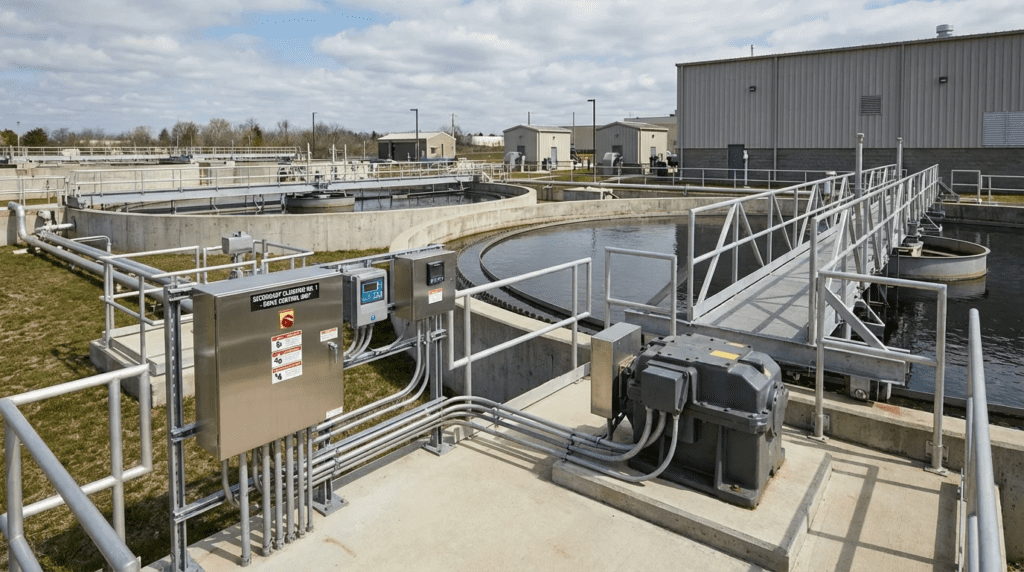
Circular clarifiers are the most ubiquitous settling basins in municipal wastewater, utilizing rotating sweep arms to collect settled sludge to a central hopper. Circular Clarifier Manufacturers—such as WesTech, Evoqua (now Xylem/Envirex), Ovivo (Eimco), and Kusters Water—design these units in center-feed, peripheral-feed, or spiral-flow configurations. They are typically deployed as primary or secondary clarifiers in medium to large municipal facilities and heavy industrial biological plants due to their excellent economy of scale and simple, centralized drive operation. Key advantages include continuous sludge removal, robust tolerance to flow surges, and highly predictable hydraulic behavior. However, their major limitation is footprint inefficiency, as circular tanks leave unused “dead space” when nested together. When specifying circular mechanisms, engineers must closely evaluate the manufacturer’s approach to energy dissipating inlets (EDI), density current baffles (such as the Stamford baffle), and specific scraper blade configurations (spiral vs. plow) which dictate sludge transport efficiency.
Rectangular Chain and Flight Clarifier Manufacturers
Rectangular clarifiers utilize a continuous chain looping around sprockets, pulling horizontal flights (scrapers) along the tank floor to push sludge into a hopper, and returning along the surface to skim scum. Leading Rectangular Chain and Flight Clarifier Manufacturers include Brentwood Industries, Evoqua (Envirex), and Polychem. These systems are predominantly utilized in space-constrained sites, indoor facilities, or where plants are built with common-wall construction to drastically reduce concrete costs and footprint. A major advantage over circular basins is the ability to achieve ideal plug-flow hydraulics, which theoretically maximizes settling efficiency. Conversely, maintenance can be more intensive due to the sheer number of submerged moving parts (chains, wear shoes, idlers, sprockets). Specification focus has shifted heavily away from legacy cast iron systems; modern engineers must evaluate OEMs based on their non-metallic component offerings, specifically the tensile strength of fiberglass reinforced plastic (FRP) flights, acetal resin chains, and ultra-high-molecular-weight (UHMW) polyethylene wear shoes.
Lamella Inclined Plate Clarifier Manufacturers
Lamella clarifiers utilize nested, parallel inclined plates (typically at 55 to 60-degree angles) to multiply the effective settling area within a highly compact volume. Lamella Inclined Plate Clarifier Manufacturers, such as Parkson, Monroe Environmental, and WesTech, cater heavily to the industrial sector, metal finishing, mining, and municipal water treatment plants facing severe footprint limitations. By decreasing the settling distance a particle must travel, a lamella unit can reduce the required footprint by up to 90% compared to a conventional circular clarifier. The primary limitations are susceptibility to biological fouling (which restricts their use in municipal secondary wastewater) and the potential for solids clogging in the plate gaps during high-loading events. Specification considerations include plate material (typically 304/316 SS or FRP), plate spacing (typically 1 to 2 inches depending on solids coercivity), and the manufacturer’s specific influent distribution and effluent launder designs to ensure equal flow across all plate packs.
Solids Contact and Upflow Clarifier Manufacturers
Solids contact clarifiers combine flash mixing, flocculation, and clarification into a single integrated basin, utilizing a recirculating sludge blanket to enhance the agglomeration of incoming raw water particles. Specialized Solids Contact and Upflow Clarifier Manufacturers—including SUEZ (Veolia), WesTech, and Evoqua—are highly prevalent in municipal drinking water treatment, surface water clarification, lime softening, and industrial process water preparation. These systems excel in cold-water applications where reaction kinetics are slow, as the presence of existing sludge drastically improves floc formation. However, they require skilled operators to maintain the precise sludge blanket depth and chemistry; sudden temperature drops or flow spikes can “wash out” the blanket. Engineers must rigorously evaluate the OEM’s draft tube design, variable speed turbine impellers, and the geometry of the reaction cone or hood to ensure proper recirculation ratios without excessive shear forces destroying the floc.
High-Rate Ballasted Clarifier Manufacturers
When extreme high-rate clarification is required—often for combined sewer overflows (CSO), peak wet weather flows, or advanced tertiary phosphorus removal—ballasted flocculation is the premier choice. High-Rate Ballasted Clarifier Manufacturers, primarily Veolia (Actiflo, using microsand) and Evoqua (CoMag, using magnetite), engineer systems that bind heavy ballast particles to the floc, increasing settling velocities exponentially. These systems can operate at Surface Overflow Rates (SOR) of 10 to 30 gpm/ft², compared to 0.5 to 1.0 gpm/ft² for conventional clarifiers. The massive footprint reduction and rapid start-up time (often under 15 minutes to reach full treatment efficiency) are unmatched. The tradeoff is high operational complexity, requiring continuous polymer injection, specialized hydrocyclones or magnetic recovery drums to recycle the ballast, and higher continuous energy consumption. Selection relies heavily on piloting and evaluating the manufacturer’s proprietary process guarantees, chemical consumption estimates, and ballast attrition rates.
Dissolved Air Flotation (DAF) Clarifier Manufacturers
Instead of relying on gravity settling, DAF systems inject microscopic air bubbles into the water, which attach to solid particles and float them to the surface for mechanical skimming. Dissolved Air Flotation (DAF) Clarifier Manufacturers—such as KWI, FRC Systems, and WesTech—dominate applications involving fats, oils, and grease (FOG), light biological flocs, algae removal in drinking water, and industrial food & beverage wastewater. DAFs are the inverse of gravity clarifiers, making them ideal for solids with a specific gravity near or below 1.0. While highly effective for specific waste streams, DAF systems are energy-intensive due to the recycle pressurization pumps and air saturation vessels. Engineers sizing DAF systems must carefully review the OEM’s recycle ratio (typically 10-30%), air-to-solids (A/S) ratio, and the design of the dispersion nozzles or valves, which dictate the critical micro-bubble size (ideally 30 to 50 microns).
Tube Settler Component Manufacturers
Similar to lamella plates but utilizing modular, extruded plastic blocks of chevron-shaped tubes, tube settlers are predominantly used to upgrade existing basins. Leading Tube Settler Component Manufacturers, most notably Brentwood Industries, provide structural media that can be retrofitted into underperforming circular or rectangular clarifiers to double or triple their hydraulic capacity. They are extensively used in municipal drinking water sedimentation basins. They offer a highly cost-effective retrofit alternative to pouring new concrete. The limitations are similar to plate clarifiers: they cannot handle heavy biological sludge without frequent plugging and require robust support grid engineering to handle the immense weight of the media when fouled or during basin drain-down. Specifications must detail the specific PVC thickness, UV stabilization, and the structural integrity of the stainless steel or FRP support network.
Clarifier Drive and Mechanism Manufacturers
The operational heart of any circular clarifier is the center drive unit. A niche group of Clarifier Drive and Mechanism Manufacturers—such as DBS Manufacturing, Ovivo, and Kusters—specialize in engineering standalone gearboxes and retrofitting aging OEM mechanisms. A clarifier drive must deliver massive torque at extremely low rotational speeds (often less than 0.05 RPM) and operate continuously for decades under high axial loads. The debate in this subcategory often centers on precision-machined cast-iron main gears (preferred for ultimate longevity and rigidity) versus fabricated steel housings with slewing ring bearings. Engineers must carefully specify continuous operating torque, peak torque, alarm/trip setpoints, and condensate management systems within the drive housing to prevent oil contamination.
SELECTION & SPECIFICATION FRAMEWORK
Selecting among the Top Clarifier Equipment Manufacturers for Water & Wastewater requires a logical decision framework that balances site constraints, biological/chemical process requirements, and total lifecycle costs (TOTEX).
Decision Tree Logic:
1. Identify the Solute/Solid Density: If the target solids are lighter than water (FOG, algae), automatically route to DAF systems. If heavier, proceed to gravity/ballasted options.
2. Evaluate Footprint Constraints: If land is abundant, conventional circular or rectangular clarifiers provide the lowest long-term OPEX. If land is heavily constrained or indoor installation is required, route to lamella, tube settlers, or high-rate ballasted systems.
3. Assess Flow Variability: For steady municipal baseloads, conventional clarifiers excel. For extreme peaking factors (e.g., CSO events requiring rapid start-up), high-rate ballasted clarification is mandated.
4. Analyze Sludge Type: Municipal secondary biological sludge (mixed liquor) is highly sensitive to shear and compression. Circular clarifiers or chain-and-flight systems are preferred; lamella plates are generally avoided for secondary biological solids due to clogging risks.
Lifecycle Cost Tradeoffs (CAPEX vs. OPEX):
Conventional circular clarifiers are highly capital-intensive due to the massive concrete structures required, but their OPEX is extraordinarily low, often requiring only a single 1.5 to 3.0 HP motor to drive the mechanism. In contrast, High-Rate Ballasted Clarifiers require significantly smaller concrete basins (lowering CAPEX), but consume continuous power for rapid mixers, hydrocyclones, and require ongoing budgets for polymer and ballast replacement.
Common Specification Pitfalls:
A frequent specification error occurs when engineers copy/paste primary clarifier specifications for a secondary clarifier application. Primary sludge is heavy, granular, and easily scoured, requiring robust torque drives and deep sludge hoppers. Secondary sludge is light, flocculent, and prone to denitrification if left too long. Specifying a standard plow-scraper for a secondary clarifier instead of a rapid suction-header (organ pipe) mechanism can result in sludge blanket deterioration and floating solids. Additionally, over-specifying drive torque (e.g., arbitrarily requiring 100,000 ft-lbs when 30,000 is adequate) forces manufacturers to use dramatically oversized, expensive gearboxes that provide no operational benefit.
COMPARISON TABLES
The following tables provide an engineer’s quick-reference map to navigate both the primary subcategories of clarification technology and the application fit for specific plant conditions.
Table 1: Subcategory & Technology Comparison
| Type / Technology | Key Mechanisms | Best-Fit Applications | Limitations | Maintenance Profile |
|---|---|---|---|---|
| Circular Clarifier Manufacturers | Center drive, rake arms, suction headers, EDI, baffling. | Municipal primary/secondary, large industrial bio-plants. | Large footprint, concrete-intensive, potential density currents. | Low. Routine drive lubrication; long life for submerged steel. |
| Rectangular Chain and Flight Clarifier Manufacturers | Non-metallic chains, FRP flights, sprockets, wear shoes. | Footprint-constrained sites, indoor plants, common-wall basins. | Length-to-width ratio constraints, cross-collector complexities. | Moderate. Chain tensioning, periodic wear shoe replacement. |
| Lamella Inclined Plate Clarifier Manufacturers | Stainless/FRP parallel plates, flash/floc tanks. | Industrial metals, mining, small municipal water plants. | High risk of biological fouling; strict hydraulic distribution needs. | Low/Moderate. Periodic acid/pressure washing of plates. |
| High-Rate Ballasted Clarifier Manufacturers | Microsand/magnetite injection, hydrocyclones, shear mixers. | CSO/SSO, tertiary Phos removal, high peak-flow events. | High OPEX (power, polymer, ballast loss), highly mechanical. | High. Pump maintenance, hydrocyclone wear, sensor calibration. |
| Dissolved Air Flotation (DAF) Clarifier Manufacturers | Recycle pumps, air saturation vessels, top skimmers. | FOG, food & beverage, algae, WAS thickening. | Ineffective on heavy, high-density solids; high energy use. | Moderate. Compressor/pump maintenance, skimmer adjustments. |
Table 2: Application Fit & Selection Matrix
| Application Scenario | Optimal Subcategory Fit | Key Engineering Constraint | Operator Skill Required |
|---|---|---|---|
| Large Municipal Secondary (Activated Sludge) | Circular Clarifier Manufacturers | State Point Analysis, RAS return rates, density currents. | Low |
| Wet Weather Peaking / CSO Treatment | High-Rate Ballasted Clarifier Manufacturers | Rapid startup time, chemical dosing pacing, ballast attrition. | High |
| Meat Processing / High FOG Industrial | Dissolved Air Flotation (DAF) Clarifier Manufacturers | A/S ratio, bubble micron size, top scum handling. | Moderate |
| Cold-Water Surface Water Treatment | Solids Contact and Upflow Clarifier Manufacturers | Sludge blanket depth control, mixing shear limits. | High |
| Upgrading Capacity of Existing Basins | Tube Settler Component Manufacturers | Structural support limits, localized hydraulic overloading. | Low |
ENGINEER & OPERATOR FIELD NOTES
Practical implementation across clarifier types reveals distinct challenges. While theoretical loading rates govern the initial sizing, long-term success is dictated by commissioning precision, O&M accessibility, and targeted troubleshooting.
Commissioning Considerations
Commissioning parameters vary wildly depending on the selected subcategory. For systems from Clarifier Drive and Mechanism Manufacturers, engineers must witness the drive torque test. This involves chaining the rake arms to structural columns and mechanically inducing a load to verify the alarm and motor cutout setpoints actuate accurately (e.g., alarm at 80% torque, trip at 100%). For Rectangular Chain and Flight Clarifier Manufacturers, the critical commissioning step is verifying chain tracking and tension in a dry, empty tank to ensure flights do not skew and bind against the basin walls. For Dissolved Air Flotation (DAF) Clarifier Manufacturers, commissioning is heavily focused on the recycle pressurization system—verifying the dispersion header yields a “milky white” cloud of microbubbles rather than turbulent, large bubbles that disrupt the float blanket.
Common Specification Mistakes
A prevalent error is underestimating the impact of density currents in circular basins. Influent mixed liquor is heavier than the clarified water; without proper energy dissipating inlets and Stamford baffles (which deflect the current back inward), the heavy sludge flows rapidly across the floor and sweeps up the outer wall, causing massive short-circuiting and TSS carryover. Another major oversight occurs with Lamella Inclined Plate Clarifier Manufacturers: engineers frequently specify plate spacing that is too narrow (e.g., 1 inch) for highly scaling or sticky sludges (like lime softening), leading to irreversible bridging and plugging of the media.
Engineers commonly default to specifying 316 SS for submerged clarifier mechanisms to prevent corrosion. However, in enclosed tanks or industrial environments with high chlorides or hydrogen sulfide off-gassing, the vapor space is highly corrosive. Submerged 316 SS often survives, while the unsubmerged 316 SS structural members above the waterline experience severe pitting and stress corrosion cracking. Consider FRP, coated 316L, or duplex stainless steels (like 2205) for vapor-space components.
O&M Comparison
The O&M burden shifts from structural/mechanical to chemical/process control depending on the technology. Rectangular Chain and Flight Clarifier Manufacturers supply systems requiring annual drain-downs to inspect hundreds of submerged wear parts. Conversely, High-Rate Ballasted Clarifier Manufacturers supply systems where the main basins rarely require drain-downs, but the operator is heavily burdened with tuning polymer dosing algorithms and maintaining high-wear hydrocyclones on a monthly basis. Operators handling Solids Contact and Upflow Clarifier Manufacturers equipment must perform frequent core sampling to visually monitor the sludge blanket inventory to prevent “bulking” or blanket washout.
Troubleshooting Overview
When clarifiers fail, the symptoms guide the diagnosis across all subcategories:
* Ashing/Pin Floc Carryover: Often an upstream biological issue (over-aeration or toxicity) rather than a mechanical clarifier fault. Affects all gravity clarifiers.
* Drive Torque Overloads: In circular mechanisms, this points to sludge blanket over-accumulation (poor RAS pumping) or foreign debris (rags/grit) binding the scraper.
* Flight Skewing: In rectangular systems, indicates uneven chain stretching or a failed drive sprocket shear pin.
* Loss of Float: In DAF systems, this indicates a failure of the air saturation system or a plugged dispersion valve.
* Uneven Weir Flow: Across all tank geometries, if water only flows over sections of the v-notch weir, the weirs must be precisely re-leveled to prevent localized velocity spikes that drag solids upward.
For large diameter circular clarifiers (>100 feet), engineers sometimes fail to specify wind baffles or adequate bridge structural reinforcement. High winds acting on the exposed surface area of an empty tank’s bridge and mechanism can induce massive rotational forces, damaging the center drive gear long before water is ever introduced into the tank.
DESIGN DETAILS & STANDARDS
Designing and specifying clarifier equipment must strictly adhere to hydraulic standards, structural codes, and biological process models.
Sizing Methodology Overview
Across all gravity settling subcategories, sizing is predominantly dictated by two parameters: Surface Overflow Rate (SOR) and Solids Loading Rate (SLR).
SOR (expressed in gallons per day per square foot, gpd/ft²) dictates the upward velocity of the water. For a particle to settle, its downward settling velocity must exceed the clarifier’s upward SOR.
SLR (expressed in pounds per day per square foot, lbs/day/ft²) dictates how much physical mass is being compressed on the tank floor. While SOR generally governs primary clarifiers, SLR frequently dictates the size of secondary biological clarifiers due to the massive volume of Return Activated Sludge (RAS) recycled through the system. For advanced secondary clarifier sizing, engineers utilize State Point Analysis (SPA), a graphical method intersecting operating lines with sludge settling curves to predict thickening failure boundaries.
Key Design Parameters by Subcategory
The accepted hydraulic parameters vary drastically depending on the OEM subcategory specified:
* Circular Clarifier Manufacturers (Secondary Municipal): Typical SOR is 400 – 600 gpd/ft² (Average) to 1,000 – 1,200 gpd/ft² (Peak). Peak SLR is typically maxed at 30 – 35 lbs/day/ft².
* Lamella Inclined Plate Clarifier Manufacturers: Effective SOR can be as high as 1,500 – 2,500 gpd/ft² based on the projected horizontal area, but loading limits are strictly capped by the flow per specific plate to prevent gap scouring.
* High-Rate Ballasted Clarifier Manufacturers: Capable of staggering SORs of 15,000 to 30,000 gpd/ft² (10 to 20 gpm/ft²) due to the artificial increase in particle density via microsand or magnetite.
Applicable Standards & Compliance
Clarifier equipment must conform to a matrix of mechanical and municipal standards:
* Ten States Standards (GLUMRB): The fundamental sizing baseline for municipal wastewater clarifiers in North America. Sets strict limits on SOR, weir loading rates (WLR), and minimum side water depths (SWD).
* AWWA F320 / F321 / F322: Essential guidelines for evaluating drinking water clarifiers, covering submerged equipment, upflow solids contact units, and DAF equipment.
* AGMA (American Gear Manufacturers Association): The critical standard for Clarifier Drive and Mechanism Manufacturers. Specifying an “AGMA 20-year design life” is essential to ensure adequate gearbox bearing sizing and tooth hardness.
Specification Checklist
When finalizing a specification, ensure the following parameters are explicitly stated to allow for normalized bidding among OEMs:
- Maximum Expected Flow (Peak Hourly Flow) and Average Daily Flow: Dictates the hydraulic profile.
- Peak Solids Loading Rate (including RAS/recycles): Dictates mechanism torque.
- Continuous and Peak Torque Rating (ft-lbs): Clearly differentiate between operating, alarm, and motor cutout torque.
- Material Specifications: Tank walls (concrete/steel), wetted mechanism (304SS, 316SS, FRP), non-wetted superstructures (Hot-Dip Galvanized, Aluminum, Painted CS).
- Drive Housing Type: Precision cast iron main gear housing vs. fabricated steel with slewing bearings.
- Sludge Collection Type: Plow scrapers, spiral scrapers, or organ-pipe suction headers.
FAQ SECTION
What are the different types of Top Clarifier Equipment Manufacturers for Water & Wastewater?
The industry is segmented into specialized subcategories based on technology. The primary categories include Circular Clarifier Manufacturers for large traditional basins, Rectangular Chain and Flight Clarifier Manufacturers for footprint-constrained basins, and Lamella Inclined Plate Clarifier Manufacturers for high-density industrial settling. Advanced high-speed options include High-Rate Ballasted Clarifier Manufacturers and Solids Contact and Upflow Clarifier Manufacturers. For floating solids, engineers utilize Dissolved Air Flotation (DAF) Clarifier Manufacturers. Upgrades rely heavily on Tube Settler Component Manufacturers and niche Clarifier Drive and Mechanism Manufacturers.
How do you choose between Circular and Rectangular manufacturers?
The choice is largely driven by site layout and concrete costs. Circular Clarifier Manufacturers offer systems with fewer moving parts, central drives, and lower maintenance needs, making them ideal when land is cheap and available. Rectangular Chain and Flight Clarifier Manufacturers provide systems that share common concrete walls and nest tightly, making them the standard choice for urban plants, indoor facilities, or highly space-constrained upgrades, despite the higher maintenance burden of chains and sprockets.
What is the most cost-effective clarification technology for small footprint upgrades?
If an existing basin is hydraulically overloaded, the most cost-effective method is to retrofit media from Tube Settler Component Manufacturers or packs from Lamella Inclined Plate Clarifier Manufacturers. By inserting inclined media into the existing tank, engineers can multiply the effective settling area by 200-300% without pouring new concrete. However, this is only viable if the sludge is not excessively sticky or prone to severe biological fouling.
How are clarifier drives properly sized?
Drives designed by Clarifier Drive and Mechanism Manufacturers are sized based on rotational torque, usually expressed in foot-pounds (ft-lbs). Torque is calculated using the clarifier diameter, the expected maximum density of the sludge blanket, and the surface area of the scraper blades. An empirical “K-factor” (a multiplier based on tank diameter squared) is often used to establish the continuous operating torque required to move the sludge mass without over-stressing the gear teeth or shear pins.
What causes short-circuiting in conventional clarifiers?
Short-circuiting occurs when influent flow bypasses the intended hydraulic pathway and rushes directly to the effluent weirs, dragging suspended solids with it. Common causes include density currents (cold/heavy water diving to the bottom and sweeping up the walls), wind-induced surface currents, and misaligned/unlevel weirs. Manufacturers combat this using energy dissipating inlets (EDI), impingement baffles, and precise v-notch weir leveling to force uniform radial or longitudinal flow.
CONCLUSION
- Evaluating the Top Clarifier Equipment Manufacturers for Water & Wastewater starts with selecting the right technological subcategory, not just picking a brand name.
- Use Circular Clarifier Manufacturers for standard baseload operations and low OPEX, but pivot to High-Rate Ballasted Clarifier Manufacturers for severe peak-flow/CSO events.
- Light solids and FOG demand technologies from Dissolved Air Flotation (DAF) Clarifier Manufacturers, as gravity settling will fail.
- Always specify Clarifier Drive and Mechanism Manufacturers‘ equipment to precise AGMA standards to guarantee the 20-year structural life of the center mechanisms.
- Avoid copying primary clarifier specs to secondary basins; secondary bio-sludge requires rapid suction removal, not heavy torque scraping.
Navigating the complex landscape of clarifier manufacturers requires a rigorous understanding of fluid mechanics, sludge characteristics, and structural design. The ultimate goal is to match the biological or physical-chemical process requirements to the correct equipment geometry and physics. No single manufacturer holds a monopoly on performance across all applications; a vendor that provides exceptional high-rate ballasted technology may not offer the best ultra-heavy-duty primary circular drive. By systematically analyzing the site constraints, performing lifecycle cost analyses balancing CAPEX against chemical/power OPEX, and standardizing specifications around strict hydraulic and torque requirements, engineers can specify equipment that guarantees long-term compliance, process resilience, and minimal operator burden.