
Top OEMs for Chemical Feed and Storage Systems
1. INTRODUCTION
In the architecture of municipal and industrial water and wastewater treatment, chemical feed and storage systems function as the critical control points for process efficacy and regulatory compliance. Unlike passive infrastructure, these systems are dynamic, requiring precise manipulation of fluid chemistry to achieve coagulation, flocculation, disinfection, pH adjustment, and odor control. For the consulting engineer and plant operator, the chemical feed system represents the intersection of hydraulic engineering, chemical compatibility science, and instrumentation and control (I&C) logic.
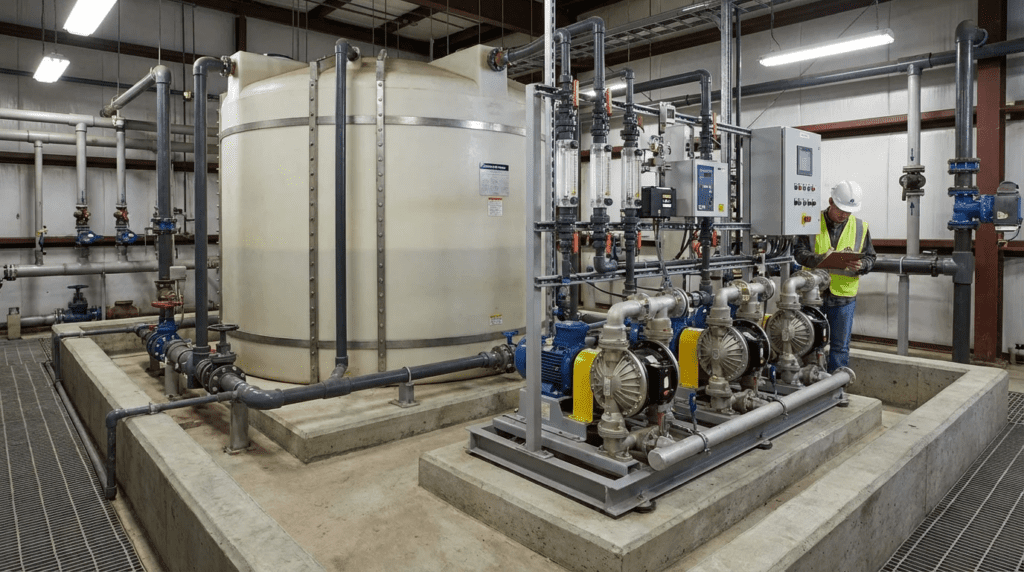
The scope of this equipment category encompasses the entire chemical handling train: bulk storage tanks, day tanks, transfer pumps, metering pumps, containment structures, and the associated instrumentation (flow meters, pressure relief valves, and backpressure valves). These systems handle a diverse array of aggressive reagents, including sodium hypochlorite, aluminum sulfate (alum), ferric chloride, sodium hydroxide (caustic), hydrofluosilicic acid, and various polymer blends. The failure of a chemical feed system does not merely result in operational inefficiency; it often leads to immediate permit violations, the release of hazardous materials, or the halting of potable water production.
Regulatory drivers, such as the EPA’s Risk Management Program (RMP) and OSHA’s Process Safety Management (PSM) standards, place a heavy burden on the design and selection of storage and feed equipment. Furthermore, the Safe Drinking Water Act (SDWA) and NSF/ANSI 61 certifications mandate strict material compatibility and leaching standards. Consequently, the selection of Original Equipment Manufacturers (OEMs) for these systems is not a commodity purchase but a risk management decision. Engineers must evaluate OEMs based on their ability to deliver precision dosing (often within ±1% accuracy), robust material integrity against oxidation and corrosion, and seamless integration into plant SCADA systems.
This article provides a comprehensive technical analysis of the leading OEMs in the chemical feed and storage sector. It is designed to assist engineers and decision-makers in navigating the complexities of specifying equipment that balances capital cost with long-term reliability, safety, and maintainability.
2. HOW TO SELECT THIS PROCESS EQUIPMENT
Selecting chemical feed and storage equipment requires a multi-dimensional engineering approach. The “black box” approach—specifying a generic pump and tank—frequently leads to operational failures, such as vapor locking in hypochlorite lines, tank stress cracking, or poor turndown ratios in dosing applications. The following criteria define the engineering framework for robust selection.
Process Function and Performance Requirements
The fundamental requirement of any chemical feed system is the ability to deliver a precise volume of chemical over a varying range of process conditions. Engineers must first define the required Turndown Ratio. A system treating a steady-state groundwater source may only require a 10:1 turndown, whereas a surface water plant or a wastewater facility with high diurnal flow variations may require 1000:1.
Accuracy and Repeatability: Most regulatory applications require metering pumps to maintain steady-state accuracy within ±1% or ±2%. However, repeatability—the ability to deliver the same volume under identical conditions over time—is often more critical for process stability.
Flow Profile: Engineers must determine if the process tolerates the pulsating flow characteristic of reciprocating diaphragm pumps or if a pulse-free flow is required (e.g., for flow-paced chlorination where pulse lag can cause residual spikes). Peristaltic pumps or diaphragm pumps equipped with pulsation dampeners are often necessary for the latter.
Hydraulic Considerations: NPSH and Viscosity
Hydraulics in chemical feed differ significantly from water pumping. The Net Positive Suction Head Available (NPSHa) is often limited because chemicals are typically stored in atmospheric tanks, and pumps are frequently skid-mounted above the tank level (suction lift) or in flooded suction arrangements with high friction losses due to small-diameter tubing.
Viscosity: Polymers and emulsions exhibit non-Newtonian fluid behaviors. High viscosity affects the ball check valve seating in diaphragm pumps and can drastically reduce the effective capacity of the pump. Peristaltic pumps are often preferred for viscosities exceeding 500-1000 cPs due to their positive displacement mechanics that do not rely on check valves.
Off-Gassing Fluids: Sodium hypochlorite and hydrogen peroxide are prone to off-gassing, creating vapor pockets in suction lines. If a traditional diaphragm pump is selected without an auto-degassing head or high-velocity flushing, the pump will lose prime (vapor lock).
Materials of Construction and Chemical Compatibility
Material selection is the primary determinant of equipment lifespan. This extends beyond the pump head or tank wall to O-rings, valve seats, and injection quills.
-
- Tanks: High-density cross-linked polyethylene (XLPE) is the standard for chemical storage due to its molecular bond strength. However, for strong oxidizers like sodium hypochlorite, an inner anti-oxidant barrier or linear polyethylene with specific UV inhibitors may be specified to prevent environmental stress cracking. Fiberglass Reinforced Plastic (FRP) is an alternative for larger volumes but requires careful resin selection.
-
- Wetted Pump Parts: PVDF (Kynar) is generally the safest default for pump heads handling aggressive acids and oxidizers. PTFE (Teflon) is standard for diaphragms. Ceramic or Hastelloy check balls are selected based on the specific gravity and abrasiveness of the fluid.
-
- Tubing/Piping: Rigid piping (Sch 80 PVC/CPVC) is preferred for permanent headers, while reinforced tubing is used for pump connections. Engineers must account for the “aging” of plastic piping; PVC becomes brittle over time when exposed to UV or certain chemicals.
Integration with Upstream and Downstream Processes
Modern chemical feed systems are rarely standalone. They must integrate with flow meters (upstream pacing) and analyzers (downstream feedback).
Control Logic: The selection process must define how the pump receives signals. Does the application require simple on/off control, 4-20mA analog pacing, or digital bus communication (Profibus, Modbus, Ethernet/IP)? Smart pumps now offer internal PID loops, allowing the pump to accept a direct signal from a residual analyzer and adjust its speed without a separate PLC PID controller.
Skid Systems: Pre-engineered, skid-mounted systems offer significant advantages in integration. These systems arrive with calibration columns, pressure relief valves, backpressure valves, and piping fully assembled and pressure-tested. This eliminates the variability of field assembly.
Footprint and Layout Constraints
Chemical rooms are notoriously cramped. Vertical storage tanks are space-efficient but require significant overhead clearance for delivery access and instrumentation. Pump skids must be laid out to allow maintenance access (diaphragm changes) without requiring the removal of adjacent piping. Double-walled tanks (safe-tanks) eliminate the need for concrete containment berms, saving substantial floor space and civil engineering costs.
Lifecycle Cost and Maintenance Impacts
The initial capital cost of a chemical feed system is often dwarfed by the lifecycle cost of consumables and operator time.
-
- Consumables: Peristaltic pump tubes have a finite life (rated in hours) and are a recurring cost. Diaphragms last longer but are more complex to replace.
-
- Energy Efficiency: While the motor horsepower is usually low, the continuous operation of these pumps adds up. Solenoid-driven pumps are generally less efficient than motor-driven (stepper or induction) pumps at higher loads.
-
- Safety: The cost of a chemical spill—remediation, reporting, and safety audits—justifies higher upfront investment in containment and leak detection technologies.
3. COMPARISON TABLE
The following table compares the top OEMs in the Chemical Feed and Storage category. Engineers should use this matrix to align specific project constraints—such as fluid viscosity, pressure requirements, and available footprint—with the specific strengths of each manufacturer. Note that “limitations” refer to typical application boundaries rather than product defects.
| OEM Name | Typical Applications | Engineering Strengths | Limitations | Best-Fit Scenarios | Maintenance Considerations |
|---|---|---|---|---|---|
| ProMinent | Municipal water disinfection, industrial wastewater dosing, polymer injection. | Advanced “smart” metering pumps (gamma/X, sigma) with integrated control logic; high-precision solenoid and motor-driven designs. | High-tech interfaces can be complex for inexperienced operators; premium pricing for advanced features. | Applications requiring high turndown ratios, SCADA integration, and automated process control loops. | Diagnostic feedback simplifies troubleshooting; diaphragms have long life but require careful torque specs during replacement. |
| Assmann Corporation | Bulk chemical storage, day tanks, double-wall containment. | Uniform wall thickness via rotational molding; cross-linked polyethylene (XLPE) durability; integral molded-in outlets reducing leak points. | Primarily a tank manufacturer; requires third-party integration for pumps and controls. | Storage of corrosive bulk chemicals (hypochlorite, sulfuric acid) where containment integrity is paramount. | Minimal maintenance; periodic visual inspection and hydrostatic testing recommended; gasket replacement on fittings. |
| Poly Processing | Chemical storage for aggressive oxidizers (hypo, sulfuric acid, hydrochloric acid). | SAFE-Tank (double wall) systems; OR-1000 anti-oxidant barrier system; IMFO (Integrally Molded Flanged Outlet) for full drainage. | Large footprint for some double-wall configurations; specific installation protocols for IMFO systems. | Projects requiring full tank drainage (sludge/sediment removal) and extended tank life for oxidizing chemicals. | Annual inspections of tank integrity; OR-1000 layer extends tank life significantly, reducing replacement frequency. |
| Watson-Marlow | Slurries, gaseous fluids (hypochlorite), viscous polymers, abrasive chemicals. | Peristaltic (hose/tube) pump technology; no check valves to clog; capable of dry running; superior handling of shear-sensitive fluids. | Hose/tube is a consumable wear part; lower pressure capabilities compared to hydraulic diaphragm pumps. | Abrasive slurries (lime, carbon), off-gassing fluids that vapor-lock diaphragm pumps, and viscous polymers. | Tube replacement is quick but frequent; preventive maintenance schedule is critical to prevent tube rupture. |
| Lutz-Jesco | Gas chlorination, dry chemical feed, liquid metering. | Extensive range of dosing technologies including mag-drive pumps and gas vacuum regulators; robust German engineering. | Product range is vast, requiring careful specification to match the exact series to the application. | Water treatment plants utilizing gas chlorine or requiring extremely robust, mechanically simple dosing pumps. | Modular designs facilitate part replacement; gas systems require specialized safety training and maintenance. |
| Milton Roy | High-pressure injection, critical process industrial applications, API 675 standards. | Industry standard for reliability (mRoy series); high pressure and temperature capabilities; hydraulic diaphragm design. | Higher capital cost and larger physical footprint for API-rated units; heavy industrial design may be overkill for light commercial use. | Oil & gas, petrochemical, and large municipal plants requiring API 675 compliance and 20+ year pump longevity. | Oil changes required for hydraulic units; robust mechanism rarely fails but requires skilled technician for major overhaul. |
4. TOP OEM MANUFACTURERS
The following sections provide a detailed engineering analysis of the specific OEMs listed for the Chemical Feed and Storage Systems category.
ProMinent
ProMinent is a global leader in fluid metering technology, widely recognized for pioneering solenoid-driven metering pumps. Their engineering philosophy centers on precision control and high-level integration with plant automation systems.
Technical Analysis: ProMinent’s flagship product lines, such as the gamma/ X and sigma series, utilize solenoid and motor-driven diaphragm technologies that offer exceptional turndown ratios. A key engineering feature is the “smart” capability of these pumps. They often include integrated pressure monitoring, flow metering, and auto-degassing logic directly within the pump firmware. This reduces the need for external instrumentation, as the pump can detect air locks or over-pressure events and react accordingly (e.g., by initiating a flush cycle or stopping to protect the system).
Application Focus: Engineers frequently specify ProMinent for applications requiring extremely precise dosing of expensive or potent chemicals, such as disinfection by-product control or fluoridation. Their DULCOdes skids offer turnkey solutions that integrate pumps, sensors, and controllers, minimizing installation errors.
Assmann Corporation
Assmann Corporation specializes in high-density cross-linked polyethylene (XLPE) storage tanks. In the water and wastewater industry, the integrity of the storage vessel is paramount, and Assmann addresses this through advanced rotational molding processes.
Technical Analysis: The core strength of Assmann tanks lies in their uniform wall thickness and the molecular bonding of the XLPE. Unlike linear polyethylene, XLPE creates a three-dimensional molecular network that provides superior resistance to environmental stress cracking and impact. Assmann’s engineering design frequently incorporates a “double wall” configuration, which serves as integrated secondary containment, eliminating the need for concrete dikes. Their molding process allows for the integration of fittings and manways that are structurally consistent with the tank body, reducing weak points where leaks typically initiate.
Application Focus: These tanks are best suited for bulk storage of corrosives like sulfuric acid, hydrochloric acid, and sodium hypochlorite. Engineers should note that while XLPE is superior for structural integrity, specific chemical compatibility (especially with strong oxidizers) should always be verified against the tank’s specific gravity rating (typically available in 1.5 and 1.9 SPG).
Poly Processing
Poly Processing is a dominant force in chemical storage, distinguished by their innovation in material science tailored to specific chemical challenges. They are widely specified for their proprietary tank technologies designed to handle difficult water treatment chemicals.
Technical Analysis: Two technologies define Poly Processing’s engineering value: the IMFO® (Integrally Molded Flanged Outlet) and the OR-1000 system. The IMFO system places the drainage flange at the absolute bottom of the tank sidewall as part of the monolithic mold, allowing for full drainage without the structural weakness of a cut-in bulkhead fitting. This is critical for sludge-prone chemicals like alum or ferric. The OR-1000 system acts as an antioxidant barrier inner surface, specifically engineered to resist the oxidizing attack of sodium hypochlorite, which significantly extends tank life compared to standard XLPE.
Application Focus: Poly Processing is the go-to OEM for sodium hypochlorite storage due to the OR-1000 innovation. They are also highly favored for sludge storage and coagulant feed systems where tank cleaning and full drainage are operational necessities.
Watson-Marlow
Watson-Marlow Fluid Technology Solutions is the global benchmark for peristaltic (hose and tube) pump technology. In sectors where diaphragm pumps struggle—specifically with abrasive, viscous, or gaseous fluids—Watson-Marlow provides the primary engineering alternative.
Technical Analysis: The fundamental advantage of Watson-Marlow’s design (seen in their Qdos and Bredel lines) is the absence of check valves, seals, and diaphragms in the fluid path. The fluid only contacts the hose or tube. This positive displacement action eliminates the issues of vapor locking common with sodium hypochlorite and the valve clogging common with lime slurries or polymers. Their Qdos series features the ReNu pumphead, a cartridge-style replacement system that allows operators to replace the entire fluid path in minutes without tools, ensuring 100% containment of the chemical.
Application Focus: Engineers specify Watson-Marlow for high-viscosity polymers (where check valves stick), abrasive slurries (lime, activated carbon), and fluids that off-gas (hypochlorite, peracetic acid). The linear flow output is also beneficial for flow-paced applications.
Lutz-Jesco
Lutz-Jesco brings a diverse portfolio of dosing technology, ranging from classic motor-driven diaphragm pumps to gas chlorination systems. Their engineering heritage is rooted in robustness and safety, particularly in the handling of chlorine gas and liquid metering.
Technical Analysis: Lutz-Jesco produces reliable solenoid and motor-driven metering pumps (such as the MEMDOS and MAGDOS series). A key differentiator is their expertise in gas feed equipment (vacuum regulators, ejectors), which remains a critical technology for large-scale disinfection. On the liquid side, their mag-drive pumps offer hermetically sealed pumping chambers, eliminating the risk of shaft seal leakage. Their system design capabilities extend to dry material feeders, providing a complete solution for powder-to-liquid processes (e.g., preparing lime slurry or polymer solutions).
Application Focus: They are a strong fit for municipal plants maintaining gas chlorination systems. Additionally, they are well-regarded for general-purpose chemical metering where ruggedness and mechanical simplicity are preferred over complex electronics.
Milton Roy
Milton Roy is synonymous with heavy-duty industrial metering. Their designs are often the standard against which other hydraulic diaphragm pumps are measured, particularly in high-pressure and critical-service applications.
Technical Analysis: The mRoy series is a hydraulically actuated diaphragm pump that adheres to API 675 standards. The engineering brilliance lies in the hydraulic balance of the diaphragm; the process fluid pressure is balanced by hydraulic oil pressure, ensuring the diaphragm is not stressed, leading to operational lifespans exceeding 20 years in some cases. Their High Performance Diaphragm (HPD) liquid end technology combines the simplicity of a diaphragm with the stiffness required for high-accuracy metering, ensuring steady-state accuracy of ±1%.
Application Focus: Milton Roy is the preferred choice for large-scale municipal water plants and industrial wastewater facilities where system pressure is high, or where the cost of downtime is extreme. They are the standard for boiler feed applications, high-pressure pH adjustment, and processes requiring API compliance.
5. APPLICATION FIT GUIDANCE
Selecting the right OEM requires matching the vendor’s core competencies with the specific demands of the facility.
Municipal Water Treatment
In potable water, hygiene, accuracy, and certification (NSF 61) are non-negotiable.
-
- Primary Disinfection (Hypochlorite): Poly Processing (tanks) combined with Watson-Marlow (pumps) is a powerful combination. The tanks resist oxidation, and the peristaltic pumps prevent vapor locking. ProMinent is also excellent here if smart control integration is prioritized.
-
- Fluoridation: This requires extreme accuracy and safety. ProMinent and Milton Roy are frequently specified for their precise dosing capabilities and ability to handle hydrofluosilicic acid safely.
Municipal Wastewater Treatment
Wastewater applications often involve solids, varying viscosities, and odor control.
-
- Polymer Feed: This is a viscosity challenge. Watson-Marlow is ideal for neat polymer transfer due to the shear-sensitive nature of the fluid. Lutz-Jesco dry feeders are applicable if the plant mixes its own polymer.
-
- Odor Control / Nutrient Removal: For dosing carbon sources (MicroC) or metal salts (Ferric/Alum), Assmann tanks (containment) and ProMinent pumps (pacing) offer a reliable solution.
Industrial Wastewater
Industrial environments (refineries, food and bev, power) demand robustness and often high pressures.
-
- Boiler Feed / High Pressure: Milton Roy is the clear leader for high-pressure injection and API 675 requirements.
-
- Corrosive Bulk Storage: Assmann and Poly Processing dominate the storage of aggressive acids and bases used in pH neutralization.
Retrofit vs. Greenfield
-
- Greenfield: Large new plants benefit from Poly Processing’s integrated tank systems and Milton Roy’s longevity.
-
- Retrofit: Macaulay Controls Company excels here by providing custom-fabricated skids that fit into existing, often compromised, spaces, integrating modern instrumentation with legacy plant controls.
6. ENGINEER & OPERATOR CONSIDERATIONS
Installation and Commissioning
The most common failure mode for chemical feed systems is improper suction piping installation. Engineers must ensure suction lines are short, flooded (if possible), and larger than the pump connection to minimize friction loss. When commissioning skid systems from OEMs like Macaulay or ProMinent, verify that pressure relief valves are set 10-15% above system operating pressure, not the maximum pump pressure. For tanks, verify that flexible connections (expansion joints) are installed at the tank outlet to account for the expansion and contraction of polyethylene.
Maintenance Access and Consumables
Peristaltic Pumps: Operators love them for their simplicity, but engineers must account for the OpEx. If a pump runs 24/7, tubes may need replacement every 3-6 months. Ensure the pump is located where the head is easily accessible.
Diaphragm Pumps: These have lower consumable costs but higher maintenance complexity. Check valves must be cleaned regularly, especially with dirty fluids (alum, ferric). Flushing capabilities should be designed into the skid to allow operators to clean lines without dismantling the pump.
Spare Parts Availability
Global OEMs like ProMinent, Watson-Marlow, and Milton Roy have extensive distribution networks. However, lead times for specific liquid ends (e.g., Hastelloy or high-viscosity heads) can be long. Plants should be designed with shelf spares for critical check valves, diaphragms, and pump tubes.
Long-Term Reliability Risks
Tank Integrity: Polyethylene tanks have a finite life, typically 15-20 years depending on UV exposure and chemical aggression. Engineers should write specifications requiring annual visual inspections and periodic ultrasonic testing or stiffness testing for tanks older than 10 years.
Electronic Obsolescence: “Smart” pumps are excellent, but their control boards are proprietary. Unlike a mechanical motor, a failed circuit board usually means a pump replacement. Engineers should weigh the benefits of smart control against the repairability of standard induction motor pumps.
7. CONCLUSION
The selection of chemical feed and storage systems is a foundational element of water and wastewater engineering. It requires a departure from treating equipment as commodities and a move towards specifying solutions based on fluid dynamics, chemical compatibility, and lifecycle operation.
For high-precision, automated dosing, OEMs like ProMinent provide the necessary intelligence. For handling difficult fluids like polymers and off-gassing oxidizers, Watson-Marlow offers superior hydraulic mechanics. When storage integrity is the priority, Poly Processing and Assmann Corporation deliver advanced material science solutions. For heavy industrial reliability, Milton Roy remains the standard, while Lutz-Jesco and Macaulay Controls Company offer robust versatility and systems integration respectively.
Engineers must evaluate the Total Cost of Ownership (TCO), factoring in chemical costs, maintenance hours, and the risk cost of failure. By matching the specific chemical properties and process control requirements to the strengths of these top OEMs, utilities can ensure safe, compliant, and efficient operations for decades.