
Top OEMs for Grinder and Chopper Pumps in Water & Wastewater Applications
Introduction
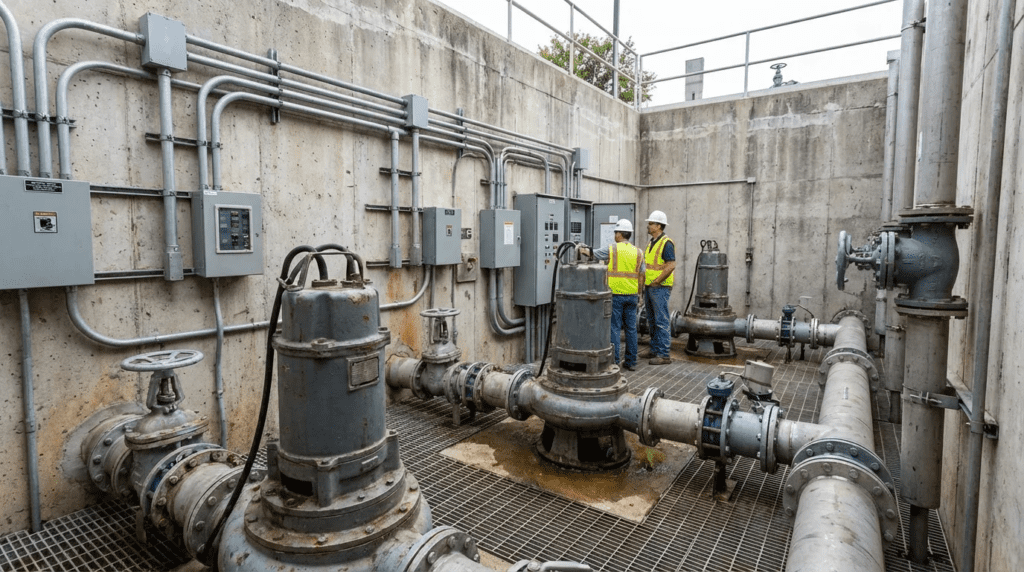
In the landscape of municipal and industrial wastewater transport, the management of solids poses the single greatest threat to continuous operation. While standard non-clog centrifugal pumps are the workhorses of the industry, they are increasingly defeated by the modern waste stream. The proliferation of non-dispersibles—specifically synthetic wipes, rags, hair, and fibrous materials—has necessitated the use of specialized solids-reduction pumping technologies: grinder and chopper pumps.
For consulting engineers and plant operators, the distinction between a grinder pump and a chopper pump is foundational. Grinder pumps typically utilize a macerating cutter assembly on the suction side to reduce solids into a fine slurry, allowing transport through small-diameter pipes (1.25″ to 4″). They are predominantly used in low-pressure sewer systems (LPSS) or applications requiring high head and low flow. Chopper pumps, conversely, are designed to slice larger solids while maintaining pass-through capability, typically acting as heavy-duty centrifugal pumps equipped with hardened cutting elements. These are deployed in lift stations, sludge recirculation, and areas with heavy debris loading.
Selecting the correct Original Equipment Manufacturer (OEM) for these assets is not merely a procurement exercise; it is a critical engineering decision that dictates the lifecycle cost, mean time between failures (MTBF), and operational safety of the facility. The market is saturated with varying cutter geometries, metallurgical specifications, and hydraulic designs. A mismatch between the pump’s solids-handling mechanism and the actual influent characteristics often results in catastrophic clogging, motor burnout, or downstream process issues.
This article provides an in-depth, unbiased engineering review of the top OEMs in the grinder and chopper pump category: Flygt (Xylem), Vaughan Company, Environment One (E/One), Tsurumi, and Zoeller. It evaluates these manufacturers based on hydraulic performance, material durability, and suitability for specific water and wastewater applications.
How to Select This Pump Type
Specification of grinder and chopper pumps requires a departure from standard clean-water pump selection. While the Best Efficiency Point (BEP) remains relevant, it must be balanced against the mechanical energy required to reduce solids. Engineers must evaluate the following criteria to ensure specification safety and operational reliability.
1. Hydraulic Performance and System Curve Analysis
The hydraulic behavior of grinder and chopper pumps varies significantly.
Grinder Pumps: Often utilize vortex or semi-open impellers, or in the case of some manufacturers, progressive cavity (PC) designs. PC pumps offer semi-positive displacement characteristics, providing nearly constant flow against variable head pressures—ideal for complex force main networks where friction losses fluctuate. Centrifugal grinders behave according to standard affinity laws but often have steep curves to overcome high static heads.
Chopper Pumps: Typically exhibit standard centrifugal curves. However, the efficiency penalty of the chopping mechanism (friction losses at the cutter plate) must be accounted for. Engineers must ensure the pump operates to the left of BEP to maintain sufficient radial loading stability but not so far left as to cause recirculation cavitation, which accelerates cutter wear.
2. Solids Handling and Cutter Geometry
The method of solids reduction is the primary differentiator.
Maceration vs. Slicing: Grinders macerate solids into a slurry. While this prevents clogging in small pipes, it can create “roping” of fibrous materials if the cutter torque is insufficient. Choppers slice materials into manageable pieces (typically 1-3 inches) rather than a slurry.
Multi-stage Cutting: High-specification units often employ multi-stage cutting: an external cutter to break down large debris before it enters the suction, and internal cutting elements (impeller against cutter bar/plate) to refine the size.
Clearances: The ability to maintain tight clearances between the rotating and stationary cutting elements is vital for efficiency. As wear occurs, the gap widens, reducing cutting effectiveness and pump efficiency. OEMs that offer externally adjustable clearances without dismantling the pump offer a significant maintenance advantage.
3. Materials of Construction and Metallurgy
Standard cast iron is insufficient for the cutting elements.
Hardness: Cutter bars and blades must be heat-treated. Look for Rockwell C hardness ratings (HRC) typically above 60 for the cutting elements to withstand grit and abrasion.
Material Compatibility: In industrial applications or aggressive wastewater (high H2S), standard hardened steels may corrode. High-chrome iron or hardened stainless steel (e.g., 440C or proprietary alloys) specifications are necessary to prevent the cutting edge from degrading due to corrosion rather than abrasion.
4. Efficiency and Lifecycle Cost
Grinder and chopper pumps are inherently less hydraulicly efficient than standard non-clog pumps due to the energy consumed by the comminution process. However, “efficiency” must be viewed holistically. A standard pump that is 5% more efficient but clogs weekly has a vastly higher operational cost than a chopper pump that runs uninterrupted.
Power Consumption: Engineers should evaluate the wire-to-water efficiency but prioritize the “cost per gallon pumped without intervention.”
Motor Service Factor: Given the shock loads experienced when a cutter strikes a hard object (wood, plastic), motors should be specified with a 1.15 service factor, and Class H insulation is preferred for submersible applications to withstand higher operating temperatures.
5. Maintenance, Serviceability, and Redundancy
Field Serviceability: Can the cutters be replaced in the field, or must the unit be sent to a shop? Are special tools required?
Cartridge Seals: Mechanical seal failure is a common failure mode. Cartridge seal systems that protect the seal faces during installation reduce human error.
Redundancy: In critical lift stations, duplex or triplex configurations are mandatory. For LPSS, the question of redundancy often shifts to storage capacity (wet well volume) versus redundant pumping units.
Comparison Table
The following table provides a technical comparison of the locked OEM list for Grinder and Chopper pumps. This data reflects general engineering consensus and typical product positioning.
| OEM | Primary Technology Focus | Typical Applications | Technical Strengths | Engineering Limitations / Considerations |
|---|---|---|---|---|
| Flygt (Xylem) | Submersible Chopper (N-Tech) & Grinder | Municipal lift stations, influent pumping, storm retention. | Adaptive N-impeller technology allows axial movement to pass solids. Hard-Iron metallurgy offers exceptional wear resistance. Integrated intelligence (SmartRun) controls. | Proprietary parts and controls ecosystem can be costly. N-impeller is a semi-chopper; heavy conditioning may require their specific F-series chopper. |
| Vaughan Company | Severe Duty Chopper Pumps | Sludge recirculation, digester mixing, prisons, hospitals, heavy-ragging lift stations. | Inventors of the chopper pump. Heavy-duty design treats the pump as a solids processor first. Heat-treated cast alloy steel cutter nut and plate. Unmatched reliability in extreme solids. | Hydraulic efficiency is generally lower than standard non-clogs due to aggressive chopping mechanics. Higher initial capital cost. |
| Environment One (E/One) | Progressive Cavity (PC) Grinders | Low Pressure Sewer Systems (LPSS), septic tank replacement, difficult terrain force mains. | Semi-positive displacement creates constant flow regardless of head (vital for shared force mains). Vertical integration of pump and tank station. Low power consumption. | Not designed for high-flow lift stations. Stators are sensitive to run-dry conditions. Maintenance differs significantly from centrifugal pumps. |
| Tsurumi | Cutter Pumps (Centrifugal) | Small municipal lift stations, construction dewatering, housing developments. | High-torque motors with serrated suction covers. Simple, robust construction. Anti-wicking cable entry prevents water ingress to motor. Cost-effective. | Typically viewed as a “cutter” rather than a full “chopper” (less aggressive reduction than Vaughan). Limited options for massive municipal flows compared to Flygt. |
| Zoeller | Submersible Grinder Pumps | Residential, commercial, light municipal pressure sewers. | Oil-filled motors for superior heat dissipation. Reversing cutter action (in specific models) to clear jams. Rail systems designed for easy retrofits. | Primarily focused on the smaller end of the municipal spectrum (up to 7.5 HP typical). Not the primary choice for large influent headworks. |
Top OEM Manufacturers
The following section details the specific engineering characteristics of the five mandatory OEMs. Analysis focuses on their specific contributions to grinder and chopper pump technology.
1. Flygt (Xylem)
Flygt, a brand of Xylem, is arguably the most recognized name in submersible wastewater pumping. Their approach to solids handling has evolved significantly over the last two decades, moving from traditional grinders to their proprietary “N-Technology.”
Technical Differentiators:
Flygt distinguishes between “Grinder” pumps (M-Series) and “Chopper” pumps (F-Series).
The M-Series (Grinder) utilizes a hardened cutter wheel and cutter plate on the suction side. These are centrifugal pumps designed for high-head, low-flow applications (force mains). The cutting mechanism is designed to macerate solids into a fine slurry.
The F-Series (Chopper) is designed for tougher applications. It features a patented technology where the impeller moves axially upwards when a large solid enters, allowing the object to pass through while being sliced, preventing the pump from seizing.
Additionally, Flygt’s Adaptive N-Impeller is a hybrid solution. While not a traditional chopper, the self-cleaning geometry moves solids along the leading edge of the impeller to a relief groove. For severe ragging, the leading edges can be hardened or sharpened to provide a chopping function.
Material Science: Flygt utilizes “Hard-Iron,” a high-chrome cast iron roughly three times harder than standard grey iron, specifically to combat the abrasive wear that dulls cutting edges.
2. Vaughan Company
Vaughan Company is unique in this list as they are the original patent holders of the chopper pump design and remain singularly focused on severe-duty solids handling. For engineers specifying pumps for “worst-case scenarios”—such as prison lift stations, slaughterhouses, or thick sludge handling—Vaughan is often the standard of design.
Technical Differentiators:
The Vaughan Chopper Pump utilizes a “cutter nut” that rotates with the impeller, acting as the first line of defense to agitate and break up solids before they enter the suction. Inside the pump, the impeller blades cut against a stationary “cutter bar” (anvil) and a serrated suction plate.
Vaughan pumps typically feature an externally adjustable clearance between the cutter and the impeller. This allows maintenance personnel to “tune” the pump back to factory cutting tolerances without disassembling the unit or replacing parts, significantly extending the wear life of the components.
They also manufacture Conditioning Pumps, which are high-speed submersibles specifically designed to be dropped into a wet well to recirculate and chop floating mats of grease and rags, protecting other standard pumps in the station.
Material Science: Vaughan uses heat-treated cast alloy steels for all wetted rotating parts, ensuring the cutting edges maintain sharpness longer than standard stainless or cast iron variants.
3. Environment One (E/One)
Environment One (E/One) occupies a distinct niche. They are the global leaders in Low Pressure Sewer Systems (LPSS). Unlike the other OEMs on this list who primarily focus on centrifugal technology, E/One utilizes Progressive Cavity (PC) technology for their grinder pumps.
Technical Differentiators:
The E/One SPD (Semi-Positive Displacement) pump consists of a stainless steel rotor turning within a rubber stator. This mechanism delivers a nearly constant flow rate regardless of the system pressure (head).
Engineering Advantage: In a municipality with a shared force main, pressures fluctuate wildly as different pumps turn on and off. A centrifugal pump might reach “shut-off head” and fail to pump if the line pressure is too high. The E/One PC pump will continue to push (up to its pressure relief limit), ensuring predictable discharge.
The grinder mechanism is a low-speed, high-torque design. Because the PC pump turns slower than a 3450 RPM centrifugal motor, the wear rates on the stator can be managed, though run-dry protection is critical.
Application Focus: E/One is almost exclusively specified for pressure sewer systems (replacing septic tanks) and is rarely used for central lift stations or high-flow transfer.
4. Tsurumi
Tsurumi Manufacturing Co., Ltd. is renowned for simplicity, durability, and mass-production consistency. While they are a giant in the construction dewatering market, their “C-Series” cutter pumps are widely used in municipal and industrial wastewater.
Technical Differentiators:
Tsurumi’s approach to solids handling involves a tungsten carbide alloy tip brazed onto the impeller vane, which rotates against a serrated suction cover. This acts as a shredding mechanism for fibrous materials.
Anti-Wicking Block: A signature Tsurumi feature is the cable entry system. If the power cable is damaged or the tip is submerged, the internal potting prevents water from wicking down the copper strands into the motor housing—a common cause of failure in submersible pumps.
Price-Performance Ratio: Tsurumi pumps are often specified where budget constraints are tight but reliability cannot be sacrificed. They are frequently used in retrofits for failing lift stations in housing developments or light commercial zones.
Limitations: Tsurumi’s cutter mechanism is effective for rags and light debris but does not offer the same “positive chopping” capability as a Vaughan for large, hard solids. They are best viewed as aggressive shredders.
5. Zoeller
Zoeller Company is a dominant player in the residential and light commercial market, with a strong presence in municipal pressure sewers. They are often the “bread and butter” specification for fractional horsepower up to 7.5 HP grinder applications.
Technical Differentiators:
Zoeller grinder pumps often feature a Reversing Cutter action. In specific microprocessor-controlled models, if the pump detects a jam (via amperage spike), it can reverse rotation to dislodge the object before attempting to cut again. This dramatically reduces operator call-outs.
Heat Dissipation: Zoeller is known for using oil-filled motor housings with finned exteriors. This provides superior heat transfer compared to air-filled motors, allowing for cooler operation during longer duty cycles or in dry-pit applications where the pump isn’t fully submerged.
Rail Systems: Zoeller engineers proprietary guide rail systems that simplify the installation and retrieval of these pumps, recognizing that maintenance access is often the biggest headache for municipal crews.
Application Fit Guidance
Engineering selection relies on matching the specific OEM strengths to the application node within the wastewater network.
1. Municipal Lift Stations (Headworks & Transfer)
Primary Choice: Flygt (Xylem) or Vaughan Company.
For main lift stations receiving raw sewage with unknown debris, high-flow capability is required. Flygt’s N-pumps offer the best balance of efficiency and non-clogging for general sewage. However, if the station has a history of severe ragging (nursing homes, prisons upstream), Vaughan is the preferred “problem solver” despite the efficiency trade-off.
2. Low Pressure Sewer Systems (LPSS)
Primary Choice: Environment One (E/One).
When designing a pressure sewer network for a new subdivision on hilly terrain or high bedrock (where deep gravity sewers are cost-prohibitive), E/One is the standard. The physics of the progressive cavity pump simplify the hydraulic modeling of the shared force main network.
3. Sludge Handling and Digester Mixing
Primary Choice: Vaughan Company.
Thickened sludge, scum pits, and digester recirculation require pumps that can handle high viscosity and high solids concentrations. Vaughan’s positive chopping action ensures that large organic solids are conditioned, aiding the digestion process and protecting heat exchangers downstream.
4. Commercial & Light Municipal (Retrofits)
Primary Choice: Tsurumi or Zoeller.
For strip malls, small housing developments, or replacing failing pumps in existing small-diameter wet wells, these OEMs offer excellent availability and robust performance. Zoeller is often preferred for 2HP residential grinders; Tsurumi is excellent for 3-10HP rugged applications.
Engineer & Operator Considerations
Beyond the catalog data, several practical factors determine the long-term success of a grinder or chopper pump installation.
Maintenance Access and Safety
Grinder and chopper pumps utilize extremely sharp, hardened steel components.
Safety: Maintenance protocols must strictly enforce Lock-Out/Tag-Out (LOTO). Unlike a standard impeller which might bruise a hand, a chopper impeller can cause severe injury instantly.
Clearance Adjustment: Engineers should favor designs that allow for external clearance adjustment. If an operator has to dismantle the pump casing to tighten the cutter gap, it likely won’t happen until the pump clogs.
Control Panel Integration
The pump is only as good as its controls.
Jam Protection: Panels should be specified with current monitoring sensors. If a hard object jams the cutter, the panel must trip quickly to prevent stator burnout.
Reversing Contactors: For centrifugal grinders/choppers, specifying a panel with reversing capability allows for automated “de-ragging” sequences. This feature alone can reduce maintenance call-outs by over 50% in rag-heavy environments.
Common Specification Mistakes
- Oversizing: Putting a massive chopper pump in a low-flow station causes short cycling. This leads to motor overheating and premature seal failure.
- Confusing Technologies: Specifying a progressive cavity pump (E/One) for a high-flow lift station, or a centrifugal grinder for a high-head/low-flow application where it will run off the curve.
- Ignoring Hardness: Failing to specify the Rockwell hardness of the cutter components allows vendors to supply softer, cheaper metals that dull within months.
Conclusion
The selection of grinder and chopper pumps is a critical defense mechanism for modern wastewater infrastructure. As the composition of municipal waste continues to evolve with higher concentrations of synthetic solids, the reliance on standard non-clog pumps is diminishing in favor of active solids-reduction technologies.
For large-scale municipal lift stations requiring a balance of efficiency and reliability, Flygt remains a dominant force. When the application demands absolute destruction of solids in severe environments, Vaughan Company offers unrivaled chopping capability. For the specific hydraulic challenges of low-pressure sewer networks, Environment One (E/One) provides the premier progressive cavity solution. Meanwhile, Tsurumi and Zoeller offer robust, cost-effective solutions for the commercial, residential, and light municipal sectors.
Engineers must move beyond simple flow and head calculations. Successful specification requires a deep understanding of the solids stream, the specific hydraulic mechanics of the pump type, and the maintenance realities faced by the end-user. By aligning the application with the specific strengths of these top OEMs, utilities can achieve resilient, clog-free operations.