
Crispin Valve vs International Valve for Air Valves: Pros/Cons & Best-Fit Applications
Introduction
One of the most frequent causes of pipeline failure in municipal water and wastewater infrastructure is not structural weakness of the pipe itself, but rather the mismanagement of entrained air and vacuum conditions. A startling number of force main bursts and transmission line collapses can be traced back to improper sizing, placement, or selection of air valves. Engineers frequently treat air valves as commodity items, copying specifications from previous projects without analyzing the specific hydraulic nuances of the current application.
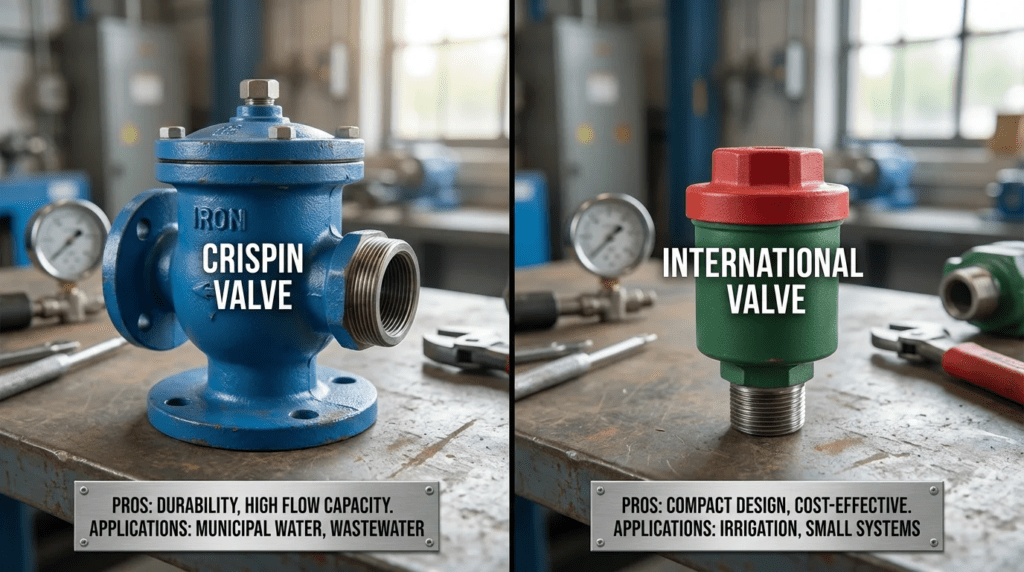
The choice of manufacturer and design philosophy plays a critical role in long-term system reliability. Two prominent names often appear in specification battles: Crispin Valve, a legacy manufacturer with over a century of history in the US market, and International Valve, known for alternative material solutions and specific design innovations. When conducting an engineering evaluation of Crispin Valve vs International Valve for Air Valves: Pros/Cons & Best-Fit Applications, the decision typically extends beyond simple price comparisons to a debate between traditional cast-metal construction and modern material science, as well as differing approaches to internal linkage mechanisms.
These components are utilized throughout the water cycle—from raw water intake and high-service pumping stations to wastewater force mains and sludge lines. In these environments, the valves must perform three distinct functions: releasing accumulated air during operation (Air Release), expelling large volumes of air during filling (Air/Vacuum), and admitting air to prevent vacuum collapse during draining or surge events. Poor selection leads to “spitting” valves, premature corrosion, biological fouling in wastewater applications, and catastrophic water hammer events.
This article aims to provide consulting engineers and utility decision-makers with a granular, technical comparison of these two distinct manufacturing approaches. By dissecting the engineering merits, failure modes, and lifecycle implications of both, we clarify which technology aligns best with specific municipal and industrial constraints.
How to Select / Specify Air Valves
Selecting the correct air valve requires a multidimensional analysis of the hydraulic profile and the physical environment. When evaluating Crispin Valve vs International Valve for Air Valves: Pros/Cons & Best-Fit Applications, engineers must look past the catalog cut-sheet and interrogate the internal design logic relative to the application’s severity.
Duty Conditions & Operating Envelope
The primary driver for specification is the definition of the operating envelope. Engineers must define the maximum working pressure (MWP) and, critically, the minimum operating pressure. Air release valves (small orifice) require a positive pressure seal; if the line pressure drops too low, some designs may not seat correctly, leading to dribbling.
For high-pressure transmission mains (class 250 or 300 service), the valve body capability is paramount. Traditional designs, like those often championed by Crispin, utilize heavy ductile iron or cast steel bodies that handle significant hoop stress and external loads. Conversely, applications with lower pressures but aggressive water chemistry might favor the composite or specialized alloy approaches often found in International Valve’s portfolio. Future capacity planning is also essential; a valve sized for today’s flow might be undersized for tomorrow’s pump upgrade, leading to insufficient vacuum protection during a rapid drain event.
Materials & Compatibility
Corrosion is the leading cause of air valve failure. In standard potable water applications, epoxy-coated ductile iron is the industry standard. However, in wastewater environments where hydrogen sulfide (H2S) gas accumulates at high points (exactly where the air valve is located), standard materials degrade rapidly.
- Internal Mechanisms: The float and linkage mechanism is the heart of the valve. 316 Stainless Steel is the baseline requirement for wastewater. However, some modern designs utilize Delrin, polypropylene, or other high-grade polymers to completely eliminate galvanic corrosion issues.
- Body Construction: While Crispin is renowned for robust Cast Iron and Ductile Iron construction (often preferred for its rigidity and impact resistance), International Valve has gained traction by offering lightweight, corrosion-immune composite bodies or specialized stainless fabrications that resist aggressive industrial effluents.
- Elastomers: The seat material (Buna-N, EPDM, Viton) must match the chemical composition of the fluid. In industrial wastewater, standard Buna-N may swell or degrade, necessitating a review of chemical compatibility charts.
Hydraulics & Process Performance
The aerodynamic performance of an air valve is defined by its intake and discharge curves. Engineers must verify that the “Air/Vacuum” (large orifice) component can admit enough air to replace the water column during a line break or pump trip to prevent vacuum collapse.
Equally important is the “Anti-Slam” or “Surge Check” characteristic. If an air valve exhausts air too quickly as the water column returns, the float slams shut instantly, creating a pressure spike (water hammer). Both Crispin and International Valve offer surge-dampening accessories or integrated designs (throttling devices). The specification must explicitly require surge analysis to determine if a standard kinetic air valve is sufficient or if a slow-closing device is required.
Installation Environment & Constructability
Air valves are frequently installed in underground vaults that are difficult to access and prone to flooding.
Space Constraints: Older cast iron designs can be extremely heavy and tall, particularly in the “elongated body” wastewater configuration designed to keep mechanisms free of grease. Lighter-weight alternatives or shorter designs (where hydraulic conditions allow) can reduce vault depth and construction costs.
Freezing: In northern climates, valves in shallow vaults are susceptible to freezing. The thermal mass of a heavy iron valve differs from a composite valve. Heat tracing and insulation specifications must be compatible with the valve body material.
Reliability, Redundancy & Failure Modes
The most common failure mode in wastewater air valves is fouling. Fats, Oils, and Grease (FOG) and ragging can jam the float mechanism.
Linkage vs. Non-Linkage: Traditional designs (heavily associated with Crispin’s heritage) often use a lever linkage to multiply the float’s buoyancy force to open the orifice against internal pressure. While effective, linkages provide catch points for debris. Alternative designs (often found in International Valve’s offerings) may utilize direct-acting floats or rolling seal mechanisms that eliminate linkages, theoretically reducing jamming potential in sewage applications.
Controls & Automation Interfaces
Historically, air valves were purely mechanical. However, modern smart water networks increasingly demand visibility. Air valves can now be specified with limit switches to signal if the valve is flooded (failed) or if a surge check device has activated. Integration into SCADA allows operators to detect a “spitting” valve before it floods a vault. Engineers should specify dry contacts or 4-20mA outputs if remote monitoring of valve status is required for critical transmission mains.
Maintainability, Safety & Access
Maintenance is dangerous; air valves are under pressure and often in confined spaces.
Backflushing: For wastewater applications, specifiers must mandate flushing attachments (inlet isolation valves and quick-connect washdown ports). This allows operators to blast the valve internals with clean water to remove sludge without dismantling the unit.
Weight: A 4-inch ductile iron wastewater combination valve can weigh over 150 lbs. A composite or modern fabricated equivalent might weigh 40 lbs. This difference significantly impacts operator safety during replacement tasks.
Lifecycle Cost Drivers
The initial purchase price of an air valve is negligible compared to the cost of a pipeline failure or the labor cost of frequent unclogging.
CAPEX vs. OPEX: A heavy-duty stainless steel specification increases CAPEX but may eliminate replacement costs for 20 years. A cheaper epoxy-coated iron valve may require recoating or replacement in 5-7 years in corrosive vault environments.
Energy: While air valves don’t consume electricity, their failure to remove air pockets increases head loss (pumping costs). Therefore, the reliability of the air release function directly impacts the energy efficiency of the pumping station.
Comparison Tables: Crispin vs. International Valve
The following tables provide a direct comparison to assist in the Crispin Valve vs International Valve for Air Valves: Pros/Cons & Best-Fit Applications evaluation. Table 1 focuses on the distinct manufacturing philosophies and typical product characteristics. Table 2 outlines the application suitability for various municipal scenarios.
| Feature / Criteria | Crispin Valve (Traditional/Legacy) | International Valve (Modern/Alternative) |
|---|---|---|
| Primary Design Philosophy | Heavy-duty, AWWA C512-compliant heritage designs. Focus on robust cast iron/ductile iron construction and proven linkage mechanisms. | Often focuses on advanced materials (composites, specific stainless alloys) and innovative internal geometries (rolling seals, reduced linkages). |
| Material Construction | Standard: Ductile/Cast Iron with Stainless trim. Optional: 316SS. Known for thick wall sections and durability. |
Standard: varies by line, but emphasizes corrosion-resistant polymers, composites, and lightweight stainless steel options alongside traditional metals. |
| Wastewater Mechanism | Elongated Body with Linkage: Uses a lever arm to multiply float force. Effective sealing but linkage can catch debris. | Variable: Often promotes designs with fewer moving parts, direct-acting floats, or rolling diaphragms to minimize clogging points. |
| Pressure Range | Extremely wide range available, including very high-pressure applications (deep mines, high-head hydro). | Generally covers standard municipal ranges (Class 150/300), but may have limitations in extreme high-pressure industrial applications compared to heavy castings. |
| Maintenance Profile | Serviceable, but heavy. Parts are widely available due to long installed base. Traditional maintenance (seat replacement) is well understood. | Often designed for “swap-out” or modular repair. Lightweight components reduce the physical burden on operators during removal. |
| Primary Strength | Proven Reliability: “Basis of Design” in thousands of US municipalities. Extreme durability in physical abuse scenarios. | Corrosion Resistance & Weight: Superior longevity in aggressive chemical environments or salt-water applications due to material choices. |
| Limitations | Weight makes handling difficult in confined spaces. Cast iron subject to external corrosion in wet vaults if coating is breached. | May face resistance from conservative engineers preferring heavy metal. Composite threads require careful installation to avoid stripping. |
| Application Scenario | Service Type | Best-Fit Recommendation | Engineering Rationale |
|---|---|---|---|
| Large Diameter Transmission Main (Potable) | Clean Water / High Pressure | Crispin (or Iron Heavy Duty) | High structural integrity is required for surge pressures. Clean water minimizes linkage fouling risks. Weight is less of an issue (rarely moved). |
| Sewer Force Main (High H2S) | Wastewater / Corrosive | International Valve (Composite/SS) | H2S gas accumulates in the air valve, rapidly corroding standard iron/steel. Composite or high-grade polymer internals significantly extend lifecycle. |
| Desalination / Brine Lines | High Chloride / Corrosive | International Valve (Composite/Duplex) | Standard 316SS can suffer pitting. Composite bodies or specialized alloys offered by International Valve provide superior chemical resistance. |
| Deep Well Vertical Turbine Pump | Clean Water / Vertical Discharge | Crispin (Deep Well Series) | Crispin’s specialized deep well valves are industry standards for handling the specific air discharge characteristics of vertical turbine start-ups. |
| Retrofit in Small/Shallow Vaults | Any | International Valve (Compact) | Lighter weight and often more compact footprints ease installation in space-constrained retrofits without heavy lifting equipment. |
| Raw Water Intake (High Grit) | Abrasive Water | Crispin (Severe Service) | Heavy wall thickness and abrasion-resistant trim options handle sand/grit wear better than lighter alternatives. |
Engineer & Operator Field Notes
Successful air valve implementation relies on more than just the brand selection. Field experience dictates that installation details and maintenance strategies are the primary determinants of reliability.
Commissioning & Acceptance Testing
Commissioning an air valve is often overlooked, with contractors assuming “if it doesn’t leak immediately, it works.” This is a dangerous assumption.
- Seating Pressure Verification: During startup, the system pressure must be brought up slowly. Verify the valve seals completely at the minimum design pressure (often 2-5 psi). Some high-pressure valve designs struggle to seal perfectly at very low start-up pressures.
- Dynamic Testing: If possible, simulate a pump trip or rapid drain to verify the air/vacuum orifice opens fully. Listen for the characteristic high-velocity air intake sound. Silence indicates a potential stuck float or an isolation valve left closed.
- Documentation: Record the serial numbers and precise GPS coordinates. Air valves are often paved over or lost in vegetation. Digital asset management starts at commissioning.
Common Specification Mistakes
Engineers frequently underspecify air valves by focusing solely on pipe diameter rather than air volume.
The “One Size Fits All” Error: Specifying a 2-inch valve simply because the tap is 2 inches is incorrect. The valve must be sized based on the filling and draining flow rates of the main. A 2-inch valve might be sufficient for release but woefully inadequate for vacuum protection on a 24-inch main during a break.
Ignoring Inlet Piping: Specifying a high-performance valve and installing it on a long, narrow run of pipe negates the valve’s capacity. The inlet piping between the main and the valve should effectively be the same size as the valve inlet to prevent “choking” the flow.
O&M Burden & Strategy
In wastewater applications, the “set it and forget it” mentality leads to failure.
Backflushing Schedule: For sewage valves, a weekly or bi-weekly backflush is recommended. If the valve is specified with a flushing kit (hoses and quick disconnects), this takes 5 minutes. Without it, the valve clogs, leading to reduced pipeline capacity.
Predictive Maintenance: Leakage is the primary indicator of failure. However, by the time leakage is visible, the vault may be flooded. Operators should periodically check the “burping” sound of valves during pump cycles. A valve that never releases air is likely clogged or air-bound.
Troubleshooting Guide
- Symptom: Leaking Water from Vent.
Cause: Debris on the needle seat (air release) or main seat. Low system pressure preventing seal.
Fix: Backflush the valve. If persistent, disassemble and clean the seat. Check line pressure. - Symptom: Valve “Slams” Shut.
Cause: Differential pressure across the float is too high; float is too buoyant or aerodynamic forces are lifting it prematurely.
Fix: Install a throttling device (surge check) on the outlet to restrict air discharge velocity. - Symptom: Pipeline Surges/Hammers on Pump Start.
Cause: Air valve is sizing is too small, or air is not being exhausted efficiently, leaving an air pocket that compresses rapidly.
Fix: Review sizing calculations. Check for obstructions in the valve discharge piping.
Design Details & Sizing Logic
Proper application of Crispin Valve vs International Valve for Air Valves: Pros/Cons & Best-Fit Applications requires adherence to fundamental sizing methodologies and industry standards.
Sizing Logic & Methodology
Sizing is not intuitive. A larger valve is not always better; an oversized air release valve can allow air to escape so quickly that water slams into the valve structure (dynamic closure), causing surges.
- Determine Flow Rates: Calculate the maximum filling rate (usually pump capacity) and the maximum gravity draining rate (based on slope and pipe diameter) assuming a line break.
- Air/Vacuum Sizing (Orifice Size): Use the manufacturer’s capacity charts (Standard Air Flow Curves). Select an orifice size that can admit the draining air volume without exceeding a 5 psi pressure drop (vacuum). Exceeding this drop risks collapsing thin-walled pipes.
- Air Release Sizing: Based on the working pressure and the estimated accumulation of entrained air (typically 2% of water volume). The release orifice is usually much smaller (1/16″ to 1/2″).
- Check Surge Potential: If the calculated air discharge velocity exceeds ~100 ft/s, a surge check / anti-slam device is mandatory.
Specification Checklist
To ensure a robust procurement, the Division 40 specification typically includes:
- Compliance: Must meet AWWA C512 (latest edition).
- Body Material: ASTM A536 Ductile Iron (Crispin preference) or Composite/Stainless (International preference), defined by environmental corrosivity.
- Float Material: 316 Stainless Steel or non-collapsible composite.
- Wastewater Features: Elongated body design, concave bottom to prevent debris buildup, backflushing attachments.
- Coating: Interior and exterior fusion-bonded epoxy (if metal body).
- Testing: Manufacturer must provide hydrostatic test certificates for body and seat.
Standards & Compliance
AWWA C512 is the governing standard for Air-Release, Air/Vacuum, and Combination Air Valves for Waterworks Service. It dictates pressure ratings, testing procedures, and material minimums. Engineers should be wary of products that claim “compliance” without third-party verification. Additionally, for drinking water applications, all wetted parts must be NSF/ANSI 61 certified.
Frequently Asked Questions
What is the difference between an Air Release Valve and a Combination Air Valve?
An Air Release Valve has a small orifice designed to release small pockets of accumulated air while the system is under pressure. It keeps the line full and efficient. A Combination Air Valve (the most common municipal spec) integrates both an Air Release function and an Air/Vacuum function (large orifice). The large orifice allows massive amounts of air to enter during draining (preventing vacuum) and escape during filling, while the small orifice manages day-to-day air accumulation.
How do Crispin Valve and International Valve differ in wastewater applications?
In wastewater contexts involving Crispin Valve vs International Valve for Air Valves: Pros/Cons & Best-Fit Applications, the difference lies in the mechanism and body. Crispin typically utilizes a heavy, elongated cast iron body with a stainless steel linkage system to keep the mechanism away from sewage. International Valve often employs composite materials or simplified float designs (fewer linkages) to reduce corrosion and ragging potential. Crispin is favored for durability; International is favored for corrosion resistance.
Why do air valves leak in wastewater systems?
Leakage is usually caused by debris (grit, rags, grease) getting lodged between the valve seat and the plunger/float. In low-pressure systems, there may not be enough internal pressure to force a tight seal. Regular backflushing is the primary preventive measure. Specifying valves with “self-cleaning” float designs or steeper seat angles can also mitigate this.
What is the typical lifespan of a municipal air valve?
A high-quality ductile iron air valve (like a Crispin) can last 20-30 years in a clean water vault, provided the coating remains intact. In wastewater environments with H2S gas, the lifespan drops significantly—often 5-10 years for standard iron valves. Composite or high-grade stainless valves (like those from International Valve) can extend wastewater lifespans to 15-20 years by eliminating the corrosion failure mode.
When is a surge check (anti-slam) device required?
A surge check device is required when the column of water rejoining the air valve moves at high velocity. If the air escapes too fast, the float slams shut, causing a water hammer. Surge checks throttle the air discharge, creating an air cushion that slows the rising water column. This is critical on high-head pump systems and long transmission mains.
Conclusion
Key Takeaways for Engineers
- Don’t Copy-Paste: Analyze the specific hydraulic profile. A valve sized for filling might be undersized for vacuum protection.
- Material Matters: Use Ductile Iron (Crispin style) for high-pressure durability and impact resistance. Use Composites/Synthetics (International style) for corrosive wastewater and salt environments.
- Vacuum is the Killer: The primary function of the valve is pipeline protection. Ensure the Air/Vacuum orifice is large enough to prevent pipe collapse during a break.
- Maintenance is Safety: Specify flushing ports and isolation valves. Heavier valves require lifting davits or lighter composite alternatives.
- Redundancy: Always design N+1 air valves at critical high points to allow for maintenance without system shutdown.
The choice between Crispin Valve vs International Valve for Air Valves: Pros/Cons & Best-Fit Applications ultimately depends on the specific priorities of the project. If the application demands extreme structural ruggedness, high-pressure ratings, and adherence to traditional heavy-duty specifications, Crispin Valve remains the industry benchmark. Their long history and deep inventory of cast parts provide a sense of security for critical transmission infrastructure.
Conversely, if the project faces aggressive corrosion issues (H2S, brine), weight constraints in retrofits, or a desire for modern materials that minimize maintenance related to rust and scale, International Valve offers compelling solutions. The modern engineer must weigh the “install and forget” durability of stainless/composite internals against the proven track record of heavy iron.
Regardless of the manufacturer selected, the success of the installation relies on accurate sizing, proper placement at high points and inflection points, and a rigorous commitment to accessibility for maintenance. By treating air valves as critical surge-control devices rather than simple vents, utilities can avoid catastrophic line failures and ensure long-term operational efficiency.