
Crispin Valve vs International Valve for Air Valves: Pros/Cons & Best-Fit Applications
Introduction
One of the most frequent causes of pipeline failure in municipal water and wastewater infrastructure is not structural weakness of the pipe itself, but rather the mismanagement of entrained air and vacuum conditions. A startling number of force main bursts and transmission line collapses can be traced back to improper sizing, placement, or selection of air valves. Engineers frequently treat air valves as commodity items, copying specifications from previous projects without analyzing the specific hydraulic nuances of the current application.
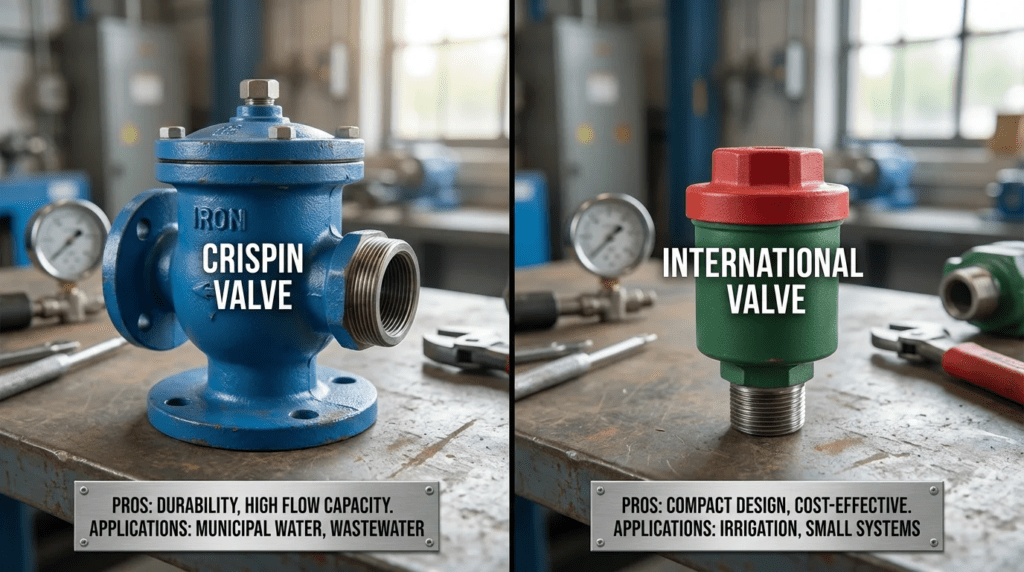
The choice of manufacturer and design philosophy plays a critical role in long-term system reliability. Two prominent names often appear in specification battles: Crispin Valve, a legacy manufacturer with over a century of history in the US market, and International Valve, known for alternative material solutions and specific design innovations. When conducting an engineering evaluation of Crispin Valve vs International Valve for Air Valves: Pros/Cons & Best-Fit Applications, the decision typically extends beyond simple price comparisons to a debate between traditional cast-metal construction and modern material science, as well as differing approaches to internal linkage mechanisms.
These components are utilized throughout the water cycle—from raw water intake and high-service pumping stations to wastewater force mains and sludge lines. In these environments, the valves must perform three distinct functions: releasing accumulated air during operation (Air Release), expelling large volumes of air during filling (Air/Vacuum), and admitting air to prevent vacuum collapse during draining or surge events. Poor selection leads to “spitting” valves, premature corrosion, biological fouling in wastewater applications, and catastrophic water hammer events.
This article aims to provide consulting engineers and utility decision-makers with a granular, technical comparison of these two distinct manufacturing approaches. This head-to-head sits within the broader supplier landscape for air valves, where a handful of established manufacturers dominate municipal specifications and each has carved out defensible territory in particular service classes. By dissecting the engineering merits, failure modes, and lifecycle implications of both, we clarify which technology aligns best with specific municipal and industrial constraints.
The Air Valve Manufacturer Landscape
No single manufacturer comparison resolves a specification in isolation. Crispin and International Valve occupy two ends of a design spectrum—heavy traditional castings on one side, alternative materials and simplified mechanisms on the other—but most municipal shortlists carry three to five names, and the eventual basis-of-design frequently comes from a different vendor than the one the engineer started with. Understanding where each major OEM sits relative to this spectrum makes the Crispin-versus-International decision considerably more legible, because the same evaluation criteria (body metallurgy, linkage architecture, wastewater body geometry, surge accessory availability, and parts lead time) apply across every pairing.
The comparisons below examine the other manufacturer pairings that most commonly appear alongside this one in municipal procurement. Each addresses a different axis of the decision: standards-driven waterworks pedigree, elastomer and sealing technology, actuation partnerships, and international supply chain depth.
Val-Matic and AVK: Waterworks Pedigree and Standards Depth
The head-to-head between Val-Matic vs AVK air valves equipment represents the most common alternative pairing to Crispin versus International, and it turns on a different question: not iron versus composite, but American waterworks convention versus European standards heritage. Val-Matic’s air valve line is built around AWWA C512 compliance with a strong emphasis on the combination air valve configuration and a well-documented family of surge-check and anti-slam accessories, which makes it a frequent basis-of-design on force mains where surge analysis has flagged high air discharge velocities. AVK, by contrast, brings an EN 1074-4 and ISO design lineage with a compact body profile and integrated anti-shock chambers that appeal to engineers working with shallow vaults or metric-dimensioned imported pipe.
For specifiers, the practical differentiator is documentation and accessory ecosystem depth rather than raw durability—both manufacturers produce valves that will outlast the vault they are installed in if the coating system is correct. Val-Matic tends to win where the specification is written tightly to AWWA language and where the utility already stocks parts across a fleet of check and air valves from the same maker. AVK gains ground where compact envelopes, metric flange patterns, or European-sourced pipeline materials are already in play. Where Crispin’s advantage is proven mass and International’s is material immunity, this pairing is decided on standards alignment and spare-parts logistics.
Proco and Henry Pratt: Elastomer Technology and Large-Diameter Waterworks
The Proco vs Henry Pratt air valves equipment comparison introduces the sealing-technology dimension that the Crispin/International debate largely sidesteps. Proco’s engineering culture is rooted in elastomer and flexible-element products, which translates into an emphasis on resilient seat design, chemical compatibility mapping, and expansion-joint integration at the air valve connection—a real consideration when the valve sits on a riser subject to thermal movement or settlement. Henry Pratt, a long-established name in large-diameter waterworks valves, approaches the same problem from the opposite direction: heavy body castings, generously sized orifices, and a product line designed to be specified alongside butterfly and cone valves on transmission-scale projects.
This pairing matters most on large-diameter potable transmission mains and treatment plant yard piping, where the air valve is one line item within a much larger valve package and procurement pressure favors consolidating vendors. Henry Pratt’s advantage is that consolidation—single submittal package, single rep, coordinated coatings. Proco’s advantage appears in aggressive industrial effluents and in installations where seat chemistry, not body metallurgy, is the governing failure mode. Engineers evaluating Crispin against International for a corrosive service should read this comparison as a check on whether the failure mechanism they are designing against is actually corrosion of the body or degradation of the elastomer.
How These Comparisons Fit Together
Read as a set, these manufacturer comparisons form a decision lattice rather than a ranking. Body material and structural class point toward Crispin or Henry Pratt. Corrosion immunity and weight reduction point toward International Valve or, in specific chemistries, Proco’s elastomer expertise. Standards alignment and accessory ecosystem point toward Val-Matic or AVK. A specification that names two acceptable manufacturers from different points on this lattice—rather than two that are functionally identical—gives the utility genuine competitive pricing without accepting a valve that is wrong for the service. That is the practical use of a manufacturer comparison: not to pick a winner, but to define the boundary conditions under which each becomes the correct answer.
How to Select / Specify Air Valves
Selecting the correct air valve requires a multidimensional analysis of the hydraulic profile and the physical environment. When evaluating Crispin Valve vs International Valve for Air Valves: Pros/Cons & Best-Fit Applications, engineers must look past the catalog cut-sheet and interrogate the internal design logic relative to the application’s severity.
Duty Conditions & Operating Envelope
The primary driver for specification is the definition of the operating envelope. Engineers must define the maximum working pressure (MWP) and, critically, the minimum operating pressure. Air release valves (small orifice) require a positive pressure seal; if the line pressure drops too low, some designs may not seat correctly, leading to dribbling.
For high-pressure transmission mains (class 250 or 300 service), the valve body capability is paramount. Traditional designs, like those often championed by Crispin, utilize heavy ductile iron or cast steel bodies that handle significant hoop stress and external loads. Conversely, applications with lower pressures but aggressive water chemistry might favor the composite or specialized alloy approaches often found in International Valve’s portfolio. Future capacity planning is also essential; a valve sized for today’s flow might be undersized for tomorrow’s pump upgrade, leading to insufficient vacuum protection during a rapid drain event.
Materials & Compatibility
Corrosion is the leading cause of air valve failure. In standard potable water applications, epoxy-coated ductile iron is the industry standard. However, in wastewater environments where hydrogen sulfide (H2S) gas accumulates at high points (exactly where the air valve is located), standard materials degrade rapidly.
- Internal Mechanisms: The float and linkage mechanism is the heart of the valve. 316 Stainless Steel is the baseline requirement for wastewater. However, some modern designs utilize Delrin, polypropylene, or other high-grade polymers to completely eliminate galvanic corrosion issues.
- Body Construction: While Crispin is renowned for robust Cast Iron and Ductile Iron construction (often preferred for its rigidity and impact resistance), International Valve has gained traction by offering lightweight, corrosion-immune composite bodies or specialized stainless fabrications that resist aggressive industrial effluents.
- Elastomers: The seat material (Buna-N, EPDM, Viton) must match the chemical composition of the fluid. In industrial wastewater, standard Buna-N may swell or degrade, necessitating a review of chemical compatibility charts.
Hydraulics & Process Performance
The aerodynamic performance of an air valve is defined by its intake and discharge curves. Engineers must verify that the “Air/Vacuum” (large orifice) component can admit enough air to replace the water column during a line break or pump trip to prevent vacuum collapse.
Equally important is the “Anti-Slam” or “Surge Check” characteristic. If an air valve exhausts air too quickly as the water column returns, the float slams shut instantly, creating a pressure spike (water hammer). Both Crispin and International Valve offer surge-dampening accessories or integrated designs (throttling devices). The specification must explicitly require surge analysis to determine if a standard kinetic air valve is sufficient or if a slow-closing device is required.
Installation Environment & Constructability
Air valves are frequently installed in underground vaults that are difficult to access and prone to flooding.
Space Constraints: Older cast iron designs can be extremely heavy and tall, particularly in the “elongated body” wastewater configuration designed to keep mechanisms free of grease. Lighter-weight alternatives or shorter designs (where hydraulic conditions allow) can reduce vault depth and construction costs.
Freezing: In northern climates, valves in shallow vaults are susceptible to freezing. The thermal mass of a heavy iron valve differs from a composite valve. Heat tracing and insulation specifications must be compatible with the valve body material.
Reliability, Redundancy & Failure Modes
The most common failure mode in wastewater air valves is fouling. Fats, Oils, and Grease (FOG) and ragging can jam the float mechanism.
Linkage vs. Non-Linkage: Traditional designs (heavily associated with Crispin’s heritage) often use a lever linkage to multiply the float’s buoyancy force to open the orifice against internal pressure. While effective, linkages provide catch points for debris. Alternative designs (often found in International Valve’s offerings) may utilize direct-acting floats or rolling seal mechanisms that eliminate linkages, theoretically reducing jamming potential in sewage applications.
Controls & Automation Interfaces
Historically, air valves were purely mechanical. However, modern smart water networks increasingly demand visibility. Air valves can now be specified with limit switches to signal if the valve is flooded (failed) or if a surge check device has activated. Integration into SCADA allows operators to detect a “spitting” valve before it floods a vault. Engineers should specify dry contacts or 4-20mA outputs if remote monitoring of valve status is required for critical transmission mains.
Maintainability, Safety & Access
Maintenance is dangerous; air valves are under pressure and often in confined spaces.
Backflushing: For wastewater applications, specifiers must mandate flushing attachments (inlet isolation valves and quick-connect washdown ports). This allows operators to blast the valve internals with clean water to remove sludge without dismantling the unit.
Weight: A 4-inch ductile iron wastewater combination valve can weigh over 150 lbs. A composite or modern fabricated equivalent might weigh 40 lbs. This difference significantly impacts operator safety during replacement tasks.
Lifecycle Cost Drivers
The initial purchase price of an air valve is negligible compared to the cost of a pipeline failure or the labor cost of frequent unclogging.
CAPEX vs. OPEX: A heavy-duty stainless steel specification increases CAPEX but may eliminate replacement costs for 20 years. A cheaper epoxy-coated iron valve may require recoating or replacement in 5-7 years in corrosive vault environments.
Energy: While air valves don’t consume electricity, their failure to remove air pockets increases head loss (pumping costs). Therefore, the reliability of the air release function directly impacts the energy efficiency of the pumping station.
Selection & Specification Framework
The criteria above are individually straightforward; the difficulty is sequencing them. Engineers who begin with the manufacturer name and work backward toward the hydraulics almost always arrive at a defensible-looking specification that fails in service. The framework below inverts that order, treating manufacturer selection as the last decision rather than the first.
Step 1: Classify the Service Before Naming a Valve
Sort the application into one of four service classes before opening any catalog. Clean high-pressure transmission (potable, Class 250/300, low fouling risk) prioritizes body structural class and surge accessory availability. Corrosive wastewater (force mains, H2S headspace, FOG and ragging) prioritizes corrosion immunity and mechanism simplicity above all else. Aggressive chemical or high-chloride service (brine, desalination reject, industrial effluent) is governed by wetted-material chemistry, where even 316 stainless may pit. Constrained retrofit (shallow or crowded vaults, no lifting equipment) is governed by weight and envelope. Only after this classification does the Crispin-versus-International question have a determinate answer, and in three of the four classes it answers itself.
Step 2: Size for the Governing Event, Not the Normal Condition
The governing event for the large orifice is almost never normal operation. It is the line break or rapid drain, when the water column leaves faster than the valve can admit air. Size the air/vacuum orifice against the maximum gravity draining rate, then verify that the resulting vacuum stays within the pipe’s collapse rating with an appropriate margin. The small orifice is sized separately, against entrained air accumulation at working pressure, and the two answers are frequently in different size ranges—which is precisely why the combination air valve exists as a product category.
Step 3: Worked Sizing Example
Consider a 24-inch ductile iron force main with a high point 900 feet downstream of a lift station, a downhill slope of roughly 2 percent beyond that point, and a design pumping rate near 3,500 gpm. Filling the line at pump capacity displaces air at approximately 780 cfm at standard conditions, which a properly selected 2-inch air/vacuum orifice will exhaust comfortably at a differential under 2 psi. The draining case, however, is the binding constraint: a full-bore break downstream allows the column to evacuate at a rate well above the filling rate, and admitting that volume through the same 2-inch orifice would drive the internal pressure several psi below atmospheric. Because a 24-inch thin-wall pipe with a modest cover load has limited vacuum tolerance, the orifice must be stepped up—typically to a 3-inch or 4-inch air/vacuum section—to hold the vacuum within roughly 5 psi. The air release orifice for the same installation, sized against an assumed entrained air fraction near 2 percent of throughput at the working pressure, lands in the 3/16-inch to 1/4-inch range. The finished specification therefore reads as a combination valve with a large air/vacuum section and a comparatively tiny release orifice, and any manufacturer proposing to match the 2-inch tap size for both functions should be rejected on capacity grounds regardless of brand.
Step 4: Apply the Anti-Slam Screen
Compute the air discharge velocity through the large orifice at the moment the returning water column approaches the valve. If it exceeds roughly 100 ft/s, a surge check or throttling device is mandatory, not optional. This screen is manufacturer-agnostic, but it does constrain the shortlist: not every product line offers a well-characterized anti-slam accessory with published discharge curves, and specifying an unquantified throttling device is arguably worse than specifying none, because it creates false confidence in the surge model.
Step 5: Lifecycle Cost Comparison, Not First Cost
Evaluate each shortlisted valve on a 20-year basis that includes the installed cost, the expected replacement interval given the vault environment, the labor hours per backflush multiplied by the flush frequency, and the confined-space entry burden implied by the valve’s weight. In clean water vaults, a heavy iron valve and a composite valve frequently converge on similar 20-year costs, and first cost reasonably decides. In an H2S-laden wastewater vault, the corrosion-immune option often wins by a wide margin even at two to three times the purchase price, because it removes an entire replacement cycle and the associated excavation or entry event. Utilities that skip this step consistently discover the difference on the second replacement, not the first.
Step 6: Write the Specification for Competition
Name two or three acceptable manufacturers drawn from different design philosophies rather than three near-identical products, and write the performance requirements—orifice capacity at stated differentials, wetted material minimums, body pressure class, flushing provisions, and coating system—tightly enough that a non-compliant substitution is obvious at submittal review. A specification that names Crispin and International Valve as co-equal alternates is only honest if both can actually meet the stated corrosion and capacity requirements for that specific service class; otherwise the utility is inviting a low bid that it will have to reject.
Comparison Tables: Crispin vs. International Valve
The following tables provide a direct comparison to assist in the Crispin Valve vs International Valve for Air Valves: Pros/Cons & Best-Fit Applications evaluation. Table 1 focuses on the distinct manufacturing philosophies and typical product characteristics. Table 2 outlines the application suitability for various municipal scenarios. Table 3 places both manufacturers within the wider OEM field covered in the comparisons above.
| Feature / Criteria | Crispin Valve (Traditional/Legacy) | International Valve (Modern/Alternative) |
|---|---|---|
| Primary Design Philosophy | Heavy-duty, AWWA C512-compliant heritage designs. Focus on robust cast iron/ductile iron construction and proven linkage mechanisms. | Often focuses on advanced materials (composites, specific stainless alloys) and innovative internal geometries (rolling seals, reduced linkages). |
| Material Construction | Standard: Ductile/Cast Iron with Stainless trim. Optional: 316SS. Known for thick wall sections and durability. |
Standard: varies by line, but emphasizes corrosion-resistant polymers, composites, and lightweight stainless steel options alongside traditional metals. |
| Wastewater Mechanism | Elongated Body with Linkage: Uses a lever arm to multiply float force. Effective sealing but linkage can catch debris. | Variable: Often promotes designs with fewer moving parts, direct-acting floats, or rolling diaphragms to minimize clogging points. |
| Pressure Range | Extremely wide range available, including very high-pressure applications (deep mines, high-head hydro). | Generally covers standard municipal ranges (Class 150/300), but may have limitations in extreme high-pressure industrial applications compared to heavy castings. |
| Maintenance Profile | Serviceable, but heavy. Parts are widely available due to long installed base. Traditional maintenance (seat replacement) is well understood. | Often designed for “swap-out” or modular repair. Lightweight components reduce the physical burden on operators during removal. |
| Primary Strength | Proven Reliability: “Basis of Design” in thousands of US municipalities. Extreme durability in physical abuse scenarios. | Corrosion Resistance & Weight: Superior longevity in aggressive chemical environments or salt-water applications due to material choices. |
| Limitations | Weight makes handling difficult in confined spaces. Cast iron subject to external corrosion in wet vaults if coating is breached. | May face resistance from conservative engineers preferring heavy metal. Composite threads require careful installation to avoid stripping. |
| Application Scenario | Service Type | Best-Fit Recommendation | Engineering Rationale |
|---|---|---|---|
| Large Diameter Transmission Main (Potable) | Clean Water / High Pressure | Crispin (or Iron Heavy Duty) | High structural integrity is required for surge pressures. Clean water minimizes linkage fouling risks. Weight is less of an issue (rarely moved). |
| Sewer Force Main (High H2S) | Wastewater / Corrosive | International Valve (Composite/SS) | H2S gas accumulates in the air valve, rapidly corroding standard iron/steel. Composite or high-grade polymer internals significantly extend lifecycle. |
| Desalination / Brine Lines | High Chloride / Corrosive | International Valve (Composite/Duplex) | Standard 316SS can suffer pitting. Composite bodies or specialized alloys offered by International Valve provide superior chemical resistance. |
| Deep Well Vertical Turbine Pump | Clean Water / Vertical Discharge | Crispin (Deep Well Series) | Crispin’s specialized deep well valves are industry standards for handling the specific air discharge characteristics of vertical turbine start-ups. |
| Retrofit in Small/Shallow Vaults | Any | International Valve (Compact) | Lighter weight and often more compact footprints ease installation in space-constrained retrofits without heavy lifting equipment. |
| Raw Water Intake (High Grit) | Abrasive Water | Crispin (Severe Service) | Heavy wall thickness and abrasion-resistant trim options handle sand/grit wear better than lighter alternatives. |
| Manufacturer / Pairing | Design Emphasis | Governing Decision Axis | Strongest Fit |
|---|---|---|---|
| Crispin Valve | Heavy ductile/cast iron bodies, lever linkage mechanisms, deep well specialty series | Structural class and pressure rating | High-pressure potable transmission, abrasive raw water, vertical turbine discharge |
| International Valve | Composites, specialized alloys, reduced-linkage and direct-acting float geometries | Corrosion immunity and weight | H2S force mains, brine and chloride service, constrained retrofits |
| Val-Matic vs AVK Air Valves Equipment | AWWA-aligned combination valves and surge accessories versus EN/ISO compact bodies | Standards alignment and accessory ecosystem | Force mains requiring documented anti-slam devices; metric or imported pipeline systems |
| Proco vs Henry Pratt Air Valves Equipment | Elastomer and flexible-element sealing versus large-diameter waterworks castings | Seat chemistry versus vendor consolidation | Industrial effluent with elastomer attack; large valve packages on transmission projects |
Engineer & Operator Field Notes
Successful air valve implementation relies on more than just the brand selection. Field experience dictates that installation details and maintenance strategies are the primary determinants of reliability.
Commissioning & Acceptance Testing
Commissioning an air valve is often overlooked, with contractors assuming “if it doesn’t leak immediately, it works.” This is a dangerous assumption.
- Seating Pressure Verification: During startup, the system pressure must be brought up slowly. Verify the valve seals completely at the minimum design pressure (often 2-5 psi). Some high-pressure valve designs struggle to seal perfectly at very low start-up pressures.
- Dynamic Testing: If possible, simulate a pump trip or rapid drain to verify the air/vacuum orifice opens fully. Listen for the characteristic high-velocity air intake sound. Silence indicates a potential stuck float or an isolation valve left closed.
- Documentation: Record the serial numbers and precise GPS coordinates. Air valves are often paved over or lost in vegetation. Digital asset management starts at commissioning.
Common Specification Mistakes
Engineers frequently underspecify air valves by focusing solely on pipe diameter rather than air volume.
The “One Size Fits All” Error: Specifying a 2-inch valve simply because the tap is 2 inches is incorrect. The valve must be sized based on the filling and draining flow rates of the main. A 2-inch valve might be sufficient for release but woefully inadequate for vacuum protection on a 24-inch main during a break.
Ignoring Inlet Piping: Specifying a high-performance valve and installing it on a long, narrow run of pipe negates the valve’s capacity. The inlet piping between the main and the valve should effectively be the same size as the valve inlet to prevent “choking” the flow.
O&M Burden & Strategy
In wastewater applications, the “set it and forget it” mentality leads to failure.
Backflushing Schedule: For sewage valves, a weekly or bi-weekly backflush is recommended. If the valve is specified with a flushing kit (hoses and quick disconnects), this takes 5 minutes. Without it, the valve clogs, leading to reduced pipeline capacity.
Predictive Maintenance: Leakage is the primary indicator of failure. However, by the time leakage is visible, the vault may be flooded. Operators should periodically check the “burping” sound of valves during pump cycles. A valve that never releases air is likely clogged or air-bound.
Troubleshooting Guide
- Symptom: Leaking Water from Vent.
Cause: Debris on the needle seat (air release) or main seat. Low system pressure preventing seal.
Fix: Backflush the valve. If persistent, disassemble and clean the seat. Check line pressure. - Symptom: Valve “Slams” Shut.
Cause: Differential pressure across the float is too high; float is too buoyant or aerodynamic forces are lifting it prematurely.
Fix: Install a throttling device (surge check) on the outlet to restrict air discharge velocity. - Symptom: Pipeline Surges/Hammers on Pump Start.
Cause: Air valve sizing is too small, or air is not being exhausted efficiently, leaving an air pocket that compresses rapidly.
Fix: Review sizing calculations. Check for obstructions in the valve discharge piping.
Vault Design & Access Realities
The valve is only as reliable as the vault around it. Field crews consistently report that the majority of “valve failures” they investigate are actually vault failures: a flooded chamber that submerged the vent, a ladder rung that corroded away and made entry unsafe, or a hatch too small to extract a 150-pound iron body. Specify a vent stack that terminates above the maximum expected flood elevation with a downturned, screened outlet. Provide a sump and, where groundwater is present, a drain to daylight rather than a pump that will be neglected. Size the hatch and the clear working envelope around the valve for extraction of the largest component with the flushing assembly attached, and confirm that the hatch opening will actually pass the valve at its widest dimension—a check that takes two minutes at design review and saves a jackhammer at replacement.
Retrofit Considerations on Aging Mains
Replacing an existing air valve is rarely a like-for-like exercise. The original may have been undersized for the current pumping regime, the tap may be smaller than the hydraulics now require, and the vault may not accommodate a correctly sized valve. When the sizing analysis calls for a larger orifice than the existing tap supports, the honest options are to hot-tap a larger connection, relocate the valve to a better high point, or accept a documented deficiency with a compensating measure such as revised surge control at the station. Substituting a lighter composite valve of the same nominal size is often the only change that fits within an existing vault, which is one practical reason corrosion-immune designs win retrofit work even where corrosion was not the original complaint.
Design Details & Sizing Logic
Proper application of Crispin Valve vs International Valve for Air Valves: Pros/Cons & Best-Fit Applications requires adherence to fundamental sizing methodologies and industry standards.
Sizing Logic & Methodology
Sizing is not intuitive. A larger valve is not always better; an oversized air release valve can allow air to escape so quickly that water slams into the valve structure (dynamic closure), causing surges.
- Determine Flow Rates: Calculate the maximum filling rate (usually pump capacity) and the maximum gravity draining rate (based on slope and pipe diameter) assuming a line break.
- Air/Vacuum Sizing (Orifice Size): Use the manufacturer’s capacity charts (Standard Air Flow Curves). Select an orifice size that can admit the draining air volume without exceeding a 5 psi pressure drop (vacuum). Exceeding this drop risks collapsing thin-walled pipes.
- Air Release Sizing: Based on the working pressure and the estimated accumulation of entrained air (typically 2% of water volume). The release orifice is usually much smaller (1/16″ to 1/2″).
- Check Surge Potential: If the calculated air discharge velocity exceeds ~100 ft/s, a surge check / anti-slam device is mandatory.
Placement Logic Along the Profile
Correct sizing at the wrong location protects nothing. Air valves belong at every true high point in the profile, at intermediate points along long ascending runs where air can migrate and stall, at the downstream end of long horizontal sections preceding a descent, and at increases in downgrade slope where the water column can separate. Vacuum protection additionally requires valves at the upstream end of long descending runs, because that is where the profile will go sub-atmospheric first during a drain. A profile drawing with the hydraulic grade line plotted for both the operating and the drain-down case will identify these points far more reliably than a rule of thumb about spacing, and it is the single deliverable most often missing from air valve submittals.
Specification Checklist
To ensure a robust procurement, the Division 40 specification typically includes:
- Compliance: Must meet AWWA C512 (latest edition).
- Body Material: ASTM A536 Ductile Iron (Crispin preference) or Composite/Stainless (International preference), defined by environmental corrosivity.
- Float Material: 316 Stainless Steel or non-collapsible composite.
- Wastewater Features: Elongated body design, concave bottom to prevent debris buildup, backflushing attachments.
- Coating: Interior and exterior fusion-bonded epoxy (if metal body).
- Testing: Manufacturer must provide hydrostatic test certificates for body and seat.
- Capacity Documentation: Submittal must include published air flow curves for both the intake and discharge cases at the stated differentials, not merely nominal orifice dimensions.
- Accessories: Isolation valve, flushing assembly with quick disconnects, and any required surge check device, with the throttling characteristic documented.
Standards & Compliance
AWWA C512 — Air-Release, Air/Vacuum, and Combination Air Valves for Waterworks Service — is the governing standard for this equipment class, dictating pressure ratings, testing procedures, and material minimums. For drinking water applications, all wetted parts must additionally be certified to NSF/ANSI/CAN 61 for drinking water system components, with NSF/ANSI/CAN 372 governing lead content. Body castings are commonly specified to ASTM A536 for ductile iron, and coatings to the applicable AWWA fusion-bonded epoxy requirements.
Engineers should be wary of products that claim “compliance” without third-party verification. Certification marks should be verified against the certifying body’s public listing rather than accepted from a submittal cover sheet, and the listing should cover the specific model and material configuration being furnished, not merely the manufacturer’s name.
Frequently Asked Questions
What is the difference between an Air Release Valve and a Combination Air Valve?
An Air Release Valve has a small orifice designed to release small pockets of accumulated air while the system is under pressure. It keeps the line full and efficient. A Combination Air Valve (the most common municipal spec) integrates both an Air Release function and an Air/Vacuum function (large orifice). The large orifice allows massive amounts of air to enter during draining (preventing vacuum) and escape during filling, while the small orifice manages day-to-day air accumulation.
How do Crispin Valve and International Valve differ in wastewater applications?
In wastewater contexts involving Crispin Valve vs International Valve for Air Valves: Pros/Cons & Best-Fit Applications, the difference lies in the mechanism and body. Crispin typically utilizes a heavy, elongated cast iron body with a stainless steel linkage system to keep the mechanism away from sewage. International Valve often employs composite materials or simplified float designs (fewer linkages) to reduce corrosion and ragging potential. Crispin is favored for durability; International is favored for corrosion resistance.
Why do air valves leak in wastewater systems?
Leakage is usually caused by debris (grit, rags, grease) getting lodged between the valve seat and the plunger/float. In low-pressure systems, there may not be enough internal pressure to force a tight seal. Regular backflushing is the primary preventive measure. Specifying valves with “self-cleaning” float designs or steeper seat angles can also mitigate this.
What is the typical lifespan of a municipal air valve?
A high-quality ductile iron air valve (like a Crispin) can last 20-30 years in a clean water vault, provided the coating remains intact. In wastewater environments with H2S gas, the lifespan drops significantly—often 5-10 years for standard iron valves. Composite or high-grade stainless valves (like those from International Valve) can extend wastewater lifespans to 15-20 years by eliminating the corrosion failure mode.
When is a surge check (anti-slam) device required?
A surge check device is required when the column of water rejoining the air valve moves at high velocity. If the air escapes too fast, the float slams shut, causing a water hammer. Surge checks throttle the air discharge, creating an air cushion that slows the rising water column. This is critical on high-head pump systems and long transmission mains.
How should I structure a specification that allows more than one air valve manufacturer?
Name manufacturers that represent genuinely different design philosophies rather than three interchangeable products, and let the performance requirements do the screening. State the required air intake and discharge capacity at defined differential pressures, the minimum wetted material grades, the body pressure class, the flushing and isolation provisions, and the coating system. Written this way, a submittal that cannot meet the corrosion or capacity requirement is rejected on objective grounds. A specification listing Crispin and International Valve as co-equal alternates is defensible only when both can actually satisfy the stated requirements for that specific service class.
Do air valves need to be sized differently for potable water versus wastewater?
The hydraulic sizing methodology is identical—filling rate, draining rate, entrained air fraction, and vacuum limit apply the same way to both. What changes is the body geometry and material specification. Wastewater service calls for an elongated body that keeps the sealing mechanism well above the liquid level, a concave or sloped bottom that resists solids accumulation, a larger release orifice than the equivalent clean-water valve to reduce plugging, and backflushing provisions as a standard inclusion rather than an option. Material selection also tightens considerably because of H2S in the valve headspace.
What causes an air valve to fail closed, and how would an operator know?
A valve fails closed when the float is jammed by debris, when grease has bonded the mechanism, or when the float has flooded and lost buoyancy. The symptom is silence: a valve that never audibly releases air during pump cycling is almost certainly clogged or air-bound, and the consequence is a growing air pocket that increases head loss and raises surge risk. Because this failure produces no leak, it is invisible to inspection routines built around looking for water in the vault. Periodic acoustic checks during pump starts, or limit-switch instrumentation reporting to SCADA on critical mains, are the practical detection methods.
Conclusion
Key Takeaways
- Don’t Copy-Paste: Analyze the specific hydraulic profile. A valve sized for filling might be undersized for vacuum protection.
- Classify the Service First: Sort the application into clean high-pressure transmission, corrosive wastewater, aggressive chemical service, or constrained retrofit before naming any manufacturer—the classification answers most of the decision.
- Material Matters: Use Ductile Iron (Crispin style) for high-pressure durability and impact resistance. Use Composites/Synthetics (International style) for corrosive wastewater and salt environments.
- Vacuum is the Killer: The primary function of the valve is pipeline protection. Ensure the Air/Vacuum orifice is large enough to prevent pipe collapse during a break.
- Maintenance is Safety: Specify flushing ports and isolation valves. Heavier valves require lifting davits or lighter composite alternatives.
- Redundancy: Always design N+1 air valves at critical high points to allow for maintenance without system shutdown.
- Compare Across the Field: Crispin and International Valve define one axis of the decision; standards alignment and sealing technology from other manufacturers define the others, and the best specification draws alternates from different points on that lattice.
The choice between Crispin Valve vs International Valve for Air Valves: Pros/Cons & Best-Fit Applications ultimately depends on the specific priorities of the project. If the application demands extreme structural ruggedness, high-pressure ratings, and adherence to traditional heavy-duty specifications, Crispin Valve remains the industry benchmark. Their long history and deep inventory of cast parts provide a sense of security for critical transmission infrastructure.
Conversely, if the project faces aggressive corrosion issues (H2S, brine), weight constraints in retrofits, or a desire for modern materials that minimize maintenance related to rust and scale, International Valve offers compelling solutions. The modern engineer must weigh the “install and forget” durability of stainless/composite internals against the proven track record of heavy iron.
Regardless of the manufacturer selected, the success of the installation relies on accurate sizing, proper placement at high points and inflection points, and a rigorous commitment to accessibility for maintenance. By treating air valves as critical surge-control devices rather than simple vents, utilities can avoid catastrophic line failures and ensure long-term operational efficiency.