
Indiana Wastewater Treatment Plants
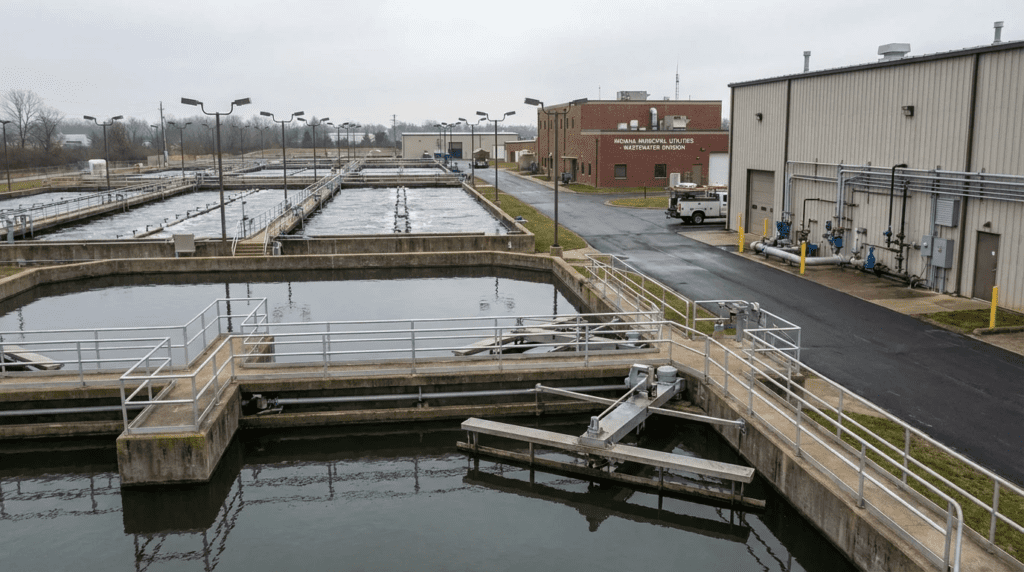
1. Introduction
Indiana’s wastewater infrastructure is currently undergoing one of the most significant transformation periods in the state’s history. Driven by the need to remediate Combined Sewer Overflows (CSOs) in river-adjacent cities and support the rapid suburban growth in the Indianapolis metropolitan area, the Hoosier state represents a robust market for engineering services and treatment technologies.
Regulated by the Indiana Department of Environmental Management (IDEM), the state oversees approximately 800 permitted wastewater facilities. The infrastructure landscape is dominated by the challenge of managing wet weather flows in legacy river cities like Indianapolis, Fort Wayne, Evansville, and South Bend, which are collectively investing billions in tunnel systems and storage capacity.
Currently, Indiana facilities process a total design capacity exceeding 1,400 MGD. The market is shifting from purely compliance-driven “gray infrastructure” (tunnels and concrete) toward “smart water” optimization, nutrient removal (specifically phosphorus), and energy neutrality through advanced biosolids processing.
2. Recent Developments & Projects
The defining characteristic of the Indiana wastewater sector in the last three years has been the culmination of Long-Term Control Plans (LTCPs) for CSO compliance. Major metropolitan districts are nearing the completion of multi-decade consent decree timelines, shifting focus toward plant optimization and asset management.
Key developments include:
- The “DigIndy” Milestone: Citizens Energy Group is nearing the final stages of its $2 billion tunnel system, significantly reducing overflows into the White River and Fall Creek.
- Regionalization Initiatives: Smaller utilities in Central Indiana are increasingly exploring consolidation or regional treatment agreements to handle the population boom in Hamilton and Boone counties (the LEAP District).
- Advanced Biosolids: There is a statewide trend toward upgrading anaerobic digestion facilities to produce Renewable Natural Gas (RNG), led by projects in Indianapolis and West Lafayette.
- State Revolving Fund (SRF) Activity: The Indiana Finance Authority (IFA) has been aggressive in leveraging IIJA funds, offering interest rate buy-downs for projects that incorporate green infrastructure and non-point source pollution control.
3. Top 20 Largest Treatment Plants in Indiana
The following list ranks the largest wastewater treatment facilities in Indiana based on average design capacity (MGD). These facilities represent the backbone of the state’s sanitary infrastructure.
| Rank | Plant Name | City/Location | Design Capacity (MGD) | Population Served | Operating Authority |
|---|---|---|---|---|---|
| 1 | Belmont Advanced Wastewater Treatment Plant | Indianapolis | 120 MGD | ~450,000 | Citizens Energy Group |
| 2 | Southport Advanced Wastewater Treatment Plant | Indianapolis | 125 MGD* | ~400,000 | Citizens Energy Group |
| 3 | Fort Wayne Water Pollution Control Plant | Fort Wayne | 100 MGD | 270,000 | Fort Wayne City Utilities |
| 4 | Gary Sanitary District WWTP | Gary | 60 MGD | 150,000 | Gary Sanitary District |
| 5 | South Bend WWTP | South Bend | 48 MGD (77 Peak) | 103,000 | City of South Bend |
| 6 | Evansville West WWTP | Evansville | 30.6 MGD | 90,000 | Evansville Water & Sewer Utility |
| 7 | Hammond Sanitary District | Hammond | 36 MGD | 120,000 | Hammond Sanitary District |
| 8 | Terre Haute WWTP | Terre Haute | 24 MGD | 60,000 | Terre Haute Wastewater Utility |
| 9 | Muncie Water Pollution Control | Muncie | 24 MGD | 70,000 | Muncie Sanitary District |
| 10 | Lafayette Renew | Lafayette | 22 MGD | 72,000 | City of Lafayette |
| 11 | Anderson Water Pollution Control | Anderson | 22 MGD | 55,000 | City of Anderson |
| 12 | Carmel WWTP | Carmel | 20 MGD | 100,000 | City of Carmel Utilities |
| 13 | Dillman Road WWTP | Bloomington | 20 MGD | 70,000 | City of Bloomington Utilities |
| 14 | Kokomo WWTP | Kokomo | 20 MGD | 58,000 | City of Kokomo |
| 15 | Elkhart WWTP | Elkhart | 20 MGD | 55,000 | City of Elkhart Public Works |
| 16 | Evansville East WWTP | Evansville | 18 MGD | 60,000 | Evansville Water & Sewer Utility |
| 17 | Columbus WWTP | Columbus | 16.5 MGD | 48,000 | Columbus City Utilities |
| 18 | Richmond Sanitary District | Richmond | 16 MGD | 36,000 | Richmond Sanitary District |
| 19 | Jeffersonville North WWTP | Jeffersonville | 15 MGD | 45,000 | City of Jeffersonville |
| 20 | Mishawaka WWTP | Mishawaka | 14 MGD | 50,000 | City of Mishawaka |
*Note: Southport typically handles higher wet weather flows, while Belmont processes higher solids loads.
Profiles of the Top 5 Largest Plants
1. Belmont Advanced Wastewater Treatment Plant
- Location: Indianapolis, Marion County
- Design Capacity: 120 MGD (Peak >300 MGD)
- Operating Authority: Citizens Energy Group
- Receiving Water: White River
- Treatment Process: Advanced secondary treatment using activated sludge with nitrification; high-rate disinfection for wet weather flows.
- Notable Infrastructure: Belmont serves as the centralized solids handling facility for both Indianapolis plants. It features large-scale incineration and recently upgraded anaerobic digesters.
- Key Project: The DigIndy Tunnel System terminates at the Southport/Belmont complex, requiring massive deep rock pump station upgrades to lift flow 200+ feet from the tunnel to the headworks.
2. Southport Advanced Wastewater Treatment Plant
- Location: Indianapolis, Marion County
- Design Capacity: 125 MGD
- Operating Authority: Citizens Energy Group
- Treatment Process: Advanced biological treatment, cryogenic oxygen plant for high-purity oxygen activated sludge.
- Infrastructure: This facility is optimized for liquid stream treatment. It pumps sludge to the Belmont plant via inter-plant pipelines.
- Compliance: Critical in meeting the 97% capture rate required by the city’s consent decree.
3. Fort Wayne Water Pollution Control Plant
- Location: Fort Wayne, Allen County
- Design Capacity: 100 MGD
- Operating Authority: Fort Wayne City Utilities
- Receiving Water: Maumee River
- Recent Upgrades: A massive focus on wet weather handling. The plant utilizes high-rate clarification and retention basins to manage flows from the “Tunnel Works” deep rock tunnel project.
- Energy: Operates a cogeneration system utilizing methane gas from digesters to offset power costs.
4. Gary Sanitary District WWTP
- Location: Gary, Lake County
- Design Capacity: 60 MGD
- Operating Authority: Gary Sanitary District
- Service Area: Includes Gary, Merrillville, and Hobart.
- Notable Feature: Designed to handle heavy industrial loads historically associated with the region’s steel manufacturing, though flows have shifted toward municipal sources in recent decades. Recent $15M investment in grit removal systems to protect downstream biological processes.
5. South Bend WWTP
- Location: South Bend, St. Joseph County
- Design Capacity: 48 MGD (Rated) / 77 MGD (Peak)
- Operating Authority: City of South Bend
- Innovation: World-renowned for its “Smart Sewer” implementation (CSOnet). By using distributed sensors and automated valves in the collection system, the plant optimized flow delivery, saving the city an estimated $400 million compared to original gray infrastructure plans.
4. Plants with Approved Budgets & Expansion Projects
Indiana currently has over $2.5 billion in active water infrastructure projects, driven largely by Consent Decrees and the federal IIJA funding influx.
A. Major Projects Under Construction (2024-2026)
Citizens Energy Group – DigIndy Tunnel System Completion
- Location: Indianapolis
- Project Scope: Completion of the 28-mile deep rock tunnel network (200 feet underground) to store 250 million gallons of sewage during rain events.
- Total Budget: ~$2.0 Billion (Total Program)
- Current Phase: Pleasant Run Tunnel and Fall Creek Tunnel sections.
- Funding: Revenue Bonds, WIFIA Loans, SRF.
- Key Contractors: Shea-Kiewit (Tunneling), Black & Veatch (Engineering).
- Expected Completion: 2025/2026.
- Impact: Will virtually eliminate CSOs in the White River and Fall Creek.
Fort Wayne – Tunnel Works (Three Rivers Protection Project)
- Location: Fort Wayne
- Project Scope: Construction of a 5-mile deep rock tunnel to intercept CSOs from the St. Marys and Maumee Rivers. Includes a massive pump station at the WPCP.
- Total Budget: $188 Million (Tunnel portion) / $500M+ (Program)
- Funding: SRF Loans, Utility Revenue Bonds.
- Timeline: Drilling completed 2023; Pump station and connection work ongoing through 2025.
- Technology: Deep rock tunnel boring, high-capacity vortex drop shafts.
Evansville – Sunrise Pump Station & Bee Slough
- Location: Evansville
- Project Scope: Part of “Renew Evansville.” Replaces the massive Bee Slough open sewer with a specialized wetland treatment system and expands pumping capacity (104 MGD).
- Total Budget: $500 Million (Long Term Control Plan Phase)
- Current Status: Construction active on Sunrise Pump Station ($30M+).
- Engineering: Jacobs / Commonwealth Engineers.
B. Projects in Design/Planning Phase (2025-2027)
- Carmel Utilities WWTP Expansion:
Budget: ~$40-50 Million
Scope: Expansion of treatment capacity to accommodate rapid population growth in Hamilton County. Includes nutrient removal upgrades.
Status: Design/Permitting. - City of Fishers – AgriPark & Reuse Initiative:
Budget: TBD
Scope: Evaluation of water reuse technologies to support local agriculture and green space, reducing discharge to receiving streams. - Jeffersonville Wastewater Capacity Upgrade:
Budget: $22 Million
Scope: Expansion of the North Plant to handle industrial growth at the River Ridge Commerce Center.
Funding: Local Revenue Bonds/SRF.
Summary Statistics
- Total Active Capital Investment: ~$2.5 Billion (Statewide active construction)
- Primary Project Drivers: CSO Compliance (60%), Growth/Capacity (25%), Aging Asset Replacement (15%).
- Funding Source Breakdown:
- State Revolving Fund (SRF): 45%
- WIFIA/Federal Loans: 30%
- Revenue Bonds: 20%
- IIJA Grants: 5%
5. Regulatory & Compliance Landscape
The Indiana Department of Environmental Management (IDEM) enforces the National Pollutant Discharge Elimination System (NPDES) in the state. The regulatory environment is currently defined by three major factors:
- CSO Long-Term Control Plans (LTCPs): Indiana has over 100 communities with Combined Sewer Overflows. Most are in the final stages of implementing their 20-year control plans (gray infrastructure tunnels and storage).
- Phosphorus Limits: IDEM is progressively tightening total phosphorus limits to 1.0 mg/L or lower for major municipal dischargers to combat algae blooms in the Great Lakes and Ohio River basin.
- PFAS Monitoring: IDEM has completed Phase 1-3 testing of community water systems and is moving toward testing wastewater effluent and biosolids. While strict effluent limits are not yet set, utilities are preparing for future regulations regarding “forever chemicals.”
6. Infrastructure Challenges & Opportunities
Aging Collection Systems: Beyond the headline-grabbing tunnel projects, Indiana faces a quiet crisis in small-town collection systems. Inflow and Infiltration (I/I) plague older communities, causing hydraulic overloads at plants even without CSOs.
Workforce Shortages: Like many states, Indiana faces a “Silver Tsunami” of retiring Class III and IV operators. This is driving demand for automation, SCADA upgrades, and contract operations services.
Industrial Pretreatment: Indiana is a manufacturing-heavy state (automotive, steel, pharmaceuticals). Publicly Owned Treatment Works (POTWs) must maintain rigorous Industrial Pretreatment Programs (IPP) to prevent upset conditions, creating opportunities for consulting engineers specialized in industrial waste.
7. Technology Trends in Indiana
- Real-Time Control (RTC): Following South Bend’s success, more utilities are adopting “Digital Twin” technology and AI-driven sensor networks to optimize collection system storage before building new concrete tanks.
- Biological Phosphorus Removal (EBPR): To meet new nutrient limits without high chemical costs, plants are retrofitting aeration basins for biological phosphorus removal.
- UV Disinfection: A rapid shift away from gaseous chlorine to UV disinfection systems to improve safety and reduce chemical handling requirements.
- Thermal Hydrolysis: Citizens Energy Group’s implementation of thermal hydrolysis (Cambi process) represents the cutting edge of biosolids management in the Midwest, allowing for higher Class A biosolids production and energy recovery.
8. Directory of Facilities
Browse our organized directory of wastewater treatment plants in Indiana:
Major Regional Facilities (>50 MGD)
- Belmont Advanced Wastewater Treatment Plant (Indianapolis)
- Southport Advanced Wastewater Treatment Plant (Indianapolis)
- Fort Wayne Water Pollution Control Plant
- Gary Sanitary District WWTP
Large Municipal Plants (20-50 MGD)
- South Bend WWTP
- Evansville West WWTP
- Hammond Sanitary District
- Terre Haute WWTP
- Muncie Water Pollution Control
- Lafayette Renew
- Carmel Utilities WWTP
Significant Community Plants (10-20 MGD)
- Elkhart WWTP
- Columbus WWTP
- Richmond Sanitary District
- Jeffersonville North WWTP
- Kokomo WWTP
9. Resources for Engineers & Operators
- Indiana Water Environment Association (IWEA): The primary professional organization for wastewater professionals in the state, offering annual conferences and technical training.
- IDEM Operator Certification: Official portal for exam scheduling, license renewal, and continuing education (CEU) requirements.
- Indiana Finance Authority – SRF: Information on State Revolving Fund loans, intended use plans (IUP), and funding cycles for infrastructure projects.
- Indiana Utility Regulatory Commission (IURC): Oversight body for utility rates and regulations.
10. Frequently Asked Questions (FAQ)
- What is the largest wastewater treatment plant in Indiana?
- The largest distinct facility is the Southport Advanced Wastewater Treatment Plant in Indianapolis, with a design capacity of 125 MGD, closely followed by its sister plant, Belmont (120 MGD).
- How many wastewater treatment plants are in Indiana?
- There are approximately 800 permitted wastewater treatment facilities in Indiana, ranging from large municipal plants to small package plants for schools and mobile home parks.
- What is the “DigIndy” project?
- DigIndy is a $2 billion deep rock tunnel system in Indianapolis designed to store over 250 million gallons of combined sewage during rain events, preventing overflows into local waterways. It is one of the largest infrastructure projects in state history.
- What funding is available for Indiana wastewater projects?
- The primary funding source is the State Revolving Fund (SRF), managed by the Indiana Finance Authority. Recent federal IIJA grants and WIFIA loans are also major sources for large-scale capital improvements.
- Are Indiana plants required to remove phosphorus?
- Yes, IDEM is increasingly including phosphorus limits (typically 1.0 mg/L) in NPDES permits for major municipal dischargers to protect downstream water quality.
- What are the operator certification levels in Indiana?
- Indiana classifies municipal wastewater operators from Class I (smallest plants) to Class IV (largest, most complex plants). Industrial operators utilize classifications A through D.
- How is Indiana addressing PFAS in wastewater?
- IDEM has initiated a sampling program for PFAS in community water systems and is currently developing strategies for testing wastewater effluent and biosolids, though strict numerical limits have not yet been universally adopted in permits.