
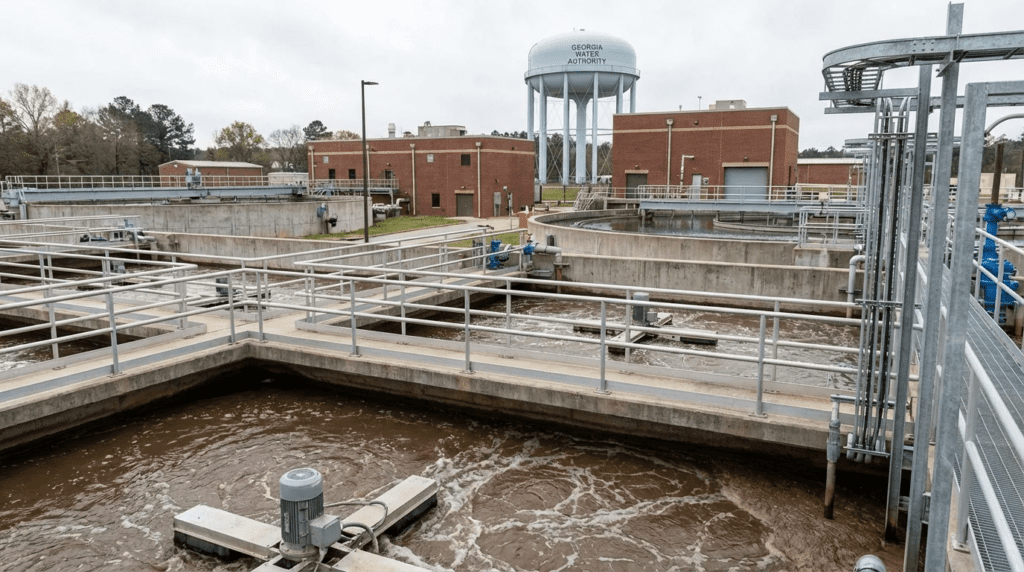
1. Introduction: Georgia’s Water Reclamation Landscape
Georgia’s wastewater infrastructure is defined by a unique combination of rapid metropolitan growth, strict regulatory requirements due to interstate water sharing (the Tri-State Water Wars), and a diverse geography ranging from the Appalachian foothills to the Atlantic coast. The state manages a robust network of over 300 major municipal wastewater treatment facilities, serving a population of approximately 11 million residents.
The regulatory environment is overseen by the Georgia Environmental Protection Division (GA EPD). Because the Metro Atlanta area sits atop a continental divide with limited natural water supply, the region has become a national leader in water reclamation and reuse. Facilities like Gwinnett County’s F. Wayne Hill Water Resources Center operate with some of the strictest effluent limits in the United States, returning highly treated water to Lake Lanier.
Current challenges include managing aging combined sewer systems (CSO) in historic urban centers, addressing nutrient loads to protect downstream waterways, and expanding capacity in the rapidly growing suburbs of Atlanta and Savannah. With billions allocated via GEFA (Georgia Environmental Finance Authority) and federal IIJA funding, the state is currently in a high-activity phase of capital improvement.
2. Recent Developments & Market Trends
In the last 24 months, Georgia has seen a significant shift toward resilience and advanced treatment technologies. Key developments impacting the engineering and vendor market include:
- The Water Tower Innovation Hub: Located in Buford, GA, this is a newly operational global innovation hub for water/wastewater technologies, fostering R&D and pilot testing for new treatment processes.
- DeKalb County Consent Decree: A massive, multi-year overhaul of the sewer system is ongoing, with hundreds of millions committed to spill reduction and capacity management.
- Indirect Potable Reuse (IPR): Georgia is advancing IPR regulations and projects, particularly in the Chattahoochee River basin, to secure long-term water supply.
- GEFA Funding Surge: The Georgia Environmental Finance Authority has been aggressive in distributing SRF and grant loans, with a specific focus on energy neutrality and biosolids optimization.
3. Top 20 Largest Wastewater Treatment Plants in Georgia
The following table ranks the largest wastewater treatment facilities in Georgia by design capacity. This data is aggregated from GA EPD permits, municipal capital improvement plans, and facility annual reports.
| Rank | Plant Name | Location | Design Capacity (MGD) | Operating Authority |
|---|---|---|---|---|
| 1 | R.M. Clayton WRC | Atlanta | 122.0 MGD | City of Atlanta |
| 2 | F. Wayne Hill WRC | Buford | 60.0 MGD | Gwinnett County DWR |
| 3 | South River WRC | Atlanta | 54.0 MGD | City of Atlanta |
| 4 | Utoy Creek WRC | Atlanta | 44.0 MGD | City of Atlanta |
| 5 | R.L. Sutton WRF | Marietta | 40.0 MGD | Cobb County Water System |
| 6 | Snapfinger Creek AWTF | Decatur | 36.0 MGD | DeKalb County |
| 7 | Rocky Creek WPCP | Macon | 28.0 MGD | Macon Water Authority |
| 8 | President Street Plant | Savannah | 27.0 MGD | City of Savannah |
| 9 | Noonday Creek WRF | Kennesaw | 20.0 MGD | Cobb County Water System |
| 10 | Pole Bridge Creek AWTF | Lithonia | 20.0 MGD | DeKalb County |
| 11 | Yellow River WRF | Lilburn | 22.0 MGD | Gwinnett County DWR |
| 12 | James E. Quarles Plant | Marietta | Not listed | Cobb County-Marietta |
| 13 | W.B. Casey WRF | Jonesboro | 24.0 MGD | Clayton County Water Authority |
| 14 | Crooked Creek WRF | Norcross | 16.0 MGD | Gwinnett County DWR |
| 15 | South Cobb WRF | Austell | 40.0 MGD | Cobb County Water System |
| 16 | Lower Poplar WPCP | Macon | 20.0 MGD | Macon Water Authority |
| 17 | J.B. Messerly WPCP | Augusta | 46.0 MGD | Augusta Utilities |
| 18 | South Columbus WRF | Columbus | 42.0 MGD | Columbus Water Works |
| 19 | Fowler WRF | Cumming | 10.0 MGD | Forsyth County |
| 20 | Shoal Creek WRF | Hampton | 4.4 MGD | Clayton County Water Authority |
Note: Capacities listed represent permitted design flow. Peak wet weather flows may be significantly higher.
Detailed Profiles: Top 5 Largest Facilities
1. R.M. Clayton Water Reclamation Center
- Location: Atlanta, Fulton County
- Design Capacity: 122 MGD (Peak hydraulic capacity >240 MGD)
- Operating Authority: City of Atlanta Department of Watershed Management
- Receiving Water: Chattahoochee River
- Treatment Process: Advanced secondary treatment involving coarse screening, grit removal, primary clarification, activated sludge, and UV disinfection. It is the largest plant in the Southeast US.
- Infrastructure Highlights: The facility handles flows from a combined sewer area, necessitating massive headworks infrastructure. Recent projects focus on grit removal efficiency and odor control systems to accommodate nearby residential growth.
- Compliance: Operates under strict NPDES permits due to discharge into the Chattahoochee, a primary drinking water source for downstream users.
2. F. Wayne Hill Water Resources Center
- Location: Buford, Gwinnett County
- Design Capacity: 60 MGD
- Operating Authority: Gwinnett County Department of Water Resources
- Receiving Water: Lake Lanier (Direct discharge)
- Treatment Process: One of the most advanced plants in the nation. Uses chemical clarification, ozonation, Granular Activated Carbon (GAC), and ultrafiltration membranes.
- Infrastructure Highlights: Features a world-class Nutrient Recovery system (WASSTRIP® and OSTARA® Pearl® process) to recover phosphorus as fertilizer. The plant returns incredibly high-quality water to Lake Lanier, the metro area’s main reservoir.
3. South River Water Reclamation Center
- Location: Atlanta, Fulton/DeKalb County line
- Design Capacity: 54 MGD
- Operating Authority: City of Atlanta
- Receiving Water: South River
- Treatment Process: Uses biological nutrient removal (BNR) to meet strict phosphorus limits.
- Recent Upgrades: The facility has undergone significant upgrades to its solids handling capabilities and UV disinfection systems to replace gaseous chlorine.
4. J.B. Messerly Water Pollution Control Plant
- Location: Augusta, Richmond County
- Design Capacity: 46 MGD
- Operating Authority: Augusta Utilities Department
- Receiving Water: Savannah River
- Infrastructure Highlights: This plant is unique for its constructed wetlands usage for polishing and its large industrial load handling capabilities. It serves the consolidated government of Augusta-Richmond County.
5. South Columbus Water Resources Facility
- Location: Columbus, Muscogee County
- Design Capacity: 42 MGD
- Operating Authority: Columbus Water Works
- Receiving Water: Chattahoochee River
- Treatment Process: A key facility in the “CSO Control Plan” for Columbus, utilizing advanced separation technologies to manage wet weather flows effectively.
- Energy: Notable for its bioconversion programs and energy recovery initiatives.
4. Plants with Approved Budgets & Expansion Projects
Georgia’s water sector represents a massive market for engineering services and equipment, driven by population growth and consent decree compliance.
A. Major Projects Under Construction (2024-2026)
Snapfinger Creek Advanced Wastewater Treatment Facility Expansion – Phase II
- Location: Decatur, DeKalb County
- Total Budget: ~$220 Million
- Project Scope: Expansion of treatment capacity from 36 MGD to 54 MGD to accommodate growth and stop sanitary sewer overflows. Includes new membrane bioreactors (MBR) and deep bed filters.
- Timeline: Construction ongoing; expected completion late 2025.
- Key Drivers: Consent decree compliance and population growth.
- Funding: Revenue bonds and WIFIA loans.
Crooked Creek WRF Improvements
- Location: Norcross, Gwinnett County
- Total Budget: ~$140 Million
- Project Scope: Comprehensive rehabilitation including electrical distribution upgrades, solids handling improvements, and headworks replacement.
- Timeline: Construction Active (2023-2026).
- Contractors: Design-Build approach utilized (various primes).
Fowler WRF Expansion
- Location: Cumming, Forsyth County
- Total Budget: ~$85 Million
- Project Scope: Expansion of capacity from 2.5 MGD to 7.5 MGD (Phase 2).
- Technology: Installation of membrane bioreactor (MBR) technology to ensure high-quality effluent for discharge into Lake Lanier.
- Status: Construction nearing completion.
B. Projects in Design/Planning Phase (2025-2027)
- Shoal Creek WRF Expansion (Clayton County): Planning underway to expand capacity and rehabilitate the constructed wetlands system. Estimated budget: $45M.
- City of Atlanta Biosolids Management Plan: Long-term CIP focusing on digester rehabilitation and dryer improvements across R.M. Clayton and Utoy Creek. Budget: Multi-year $100M+ allocation.
- Savannah President Street Plant Upgrade: Design phase for electrical and structural hardening against storm surge and sea-level rise.
Summary Statistics
- Total Active Capital Investment: >$1.2 Billion (Statewide)
- Primary Drivers: Capacity (Suburban), Consent Decree/Rehab (Urban Core)
- Key Funding Sources: GEFA SRF Loans (45%), Revenue Bonds (40%), WIFIA/Grants (15%)
5. Regulatory & Compliance Landscape
Engineers operating in Georgia must navigate the Georgia Environmental Protection Division (EPD) regulations, which are heavily influenced by the tri-state water dispute between Alabama, Florida, and Georgia.
- Phosphorus Limits: Extremely strict limits (often < 0.1 mg/L) exist for plants discharging into the Lake Lanier watershed.
- Water Stewardship Act: Requires strict water loss auditing and reporting for all utilities serving >3,300 people.
- PFAS Monitoring: GA EPD has initiated phases of PFAS monitoring in drinking water and is moving toward wastewater effluent monitoring, likely leading to future treatment requirements.
6. Infrastructure Challenges & Opportunities
Combined Sewer Overflows (CSOs): Atlanta and Columbus manage legacy combined systems. Opportunities exist for tunneling, rapid treatment technologies, and green infrastructure design.
Biosolids Disposal: Land application is becoming more restricted due to odor complaints and emerging contaminant concerns. This is driving a market for advanced dewatering, thermal drying, and pyrolysis/gasification technologies.
Workforce: A severe shortage of Class I and II operators is driving automation and SCADA upgrades across the state.
7. Technology Trends in Georgia
- Membrane Bioreactors (MBR): Becoming the standard for expansions in North Georgia (Forsyth, Gwinnett, Cherokee) where land is expensive and effluent standards are high.
- Constructed Wetlands: Clayton County Water Authority is a global pioneer in using constructed wetlands for indirect potable reuse, a trend that continues to be optimized.
- Nutrient Recovery: Technologies like Ostara (struvite recovery) are operational at F. Wayne Hill, turning phosphorus nuisance into marketable fertilizer.
9. Resources for Engineers & Operators
- Georgia Association of Water Professionals (GAWP): The primary body for training, conferences, and networking. Visit GAWP.
- Georgia Environmental Finance Authority (GEFA): The hub for SRF loans and water infrastructure financing.
- Georgia EPD Watershed Protection Branch: For permitting and regulatory guidance.
- The Water Tower: A non-profit innovation center in Gwinnett County providing R&D and training.
10. Frequently Asked Questions
What is the largest wastewater treatment plant in Georgia?
The R.M. Clayton Water Reclamation Center in Atlanta is the largest, with a permitted design capacity of 122 MGD.
Who regulates wastewater treatment in Georgia?
The Georgia Environmental Protection Division (GA EPD), specifically the Watershed Protection Branch, issues NPDES permits and enforces compliance.
How is Georgia funding wastewater projects?
Funding primarily comes from the Clean Water State Revolving Fund (CWSRF) administered by GEFA, municipal revenue bonds, and WIFIA federal loans.
Are there water reuse projects in Georgia?
Yes. Clayton County utilizes constructed wetlands for indirect potable reuse, and Gwinnett County returns highly treated effluent to Lake Lanier, which serves as the region’s drinking water reservoir.
What are the operator certification levels in Georgia?
Georgia classifies operators from Class IV (entry-level) to Class I (highest level). Licenses are managed by the Georgia Secretary of State Professional Licensing Boards.