
Top 10 Flocculation Manufacturers for Water and Wastewater
Introduction to Flocculation Systems
For municipal and industrial treatment plant engineers, the flocculation basin is often where the battle for water quality is won or lost. While the chemical dosing pumps get the attention for “precision,” the physical flocculators determine whether those chemicals actually perform. A startling industry reality is that poor mixing energy distribution can increase chemical consumption by 15% to 30% and significantly reduce filter run times. Engineers frequently overlook the nuance of the “G-value” (velocity gradient) distribution, assuming that any agitator turning at a slow RPM will suffice. This oversight leads to floc shear, short-circuiting, and poor settleability in the clarifiers.
Flocculation technology is utilized critically in both potable water treatment (for turbidity and color removal) and wastewater treatment (for chemically enhanced primary treatment or tertiary phosphorus removal). The equipment operates in harsh environments—submerged in corrosive fluids, subjected to variable hydraulic loads, and required to run continuously for decades. The distinction between a specification-compliant unit and a high-performance unit often lies in the mechanical integrity of the gearbox, the hydraulic efficiency of the impeller, and the ease of maintenance for submerged components.
Proper selection requires more than just picking a brand; it requires matching the mixing physics to the specific influent characteristics. Consequences of poor choices include massive energy waste, frequent mechanical seal failures, and the dangerous accumulation of sludge in “dead zones” within the basin. This article provides a technical evaluation of the Top 10 Flocculation Manufacturers for Water and Wastewater, outlining how to specify these systems to maximize process reliability and minimize lifecycle costs.
How to Select and Specify Flocculation Equipment
When evaluating the Top 10 Flocculation Manufacturers for Water and Wastewater, engineers must move beyond the catalogue data and interrogate the engineering constraints. The goal is to achieve a uniform velocity gradient without shearing fragile floc particles. The following criteria should form the backbone of any robust technical specification.
Duty Conditions & Operating Envelope
The operating envelope of a flocculator is defined by the process need for “Tapered Flocculation.” In a multi-stage basin, the mixing energy must decrease from the first stage to the last to build large, settleable particles.
- G-Value Range: Specifications must define the required Velocity Gradient ($G$, measured in $s^{-1}$). Typical ranges start at 60-80 $s^{-1}$ in the first stage and taper down to 10-20 $s^{-1}$ in the final stage.
- Variable Frequency Drives (VFDs): Fixed-speed flocculators are rarely acceptable in modern design. The equipment must be rated for VFD turndown ratios (typically 10:1) to accommodate changing flow rates and temperature-induced viscosity changes.
- Torque Requirements: The motor and gearbox must be sized not just for the impeller’s power draw, but for the starting torque under load, particularly if the basin contains settled solids after a power outage.
Materials & Compatibility
Material selection dictates the lifespan of the wetted parts. Flocculation basins are humid, corrosive environments.
- Shafts and Impellers: Stainless steel (304L or 316L) is standard. For high-chloride environments (desalination or seawater applications), Duplex 2205 stainless steel is required to prevent stress corrosion cracking.
- Coatings: Carbon steel shafts with epoxy coatings are a lower-cost alternative but present high risks. If the coating is chipped during installation, rapid corrosion will occur.
- FRP (Fiberglass Reinforced Plastic): Some manufacturers offer FRP paddle wheels. While corrosion-resistant, engineers must verify the structural integrity and UV resistance if the basins are uncovered.
Hydraulics & Process Performance
The interaction between the impeller and the fluid is critical. The “Top 10 Flocculation Manufacturers for Water and Wastewater” differentiate themselves through impeller efficiency and flow pattern control.
- Tip Speed: To prevent floc shear, tip speeds should generally be limited to 2.0–3.0 m/s (6–10 ft/s), depending on the floc strength.
- Pumping Capacity ($N_q$): High-flow, low-head impellers (hydrofoils) are preferred over high-shear, radial-flow impellers (turbines). The goal is to turn over the tank volume without creating localized high-shear zones.
- Short-Circuiting: The specification must require baffling (wall baffles or inter-stage baffles) to prevent the entire fluid mass from rotating with the impeller (swirl), which reduces the effective mixing energy.
Installation Environment & Constructability
Physical constraints often drive the selection between vertical and horizontal shaft configurations.
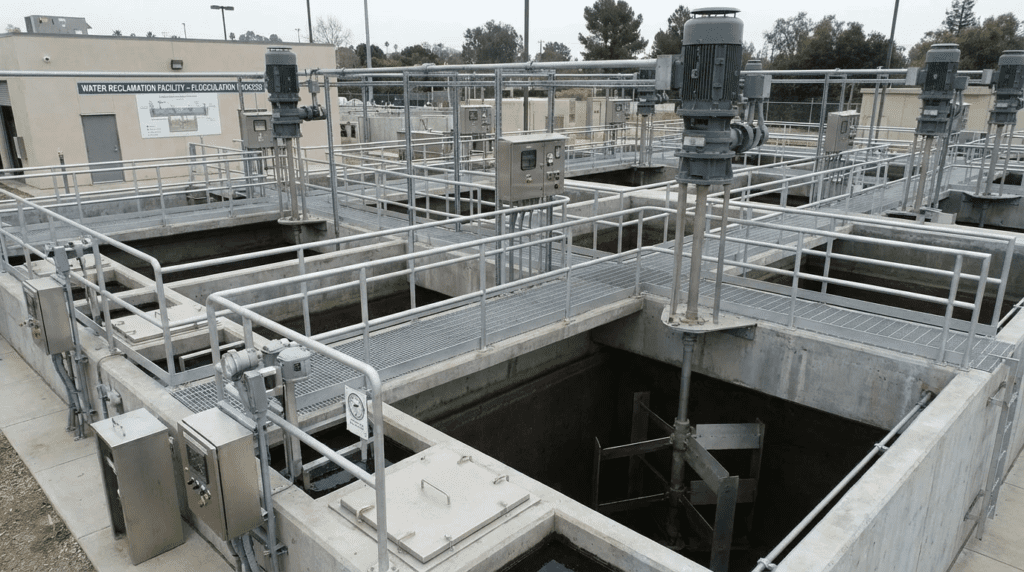
- Vertical Shaft: Motor and gearbox are on a bridge; impeller is submerged. Preferred for ease of maintenance as no bearings are underwater (if designed correctly with a steady bearing exclusion).
- Horizontal Paddle Wheel: Classic design for large water treatment plants. Requires through-wall stuffing boxes and submerged bearings, which are maintenance intensive. However, they provide excellent plug-flow characteristics.
- Headroom: For indoor filter galleries, vertical shaft removal height must be calculated. Split-shaft designs may be required.
Reliability, Redundancy & Failure Modes
Flocculators are critical path equipment. If they fail, the sedimentation process fails.
- Gearbox Service Factor: Always specify AGMA service factors. A minimum service factor of 1.5 or 2.0 is recommended for continuous wastewater duty to handle shock loads.
- L-10 Bearing Life: Specify a minimum L-10 bearing life of 100,000 hours for the gearbox and motor bearings.
- Seal Failure: Dry-well construction on gearboxes is preferred to prevent oil leakage down the shaft into the water.
Controls & Automation Interfaces
Modern flocculation requires tight integration with SCADA.
- Torque Monitoring: High-end gearboxes can be equipped with torque sensors to protect against overload and alert operators to process anomalies (e.g., heavy sludge accumulation).
- Speed Feedback: 4-20mA speed feedback signals allow the SCADA system to verify that the actual mixing intensity matches the setpoint.
Maintainability, Safety & Access
Operator safety during maintenance is a major design consideration.
- Oil Changes: Gearboxes should have oil drain extensions piped to the walkway level so operators do not have to lean over open basins.
- Steady Bearings: Avoid submerged steady bearings whenever possible. If shaft length requires stabilization, use a “stabilizer ring” or hydraulic stabilizer on the impeller rather than a mechanical bearing at the tank floor.
Lifecycle Cost Drivers
- Energy Consumption: Flocculators run 24/7. High-efficiency hydrofoil impellers can consume 30-50% less energy than older pitch-blade turbines for the same G-value.
- Chemical Savings: Efficient mixing can reduce coagulant and polymer dosing requirements significantly, which often dwarfs the electrical energy savings in Total Cost of Ownership (TCO) models.
Comparison of Manufacturers and Technologies
The following tables provide an engineering comparison of the leading market options. Table 1 outlines the specific strengths of the manufacturers often cited as the Top 10 Flocculation Manufacturers for Water and Wastewater (listed alphabetically to maintain neutrality). Table 2 compares the underlying technology types to aid in application selection.
| Manufacturer | Primary Engineering Strengths | Typical Applications | Considerations / Limitations | Maintenance Profile |
|---|---|---|---|---|
| Philadelphia Mixing Solutions (SPX Flow/Lightnin) | Advanced hydrofoil technology; extensive CFD validation; high-efficiency impellers. | Large WTPs, Flash Mix, Flocculation, Sludge Blending. | Premium pricing; typically vertical shaft only. | Low (Robust gearboxes, few submerged parts). |
| WesTech Engineering | Heavy-duty construction; custom solids contact clarifiers; extensive municipal experience. | Flocculating Clarifiers, Horizontal Paddle Wheels, Vertical Mixers. | Often integrated into larger treatment units rather than standalone mixers. | Moderate (Depends on submerged bearing configuration). |
| Evoqua (Xylem) | Diverse portfolio (Envirex legacy); V-bucket designs; varied material options. | Municipal Wastewater, Retrofits, Oxidation Ditches. | Large corporate structure can complicate simple spare parts orders. | Moderate to Low (Standardized industrial components). |
| INVENT Umwelt- und Verfahrenstechnik | Hyperboloid mixing technology (HyperClassic); vertical flow mixing; high energy efficiency. | Anoxic zones, Flocculation, Suspension mixing. | Unique flow pattern requires specific tank geometry; typically not for flash mix. | Very Low (No submerged bearings, reliable drive units). |
| Chemineer (NOV) | Industrial-grade gearboxes (HT, GT series); high torque capacity; rigid shaft design. | Industrial Wastewater, high-viscosity sludge, flash mixing. | Industrial focus may require adaptation for municipal specifications. | Low (Heavy duty cycle ratings). |
| Roberts Filter Group | Traditional horizontal paddle wheels; expertise in gravity filtration integration. | Potable Water Treatment Plants (Classic Flocculation). | Horizontal designs have submerged bearings requiring seal maintenance. | High (Due to submerged seals/bearings). |
| Ovivo | Reactor clarifiers; heavy solids handling; large diameter mechanisms. | Lime Softening, Flocculating Clarifiers. | Specialized for integrated treatment processes. | Moderate. |
| Koflo Corporation | Static mixers; pipe flocculators; no moving parts. | Flash mixing, Inline flocculation for small packaged plants. | Head loss penalty; limited turndown/control ability. | Zero (No moving parts, but requires cleaning). |
| Drydon Equipment (Amark) | Custom fabrication; direct replacement of legacy horizontal paddles. | Municipal WTP retrofits. | Regional availability varies; focused on custom mechanical fit. | Depends on design (Horizontal vs Vertical). |
| Ekato | Advanced impeller geometries; high-end chemical engineering focus. | Industrial wastewater, complex rheology fluids. | Usually over-specified for simple municipal flocculation. | Low (Precision engineering). |
| Technology Type | Fluid Mechanics | Best-Fit Application | Key Constraints | Relative Capital Cost |
|---|---|---|---|---|
| Vertical Hydrofoil | Axial flow; low shear; high pumping rate. | Most modern WTP/WWTP flocculation basins. | Requires bridge structure; tank depth limits shaft length (critical speed). | Medium |
| Horizontal Paddle Wheel | Plug flow simulation; gentle collisions. | Large, rectangular potable water basins (legacy design). | High maintenance on submerged seals/bearings; difficult to access. | High |
| Hyperboloid Mixer | Radial bottom flow; vertical circulation. | Deep tanks; suspension mixing; anoxic zones. | Requires specific floor clearance; not suitable for high-viscosity scum. | Medium-High |
| Walking Beam | Reciprocating vertical motion. | Flocculation where zero rotating shear is desired. | Mechanical complexity of linkage; widely considered obsolete/niche. | High |
| Hydraulic (Baffled) | Serpentine flow utilizes head loss for mixing. | Small systems; steady flow rates. | No adjustability for changing flows; high civil construction cost. | Low (Equipment) / High (Civil) |
Engineer & Operator Field Notes
Real-world experience often diverges from the catalogue specifications. The following notes are compiled from field observations regarding the Top 10 Flocculation Manufacturers for Water and Wastewater.
Commissioning & Acceptance Testing
Commissioning is the first time the theoretical G-value meets reality.
- Drawdown Test: Do not just bump the motor. Perform a drawdown test to verify shaft runout is within tolerances (typically 0.005 inches per foot of shaft length) before filling the basin.
- VFD Tuning: The VFD ramp-up and ramp-down times must be adjusted. Rapid acceleration can shear the gearbox keys or twist long shafts due to the inertia of the water. Set ramp times to 30-60 seconds minimum.
- Power Verification: Measure amp draw at various speeds. If the amp draw is significantly lower than design, the impeller may be undersized, or the fluid is rotating (swirling) with the mixer, indicating baffle failure.
Pro Tip: Always require a “dry run” for noise and vibration baselines, followed by a “wet run” at full load. Gearbox noise often indicates misalignment that will destroy bearings within months.
Common Specification Mistakes
Errors in the Request for Proposal (RFP) stage often lock utilities into poor equipment.
- Ignoring Critical Speed: Long vertical shafts have a “natural frequency.” If the operating speed matches this frequency, the shaft will wobble destructively. Specifications must require the first critical speed to be at least 125% of the maximum operating speed.
- Under-specifying Baffles: Engineers often specify the mixer but forget the tank internals. Without wall baffles, a vertical mixer acts like a centrifuge, spinning the water without mixing it. This drastically reduces the $G$ value.
- “Or Equal” Traps: Allowing “Or Equal” without defining strict mechanical minimums (e.g., shaft diameter, gearbox service factor) allows contractors to supply undersized, light-duty agricultural agitators instead of municipal-grade equipment.
O&M Burden & Strategy
Operational strategies should focus on predictive maintenance.
- Oil Analysis: Perform gearbox oil analysis every 6 months. High metal content indicates gear wear; water indicates seal failure.
- Grease Lines: If the unit has a lower steady bearing (not recommended, but sometimes unavoidable), ensure automatic grease lubricators are installed and functioning. Manual greasing of submerged bearings is rarely done on schedule.
- Visual Floc Inspection: Operators should routinely sample floc size at the basin effluent. If floc is “pinpoint” (too small), mixing energy may be too high (shear) or too low (insufficient collisions). Use the VFD to adjust.
Troubleshooting Guide
- Symptom: Vortexing on surface.
Root Cause: Insufficient baffling or liquid level too low.
Fix: Install anti-vortex baffles or raise weir level. - Symptom: Gearbox overheating.
Root Cause: Wrong oil viscosity, overfilling oil, or overload.
Fix: Check oil level (too much oil causes churning heat) and verify motor amp draw. - Symptom: Poor Settleability (Turbid Supernatant).
Root Cause: Floc shear due to high tip speed.
Fix: Reduce VFD speed. If this causes solids to settle in the floc basin, the impeller hydraulic design is likely incorrect for the application (pumping vs. shear ratio is wrong).
Design Details and Calculations
To properly validate submittals from the Top 10 Flocculation Manufacturers for Water and Wastewater, engineers must understand the governing physics.
Sizing Logic: The G-Value
The intensity of mixing is quantified by the Velocity Gradient ($G$), measured in inverse seconds ($s^{-1}$).
The Formula:
$$G = sqrt{frac{P}{mu V}}$$
- $P$ = Power input to the water (Watts or lb-ft/s)
- $mu$ = Dynamic viscosity of the water (Pa·s or lb-s/ft²)
- $V$ = Volume of the tank (m³ or ft³)
Key Design Steps:
- Determine water temperature range. Viscosity ($mu$) changes significantly with temperature. Cold water is more viscous and requires more power to achieve the same $G$, or results in a lower $G$ for the same power.
- Select $G$ values for each stage (e.g., Stage 1: 70 $s^{-1}$, Stage 2: 40 $s^{-1}$, Stage 3: 20 $s^{-1}$).
- Calculate required Water Horsepower ($P$).
- Apply efficiency factors. Motor and gearbox inefficiencies mean the nameplate HP must be higher than the Water HP.
Specification Checklist
Ensure these items are in your Division 11 or Division 46 specifications:
- Motor: TEFC or TENV, Premium Efficiency, Inverter Duty, Class F Insulation, 1.15 Service Factor.
- Gearbox: Helical or bevel-helical gears (no worm gears), minimal AGMA Service Factor 2.0, dry-well construction.
- Impeller: 3-blade hydrofoil (high efficiency), bolted or keyed to shaft.
- Shaft: Solid shaft preferred over hollow. Maximum deflection calculated at impeller.
- Support: Bridge design must account for torque loads and resonance.
Standards & Compliance
- AWWA: Adherence to American Water Works Association standards for mixing.
- AGMA: American Gear Manufacturers Association standards for gearbox rating are non-negotiable.
- OSHA: Guarding requirements for rotating shafts are critical.
Frequently Asked Questions
What is the difference between flash mixing and flocculation?
Flash mixing (rapid mix) is the violent, high-energy application of coagulant chemicals to the raw water to destabilize particles instantly. $G$-values range from 300 to 1,000 $s^{-1}$ with retention times of 30-60 seconds. Flocculation is the subsequent gentle mixing to agglomerate these destabilized particles into settleable solids, using low $G$-values (20-70 $s^{-1}$) and longer retention times (20-45 minutes).
Why is tapered flocculation important?
Tapered flocculation gradually reduces mixing energy across sequential basins. The first stage uses higher energy to ensure collisions between small particles. As flocs grow, they become fragile. Subsequent stages reduce energy to prevent shearing (breaking) the large flocs that have already formed. Using the same energy input across all stages often results in poor settling.
How often should flocculator gearboxes be serviced?
Typical maintenance includes checking oil levels monthly and changing oil every 6 months or 2,500 hours of operation, depending on the manufacturer’s O&M manual. Synthetic lubricants may extend this interval to 1 year. Greasing of motor bearings is typically required quarterly.
What is a typical “Camp Number” (Gt)?
The Camp Number ($Gt$) is the product of the velocity gradient ($G$) and the hydraulic retention time ($t$). It represents the total number of particle collisions. A typical target range for flocculation is 30,000 to 150,000 (dimensionless). If $Gt$ is too low, flocs don’t form; if too high, flocs may shear.
Can I use a vertical mixer in a square tank?
Yes, vertical mixers generally perform best in square tanks. However, corners in square tanks can act as partial baffles. In circular tanks, full wall baffles are mandatory to prevent bulk rotation (swirl). Without baffles, the mixer simply spins the water like a merry-go-round, resulting in near-zero mixing energy.
Why avoid submerged bearings?
Submerged bearings (steady bearings) are the most common failure point in flocculators. They are located at the bottom of the tank, in abrasive sludge, and are difficult to inspect. If the shaft design (diameter and wall thickness) is robust enough to operate without a bottom bearing (“cantilevered” or “overhung” design), this is always preferred for long-term maintenance reduction.
Conclusion
KEY TAKEAWAYS
- Focus on “G” not HP: Specify the Velocity Gradient required for the process; let the manufacturer calculate the horsepower needed to achieve it.
- Eliminate Underwater Bearings: Whenever structurally possible, specify cantilevered shafts to remove the highest maintenance burden.
- Baffles are Mandatory: Never install a vertical mixer without verifying the baffling strategy to prevent swirling.
- Verify Turndown: Ensure VFDs and motors are rated for the thermal loads of running at 20-30% speed during low-flow or winter conditions.
- Taper the Energy: Design for multi-stage basins with decreasing energy input to maximize floc size and settling speed.
Selecting from the Top 10 Flocculation Manufacturers for Water and Wastewater requires a balanced approach between process hydraulics and mechanical longevity. The ideal system provides the gentle, uniform mixing necessary to build robust floc particles while minimizing shear forces that would break them apart.
For the engineer, the specification process is the primary tool for risk management. By rigidly defining AGMA service factors, demanding CFD validation of flow patterns, and prioritizing maintenance access (such as dry-well gearboxes), utilities can secure equipment that lasts 20+ years. Whether choosing a high-tech vertical hydrofoil from manufacturers like Philadelphia Mixing Solutions or a robust horizontal paddle from Roberts Filter, the success of the installation ultimately relies on matching the equipment’s hydraulic profile to the plant’s specific water chemistry and flow variability.