
JWC Environmental vs Franklin Miller Grit Removal Equipment
Introduction
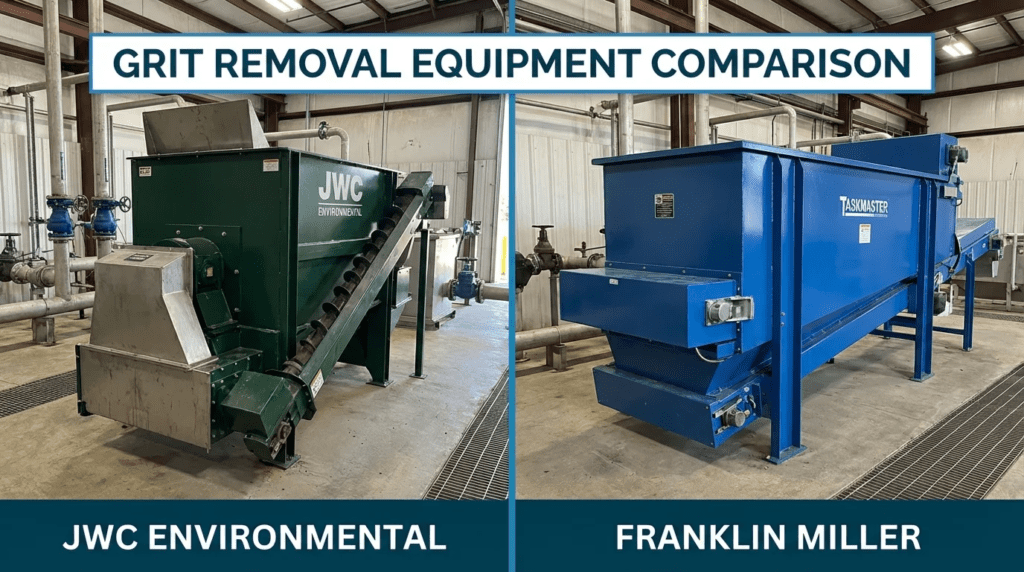
For municipal and industrial wastewater engineers, the protection of downstream process equipment—pumps, valves, centrifuges, and digesters—starts at the headworks. The improper reduction of solids or the inefficient separation of inorganic grit can lead to catastrophic pump cavitation, seal failures, and the rapid accumulation of rag balls in digesters that necessitates expensive cleanouts. When specifying solids reduction and separation technologies, the industry often boils down to a comparative analysis of two dominant Original Equipment Manufacturers (OEMs): JWC Environmental vs Franklin Miller Grit Removal Equipment and solids handling systems.
This comparison is ubiquitous in the North American wastewater sector. Consulting engineers frequently face the challenge of evaluating “Or Equal” substitutions between JWC’s “Monster” series and Franklin Miller’s “Taskmaster” or “Super Shredder” lines. While marketing literature often highlights patented cutter geometries or proprietary seal technologies, the engineering reality is more nuanced. The decision impacts not only capital expenditure but also the long-term operational burden placed on plant staff regarding cutter stack replacements, seal cartridge maintenance, and hydraulic head loss management.
This article provides a technical, specification-safe evaluation of these technologies. It is designed to assist engineers and plant directors in navigating the trade-offs between two-shaft and single-shaft designs, understanding the implications of cutter hardness ratings, and evaluating the total lifecycle cost of headworks protection systems. The focus is strictly on engineering performance, reliability data, and application fit, devoid of manufacturer bias.
How to Select and Specify Solids Handling Equipment
Properly selecting between JWC Environmental vs Franklin Miller Grit Removal Equipment requires a granular understanding of the process constraints. Engineers must move beyond flow rate tables and analyze the mechanical integrity of the comminution or separation process relative to the specific waste stream characteristics.
Duty Conditions & Operating Envelope
The first step in specification is defining the duty cycle. Headworks equipment typically operates in harsh, corrosive environments with highly variable loading.
- Peak Instantaneous Flow (PIF): Sizing must accommodate PIF to prevent hydraulic bottlenecks. However, oversizing based solely on PIF can lead to low velocities during average flows, causing grit deposition in the channel upstream of the grinder.
- Solids Loading Factor: Municipal sewage typically contains 200–400 mg/L of suspended solids, but “flushables” and rags create shock loads. Specifications must account for high-torque requirements during “slug” loading events.
- Grit Characterization: If the application involves septage receiving (a common application for both JWC’s Honey Monster and Franklin Miller’s Spiralift), the equipment must handle high concentrations of inorganic grit (specific gravity > 2.65) without excessive abrasion to the cutter stack.
Materials & Compatibility
The longevity of a grinder or grit washer is dictated by metallurgy. When evaluating submittals, pay close attention to the following:
- Cutter Hardness: Cutters should typically be heat-treated alloy steel (e.g., 4130 or 4140) hardened to a minimum of 45-50 Rockwell C. For high-grit environments, tungsten carbide coatings or specialized boride treatments may be required to resist abrasion.
- Shaft Material: Hexagonal shafts are standard to drive the cutters. High-tensile strength steel (100,000+ psi yield) is critical to minimize deflection. Shaft deflection is a primary cause of seal failure.
- Housing Construction: In standard municipal wastewater, Ductile Iron (ASTM A536) is common. For industrial applications with low pH or high salinity, 304 or 316 Stainless Steel housings are necessary to prevent galvanic corrosion.
Hydraulics & Process Performance
Introducing a grinder or screen into a channel introduces head loss. This must be calculated carefully to prevent upstream flooding or backing up interceptors.
Head Loss Coefficient (K): Engineers must evaluate the “clean” vs. “blinded” head loss. A common specification error is sizing based on clean water curves. In operation, a percentage of the open area (typically 20-30%) will be occluded by solids. The equipment selected must allow the hydraulic profile to remain within the channel freeboard limits under peak flow conditions with partial blinding.
Installation Environment & Constructability
Retrofit applications often drive the selection between JWC Environmental vs Franklin Miller Grit Removal Equipment based on footprint.
- Channel Fit: Custom frames or wall-mounted rail systems are often required. The tolerance between the grinder frame and the concrete channel wall must be sealed (typically with neoprene gaskets) to prevent bypass. Bypass allows stringy material to foul downstream pumps, negating the equipment’s purpose.
- Substitutability: For plants looking to switch manufacturers, verifying flange-to-flange dimensions and anchor bolt patterns is critical. Some OEMs offer “drop-in” replacements designed to match the competitor’s dimensions to reduce concrete work.
Reliability, Redundancy & Failure Modes
The most common failure mode in twin-shaft grinders is the mechanical seal assembly. Grit intrusion into the seal faces causes leakage, which eventually contaminates the bearing lubrication and leads to lower bearing failure.
- Seal Technology: Look for cartridge-style mechanical seals rated for substantial pressure (e.g., 60-90 PSI). Tungsten carbide vs. silicon carbide faces should be evaluated based on the abrasiveness of the fluid.
- Shaft Deflection: Stiff shafts reduce movement at the seal face. Compare the shaft diameter and unsupported length between bearings in the manufacturer’s data sheets.
- Redundancy: For critical lift stations, N+1 redundancy is standard. If physical redundancy isn’t possible, a bypass channel with a manual bar screen is a mandatory requirement for emergency maintenance.
Controls & Automation Interfaces
Modern grinders are not “plug and run.” They require intelligent control panels (PLCs) to manage jams.
- Jam Sensing logic: The controller must detect over-current (amps) conditions indicating a jam. The standard logic is: Stop -> Reverse -> Stop -> Forward. This cycle attempts to clear the obstruction.
- Fail-Safe: After a specified number of clearing attempts (usually 3), the unit should shut down and alarm via SCADA to prevent motor burnout or shaft breakage.
- SCADA Integration: Specifications should require dry contacts or Ethernet/IP communication for Run Status, Fail Status, and High Torque Alarm.
Lifecycle Cost Drivers
The purchase price (CAPEX) is often 10-15% of the 20-year Total Cost of Ownership (TCO). The bulk of the cost lies in O&M.
- Cutter Stack Rebuilds: Cutters wear out. A typical interval is 3-7 years depending on grit load. Engineers should analyze the cost of a “cutter cartridge” exchange program versus on-site individual cutter replacement.
- Energy Efficiency: While motors are generally small (3HP – 10HP), continuous operation adds up. High-efficiency motors (NEMA Premium) should be specified.
Comparison Tables
The following tables provide a side-by-side engineering evaluation. Table 1 focuses on the primary grinding and solids reduction technologies offered by both manufacturers. Table 2 provides an application matrix to assist in selecting the correct technology for specific plant constraints.
| Feature / Attribute | JWC Environmental (Typical Muffin Monster Series) | Franklin Miller (Typical Taskmaster / Super Shredder Series) |
|---|---|---|
| Primary Mechanism | Dual-shaft, low-speed, high-torque grinding. Known for “stack” cutter design. | Offers both Dual-shaft (Taskmaster) and Single-shaft (Super Shredder) technologies. |
| Cutter Stack Design | Individual cutters and spacers on hex shaft. Newer models utilize integrated cartridges (Wipes Ready) to improve strength. | “Cutter Cartridge” technology is a core feature, machining multiple cutters from a solid block to eliminate stack loosening. | Seal Technology | Proprietary mechanical seals; emphasis on distinct separation between seal and bearing housing. | Cartridge seal designs; emphasizes high-pressure ratings and ease of field replacement without full disassembly. |
| Throughput Capability | Extensive range of channel widths and motor HPs. High flow capabilities in the “Mach” series. | Comparable range. The Super Shredder (single shaft) offers very high throughput with lower head loss due to open flow path. |
| Typical Maintenance | Cutter exchange program (Monster Renew) is widely used. Requires removing unit for stack overhaul. | Cutter cartridge design aims to simplify rebuilding, but unit removal is still typically required for bearing/seal work. |
| Grit Handling | Honey Monster: Integrated septage receiving with auger screening and grinding. | Spiralift: Integrated screw screen/grinder/washer system. Taskmaster often paired with grit washers. |
| Application Scenario | Solids/Grit Profile | Space Constraints | Recommended Technology | Key Design Consideration |
|---|---|---|---|---|
| Pump Station Protection | High rags, low to medium grit | Tight retrofits, existing pipe | Inline Grinder (e.g., Super Shredder or Inline Monster) | Ensure straight pipe runs upstream/downstream to stabilize flow profile. |
| Headworks Channel | Mixed solids, heavy slug loads | Open channel | Dual-Shaft Channel Grinder | Calculate head loss at peak flow to prevent channel overflow. |
| Septage Receiving | Extreme grit (rocks, sand), heavy sludge | Dedicated receiving bay | Integrated System (Screen + Grinder + Washer) | Must separate rocks before grinding to prevent cutter breakage. |
| Sludge Recirculation | Homogenous sludge, re-woven rags | Pipeline | Inline Macerator | Focus on seal integrity due to constant abrasive sludge contact. |
Engineer and Operator Field Notes
Field experience often deviates from the ideal scenarios presented in catalog data. The following notes are compiled from commissioning reports, maintenance logs, and root cause analysis of failures involving JWC Environmental vs Franklin Miller Grit Removal Equipment.
Commissioning & Acceptance Testing
The Site Acceptance Test (SAT) is the engineer’s final leverage point. Do not sign off until the following are verified:
- Rotation Verification: It sounds basic, but 3-phase motors often run backward upon initial wiring. For a grinder, reverse rotation may not grind effectively or may trigger premature “jam” alarms. Visual verification of the cutter rotation direction against the housing arrows is mandatory.
- Amp Draw Baseline: Record the amperage draw while running in clean water (no load). This establishes a baseline for future troubleshooting. If “clean” amps are within 10% of Full Load Amps (FLA), there is a mechanical bind or alignment issue.
- Seal Leakage Test: Inspect the tell-tale drain ports on the seal housing. Any dripping water during the SAT indicates a compromised seal installation.
Pro Tip: During commissioning, simulate a jam by introducing a piece of sacrificial lumber (2×4) if permitted by the manufacturer’s protocol, or verify the current sensing relay settings using a signal generator. Ensuring the “Reverse-Clear” logic works before the operator faces a real rag ball is critical.
Common Specification Mistakes
One of the most frequent errors in comparing JWC Environmental vs Franklin Miller Grit Removal Equipment is ambiguity in material definitions.
- “Or Equal” Traps: Specifying “Hardened Steel Cutters” is insufficient. A low-grade heat treatment may test hard on the surface but lack core toughness, leading to shattering under shock loads. Specify the alloy (e.g., 4140) and the specific hardening process.
- Ignoring Velocity Profiles: Placing a grinder in a channel where the velocity drops below 1.5 ft/s (0.45 m/s) allows grit to settle in front of the grinder. This creates a sandbar that blinds the bottom cutters, forcing flow over the top and bypassing the treatment.
O&M Burden & Strategy
Maintenance strategies for these units generally fall into two categories: proactive cutter stack management and reactive seal failure response.
- Inspection Intervals: Visual inspection of cutter teeth wear should occur monthly. Look for rounded edges or missing teeth. As teeth round off, the grinder pulls more amps to do the same work, increasing electrical costs and motor heat.
- Lubrication: Automatic greasers are common, but they must be checked. An empty autoluber is a leading cause of upper bearing failure.
- Spare Parts: Critical spares include a full set of mechanical seals, a lower bearing assembly, and a spare motor. Keeping a full spare cutter stack is expensive; most utilities rely on the OEM’s exchange program for the cartridge/stack.
Troubleshooting Guide
Symptom: Frequent “Phantom” Jams
If the grinder reverses frequently without visible solids load, check the Variable Frequency Drive (VFD) ramp times. If the acceleration time is too short, the inrush current may trigger the jam protection logic falsely. Increase the ramp-up time to 3-5 seconds.
Symptom: Vibration and Noise
Excessive vibration usually points to a bent shaft or a failed bottom bearing. If the unit has digested a large rock or metal object (common in combined sewer systems), the shaft may have deflected permanently. Dial indicator checks on the shaft runout are required.
Design Details and Calculations
Accurate hydraulic calculations are required to ensure that the insertion of a grinder does not negatively impact the hydraulic grade line (HGL) of the facility.
Sizing Logic & Methodology
To properly size a channel grinder, follow this logic:
- Determine Peak Flow (Qpeak): Identify the maximum hydraulic throughput required.
- Calculate Channel Cross-Sectional Area (Achannel): Width × Maximum Water Depth.
- Determine Grinder Open Area: Consult the JWC or Franklin Miller data sheets for the specific model. The “Open Area” is usually 50-70% of the drum/cutter height depending on the design.
- Calculate Velocity through Grinder (Vgrinder):
Vgrinder = Qpeak / (Agrinder_open)
Target velocity should be between 2.0 and 3.0 ft/s. Exceeding 4.0 ft/s causes excessive head loss and forces solids through without proper grinding.
Specification Checklist
When preparing bid documents for JWC Environmental vs Franklin Miller Grit Removal Equipment, ensure the following line items are explicit:
- Motor Rating: TEFC or IP68 (Submersible). If the unit is in a flood-prone dry pit, specify IP68/IP67 explosive proof (Class 1 Div 1/2) even if it’s not submerged during normal operation.
- Controller Enclosure: NEMA 4X Stainless Steel or Polycarbonate. Avoid painted carbon steel for outdoor wastewater environments.
- Warranty: Standard warranties are 1 year. For these high-wear items, specifying a 3-year prorated warranty on the cutter stack can protect the utility from premature metallurgical failure.
Standards & Compliance
Adherence to industry standards ensures safety and interoperability.
- Electrical: NFPA 70 (NEC) Article 500 for hazardous locations.
- Manufacturing: ISO 9001 quality management systems.
- Materials: ASTM A536 for Ductile Iron castings; ASTM A276 for Stainless Steel shafting.
Frequently Asked Questions
The following questions address common inquiries regarding the selection and operation of JWC Environmental vs Franklin Miller Grit Removal Equipment.
What is the primary difference between twin-shaft and single-shaft grinders?
Twin-shaft grinders (like the standard Muffin Monster or Taskmaster) use two counter-rotating shafts to pull solids into the cutter stack, offering high torque for shredding tough debris like wood or heavy rags. Single-shaft grinders (like the Super Shredder) use a high-speed rotating cutter inside a stationary screen, acting more like a macerator. Twin-shaft units are generally preferred for open channels with heavy, diverse solids, while single-shaft units are excellent for inline pipe applications or sludge lines.
How does grit impact the lifespan of these grinders?
Grit (sand, gravel) is highly abrasive. In applications with high grit content, the clearance between the cutters and spacers increases due to abrasion, reducing grinding efficiency (known as “slicing” rather than “shredding”). High grit loads significantly reduce the MTBF (Mean Time Between Failures) of the mechanical seals. For high-grit influent, a rock trap or grit settling chamber should ideally precede the grinder.
What is the typical cost range for a municipal channel grinder?
Costs vary widely by size and options. A small pump station grinder (flow < 1 MGD) typically ranges from $25,000 to $45,000. Large headworks units for flows > 10 MGD can range from $80,000 to $150,000. Installation, controls, and concrete work are additional. Always budget for the “cutter exchange” program in the OPEX budget, which can cost 30-50% of the new unit price every 5-7 years.
Can these grinders replace bar screens?
Generally, no. Grinders reduce solids size so they can pass through pumps without clogging, but the solids remain in the waste stream. Bar screens remove the solids completely. Grinders are often used at pump stations where screenings removal is logistical impossible, but at a main treatment plant headworks, screening (removal) is preferred over grinding to reduce the load on the digesters.
How often should cutter stacks be replaced?
In typical municipal sewage applications, cutter stacks last between 3 to 7 years. Factors reducing this lifespan include high grit content, combined sewer systems (rocks/debris), and the frequency of reversing cycles. Operators should monitor the “gap” between cutters; once the gap widens significantly, grinding efficiency drops, and ragging downstream will increase.
What causes seal failure in wastewater grinders?
Seal failure is usually caused by the intrusion of abrasive fines (grit) or fiber wrapping around the seal housing. Shaft deflection during shock loads (e.g., grinding a piece of lumber) can also momentarily open the seal faces, allowing debris ingress. Once the seal faces are scored, leakage is inevitable.
Conclusion
KEY TAKEAWAYS
- Application First: Use twin-shaft units for heavy solids/open channels; use single-shaft/inline units for sludge or pipe-constrained pump protection.
- Define Materials: Specify cutter hardness (Rockwell C 45+) and shaft tensile strength to avoid “or equal” inferior substitutions.
- Watch the Seals: Seal cartridge technology is the primary differentiator for reliability. Prioritize designs that protect the seal faces from grit intrusion.
- Hydraulics Matter: Calculate head loss based on a partially blinded condition, not clean water curves.
- Lifecycle Planning: Budget for cutter stack replacements every 5 years in the TCO analysis.
Choosing between JWC Environmental vs Franklin Miller Grit Removal Equipment is rarely a question of one being objectively “better” than the other across the board. Both OEMs manufacture high-quality, industrial-grade equipment capable of handling severe wastewater environments. The engineering decision typically hinges on specific application constraints: available footprint, specific hydraulic requirements, and the preference for cutter cartridge maintainability versus individual cutter replacement.
For the consulting engineer, the goal is to write a specification that ensures mechanical robustness—focusing on shaft deflection, seal pressure ratings, and cutter metallurgy—rather than focusing on brand names. For the operator, the focus must be on ease of access, safety during maintenance, and the availability of local support for the inevitable cutter stack overhaul. By focusing on the physics of the application and the reality of the operating environment, utilities can select a solution that protects downstream assets effectively for the 20-year design horizon.