
Top OEMs for Oxidation Ditch Systems
1. Introduction
The oxidation ditch is a modified activated sludge biological treatment process that utilizes long solids retention times (SRTs) to remove biodegradable organics. Oxidation ditches are typically complete mix systems, but they can be modified to approach plug flow conditions. Ideally suited for small- to medium-sized municipal wastewater treatment plants, these systems are renowned for their reliability, ease of operation, and ability to handle shock loads compared to conventional activated sludge processes.
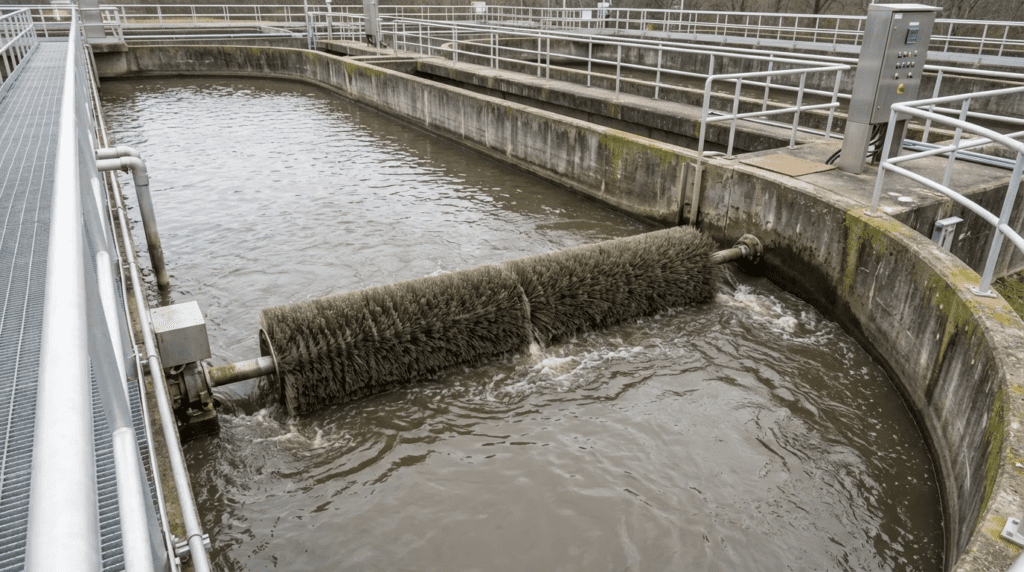
Characterized by a closed-loop channel (often in a racetrack or oval configuration), the oxidation ditch relies on mechanical aeration equipment to provide both oxygen for biological metabolism and channel velocity to keep solids in suspension. The extended aeration typically provided by these systems facilitates not only carbonaceous biochemical oxygen demand (BOD) removal but also nitrification and, with specific process designs, denitrification and biological phosphorus removal.
For consulting engineers and utility decision-makers, selecting the correct Original Equipment Manufacturer (OEM) for an oxidation ditch system is not merely a matter of procuring hardware. It involves selecting a proprietary process technology that dictates civil design, hydraulic profiles, energy consumption baselines, and long-term maintenance strategies. Unlike generic pumping or piping systems, oxidation ditches often utilize patented aeration and flow configurations—such as the brush rotor, the vertical shaft surface aerator, or the rotating disc—that fundamentally alter the plant’s footprint and operational philosophy.
Regulatory drivers, including stringent nutrient limits (Total Nitrogen and Total Phosphorus), have forced the evolution of the basic oxidation ditch from a simple aerobic basin into sophisticated, phased-isolation or multi-zone reactors. Modern designs must balance energy efficiency (turndown capabilities) with the hydraulic requirement to maintain minimum channel velocities (typically 1.0 ft/s or 0.3 m/s) to prevent mixed liquor suspended solids (MLSS) from settling. This article provides a comprehensive engineering analysis of the leading OEMs in this sector, focusing on technical specifications, process capabilities, and lifecycle considerations.
2. How to Select This Process Equipment
Selecting an oxidation ditch system requires a multi-disciplinary engineering approach, integrating process biology, hydraulics, and mechanical reliability. The following factors must be evaluated during the preliminary design and equipment selection phases.
Process Function and Performance Requirements
The primary function of the oxidation ditch is to create a stable environment for biomass to degrade organic matter. Engineers must evaluate the OEM’s ability to meet specific effluent limits, particularly for nitrogen.
- Nitrification: Due to large tank volumes and long SRTs (typically 15 to 30 days), oxidation ditches differ from high-rate activated sludge. Equipment selection must ensure adequate oxygen transfer rates (Standard Oxygen Transfer Rate – SOTR) to satisfy the nitrogenous oxygen demand (NOD) alongside carbonaceous demand.
- Denitrification: Modern permits often require Total Nitrogen (TN) removal. Engineers must assess whether the OEM offers discrete anoxic zones or promotes Simultaneous Nitrification and Denitrification (SND). SND relies on creating anoxic micro-zones within the floc or specific oxygen gradients within the channel, heavily influenced by the type of aerator selected (e.g., discs vs. rotors).
- Bio-P Removal: If biological phosphorus removal is required, the system design must include an anaerobic selector zone upstream of the ditch, integrated with the return activated sludge (RAS) line.
Hydraulics and Channel Velocity
A defining characteristic of the oxidation ditch is the horizontal velocity. The aeration device must impart enough momentum to the liquid to maintain a velocity of 0.8 to 1.2 ft/s throughout the entire channel cross-section.
- Propulsion Efficiency: Some aerators are excellent at oxygen transfer but poor at propulsion (and vice versa). Engineers must calculate the hydraulic energy required to overcome channel friction and head loss through bends.
- Depth Limitations: Horizontal brush rotors typically limit channel depth to 8–12 feet. Vertical shaft aerators allow for much deeper tanks (12–20+ feet), which can significantly reduce the civil footprint.
- Baffle Walls: The inclusion of flow directional baffles or turning vanes is often required to minimize head loss at channel turns and prevent dead zones where solids can accumulate and go septic.
Materials of Construction
Oxidation ditch equipment operates continuously in a corrosive, wet environment. Material selection dictates the longevity of the installation.
- Rotors/Discs: Shafts should typically be carbon steel with robust epoxy coatings or stainless steel. Blades or discs are often molded high-density polyethylene (HDPE) or fiberglass-reinforced plastic (FRP) to resist UV degradation and chemical attack.
- Splash Covers: To control aerosols and odor, and to prevent freezing in cold climates, covers are essential. These are usually fabricated from FRP or aluminum.
- Bearings: This is the most critical mechanical component. Outboard bearings must be heavy-duty, pillow-block style with easy access for lubrication.
Energy Efficiency and Operating Cost
Aeration accounts for 50–70% of a wastewater plant’s energy usage. In oxidation ditches, efficiency is measured in Standard Aeration Efficiency (SAE), typically expressed as lb O2/hp-hr.
- Turndown Capability: Influent loads vary diurnally. The equipment must be able to turn down oxygen delivery without compromising mixing velocity. Variable Frequency Drives (VFDs) are standard, but mechanical aerators have a lower limit (often 50-60% speed) below which mixing fails.
- Submergence Control: Some systems utilize automated adjustable output weirs to change the immersion depth of the rotors, allowing oxygen transfer adjustment independent of motor speed.
Operations and Maintenance Impacts
The physical layout of an oxidation ditch impacts O&M significantly.
- Access: Engineers must design walkways and platforms that allow safe access to drive units and bearings.
- Winter Operation: In northern climates, surface aerators can cause significant heat loss and icing. Covers or housing structures are mandatory to prevent ice buildup on rotor blades which can cause catastrophic imbalance and vibration.
- Aerosols: Surface aeration generates mist, which can carry pathogens. Site layout must consider prevailing winds and proximity to neighbors or plant staff working areas.
Lifecycle Cost Considerations
While surface aeration oxidation ditches generally have lower capital costs than diffused air systems due to the lack of blowers and piping grids, the lifecycle analysis must account for:
- Gearbox Replacement: Vertical shaft aerators rely on large reduction gearboxes that require periodic overhaul or replacement (10-15 year intervals).
- Civil Costs: Shallow ditches require large land areas. Deep ditches require more expensive excavation and concrete work.
- Diffuser Replacement: Unlike diffused air systems that require tank draining to replace membranes every 7-10 years, surface aerators can often be serviced from the bridge, though complete removal usually requires a crane.
3. Comparison Table
The following table compares the leading OEMs based on their primary oxidation ditch technologies. Engineers should use this matrix to align specific project constraints—such as land availability, nutrient limits, and maintenance capabilities—with the inherent strengths of each manufacturer’s design philosophy.
| OEM Name | Core Technology | Engineering Strengths | Limitations | Best-Fit Scenarios |
|---|---|---|---|---|
| Lakeside Equipment | Horizontal Magna Rotor (Brush Rotor) | Simplicity of design; high propulsion efficiency; proven longevity; accessible maintenance. | Shallow depth requirement increases land use; potential for aerosol generation; heat loss in winter. | Small to mid-sized municipalities with available land; plants requiring robust, simple mechanicals. |
| Evoqua (Xylem) | Orbal (Disc Aeration) & VLR | SND capability via oxygen layering; series operation (concentric channels); resistance to clogging. | Large footprint (Orbal); complex concrete forming for concentric channels; proprietary nature of discs. | Projects with strict TN limits; facilities requiring process stability under varying loads. |
| Ovivo | Carrousel Systems (Vertical Impeller) | Deep tank capability (small footprint); efficient vertical aeration; excellent mixing energy. | Requires large gearboxes; bridge infrastructure required; distinct anoxic zones often needed for low TN. | Land-constrained sites; larger municipal plants (>5 MGD); deep excavation scenarios. |
| WesTech Engineering | OxyStream & Landox | Slow-speed surface aeration; Landox drum provides high efficiency mixing with low energy; robust builds. | May require specialized maintenance for proprietary drum mechanisms; slightly more complex drive assemblies. | Industrial wastewater; municipal plants prioritizing energy efficiency and durable heavy-duty mechanics. |
| Aero-Mod | Sequox & ClarAtor | Integrated clarification (no external clarifiers); sequential batch-like performance in flow-through mode. | Process control complexity is higher than standard ditches; dependent on proprietary internal geometry. | Small to medium plants wanting a compact “all-in-one” nutrient removal solution without separate clarifiers. |
4. Top OEM Manufacturers
The following manufacturers represent the industry standard for oxidation ditch technologies. Selection should be based on the specific compatibility of their proprietary aeration and flow configurations with the project’s biological and hydraulic goals.
Lakeside Equipment Corporation
Lakeside Equipment is a historic leader in the oxidation ditch market, largely responsible for popularizing the technology in the United States. Their core offering revolves around the Magna Rotor, a horizontal brush aerator.
- Technology Description: The Magna Rotor consists of a horizontal shaft with die-formed stainless steel blades. As the rotor spins, it impacts the water surface to introduce oxygen while simultaneously pushing the water to create channel velocity. The design is mechanically simple, relying on a motor, gear reducer, and horizontal bearings.
- Engineering Advantage: The primary advantage of the Lakeside system is the “Closed Loop Reactor” (CLR) process stability. The rotors provide aggressive mixing, ensuring solids do not settle. Maintenance is straightforward as all moving parts are accessible from the bridge surface without the need for cranes or tank draining.
- Process Considerations: Lakeside designs often utilize adjustable effluent weirs to control rotor immersion. This allows operators to match oxygen transfer to influent load without changing rotor speed (though VFDs are now common). This flexibility helps maintain process stability during low-flow initial years.
Evoqua (Xylem)
Evoqua (now part of Xylem) offers the widely recognized Orbal system and the Vertical Loop Reactor (VLR). The Orbal system is distinct in its geometry and aeration method.
- Technology Description: The Orbal system typically features concentric channels (usually three) operating in series. The outer channel is aerated to operate in an oxygen-deficit mode, the middle channel is a transition zone, and the inner channel acts as a polishing step. Aeration is provided by rotating discs rather than bladed rotors.
- Engineering Advantage: The disc design introduces oxygen in a way that creates layers of aerobic and anoxic zones within the same channel depth. This facilitates Simultaneous Nitrification and Denitrification (SND) with high efficiency. The concentric design provides a built-in “step-feed” effect and buffers the system against hydraulic shock loads.
- Process Considerations: For sites with limited footprint, Evoqua offers the VLR, which flips the oxidation ditch on its side, using deep tanks and surface discs or diffused air to achieve similar results in a smaller area.
Ovivo
Ovivo (formerly Eimco) markets the Carrousel system, one of the most widely installed oxidation ditch technologies globally. The Carrousel system is fundamentally different from horizontal rotor systems as it utilizes vertical shaft surface aerators.
- Technology Description: The Carrousel design uses a low-speed vertical shaft aerator located at the turn of the channel. This aerator draws liquid from the bottom of the tank and throws it outward across the surface, providing oxygen transfer and significant hydraulic propulsion.
- Engineering Advantage: The vertical pumping action allows Carrousel systems to operate at depths of 12 to 20 feet or more, significantly deeper than brush rotor ditches. This reduces the surface area required for the plant. The “denitIR” modification includes an internal anoxic zone with a dedicated mixer, allowing for controlled denitrification and total nitrogen removal.
- Process Considerations: The hydraulic radius of influence of the aerator dictates the channel width. Engineers must carefully size the aerator not just for oxygen but for the hydraulic thrust required to maintain velocity through the entire loop.
WesTech Engineering
WesTech provides oxidation ditch solutions with a focus on robust mechanical design and energy efficiency, offering both the OxyStream and Landox systems.
- Technology Description: The OxyStream system is a vertical shaft, low-speed surface aerator design similar to traditional carrousels but optimized for mixing efficiency. The Landox system utilizes a drum-style mixer/aerator that separates the mixing function from the aeration function to some degree, or utilizes specific drum geometries to maximize interfacial contact.
- Engineering Advantage: WesTech is noted for heavy-duty drive assemblies and gearboxes designed for long life. The Landox system is particularly effective in industrial applications or high-strength waste scenarios where oxygen transfer efficiency and mixing reliability are paramount.
- Process Considerations: WesTech systems are highly customizable. They can be configured for flow-through or semi-batch operation. The focus on slow-speed aeration minimizes shearing of the biological floc, which can improve settling characteristics in the downstream secondary clarifiers.
Aero-Mod
Aero-Mod distinguishes itself with the Sequox and ClarAtor technologies, which often integrate the clarification step directly into the process train, eliminating the need for traditional external circular clarifiers.
- Technology Description: The Aero-Mod approach often utilizes a belt-driven roughing filter/aerator or diffused air systems combined with a unique clarification geometry. The ClarAtor is a clarifier integrated into the ditch footprint that uses specific hydraulic principles to settle solids and return them to the aeration zone.
- Engineering Advantage: The primary benefit is the elimination of separate return activated sludge (RAS) pumping stations and external clarifier mechanisms. This simplifies the hydraulic profile and significantly reduces the total plant footprint and capital cost for concrete.
- Process Considerations: This system is ideal for batch-like performance in a continuous flow regime. It handles peak flows well due to the integrated surge capacity. However, the unique design requires operators to be trained specifically on Aero-Mod’s process control philosophy, which differs from standard flow-through ditches.
5. Application Fit Guidance
Choosing the right OEM often depends on the facility size, wastewater characteristics, and site constraints.
Municipal Wastewater (Small to Mid-Sized)
For communities ranging from 0.5 MGD to 5 MGD, Lakeside and Aero-Mod are often preferred. Lakeside’s brush rotors are easy for small staffs to maintain (no complex hydraulics or submerged maintenance), while Aero-Mod offers a compact solution that reduces civil work by eliminating external clarifiers.
Municipal Wastewater (Mid to Large)
For facilities larger than 5 MGD, or where land costs are high, Ovivo (Carrousel) and Evoqua (Orbal/VLR) are dominant. The Carrousel’s deep tank design minimizes land usage. The Orbal system is frequently selected when stringent Total Nitrogen limits are in place, as its concentric channel design allows for sophisticated series-operation nutrient removal strategies without complex internal recycling pumping.
Industrial Wastewater
WesTech and Ovivo are strong contenders here. Industrial waste often involves higher strength variations and potential toxicity. The robust mixing energy of vertical shaft aerators (WesTech/Ovivo) ensures complete suspension of heavier industrial solids and provides aggressive oxygen transfer for high-BOD loads.
Retrofit vs. Greenfield
For retrofitting existing lagoons or shallow basins, Lakeside rotor systems are ideal as they are designed for shallower depths. For greenfield projects on restricted sites, Ovivo or Evoqua VLR are preferred for their vertical utilization of space.
6. Engineer & Operator Considerations
Beyond the process selection, successful implementation relies on detailed attention to installation and long-term maintainability.
Installation and Commissioning
Concrete Tolerance: Oxidation ditch aerators, particularly brush rotors and discs, require tight concrete tolerances. If the channel walls are not perfectly parallel or the floor is not level, the immersion depth of the rotor will vary along its length, causing uneven loading on the drive and poor process performance. Engineers must specify strict concrete tolerances.
Clean Water Testing: It is highly recommended to specify clean water oxygen transfer testing as part of the commissioning process to verify the manufacturer’s SOTR claims before the biology is introduced.
Maintenance Access
Bridge Design: Bridges spanning the ditch must be designed not just for foot traffic, but for maintenance loads. Can a small crane or forklift access the drive unit? Is there laydown space for a removed motor?
Lubrication: Automated greasing systems are recommended for outboard bearings on rotor systems, as these are often located in hard-to-reach areas over the water.
Operational Lessons Learned
Icing: In freezing climates, un-covered rotors act as snow-making machines. Ice buildup causes imbalance and gearbox failure. Engineers must specify insulated, heat-traced, or robust FRP covers for rotors in northern zones.
Ragging: While oxidation ditches are generally resistant to clogging, the aeration rotors or vertical shafts can accumulate rags if upstream screening is poor. 6mm or finer screening is recommended upstream of any mechanical aeration device.
Long-Term Reliability Risks
The gearbox is the weak link in vertical shaft systems. Engineers should specify a minimum Service Factor (typically 2.0 or higher) for gear reducers to handle the shock loads of starting and stopping large aerators. For horizontal rotors, the primary risk is bearing failure due to seal degradation and water intrusion; selection of triple-lip seals or purgeable seals is advisable.
7. Conclusion
The oxidation ditch remains a workhorse of the wastewater treatment industry, offering a balance of process stability and nutrient removal capability. However, the category is not monolithic; the choice between horizontal rotors (Lakeside), rotating discs (Evoqua), vertical impellers (Ovivo/WesTech), or integrated clarification systems (Aero-Mod) fundamentally changes the plant design.
Engineers must look beyond the capital cost of the equipment and evaluate the civil construction implications (depth vs. area), the energy lifecycle (SAE and turndown), and the maintenance reality (gearbox vs. bearing accessibility). By aligning the specific biological requirements—particularly nitrogen targets—with the unique mixing and aeration physics of these top OEMs, utilities can ensure a resilient treatment system with a service life exceeding 20 years.