
Purafil vs Engineered Air for Odor Control: Pros/Cons & Best-Fit Applications
Introduction
For municipal and industrial plant engineers, odor control is rarely the most expensive process on site, but it is frequently the most politically volatile. A single failure in hydrogen sulfide (H2S) capture can result in public complaints, regulatory fines, and rapid corrosion of critical electrical assets. A surprising statistic in municipal wastewater management is that up to 40% of public works complaints are odor-related, often driving capital expenditures that prioritize nuisance abatement over process efficiency. However, the engineering challenge lies in the nuance of equipment selection. Many specifiers overlook the distinct operational differences between proprietary dry-chemical scrubbing systems and custom-fabricated air handling units.
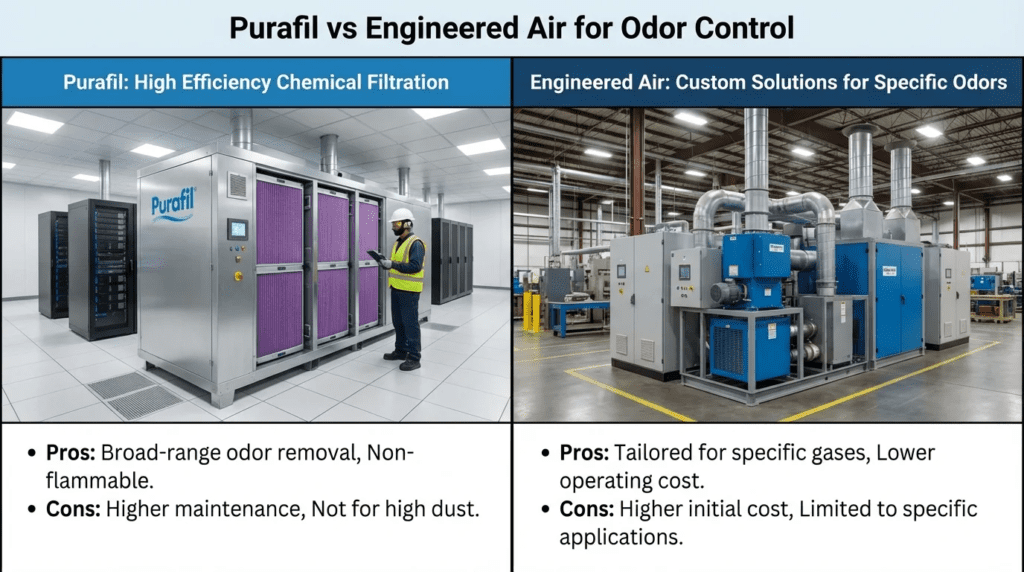
This article provides a detailed technical analysis of Purafil vs Engineered Air for Odor Control: Pros/Cons & Best-Fit Applications. In the context of this engineering guide, we evaluate “Purafil” as the representative standard for proprietary, media-based chemisorption scrubbers (utilizing engineered pellets like permanganate-impregnated alumina), and “Engineered Air” as the representative standard for custom-fabricated air handling units (AHUs) designed for deep-bed activated carbon adsorption or general ventilation integration. These technologies are ubiquitous in headworks, pump stations, sludge dewatering facilities, and industrial digestors.
Proper specification is critical. Selecting a deep-bed carbon unit (Engineered Air style) for a high-humidity, variable-loading application can lead to bed fires or rapid saturation. Conversely, specifying a polished chemisorption unit (Purafil style) for a massive airflow application with low concentrations may result in unjustifiable lifecycle costs due to media pricing. This guide aims to help engineers, plant directors, and maintenance supervisors navigate the hydraulics, chemistry, and lifecycle economics of these distinct approaches.
How to Select and Specify Odor Control Technologies
When evaluating Purafil vs Engineered Air for Odor Control: Pros/Cons & Best-Fit Applications, the decision cannot be based on capital cost alone. The selection process must follow a rigorous evaluation of the process conditions, specifically the nature of the foul air stream and the physical constraints of the facility.
Duty Conditions & Operating Envelope
The primary differentiator between these technologies is their response to contaminant concentration and airflow variability.
- Contaminant Loading: Proprietary chemisorption media (Purafil type) is typically engineered to target specific molecular weights and chemical groups. It excels in environments with “cocktails” of odors—H2S, mercaptans, and organic sulfides—where the chemisorption process permanently oxidizes the contaminant. Deep-bed carbon (Engineered Air type) relies heavily on physical adsorption. While effective for H2S, standard carbon can desorb VOCs if temperatures rise or concentrations shift.
- Airflow (CFM) vs. Concentration (PPM): Engineered Air style units are often preferred for high-volume, low-concentration applications (e.g., general building ventilation) where low pressure drop is critical. Purafil style units are often modular and better suited for treating concentrated point sources (e.g., a wet well headspace) where higher pressure drops (1.0–4.0 in. w.g.) are acceptable to achieve high removal efficiency.
- Intermittent vs. Continuous: If the fan cycles on and off, biological systems fail (bugs die), but both dry media and carbon work well. However, in high humidity, stagnant air in a carbon bed can lead to condensation and “mudding” of the bed, blinding the media.
Materials & Compatibility
Corrosion resistance is non-negotiable in wastewater headspaces.
- Vessel Construction: Both technologies typically utilize FRP (Fiberglass Reinforced Plastic) or 316L Stainless Steel. However, custom AHUs (Engineered Air) are often double-wall insulated metal panels. Engineers must verify that the inner liner of these AHUs is coated with a high-build epoxy or similar barrier if the unit will handle raw H2S streams, as standard HVAC galvanizing will corrode within months.
- Media Chemistry: Purafil-type systems often use potassium permanganate (KMnO4) impregnated on alumina. This is an oxidizer; dust from this media is corrosive to metals if it escapes the vessel. Engineered Air systems using activated carbon introduce a different risk: exothermic reaction. High concentrations of H2S reacting with carbon can generate significant heat, occasionally leading to bed fires if not monitored.
Hydraulics & Process Performance
The aerodynamic performance of the scrubber defines the fan energy consumption.
- Empty Bed Residence Time (EBRT): This is the critical design parameter. Proprietary chemisorption (Purafil) often claims effective treatment with an EBRT of 2-4 seconds due to rapid reaction kinetics. Deep-bed carbon (Engineered Air) typically requires 3-5 seconds or more, translating to physically larger vessel footprints.
- Face Velocity: To prevent media fluidization or “dusting,” face velocity is generally limited to 60-100 fpm. Custom AHUs usually offer larger cross-sectional areas, allowing for lower face velocities and reduced pressure drop, which can lower fan horsepower requirements over the life of the system.
Installation Environment & Constructability
Purafil vs Engineered Air for Odor Control: Pros/Cons & Best-Fit Applications often comes down to available real estate.
- Footprint: Purafil-style units are often vertical vessels or canister-based “side-stream” units, minimizing the horizontal footprint. Custom AHUs are typically horizontal layout, requiring significant floor space.
- Access: Engineered Air units often feature walk-in plenums, allowing operators to enter the unit for inspection (confined space protocols apply). Proprietary scrubbers are often designed for external service, where media is vacuumed out or canisters are swapped, eliminating the need for entry.
Reliability, Redundancy & Failure Modes
Understanding how each system fails is crucial for risk management.
- Breakthrough: Activated carbon (Engineered Air) fails relatively silently. Without real-time monitoring, the first indication of failure is often an odor complaint. Chemisorption media (Purafil) typically changes color (e.g., purple to brown/white) as it is consumed, providing a visual “fuel gauge” for remaining life.
- Moisture Tolerance: High relative humidity (>95%) is fatal to standard activated carbon, filling the pores with water molecules. Chemisorption media is more tolerant of moisture but can still be compromised by liquid water carryover. Mist eliminators are mandatory for both.
Lifecycle Cost Drivers
- Media Cost: This is the primary OPEX driver. Standard activated carbon is a commodity, costing significantly less per pound than engineered chemisorption pellets. However, chemisorption media often has a higher capacity for H2S by weight.
- Disposal: Spent carbon may be classified as hazardous waste depending on what it adsorbed. Spent permanganate media is generally non-toxic landfillable waste (check local regulations), often composed of manganese dioxide and salt.
Comparison Tables
The following tables provide a direct side-by-side analysis to assist in the specification process. Table 1 compares the technological attributes of the two approaches, while Table 2 provides an application matrix to identify the best fit for common plant scenarios.
| Feature/Attribute | Purafil-Style (Chemisorption) | Engineered Air-Style (Custom AHU/Carbon) |
|---|---|---|
| Primary Removal Mechanism | Chemical Reaction (Chemisorption). Contaminants are permanently oxidized into harmless solids. | Physical Adsorption. Contaminants are trapped in pore structure (reversible). |
| Target Contaminants | Broad spectrum: H2S, SOx, NOx, Chlorine, Formaldehyde. Excellent for variable “cocktails.” | Excellent for H2S and VOCs. Less effective on low molecular weight compounds without impregnation. |
| Remaining Life Indicator | Visual: Media changes color (Purple → Brown/White) as efficacy depletes. | Testing Required: Must send samples to lab for remaining life analysis (RLA). No visual cue. |
| Fire Risk | Low. Media is non-flammable and reaction heat is generally managed. | Moderate/High. High H2S loading on carbon generates heat; bed fires are a known risk without controls. |
| Typical Media Cost | High ($$$). Proprietary pellets are expensive but have high capacity. | Low/Medium ($$). Carbon is a commodity. Impregnated carbon costs more but is still generally cheaper. |
| Pressure Drop | Moderate to High (Requires higher fan static pressure). | Low to Moderate (Large bed areas allow lower velocity). |
| Application Scenario | Best Fit | Engineering Rationale |
|---|---|---|
| Wet Well Headspace (High H2S) | Purafil-Style | The chemisorption process handles spikes in H2S without desorption. The visual life indicator is crucial for remote stations with infrequent visits. |
| Large Room Ventilation (Dewatering Building) | Engineered Air | High airflow (CFM) volumes make proprietary media cost-prohibitive. Deep-bed carbon offers the most economical solution for dilute airstreams. |
| Electrical/Control Rooms | Purafil-Style | Critical for removing corrosive gases (ISA 71.04 G1 standard) to protect electronics. Recirculation units (SAUs) are standard here. Carbon creates conductive dust which is bad for electronics. |
| Variable/Unknown Industrial Discharge | Hybrid | Often requires a multi-stage approach: Carbon for bulk VOC removal followed by Chemisorption polishing. |
| Residential Neighborhood Fence-line | Purafil-Style | Zero-tolerance for breakthrough. The “polishing” capability ensures odors are undetectable even as media nears exhaustion. |
Engineer & Operator Field Notes
Real-world performance often deviates from the datasheet. The following insights regarding Purafil vs Engineered Air for Odor Control: Pros/Cons & Best-Fit Applications are derived from field commissioning and long-term operations.
Commissioning & Acceptance Testing
During the Site Acceptance Test (SAT), engineers must verify system integrity before media loading.
- Leak Testing: Before loading media, the vessel should be smoke-tested or pressure-tested to ensure no air bypasses the media bed. Air takes the path of least resistance; a 1% bypass can result in 100% odor complaints.
- Airflow Balancing: Verify the fan curve. Because chemisorption beds often have higher packing densities, the actual static pressure drop may exceed design estimates. Ensure the fan motor is not over-amping.
- Vibration Analysis: For custom AHUs (Engineered Air style), baseline vibration readings should be taken on the fan assembly. Large plenums can act as resonance chambers if not properly stiffened.
When testing media life for carbon systems, do not just grab media from the top of the bed. The “mass transfer zone” moves through the bed. Use a grain thief (slotted probe) to take samples at 25%, 50%, and 75% depth to get an accurate profile of bed exhaustion.
Common Specification Mistakes
- Ignoring Mist Eliminators: Specifying a dry scrubber without a demister/mist eliminator on the inlet is a critical error. Water droplets will dissolve permanganate (creating a purple liquid mess) and block carbon pores.
- Undersized Plenums: In custom AHUs, if the transition from the duct to the filter face is too abrupt, velocity profiles will be uneven. This causes “tunneling” where the center of the bed is exhausted quickly while the corners remain unused.
- Material Mismatch: Using aluminum impellers in H2S service. Even with air scrubbing, fugitive emissions or system downtime can lead to rapid corrosion of aluminum components. Specify FRP or coated steel fans.
O&M Burden & Strategy
Maintenance strategies differ significantly between the two technologies.
- Purafil-Style: The primary burden is media replacement. Because the media is heavy and often hazardous (oxidizer), vacuum trucks are usually required. The visual indicator simplifies the “when,” reducing the need for constant lab testing.
- Engineered Air (Carbon): The burden is monitoring. Operators must perform regular H2S logging at the outlet. Because breakthrough can happen suddenly after the wavefront passes, sampling intervals must increase as the bed ages.
- Grease/Particulates: Both systems require pre-filters. If the air stream contains grease (e.g., from scum pits), the pre-filters will blind rapidly. Washable metal mesh filters are recommended over disposable pleated filters in these locations.
Design Details and Calculations
To accurately specify Purafil vs Engineered Air for Odor Control: Pros/Cons & Best-Fit Applications, engineers must perform basic loading calculations.
Sizing Logic & Methodology
The sizing of a dry scrubber is governed by the Empty Bed Residence Time (EBRT). This is the time it takes for air to pass through the volume of the media bed if the media were not present.
Formula:
EBRT (seconds) = Bed Volume (ft³) / Airflow Rate (ft³/sec)
Step-by-Step Selection:
- Determine Airflow (Q): Based on air changes per hour (ACH) for the space. Typically 6-12 ACH for occupied spaces, 12-20 ACH for wet wells.
- Determine Loading: Estimate average H2S concentration (ppm).
- Select Media Capacity:
- Standard Carbon: ~0.10 – 0.20 g H2S / cc capacity (approximate).
- Engineered Chemisorption Media: Can differ significantly, often expressed as percentage by weight (e.g., media can hold 8%, 12%, or 20% of its weight in gases).
- Calculate Media Volume:
- For H2S polishing (low load): Target EBRT 2-3 seconds.
- For heavy H2S removal (>10 ppm continuous): Target EBRT 10-20 seconds.
- Check Velocity: Ensure Airflow / Bed Surface Area < 60-80 fpm.
Specification Checklist
Ensure the following are included in your 11300 or 15000 series specifications:
- Media Life Guarantee: Require the vendor to guarantee media life (e.g., 12 months) based on provided inlet conditions.
- Sampling Ports: Specify 1-inch ball valves or capped ports at inlet, mid-bed, and outlet for easy gas detection testing.
- Differential Pressure Gauges: Magnehelic or digital gauges across the pre-filter, media bed, and post-filter.
- Grounding: For carbon systems, grounding straps are mandatory due to static electricity generation during air friction.
Standards & Compliance
- NFPA 820: Standard for Fire Protection in Wastewater Treatment and Collection Facilities. This dictates ventilation rates which drive the size of the unit.
- ISA 71.04: Environmental Conditions for Process Measurement and Control Systems. Critical for electronic control rooms (G1 Severity Level requires < 3 ppb H2S).
- UL 94: Flammability ratings for the media housing/FRP construction.
Frequently Asked Questions
What is the difference between adsorption and chemisorption in odor control?
Adsorption (typical of activated carbon/Engineered Air systems) is a physical process where gas molecules adhere to the surface of the media pores. It is reversible; heat can cause the gas to release. Chemisorption (typical of Purafil systems) involves a chemical reaction where the media (e.g., potassium permanganate) converts the gas into a different, harmless solid salt. Chemisorption is irreversible and generally preferred for critical applications where desorption cannot be tolerated.
How do you calculate the lifespan of Purafil media vs. Activated Carbon?
Lifespan is calculated by Total Capacity divided by Loading Rate.
Life (days) = [Mass of Media (lbs) × Capacity (%)] / [Airflow (CFM) × Concentration (ppm) × Conversion Factor].
Engineers should note that while carbon is cheaper per pound, chemisorption media often handles “spikes” better without bleed-through. Vendors typically provide software-generated life reports. Always demand a life calculation based on average and peak loading.
Can Purafil and Engineered Air systems be combined?
Yes, and this is often the “Best-Fit” application for industrial wastewater. A common design is a dual-stage system: Stage 1 uses deep-bed activated carbon (Engineered Air style) to remove the bulk of heavy organic loads cheaply. Stage 2 uses a chemisorption polishing stage (Purafil style) to target specific compounds and ensure zero breakthrough. This hybrid approach optimizes Operating Expense (OPEX) by saving the expensive media for the final polish.
Why does Purafil vs Engineered Air selection impact fan static pressure?
Purafil-style media is often spherical pellets packed tightly, creating higher resistance to airflow. Canister modules also add restrictions. Custom AHUs (Engineered Air) using deep carbon beds can be designed with larger face areas, reducing the velocity and thus the pressure drop. When retrofitting, you cannot simply swap one for the other without evaluating the existing fan’s ability to overcome the new system curve.
How often should odor control media be tested?
For critical municipal applications, media analysis (Remaining Life Analysis – RLA) should be performed every 6 months or when the pressure drop increases significantly. For Purafil-style media, visual inspection can be done monthly (checking for color change). For Carbon systems, quarterly H2S outlet logging is recommended to detect breakthrough before complaints occur.
What are the fire risks associated with odor control units?
Standard activated carbon can support combustion and can self-heat when adsorbing high concentrations of VOCs or H2S. Wetting the carbon reduces efficiency but increases safety. Chemisorption media is generally non-flammable (alumina substrate). When specifying Purafil vs Engineered Air for Odor Control: Pros/Cons & Best-Fit Applications in hazardous zones, ensure the vessel and media selection align with fire safety protocols (NFPA 820).
Conclusion
KEY TAKEAWAYS
- Flow vs. Concentration: Use Custom AHU/Carbon (Engineered Air) for high flow/low concentration. Use Chemisorption (Purafil) for low flow/high concentration or “cocktail” odors.
- Media Visibility: Purafil-style media changes color, offering instant visual status. Carbon requires lab testing or outlet monitoring.
- Moisture Control: Both fail with liquid water, but humidity >95% specifically blinds activated carbon.
- OPEX Reality: Chemisorption media is 2-4x more expensive per pound than carbon, but may last longer in specific chemical environments.
- Electronics Protection: Always use Chemisorption (Side Access Units) for protecting server rooms and MCCs (ISA 71.04 compliance).
The debate of Purafil vs Engineered Air for Odor Control: Pros/Cons & Best-Fit Applications is not about finding a superior manufacturer, but about matching the physics of filtration to the specific plant environment. For general ventilation of large spaces like dewatering buildings where massive volumes of air with low-level odors must be treated, custom air handling units with deep-bed carbon offer the most economical lifecycle solution.
Conversely, for treating wet well headspaces, lift stations, or protecting critical electrical infrastructure from corrosion, the reliability, irreversibility, and visual maintenance indicators of proprietary chemisorption systems provide superior assurance. Engineers should resist the urge to copy-paste specifications from previous projects. Instead, conduct a lifecycle cost analysis that factors in media replacement labor, disposal costs, and the risk cost of odor complaints. By understanding the distinct mechanics of adsorption versus chemisorption, utilities can achieve compliance without overspending on capital or operations.