
Purafil vs Engineered Air for Odor Control: Pros/Cons & Best-Fit Applications
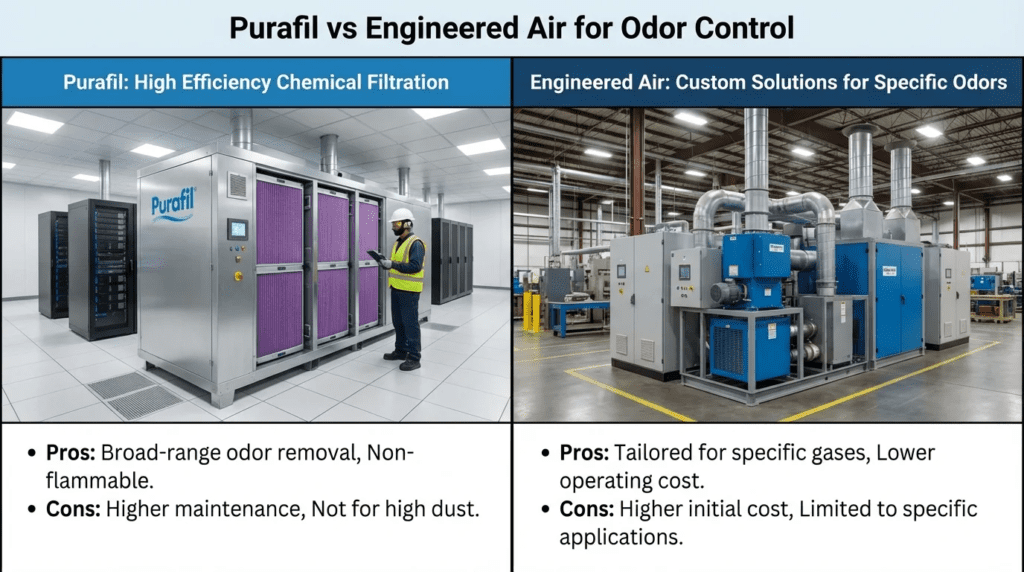
Purafil vs Engineered Air for Odor Control: Pros/Cons & Best-Fit Applications
Introduction
Odor control is rarely the most expensive process at a plant, but it is frequently the most politically volatile. A single failure in hydrogen sulfide (H2S) capture produces public complaints, regulatory attention and rapid corrosion of critical electrical assets. Yet the engineering challenge sits in a nuance most specifiers skip: the difference between proprietary media-based chemisorption systems and custom-fabricated air handling units running deep-bed carbon.
A clarification is needed before the Purafil vs Engineered Air for Odor Control: Pros/Cons & Best-Fit Applications comparison proceeds, because the two names sit in different industries. Purafil is a genuine odor control specialist — engineered chemisorption media and scrubber equipment for wastewater facilities, pump stations and corrosive-atmosphere electronics protection, now part of Parker Hannifin following its acquisition of Filtration Group. Engineered Air is a Canadian HVAC manufacturer producing air handling units, heating and ventilation equipment. It is not a wastewater odor control supplier, and specifiers will not find it on odor control bid lists.
What the pairing actually describes is a real and common engineering decision: purpose-built chemisorption scrubbers against custom air handling units adapted to carry deep-bed activated carbon. Both approaches appear on wastewater projects, and the second frequently arrives via the mechanical HVAC scope rather than the process scope. This article compares them on that basis, and names the actual odor control suppliers where relevant.
Proper specification matters. A deep-bed carbon unit in a high-humidity, variable-loading application risks bed fires or rapid saturation. A polished chemisorption unit on a massive airflow application at low concentration produces unjustifiable lifecycle costs. Broader supplier positioning is covered in our overview of the top OEMs for odor control systems.
How to Select and Specify Odor Control Technologies
Duty Conditions & Operating Envelope
The primary differentiator between the approaches is their response to contaminant concentration and airflow variability.
- Contaminant loading: Engineered chemisorption media is formulated to target specific chemical groups and excels where the airstream carries a mixture of odorants — H2S, mercaptans and organic sulfides — because the reaction permanently oxidizes the contaminant. Deep-bed carbon relies on physical adsorption. It handles H2S effectively, but standard carbon can desorb volatile organics if temperature rises or concentrations shift.
- Airflow against concentration: Custom air handling units suit high-volume, low-concentration applications such as general building ventilation, where low pressure drop is critical. Chemisorption units are typically modular and better suited to concentrated point sources such as a wet well headspace, where a higher pressure drop is acceptable to achieve high removal efficiency.
- Intermittent against continuous: Where the fan cycles, biological systems fail because the organisms die, but both dry media and carbon tolerate it. In high humidity, though, stagnant air in a carbon bed causes condensation and mudding of the bed, blinding the media.
Materials & Compatibility
- Vessel construction: Purpose-built odor control vessels typically use fiberglass reinforced plastic or 316L stainless. Custom air handling units are usually double-wall insulated metal panels. This is where the approaches diverge most dangerously: verify that the inner liner of an AHU handling raw H2S is coated with a high-build epoxy or equivalent barrier, because standard HVAC galvanizing corrodes within months in that service.
- Media chemistry: Chemisorption systems often use potassium permanganate impregnated on an alumina substrate. This is an oxidizer, and dust escaping the vessel is corrosive to metals. Carbon systems carry a different risk: the reaction can be exothermic, and high H2S concentrations reacting with carbon generate heat that has caused bed fires where monitoring was inadequate.
Hydraulics & Process Performance
- Empty bed residence time: This is the critical design parameter. Chemisorption media claims effective treatment at short residence times owing to rapid reaction kinetics. Deep-bed carbon typically requires longer contact, translating into physically larger vessels.
- Face velocity: To prevent media fluidization or dusting, face velocity is limited. Custom AHUs usually offer larger cross-sectional area, allowing lower face velocity and reduced pressure drop, which lowers fan horsepower over the life of the system.
Installation Environment & Constructability
- Footprint: Chemisorption units are often vertical vessels or canister-based side-stream units, minimizing horizontal footprint. Custom AHUs are typically horizontal, requiring significant floor space.
- Access: AHUs often feature walk-in plenums allowing operators to enter for inspection, which brings confined space protocols into play. Purpose-built scrubbers are usually designed for external service, where media is vacuumed out or canisters swapped, eliminating entry.
Reliability & Failure Modes
- Breakthrough: Activated carbon fails silently. Without real-time monitoring, the first indication is often an odor complaint. Chemisorption media typically changes color as it is consumed, providing a visual gauge of remaining life.
- Moisture tolerance: Very high relative humidity is fatal to standard activated carbon, filling the pores with water. Chemisorption media tolerates moisture better but is still compromised by liquid carryover. Mist eliminators are mandatory for both.
Lifecycle Cost Drivers
- Media cost: The primary operating driver. Standard activated carbon is a commodity and costs substantially less per pound than engineered chemisorption pellets, though chemisorption media often carries higher H2S capacity by weight.
- Disposal: Spent carbon may be classified as hazardous depending on what it adsorbed. Spent permanganate media is generally landfillable, though local regulations govern.
Comparison Tables
| Attribute | Chemisorption (Purafil and peers) | Custom AHU with carbon (Engineered Air and HVAC-derived units) |
|---|---|---|
| Removal mechanism | Chemical reaction. Contaminants are permanently oxidized into stable solids. | Physical adsorption. Contaminants are trapped in the pore structure, reversibly. |
| Target contaminants | Broad spectrum — H2S, sulfur oxides, chlorine, aldehydes. Strong on variable mixtures. | Effective on H2S and volatile organics. Less effective on low molecular weight compounds without impregnation. |
| Remaining life indicator | Visual: media changes color as efficacy depletes. | Testing required: samples must go to a lab for remaining life analysis. No visual cue. |
| Fire risk | Low. Media is non-flammable on an alumina substrate. | Moderate. High H2S loading on carbon generates heat; bed fires are a documented risk without controls. |
| Media cost | High. Engineered pellets are expensive but carry high capacity. | Lower. Carbon is a commodity; impregnated carbon costs more but remains cheaper. |
| Pressure drop | Moderate to high, requiring greater fan static pressure. | Low to moderate, as large bed areas allow lower velocity. |
| Supplier ecosystem | Dedicated odor control manufacturers with wastewater process experience | Frequently arrives through the HVAC scope; process knowledge must be verified separately |
| Application | Best Fit | Engineering Rationale |
|---|---|---|
| Wet well headspace, high H2S | Chemisorption | The reaction handles H2S spikes without desorption. The visual life indicator matters at remote stations with infrequent visits. |
| Large room ventilation, dewatering building | Custom AHU with carbon | High airflow volumes make engineered media cost-prohibitive. Deep-bed carbon is the economical route for dilute airstreams. |
| Electrical and control rooms | Chemisorption | Critical for removing corrosive gases to protect electronics against recognized severity level standards. Recirculation units are standard here, and carbon dust is conductive. |
| Variable industrial discharge | Hybrid | Multi-stage is often the answer: carbon for bulk organic removal, chemisorption for polishing. |
| Residential fence line | Chemisorption | Zero tolerance for breakthrough. Polishing capability keeps odors undetectable even as media nears exhaustion. |
Engineer & Operator Field Notes
Commissioning & Acceptance Testing
- Leak testing: Before loading media, smoke-test or pressure-test the vessel to confirm no air bypasses the bed. Air takes the path of least resistance, and a small percentage bypass produces full-strength odor complaints.
- Airflow balancing: Verify the fan curve. Chemisorption beds have higher packing density, so actual static pressure drop may exceed design estimates. Confirm the fan motor is not over-amping.
- Vibration analysis: For custom AHUs, take baseline vibration readings on the fan assembly. Large plenums act as resonance chambers if not properly stiffened.
When testing media life on carbon systems, do not sample only from the top of the bed. The mass transfer zone moves downward through the bed. Use a slotted probe to take samples at multiple depths for an accurate exhaustion profile.
Common Specification Mistakes
- Ignoring mist eliminators: Specifying a dry scrubber without a demister on the inlet is a critical error. Water droplets dissolve permanganate and block carbon pores.
- Undersized plenums: In custom AHUs, an abrupt transition from duct to filter face produces uneven velocity profiles. This causes tunneling, where the center of the bed exhausts quickly while corners go unused.
- Material mismatch: Aluminum impellers in H2S service corrode rapidly during fugitive emissions or downtime. Specify fiberglass or coated steel fans.
- Scope confusion: Where the odor control unit arrives through the mechanical HVAC scope rather than the process scope, corrosion-resistant construction and media performance guarantees are frequently omitted. Specify them explicitly regardless of which division carries the equipment.
O&M Burden & Strategy
- Chemisorption: The burden is media replacement. Media is heavy and is an oxidizer, so vacuum trucks are usually required. The visual indicator simplifies timing and reduces lab testing.
- Carbon: The burden is monitoring. Operators must log outlet H2S regularly, and sampling intervals must tighten as the bed ages, because breakthrough can occur abruptly once the wavefront passes.
- Grease and particulates: Both require pre-filters. Where the airstream carries grease from scum pits, pre-filters blind rapidly; washable metal mesh filters outperform disposable pleated filters in these locations.
Design Details and Calculations
Sizing Methodology
Dry scrubber sizing is governed by empty bed residence time — the time air takes to pass through the bed volume if the media were not present.
Formula: EBRT (seconds) = Bed Volume (ft³) / Airflow Rate (ft³/sec)
- Determine airflow: Based on air changes per hour for the space. Occupied spaces and wet wells carry different requirements, with NFPA 820 governing minimums in many areas.
- Determine loading: Estimate average and peak H2S concentration, not average alone.
- Select media capacity: Carbon capacity is expressed per unit volume; engineered chemisorption media capacity is usually expressed as a percentage of its own weight in captured gas.
- Calculate media volume: Polishing duty at low load requires only a short residence time; heavy continuous H2S removal requires substantially longer.
- Check velocity: Confirm airflow divided by bed surface area stays within the media manufacturer’s face velocity limit.
Specification Checklist
- Media life guarantee: Require the vendor to guarantee media life based on stated inlet conditions
- Sampling ports: Specify ports at inlet, mid-bed and outlet for gas detection testing
- Differential pressure gauges: Across pre-filter, media bed and post-filter
- Grounding: For carbon systems, grounding straps are mandatory due to static generation
Standards
- NFPA 820: Fire protection in wastewater treatment and collection facilities. Dictates ventilation rates, which drive unit size.
- ISA 71.04: Environmental conditions for process measurement and control systems. Critical for electronic control rooms.
- UL 94: Flammability ratings for media housing and fiberglass construction.
Frequently Asked Questions
Does Engineered Air make wastewater odor control equipment?
No. Engineered Air is a Canadian HVAC manufacturer producing air handling units and heating equipment. It does not supply odor control scrubbers for wastewater facilities. The comparison holds engineering value because custom air handling units — from Engineered Air and other HVAC manufacturers — are frequently adapted to carry deep-bed carbon on wastewater projects, usually arriving through the mechanical scope. Engineers evaluating dedicated odor control suppliers should be looking at Purafil, PureAir Filtration, Integrity Municipal Systems, CECO and similar specialists.
What is the difference between adsorption and chemisorption?
Adsorption, typical of activated carbon, is physical: gas molecules adhere to the surface of media pores. It is reversible, and heat can release the captured gas. Chemisorption involves a chemical reaction where the media converts the gas into a different, stable solid. Chemisorption is irreversible and generally preferred where desorption cannot be tolerated.
How do you calculate media lifespan?
Total capacity divided by loading rate. Carbon is cheaper per pound, but chemisorption media handles concentration spikes better without bleed-through. Vendors provide software-generated life reports; always demand a calculation based on both average and peak loading, since peak events determine when complaints occur.
Can the two approaches be combined?
Yes, and this is often the best fit for industrial wastewater. A dual-stage design uses deep-bed carbon to remove bulk organic load economically, followed by a chemisorption polishing stage targeting specific compounds and ensuring no breakthrough. This reserves the expensive media for the final polish.
Why does the choice affect fan static pressure?
Chemisorption media is typically spherical pellets packed tightly, creating higher resistance to airflow, and canister modules add further restriction. Custom AHUs with deep carbon beds can be built with larger face areas, reducing velocity and pressure drop. When retrofitting, you cannot swap one for the other without evaluating the existing fan against the new system curve.
How often should media be tested?
For critical municipal applications, remaining life analysis every six months, or whenever pressure drop increases significantly. Chemisorption media can be inspected visually monthly for color change. Carbon systems warrant quarterly outlet H2S logging to detect breakthrough before complaints occur.
What are the fire risks?
Standard activated carbon can support combustion and self-heat when adsorbing high concentrations of volatile organics or H2S. Chemisorption media on an alumina substrate is generally non-flammable. In hazardous zones, ensure vessel and media selection align with NFPA 820 requirements.
Conclusion
KEY TAKEAWAYS
- Know the suppliers: Purafil is an odor control specialist; Engineered Air is an HVAC manufacturer. The real comparison is chemisorption against carbon in custom air handling units.
- Flow against concentration: Custom AHU with carbon for high flow and low concentration; chemisorption for low flow, high concentration or mixed odorants.
- Media visibility: Chemisorption media changes color, giving instant status. Carbon requires lab testing or outlet monitoring.
- Moisture control: Both fail with liquid water, but very high humidity specifically blinds activated carbon.
- Electronics protection: Use chemisorption for server rooms and motor control centers where corrosive gas severity standards apply.
The decision is not about finding a superior manufacturer but about matching the physics of filtration to the plant environment — and about making sure the equipment comes from a supplier that understands wastewater service. For general ventilation of large spaces where high volumes of dilute odorous air must be treated, custom air handling units with deep-bed carbon offer the most economical lifecycle solution.
For wet well headspaces, lift stations and protection of critical electrical infrastructure, the reliability, irreversibility and visual maintenance indicators of chemisorption systems provide better assurance. Chemical-based approaches are covered separately in our review of the top wastewater odor control chemicals.