
Evoqua vs WesTech for Other Process: Pros/Cons & Best-Fit Applications
INTRODUCTION
One of the most persistent challenges in municipal and industrial treatment plant design is the “Proprietary vs. Custom” dilemma. Engineers frequently encounter this when selecting equipment for specialized unit processes—such as high-rate clarification, tertiary filtration, or anaerobic digestion auxiliaries. A surprising statistic from lifecycle audits reveals that while proprietary high-rate systems can reduce civil footprint costs by 30-50%, they can simultaneously increase long-term O&M costs by 20% due to sole-sourced replacement parts and specialized media requirements. Conversely, robust custom-fabricated mechanical systems often carry higher initial installation costs but offer significantly lower 20-year ownership costs.
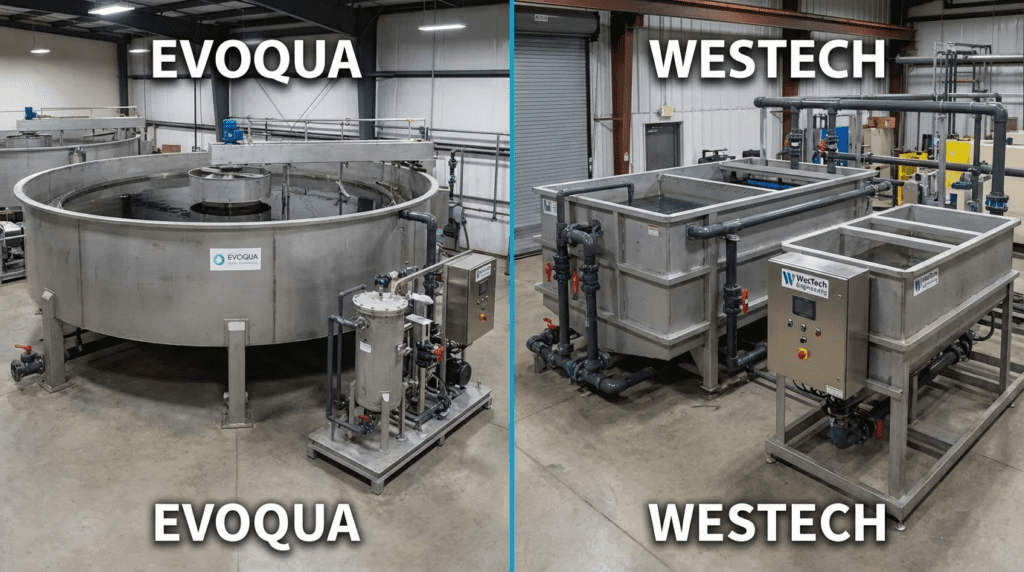
This article provides a detailed engineering analysis of Evoqua vs WesTech for Other Process: Pros/Cons & Best-Fit Applications. While both manufacturers are titans in the industry (with Evoqua now part of Xylem), they represent fundamentally different engineering philosophies. Evoqua historically excels in proprietary, technology-driven process solutions (e.g., ballasted clarification, membrane systems), whereas WesTech built its reputation on heavy-duty, custom-engineered mechanical fabrication (e.g., solids contact clarifiers, digestor covers).
These technologies are typically applied in tertiary treatment for nutrient removal, industrial process water polishing, and sludge handling. Proper specification is critical; selecting the wrong equipment class can lead to hydraulic bottlenecks, inability to meet emerging discharge permits, or unsustainable maintenance burdens for plant staff. This guide assists consulting engineers and utility decision-makers in navigating the nuances of Evoqua vs WesTech for Other Process: Pros/Cons & Best-Fit Applications to ensure the selected equipment aligns with the facility’s hydraulic profile, operator capability, and lifecycle budget.
HOW TO SELECT / SPECIFY
When evaluating Evoqua vs WesTech for Other Process: Pros/Cons & Best-Fit Applications, the decision rarely comes down to “good vs. bad.” Instead, it is a matter of aligning the equipment’s engineering characteristics with the specific constraints of the project. The following criteria should guide the specification process.
Duty Conditions & Operating Envelope
The first step in differentiation is analyzing the hydraulic and solids loading regimes. Evoqua’s high-rate technologies (such as CoMag or BioMag) are often selected when duty conditions require handling massive flow spikes in limited footprints. These systems can typically handle surface overflow rates (SOR) significantly higher than conventional designs.
Conversely, WesTech’s strength lies in applications with heavy, variable solids loads where mechanical torque is the limiting factor. For “other processes” like lime softening or solids contact clarification, the operating envelope is defined by the torque rating of the drive unit. Engineers must specify the AGMA (American Gear Manufacturers Association) service factor explicitly. WesTech equipment is frequently specified where continuous, heavy-sludge scraping is required without the sensitivity to chemical dosing upsets that might affect a ballasted system.
Materials & Compatibility
Material selection drives the longevity of the asset. In the context of Evoqua vs WesTech for Other Process: Pros/Cons & Best-Fit Applications, the philosophy differs:
- WesTech: Often favors heavy-gauge carbon steel with high-performance immersion-grade coatings (epoxy systems). They are highly amenable to customizing steel thickness (e.g., specifying 3/8″ plate where 1/4″ is standard) to add corrosion allowance.
- Evoqua: In their filtration and high-rate product lines, there is a heavy reliance on stainless steel wetted parts and proprietary polymers for lamella plates or filter media. Engineers must verify chemical compatibility not just with the steel, but with the proprietary internal components (seals, media, membranes).
Hydraulics & Process Performance
Process performance guarantees differ between the two approaches. High-rate proprietary systems (common with Evoqua) rely on tight hydraulic profiles. The headloss across a disk filter or a ballasted flocculation system must be calculated precisely, as these systems have less hydraulic buffering capacity than a large concrete basin.
Pro Tip: When retrofitting, pay close attention to the hydraulic grade line. Evoqua’s filtration systems often require specific influent head conditions that may necessitate intermediate pumping, whereas WesTech’s conventional gravity designs might fit within the existing hydraulic profile but require more civil work.
Installation Environment & Constructability
Space constraints are often the tie-breaker. Evoqua’s packaged solutions are designed for “drop-in” installation. This is ideal for industrial retrofits or municipal plants land-locked by residential development. The trade-off is often modularity; expanding capacity requires adding entire new units.
WesTech designs are typically erected on-site or integrated into large concrete civil works. This offers superior constructability for new greenfield plants where the equipment can be built around. However, for tight retrofit applications, the requirement for large cranes and field welding can be a significant logistical hurdle.
Reliability, Redundancy & Failure Modes
Reliability analysis must look at the “weakest link.”
- Proprietary Systems (Evoqua): Failure modes often involve instrumentation (turbidity meters, level sensors) or specialized components (media loss, membrane fouling). Redundancy is usually achieved by installing an N+1 unit.
- Mechanical Systems (WesTech): Failure modes are typically mechanical (gearbox wear, shear pin fatigue, bearing failure). These components have predictable wear curves (MTBF), allowing for planned maintenance. However, a catastrophic drive failure on a singular large mechanism can take a major process train offline for weeks.
Controls & Automation Interfaces
Evoqua systems typically come with a dedicated local control panel (LCP) containing proprietary logic. This “black box” approach ensures process guarantees but can be frustrating for SCADA integrators trying to extract specific data points. The specification must explicitly state which tags are available via Modbus/Ethernet IP.
WesTech equipment is often supplied with standard motor starters or VFDs that can be easily integrated into the plant’s main PLC. This “open architecture” is preferred by municipalities that want to standardize control logic across the plant.
Maintainability, Safety & Access
Operator access is critical. Advanced filtration systems (Evoqua) often require platform access for changing media or cleaning spray headers. Engineers must review 3D models to ensure adequate clearance for pulling filter cartridges or membranes.
For WesTech’s large mechanical clarifiers or thickeners, maintenance focuses on the center drive access bridge. Safety specifications must include proper handrails, toe boards, and non-slip grating, particularly for winter climates where bridges ice over. Lubrication points should be piped to the bridge deck to avoid requiring operators to access the mechanism directly.
Lifecycle Cost Drivers
A Total Cost of Ownership (TCO) analysis is essential for comparing Evoqua vs WesTech for Other Process: Pros/Cons & Best-Fit Applications.
- CAPEX: Evoqua often has higher equipment cost but lower civil cost. WesTech has lower equipment cost (typically) but higher civil/installation cost.
- OPEX: Evoqua systems may have higher energy density (pumping/mixing for high-rate) and recurring costs for proprietary media replacement. WesTech systems generally have low energy consumption (low horsepower drives) but require periodic sandblasting and recoating of steel structures every 15-20 years.
COMPARISON TABLES
The following tables provide a direct comparison to assist engineers in selecting between these two major OEMs for specific “Other Process” applications. Table 1 focuses on technology differentiation, while Table 2 assists with application fit.
| Feature / Attribute | Evoqua (Xylem) High-Rate/Proprietary Focus | WesTech Engineering Custom/Mechanical Focus |
|---|---|---|
| Primary Engineering Philosophy | Process-intensive, high-rate technologies utilizing ballast, membranes, or specialized media to reduce footprint. | Mechanically robust, custom steel fabrication utilizing gravity, settling, and torque. Heavy duty cycle focus. |
| Key “Other Process” Technologies | BioMag/CoMag (Ballasted Clarification), Forty-X (Disk Filters), Memcor (Membranes), JetMix (Digester Mixing). | Solids Contact Clarifiers, SuperDisc (Disk Filters), DuoSphere (Digester Covers), CleanFlo (Shear Flocculation). |
| Civil Footprint Impact | Low: Can often treat equal flow in 20-30% of the footprint of conventional systems. | Moderate/High: Generally requires standard hydraulic retention times, leading to larger basins. |
| Proprietary Lock-in Risk | High: Specialized parts (media, nozzles, proprietary operational code) often sole-sourced. | Low: Bearings, motors, and gearboxes are often standard industrial components (Dodge, SEW, etc.). |
| Energy Intensity | Medium/High: Process performance often requires auxiliary pumping, recycle loops, or air scour. | Low: Slow-moving mechanical drives use minimal horsepower. |
| Maintenance Profile | Instrument heavy; requires calibration, media replacement, and chemical cleaning cycles. | Mechanical heavy; requires lubrication, torque monitoring, and periodic structural coating. |
| Application Scenario | Preferred Approach | Engineering Rationale |
|---|---|---|
| Greenfield Plant (Ample Land) | WesTech (Conventional) | Lower lifecycle energy costs and simpler O&M favor large concrete basins with robust mechanical drives. |
| Urban Retrofit (Space Limited) | Evoqua (High-Rate) | The value of land and the cost of new concrete often outweigh the higher OPEX of ballasted/membrane systems. |
| High Solids/Variable Load | WesTech (High Torque) | Massive torque ratings and robust rake arms handle process upsets better than sensitive high-rate lamella systems. |
| Tertiary Phosphorus Removal (<0.1 mg/L) | Evoqua (CoMag/Filtration) | Chemical ballasted flocculation coupled with tertiary filtration provides superior particle capture for strict limits. |
| Operator Skill: Limited/Generalist | WesTech | Visual observation of torque and sludge blankets is more intuitive than managing automated process algorithms. |
| Industrial Process Water | Depends on Contaminant | Evoqua for specific removal (e.g., heavy metals via precipitation/filtration); WesTech for bulk solids removal. |
ENGINEER & OPERATOR FIELD NOTES
Real-world experience often diverges from the sales brochure. The following sections detail practical insights for specifying and operating these systems, specifically focusing on the Evoqua vs WesTech for Other Process: Pros/Cons & Best-Fit Applications dynamic.
Commissioning & Acceptance Testing
Commissioning is the first test of the specification. For WesTech mechanical equipment, the primary focus during the Site Acceptance Test (SAT) is the torque test. Engineers should require a simulated load test where the rake arms are physically obstructed or weighted to verify the drive unit trips at the specified torque rating (typically 100% alarm, 120% cutoff). Failure to verify this can lead to structural damage during the first major sludge event.
For Evoqua high-rate systems, commissioning revolves around performance stress testing. The Factory Acceptance Test (FAT) of the control panel is crucial. Simulate sensor failures (e.g., loss of turbidity signal) to ensure the system defaults to a safe state rather than washing out solids. During SAT, process guarantees for effluent quality must be verified at peak hydraulic flow, not just average flow.
Common Specification Mistakes
One of the most frequent errors is the misuse of “Or Equal” clauses. Specifying a WesTech Solids Contact Clarifier but allowing a generic “clarifier” as an equal can result in a contractor supplying a lightweight suction header system that cannot handle the sludge inventory.
Similarly, when specifying Evoqua disk filters, engineers often fail to specify the backwash logic. Some systems backwash based on time, others on differential pressure, and others on fluid level. Leaving this open allows vendors to supply the cheapest control strategy, which may result in excessive backwash water return, hydraulically overloading the headworks.
O&M Burden & Strategy
Operational strategies differ significantly:
- WesTech (Mechanical): The O&M burden is low-frequency but high-effort. Examples include changing gearbox oil (annually) and inspecting underwater bearings (every 5-10 years). Proactive vibration monitoring on the drive motor is highly recommended to predict bearing failures.
- Evoqua (Process): The O&M burden is high-frequency but lower physical effort. Operators must frequently clean sensors, replenish ballast (magnetite or microsand), and monitor chemical feed rates. The strategy relies on maintaining inventory of proprietary consumables (seals, cloth media).
Troubleshooting Guide
Symptom: High Torque Alarm (WesTech type units)
Root Cause: Often excessive sludge blanket depth or a foreign object (rag ball, tool) in the tank.
Response: Do not simply reset the alarm. Verify blanket level. If blanket is low but torque is high, check for mechanical binding or lower bearing failure.
Symptom: High Effluent Turbidity (Evoqua type units)
Root Cause: Loss of ballast, chemical feed pump failure, or hydraulic surge.
Response: Check coagulant/polymer dosing immediately. In ballasted systems, verify the hydrocyclone is effectively recovering the ballast and not sending it to waste.
DESIGN DETAILS / CALCULATIONS
Engineering appropriate solutions requires moving beyond catalog selection to fundamental sizing logic.
Sizing Logic & Methodology
Surface Overflow Rate (SOR):
The critical sizing parameter.
- Conventional Solids Contact (WesTech): Typical SOR is 0.5 – 1.0 gpm/ft².
- Ballasted Flocculation (Evoqua BioMag/CoMag): Typical SOR can range from 4.0 – 10.0+ gpm/ft².
Calculation Note: When comparing, remember that the “footprint” savings of the high-rate system must be balanced against the volume required for auxiliary tanks (mix tanks, injection tanks, recovery drums). Do not calculate SOR based solely on the settling tank area; consider the total process envelope.
Specification Checklist
To ensure a fair comparison and robust installation, specifications must include:
- Drive Calculation: Require AGMA 20-year durability rating for all gearboxes. Specify a minimum service factor of 1.25 or 1.5 for heavy duty applications.
- Coating Systems: For steel tanks/mechanisms, specify SSPC-SP10 (Near-White Metal Blast) surface preparation and a high-solids epoxy system.
- Materials: Explicitly state 304L or 316L stainless steel for wetted parts in filtration units. For carbon steel, specify minimum thickness (e.g., 1/4″ minimum) regardless of structural stress requirements to provide corrosion allowance.
- Anchor Bolts: Always require 316SS anchor bolts. Galvanized anchors eventually corrode at the concrete interface, making replacement nearly impossible without major demolition.
Standards & Compliance
Referencing the correct standards is mandatory for liability protection:
- ANSI/AWWA D100: For welded carbon steel tanks for water storage (applicable to clarifier basins).
- AGMA 6013/6010: Standard for Enclosed Epicyclic Gear Units (crucial for clarifier drives).
- NFPA 820: Standard for Fire Protection in Wastewater Treatment and Collection Facilities (critical for digestion equipment and enclosed headworks).
FREQUENTLY ASKED QUESTIONS
What is the primary difference between Evoqua and WesTech equipment philosophies?
The primary difference lies in the engineering focus. Evoqua (now Xylem) focuses on high-rate, technology-driven process solutions (like ballasted settling and membranes) that minimize footprint and maximize throughput using proprietary designs. WesTech focuses on custom, heavy-duty mechanical fabrication (like conventional clarifiers and digester covers) that prioritizes longevity, mechanical robustness, and simplicity. When evaluating Evoqua vs WesTech for Other Process: Pros/Cons & Best-Fit Applications, you are effectively choosing between process intensity and mechanical endurance.
How do maintenance costs compare between high-rate and conventional systems?
High-rate systems (Evoqua) generally have higher OPEX due to energy costs (pumps/mixers), chemical consumption (polymer/coagulant), and proprietary part replacement (media/membranes). Conventional mechanical systems (WesTech) have lower annual OPEX but require significant periodic maintenance (sandblasting/coating every 15-20 years) and have higher initial civil costs due to larger concrete basins.
Can WesTech equipment be retrofitted into Evoqua basins?
Typically, no. Evoqua’s high-rate systems are much smaller than WesTech’s conventional designs. A basin sized for a CoMag system (high SOR) would be vastly undersized for a conventional WesTech gravity clarifier. However, the reverse is possible: an Evoqua system can often be retrofitted into an existing, larger WesTech basin to significantly increase plant capacity without building new concrete structures.
What is the typical lifespan of a disk filter cloth media?
For both Evoqua and WesTech disk filters, the typical lifespan of the cloth media is 3 to 7 years, depending heavily on the influent water quality, presence of abrasive solids, and frequency of backwashing. Premature failure often occurs due to over-pressurization or chemical attack from incompatible coagulants. See the [[Materials & Compatibility]] section for more details.
Why is torque rating critical for selecting clarification equipment?
Torque rating defines the machine’s ability to move sludge. In wastewater applications, sludge density can vary unpredictably. Under-specifying torque (a common cost-cutting measure) results in the mechanism tripping off-line during high-loading events—exactly when the plant needs it most. WesTech is known for accommodating high-torque specifications, which is critical for primary sludge and thickener applications.
Does Evoqua or WesTech offer better support for legacy equipment?
Both companies have extensive files on legacy installations. WesTech is often praised for its ability to fabricate drop-in replacement parts for defunct brands (like Eimco, Dorr-Oliver, etc.) because they possess many of the original drawings or have reverse-engineering capabilities. Evoqua maintains support for its acquired brands (Envirex, USFilter, etc.), but proprietary parts for older high-tech systems can sometimes face obsolescence issues necessitating upgrades.
CONCLUSION
KEY TAKEAWAYS
- Footprint vs. Longevity: Choose Evoqua/High-Rate when space is premium or expansion is physically constrained. Choose WesTech/Conventional when land is available and long-term mechanical simplicity is prioritized.
- Proprietary Risks: Be aware that high-rate systems often lock utilities into single-source supply chains for media and specialized parts.
- Mechanical Specs: For mechanical units, the AGMA torque rating and coating specification are the two most critical drivers of asset life.
- Operational Reality: High-rate systems require “process” operators (monitoring trends/chemistry); Mechanical systems require “maintenance” operators (lubrication/repairs).
- Cost Structure: Evoqua shifts cost to OPEX (chemicals/energy); WesTech shifts cost to Initial Civil CAPEX.
In the final analysis of Evoqua vs WesTech for Other Process: Pros/Cons & Best-Fit Applications, the “best” choice is entirely dependent on the specific constraints of the facility. There is no universal winner. For a space-constrained urban plant facing strict phosphorus limits, an Evoqua CoMag or disk filter system offers a solution that a conventional design simply cannot provide. Conversely, for a rural plant with ample acreage and a limited maintenance staff, a robust WesTech solids contact clarifier provides a forgiving, 50-year asset that is immune to delicate process upsets.
Engineers must resist the temptation to copy-paste specifications from previous projects. A rigorous evaluation of the hydraulic profile, solids loading variability, and the utility’s ability to maintain proprietary technology is essential. By focusing on the duty conditions and lifecycle implications detailed in this guide, decision-makers can ensure they select the technology that offers the best long-term value for their specific application.