
Pulsco vs Hallsten for Tanks & Covers: Pros/Cons & Best-Fit Applications
1) INTRODUCTION
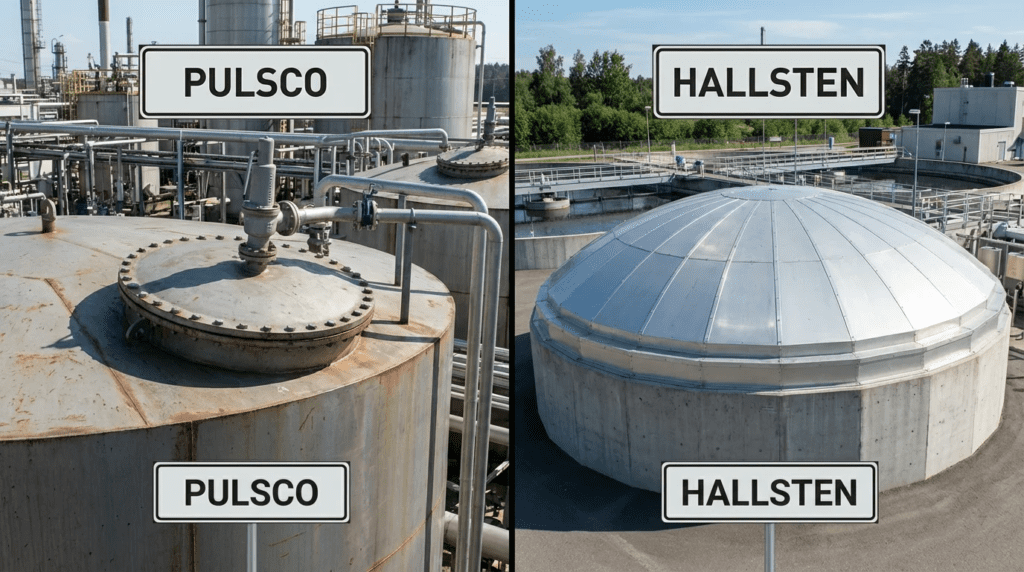
In the design of municipal water and wastewater infrastructure, the management of fluid dynamics and headspace containment represents a critical intersection of hydraulics, structural engineering, and environmental control. One of the most frequent trade-off analyses engineers face—particularly in surge control and storage applications—involves choosing between active pressurized containment and passive atmospheric covering. This debate often crystalizes into a comparison of Pulsco vs Hallsten for Tanks & Covers: Pros/Cons & Best-Fit Applications.
The “common problem” here is not just brand selection, but a fundamental choice in engineering philosophy. Engineers are frequently tasked with mitigating hydraulic transients (water hammer) or managing odors in equalization basins. The industry standard approaches often diverge: do you employ a high-pressure, bladder-style surge vessel (exemplified by Pulsco) or construct an open atmospheric tank secured by a structural aluminum cover (exemplified by Hallsten)?
Failure to correctly evaluate these methodologies leads to significant operational consequences. A specification mistake here can result in catastrophic pipe bursts due to unmitigated surge, or conversely, massive corrosion issues and odor complaints from improperly contained atmospheric headspaces. In wastewater applications specifically, the lifecycle cost variance between a lined steel pressure vessel and an aluminum-covered concrete tank can exceed 30% over a 20-year period, driven largely by maintenance and coating requirements.
This article provides a rigorous, engineer-to-engineer analysis of these two distinct approaches. We will explore the structural mechanics, hydraulic capabilities, and long-term maintenance realities of using Pulsco-style pressure vessels versus Hallsten-style structural covers. By dissecting the pros, cons, and best-fit applications, we aim to equip consulting engineers and utility directors with the data necessary to defend their design decisions during value engineering (VE) exercises.
2) HOW TO SELECT / SPECIFY
Selecting between a pressurized vessel solution and a structural cover solution requires a multi-disciplinary approach. When evaluating Pulsco vs Hallsten for Tanks & Covers: Pros/Cons & Best-Fit Applications, the decision matrix must prioritize hydraulic necessity first, followed by environmental constraints and constructability.
Duty Conditions & Operating Envelope
The primary differentiator is the hydraulic pressure regime. Engineers must define the system’s transient profile before selecting equipment.
- Transient Analysis: If the hydraulic modeling (using software like KYPipe or AFT Impulse) indicates rapid, high-magnitude pressure waves (water hammer) that require immediate damping, a pressurized bladder tank (Pulsco) is generally the requisite solution. These vessels operate under ASME pressure codes and provide active energy dissipation.
- Atmospheric Storage: If the application is for flow equalization, slow-fill storage, or chlorine contact, the pressure is hydrostatic/gravity-based. In these scenarios, an open concrete or steel tank fitted with a Hallsten aluminum cover is the standard. The cover defines the operating envelope by containing odors and preventing algae growth, but it does not contribute to pressure retention.
- Capacity Fluctuations: Variable volume applications favor open tanks with covers. A Hallsten cover on a rectangular basin accommodates massive volume changes without the need for air compressors or bladder management, whereas a Pulsco vessel has a fixed total volume with a specific acceptance ratio.
Materials & Compatibility
Material science plays a pivotal role in the longevity of these assets, particularly in wastewater environments rich in Hydrogen Sulfide (H2S).
- Corrosion Resistance (Hallsten): Hallsten covers are typically fabricated from 6061-T6 marine-grade aluminum. This material forms a passive oxide layer that is highly resistant to the moist, corrosive headspace of wastewater tanks. It requires no painting or coating, making it ideal for aggressive environments where steel would fail.
- Corrosion Resistance (Pulsco): Pulsco vessels are typically Carbon Steel or Stainless Steel. In wastewater applications, carbon steel requires robust interior linings (epoxy, glass-lined) to prevent corrosion. The “Achilles heel” is often the interface between the bladder and the shell, where lining defects can lead to rapid pitting.
- UV and Temperature: Aluminum covers reflect solar radiation, reducing thermal gain in the fluid. Steel pressure vessels absorb heat unless insulated, which can affect biological processes or bladder elasticity.
Hydraulics & Process Performance
The choice heavily impacts the hydraulic profile of the plant.
- Energy Dissipation: Pulsco vessels utilize internal diffusers and pre-charged air/gas bladders to absorb kinetic energy. The performance is defined by the polytropic expansion of gas.
- Gas Phase Management: Hallsten covers create a confined headspace. Engineers must calculate the air exchange rate to size odor control scrubbers. The cover must be tight enough to prevent fugitive emissions but allow for air intake during rapid tank draining to prevent vacuum damage (panel implosion).
Installation Environment & Constructability
Space Constraints:
Pulsco vessels are vertical or horizontal cylinders with a relatively small footprint compared to the volume they protect, but they are heavy and require substantial foundations and crane access for single-piece installation.
Hallsten covers are modular. They are ideal for retrofitting existing large basins where site access is limited. The components can be hand-carried or lifted in small bundles, allowing for installation in tight urban footprints or inside existing buildings.
Structural Interfaces:
Specifying a cover requires detailed analysis of the tank walls (concrete or steel). The cover imparts dead loads, snow loads, and wind uplift forces to the tank rim. A pressure vessel is self-contained, transferring load only to its foundation pad.
Reliability, Redundancy & Failure Modes
The failure modes of these two technologies are distinct:
- Bladder Failure (Pulsco): The primary failure mode is bladder rupture. When this occurs, the vessel loses its surge dampening capability, potentially exposing the pipeline to immediate risk. Redundancy (N+1 vessels) is often required for critical force mains.
- Seal/Structural Failure (Hallsten): Aluminum covers rarely experience catastrophic structural failure if designed to local building codes (snow/wind). The common failure mode is seal degradation, leading to odor escape. This is a nuisance failure, not a catastrophic process failure.
Maintainability, Safety & Access
Access Requirements:
Hallsten covers are frequently designed as “walking surfaces.” Engineers must specify the live load (e.g., 50 psf or 100 psf) to allow operators to walk freely over the tank for sampling and mixer maintenance.
Pulsco vessels are confined spaces. Maintenance requires Lockout/Tagout (LOTO), draining the vessel, and permit-required confined space entry to inspect the bladder or lining.
Lifecycle Cost Drivers
When analyzing Pulsco vs Hallsten for Tanks & Covers: Pros/Cons & Best-Fit Applications financially:
- CAPEX: Concrete tanks with aluminum covers generally have a higher initial construction cost for small volumes compared to a prefabricated steel vessel. However, for large volumes (>100,000 gallons), concrete/aluminum becomes cheaper per gallon.
- OPEX: Pulsco systems require periodic bladder replacement (every 5-10 years) and compressor maintenance if active. Hallsten covers have near-zero OPEX, requiring only occasional seal inspection and cleaning.
3) COMPARISON TABLES
The following tables provide a direct comparison to assist engineers in the selection process. Table 1 focuses on the technological differences between the pressurized and atmospheric approaches. Table 2 provides an application fit matrix to quickly identify the preferred solution based on project constraints.
Table 1: Technology Comparison – Pressurized Vessel vs. Structural Cover
| Feature/Attribute | Pulsco-Style Systems (Pressurized Surge/Bladder Tanks) | Hallsten-Style Systems (Structural Aluminum Covers) |
|---|---|---|
| Primary Function | Active Hydraulic Transient Control (Surge/Water Hammer Protection) | Passive Containment (Odor Control, Algae Block, Debris Protection) |
| Operating Pressure | High Pressure (ASME Rated, often 100+ PSI) | Atmospheric (Gravity flow or slight negative pressure for odor piping) |
| Material of Construction | Epoxy-lined Carbon Steel or Stainless Steel | Marine Grade Aluminum (6061-T6) with 316SS hardware |
| Corrosion Strategy | Barrier coatings (linings) and cathodic protection | Inherent material resistance (Aluminum Oxide layer) |
| Maintenance Profile | Moderate/High: Bladder checks, pre-charge monitoring, lining inspection, compressor maintenance. | Low: Visual inspection of gaskets/seals. Occasional cleaning. No painting required. |
| Operator Access | Confined Space Entry required for internals. External gauges only. | Walkable deck surface available. Hatches for sampling/mixer access. |
| Typical Lifespan | Vessel: 20-30 years (with relining) Bladder: 5-10 years |
Cover Structure: 50+ years Gaskets/Seals: 15-20 years |
Table 2: Application Fit Matrix
| Application Scenario | Best Fit Technology | Key Engineering Decision Drivers |
|---|---|---|
| Raw Sewage Surge Control | Pulsco (Bladder Tank) | Separation of air/liquid prevents solids buildup and odor release. Immediate response to pump trips. |
| Large Flow Equalization (EQ) | Hallsten (Covered Basin) | Volume too large for pressure vessels. Need for walkable access to maintain mixers/aerators. |
| Potable Water Clearwell | Hallsten (Covered Basin) | Protection from airborne contaminants/birds. Aluminum is NSF 61 compatible. |
| High-Head Force Main Protection | Pulsco (Bladder Tank) | System pressures exceed structural capabilities of open tanks. Compressible gas volume required. |
| Sludge Thickening/Storage | Hallsten (Covered Tank) | Extreme odor containment required (H2S). Aluminum withstands corrosive headspace better than coated steel. |
| Retrofit of Existing Clarifier | Hallsten (Flat/Dome Cover) | Lightweight aluminum minimizes load on existing walls. Modular construction allows install in tight sites. |
4) ENGINEER & OPERATOR FIELD NOTES
Beyond the catalog specifications, real-world experience dictates the success of these installations. The following notes are compiled from commissioning reports and long-term operational feedback regarding Pulsco vs Hallsten for Tanks & Covers: Pros/Cons & Best-Fit Applications.
Commissioning & Acceptance Testing
For Pulsco Systems:
The critical path during commissioning is the Bladder Integrity Test. Before the vessel is filled with liquid, the bladder must be pre-charged with air/nitrogen. The pressure must hold for 24 hours (accounting for thermal changes) to ensure no leaks exist. Additionally, verify the Level Instrumentation. The differential pressure transmitters or load cells used to monitor bladder volume must be calibrated empty and full. A common SAT (Site Acceptance Test) failure is incorrect pre-charge pressure, rendering the surge tank ineffective during the first pump trip.
For Hallsten Systems:
Acceptance testing revolves around Seal Tightness and Deflection. A “smoke test” is often performed where the headspace is pressurized slightly with smoke to identify leaks in the panel joints or perimeter wiper seals. Structurally, engineers should verify deflection under load. If the design specifies a live load, walking on the cover should not produce audible creaking or visible bowing beyond L/240 or L/360 limits. Check the Electrical Isolation—aluminum covers on concrete tanks must be isolated from dissimilar metals (like steel piping) or properly grounded to prevent galvanic corrosion.
When installing an aluminum cover (Hallsten) on a steel tank, or connecting stainless piping to a carbon steel surge tank (Pulsco), strictly enforce dielectric isolation. Failure to use isolation kits is the #1 cause of premature flange and rim corrosion in the field.
Common Specification Mistakes
Over-Specifying Live Loads (Hallsten):
Engineers often default to “100 psf live load” for covers out of habit. However, if the tank only requires occasional inspection access, 50 psf is sufficient and significantly reduces the weight and cost of the aluminum beams. Only specify 100 psf if heavy equipment placement is anticipated.
Ignoring Bladder Material Compatibility (Pulsco):
Specifying a standard Butyl rubber bladder for wastewater with high hydrocarbon or grease content can lead to swelling and failure. For industrial wastewater or specialized chemical applications, ensure the bladder elastomer (e.g., Buna-N, EPDM) is chemically compatible with the specific fluid matrix.
O&M Burden & Strategy
Pulsco Maintenance Strategy:
Develop a Predictive Maintenance (PdM) program for the bladder. Monitoring the cycle frequency of the air compressor (if applicable) or the static pre-charge pressure can predict bladder failure. A sudden drop in pre-charge pressure usually indicates a pinhole leak. Keep a spare bladder on the shelf; lead times can be 12-16 weeks.
Hallsten Maintenance Strategy:
The burden is low, but not zero. The perimeter seals (wipers) eventually dry rot or wear out from tank wall abrasion. Schedule replacement every 10-15 years. Inspect the hatch latches annually—stainless steel hardware can gall if not lubricated, leading to seized hatches that operators cannot open.
Troubleshooting Guide
- Symptom: Slamming noises in pipes (Water Hammer).
- Pulsco Check: Has the bladder lost its air charge? Is the isolation valve accidentally closed? Is the connection pipe clogged with solids?
- Hallsten Context: This indicates a need for a surge solution, not a cover issue. However, if the cover is “jumping,” the tank venting is severely undersized.
- Symptom: Strong Odors around the Tank.
- Pulsco Check: Check the air release valve. If the bladder is compromised, sewage may be entering the air side and venting to the atmosphere.
- Hallsten Check: Inspect perimeter seals. Check that the negative pressure setpoint on the odor control fan is sufficient to maintain a slight vacuum (-0.1 to -0.2 inches W.C.) under all fill conditions.
5) DESIGN DETAILS / CALCULATIONS
Proper integration of these systems requires specific engineering calculations. The physics governing a pressurized bladder tank differ entirely from the statics of a flat cover.
Sizing Logic & Methodology
Pulsco (Surge Vessel) Sizing
Sizing is based on the Ideal Gas Law (PV = nRT), modified for polytropic expansion/compression. The key parameters are:
- Static Pressure: The normal operating pressure at the tank location.
- Pump Trip Vacuum: The minimum pressure experienced during the down-surge.
- Max Surge Pressure: The maximum allowable pressure during the up-surge.
- Polytropic Index (n): Typically 1.2 for fast transients.
The required gas volume ($V_{gas}$) is calculated to ensure the liquid volume change ($Delta V$) needed to decelerate or accelerate the column of water can be accommodated without violating the min/max pressure limits.
Hallsten (Cover) Structural Sizing
Sizing follows Aluminum Association Design Manual and local building codes (IBC/ASCE 7). Key inputs:
- Span: Clear distance between tank walls.
- Snow Load: Local ground snow load.
- Wind Uplift: Critical for large flat surface areas.
- Deflection Criteria: Typically L/240 for total load or L/360 for live load.
For spans greater than 30 feet, trusses or extruded beams with high moments of inertia are required. Engineers must calculate the reaction forces at the tank rim to ensure the concrete wall can support the point loads from the cover beams.
Specification Checklist
When writing the spec section (e.g., CSI Division 13 or 43), ensure these items are included:
- Pulsco Spec: ASME Section VIII Div 1 stamp (U-stamp), National Board registration, Bladder cycle life guarantee (>100,000 cycles), Coating holiday testing requirements.
- Hallsten Spec: Alloy 6061-T6 for structural members, 5052-H32 for sheet, Stainless Steel 316 hardware, Non-skid surface treatment for walkways, Warranty on seal performance.
Standards & Compliance
AWWA D100 vs. D120: While AWWA D100 covers steel tanks, AWWA D120 applies to Thermosetting Fiberglass. Aluminum covers occupy a niche covered by the Aluminum Association standards. Ensure structural calculations are stamped by a PE licensed in the project state.
OSHA: Covers must meet OSHA requirements for guardrails (if used as a deck) and fall protection. Pressure vessels must have relief valves sized per ASME to prevent explosion over-pressure.
6) FAQ SECTION
What is the main difference between Pulsco and Hallsten in water applications?
The main difference lies in their function and pressure handling. Pulsco specializes in active hydraulic control using pressurized vessels (bladder tanks) to manage surges and transients in pipelines. Hallsten specializes in passive structural containment, manufacturing aluminum covers for open atmospheric tanks to control odors, temperature, and algae. They rarely compete directly but are often used on different assets within the same plant.
Why would an engineer choose an aluminum cover over a fiberglass (FRP) cover?
Engineers often choose aluminum (Hallsten) over FRP for durability and stiffness. Aluminum has a higher modulus of elasticity, allowing for longer spans without intermediate supports. It is also UV immune, whereas FRP can degrade and “bloom” fibers over decades of sun exposure. Aluminum is generally preferred for “walkable” covers where operator access is required.
How do you select the correct size for a Pulsco surge tank?
Selection requires a comprehensive Transient Analysis (surge study). You cannot size a surge tank based solely on flow rate. The study models the pipeline profile, wave speed, and pump inertia to calculate the required gas volume to keep pressures within the pipe’s safety ratings. Typical inputs include pump curves, valve closure times, and elevation profiles.
Can Hallsten covers be used for odor control in wastewater plants?
Yes, this is a primary application. Hallsten covers create a confined headspace that prevents H2S and mercaptans from escaping. However, the cover itself does not treat the odor; it contains it so it can be withdrawn via ductwork to a scrubber system. The seal design is critical to maintaining the negative pressure required for effective capture.
What are the lifecycle costs of Pulsco vs Hallsten for Tanks & Covers?
Pulsco vessels have higher O&M costs due to the need for bladder inspections, potential replacement (every 5-10 years), and lining maintenance. Hallsten covers have a higher upfront material cost (aluminum vs steel) but significantly lower O&M costs, often lasting 20+ years with only minor seal maintenance. See the [[Lifecycle Cost Drivers section]] for more details.
Do Pulsco tanks require air compressors?
Not always. Many modern bladder tanks are “pre-charged” with nitrogen or air and sealed, operating without a permanent compressor connection. However, very large surge vessels or hybrid hydropneumatic tanks may utilize active air make-up systems (compressors) to maintain the correct liquid level.
7) CONCLUSION
KEY TAKEAWAYS
- Define the Physics: Use Pulsco (pressurized vessels) for energy dissipation and surge control. Use Hallsten (structural covers) for atmospheric containment and environmental protection.
- Material Matters: Aluminum covers (Hallsten) offer superior corrosion resistance in H2S headspaces without coatings. Steel vessels (Pulsco) require high-quality linings and maintenance to survive wastewater service.
- Operational Access: If operators need to walk over the tank for mixing or sampling, a structural aluminum cover is the only viable option.
- Failure Modes: Bladder rupture in surge tanks is a critical process failure. Seal leaks in covers are maintenance nuisances. Plan redundancy accordingly.
- Cost Analysis: Evaluate Total Cost of Ownership (TCO). The zero-maintenance nature of aluminum often justifies the higher initial CAPEX compared to coated steel structures.
The comparison of Pulsco vs Hallsten for Tanks & Covers: Pros/Cons & Best-Fit Applications is ultimately a study in application engineering. These two manufacturers represent the gold standards in their respective niches: Pulsco for the containment of hydraulic energy, and Hallsten for the containment of environmental hazards.
For the municipal engineer, the path to a successful specification involves a clear delineation of the problem. If the challenge is a pressure wave generated by a pump trip, the solution is a Pulsco bladder vessel, sized rigorously via transient analysis. If the challenge is an odorous equalization basin or a potable water clearwell requiring protection, the solution is a Hallsten aluminum cover, designed for the specific structural loads of the site.
By understanding the material properties, maintenance profiles, and structural limitations outlined in this article, engineers can confidently integrate both technologies where they fit best, ensuring safe, compliant, and long-lasting water infrastructure.