
Retrofit vs Replace: When to Upgrade Misc. Pumps in Aging Stations
Introduction
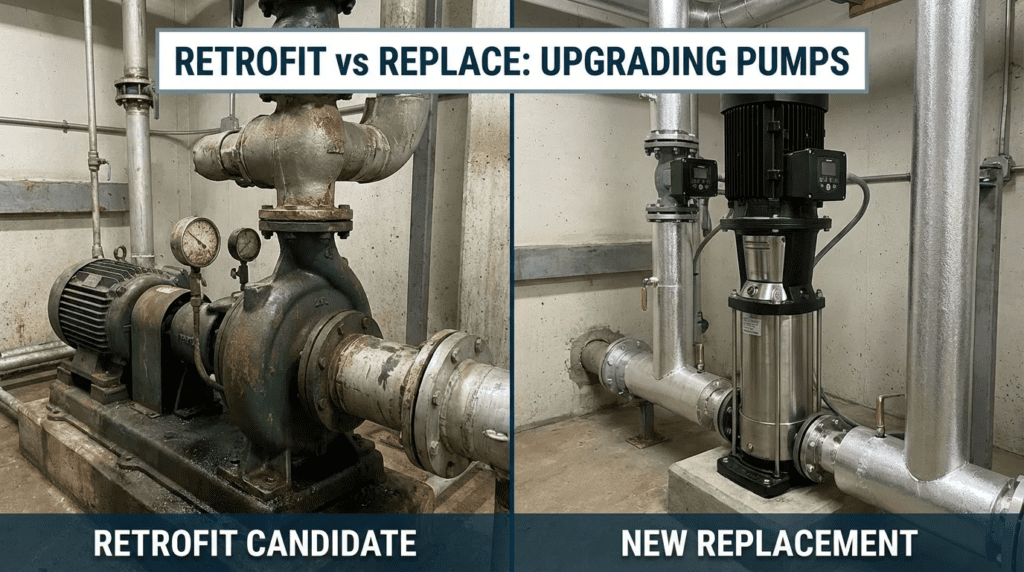
In municipal and industrial water treatment infrastructure, the reliability of auxiliary equipment often dictates the resilience of the entire process. While massive raw sewage lift pumps garner the majority of capital planning attention, the failure of miscellaneous pumps—seal water systems, polymer feed pumps, sampling units, and dry-pit sump pumps—frequently triggers permit violations or costly emergency call-outs. A surprising industry statistic suggests that while main process pumps consume 80% of the energy, miscellaneous support pumps account for nearly 60% of corrective maintenance work orders in facilities older than 20 years. This disproportionate maintenance burden forces engineers and plant directors to face a critical decision point: Retrofit vs Replace: When to Upgrade Misc. Pumps in Aging Stations.
These decisions are rarely straightforward. A 30-year-old dry-pit station may have structurally sound piping but hydraulically obsolete pumping equipment. Conversely, a newer station might suffer from pumps that were value-engineered into chronic cavitation. This article addresses the technical, hydraulic, and economic factors required to make data-driven decisions for miscellaneous pumps in water and wastewater applications. It moves beyond simple “run-to-failure” strategies, offering a rigorous engineering framework for determining whether to rehabilitate existing rotating assemblies, retrofit with modern hydraulics and drives, or execute a complete demolition and replacement.
We will examine the nuances of duty point drift, the impact of modern motor efficiency standards on physical footprints, and the integration of Variable Frequency Drives (VFDs) into aging electrical infrastructures. The goal is to empower consulting engineers and utility managers to specify solutions that lower Total Cost of Ownership (TCO) while maximizing process uptime.
How to Select / Specify: Engineering the Upgrade
When evaluating the status of aging equipment, the specification process must begin with a forensic analysis of the current installation. Simply specifying a “like-for-like” replacement is often a critical error, as the station’s hydraulic reality likely no longer matches the original design documents from decades prior.
Duty Conditions & Operating Envelope
The first step in the Retrofit vs Replace: When to Upgrade Misc. Pumps in Aging Stations analysis is re-establishing the system curve. Over 20 years, force mains experience decreased C-factors due to slime buildup or scaling, effectively increasing friction head. Conversely, if parallel force mains were added, the system head might have dropped, pushing existing pumps into runout.
- Flow Rates & Pressures: Measure actual flow and discharge pressure using portable ultrasonic flow meters and calibrated gauges. Do not rely on the original pump curve; wear rings and impeller erosion likely shifted the performance.
- Operating Modes: Determine if the pump operates continuously or intermittently. A sump pump running 5% of the time has a different LCC profile than a seal water pump running 24/7.
- Future Capacity: Does the master plan call for increased plant throughput? A retrofit solution (e.g., a VFD addition) might offer the turndown required for today while preserving the capacity for tomorrow.
Materials & Compatibility
Material science has advanced significantly since many aging stations were built. A retrofit often allows for the introduction of superior materials without changing the volute, whereas a replacement opens the door to entirely new construction standards.
- Corrosion Resistance: For wastewater applications, assess the presence of hydrogen sulfide (H2S). If the existing cast iron baseplates are severely corroded, a simple pump head replacement is insufficient; the structural integrity is compromised.
- Abrasion: In grit-heavy applications, verify if the existing volute thickness allows for a retrofit. If the casing is washed out, replacement with high-chrome iron or hardened stainless steel becomes mandatory.
- Chemical Compatibility: For metering pumps (hypochlorite, ferric chloride), verify that piping and seal elastomers match current chemical concentrations, which may differ from the original design.
Hydraulics & Process Performance
Comparing the hydraulic efficiency of an existing unit against modern alternatives is central to the upgrade decision. Older impeller designs often prioritized non-clogging features at the expense of hydraulic efficiency. Modern computational fluid dynamics (CFD) designed impellers can often deliver both.
- NPSH Margin: Calculate Net Positive Suction Head Available (NPSHa) under current conditions. If the station level setpoints have changed, the NPSHa may have decreased. A replacement pump must have an NPSH Required (NPSHr) at least 1.5 to 2 feet below the NPSHa to prevent cavitation.
- BEP Proximity: Plot the current operating point against the Best Efficiency Point (BEP). If the pump is operating far to the left (recirculation) or right (cavitation/runout) of BEP, a retrofit via impeller trimming or VFD installation is required to realign the hydraulics.
Installation Environment & Constructability
Constructability is often the “silent killer” of replacement projects in aging stations. While a new pump might look great on paper, physically installing it can be cost-prohibitive.
- Space Constraints: Measure door widths, hatch sizes, and overhead crane clearances. A “Replace” decision often incurs significant civil costs if concrete pads must be demolished or if the new pump exceeds the hatch dimensions.
- Piping Interfaces: A retrofit that utilizes existing suction and discharge flanges saves thousands in piping modifications. Conversely, if the isolation valves are seized and require replacement, the argument for a full pump replacement strengthens.
- Electrical Footprint: Modern Premium Efficiency (IE3/IE4) motors often have larger frame sizes than their predecessors. Verify that a new motor will fit within the physical envelope and not interfere with adjacent equipment.
Reliability, Redundancy & Failure Modes
Analyze the maintenance logs. If a pump requires seal changes every six months, is it a pump problem or a system problem?
- Common Failure Modes: Chronic bearing failure usually indicates misalignment or operation off the BEP. If a retrofit cannot correct the operating point, replacement is necessary.
- Obsolete Parts: If the OEM no longer supports the model, or if lead times for impellers exceed 12 weeks, the reliability risk is unacceptable for critical service.
- Redundancy: Use the upgrade project to re-evaluate redundancy (N+1). In some cases, replacing two large pumps with three smaller pumps provides better process control and redundancy.
Controls & Automation Interfaces
The decision regarding Retrofit vs Replace: When to Upgrade Misc. Pumps in Aging Stations is heavily influenced by the desired level of automation.
- SCADA Integration: Old pumps on relay logic offer zero data. New systems or VFD retrofits can provide power monitoring, vibration trends, and flow estimation to SCADA, enabling predictive maintenance.
- Instrumentation: A full replacement often includes adding flow meters and pressure transducers that were absent in the original design, facilitating tighter process control.
Maintainability, Safety & Access
- Safety: Older stations may have non-compliant coupling guards or exposed rotating elements. Replacement allows for bringing the asset up to current OSHA standards.
- Ergonomics: Consider the “back-breaking” aspect of maintenance. Replacing a heavy, submersible pump with a self-priming surface-mounted unit (where suction lift permits) can significantly reduce safety risks for operators during de-clogging events.
Lifecycle Cost Drivers
Engineers must present a Total Cost of Ownership (TCO) analysis, not just a bid price. A retrofit usually has a lower Capital Expenditure (CAPEX) but may retain higher Operational Expenditure (OPEX) due to lower efficiency.
- Energy Efficiency: A new pump with a VFD can reduce energy consumption by 30-50% compared to an old across-the-line starter unit throttled by a valve.
- Labor: Factor in the cost of operator rounds. Automated systems reduce the need for manual checks.
Comparison Tables: Evaluating Options
The following tables provide a structured comparison to assist engineers in weighing the technical trade-offs. Table 1 outlines the specific pros and cons of retrofit methodologies versus full replacement. Table 2 serves as an application fit matrix to guide decision-making based on pump service type.
| Strategy | Scope of Work | Best-Fit Applications | Limitations / Risks | Typical Cost Impact (Relative) |
|---|---|---|---|---|
| Hydraulic Retrofit (Re-bowl / Trim) | Retain volute/casing; replace impeller and wear rings; trim impeller to new duty point. | Large split-case or dry-pit pumps where piping mod costs are prohibitive. Duty point is slightly off. | Does not address volute wear or corrosion. Limited efficiency gains. Old motor remains a weak link. | Low to Medium |
| Drive Retrofit (VFD Addition) | Retain pump and motor; install VFD to control speed/flow. | Variable flow applications; oversized pumps operating near shut-off; water hammer mitigation. | Motor must be “Inverter Duty” rated (or replaced). Potential for resonance frequencies at lower speeds. | Medium |
| “Drop-In” Replacement | New pump specifically engineered to match existing flange dimensions (custom or adapter). | Critical stations requiring quick turnaround; limited floor space for piping mods. | Often carries a premium price for custom casting or machining. May lock utility into single vendor. | Medium to High |
| Complete System Replacement | Demolish pump, base, and piping. Install modern standard pump with optimized hydraulics. | Obsolete pumps; severe cavitation damage; major duty point changes; desire for standardization. | Highest construction complexity (civil/mechanical). Requires bypass pumping during install. | High |
| Service Type | Typical Issues | Retrofit Viability | Replace Viability | Key Decision Driver |
|---|---|---|---|---|
| Seal Water Systems | Inconsistent pressure, scaling, oversized for current seal needs. | Low | High | Commodity items. Usually cheaper to replace with a modern multistage booster package than to rebuild. |
| Dry Pit Sewage Pumps (>50HP) | Impeller wear, bearing vibration, seal failures. | High | Medium | Piping modification costs dominate. If volute is sound, retrofit rotating assembly + VFD is preferred. |
| Chemical Metering (Diaphragm) | Loss of prime, diaphragm fatigue, outdated controls. | Low | High | Technology leap. New smart dosing pumps offer SCADA integration impossible with old solenoid pumps. |
| Submersible Sump Pumps | Moisture intrusion, cable damage, clogging. | Very Low | High | “Disposable” asset class. Repair labor usually exceeds replacement cost. Upgrade to grinder/shredder type if clogging is frequent. |
| Sludge Recirculation | High viscosity, severe abrasion/wear. | Medium | Medium | Material hardness. If wear is excessive, replace with Hard Iron. If duty is variable, VFD retrofit is essential. |
Engineer & Operator Field Notes
Successful execution of a pump upgrade project relies on bridging the gap between design theory and field reality. The following notes are compiled from commissioning experiences and lessons learned in municipal environments.
Commissioning & Acceptance Testing
Whether you retrofit or replace, rigorous testing is mandatory. Do not accept the equipment based solely on a “bump test” for rotation.
- Vibration Baseline: Establish a vibration signature baseline (ISO 10816-1) immediately upon startup. For retrofits, this confirms that the new impeller isn’t inducing resonance in the old structure or piping.
- Thermal Imaging: Perform thermography on motors and bearings after 4 hours of continuous run time. Hot spots often indicate alignment issues or soft-foot conditions on the baseplate.
- Hydraulic Verification: Verify the pump is hitting the design point on the curve. Close the discharge valve momentarily to verify shut-off head (confirms impeller diameter and wear ring integrity), then open to design flow. Note: Do not run at shut-off for extended periods.
Common Specification Mistakes
- Copy/Paste Specs: Using a specification from 2005 for a project in 2024 is a recipe for disaster. References to obsolete standards or discontinued model numbers confuse bidders and lead to change orders.
- Ignoring the “System” Curve: Specifying a replacement pump based on the nameplate of the old pump assumes the old pump was sized correctly. In many aging stations, the original pump was oversized by 20-30%, leading to years of inefficient operation. Always re-calculate head requirements.
- Over-Constraining the Vendor: In “Replace” scenarios, specifying exact dimensions of the old unit limits competition. Instead, specify performance and allow the contractor to include piping transitions in their bid.
O&M Burden & Strategy
The upgrade is an opportunity to reset the maintenance culture.
- Standardization: If the plant has 50 pumps, try to limit the population to 2-3 manufacturers to consolidate spare parts inventory (seals, bearings, O-rings).
- Accessibility: During replacement design, ensure isolation valves are accessible without confined space entry if possible. Install pressure gauges with diaphragm seals to prevent clogging, ensuring operators can actually read the discharge pressure.
Troubleshooting Guide
When an aging pump acts up, diagnose before deciding to replace:
- Symptom: High Amperage/Tripping.
Potential Cause: Pump operating at runout (flow too high, head too low) or mechanical binding.
Action: Throttle discharge valve. If amps drop, it’s a hydraulic issue. If amps stay high, it’s mechanical/electrical. - Symptom: No Flow / Low Flow.
Potential Cause: Air binding, incorrect rotation (happens frequently after electrical work), or excessive wear ring clearance.
Action: Check rotation first. Then check for air leaks in suction piping.
Design Details / Calculations
This section outlines the technical methodology for quantifying the Retrofit vs Replace: When to Upgrade Misc. Pumps in Aging Stations decision.
Sizing Logic & Methodology
The core of the decision lies in the intersection of the pump curve and the system curve. Use the Affinity Laws cautiously; they are accurate for speed changes but do not account for static head limitations.
1. Define System Head Curves:
$$H_{system} = H_{static} + H_{friction}$$
Where $H_{friction}$ varies with the square of the flow ($Q^2$). In aging pipes, use a conservative Hazen-Williams C-factor (e.g., C=100 for old iron pipe, rather than C=120).
2. Calculate NPSH Available (NPSHa):
$$NPSHa = P_{atm} + H_{static_suction} – H_{friction_suction} – P_{vapor}$$
For retrofits, pay close attention to $H_{friction_suction}$. Accumulated scale in the suction line can destroy NPSHa, making a new high-speed pump cavitate instantly.
Specification Checklist
Ensure these items are in your bid package:
- Duty Points: Primary design point, plus secondary points for min/max flow.
- Motor Specs: Service Factor (1.15 min), Enclosure (TEFC vs TENV vs Submersible), Efficiency (NEMA Premium), and Inverter Duty rating (MG-1 Part 31).
- Material Certification: ASTM standards for casing, impeller, and shaft.
- Testing: HI 11.6 (Submersible) or HI 14.6 (Rotodynamic) acceptance grade (typically Grade 1B or 2B for municipal).
- Baseplate: For replacements, specify groutable baseplates with adequate stiffness to prevent resonance.
Standards & Compliance
Adherence to current standards is non-negotiable for liability and insurance reasons.
- Hydraulic Institute (HI): Standards for pump testing, intake design, and operating regions.
- AWWA E103: Horizontal and Vertical Line-Shaft Pumps.
- NEC (NFPA 70): wiring and disconnect requirements, particularly Art. 430 (Motors) and Art. 500 (Hazardous Locations for Class 1 Div 1/2 environments).
Frequently Asked Questions
What are the primary drivers for the Retrofit vs Replace: When to Upgrade Misc. Pumps in Aging Stations decision?
The primary drivers are lifecycle cost, hydraulic suitability, and physical constructability. If the existing pump casing is intact and the hydraulic conditions haven’t changed drastically, a retrofit is often cost-effective. However, if the duty point has shifted significantly or the equipment is obsolete (no parts available), replacement is the only viable engineering solution.
How does a VFD retrofit impact pump life in older stations?
A VFD retrofit generally extends pump life by allowing soft starts/stops (reducing water hammer and mechanical stress) and enabling operation at the Best Efficiency Point (BEP). However, engineers must verify that the existing motor is rated for VFD use and that the pump won’t be run at speeds where system resonance occurs. See the [[Commissioning & Acceptance Testing]] section for details on vibration baselines.
When is impeller trimming a viable retrofit strategy?
Impeller trimming is viable when the pump is producing too much head or flow for the current system requirements, causing it to operate too far to the right of the BEP (wasting energy and risking cavitation). Trimming the impeller reduces head and flow according to affinity laws. It is not a solution if the pump is undersized or if the system head has increased due to pipe fouling.
What is the typical cost difference between retrofitting and replacing a large centrifugal pump?
While highly variable, a hydraulic retrofit (new rotating assembly) typically costs 40-60% of a full replacement. The savings largely come from avoiding civil work (concrete pads), piping modifications, and electrical conduit rerouting. However, if the volute is worn, the savings of a retrofit evaporate quickly due to poor subsequent efficiency.
How do I determine if my existing pump piping is suitable for a new pump?
Engineers must check velocity limits and flange compatibility. Suction velocity should typically remain below 8 ft/sec and discharge below 10-15 ft/sec. If a new, higher-capacity pump drives velocities above these limits, noise, vibration, and erosion will occur, necessitating piping upgrades alongside the pump replacement.
What is the recommended service life for miscellaneous wastewater pumps?
Typical service life expectations are: 15-20 years for dry-pit centrifugal pumps, 10-15 years for submersible sewage pumps, and 5-10 years for chemical metering pumps. “Service life” implies the point where repair costs approach 50% of replacement costs, necessitating a formal upgrade analysis.
Conclusion
KEY TAKEAWAYS
- Hydraulics First: Never simply replace “like-for-like.” Always re-calculate the system head curve to account for pipe aging and process changes.
- The 50% Rule: If the cost of the retrofit (parts + labor + machining) approaches 50-60% of the cost of a new unit, choose replacement to reset the reliability clock.
- Check Constraints: Physical access (hatches, cranes) and electrical capacity often dictate the feasibility of replacement projects more than the pump cost itself.
- Material Matters: Use the upgrade opportunity to improve metallurgy (e.g., CD4MCu or Hard Iron) for better resistance to modern wastewater streams.
- Verification: A retrofit is not complete until vibration, thermal, and hydraulic performance are verified against the new target baseline.
The dilemma of Retrofit vs Replace: When to Upgrade Misc. Pumps in Aging Stations is a constant challenge for utility engineers. It requires balancing the immediate constraints of budget and space against the long-term necessities of efficiency and reliability. There is no universal answer; a 50HP seal water pump might be a “throw-away” replacement item, while a 200HP dry-pit effluent pump is a prime candidate for a hydraulic retrofit and VFD addition.
By following a systematic approach—verifying current hydraulic conditions, assessing physical and electrical constraints, and calculating the total lifecycle cost—engineers can navigate these decisions with confidence. The goal is not merely to restore flow, but to enhance the station’s resilience, ensuring that these “miscellaneous” assets do not become the weak link in the water treatment chain.