
Commissioning Propeller Pump: Startup Checklist and Acceptance Tests
Introduction to High-Volume Pumping Systems
In the realm of municipal stormwater management and large-scale raw water intake, the axial flow (propeller) pump is the workhorse of the industry. However, these high-flow, low-head machines are notoriously sensitive to installation conditions and hydraulic environments. A surprising statistic from reliability studies indicates that nearly 60% of premature failures in vertical column pumps are traceable to installation errors, poor intake design, or inadequate startup procedures rather than manufacturing defects. For engineers and plant directors, the process of Commissioning Propeller Pump: Startup Checklist and Acceptance Tests is not merely a bureaucratic final step; it is the critical phase where the theoretical design meets the harsh reality of hydraulic physics.
Propeller pumps differ significantly from the standard centrifugal pumps used in wastewater lift stations. They rely on lift generated by the impeller blades rather than centrifugal force, making them highly susceptible to vortexing, pre-swirl, and cavitation if the submergence is insufficient. Because these pumps often handle massive volumes—ranging from 10,000 to over 100,000 GPM—the energy release during a catastrophic failure can be structurally damaging.
Typical applications include flood control stations, irrigation districts, and power plant cooling water intakes. In these environments, reliability is paramount; a pump failure during a 100-year storm event is not an option. Yet, many specifications overlook the nuances of field testing, relying too heavily on factory data that cannot replicate site-specific intake conditions.
This article serves as a definitive guide for consulting engineers and utility managers. We will move beyond the catalog curves to discuss the practical realities of selecting, specifying, and commissioning these systems. By focusing on rigorous acceptance criteria and a detailed Commissioning Propeller Pump: Startup Checklist and Acceptance Tests protocol, engineers can ensure their systems deliver the expected lifecycle performance and safeguard public infrastructure assets.
How to Select and Specify Propeller Pumps
Successful commissioning begins during the design phase. If the equipment specified does not match the hydraulic reality of the site, no amount of tuning during startup will resolve the underlying issues. The selection process for axial flow pumps requires a distinct mindset compared to radial flow wastewater pumps.
Duty Conditions & Operating Envelope
Propeller pumps have a steep head-capacity curve. A small change in static head results in a significant change in power consumption and flow. When defining duty conditions:
- Total Dynamic Head (TDH) Sensitivity: Unlike centrifugal pumps, propeller pumps can overload the motor if operated against a closed valve or at heads significantly higher than the design point. Specifications must clearly define the “shut-off head” and ensure the motor is sized to handle the entire curve, or that interlocks prevent operation in high-head zones.
- Siphon Recovery: Many propeller pump stations utilize siphon discharge piping to minimize static head. The specification must account for the transient phase during priming when the pump must overcome the full geometric height before the siphon is established.
- Variable Speed Operation: If VFDs are used, the operating envelope must be checked against the system curve. Propeller pumps often have a “dip” in their H-Q curve (the saddle region). Operating in this unstable zone can cause severe vibration and noise.
Materials & Compatibility
Material selection dictates the longevity of the wet end, particularly in abrasive stormwater or corrosive brackish water applications.
- Impeller Metallurgy: Aluminum bronze or varying grades of stainless steel (316, Duplex 2205) are standard. For stormwater containing grit, harder alloys or specialized coatings may be required to prevent erosion at the blade tips.
- Bowl Assembly: Cast iron is standard, but in aggressive soil or water conditions, Ni-Resist or stainless steel liners are necessary to maintain the tight tip clearances required for efficiency.
- Galvanic Corrosion: In seawater applications, the interaction between dissimilar metals (e.g., stainless shaft and bronze impeller) requires robust cathodic protection specifications (sacrificial anodes).
Hydraulics & Process Performance
The hydraulic performance of an axial flow pump is inextricably linked to the intake design. Specifications must reference Hydraulic Institute (HI) Standard 9.8 for Pump Intake Design.
- Submergence: Minimum submergence is critical to prevent air-entraining surface vortices. The spec must define the “Minimum Submergence” relative to the bell diameter (typically 1.5D to 2.0D) and ensure the lowest operating level respects this limit.
- Efficiency definitions: Specify whether efficiency requirements refer to Bowl Efficiency (pump only) or Wire-to-Water Efficiency (including motor and column losses).
Installation Environment & Constructability
Propeller pumps are often long, vertical structures. The physical installation constraints are major cost drivers.
- Sole Plate Leveling: The specification must require sole plates to be leveled to within 0.002 inches per foot. Any tilt in the sole plate translates to significant runout at the bottom of a 30-foot column.
- Pull-out Requirements: For enclosed screw or canister-style pumps, ensure the building overhead crane height is sufficient to lift the entire unit or that the unit is segmented for removal.
Reliability, Redundancy & Failure Modes
Understanding how these pumps fail helps in writing better specs.
- Bearing Lubrication: Vertical column pumps typically use product-lubricated bearings (rubber or composite) or oil-lubricated enclosed tube systems. For dirty stormwater, an enclosed oil or fresh-water flush system is far superior to product lubrication, which wears bearings rapidly when grit is present.
- Resonance: Large vertical structures have natural frequencies. The spec must require a torsional and lateral analysis to ensure the operating speed does not coincide with the reed frequency of the structure.
Controls & Automation Interfaces
Modern commissioning requires deep integration with SCADA.
- Vibration Monitoring: Specify permanently installed accelerometers on the motor bearing housing. For critical large pumps, X-Y proximity probes on the shaft are recommended.
- Temperature Monitoring: RTDs in motor windings and bearings are mandatory.
- Seal Leak Detection: For submersible variations, moisture detection relays must be integrated into the pump protection logic.
Maintainability, Safety & Access
Operational safety is often overlooked in design.
- Split Packing Glands: If packing is used, specify split glands to facilitate repacking without dismantling the motor.
- Coupling Access: Ensure the motor stand design allows easy access to the coupling for alignment verification without removing heavy guards that require a crane.
Lifecycle Cost Drivers
The purchase price of a propeller pump is often only 10-15% of its 20-year lifecycle cost.
- Energy Costs: Even a 1% efficiency gain in a 500 HP continuous-duty pump yields massive savings. Use Net Present Value (NPV) analysis in bid evaluations.
- Rebuild Intervals: Evaluate the cost of replacing wear rings and bearings. Pumps with replaceable liner rings are preferred over those requiring bowl machining during repair.
Technology Comparison and Application Fit
The following tables provide an engineering comparison of common configurations for high-flow pumping. Table 1 compares the technological architecture, helping engineers choose between vertical column and submersible designs. Table 2 provides an application fit matrix to guide selection based on site constraints.
| Technology Type | Primary Features | Best-Fit Applications | Limitations / Considerations | Maintenance Profile |
|---|---|---|---|---|
| Vertical Column Axial Flow | Motor above grade (dry); long drive shaft; product or oil lube bearings; highest efficiency options. | Large flood control; Raw water intake; Irrigation; Continuous duty service. | Requires precise column alignment; sensitive to structural resonance; requires tall superstructure. | Moderate: Motor accessible; Wet end requires pulling entire column; Shaft bearings require monitoring. |
| Submersible Axial/Propeller | Close-coupled motor/pump submerged in discharge tube; installs in a canister or simply rests on a seating ring. | Stormwater retrofit; Space-constrained sites; Noise-sensitive areas; Stations without superstructures. | Lower wire-to-water efficiency (motor drag); Cable handling challenges; Limited head capability per stage. | Low/High: Low routine maintenance, but repair requires lifting entire unit; Mechanical seal failure is a critical risk. |
| Vertical Mixed Flow | Hybrid between centrifugal and axial; provides higher head capabilities; wider operating efficiency range. | High-head flood control; Wastewater effluent; Raw water with elevation changes. | Physically larger bowl assembly; Higher NPSH requirements than pure axial flow at certain points. | Moderate: Similar to vertical axial but impellers are heavier and more costly to balance/repair. |
| Application Scenario | Typical Flow Range | Head Range | Recommended Technology | Key Design Constraint |
|---|---|---|---|---|
| Main Flood Control (River Discharge) | > 50,000 GPM | 10 – 30 ft | Vertical Column Axial Flow | Must analyze for siphon recovery and discharge flap valve losses. |
| Stormwater Lift Station (Urban) | 5,000 – 30,000 GPM | 15 – 40 ft | Submersible Axial / Mixed Flow | Screening is critical; trash/debris tolerance is the primary driver. |
| WWTP Effluent / Recirculation | Variable | < 10 ft | Horizontal Axial / Wall Pump | Extremely low head requirements; focus on wire-to-water efficiency. |
| Deep Tunnel Dewatering | High | > 100 ft | Vertical Turbine (Multi-stage) | Propeller pumps unsuitable due to high head; use multi-stage vertical turbines. |
Field Notes: Execution and Operations
The gap between a specification and a functioning plant is bridged by the commissioning team. This section details practical strategies for managing the Commissioning Propeller Pump: Startup Checklist and Acceptance Tests process and ensuring long-term operability.
Commissioning & Acceptance Testing
Commissioning is split into two distinct phases: Factory Acceptance Testing (FAT) and Site Acceptance Testing (SAT). Do not conflate the two.
Factory Acceptance Test (FAT)
For large propeller pumps, a witnessed FAT is mandatory. The FAT confirms the pump meets the certified curve under ideal conditions.
- Hydraulic Performance: Verify 5-7 points along the curve, including Shut-off, BEP (Best Efficiency Point), and Run-out.
- NPSHr Testing: Critical for propeller pumps. Ensure the manufacturer performs a vacuum suppression test to verify NPSH requirements, as cavitation in axial pumps leads to rapid blade destruction.
- Mechanical Integrity: Check vibration levels at the factory mounting. Note that site vibration will differ due to structural stiffness differences.
Site Acceptance Test (SAT) – The Checklist
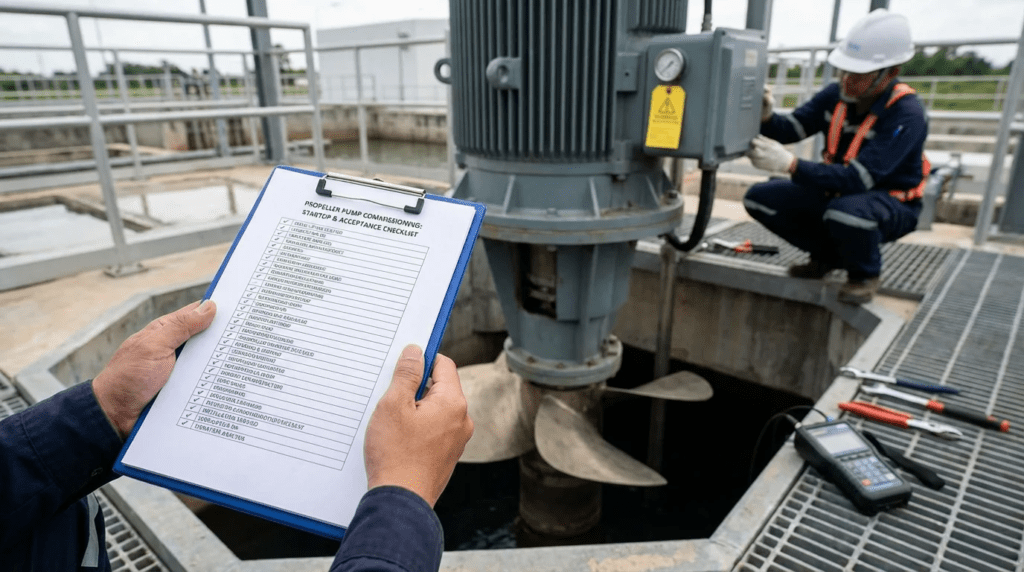
The SAT validates the pump within the system. This is where the Commissioning Propeller Pump: Startup Checklist and Acceptance Tests document becomes the governing authority.
- Pre-Rotation Check: Uncouple the motor. Bump the motor to verify rotation direction. (Running a propeller pump backward can unscrew shaft couplings).
- Lubrication Verification: If water-flushed bearings are used, verify flow and pressure to the stuffing box/enclosing tube before pump rotation.
- Valve Positioning: For axial flow pumps, starting against a closed valve often causes a massive horsepower spike (unlike centrifugal pumps). Confirm discharge valve logic (often open or partially open start).
- Vibration Baseline: Record vibration signatures (displacement, velocity, acceleration) at startup, steady state, and shutdown.
- Resonance Sweep: If VFD driven, slowly ramp up from minimum to maximum speed while monitoring vibration to identify and program “skip frequencies” to avoid structural resonance.
Common Specification Mistakes
Engineers often copy-paste specifications from centrifugal pump projects, leading to errors in propeller pump procurement.
- Over-specifying Head: Adding excessive safety factors to the TDH can be disastrous. If a propeller pump is designed for 20ft TDH but operates at 10ft, it may run in a cavitation zone or overload the motor depending on the specific speed ($N_s$). Propeller pumps must be sized for the actual system curve, not a hypothetical maximum.
- Ignoring Intake Velocity: High approach velocities or uneven flow distribution into the bell mouth causes pre-swirl. This uneven loading on the impeller blades causes shaft deflection and bearing failure.
- Ambiguous Vibration Limits: Specifying standard HI 9.6.4 limits without accounting for the structural height of the motor can lead to disputes. Taller structures naturally have higher displacement at the top, even if velocity is within limits.
O&M Burden & Strategy
Operational strategies for axial flow pumps differ from standard sewage pumps.
- Daily/Weekly: Monitor seal water pressure and solenoid operation. Propeller pumps with rubber bearings will self-destruct in minutes if run dry.
- Seasonal: For flood control pumps that sit idle for months, shafts must be rotated manually (or via inching drives) monthly to prevent bearing set and shaft bowing (brinelling).
- Predictive Maintenance: Oil analysis is crucial for gear-driven or oil-filled tube pumps. Look for brass/bronze particles indicating bushing wear or water intrusion indicating seal failure.
Troubleshooting Guide
When issues arise, the root cause is often hydraulic.
- Symptom: High Vibration at specific tank levels.
Cause: Vortexing. As the water level drops, surface vortices may form, feeding air into the prop.
Fix: Install vortex breakers, increase minimum submergence setpoints, or reduce pump speed as levels drop. - Symptom: Motor Overload at Startup.
Cause: Starting against a closed valve or siphon priming issues.
Fix: Axial flow pumps draw maximum power at shut-off (zero flow). Change start sequence to open discharge valve sooner or install a bypass.
Design Details and Calculation Logic
Engineering the system requires specific calculations regarding specific speed and intake geometry.
Sizing Logic & Methodology
The selection of a propeller pump is governed by Specific Speed ($N_s$).
$$N_s = frac{N times sqrt{Q}}{H^{0.75}}$$
Where:
- $N$ = Pump Speed (RPM)
- $Q$ = Flow (GPM)
- $H$ = Head (ft)
Propeller (Axial flow) pumps typically have an $N_s$ between 10,000 and 15,000. Mixed flow pumps range from 4,000 to 9,000.
Why this matters: High $N_s$ pumps have steep H-Q curves. A small calculation error in friction loss (H) results in a large deviation in Flow (Q). Engineers must calculate system curves with high precision, using bounding scenarios for “High Water Level” and “Low Water Level” on the discharge side.
Specification Checklist
When drafting the RFP, ensure these items are explicit:
- Pump Performance: Rated conditions, minimum shut-off head, maximum run-out flow.
- Testing: HI 14.6 Acceptance Grade (Grade 1U or 1B recommended for municipal).
- Materials: ASTM designations for bowl, impeller, shaft, and wear rings.
- Documentation: Requirement for a site-specific Commissioning Propeller Pump: Startup Checklist and Acceptance Tests plan to be submitted 60 days prior to startup.
Standards & Compliance
Adherence to standards protects the engineer from liability.
- ANSI/HI 9.8 (Intake Design): The most critical standard for propeller pumps. It dictates bay width, submergence, and anti-vortex devices.
- ANSI/HI 14.6 (Rotodynamic Pumps for Hydraulic Performance Acceptance Tests): Defines the testing tolerances.
- AWWA E103 (Horizontal and Vertical Line-Shaft Pumps): The governing standard for municipal water applications.
Frequently Asked Questions
What is the difference between an axial flow pump and a mixed flow pump?
The primary difference lies in the direction of the fluid discharge relative to the shaft. In an axial flow (propeller) pump, the fluid is pushed parallel to the shaft, similar to a boat propeller. This design generates high flow at low head. In a mixed flow pump, the fluid exits at an angle (partially radial, partially axial), allowing it to generate higher pressures (heads) suitable for effluent pumping or higher-lift applications. Axial flow pumps typically operate efficiently up to 20-25 feet of head, while mixed flow can handle 20-80+ feet.
How do you determine the minimum submergence for a propeller pump?
Minimum submergence is calculated to prevent the formation of surface vortices that introduce air into the pump, causing vibration and performance loss. The Hydraulic Institute (HI 9.8) provides a formula based on the Froude number and bell diameter ($D$). A typical rule of thumb is $S = D times (1.0 + 2.3F_d)$, where $S$ is submergence and $F_d$ is the Froude number. However, for most large pumps, a minimum of 1.5 to 2.0 times the bell diameter above the lip is a standard starting point, verified by CFD modeling or physical model testing for critical stations.
Why does vibration increase when a propeller pump operates at low flow?
Propeller pumps suffer from flow separation and recirculation at the impeller vanes when operated far to the left of the Best Efficiency Point (BEP). This creates hydraulic instability and cavitation, leading to severe vibration. Unlike centrifugal pumps which can often run safely at 50% flow, axial flow pumps are generally restricted to a narrower operating window (e.g., 70% to 110% of BEP). Operating against a closed valve or high head forces the pump into this unstable region.
What should be included in the Commissioning Propeller Pump: Startup Checklist and Acceptance Tests?
A comprehensive checklist must include: dry installation checks (leveling, alignment, anchor torque), lubrication system verification (oil level, grease lines, water flush pressure), electrical checks (megger, rotation, safety interlocks), and hydraulic checks (static water level confirmation, valve lineup). The acceptance test must verify flow, head, power draw, vibration at multiple points, and bearing temperatures after a 4-hour run-in period.
How often should propeller pumps be maintained?
Maintenance intervals depend on duty cycle and water quality. For continuous service, bearing lubrication checks should be daily or automated. Stuffing box adjustments are required weekly/monthly. Vibration analysis should be conducted quarterly. Major overhauls (pulling the pump to inspect impeller clearance, wear rings, and bowl bearings) are typically scheduled every 5-7 years or 25,000 hours. For flood control pumps (intermittent duty), annual exercising and insulation resistance testing are critical to ensure readiness.
Can I use a VFD with a propeller pump?
Yes, but with caution. VFDs are excellent for matching flow to incoming rates, but you must program minimum speed limits. Axial flow pumps generate very little head at low speeds; if the speed drops too low, the pump may not overcome static lift, resulting in zero flow and rapid overheating (churning). Additionally, the VFD must be programmed to skip critical resonant frequencies of the long vertical column structure.
Conclusion: Ensuring Project Success
KEY TAKEAWAYS
- Selection is Critical: Match the pump’s specific speed ($N_s$) to the application. Do not use axial flow pumps for high-variable-head applications without careful analysis.
- Intake Design Matters: 80% of hydraulic issues trace back to the sump, not the pump. Follow ANSI/HI 9.8 strictly.
- Startup Protocol: Never start an axial flow pump against a closed valve without a specific bypass or relief design—horsepower spikes at shut-off.
- Vibration Analysis: Establish a baseline during commissioning. Changes in vibration are the earliest warning of bearing wear or alignment shifts.
- Documentation: Enforce the submission of a detailed Commissioning Propeller Pump: Startup Checklist and Acceptance Tests document before the contractor mobilizes for startup.
- System Curve Accuracy: Verify static head calculations precisely; small errors significantly impact flow in high-$N_s$ pumps.
Commissioning a propeller pump station is a multidisciplinary effort involving civil hydraulic design, mechanical precision, and electrical control strategy. For the engineer, the goal is to deliver a system that is not only compliant with specifications but also robust enough to handle the realities of municipal and industrial wastewater environments.
By shifting focus from simple equipment procurement to a holistic view of the pumping system—including the intake geometry and the discharge piping characteristics—engineers can mitigate the risks of cavitation, resonance, and premature failure. The successful execution of the Commissioning Propeller Pump: Startup Checklist and Acceptance Tests is the final validation of this design process. It transforms a collection of steel and iron into a reliable asset capable of protecting communities and infrastructure for decades to come.
When in doubt during the specification or startup phase, consult with hydraulic specialists or require physical model testing for large intake structures. The cost of verification is negligible compared to the cost of retrofitting a failing pump station foundation.