
Preventive Maintenance Plan for Split Case (Intervals Spares Work Orders)
INTRODUCTION
The axially split case centrifugal pump remains the workhorse of the water and wastewater industry. Its robust design, high flow capabilities, and relative ease of maintenance—allowing access to rotating assemblies without disturbing piping—make it a staple in raw water intakes, high-service pump stations, and large-scale cooling loops. However, despite their inherent durability, these assets frequently suffer from a “set it and forget it” mentality. Industry data suggests that reactive maintenance on large split case pumps costs 3 to 4 times more than a planned strategy, yet many utilities lack a formalized approach to asset preservation.
For municipal engineers and plant managers, the challenge is not just repairing a pump when it fails, but engineering a system that prevents failure. A successfully executed Preventive Maintenance Plan for Split Case (Intervals Spares Work Orders) is the critical differentiator between a facility that operates within budget and one plagued by emergency overtime and unexpected capital replacement. The most common oversight in pump specification and management is failing to align the physical design of the equipment with the logistical realities of the maintenance department.
This article provides a technical framework for engineers and operators to design, specify, and implement a rigorous maintenance strategy. It moves beyond generic manufacturer recommendations to address the specific engineering constraints of creating a Preventive Maintenance Plan for Split Case (Intervals Spares Work Orders). We will examine how duty cycles impact component life, how to optimize spare parts inventory based on criticality, and how to structure work orders to capture data that drives reliability engineering.
HOW TO SELECT / SPECIFY
The foundation of any maintenance program is laid during the selection and specification phase. If a pump is selected improperly for its hydraulic conditions or installed without regard for serviceability, even the most robust Preventive Maintenance Plan for Split Case (Intervals Spares Work Orders) will fail to deliver expected MTBF (Mean Time Between Failure).
Duty Conditions & Operating Envelope
The interaction between the pump’s Best Efficiency Point (BEP) and its actual operating point is the single largest predictor of maintenance intervals. Engineers must specify pumps where the primary operating range falls within 80% to 110% of BEP. Operating outside this window, particularly at low flows, increases radial loads on the impeller, leading to shaft deflection.
Shaft deflection is a primary antagonist in split case pump reliability. It accelerates mechanical seal failure and reduces bearing life. When specifying for variable speed applications, the system curve must be overlaid on the pump curve to ensure that reduced speed operation does not force the pump into unstable recirculation zones. For intermittent duty applications, such as stormwater management, the start/stop frequency must be evaluated against the motor’s thermal capacity and the torque stress on the shaft coupling.
Materials & Compatibility
Material selection dictates the corrosion and abrasion rate, which directly influences the inspection intervals in your maintenance plan. For potable water, standard cast iron casings with bronze impellers are common, but in wastewater or raw water applications with grit, this combination may necessitate frequent wear ring replacements.
Engineers should consider upgrading wear rings and shaft sleeves to hardened stainless steel (e.g., 400 series or duplex) in abrasive environments. This increases the initial capital cost but significantly extends the interval between major overhauls. Furthermore, galvanic corrosion must be considered. Dissimilar metals in the wet end can essentially turn the pump into a battery, necessitating sacrificial anodes which then become another line item on the preventive maintenance work order.
Hydraulics & Process Performance
Net Positive Suction Head (NPSH) margin is critical. A pump may operate without full cavitation but still suffer from micro-cavitation if the NPSH Margin (NPSHA / NPSHR) is insufficient (typically less than 1.1 to 1.3). This chronic condition erodes impellers and causes vibration that destroys bearings.
When developing the Preventive Maintenance Plan for Split Case (Intervals Spares Work Orders), engineers must note the Suction Specific Speed (Nss). Pumps with high Nss (above 11,000 US units) generally have tighter operating windows and require more frequent vibration monitoring than lower Nss designs. The specification should require performance curves that clearly indicate the preferred and allowable operating regions.
Installation Environment & Constructability
A frequent failure in design is neglecting the physical access required to maintain a split case pump. The primary advantage of the split case design is the ability to remove the top casing half to access the rotor. Specifiers must ensure there is adequate vertical clearance for lifting equipment and no overhead piping or conduit obstructions.
Additionally, the “work order” aspect of the plan requires space. Maintenance personnel need approximately 3 feet of clearance on all sides to safely remove bearing housings, extract shafts, and stage components. If the pump is jammed against a wall, routine inspections become arduous and are often skipped. Foundation mass is also critical; the concrete pad should typically weigh 3 to 5 times the mass of the pump assembly to dampen vibration.
Reliability, Redundancy & Failure Modes
Reliability must be specified quantitatively. Engineers should specify L-10 bearing life (the number of hours 90% of bearings will survive) at a minimum of 50,000 to 100,000 hours under maximum load. This aligns the bearing replacement interval with major overhaul schedules.
Redundancy strategies (N+1 or N+2) influence the “Spares” component of the Preventive Maintenance Plan for Split Case (Intervals Spares Work Orders). In an N+1 scenario, critical spares can often be held in central inventory rather than per-unit. However, for critical non-redundant pumps, a complete rotating assembly (CRA) should be specified as a capital spare to minimize downtime from weeks to hours.
Controls & Automation Interfaces
Modern preventive maintenance is shifting toward predictive maintenance. Specifications should include provisions for permanent condition monitoring. This includes accelerometers mounted on bearing housings (x, y, and z axes) and RTDs (Resistance Temperature Detectors) in the bearing reservoirs and motor windings.
These sensors should feed into the SCADA system or a dedicated vibration monitoring system. The specification should define alarm (warning) and trip (shutdown) setpoints based on Hydraulic Institute Standard 9.6.4. Integrating this data allows the generation of automated work orders based on asset health rather than arbitrary calendar dates.
Maintainability, Safety & Access
Safety is paramount in work order execution. Specifications must require coupling guards that allow for visual inspection of the coupling without removal (using mesh or clear windows). Jacking screws should be specified on the motor feet to facilitate precise alignment. For larger pumps, the casing itself should feature jacking bolts to assist in separating the upper and lower halves, preventing damage to the machined parting surface during disassembly.
Lifecycle Cost Drivers
The decision to implement a high-level maintenance plan is economic. While the pump’s purchase price is visible, energy and maintenance comprise 80-90% of the 20-year lifecycle cost. A pump with slightly lower efficiency but robust bearings, ample wear ring clearances, and accessible seals may offer a lower Total Cost of Ownership (TCO) than a high-efficiency unit that is fragile and difficult to service. Engineers should evaluate bids based on TCO, factoring in the estimated labor hours for routine PMs and the cost of replacement parts.
COMPARISON TABLES
The following tables provide a structured comparison to assist engineers in decision-making. Table 1 compares maintenance strategies to help determine the appropriate level of sophistication for a facility. Table 2 serves as an application fit matrix, guiding the selection of split case configurations based on specific operational constraints.
Table 1: Maintenance Strategy Comparison for Split Case Pumps
| Strategy Type | Trigger Mechanism | Best-Fit Application | Limitations / Risks | Typical Spares Requirement |
|---|---|---|---|---|
| Reactive (Run-to-Failure) | Equipment failure or loss of performance. | Non-critical, small pumps with full redundancy where downtime is acceptable. | Catastrophic damage often increases repair cost by 400%. Unpredictable labor demand. | Full replacement units or Complete Rotating Assemblies (CRA). |
| Preventive (Calendar-Based) | Time intervals (e.g., Monthly, Quarterly, Annual). | Standard municipal duty where wear rates are predictable and load is constant. | Risk of “over-maintaining” (intrusive maintenance inducing failure) or under-maintaining if intervals are wrong. | Consumables (grease, oil), seals, gaskets, wear rings. |
| Predictive (Condition-Based) | Real-time data (Vibration, Temp, Pressure). | Critical large-HP pumps (100HP+), raw water intake, single-point-of-failure assets. | Requires higher CAPEX for sensors and training for data analysis. | Just-in-time ordering possible, but critical long-lead items (bearings/shafts) must be stocked. |
| Prescriptive (AI/Analytics) | Algorithmic analysis of multi-variable trends. | Complex, high-value industrial plants with integrated IoT ecosystems. | High implementation cost and complexity. Overkill for small municipalities. | Optimized dynamic inventory based on calculated probability of failure. |
Table 2: Split Case Configuration & Application Matrix
| Configuration | Typical Flow / Head | Space Constraints | Maintenance Profile | Key Specification Notes |
|---|---|---|---|---|
| Horizontal Split Case (Double Suction) | 500 – 50,000+ GPM Low to High Head |
Requires large footprint. High access required for lifting upper casing. | Easiest for major overhauls. Rotor accessible without disconnecting piping. Heavy lifting gear required. | Ideal for main pump stations. Specify casing lifting lugs and jacking screws. |
| Vertical Split Case (Inline piping) | 500 – 15,000 GPM Low to Medium Head |
Excellent for tight footprints. Saves up to 50% floor space vs horizontal. | More complex maintenance. Motor removal often required to access pump internals. Access to bottom bearing can be difficult. | Check ceiling height for motor removal. Ensure adequate support for motor weight. |
| Multi-Stage Split Case | Moderate Flow Very High Head (500ft+) |
Long horizontal footprint. | Complex. Multiple impellers and interstage bushings increase alignment sensitivity and overhaul time. | Crucial to specify correct rotor balancing (ISO G1.0 or G2.5). |
ENGINEER & OPERATOR FIELD NOTES
The gap between a specification document and field reality is where reliability issues often arise. The following notes provide actionable guidance for commissioning and maintaining split case pumps, focusing on the practical execution of the Preventive Maintenance Plan for Split Case (Intervals Spares Work Orders).
Commissioning & Acceptance Testing
Commissioning is the “birth certificate” of the pump. Without accurate baseline data, future predictive maintenance is impossible. During the Site Acceptance Test (SAT), do not simply verify flow and pressure. Engineers must require a full vibration signature analysis across the operating range. This establishes the baseline for “new and healthy” condition.
Verify the “soft foot” condition. This occurs when the pump or motor feet do not sit flat on the baseplate. Tightening the hold-down bolts on a soft foot distorts the casing, leading to internal misalignment and premature bearing failure. Tolerance for soft foot should be less than 0.002 inches. Additionally, ensure the final shaft alignment is performed after piping is connected and, if possible, at operating temperature to account for thermal growth.
Common Specification Mistakes
Another frequent error is vague work order definitions in service contracts. RFPs often state “Check pump condition.” This is unenforceable. Specifications must detail the work order requirements: “Measure and record vibration velocity (in/sec) at inboard and outboard bearings,” “Verify and record discharge pressure,” “Check and record seal water flow rate.” Data is the fuel for reliability.
O&M Burden & Strategy
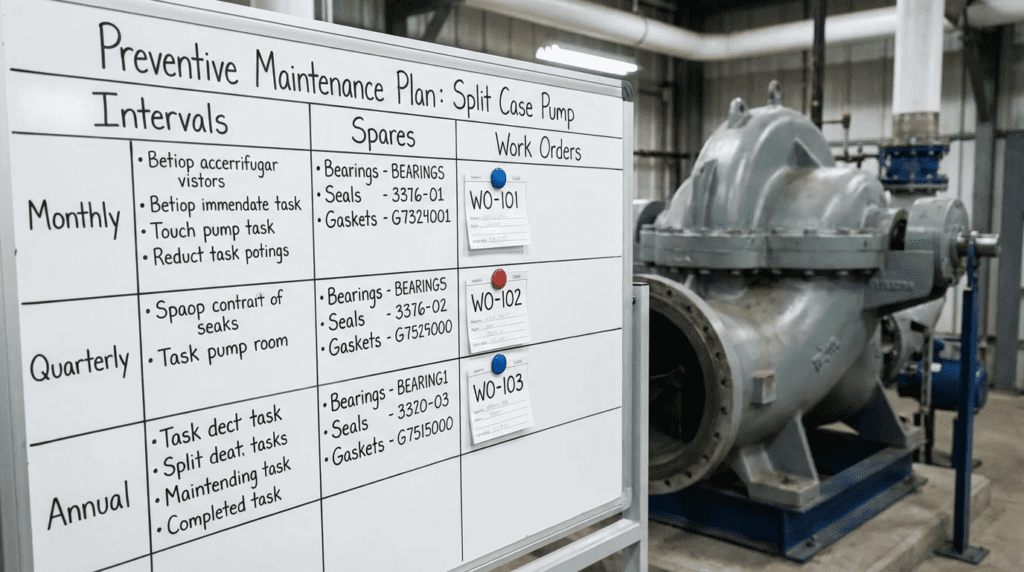
A robust strategy requires breaking down maintenance into intervals. A typical tiered approach includes:
- Daily/Weekly (Operator Routes): Visual inspection of seal leakage (none for mechanical, slight drip for packing), oil level/color check, noise check, and suction/discharge pressure log.
- Quarterly (Mechanical Tech): Vibration measurement, bearing temperature check, checking coupling guard and foundation bolts. Lubrication (if grease lubricated).
- Annual (Major PM): Check coupling alignment (laser alignment recommended), check packing box or seal flush lines for clogging, obtain oil sample for tribology analysis (moisture, metal particles).
- 3-5 Year (Overhaul): Lift upper casing, inspect wear ring clearance, inspect impeller for cavitation/erosion, replace bearings and seals.
Troubleshooting Guide
When a split case pump underperforms, the root cause is often hydraulic or systemic rather than mechanical.
- Symptom: High Vibration at 1x RPM. Likely Cause: Imbalance (impeller clog or erosion) or Misalignment.
- Symptom: High Vibration at Vane Pass Frequency. Likely Cause: Operating too far from BEP or gap ‘B’ (cutwater clearance) is too tight.
- Symptom: Hot Bearings. Likely Cause: Misalignment, over-greasing (churning), or wrong oil viscosity.
- Symptom: Rapid Seal Failure. Likely Cause: Shaft deflection, poor flush plan, or dry running.
DESIGN DETAILS / CALCULATIONS
Developing the Preventive Maintenance Plan for Split Case (Intervals Spares Work Orders) requires specific calculations regarding sizing and parts management. This section details the logic engineers should apply.
Sizing Logic & Methodology
The speed of the pump (RPM) has a quadratic effect on wear. A pump running at 3600 RPM will generally experience wear on wetted components four times faster than a comparable pump at 1800 RPM, assuming similar tip speeds and abrasive content. When sizing for longevity and reduced maintenance intervals, prioritize lower speed (1800 or 1200 RPM) selections, even if the initial pump cost is higher due to the larger frame size required.
Spares Inventory Calculation (Poisson Distribution):
To determine if a spare part should be stocked, consider the usage rate and criticality. For critical split case pumps, use a probability calculation.
Risk = (Probability of Failure) x (Cost of Downtime)
If the lead time for a specific bearing is 12 weeks and the cost of downtime is $10,000/day, the risk cost is astronomical. Even if the MTBF is 5 years, the sheer financial exposure mandates stocking the bearing.
Specification Checklist for Maintenance
Ensure the following are included in the specifications to support the future Preventive Maintenance Plan for Split Case (Intervals Spares Work Orders):
- Split Glands: For pumps with packing, split glands allow for repacking without dismantling the pump.
- Replaceable Wear Rings: Both case and impeller wear rings should be specified. Relying on machining the casing is a poor long-term strategy.
- Bearing Isolators: Specify Inpro/Seal or equivalent bearing isolators rather than standard lip seals to prevent contaminant ingress and oil egress.
- Casing Drains/Vents: Ensure drains are piped to a floor drain, not just plugged, to facilitate safe and clean draining during maintenance.
Standards & Compliance
Adherence to standards ensures the equipment is capable of surviving the maintenance plan.
- AWWA E103: Standard for Horizontal Centrifugal Water Pumps.
- Hydraulic Institute 9.6.4: Rotodynamic Pumps for Vibration Measurements and Allowable Values.
- ISO 1940-1: Mechanical vibration — Balance quality requirements (Specify G6.3 as standard, G2.5 for precision).
- OSHA 1910.147: The Control of Hazardous Energy (Lockout/Tagout). Design the system with distinct isolation valves and electrical disconnects within sight of the pump to streamline LOTO procedures during work orders.
FAQ SECTION
How do you determine the correct lubrication interval for split case pumps?
Lubrication intervals should not be guessed. For oil-lubricated pumps, synthetic oil changes are typically required every 6-12 months, but oil analysis is the gold standard. For grease, use the formula: Interval (Hours) = $14,000,000 / (n times sqrt{d})$, where $n$ is speed (RPM) and $d$ is bore diameter (mm). Adjust based on temperature and contamination. Over-greasing is as dangerous as under-greasing due to heat buildup.
What are the critical spare parts for a Preventive Maintenance Plan for Split Case (Intervals Spares Work Orders)?
The minimum critical spares inventory includes a complete set of mechanical seals (or packing), a full set of gaskets (casing and bearing housing), a complete set of bearings, and a coupling element. For critical pumps without installed redundancy, a Complete Rotating Assembly (CRA)—consisting of the shaft, impeller, sleeves, and bearings pre-assembled—is recommended to reduce repair time from days to hours.
What is the difference in maintenance between single-stage and multi-stage split case pumps?
Single-stage double-suction pumps are simpler, with bearings on either end and a centered impeller. Multi-stage pumps have multiple impellers and interstage bushings. The maintenance of multi-stage pumps is significantly more complex due to the precise axial alignment required and the difficulty in assessing interstage wear without full disassembly. They often require factory-authorized service centers for rebuilding.
How does operating off-BEP impact the maintenance schedule?
Operating away from the Best Efficiency Point (BEP) creates radial forces that deflect the shaft. This deflection creates uneven loading on bearings and seals. If a pump consistently operates below 70% or above 110% of BEP, the maintenance intervals for seals and bearings should be halved compared to a unit running near BEP. Vibration monitoring becomes critical in these applications.
Why is shaft alignment so critical in the Preventive Maintenance Plan for Split Case (Intervals Spares Work Orders)?
Misalignment is responsible for over 50% of rotating machinery failures. It causes vibration, excessive energy consumption, and premature failure of couplings, bearings, and seals. Laser alignment should be part of the commissioning work order and checked annually. “Rough” alignment using a straight edge is insufficient for modern high-speed pumps.
CONCLUSION
Key Takeaways
- Selection is Prevention: Specify pumps that operate within 80-110% of BEP to minimize hydraulic loads and extend component life.
- Access Matters: Ensure physical installation allows for overhead lifting and 360-degree personnel access for execution of work orders.
- Data-Driven Strategy: Move from reactive to condition-based maintenance by utilizing vibration and temperature monitoring (HI 9.6.4 standards).
- Spares Logic: Balance inventory costs against the cost of downtime; stock Complete Rotating Assemblies (CRAs) for non-redundant critical assets.
- Documentation: Define specific, quantifiable tasks in work orders (e.g., “Record Vibration”) rather than generic “Check Pump” instructions.
Developing a comprehensive Preventive Maintenance Plan for Split Case (Intervals Spares Work Orders) is not an administrative burden; it is a core engineering responsibility that directly impacts the hydraulic utility’s bottom line and reliability. The split case pump is designed for longevity, but that potential is only realized through deliberate specification, precise installation, and disciplined maintenance execution.
Engineers must bridge the gap between design parameters and operational realities. By specifying the right materials, ensuring proper hydraulic fit, and leveraging modern predictive technologies, utilities can transition from a cycle of emergency repairs to a culture of asset stewardship. The success of the plan relies on the seamless integration of correct intervals, strategic spares management, and detailed work orders—a triad that ensures water keeps flowing and systems remain secure.