
PFAS in Wastewater: Treatment Methods Risks & Compliance
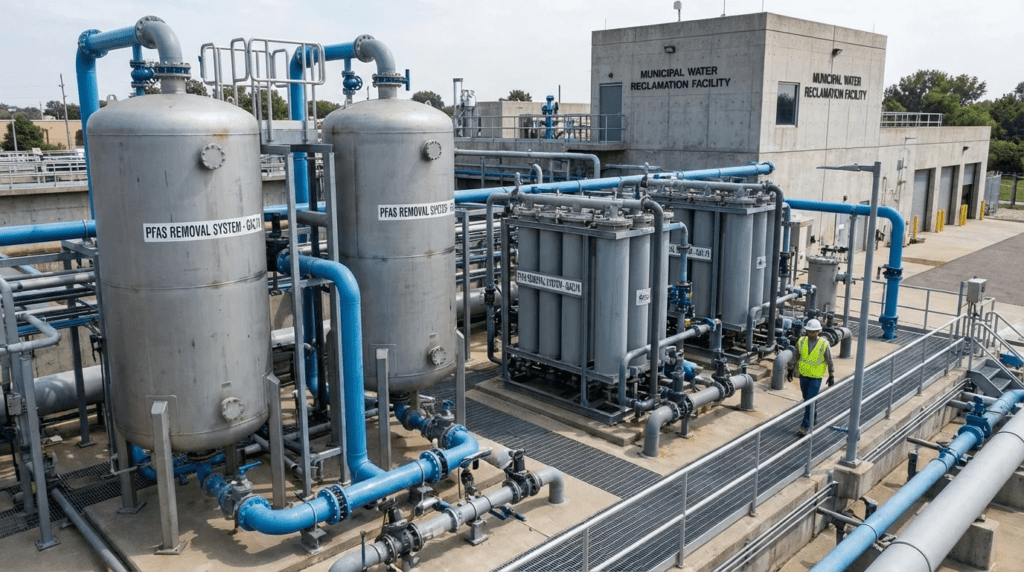
Introduction: The Complex Landscape of PFAS Management
The transition from regulating conventional pollutants in parts-per-million (ppm) to treating per- and polyfluoroalkyl substances (PFAS) in parts-per-trillion (ppt) or even parts-per-quadrillion (ppq) represents one of the most significant engineering challenges in modern environmental history. For consulting engineers, plant operators, and public works directors, understanding PFAS in Wastewater: Treatment Methods Risks & Compliance is no longer optional—it is a critical requirement driven by rapidly evolving federal and state mandates. Unlike traditional biological oxygen demand (BOD) or suspended solids, these “forever chemicals” feature virtually unbreakable carbon-fluorine (C-F) bonds that resist conventional biological wastewater treatment processes, passing through traditional clarifiers and aeration basins completely untouched.
Managing PFAS in wastewater involves a vast ecosystem of technologies and regulatory frameworks. The landscape spans from separation technologies that concentrate the contaminant to emerging destruction technologies that mineralize the molecules. Furthermore, it spans municipal sewage influent, highly concentrated industrial discharges, landfill leachates, and the critical complexities of biosolids management. Selecting the wrong treatment train can lead to millions of dollars in premature media exhaustion, secondary contamination pathways, or permit violations. This pillar page comprehensively outlines the full spectrum of subcategories within PFAS in Wastewater: Treatment Methods Risks & Compliance, providing engineers with a structured, technical framework for evaluating, specifying, and operating these critical systems.
Subcategory Landscape — Types, Technologies & Approaches
The field of PFAS management is broadly divided into two main categories: Separation technologies (which remove PFAS from the water stream but generate a concentrated waste stream or spent media) and Destruction technologies (which break the C-F bonds). Surrounding these technologies are specific application contexts, pretreatment requirements, and regulatory compliance frameworks. The following subsections detail the essential branches of this topic.
Granular Activated Carbon (GAC) for PFAS
Granular Activated Carbon (GAC) for PFAS is the most widely established separation technology in municipal and industrial water treatment. It relies on physical adsorption, where organic molecules become trapped in the porous structure of bituminous, sub-bituminous, or coconut-shell carbon. In wastewater applications, GAC requires significant pretreatment to remove Total Organic Carbon (TOC) and suspended solids, which will otherwise competitively adsorb or physically blind the carbon bed. Typical Empty Bed Contact Times (EBCT) range from 10 to 20 minutes, which demands massive vessel sizing for high-flow municipal applications. While highly effective at capturing long-chain PFAS (like PFOA and PFOS), GAC typically exhibits early breakthrough for short-chain variants (like PFBA and PFBS). Engineers must carefully calculate bed volumes (BV) to exhaustion, as high background organic matter can reduce media life from years to mere months.
Ion Exchange (IX) Resins for PFAS
Ion Exchange (IX) Resins for PFAS utilize synthetic polymeric resins engineered with positively charged functional groups. Because PFAS molecules exist as anions in typical wastewater pH ranges, they are drawn to the resin through both ion exchange and hydrophobic adsorption. IX resins offer significantly faster kinetics than GAC, allowing for EBCTs of 2 to 3 minutes, which dramatically reduces the required vessel footprint. They are highly effective at capturing short-chain PFAS. However, IX resins are highly susceptible to fouling from background dissolved organic matter (DOM) and competing anions (like high sulfates or nitrates). Most systems currently utilize single-use resins due to the complexity of managing highly concentrated, toxic regenerant brines, though regenerable systems are emerging for specific industrial applications.
Reverse Osmosis (RO) and Nanofiltration (NF) for PFAS
Reverse Osmosis (RO) and Nanofiltration (NF) for PFAS employ high-pressure membrane separation to physically block the passage of PFAS molecules based on molecular weight cutoff and charge exclusion. These systems achieve >99% rejection rates for both long- and short-chain PFAS, serving as an absolute barrier. They are typically specified for direct or indirect potable reuse (DPR/IPR) projects or industrial facilities requiring ultra-pure water. The critical limitation is the generation of a concentrated reject stream (brine) that comprises 15% to 25% of the total feed volume. This reject contains highly concentrated PFAS, demanding secondary treatment or deep-well injection. Furthermore, the operational expenditure (OPEX) is substantial due to high energy consumption (pumping pressures of 150-400+ psi) and mandatory membrane clean-in-place (CIP) routines.
Foam Fractionation (SAFF) Systems
Foam Fractionation (SAFF) Systems (Surface Active Foam Fractionation) leverage the inherent surfactant properties of PFAS molecules. In a reaction vessel, fine air bubbles are introduced; the hydrophobic fluorinated carbon tails of the PFAS molecules attach to the bubbles and rise to the surface, creating a highly concentrated PFAS foam. This foam is then skimmed, collapsed, and either destroyed or sequestered. SAFF is particularly well-suited for high-concentration, highly complex matrices like landfill leachate or AFFF (aqueous film-forming foam) contaminated groundwater. It operates with minimal pretreatment, ignores background organics, and utilizes no consumable media, resulting in very low OPEX. However, it struggles to achieve the ultra-low parts-per-trillion effluent limits required for drinking water without secondary polishing steps.
Coagulation and Flocculation Pretreatment
Because downstream media like GAC and IX are highly sensitive to particulate and organic fouling, Coagulation and Flocculation Pretreatment is a mandatory sub-system in wastewater applications. Traditional metal salts (ferric chloride, alum) or advanced polymeric coagulants are utilized to precipitate suspended solids and natural organic matter (NOM). In some emerging approaches, specialty fluorinated coagulants or modified clays are injected to bind with PFAS directly, settling out in the clarifier. Proper specification of this pretreatment step dictates the lifecycle cost of the entire treatment train; failing to adequately depress TOC will lead to rapid exhaustion of downstream adsorptive media.
Supercritical Water Oxidation (SCWO)
Moving into destruction technologies, Supercritical Water Oxidation (SCWO) subjects the concentrated PFAS waste stream to temperatures above 374°C and pressures exceeding 3,200 psi. In this supercritical state, water acts as a completely non-polar solvent, allowing oxygen and organic compounds to mix freely. The process rapidly breaks the stubborn C-F bonds, mineralizing the PFAS into carbon dioxide, water, and benign fluoride ions within seconds. SCWO is generally applied to concentrated residuals (like spent IX regenerant, RO reject, or collapsed SAFF foam) rather than dilute wastewater flow. The engineering challenges include managing severe corrosion of the reactor vessels (due to hydrofluoric acid generation) and salt precipitation.
Electrochemical Oxidation (EO)
Electrochemical Oxidation (EO) utilizes specialized electrodes—typically Boron-Doped Diamond (BDD) or mixed metal oxides—to generate powerful hydroxyl radicals and directly oxidize PFAS molecules via electron transfer. When a direct current is applied, the process effectively cleaves the C-F bonds, defluorinating both long and short-chain PFAS. EO operates at ambient temperatures and pressures, making it safer and easier to integrate than high-pressure thermal systems. It is best applied to industrial wastewater streams or RO concentrates with high electrical conductivity. Key specification factors include managing the generation of hazardous byproducts (like perchlorate or halogenated organics) if chloride is present in the feed stream.
Hydrothermal Alkaline Treatment (HALT)
Hydrothermal Alkaline Treatment (HALT) combines high heat (around 350°C), elevated pressure, and a strong alkaline reagent (typically sodium hydroxide) to chemically destroy PFAS. The alkaline environment prevents the severe acidic corrosion seen in SCWO by neutralizing the generated fluoride ions into inert sodium fluoride salts. HALT is highly effective at destroying PFAS in complex, high-solids matrices, making it a primary candidate for treating municipal biosolids or heavily contaminated industrial sludge. The technology requires careful heat-recovery engineering to minimize the energy penalty associated with heating high-moisture sludge.
RO Concentrate and Reject Water Management
The management of high-strength waste streams is a subcategory of its own. RO Concentrate and Reject Water Management dictates the feasibility of membrane systems. Engineers cannot simply discharge PFAS-laden RO brine back into the municipal sewer or local waterways. Current approaches include thermal evaporation/crystallization (Zero Liquid Discharge – ZLD), deep-well injection, or routing the concentrate to destruction technologies like EO or SCWO. The specification of reject management often eclipses the capital cost of the primary RO system itself and requires rigorous mass-balance modeling.
Spent Media Thermal Reactivation
For systems utilizing carbon, Spent Media Thermal Reactivation is a critical lifecycle component. Exhausted GAC is typically removed via slurry pumps and transported to a specialized off-site thermal reactivation facility. The media is subjected to temperatures exceeding 1,000°C in a rotary kiln, which volatilizes and destroys the adsorbed PFAS while restoring the carbon’s pore structure. Because high-temperature incineration is required to ensure complete destruction (preventing incomplete combustion products like CF4 gas), engineers must specify rigorous chain-of-custody tracking. IX resins, containing a polymer backbone, generally cannot be thermally reactivated in the same manner and require specialized incineration or landfilling.
Biosolids PFAS Management
In municipal treatment, the majority of long-chain PFAS partition into the sludge during primary settling and biological treatment. Biosolids PFAS Management focuses on the regulatory and technical challenge of handling this contaminated sludge. Historically land-applied as fertilizer, PFAS-laden biosolids are increasingly facing state-level bans. Engineering solutions involve transitioning away from land application toward thermal drying followed by pyrolysis or gasification, which operate at temperatures sufficient to break down PFAS compounds, yielding a safe biochar. Managing the off-gas from these thermal processes is a critical regulatory hurdle.
Landfill Leachate PFAS Treatment
Landfill Leachate PFAS Treatment represents one of the harshest application environments. Leachate contains massive concentrations of ammonia, heavy metals, total dissolved solids (TDS), and high TOC alongside high PFAS levels. Traditional GAC or IX fails rapidly in this matrix due to immediate fouling. Engineers typically specify a train combining biological pretreatment (for ammonia/BOD), followed by UF/RO or SAFF technologies. Due to the remote location of many landfills and minimal operator presence, systems must be highly robust and automated.
Industrial PFAS Wastewater Treatment
Industrial PFAS Wastewater Treatment deals with localized, high-concentration discharges from facilities such as semiconductor manufacturing, chrome plating, textile waterproofing, and AFFF training sites. Influent concentrations can range from hundreds of ppt to parts-per-million (ppm). Treatment trains here are highly customized. Because the wastewater matrix is generally more defined than municipal sewage, engineers can specify tailored IX resins, targeted chemical precipitation, or direct EO destruction. Space constraints and factory integration are primary selection criteria.
Municipal Water Resource Recovery Facility (WRRF) Integration
Municipal Water Resource Recovery Facility (WRRF) Integration addresses the challenge of retrofitting existing centralized sewage treatment plants to capture PFAS. Because treating the entire plant influent (millions of gallons per day) with GAC or IX is economically unfeasible, strategies focus on source control (industrial pretreatment programs), targeted side-stream treatment (treating high-strength return liquors from dewatering), or advanced tertiary treatment (membrane bioreactors followed by RO/UV-AOP) for reuse applications.
EPA NPDES PFAS Permitting Requirements
On the compliance side, EPA NPDES PFAS Permitting Requirements are forcing municipalities and industrial dischargers to implement comprehensive monitoring and reporting. The EPA’s recent guidance requires permit writers to include requirements for PFAS monitoring using Draft Method 1633, implementation of Best Management Practices (BMPs), and eventual numeric effluent limits. Engineers must design treatment systems with built-in sampling ports, flow-proportional auto-samplers, and sufficient redundancy to guarantee compliance as draft permits evolve into strict enforcement.
MCLs and State-Level PFAS Regulations
Finally, MCLs and State-Level PFAS Regulations dictate the actual target performance of the treatment system. The EPA’s National Primary Drinking Water Regulation establishes legally enforceable Maximum Contaminant Levels (MCLs) for six PFAS (including PFOA and PFOS at 4.0 ppt). While these are drinking water standards, they directly impact wastewater engineers through surface water quality criteria, indirect potable reuse standards, and groundwater discharge limits. Certain states (like Michigan, California, and Massachusetts) have implemented their own rigorous guidelines, requiring engineers to design treatment vessels with sufficient series-configuration (lead-lag) to guarantee non-detect effluent.
Selection & Specification Framework
Choosing the correct approach within PFAS in Wastewater: Treatment Methods Risks & Compliance requires a rigorous decision framework, balancing capital expenditure (CAPEX), operating expenditure (OPEX), footprint, and regulatory risk.
1. Assess the Water Matrix (Background Contaminants):
The presence of Total Organic Carbon (TOC), Total Suspended Solids (TSS), and competing ions dictates the technology.
- If TOC is high (>2-5 mg/L) and cannot be easily pre-treated: Reverse Osmosis (RO) and Nanofiltration (NF) for PFAS or Foam Fractionation (SAFF) Systems are highly preferred. Granular Activated Carbon (GAC) for PFAS will suffer from rapid pore blockage.
- If competing ions (sulfates, nitrates) are high: Avoid single-use Ion Exchange (IX) Resins for PFAS, as these background ions will consume the exchange capacity rapidly.
2. Target Contaminant Chain Length:
- For primarily long-chain PFAS (PFOA, PFOS), GAC provides an excellent, cost-effective lifecycle.
- If short-chain PFAS (PFBA, PFBS) must be removed to non-detect levels, IX resins or RO are mandatory, as short-chains break through GAC beds very early in the operational cycle.
3. Flow Rate vs. Concentration Logic:
- High Flow, Low Concentration (Municipal Effluent): Use GAC or IX in a lead-lag configuration. Focus on low headloss and media optimization.
- Low Flow, High Concentration (Industrial/Leachate): Use SAFF or RO, followed by on-site destruction like Electrochemical Oxidation (EO) or Hydrothermal Alkaline Treatment (HALT).
Lifecycle Cost Tradeoffs:
GAC features low initial media cost but requires massive steel vessels (high CAPEX) and frequent changeouts if TOC is high (high OPEX). IX requires smaller vessels (lower CAPEX) but the media is 3 to 5 times more expensive per cubic foot than GAC. RO has the highest energy footprint and requires a permanent solution for RO Concentrate and Reject Water Management, making its 20-year lifecycle cost the highest, though it guarantees the highest water quality.
Specification Pitfalls:
A common engineering mistake is evaluating media life purely on PFAS loading curves provided by manufacturers, ignoring the impact of dissolved organics. Engineers must require rapid small-scale column tests (RSSCT) using the actual site wastewater, not synthetic lab water, to establish accurate bed volume (BV) exhaustion rates.
Comparison Tables
The following tables provide an engineer-level comparative matrix mapping the various separation and destruction technologies against operational parameters and application suitability.
Table 1: Subcategory Comparison – PFAS Treatment Technologies
| Type / Technology | Key Mechanisms | Best-Fit Applications | Primary Limitations | Relative CAPEX/OPEX |
|---|---|---|---|---|
| Granular Activated Carbon (GAC) for PFAS | Physical adsorption into carbon pores | Low TOC municipal tertiary treatment, long-chain PFAS | Massive footprint (10-20 min EBCT); early short-chain breakthrough | High CAPEX / Med OPEX |
| Ion Exchange (IX) Resins for PFAS | Anion exchange + hydrophobic interaction | Space-constrained sites; short-chain PFAS targets | Highly sensitive to competing anions (sulfates/nitrates) & DOM | Med CAPEX / High OPEX |
| Reverse Osmosis (RO) and Nanofiltration (NF) for PFAS | High-pressure membrane exclusion | Potable reuse; extreme effluent standards (<1 ppt) | Generates 15-25% reject brine; high pumping energy | High CAPEX / High OPEX |
| Foam Fractionation (SAFF) Systems | Surfactant collection via fine air bubbles | Landfill leachate; AFFF wastewater; high concentration | Cannot achieve ultra-low ppt limits without polishing step | Low CAPEX / Low OPEX |
| Supercritical Water Oxidation (SCWO) | Thermal destruction in supercritical phase (>374°C) | Concentrated liquid residuals, exhausted regenerant | Severe reactor corrosion; complex high-pressure safety | High CAPEX / High OPEX |
| Hydrothermal Alkaline Treatment (HALT) | Thermal destruction with alkaline reagent | Biosolids PFAS Management; thick industrial sludges | High energy penalty for heating water-heavy sludge | High CAPEX / Med OPEX |
Table 2: Application Fit Matrix
| Application Scenario | Recommended Subcategory Fit | Key Constraints to Manage | Operator Skill Required |
|---|---|---|---|
| Municipal Potable Reuse (High Flow, Ultra-low limits) | Reverse Osmosis (RO) and Nanofiltration (NF) for PFAS | Brine disposal feasibility; membrane fouling | Very High (Membrane CIP, High Pressure) |
| Polishing Secondary Municipal Effluent (Low TOC) | Granular Activated Carbon (GAC) for PFAS (Lead-Lag) | Footprint availability; tracking BV to exhaustion | Low/Medium (Valve manipulation, sampling) |
| Landfill Leachate PFAS Treatment | Foam Fractionation (SAFF) Systems | Foam collapse chemistry; cold weather impacts | Medium (Airflow adjustment, skimming) |
| Low-flow, Short-chain contaminated industrial discharge | Ion Exchange (IX) Resins for PFAS | Pre-filtration for TSS; competing sulfates | Medium (Vessel sequencing) |
| Handling RO Concentrate on-site | Electrochemical Oxidation (EO) | Electrode scaling; byproduct formation (perchlorate) | High (Electrical systems, cleaning cycles) |
Engineer & Operator Field Notes
Bridging the gap between theoretical design and real-world plant operation reveals nuances that can make or break a PFAS treatment facility. The following notes span across subcategories, highlighting where practical requirements diverge.
Commissioning Considerations
Commissioning procedures vary wildly between technologies. For Granular Activated Carbon (GAC) for PFAS, the initial backwashing and wetting process is critical. Carbon contains trapped air and fines; vessels must be soaked (often for 24+ hours) and slowly backwashed to stratify the bed and prevent channeling. Conversely, Ion Exchange (IX) Resins for PFAS do not require backwashing (and backwashing can actually disrupt the optimized resin packing), but they must be properly hydrated and flushed of organic manufacturing residuals before being placed into service. For destruction systems like Supercritical Water Oxidation (SCWO), commissioning involves rigorous pressure-testing of specialized high-alloy steel pipework to withstand >3000 psi operations safely.
Common Specification Mistakes
A frequent specification error is designing a system based solely on the target PFAS concentration. If an engineer specifies an IX system for a groundwater stream with 50 ppt of PFAS but ignores a background sulfate concentration of 150 mg/L, the sulfates will completely exhaust the resin’s exchange capacity within weeks, resulting in exorbitant media replacement costs. Always analyze full general chemistry (anions, cations, TOC, metals) before selecting media.
Operations & Maintenance Profiles
The O&M burden shifts heavily depending on the technology. Systems relying on Coagulation and Flocculation Pretreatment combined with GAC require routine sludge handling, coagulant dose optimization (often automated via streaming current detectors), and media changeouts managed by specialized contractors. The maintenance profile for Reverse Osmosis (RO) and Nanofiltration (NF) for PFAS is chemical-intensive, requiring frequent antiscalant monitoring, daily performance normalization tracking, and aggressive CIP routines using specialized acids and bases to clear membrane fouling.
Troubleshooting Overviews
When an effluent violation occurs, root-cause analysis is technology-specific:
- GAC/IX Early Breakthrough: Usually points to short-circuiting/channeling in the vessel (due to broken underdrains or improper backwashing) or an unexpected spike in influent TOC/competing ions.
- RO Permeate Quality Drop: Indicates membrane degradation (O-ring failure or oxidative damage from chlorine).
- SAFF Performance Drop: Often traced to a change in influent surface tension (presence of competing industrial surfactants or oils) disrupting foam formation.
Design Details & Standards
Sound engineering design requires strict adherence to sizing methodologies and industry standards. The specifications for treating PFAS in Wastewater: Treatment Methods Risks & Compliance utilize specific mathematical frameworks.
Sizing Methodology Overview
For adsorptive media (GAC and IX), the primary sizing metrics are Empty Bed Contact Time (EBCT), Hydraulic Loading Rate (HLR), and Bed Volumes (BV) to exhaustion:
EBCT (min) = [Bed Volume (gallons)] / [Flow Rate (GPM)]
While Ion Exchange (IX) Resins for PFAS operate effectively at shorter EBCTs (2.5 – 3 minutes) with higher hydraulic loading rates (up to 10 GPM/ft²), Granular Activated Carbon (GAC) for PFAS demands much larger vessels to achieve 10 – 20 minute EBCTs at slower loading rates (2 – 5 GPM/ft²). This disparity means a 1 MGD plant might require two 10-foot diameter IX vessels versus four 12-foot diameter GAC vessels.
Regardless of whether you choose GAC or IX, vessels must be specified in a series “lead-lag” (or merry-go-round) configuration. This allows the primary (lead) vessel to run to complete exhaustion, fully utilizing the media’s capacity, while the secondary (lag) vessel safely polishes the effluent. Once the lead is replaced, valves are switched so the old lag becomes the new lead.
Standards and Compliance Guidelines
Engineers must ensure components meet strict codes:
- Pressure Vessels: Must be stamped to ASME Boiler and Pressure Vessel Code (BPVC) Section VIII, especially critical for RO and thermal destruction technologies.
- Media and Linings: For any system treating water that may enter indirect potable reuse, components must hold NSF/ANSI 61 certification. Linings for IX vessels are critical; standard epoxy may fail, requiring vinyl ester linings to prevent leaching.
- Piping: Due to the extreme corrosive nature of processes like Hydrothermal Alkaline Treatment (HALT) and SCWO, standard 316SS is insufficient; high-nickel alloys (Hastelloy, Inconel) or titanium are required.
Specification Checklist
When drafting the specification package, ensure the following are clearly defined:
1. Exact target effluent limits (e.g., non-detect vs. <4.0 ppt).
2. Requirement for full-scale pilot testing or RSSCT before finalizing media volume.
3. Media changeout service requirements (e.g., turnkey service including vacuum removal, disposal, and virgin media reload).
4. Specific protocols for Spent Media Thermal Reactivation chain-of-custody.
5. Guaranteed maximum pressure drop across vessel internals.
FAQ Section
What are the different types of technologies for treating PFAS in wastewater?
The field is divided into separation and destruction. Separation includes Granular Activated Carbon (GAC) for PFAS, Ion Exchange (IX) Resins for PFAS, Reverse Osmosis (RO) and Nanofiltration (NF) for PFAS, and Foam Fractionation (SAFF) Systems. Destruction technologies, which break the carbon-fluorine bond, include Supercritical Water Oxidation (SCWO), Electrochemical Oxidation (EO), and Hydrothermal Alkaline Treatment (HALT). Coagulation and Flocculation Pretreatment is also utilized to prepare the water for downstream processes.
How do you choose between Granular Activated Carbon (GAC) and Ion Exchange (IX) for PFAS?
The choice heavily depends on background water chemistry and space constraints. Granular Activated Carbon (GAC) for PFAS is cost-effective for waters with low organics and large footprints, particularly targeting long-chain PFAS. Ion Exchange (IX) Resins for PFAS are selected when space is limited (due to shorter contact times required), when short-chain PFAS removal is critical, and when background competing ions (like sulfates) are low.
What is the most cost-effective treatment for high-concentration leachate?
For high-concentration, high-TOC applications like Landfill Leachate PFAS Treatment, traditional media fails rapidly. Foam Fractionation (SAFF) Systems are highly cost-effective here because they do not rely on consumable media, instead using air bubbles to concentrate the PFAS into a small volume of foam, generating very low OPEX despite the difficult water matrix.
How are PFAS regulations impacting wastewater permitting?
Under new EPA NPDES PFAS Permitting Requirements, wastewater facilities must implement rigorous monitoring using Method 1633. As federal MCLs and State-Level PFAS Regulations take effect, surface water quality standards are driving numeric limits into discharge permits, forcing Municipal Water Resource Recovery Facility (WRRF) Integration of advanced treatment trains.
How are RO concentrates and spent media handled?
Separation technologies generate concentrated waste. Spent Media Thermal Reactivation relies on >1000°C kilns to destroy PFAS on carbon so it can be reused. RO Concentrate and Reject Water Management is more complex, often requiring deep well injection or emerging destruction techs like Electrochemical Oxidation (EO) to mineralize the liquid brine safely.
How are PFAS handled in municipal sludge?
Because PFAS partition heavily into solids during biological treatment, Biosolids PFAS Management is a critical challenge. Traditional land application is being restricted. Modern approaches involve thermal drying followed by high-temperature pyrolysis, gasification, or processing the sludge through Hydrothermal Alkaline Treatment (HALT) to destroy the chemical bonds.
Conclusion
KEY TAKEAWAYS: PFAS in Wastewater: Treatment Methods Risks & Compliance
- Separation vs. Destruction: Current commercial scale is dominated by separation (GAC, IX, RO, SAFF), while destruction (SCWO, EO, HALT) is evolving for high-strength residuals.
- Media Life is Contextual: Never specify adsorptive media without analyzing background TOC and competing anions; they dictate OPEX more than the PFAS itself.
- Sizing Rules: GAC requires 10-20 minutes EBCT; IX requires 2-3 minutes. Always utilize a Lead-Lag vessel configuration for safety and efficiency.
- Residuals Dictate Feasibility: The cost and method of RO Concentrate and Reject Water Management or Spent Media Thermal Reactivation must be solved before equipment selection.
- Regulatory Trajectory: Design with future limits in mind. EPA NPDES PFAS Permitting Requirements are shifting from monitoring-only to strict numeric effluent limits.
Mastering the engineering required for PFAS in Wastewater: Treatment Methods Risks & Compliance is an exercise in balancing complex physical chemistry, life-cycle economics, and evolving legal standards. There is no universally superior technology. Municipalities dealing with dilute, high-flow streams will largely depend on optimized GAC and single-use IX systems integrated via careful Municipal Water Resource Recovery Facility (WRRF) Integration. In contrast, industrial sites dealing with AFFF or complex wastewater must evaluate resilient technologies like SAFF, RO, or direct electrochemical destruction. Ultimately, success requires engineers to look beyond the immediate capital cost of pressure vessels and rigorously model the 20-year operational lifecycle—factoring in media replacement frequency, residual disposal pathways, energy consumption, and the inevitable tightening of regulatory limits. By understanding the detailed subcategories outlined in this guide, technical professionals can navigate this complex landscape safely and effectively.