
Biogas & Energy Recovery: Methods and Best Practices
Introduction
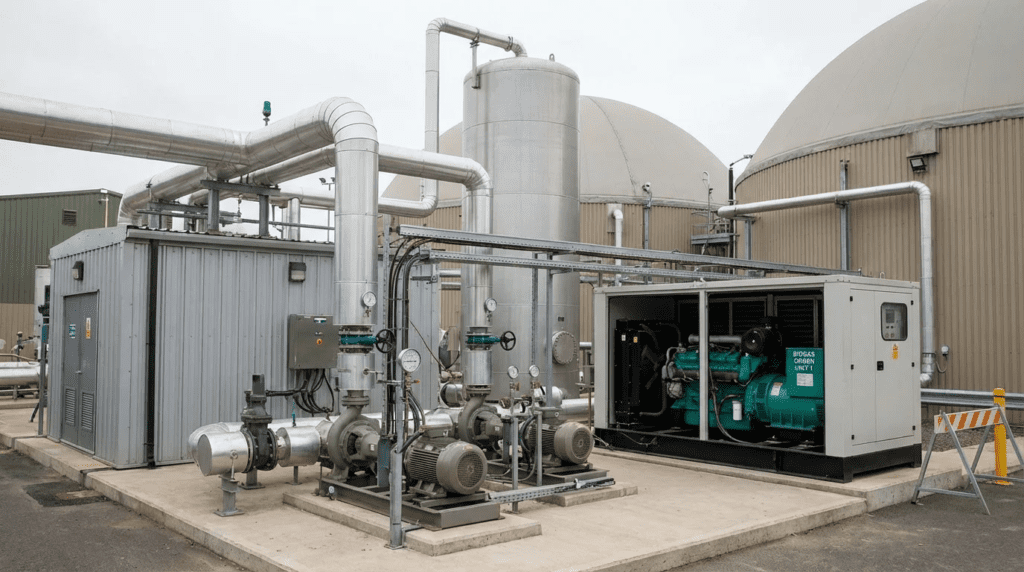
Flaring raw, unconditioned biogas is the engineering equivalent of setting utility budget dollars on fire. For decades, wastewater treatment facilities viewed biogas merely as a hazardous byproduct of anaerobic digestion—a nuisance gas to be safely combusted and vented. Today, navigating Biogas & Energy Recovery: Methods and Best Practices is a core competency for modern public works directors and process engineers. As municipal and industrial facilities push toward net-zero energy consumption and strict greenhouse gas (GHG) emission targets, capturing the latent chemical energy in biogas has shifted from a luxury to a baseline design requirement.
Biogas—typically composed of 60% methane (CH4) and 40% carbon dioxide (CO2), along with destructive trace impurities—presents unique engineering challenges. The equipment required to handle, treat, and convert this gas spans a massive landscape of technologies. From massive internal combustion engines providing combined heat and power (CHP), to high-tech membrane separators injecting biomethane directly into commercial natural gas grids, the choices are vast.
Properly understanding this technical landscape matters because specification errors in the gas train lead to catastrophic downstream failures, such as siloxane polymerization destroying million-dollar engine cylinder heads, or hydrogen sulfide (H2S) inducing rapid corrosion in gas compressors. This pillar page provides a comprehensive overview of Biogas & Energy Recovery: Methods and Best Practices, categorizing the distinct technologies, comparing lifecycle costs, outlining selection frameworks, and establishing foundational standards for resilient gas train design.
Subcategory Landscape — Types, Technologies & Approaches
The biogas energy recovery landscape is conceptually divided into four sequential stages: Generation & Collection, Gas Handling & Storage, Conditioning (Cleaning), and Utilization (Energy Recovery). Engineers must view these subcategories not as isolated equipment choices, but as a deeply integrated process train. The selection of a downstream utilization technology directly dictates the stringency of the upstream conditioning equipment. Below is a detailed breakdown of the major subcategories that define the current technical landscape.
Generation & Collection Systems
Before biogas can be utilized, it must be optimized during production and safely captured. The following subcategories govern the physical interface between the liquid anaerobic digestion process and the gaseous handling train.
Anaerobic Digester Tank Mixing Systems
Digester mixing relies on mechanical, pumped liquid, or gas draft-tube technologies to maintain homogeneous sludge conditions. Efficient Anaerobic Digester Tank Mixing Systems maximize volatile solids reduction (VSR) and stabilize the daily volume of biogas production. By preventing grit settling and scum layer formation, advanced mixing ensures that methane generation does not suffer from "short-circuiting" or dead zones. Selecting the right mixing system directly impacts the economic viability of downstream energy recovery by ensuring a predictable baseline flow of standard cubic feet per minute (scfm).
Biogas Collection Covers and Domes
To capture the produced gas, digesters are fitted with rigid or flexible covers. Biogas Collection Covers and Domes must withstand significant weather loads, pressure fluctuations, and a highly corrosive internal atmosphere. Traditional fixed steel covers provide high pressure ratings but limited volume flexibility, while dual-membrane flexible domes act as an integrated collection and low-pressure storage solution. Proper specification requires balancing snow/wind load requirements against the necessary variable gas volume storage needed to buffer downstream equipment.
Biogas Piping and Condensate Traps
Once captured, the gas must be safely transported. Saturated with water vapor at digester temperatures (typically 95°F for mesophilic), raw biogas cools as it enters piping, leading to continuous condensation. Biogas Piping and Condensate Traps (including drip traps and sediment accumulators) are strictly regulated components designed to prevent water pooling. Water hammer or occlusion in low-pressure biogas lines can cause digester over-pressurization. Stainless steel (304/316L) or HDPE are typical pipe materials, sized to maintain low gas velocities (typically <15 ft/sec) to minimize pressure drop.
Gas Handling and Storage
Because biogas production rates rarely perfectly match real-time energy demands, handling and buffering equipment is mandatory to smooth out the operational profile.
Biogas Blowers and Gas Compressors
Most digesters operate at a very low pressure (typically 8 to 15 inches of water column [in. w.c.]). Downstream equipment requires higher delivery pressures. Biogas Blowers and Gas Compressors elevate this pressure. Centrifugal or positive displacement (PD) blowers are used for low-to-medium pressure applications (boilers, flares), while rotary vane, liquid ring, or screw compressors are specified when feeding microturbines or RNG upgrading systems requiring high pressures (up to 200+ psig). Materials of construction must account for wet H2S gas environments, often utilizing spark-proof brass, aluminum, or coated steel components.
Low-Pressure Biogas Storage Membranes
To prevent frequent startup/shutdown cycling of engines or flares due to fluctuating gas production, plants rely on Low-Pressure Biogas Storage Membranes. Often configured as standalone spheres or digester-mounted dual membranes, these systems provide buffer capacity. A typical design holds 4 to 12 hours of average gas production. The outer membrane provides weather protection while the inner membrane expands and contracts with gas volume, monitored by ultrasonic or radar level sensors that send start/stop signals to the energy recovery equipment.
Biogas Conditioning & Upgrading (Cleaning)
Raw biogas is saturated with moisture, laced with corrosive H2S, and often contaminated with volatile siloxanes. Proper conditioning is the most critical factor in the longevity of any energy recovery project.
Biogas Chilling and Moisture Removal
Moisture acts as a vector for corrosion when combined with H2S, forming sulfuric acid. Biogas Chilling and Moisture Removal systems typically employ shell-and-tube or fin-and-tube heat exchangers paired with a glycol chiller loop to drop the gas temperature below its dew point (typically chilling to 40°F). The condensed water is knocked out via a moisture separator. Reheating the gas slightly after chilling drops the relative humidity, preventing any subsequent condensation in downstream equipment and improving combustion stability.
Hydrogen Sulfide (H2S) Scrubber Systems
H2S is highly toxic, corrosive, and produces environmentally regulated sulfur dioxide (SO2) when burned. Depending on the substrate (e.g., high-protein industrial waste), raw H2S levels can range from 100 to 5,000+ ppm. Hydrogen Sulfide (H2S) Scrubber Systems are deployed to reduce these levels. Options include passive solid-media vessels (iron sponge or specialized activated carbon), liquid chemical scrubbers (caustic/hypochlorite), or biological trickling filters. Selection depends entirely on the mass loading of sulfur and the strictness of the downstream requirement (e.g., boilers can handle ~1000 ppm, whereas RNG requires <4 ppm).
Siloxane Removal Systems
Siloxanes are volatile silicon-based compounds prevalent in municipal wastewater due to their use in personal care products. When burned, siloxanes oxidize into silicon dioxide (SiO2)—essentially sand—which coats spark plugs, heat exchangers, and cylinder walls, destroying engines in a matter of months. Siloxane Removal Systems generally rely on temperature-swing adsorption (TSA) using specialized activated carbon or silica gel beds. Sizing these vessels requires careful gas sampling, as premature breakthrough will void OEM engine warranties.
Carbon Dioxide (CO2) Removal Technologies
If the goal is to produce pipeline-quality natural gas rather than onsite electricity, the ~40% CO2 content must be removed to increase the gas heating value. Carbon Dioxide (CO2) Removal Technologies include polymeric membrane separation, pressure swing adsorption (PSA), water scrubbing, or amine gas treating. These are highly complex, capital-intensive processes that upgrade raw biogas (approx. 600 BTU/scf) to biomethane/RNG (>970 BTU/scf).
Energy Recovery Equipment (Utilization)
This category defines how the latent chemical energy of the gas is actually converted into usable utilities (heat, electricity, or vehicle fuel).
Internal Combustion (IC) Engine Cogeneration
The most common form of municipal energy recovery is Internal Combustion (IC) Engine Cogeneration. These modified natural gas engines drive a generator to produce electricity while capturing waste heat from the engine jacket water and exhaust gas to heat the anaerobic digesters. Suitable for flows scaling from 100 kW to multiple megawatts, IC engines offer high electrical efficiency (35-42%). However, they demand rigorous maintenance and strictly conditioned gas to prevent premature top-end overhauls.
Biogas Microturbines
For smaller plants with lower gas volumes (typically under 200 kW of output), Biogas Microturbines present a high-reliability alternative to reciprocating engines. Microturbines utilize a continuous combustion process with only one moving part (a single shaft carrying the compressor, turbine, and generator). While their electrical efficiency is slightly lower than IC engines (around 25-30%), they are highly tolerant of H2S and rarely require siloxane removal, dramatically reducing upstream conditioning OPEX.
Fuel Cell Energy Recovery
Representing the cutting edge of ultra-low emission technology, Fuel Cell Energy Recovery chemically reacts methane and oxygen to produce electricity and heat without combustion. Systems like molten carbonate fuel cells (MCFC) or solid oxide fuel cells (SOFC) yield very high electrical efficiencies and virtually zero NOx emissions, making them ideal for strict air-quality districts like Southern California. However, fuel cells require absolute purity in gas conditioning, demanding near-zero ppm for sulfur, siloxanes, and halocarbons.
Hot Water Boilers and Heat Recovery
The simplest and most robust form of energy recovery involves burning gas directly to create heat. Hot Water Boilers and Heat Recovery systems utilize biogas-specific dual-fuel burners to maintain digester temperatures and heat plant facilities. Boilers are highly tolerant of impurities; typically, a simple moisture knockout and basic H2S reduction are sufficient. While boilers do not offset plant electrical draw, their extremely low capital and maintenance costs make them the fallback standard for smaller facilities.
Renewable Natural Gas (RNG) Upgrading Technologies
Rather than burning the gas onsite, Renewable Natural Gas (RNG) Upgrading Technologies clean and compress the gas to commercial utility standards for injection into a natural gas pipeline or for use as compressed natural gas (CNG) vehicle fuel. This subcategory aggregates CO2 removal, deep desulfurization, and high-pressure compression. Driven by lucrative environmental commodities markets (like US EPA RINs or California LCFS credits), RNG has become the preferred approach for medium to large-scale WWTPs, despite the enormous upfront CAPEX.
Waste Gas Burners and Flares
Even the most optimized energy recovery system experiences downtime for maintenance. Regulatory agencies require a fail-safe method to destroy methane and mitigate odors. Waste Gas Burners and Flares (either open-candlestick or enclosed ground flares) serve as the mandatory pressure-relief and emergency destruction mechanism. Enclosed flares provide guaranteed destruction efficiencies (typically >99%) and hidden flames to satisfy local visual and emissions permitting.
Contextual Applications
The origin of the biogas radically alters the gas composition, flow stability, and project economics.
Municipal Wastewater Biogas Systems
Generated from primary sludge and waste activated sludge (WAS), Municipal Wastewater Biogas Systems provide a relatively stable, predictable volume of gas. However, municipal biogas is notorious for high siloxane concentrations due to residential soaps and shampoos, requiring stringent pretreatment for engines.
Industrial Anaerobic Pretreatment Biogas
Food and beverage, brewery, and dairy processors utilize high-rate anaerobic digesters (like UASB or EGSB reactors) to handle high-strength wastewater. Industrial Anaerobic Pretreatment Biogas systems typically produce gas with negligible siloxanes but wildly fluctuating volumes based on factory production schedules. High H2S levels are common if the influent has high protein or sulfate concentrations.
Agricultural Co-Digestion Biogas
When agricultural waste (dairy manure, swine waste) is combined with outside organic streams (food waste), the process is termed co-digestion. Agricultural Co-Digestion Biogas yields extremely high gas production rates, making it an ideal candidate for large-scale RNG pipeline injection. Siloxanes are rarely an issue, but H2S loading can be substantial.
Selection & Specification Framework
Choosing between the myriad options within Biogas & Energy Recovery: Methods and Best Practices requires a disciplined decision-making logic. Engineers cannot simply pick the technology with the highest theoretical efficiency; they must balance facility size, electrical tariffs, gas composition, and operator skill level.
The Decision Tree Logic
- Assess Total Gas Volume (scfm): The lowest barrier to entry is flow. Flows under 50 scfm generally dictate Hot Water Boilers and Heat Recovery or simply flaring. Flows from 50–150 scfm might support Biogas Microturbines. Flows spanning 150–1,000 scfm fall squarely into the Internal Combustion (IC) Engine Cogeneration range. Only at higher continuous flows (typically >400 scfm) do the economies of scale justify Renewable Natural Gas (RNG) Upgrading Technologies.
- Evaluate the Plant Thermal vs. Electrical Demand: Digesters must be kept warm (approx. 95°F). If a plant utilizes an IC engine, the waste heat is typically enough to sustain the digester. However, if RNG upgrading is selected, the biomethane is exported, meaning the plant must purchase external natural gas to run its digester boilers.
- Analyze Local Air Quality Restrictions: In extreme non-attainment zones, combustion technologies (engines/flares) may be denied air permits due to NOx limits. This drives plants toward ultra-low emission Biogas Microturbines or zero-combustion Fuel Cell Energy Recovery.
- Determine Operator Bandwidth: Internal Combustion (IC) Engine Cogeneration requires dedicated daily oversight, frequent oil changes, and top-end rebuilds. If a municipal plant lacks dedicated mechanics, heavily automated Biogas Microturbines or passive boiler systems represent safer lifecycle choices.
Lifecycle Cost Comparisons (CAPEX vs OPEX)
When evaluating tradeoffs, the capital expenditure (CAPEX) is only a fraction of the story.
- Boilers: Low CAPEX, very low OPEX.
- Microturbines: Moderate CAPEX, moderate-to-low OPEX (fewer moving parts, no siloxane media to replace).
- IC Engines: High CAPEX, High OPEX (constant oil analyses, spark plug replacements, heavy reliance on costly siloxane media).
- RNG Upgrading: Extreme CAPEX (often >$5M to $15M for municipal scale), High OPEX (compressor power, membrane replacements), but potentially massive revenue generation through RINs/LCFS credits.
Common Specification Pitfalls
The most frequent specification error occurs when engineers copy-paste natural gas (pipeline gas) specifications into a biogas project. Biogas is "wet and dirty." Specifying a generic air compressor instead of dedicated Biogas Blowers and Gas Compressors will lead to rapid internal corrosion from H2S. Similarly, selecting an H2S scrubber media based purely on initial cost per cubic foot, without running a mass-balance calculation on the sulfur loading (lbs/day), often results in facilities replacing media every three weeks instead of the planned six months.
Comparison Tables
The following tables provide an engineer’s quick-reference map to the vast array of subcategories, allowing for rapid elimination of unfit technologies based on application parameters.
Table 1: Subcategory Equipment & Technology Comparison
| Type / Technology | Key Features | Best-Fit Applications | Critical Limitations | Relative CAPEX | Maintenance Profile |
|---|---|---|---|---|---|
| Internal Combustion (IC) Engine Cogeneration | High electrical efficiency (35-42%), abundant waste heat recovery. | Medium-to-large WWTPs (200 kW – 2 MW+), steady gas flow. | Intolerant of siloxanes; high NOx emissions without aftertreatment. | High | Intensive (frequent oil changes, spark plugs, overhauls). |
| Biogas Microturbines | Low emissions, 1 moving part, highly tolerant of H2S (up to 1,000 ppm) & siloxanes. | Small plants (<200 kW), strict air-quality districts. | Lower electrical efficiency (25-30%), requires high gas compression. | Moderate | Low (annual filter changes, periodic bearing checks). |
| Hot Water Boilers and Heat Recovery | Simple combustion to heat fluid; dual-fuel capable. | Plants needing primary heat, low gas volume facilities. | Does not offset facility electrical demand. | Low | Very Low (burner tuning, tube cleaning). |
| Renewable Natural Gas (RNG) Upgrading Technologies | Removes CO2, upgrades to >970 BTU/scf for pipeline injection. | Large scale operations, high-yield co-digestion facilities. | Requires massive scale to offset equipment cost; stringent pipeline specs. | Very High | High (membrane/media replacements, compressor maintenance). |
| Hydrogen Sulfide (H2S) Scrubber Systems | Biological, liquid, or solid media removal of sulfur. | All facilities utilizing engines, fuel cells, or RNG. | Solid media OPEX can spike if upstream H2S load increases unexpectedly. | Moderate | Moderate (routine media extraction/replacement or chemical dosing). |
| Siloxane Removal Systems | Activated carbon / silica gel adsorption of volatile silicon. | Municipal Wastewater Biogas Systems feeding IC engines or fuel cells. | Does not work well on wet gas (requires chilling first). | Moderate | Moderate to High (frequent media testing and replacement). |
Table 2: Application Fit Matrix
| Application Scenario | Best-Fit Subcategory Focus | Key Constraints & Dealbreakers | Operator Impact |
|---|---|---|---|
| Small Municipal WWTP (<2 MGD) / Low Gas Yield | Hot Water Boilers and Heat Recovery paired with Waste Gas Burners and Flares | Gas flow too low to justify electrical generation ROI. | Low impact; familiar HVAC-style maintenance. |
| Medium Municipal WWTP (5-15 MGD) with High Power Costs | Internal Combustion (IC) Engine Cogeneration with Siloxane Removal Systems | Cannot proceed without deep siloxane/H2S conditioning to protect engine. | High impact; requires dedicated mechanical oversight. |
| Large Ag / Co-Digestion Facility (High Volumetric Yield) | Renewable Natural Gas (RNG) Upgrading Technologies | Must be located near a commercial natural gas pipeline interconnect. | Very High impact; complex chemical process plant operations. |
| Industrial Food/Bev Pretreatment in Strict Air Zone | Biogas Microturbines or Fuel Cell Energy Recovery | Stringent local NOx limits rule out traditional engines. | Low/Medium impact; relies heavily on OEM service contracts. |
Engineer & Operator Field Notes
A robust biogas train is not achieved purely in the design phase; field execution dictates long-term viability. The integration between Biogas Piping and Condensate Traps and downstream prime movers is a frequent source of operational friction.
Commissioning Considerations
During commissioning, purging the gas train is an absolute safety requirement. Raw biogas mixed with ambient air creates a highly explosive mixture at specific concentrations (methane LEL is 5%, UEL is 15%). Prior to starting any Biogas Blowers and Gas Compressors or igniting Waste Gas Burners and Flares, the entire piping network must be purged with inert nitrogen gas until oxygen levels drop below 1%. Furthermore, commissioning of Biogas Chilling and Moisture Removal units must be verified by measuring the dew point at the exact point of entry into the engine or compressor to ensure no subsequent condensation occurs.
Common Specification Mistakes
Another frequent issue lies in Hydrogen Sulfide (H2S) Scrubber Systems. Engineers sometimes place passive iron sponge scrubbers downstream of the gas chiller. Iron sponge media requires moisture (ideally saturated gas) to facilitate the chemical reaction that binds sulfur. If the gas is chilled and dried first, the media will dry out, channel, and fail instantly. Conditioning equipment must be ordered sequentially: H2S removal (wet) -> Chilling (dry) -> Siloxane removal (dry) -> Engine.
Operations and Maintenance Burden
When comparing Internal Combustion (IC) Engine Cogeneration to Biogas Microturbines, O&M profiles dictate long-term success. IC engines require oil analysis every few hundred hours because trace H2S blow-by inevitably acidifies the engine oil. Once the Total Base Number (TBN) drops below acceptable limits, the oil must be dumped. Conversely, microturbines use air bearings (no oil), entirely removing this maintenance vector, though they require scrupulous intake air filter maintenance to prevent turbine blade fouling.
Troubleshooting Matrix
- Symptom: Engine knocking or rapid power derating.
- Root Cause: Likely CO2 levels have increased (dropping the BTU value) or water is passing the Biogas Chilling and Moisture Removal system.
- Symptom: Blower vibration and high-amperage draw.
- Root Cause: Water pooling in the blower casing due to failed or bypassed Biogas Piping and Condensate Traps on the suction side.
- Symptom: H2S levels breaking through the scrubber media prematurely.
- Root Cause: Sludge feeding schedule changed, causing a mass-loading spike that overwhelmed the design capacity of the Hydrogen Sulfide (H2S) Scrubber Systems.
Design Details & Standards
Proper implementation of Biogas & Energy Recovery: Methods and Best Practices relies on strict adherence to design arithmetic and safety codes. Biogas is wet, dirty, and explosive; it does not forgive lax engineering.
Sizing Methodology
The foundational metric for any energy recovery design is determining the energy potential of the gas stream. Methane has a Lower Heating Value (LHV) of roughly 910 BTU/scf. Because raw biogas is only ~60% methane, the typical LHV of biogas is approximately 550 to 600 BTU/scf.
To size an Internal Combustion (IC) Engine Cogeneration system:
- Calculate daily gas production: Flow (scfm) × 60 min × 24 hrs. (e.g., 200 scfm = 288,000 scf/day).
- Calculate energy rate: 200 scfm × 600 BTU/scf = 120,000 BTU/minute = 7.2 MMBTU/hr.
- Convert to Electrical Power: 7.2 MMBTU/hr ≈ 2,110 kW (thermal input).
- Apply electrical efficiency: 2,110 kW × 35% engine efficiency = ~738 kWe output.
Sizing Anaerobic Digester Tank Mixing Systems and Low-Pressure Biogas Storage Membranes must reflect these consumption rates to guarantee the engine runs continuously at a steady load, maximizing generator lifespan.
Applicable Standards & Compliance
Engineers must rigidly enforce safety codes when detailing the gas train:
- NFPA 820: Standard for Fire Protection in Wastewater Treatment and Collection Facilities. This dictates the electrical hazardous classification (Class 1, Division 1 or 2) around digesters, gas piping, and compressor rooms.
- ASME B31.3 / B31.1: Process Piping standards dictate the welding and fabrication requirements for Biogas Piping and Condensate Traps.
- EPA 40 CFR Part 60: Regulates emissions from stationary internal combustion engines, dictating the sizing and type of catalytic converters (if siloxanes allow their use).
- UL / CSA: All Waste Gas Burners and Flares control panels must meet UL 508A and appropriate hazardous area ratings.
Specification Checklist
When drafting a procurement specification covering these subcategories, ensure the following constraints are defined:
- [ ] Minimum, Average, and Peak scfm gas flow.
- [ ] Guaranteed H2S, moisture, and Siloxane influent concentrations.
- [ ] Turndown ratio required for Waste Gas Burners and Flares (typically 4:1 or 10:1).
- [ ] Material of construction for Biogas Blowers and Gas Compressors (e.g., Cast iron casing, phenolic coated rotors).
- [ ] Allowable pressure drop across Biogas Chilling and Moisture Removal equipment (critical to prevent starving downstream suction).
FAQ Section
What are the different types of biogas energy recovery and handling systems?
The ecosystem spans generation to utilization. Generation includes Anaerobic Digester Tank Mixing Systems and Biogas Collection Covers and Domes. Gas is handled via Biogas Piping and Condensate Traps, buffered in Low-Pressure Biogas Storage Membranes, and pressurized by Biogas Blowers and Gas Compressors. It is cleaned using Biogas Chilling and Moisture Removal, Hydrogen Sulfide (H2S) Scrubber Systems, and Siloxane Removal Systems (or deep Carbon Dioxide (CO2) Removal Technologies). Finally, energy is extracted via Internal Combustion (IC) Engine Cogeneration, Biogas Microturbines, Fuel Cell Energy Recovery, Hot Water Boilers and Heat Recovery, or Renewable Natural Gas (RNG) Upgrading Technologies, with excess safely burned in Waste Gas Burners and Flares.
How do you choose between IC Engines and Microturbines?
The choice depends on gas volume, air quality permits, and maintenance capacity. Internal Combustion (IC) Engine Cogeneration is favored for flows >200 kW where high electrical efficiency (approx 40%) is required and operators can handle rigorous mechanical maintenance. Biogas Microturbines are specified for smaller applications (<200 kW) or in strict non-attainment air districts because they produce ultra-low NOx and tolerate higher H2S/siloxanes, lowering conditioning costs despite their lower efficiency (approx 25-30%).
What is the most cost-effective biogas utilization for small municipal plants?
For facilities with very low gas flow (under 50-75 scfm), the capital cost of electrical generation rarely pencils out. The most cost-effective approach is utilizing Hot Water Boilers and Heat Recovery systems. These offset the natural gas otherwise needed to heat the anaerobic digesters. The minimal required gas conditioning and extremely low operational burden make boilers the standard for small plants, pairing them with simple Waste Gas Burners and Flares for excess gas.
Why is siloxane removal critical for biogas engines?
Found heavily in Municipal Wastewater Biogas Systems, siloxanes are silicon-based vapor compounds. When combusted in an engine or boiler, they oxidize into abrasive silicon dioxide (sand/glass). This coats spark plugs, valves, and cylinder liners, causing rapid loss of compression, detonation, and catastrophic engine failure. Siloxane Removal Systems use specialized media beds to capture these compounds before combustion, protecting million-dollar prime movers.
How do RNG upgrading systems differ from standard CHP gas conditioning?
While CHP requires gas to be dry, free of siloxanes, and relatively low in H2S, it still utilizes gas at ~600 BTU/scf with all its inherent CO2. Renewable Natural Gas (RNG) Upgrading Technologies must go much further. They require deep desulfurization (<4 ppm), complete moisture removal, and utilization of complex Carbon Dioxide (CO2) Removal Technologies (like membranes or PSA) to strip the inert CO2. This elevates the gas heating value to >970 BTU/scf, matching commercial pipeline specifications.
Conclusion
- System Integration is Vital: Downstream utilization dictates upstream conditioning. You cannot specify Renewable Natural Gas (RNG) Upgrading Technologies without parallel investments in deep H2S and moisture removal.
- Protect the Prime Mover: Internal Combustion (IC) Engine Cogeneration units will fail rapidly if Siloxane Removal Systems and Biogas Chilling and Moisture Removal are under-sized.
- Gas Buffering Prevents Short-Cycling: Use Low-Pressure Biogas Storage Membranes to decouple real-time digester production spikes from the stable fuel demands of engines or microturbines.
- Respect the Chemistry: Biogas is 600 BTU/scf, highly corrosive, and saturated with water. Never use off-the-shelf natural gas equipment; specify dedicated Biogas Blowers and Gas Compressors.
- Flare Redundancy is Mandatory: Regardless of the primary energy recovery method, properly sized Waste Gas Burners and Flares must be integrated for emergency pressure relief and downtime destruction.
Mastering Biogas & Energy Recovery: Methods and Best Practices requires a holistic approach to wastewater facility design. From the generation stability provided by Anaerobic Digester Tank Mixing Systems to the strict emissions compliance of Fuel Cell Energy Recovery, every component in the gas train relies on the integrity of the one before it.
Engineers must navigate a complex tradeoff between capital expenditure, long-term maintenance burdens, and site-specific conditions like influent strength and local air quality regulations. While emerging approaches like Agricultural Co-Digestion Biogas and RNG pipeline injection are shifting the economic calculus from simple cost-savings to active revenue generation, the foundational engineering rules remain the same. Extract the moisture, neutralize the acid-forming gases, buffer the volume, and match the conversion technology precisely to the facility’s operational reality. By prioritizing robust gas conditioning and respecting the rigorous safety codes governing explosive environments, engineers can reliably transform a hazardous byproduct into a cornerstone of municipal and industrial energy resilience.