
UV Lamps for Water Disinfection: Types and Selection Guide
1. Introduction to UV Disinfection Technology
One of the most critical and frequently misjudged specifications in modern treatment plant design revolves around UV Lamps for Water Disinfection: Types and Selection Guide. As municipalities and industries face tightening regulations regarding disinfection byproducts (DBPs) like trihalomethanes (THMs) and haloacetic acids (HAAs), as well as chlorine-resistant pathogens like Cryptosporidium and Giardia, ultraviolet (UV) treatment has transitioned from a specialty technology to a primary baseline requirement.
However, specifying “a UV system” is no longer sufficient. The technological landscape encompasses a broad matrix of lamp technologies, reactor configurations, validation protocols, and ancillary components. A mismatch between lamp type and application duty can result in catastrophic operational expenditure (OPEX) overruns—often doubling anticipated energy costs or requiring excessive maintenance labor to combat sleeve fouling.
This pillar page provides a comprehensive framework for water and wastewater engineers, plant directors, and specification writers. It maps out the entire ecosystem of UV disinfection, detailing the myriad subtypes of lamps, reactor designs, application-specific systems, and critical components. By understanding how these branches relate, engineers can move beyond vendor boilerplate to make objective, lifecycle-cost-driven decisions regarding UV technology implementation.
2. Subcategory Landscape — Types, Technologies & Approaches
The field of UV Lamps for Water Disinfection: Types and Selection Guide is fundamentally divided by the physical mechanisms used to generate germicidal wavelengths, the geometric configurations of the reactors housing them, the target applications, and the regulatory frameworks governing their validation. Navigating this landscape requires understanding the nuanced tradeoffs between electrical efficiency, germicidal output, operating temperature, and footprint constraints. The following subsections detail the critical technologies and approaches that make up this ecosystem.
Lamp Technologies
Low-Pressure (LP) UV Lamps are the foundational technology of ultraviolet water treatment. Operating at relatively low mercury vapor pressures (around 10^-2 to 10^-3 Torr) and low temperatures (~40°C), these lamps produce a monochromatic output almost exclusively at the 254 nm wavelength—near the peak of the germicidal action spectrum for DNA disruption. They are highly electrically efficient (converting roughly 35-40% of electrical input into UV-C output) but suffer from low power density (typically 0.5 to 1.5 Watts per centimeter of lamp length). Because of their low output, they are generally restricted to small residential, commercial, or very low-flow industrial applications where large arrays are not required. Their primary advantage is long operational life (often 9,000+ hours) and low energy consumption, but their core limitation is the massive physical footprint required to treat municipal-scale flows.
Low-Pressure High-Output (LPHO) UV Lamps represent an engineering evolution of standard LP technology, utilizing advanced filament designs and specialized gas mixtures to drive higher currents through the lamp. Operating at slightly higher temperatures, LPHO lamps maintain the 254 nm monochromatic output and high electrical efficiency of standard LP lamps but achieve power densities between 3 to 5 W/cm. They are the dominant workhorse in Municipal Wastewater UV Disinfection and mid-to-large-scale drinking water plants. The key advantage of LPHO is the significant reduction in the number of lamps required compared to standard LP, minimizing the overall footprint and maintenance points while keeping OPEX remarkably low. However, at extreme municipal flows (e.g., >100 MGD), the sheer number of LPHO lamps required can still result in exceptionally large reactor trains.
Amalgam UV Lamps are a specialized, high-performance variant of LPHO technology. Instead of relying on liquid mercury, these lamps utilize a solid amalgam (typically a mercury-indium or mercury-bismuth alloy) to control the mercury vapor pressure within the tube. This allows the lamp to operate at higher power densities (up to 10 W/cm) and, crucially, makes the UV output highly stable across a wide range of varying water temperatures (from near freezing up to 40°C). Amalgam UV Lamps offer exceptional operational lifespans, frequently exceeding 12,000 to 16,000 hours before reaching their end-of-lamp-life (EOLL) output threshold. They are heavily specified in large municipal drinking water facilities and advanced industrial setups where temperature fluctuations would otherwise cripple the output of standard LP or LPHO lamps.
Medium-Pressure (MP) UV Lamps operate at vastly different physical parameters compared to low-pressure variants. Running at high electrical currents, high mercury vapor pressures (10^2 to 10^4 Torr), and extreme surface temperatures (600°C to 900°C), MP lamps produce a polychromatic, broad-spectrum UV output spanning 200 nm to 400 nm. Their power density is immense—typically 100 to 250 W/cm—meaning a single MP lamp can replace 15 to 20 LPHO lamps. They are primarily used in high-flow, space-constrained municipal environments, or applications requiring specific wavelength destruction, such as chloramine breakdown in pools or industrial processes. The primary advantage is an ultra-compact footprint. The limitations, however, are significant: low electrical efficiency (only 10-15% conversion to UV-C), shorter lifespans (4,000 to 6,000 hours), and high heat generation that rapidly accelerates inorganic fouling (scaling) on quartz sleeves in hard water conditions.
UV Light-Emitting Diodes (UV-C LEDs) are the most disruptive emerging technology in the water disinfection space. Utilizing semiconductor materials (like Aluminum Gallium Nitride) instead of mercury gas plasma, UV-C LEDs can be engineered to emit specific, targeted wavelengths (typically 265 nm, which is the absolute peak of DNA absorption). They contain no toxic mercury, require no warm-up time (instant on/off), and are completely unaffected by water temperature. Currently, UV-C LEDs are utilized primarily in point-of-use (POU), remote/off-grid, and highly specialized industrial instruments due to their current limitations in radiometric power output per diode. However, as semiconductor efficiencies improve, they are rapidly scaling into multi-MGD municipal applications, promising to eventually phase out mercury-based lamps.
Excimer UV Lamps (Excited Dimer lamps) are a niche but highly specialized UV technology that generates photons through the spontaneous emission of excimer molecules (like Krypton-Chloride, KrCl) in a plasma. They uniquely produce monochromatic output at 222 nm (Far-UV). While highly effective at viral and bacterial inactivation without the use of mercury, their application in water treatment is currently limited by high costs, lower electrical efficiencies compared to LPHO, and the rapid absorption of 222 nm wavelengths by water and dissolved organics, severely limiting the effective penetration depth in standard reactors.
Configurations and Reactor Types
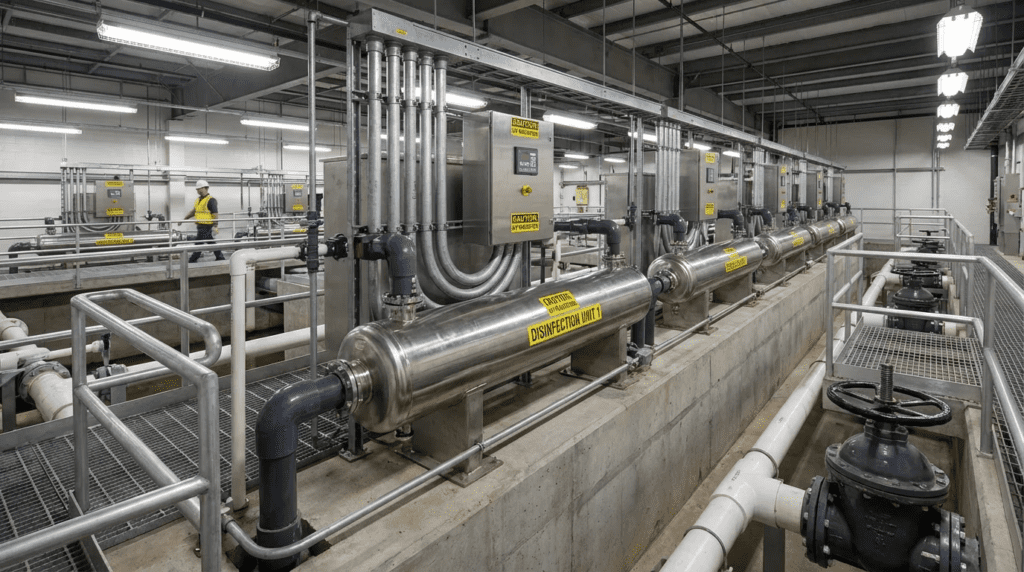
Closed-Vessel UV Reactors are pressurized pipe configurations where water flows through a sealed stainless steel (typically 316L) or HDPE chamber containing the UV lamps inside quartz sleeves. This configuration is universally required for drinking water applications to prevent atmospheric contamination post-filtration. It is also the standard for industrial applications. Flow dynamics (baffling, inlet/outlet configurations) are heavily engineered using Computational Fluid Dynamics (CFD) to ensure plug-flow characteristics and eliminate short-circuiting, guaranteeing every pathogen receives the target Reduction Equivalent Dose (RED).
Open-Channel UV Systems are zero-headloss gravity configurations almost exclusively used in Municipal Wastewater UV Disinfection. Banks of UV lamps are submerged in concrete channels. Water flows by gravity past the horizontal or vertical lamp arrays. These systems are advantageous for wastewater because they prevent the pressure-drop issues that plague closed-vessel systems when handling high suspended solids. Modules can be lifted out of the channel using automated hoists for maintenance without interrupting the overall plant flow, provided redundant channels are incorporated.
Application Contexts
Municipal Drinking Water UV Disinfection focuses fundamentally on the multi-log inactivation of chlorine-resistant protozoa (Cryptosporidium and Giardia), which require relatively low UV doses (e.g., 12 to 22 mJ/cm² for 3-log to 4-log reduction). Because drinking water has high UV Transmittance (UVT > 85%) and low total suspended solids (TSS), reactors can be highly optimized. The specification focus here is overwhelmingly on rigorous regulatory validation and failsafe monitoring.
Municipal Wastewater UV Disinfection targets coliforms, E. coli, and enterococcus prior to environmental discharge. Wastewater presents severe challenges: low and highly variable UVT (30% to 65%), high TSS, and high fouling potential. Required doses are often higher (30 to 40+ mJ/cm²). Systems must be robust, heavily reliant on automated wiping, and capable of pacing power output to wide diurnal flow variations.
Industrial Ultrapure Water UV Systems are critical in microelectronics, pharmaceutical, and power generation sectors. Beyond simple microbial disinfection (which uses 254 nm), these systems frequently utilize 185 nm output to achieve Total Organic Carbon (TOC) reduction by generating hydroxyl radicals. Industrial Ultrapure Water UV Systems require hyper-sanitary design (ASME BPE standards), zero dead-legs, and highly polished internal surfaces (Ra < 15 micro-inches).
Advanced Oxidation Process (AOP) UV Systems combine UV light with chemical oxidants (hydrogen peroxide, ozone, or chlorine) to generate powerful, non-selective hydroxyl radicals. This process is utilized to destroy trace organic contaminants, 1,4-dioxane, NDMA, endocrine disruptors, and taste/odor compounds (geosmin, MIB). Advanced Oxidation Process (AOP) UV Systems require massive UV energy input—often an order of magnitude higher than standard disinfection (doses ranging from 500 to >1000 mJ/cm²)—making MP or high-density Amalgam lamps strictly necessary.
Water Reuse UV Disinfection bridges the gap between wastewater and drinking water. Indirect Potable Reuse (IPR) and Direct Potable Reuse (DPR) systems demand exceptionally high-dose UV, frequently integrated as part of an AOP train, to guarantee absolute pathogen destruction and chemical contaminant breakdown, governed by ultra-strict validation protocols.
Critical System Components
UV Quartz Sleeves are the critical barrier between the electrical lamp and the water. They must transmit UV-C light efficiently; hence, they are fabricated from high-purity fused silica (Type 214 or similar). Different grades of quartz can be specified to either block or transmit 185 nm ozone-producing wavelengths. Over time, sleeves suffer from “solarization” (a permanent reduction in transmittance due to UV exposure) and external inorganic scaling.
UV Lamp Ballasts and Drivers are the power supply units that regulate the electrical current to the lamps. Modern systems utilize electronic ballasts capable of variable power output (dose pacing). In MP systems, ballasts manage immense power loads and require robust cooling. In LED systems, traditional ballasts are replaced by highly precise solid-state DC drivers.
UV Intensity Sensors (or duty sensors) are optical instruments threaded into the reactor wall that continuously measure the actual UV energy penetrating the water. They are the single most important component for compliance reporting. Sensors must be highly selective to germicidal wavelengths (ignoring visible light) and require strict periodic calibration against reference sensors.
Automatic Mechanical Wiper Systems are essential in wastewater, reuse, and hard drinking-water applications. They utilize Teflon or elastomeric rings that periodically stroke along the UV Quartz Sleeves to physically remove biofilm, iron, and calcium scaling. Advanced designs incorporate chemical reservoirs (e.g., citric acid or phosphoric acid) to combine mechanical wiping with chemical descaling in a single stroke.
Regulatory & Validation Frameworks
USEPA UVDGM Validated UV Systems comply with the 2006 United States Environmental Protection Agency Ultraviolet Disinfection Guidance Manual. This is the gold standard for municipal drinking water in North America. Validation involves injecting live surrogate organisms (like MS2 bacteriophage or T1) into a full-scale reactor to empirically prove the Reduction Equivalent Dose (RED) across specific flow rates and UVTs.
NWRI Validated UV Systems adhere to the guidelines published by the National Water Research Institute, which specifically target wastewater reuse and reclamation. NWRI standards are notably more conservative, demanding higher minimum doses, rigorous redundancy, and stringent transmittance assumptions compared to standard wastewater applications.
NSF/ANSI 55 Validated UV Systems apply primarily to residential, commercial, and small community systems. Class A certification dictates a minimum UV dose of 40 mJ/cm² at failsafe conditions and requires integrated sensor alarms, assuring the system is suitable for microbiologically unsafe water.
3. Selection & Specification Framework
When selecting from the options under UV Lamps for Water Disinfection: Types and Selection Guide, engineers must navigate a complex decision tree. The specification process is not about finding the “best” lamp, but rather the most appropriate technology for the specific hydraulic, water quality, and economic constraints of the facility.
Decision Tree Logic
- Step 1: Define the Application & Regulatory Standard. If the application is potable water, specify USEPA UVDGM Validated UV Systems. If the goal is trace organic destruction, mandate Advanced Oxidation Process (AOP) UV Systems.
- Step 2: Assess Space Constraints vs. Flow Rate. For highly constrained pipe galleries moving high flows (>20 MGD), Medium-Pressure (MP) UV Lamps are often the only geometric fit. If space permits, Amalgam UV Lamps or Low-Pressure High-Output (LPHO) UV Lamps are vastly superior for lifecycle OPEX.
- Step 3: Evaluate Water Quality (UVT and Hardness). If water hardness is high (e.g., >120 mg/L as CaCO3) or iron/manganese levels are elevated, avoiding MP lamps is critical. The 600°C to 800°C surface temperature of MP lamps bakes hardness onto the UV Quartz Sleeves instantly. In these conditions, use LPHO/Amalgam with robust Automatic Mechanical Wiper Systems.
- Step 4: Analyze Diurnal Flow Variations. For plants with massive swings between peak hour and low night flows, LPHO/Amalgam systems allow discrete banks of lamps to be shut down. MP systems have poorer turndown ratios and suffer from lamp life degradation if cycled on and off frequently.
CAPEX vs. OPEX Tradeoffs
The classic engineer’s dilemma in UV specification is the LPHO vs. MP debate. Medium-Pressure (MP) UV Lamps offer low CAPEX (smaller stainless steel reactor, fewer lamps, smaller building footprint). However, their OPEX is exorbitant. They consume 3 to 4 times more electricity than LPHO systems per log reduction of pathogens. Furthermore, MP lamps require replacement every 4,000 to 6,000 hours, whereas Amalgam UV Lamps can stretch to 12,000+ hours. Over a 20-year lifecycle evaluation, LPHO/Amalgam systems almost universally win the Net Present Value (NPV) calculation unless space restrictions physically prohibit their installation.
Common Specification Pitfalls
Engineers frequently err by “copy-pasting” specifications from previous projects. A common mistake is specifying Open-Channel UV Systems for a tertiary wastewater plant that experiences periodic filamentous algae blooms, which rapidly blind the submerged systems. Another major pitfall is over-specifying UV Quartz Sleeves without accounting for the site-specific fouling factor in the RED calculations, resulting in a system that passes commissioning but fails compliance within six months.
Never specify a flat “UV Dose” without defining what it means. Is it theoretical dose? Average dose? You MUST specify the Reduction Equivalent Dose (RED) at a specific UV Transmittance (UVT), End of Lamp Life (EOLL) factor, and Fouling Factor (FF), validated by bioassay.
4. Comparison Tables
The following tables provide rapid reference matrices for engineers evaluating the primary subcategories of UV technologies and their application suitability. Use these to baseline preliminary design reports and feasibility studies.
Table 1: UV Lamp Technology Subcategory Comparison
| Type / Technology | Key Features & Output | Best-Fit Applications | Limitations | Electrical Efficiency | Lamp Life (approx.) |
|---|---|---|---|---|---|
| Low-Pressure (LP) UV Lamps | Monochromatic (254nm), low heat, low power density (1W/cm) | Residential, small commercial, point-of-use | Requires massive arrays for municipal flows | High (35-40%) | 9,000 hrs |
| Low-Pressure High-Output (LPHO) UV Lamps | Monochromatic (254nm), medium power density (3-5W/cm) | Municipal Wastewater UV Disinfection, mid-size potable | Output drops if water temp fluctuates heavily | High (35-40%) | 10,000 – 12,000 hrs |
| Amalgam UV Lamps | Monochromatic (254nm), temp-stable, high density (10W/cm) | Large municipal drinking water, industrial UPW | Higher initial lamp cost than LPHO | High (35-40%) | 12,000 – 16,000 hrs |
| Medium-Pressure (MP) UV Lamps | Polychromatic (200-400nm), extreme heat, extreme density (150W/cm) | Space-constrained facilities, chloramine destruction, AOP | High OPEX, severe quartz fouling in hard water | Low (10-15%) | 4,000 – 6,000 hrs |
| UV Light-Emitting Diodes (UV-C LEDs) | Targeted (265nm), instant on/off, mercury-free, solid-state | Intermittent flow, remote sites, small instruments | Currently low power output per diode, high CAPEX | Moderate (improving) | 10,000+ hrs |
Table 2: Application Fit Matrix
| Application Scenario | Optimal Subcategory Fit | Key Engineering Constraints | Required Validation Standard |
|---|---|---|---|
| Large Potable Water Plant (Crypto focus, wide space) | Amalgam UV Lamps in Closed-Vessel UV Reactors | Hydraulic headloss, precise dose pacing | USEPA UVDGM Validated UV Systems |
| Wastewater Plant Retrofit (High TSS, variable flow) | LPHO UV Lamps in Open-Channel UV Systems | Robust Automatic Mechanical Wiper Systems essential | Site-specific state approvals / NWRI guidelines |
| Trace Contaminant Removal (NDMA, 1,4-Dioxane) | Medium-Pressure (MP) UV Lamps for Advanced Oxidation Process (AOP) UV Systems | Massive energy supply, oxidant dosing integration | Custom validation / Pilot testing required |
| Microelectronics Fab (TOC reduction) | Amalgam UV Lamps (185nm specific) in Industrial Ultrapure Water UV Systems | ASME BPE materials, Ra < 15 micro-inch finishes | Industry-specific (e.g., SEMI standards) |
5. Engineer & Operator Field Notes
The theoretical selection of UV equipment frequently crashes into real-world operational realities. Design engineers must bridge the gap between idealized specification sheets and the daily life of plant operators. Below are critical field notes spanning across the various subcategories of UV disinfection.
Commissioning Considerations
Commissioning differs wildly depending on the reactor and lamp type. For USEPA UVDGM Validated UV Systems, commissioning requires strict verification of the UV Intensity Sensors against reference sensors (often multiple sets). Furthermore, control systems must be proven to dose-pace accurately across multiple flow points. In Open-Channel UV Systems using LPHO lamps, commissioning must verify the hydraulic profile over the channel weirs to ensure lamps are never exposed to air during low flows, which would cause immediate overheating and failure.
Common Specification Mistakes
One of the most catastrophic errors is failing to match lamp type with water hardness. Specifying Medium-Pressure (MP) UV Lamps in groundwater systems with high calcium hardness or elevated iron levels guarantees continuous operator headaches. The high surface heat bakes on scaling so rapidly that even Automatic Mechanical Wiper Systems equipped with chemical cleaning cannot keep up, resulting in continuous low-UV-dose alarms.
Another common mistake is neglecting power quality requirements. UV Lamp Ballasts and Drivers are highly sensitive to voltage sags and harmonic distortion. Specifying massive MP systems without dedicated active harmonic filters or robust Uninterruptible Power Supplies (UPS) will lead to frequent nuisance tripping and premature ballast failure.
5C: O&M Comparison Across Subcategories
The daily burden on plant operators varies fundamentally based on the chosen subcategory.
- Daily Attention: Medium-Pressure (MP) UV Lamps require intense daily monitoring. Their short lifespans and high heat output mean operators must frequently check sensor readings, wiper fluid levels, and ballast cooling systems. Conversely, modern UV Light-Emitting Diodes (UV-C LEDs) are virtually hands-off, requiring only periodic sensor checks since there are no moving parts or heat-induced fouling.
- Labor Hours: Open-Channel UV Systems utilizing large arrays of LPHO lamps require extensive labor during lamp changeouts simply due to volume. A 20 MGD wastewater plant might have 200+ lamps to replace annually. A similarly sized MP system might only have 12 lamps, theoretically taking less time, but the physical difficulty of handling massive MP lamps and heavy reactor components balances the scale.
- Consumables: LPHO and Amalgam UV Lamps have predictable replacement cycles (typically 12-18 months). Wiper seals (Teflon or EPDM) must be replaced annually. UV Quartz Sleeves generally require replacement every 3 to 5 years due to solarization. Chemical consumption (citric acid for wipers) must be factored into OPEX for both open-channel and hard-water closed-vessel systems.
- Operator Training: AOP systems and Industrial Ultrapure Water UV Systems demand highly skilled operators capable of troubleshooting complex PLC logic and chemical dosing loops. Standard LPHO drinking water systems demand only basic mechanical and electrical familiarity.
Troubleshooting Overview
Symptoms and root causes often align heavily with the specific subcategory:
- Symptom: Rapid decline in UV Intensity reading on a newly commissioned system.
Root Cause (MP Systems): Instantaneous thermal scaling on the UV Quartz Sleeves.
Root Cause (LPHO Systems): Sensor window fouling, or air entrainment in the pipe scattering the light. - Symptom: Lamp fails to strike/ignite.
Root Cause (All Lamp Types): Worn out UV Lamp Ballasts and Drivers, or water ingress into the lamp socket due to a failed O-ring on the quartz sleeve. - Symptom: System unable to hit target RED during peak wet weather flows.
Root Cause (Wastewater Open Channel): UV Transmittance (UVT) drops lower than the design baseline due to combined sewer overflow (CSO) washout, or the automated wiping frequency is insufficient for the elevated TSS.
Always mandate that the contractor provides a spare parts inventory equal to 10% of total lamps, 10% of total UV Quartz Sleeves, and at least one complete set of UV Lamp Ballasts and Drivers at plant turnover. Supply chain delays on proprietary quartz can leave a plant out of compliance for months.
6. Design Details & Standards
Specifying UV Lamps for Water Disinfection: Types and Selection Guide requires adherence to strict mathematical models and international engineering standards. Sizing is not a matter of guessing; it relies on empirically derived dose equations.
Sizing Methodology Overview
All UV systems are sized based on the fundamental equation: Dose = Intensity × Retention Time. However, in flow-through reactors, this is complicated by fluid dynamics. Therefore, engineers use CFD combined with bioassay data to determine the Reduction Equivalent Dose (RED).
The design equation incorporates derating factors: Design Dose = validated RED × End-of-Lamp-Life (EOLL) factor × Fouling Factor (FF).
Parameter Differences by Subcategory
The assumptions used in sizing differ drastically by technology. When sizing Amalgam UV Lamps, the EOLL factor is typically 0.85 to 0.90 (they retain 85-90% of output at the end of their life). When sizing Medium-Pressure (MP) UV Lamps, the EOLL factor is much more severe, often 0.70 to 0.80, requiring the engineer to oversize the initial installation significantly to ensure compliance on day 365 of operation.
Similarly, the Fouling Factor for a well-maintained LPHO system might be 0.90, whereas for an MP system in hard water, it might be heavily penalized down to 0.70.
Applicable Standards & Compliance
- AWWA B300-18: Standard for hypochlorites (relevant when designing Advanced Oxidation Process (AOP) UV Systems combining UV and chlorine).
- DVGW W294 / ÖNORM M 5873: Strict European standards that dictate physical reactor design, requiring specific sensor geometries (e.g., measuring the darkest path length). Highly prescriptive compared to the flexible empirical approach of USEPA.
- USEPA UVDGM (2006): The absolute Bible for North American municipal drinking water. Dictates how USEPA UVDGM Validated UV Systems must be tested, how surrogate organisms are handled, and how uncertainty factors are applied to the calculated dose.
- NWRI: Standardizes requirements for Water Reuse UV Disinfection, mandating higher minimum doses (e.g., 100 mJ/cm² for specific reuse scenarios) compared to standard wastewater.
Specification Checklist Items
- Specify the required validation standard (UVDGM, NWRI, NSF 55).
- Define Design Flow (Peak, Average, Minimum).
- Define minimum Design UV Transmittance (UVT at 254 nm, 1-cm path length).
- Define max allowed Headloss across Closed-Vessel UV Reactors.
- Specify the type of Automatic Mechanical Wiper Systems (electrical, pneumatic, chemical-assist).
- Demand site-specific harmonic studies for UV Lamp Ballasts and Drivers.
7. FAQ Section
What are the different types of UV disinfection technologies?
The main technologies encompass various lamp types: Low-Pressure (LP) UV Lamps (residential/small flow), Low-Pressure High-Output (LPHO) UV Lamps (standard municipal), Amalgam UV Lamps (high-efficiency, temperature stable), Medium-Pressure (MP) UV Lamps (compact, high heat/energy), UV Light-Emitting Diodes (UV-C LEDs) (emerging, solid-state), and Excimer UV Lamps. These are housed in either Closed-Vessel UV Reactors or Open-Channel UV Systems depending on the application.
How do you choose between LPHO/Amalgam and Medium-Pressure lamps?
The choice hinges on footprint versus OPEX. If physical space is severely constrained (e.g., retrofitting a tiny pipe gallery), Medium-Pressure (MP) UV Lamps are required because one MP lamp equals the output of 15+ LPHO lamps. However, if space allows, Amalgam UV Lamps or LPHO are vastly superior due to consuming 60-75% less energy and lasting twice as long, drastically lowering lifecycle costs.
What is the most cost-effective UV system for small remote plants?
For highly intermittent flows or remote small community systems, UV Light-Emitting Diodes (UV-C LEDs) are increasingly cost-effective. They require no warm-up time, save energy during no-flow periods, and eliminate the risk of mercury contamination if broken. Alternatively, small NSF/ANSI 55 Validated UV Systems using standard LP lamps offer the lowest initial CAPEX.
Why are wipers necessary on UV systems?
Dissolved minerals (like calcium and iron) and biological matter scale onto UV Quartz Sleeves as water passes the hot lamps, blocking the UV light from reaching pathogens. Automatic Mechanical Wiper Systems scrape this fouling off at timed intervals. They are virtually mandatory for Municipal Wastewater UV Disinfection and highly recommended for any groundwater application.
What does UVT mean and why is it critical?
UV Transmittance (UVT) is the percentage of UV light (at 254 nm) that successfully passes through 1 centimeter of a water sample. High UVT (e.g., 95% in drinking water) means light travels easily, requiring less power. Low UVT (e.g., 55% in wastewater) means light is absorbed by dissolved organics and suspended solids, requiring significantly more powerful UV Lamp Ballasts and Drivers and tighter lamp spacing to achieve disinfection.
How frequently do UV sensors need calibration?
Regulatory bodies typically mandate that operational UV Intensity Sensors be checked against a freshly calibrated reference sensor at least monthly. The operational sensors themselves must usually be sent back to the manufacturer for factory recalibration annually to maintain the validity of USEPA UVDGM Validated UV Systems.
8. Conclusion
KEY TAKEAWAYS: Specification & Selection Rules
- Base Selection on OPEX: Default to Low-Pressure High-Output (LPHO) UV Lamps or Amalgam UV Lamps unless footprint or specific photolysis chemistry absolutely dictates otherwise.
- Understand Fouling: Never specify Medium-Pressure (MP) UV Lamps in hard water or high-iron groundwater without massive pretreatment.
- Match Validation to Application: Use USEPA UVDGM Validated UV Systems for potable water and NWRI Validated UV Systems for reuse. Do not mix and match standards.
- Protect the Power: Always account for the harmonic distortion introduced by large banks of UV Lamp Ballasts and Drivers in the electrical design.
- Dose Pacing is Mandatory: Ensure the system utilizes variable output drivers to pace UV intensity against real-time flow and UVT data, saving immense electrical costs over the system lifecycle.
Specifying UV Lamps for Water Disinfection: Types and Selection Guide is a multidisciplinary engineering challenge that intersects hydraulics, photochemistry, electrical design, and regulatory compliance. The days of simply picking a reactor out of a catalog based purely on pipe diameter are long gone. The modern landscape demands a nuanced understanding of how different technologies react to specific water quality matrices.
Whether deploying Open-Channel UV Systems to protect a local watershed from wastewater effluent, or engineering multi-barrier Water Reuse UV Disinfection trains combining AOP with ultrafiltration, the core methodology remains the same: design for the worst-case water quality, validate the bio-dosimetry, and ruthlessly optimize for lifecycle operational costs over initial capital expenditure. By mastering the subcategories detailed in this guide—from legacy mercury vapor dynamics to cutting-edge solid-state LEDs—plant engineers can ensure robust, failsafe public health protection while responsibly managing municipal resources.