
Ozone Systems for Water Treatment: Equipment and Applications
Introduction
Ozone has become one of the most powerful tools available to water and wastewater engineers seeking to oxidize contaminants that conventional treatment leaves behind. A working command of Ozone Systems for Water Treatment: Equipment and Applications is increasingly necessary as utilities confront taste and odor complaints, color, iron and manganese, disinfection byproduct limits, and a growing list of micropollutants that chlorine cannot address. Unlike chemical oxidants delivered by truck, ozone must be generated on site from oxygen, used within seconds of production, and destroyed before the off-gas leaves the building. That single characteristic shapes every design decision that follows.
A frequent and expensive mistake is treating an ozone installation as a generator purchase rather than a system design. The generator is one component in a chain that includes feed gas preparation, power supply and cooling, injection and contacting, off-gas destruction, ambient monitoring, and the control logic that ties them together. A facility that specifies a high-output generator and neglects cooling water temperature, feed gas dew point, or contactor geometry will produce less ozone than the nameplate promises and will transfer less of it into the water than the calculation assumed.
Ozone belongs to the advanced end of tertiary treatment, the stage where the objective shifts from removing bulk solids and organics to addressing what remains at low concentration. It is rarely deployed alone. In most municipal trains ozone sits alongside filtration and adsorption, either preparing the water for a downstream barrier or polishing what a barrier has already produced, and evaluating it in isolation from those neighbors produces a system that works on paper and disappoints in service.
This guide provides consulting engineers, plant managers, and operators with a detailed breakdown of ozone generation technologies, contacting methods, ancillary equipment, and the applications where ozone earns its considerable capital and operating cost. It covers selection criteria, sizing methodology, field-tested commissioning practice, and the standards that govern safe installation.
Subcategory Landscape — Equipment and Technologies
An ozone installation is best understood as a set of interacting subsystems rather than a single machine. Each has its own selection criteria, failure modes, and maintenance burden. The sections below break down the equipment families that make up a complete ozone island.
Corona Discharge Ozone Generators
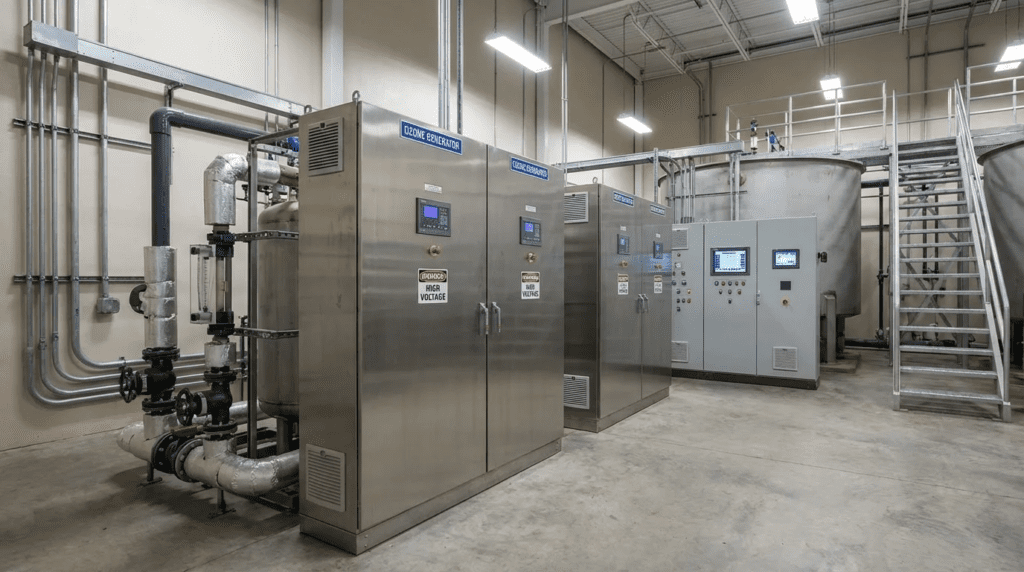
Corona Discharge Ozone Generators are the dominant technology in municipal and large industrial service. Oxygen passes through a narrow gap between a high-voltage electrode and a ground electrode separated by a dielectric barrier, and the electrical discharge splits molecular oxygen so that the fragments recombine into ozone. Output scales with applied power, gap uniformity, and feed gas purity. Generators are classified by power supply frequency, with medium and high frequency units offering better turndown and higher concentration than the older low frequency designs. The dielectric is the primary wear component and the primary failure mode, and because roughly 85 to 90 percent of input power leaves as heat, cooling water temperature has a direct and immediate effect on yield.
UV Ozone Generators
UV Ozone Generators produce ozone by exposing oxygen to ultraviolet light at 185 nm. The mechanism is simple and the equipment inexpensive, but output concentration is very low, typically well under one percent by weight. This limits the technology to small-scale applications such as laboratory use, point-of-use water treatment, and small pool or spa systems. UV generation is not a serious candidate for municipal treatment, where the gas volumes required to deliver a meaningful dose at such low concentration would be impractical.
Cold Plasma Ozone Generation
Cold Plasma Ozone Generation uses a dielectric barrier discharge operating at near-ambient gas temperature to produce ozone with reduced thermal losses. The approach overlaps substantially with conventional corona discharge and is often presented as a refinement of it rather than a separate technology. Claimed advantages include higher energy efficiency and reduced cooling demand. Engineers evaluating cold plasma offerings should insist on independently verified specific power figures measured at a stated concentration and cooling water temperature, since the terminology is used loosely across the market.
Oxygen Concentrators and Feed Gas Preparation
Oxygen Concentrators and Feed Gas Preparation determine both the achievable ozone concentration and the reliability of the generator. Three options dominate. Liquid oxygen delivered and stored on site provides the highest purity and the highest achievable concentration, typically 10 to 14 percent by weight, and is standard for large municipal plants. Pressure swing adsorption and vacuum swing adsorption generate oxygen on site from ambient air, avoiding delivery logistics at the cost of purity, footprint, and compressor maintenance. Air feed, once common, is now largely obsolete for new installations because concentration is limited to 2 or 3 percent and the nitrogen present forms nitric acid if any moisture reaches the discharge chamber. Dew point control is the single most critical parameter in this subsystem; moisture breakthrough destroys dielectrics.
Ozone Injection Systems
Ozone Injection Systems transfer the gas into the water, and transfer efficiency determines how much of the ozone produced actually does useful work. Fine bubble diffusers release gas through porous ceramic or membrane diffusers at the base of a deep contact basin, relying on submergence to drive dissolution. Side-stream injection pumps a fraction of the main flow through a venturi injector, where the pressure drop draws ozone gas into the stream, then returns the ozonated side-stream to the main flow through a nozzle or degassing arrangement. Side-stream systems achieve transfer efficiencies above 90 percent and suit retrofits with shallow basins, at the cost of booster pump energy. Diffuser systems have no moving parts but require deep tanks.
Ozone Contact Chambers
Ozone Contact Chambers provide the residence time for oxidation and disinfection to occur. Multi-chamber over-and-under baffled basins are the municipal standard, creating a near plug-flow regime that maximizes the ratio of effective to theoretical detention time. Chamber count, baffling, and depth together determine the CT value the installation can credit. Concrete surfaces in contact with ozonated water require ozone-resistant coatings or stainless liners, since ozone attacks the cement paste and exposes aggregate over time. Headspace above the water must be collected and routed to the destruct unit rather than vented.
Ozone Destruct Units
Ozone Destruct Units convert residual ozone in the contactor off-gas back to oxygen before discharge to atmosphere. Thermal, catalytic, and thermal-catalytic designs are available, with catalytic units using manganese dioxide or similar transition metal oxides being the most common in water treatment. The catalyst is vulnerable to moisture carryover, which is why a demister upstream of the destruct unit is not optional. Undersizing this component is a common design error, since it must handle the maximum off-gas flow at the maximum concentration the system can produce, not the average.
Ozone Monitoring and Control
Ozone Monitoring and Control encompasses the instrumentation that keeps the system safe and efficient. Ambient ozone detectors interlocked with ventilation and generator power are a life safety requirement, typically alarming near 0.1 ppm and tripping at higher setpoints. Dissolved ozone analyzers in the contactor provide the residual measurement that drives CT calculation and dose control. Feed gas dew point monitors protect the generator. Control strategy generally pairs feed-forward dosing against measured flow with feed-back trimming against dissolved residual, and the generator must be capable of the turndown that strategy requires across the diurnal flow range.
Portable and Package Ozone Systems
Portable and Package Ozone Systems deliver a complete skid-mounted island for small flows, combining oxygen concentration, generation, injection, and destruct in a single factory-assembled unit. They suit small municipal systems, remote sites, industrial process water, and temporary treatment applications. The advantage is that system integration has already been done and verified. The limitations are capacity, lower achievable concentration than a purpose-built LOX-fed installation, and less flexibility to match an unusual contacting arrangement.
Industrial Ozone Systems
Industrial Ozone Systems serve applications outside municipal drinking water and wastewater, including food and beverage processing, pharmaceutical water, semiconductor ultrapure water, cooling tower biocontrol, and aquaculture. The drivers differ from municipal practice: sanitary construction and clean-in-place capability matter in food service, ultrapure requirements dominate in semiconductor use, and continuous low-dose biocontrol rather than batch disinfection characterizes cooling tower applications. Materials specification is frequently more demanding, and regulatory frameworks differ from those governing potable water.
Related Coverage in This Category
Two further resources sit within this category and are worth locating, although both address subjects other than ozone. Comparative analysis of water filtration types compared covers the technology selection decision that most often runs in parallel with an ozone evaluation, since tertiary trains generally pair oxidation with a physical or adsorptive barrier and the two choices constrain each other. An engineer sizing an ozone system for micropollutant destruction will usually be comparing filtration options in the same study.
Separately, the head-to-head comparison of JWC Environmental and Lakeside for screenings addresses headworks equipment selection rather than tertiary treatment. Its relevance here is upstream: solids carried through the plant exert ozone demand and reduce transfer efficiency, so the performance of the screening and primary treatment stages sets the baseline against which any tertiary oxidation dose is calculated. The vendor comparison methodology it demonstrates also transfers directly to ozone OEM evaluation.
Selection and Specification Framework
Specifying an ozone system begins with establishing what the ozone is being asked to do, because disinfection, oxidation, and advanced oxidation lead to different capacity, contactor, and control requirements from the same nominal water quality target.
Define the Duty First
If the objective is disinfection with CT credit, the design point is a measurable dissolved residual maintained across a defined contact time, and contactor baffling becomes critical. If the objective is oxidation of taste and odor compounds, color, or iron and manganese, the design point is applied dose and the residual matters less. If the objective is advanced oxidation through the addition of hydrogen peroxide, the residual is consumed almost immediately by design, disinfection credit must be earned elsewhere, and the contactor shifts toward rapid mixing rather than plug flow.
Characterize Ozone Demand
Bench-scale testing establishes the immediate ozone demand of the specific water, which is the ozone consumed instantly by organics, iron, manganese, and other reduced species before any residual can form. Decay kinetics then determine how much additional ozone is required to hold a residual across the contact time. Both vary seasonally, often by a factor of two or more in surface water sources, and sizing on annual average conditions guarantees a shortfall in the worst month.
Watch the Bromate Constraint
Where source water contains bromide, ozone oxidizes it to bromate, a regulated disinfection byproduct with a very low limit in drinking water. This places a ceiling on applied dose that can conflict directly with the dose required for disinfection or oxidation. Mitigation options include pH depression, ammonia addition, peroxide addition to shift the reaction pathway, and staged dosing to limit peak concentration. Any project on a bromide-bearing source should establish this constraint before sizing the generator, because it may cap the achievable dose regardless of installed capacity.
Evaluate the Downstream Barrier Together
Ozone rarely stands alone in a tertiary train. The most common municipal pairing places ozone ahead of biologically active carbon, where oxidation converts refractory organics into biodegradable fractions that the carbon bed then removes biologically rather than by adsorption alone, substantially extending media life. Engineers evaluating this arrangement should work through the activated carbon filtration design in parallel, since empty bed contact time, media selection, and backwash strategy all change when the bed is operating biologically.
Where membranes provide the downstream barrier, ozone serves a different function, oxidizing organics that would otherwise foul the membrane surface and reducing cleaning frequency. That application requires careful attention to residual ozone reaching the membrane itself, since many polymeric membrane materials are not ozone tolerant. The compatibility question belongs in the advanced membrane technologies evaluation rather than being resolved after both packages are procured. More broadly, ozone is one option among several in the advanced filtration technologies landscape, and a rigorous options study will price it against the alternatives before committing to on-site gas generation.
Lifecycle Cost
Capital cost is dominated by the generator, the oxygen supply arrangement, and the contactor civil works. Operating cost is dominated by two items: electrical energy, generally 3.5 to 5.0 kilowatt-hours per pound of ozone for a LOX-fed system, and the oxygen supply itself, which is frequently the larger figure. A generator producing 12 percent concentration rather than 10 percent consumes meaningfully less oxygen per pound of ozone delivered, and that difference compounds over a twenty-year life. Dielectric replacement, catalyst replacement in the destruct unit, and analyzer consumables round out the recurring costs.
Comparison Tables
The tables below compare generation technologies and map system configurations against application scenarios.
| Technology | Typical Output Concentration | Best-Fit Applications | Limitations | Maintenance Profile |
|---|---|---|---|---|
| Corona discharge, LOX fed | 10–14% by weight | Large municipal water and wastewater; high-dose oxidation. | Highest capital cost; requires LOX storage with setbacks and vaporizers. | Dielectric inspection and replacement; cooling system maintenance; LOX system upkeep. |
| Corona discharge, PSA/VSA fed | 6–10% by weight | Mid-size municipal; sites where LOX delivery is impractical. | Lower concentration; compressor and adsorbent maintenance; larger footprint. | As above plus air compressor, dryer, and adsorbent bed service. |
| Corona discharge, air fed | 2–3% by weight | Legacy installations only; not recommended for new large systems. | Low concentration drives large gas volumes and oversized contactors and destruct units. | High. Extensive air preparation; nitric acid risk on moisture breakthrough. |
| UV generation | Well under 1% by weight | Laboratory, point of use, small pool and spa systems. | Output far too low for municipal dosing. | Low. Lamp replacement. |
| Package / skid systems | Varies, typically 6–10% | Small municipal, remote sites, industrial process water, temporary use. | Capacity ceiling; limited flexibility in contactor arrangement. | Moderate. Integrated design simplifies service but limits component substitution. |
| Application | Primary Objective | Recommended Configuration | Governing Constraint |
|---|---|---|---|
| Surface water taste and odor | Oxidation of geosmin and MIB | LOX-fed corona discharge; side-stream or diffuser contacting. | Seasonal variation in ozone demand; size on the worst month. |
| Potable disinfection with CT credit | Pathogen inactivation | Multi-chamber baffled contactor; dissolved residual monitoring. | Baffling factor; bromate ceiling on bromide-bearing sources. |
| Wastewater reuse / micropollutants | Destruction of trace organics | Ozone with peroxide addition, followed by biologically active carbon. | Scavenging by residual organics; downstream media strategy. |
| Membrane pre-treatment | Fouling control | Side-stream injection with residual quenched ahead of membranes. | Membrane material ozone tolerance; residual control. |
| Iron and manganese removal | Oxidation ahead of filtration | Modest dose; contacting ahead of a filtration barrier. | Overdosing manganese to permanganate causes pink water. |
Engineer and Operator Field Notes
Commissioning and Acceptance
Commissioning an ozone system is hazardous and sequence-dependent. Feed gas dew point must be verified below the specified limit before the dielectrics are energized; rushing this step is the most common cause of early generator damage. Leak testing should use oxygen-compatible detection fluid rather than ordinary soap solution. Mass transfer efficiency should be verified by measuring ozone concentration in both feed gas and off-gas and calculating the dissolved fraction, with values below 85 to 90 percent indicating a contacting problem. The destruct unit should be verified at maximum hydraulic flow, since high water levels in the contactor can carry moisture into the catalyst and deactivate it permanently.
Pro Tip: Never Shock the Dielectrics. Ensure cooling water is flowing before energizing the generator, and never introduce cooling water to a vessel that has been running without flow. Thermal shock is the leading cause of glass dielectric cracking, and the failure is not always immediate; a cracked tube may continue operating at reduced output until it fails completely months later.
Common Specification Mistakes
- Guaranteeing output without stating conditions. An ozone production guarantee is meaningless unless the specification fixes feed gas source and purity, dew point, cooling water temperature and flow, and the concentration at which output is measured.
- Designing for average cooling water temperature. Production falls measurably as cooling water warms. A system sized on annual average temperature will under-produce in the summer months, which is often when demand peaks.
- Sizing the destruct unit as a catalog item. It must be sized against maximum off-gas flow at maximum concentration, and it must be protected from moisture carryover by a demister.
- Ignoring turndown. Diurnal flow variation of four or five to one is normal. A generator that cannot turn down smoothly will cycle on and off, stressing components and producing erratic dosing.
- Omitting the bromate evaluation. On bromide-bearing source water, bromate formation may cap the dose below what the process requires, and discovering that after the generator is purchased is an expensive way to learn it.
Common Mistake: Specifying Materials by Habit. Ozone rapidly destroys natural rubber, standard EPDM, PVC, and carbon steel. Every wetted or gas-contacting component must be 316L stainless steel, PTFE, or a specifically ozone-rated elastomer such as certain FKM grades. Concrete contactor surfaces need an ozone-resistant lining. A single overlooked gasket in the gas train will fail within weeks and will usually be discovered as an ambient ozone alarm rather than as a leak.
Operations and Maintenance
The recurring maintenance items are predictable. Dielectric inspection and eventual replacement dominate the mechanical program, with service life ranging from five to fifteen years depending on operating conditions. Cooling systems require strainer cleaning and, where a chiller is involved, its own maintenance program, since a chiller failure trips the generator on high temperature immediately. Destruct catalyst degrades over time and after any moisture event. Ambient ozone sensors and dissolved ozone analyzers both require scheduled calibration, and an uncalibrated ambient sensor is a life safety issue rather than a performance one.
Troubleshooting
- Symptom: Output below nameplate. Check cooling water temperature first, then feed gas dew point and purity. Both degrade output before any component has actually failed.
- Symptom: High dew point alarm. Usually a vaporizer problem on a LOX system or a leak drawing ambient air into the feed gas piping. Do not bypass the interlock; moisture in the discharge chamber forms nitric acid.
- Symptom: Ambient ozone alarm with no visible leak. Check the destruct unit first. A wet or spent catalyst passes undestroyed ozone straight to the vent.
- Symptom: Dissolved residual low despite normal production. A transfer problem rather than a generation problem. Inspect diffusers for fouling or the venturi and side-stream pump for cavitation and reduced draw.
Design Details and Standards
Sizing Methodology
Required ozone capacity follows from flow, applied dose, and transfer efficiency. Applied dose is the sum of immediate ozone demand, decay across the contact time, and the residual required at the end of the contactor. Capacity in pounds per day equals flow in million gallons per day multiplied by dose in milligrams per liter multiplied by 8.34. Dividing by transfer efficiency gives the required generator output, and a safety factor of 1.2 to 1.5 should then be applied for seasonal water quality variation and dielectric aging.
The resulting turndown requirement deserves explicit attention. A plant sized for peak summer demand with a safety factor may need to operate at a fifth of installed capacity on a winter night, and that ratio belongs in the specification rather than being discovered at startup.
Applicable Standards
AWWA B304 — Liquid Oxygen for Ozone Generation. Governs the purity and handling of the feed gas supply.
NFPA 55 — Compressed Gases and Cryogenic Fluids Code. Critical for LOX tank siting, setbacks, and separation distances.
CGA G-4.1 — Cleaning Equipment for Oxygen Service. Governs preparation of all oxygen-wetted piping and components.
ASME Boiler and Pressure Vessel Code, Section VIII — Applies to generator vessels operating above 15 psig.
OSHA 29 CFR 1910.1000 — Air contaminant limits, establishing the 0.1 ppm time-weighted average exposure limit for ozone that drives ambient monitoring setpoints.
UL 508A — Industrial Control Panels, applicable to the generator control and power supply enclosures.
NSF/ANSI 61 — Required for any component in contact with potable water.
Specification Checklist
- Design flow at minimum, average, and maximum conditions, with the turndown ratio stated.
- Water quality basis including immediate ozone demand and decay rate, measured across at least two seasons.
- Treatment objective: disinfection with CT credit, oxidation, or advanced oxidation with peroxide.
- Required applied dose and residual, with the bromate constraint evaluated where bromide is present.
- Feed gas source, purity, and dew point limit, with the trip logic that protects the generator.
- Generator output guaranteed at a stated concentration, cooling water temperature, and feed gas condition.
- Specific power in kilowatt-hours per pound at the guaranteed operating point.
- Contacting method, guaranteed transfer efficiency, and the verification protocol.
- Contactor baffling factor and the tracer study that will confirm it at acceptance.
- Destruct unit capacity at maximum off-gas flow and concentration, with demister protection.
- Materials of construction for every gas-contacting and wetted component.
- Ambient monitoring, interlock logic, and ventilation sequence on alarm.
- Cooling water design temperature at summer maximum, not annual average.
- Control strategy across the full flow range, with feed-forward and feed-back logic defined.
- Spare parts inventory and the projected dielectric and catalyst replacement schedule.
Frequently Asked Questions
Why is ozone generated on site rather than delivered?
Ozone is unstable and decomposes back to oxygen within minutes, so it cannot be stored or transported. Every installation therefore includes generation equipment, feed gas supply, and the supporting cooling and power infrastructure, which is the principal reason ozone carries higher capital cost than delivered chemical oxidants.
How does cooling water temperature affect ozone production?
Ozone decomposition accelerates with temperature, so as the dielectric gap warms, net yield falls. Manufacturers typically rate output at a cooling water temperature around 20 to 25 degrees Celsius. If plant water reaches the high twenties or low thirties in summer, output can drop by 10 to 20 percent, which is why the design temperature should be the summer maximum rather than the annual average.
What is bromate and why does it limit ozone dose?
Bromate forms when ozone oxidizes naturally occurring bromide in the source water. It is regulated at very low concentration in drinking water, so on bromide-bearing sources the permissible bromate concentration places a ceiling on applied ozone dose that may conflict with the dose the process requires. Mitigation includes pH depression, ammonia addition, peroxide addition, and staged dosing.
Should ozone be paired with biologically active carbon?
In many municipal applications, yes. Ozone converts refractory organic matter into smaller, more biodegradable molecules, which a downstream carbon bed then removes biologically rather than by adsorption alone. The result is substantially longer media life than adsorption-only operation and better removal of assimilable organic carbon that would otherwise promote biological regrowth in the distribution system.
What are the main safety requirements for an ozone installation?
Ambient ozone detection interlocked with ventilation and generator shutdown, oxygen deficiency monitoring in the generation room, an off-gas destruct unit sized for maximum conditions, and emergency stop devices accessible outside the generation room. LOX storage brings its own requirements under NFPA 55, including setbacks and oxygen-clean piping per CGA G-4.1.
How does ozone compare with UV for disinfection?
UV achieves high log reduction of chlorine-resistant protozoa at lower capital and operating cost and requires no chemical handling, but provides no residual and no oxidation. Ozone costs more to install and operate and requires oxygen supply, cooling, and off-gas destruction, but disinfects and oxidizes simultaneously and leaves a measurable residual for CT credit. Facilities needing disinfection alone generally select UV; facilities with taste and odor, color, iron and manganese, or micropollutant obligations generally select ozone.
What is the typical service life of an ozone generator?
The stainless steel vessel commonly lasts 20 to 30 years. Dielectrics typically last five to fifteen years depending on operating temperature and duty cycle. Power supply units generally require capacitor refurbishment or replacement at seven to ten years. Feed gas system maintenance is the single largest determinant of dielectric life, since moisture breakthrough shortens it dramatically.
Conclusion
Key Takeaways
- Specify a system, not a generator — feed gas, cooling, contacting, destruct, and monitoring all determine whether the installed capacity does useful work.
- Settle the duty before sizing — disinfection with CT credit, oxidation, and advanced oxidation lead to different capacity, contactor geometry, and control requirements.
- Design cooling for summer maximum — output falls with cooling water temperature, and the shortfall arrives in the season when demand is highest.
- Check the bromate ceiling first — on bromide-bearing sources it may cap the achievable dose regardless of installed capacity.
- Materials are non-negotiable — 316L stainless, PTFE, and ozone-rated elastomers throughout; ordinary rubber and PVC fail within weeks.
- Evaluate the downstream barrier together — ozone and biologically active carbon, or ozone and membranes, are one decision rather than two.
Ozone earns its capital and operating cost where the treatment objective extends beyond pathogen inactivation to the destruction of compounds that conventional processes leave behind. For taste and odor, color, iron and manganese, and an expanding list of trace organics, it remains among the most capable tools available, and its position within advanced tertiary treatment continues to strengthen as reuse and micropollutant obligations spread.
The engineering discipline it demands is correspondingly higher than for a delivered chemical. On-site generation ties performance to feed gas quality, cooling capacity, and transfer efficiency in ways that a hypochlorite system never experiences. Engineers who characterize the water honestly across seasons, settle the treatment objective before sizing, specify materials without compromise, and design the contactor and destruct unit with the same rigor applied to the generator will deliver installations that perform as calculated and remain serviceable for decades.