
Desalination & Emerging Technologies: Beyond Traditional Methods
Introduction
As conventional reverse osmosis (RO) approaches its theoretical thermodynamic limits for specific energy consumption (SEC)—hovering near 1.06 kWh/m³ for seawater at 50% recovery—water and wastewater engineers are forced to explore alternative separation techniques. Treating hypersaline brines, handling produced water, and achieving stringent industrial discharge limits require processes that tolerate extreme osmotic pressures and severe fouling conditions. This is where Desalination & Emerging Technologies: Beyond Traditional Methods becomes a critical knowledge domain for facility designers and operators.
While RO and Multi-Stage Flash (MSF) remain the stalwarts of municipal seawater desalination, they struggle with total dissolved solids (TDS) exceeding 70,000 mg/L and specific scaling contaminants like silica and barium. Navigating Desalination & Emerging Technologies: Beyond Traditional Methods involves understanding alternative driving forces—such as thermal gradients, electrical potentials, and draw-solution osmotic gradients. This pillar page covers the full landscape of these emerging subcategories, providing water treatment professionals with the technical framework required to specify, operate, and maintain next-generation desalination processes.
Subcategory Landscape — Types, Technologies & Approaches
The landscape of emerging desalination technologies can be broadly categorized by their primary driving force: osmotic potential, thermal gradients, electrochemical separation, and advanced materials. Understanding how these processes differ from conventional hydraulic pressure-driven RO is essential for proper specification. Engineers must evaluate these technologies not just as direct RO replacements, but as niche solutions for high-recovery, high-TDS, or low-energy applications. Below is a detailed breakdown of the major subcategories that comprise this field.
Advanced Membrane Technologies
Forward Osmosis (FO)
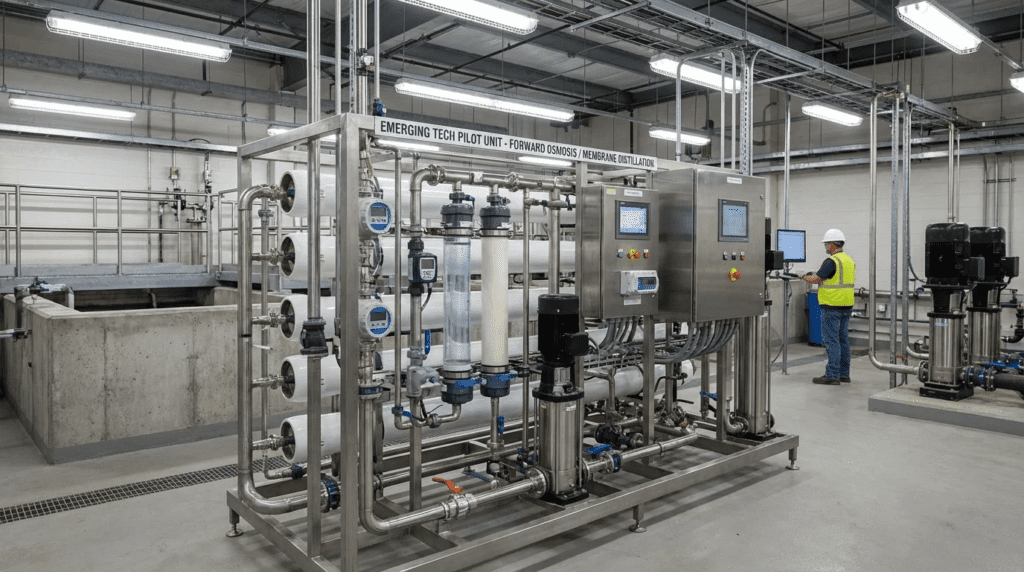
Forward Osmosis (FO) utilizes the natural osmotic pressure gradient across a semi-permeable membrane to draw water from a lower osmotic pressure feed solution into a highly concentrated draw solution. Because it relies on osmotic potential rather than hydraulic pressure, FO operates at very low hydraulic pressures (typically <3 bar), drastically reducing the fouling compaction common in RO. FO is highly effective for highly fouling wastewaters, landfill leachates, and zero liquid discharge pre-concentration. The critical engineering challenge is the draw solution recovery step; if the draw solute cannot be regenerated easily (e.g., using low-grade waste heat), the overall system energy consumption will exceed conventional RO.
Nanofiltration (NF) for Desalination
While NF is traditionally used for softening, Nanofiltration (NF) for Desalination is emerging as a critical pretreatment or standalone process for selective ion removal. NF membranes typically feature pore sizes around 1-10 nanometers and rely on both steric hindrance and Donnan exclusion (electrical charge) to reject multivalent ions (like sulfate, calcium, and magnesium) at rates exceeding 95%, while allowing monovalent ions (chloride, sodium) to pass at varying rates (30-60%). By utilizing NF ahead of thermal or RO desalination, engineers can significantly reduce the scaling potential of the feedwater, allowing for much higher downstream recovery rates. It requires lower operating pressures than RO (typically 5 to 15 bar), offering OPEX savings in brackish water applications.
Biomimetic Membranes
Biomimetic Membranes represent the cutting edge of materials science, utilizing biological structures like Aquaporins (water channel proteins) embedded in a synthetic polymer matrix. These membranes attempt to replicate the highly efficient water transport found in biological cell membranes, theoretically offering much higher specific flux rates (LMH/bar) and near-perfect salt rejection compared to traditional thin-film composite (TFC) polyamide membranes. Currently transitioning from lab-scale to commercial industrial pilots, these membranes are highly sensitive to oxidative degradation. They are specified in high-value, low-volume applications where extreme purity and low energy consumption are paramount.
Graphene-Based Membranes
Graphene-Based Membranes utilize single-layer or few-layer graphene sheets, typically engineered as Graphene Oxide (GO) or nanoporous graphene. By precisely controlling the nanopore sizes to roughly 0.9 nanometers, these membranes physically block hydrated salt ions while providing a nearly frictionless pathway for water molecules. The result is a membrane that can theoretically operate at 10 to 100 times the permeability of current RO membranes. While still largely in the advanced R&D and pilot phases, successful commercialization will drastically reduce the physical footprint of high-capacity municipal desalination plants.
Thermal and Phase-Change Alternatives
Membrane Distillation (MD)
Membrane Distillation (MD) is a thermally driven process where separation is governed by phase change. A heated hydrophobic, microporous membrane allows water vapor to pass through while retaining liquid water and dissolved, non-volatile solids. The driving force is the vapor pressure difference induced by a temperature gradient (typically a feed temperature of 60°C to 90°C). MD is practically insensitive to feed concentration, making it ideal for treating hypersaline brines (up to 300,000 mg/L TDS) where RO fails due to extreme osmotic pressure. It is best applied where low-grade industrial waste heat or solar thermal energy is abundant.
Adsorption Desalination (AD)
Adsorption Desalination (AD) utilizes solid desiccants (most commonly silica gel) to adsorb water vapor from saline water in an evaporator, leaving the brine behind. The saturated desiccant is then regenerated using low-temperature heat (50°C to 85°C) to release the pure water vapor, which is subsequently condensed. AD operates below atmospheric pressure, utilizing the latent heat of vaporization and condensation. Its primary advantage is minimal electrical power requirement and near-zero scaling, making it highly suitable for integration with industrial cooling water circuits or solar thermal collectors in remote installations.
Freeze Desalination
Freeze Desalination leverages the principle that when salt water freezes, the ice crystal lattice rejects dissolved salts, forming pure water ice. The process involves chilling the feedwater to form an ice slurry, separating the ice crystals from the brine, washing the ice to remove adhering salts, and finally melting the ice to produce product water. Because the latent heat of fusion (334 kJ/kg) is significantly lower than the latent heat of vaporization (2257 kJ/kg), it boasts theoretical energy advantages over thermal distillation. However, mechanical complexity in the ice-washing and separation stages currently limits its use to niche industrial brine concentrations.
Humidification-Dehumidification (HDH)
Humidification-Dehumidification (HDH) mimics the natural water cycle. Carrier gas (usually air) is heated and humidified by contact with heated saline water in a packed bed or spray tower. The moisture-laden air is then routed to a dehumidifier where it cools, causing pure water to condense. HDH operates at atmospheric pressure, does not require membranes, and is highly robust against fouling and scaling. While it has a high specific thermal energy consumption, its mechanical simplicity and ability to run entirely on low-grade thermal energy make it a viable technology for decentralized, off-grid applications.
Electrochemical Separation Processes
Electrodialysis Reversal (EDR)
Electrodialysis Reversal (EDR) utilizes an electrical direct current (DC) applied across alternating cation- and anion-exchange membranes. The electrical field drives the migration of ions, depleting salt in the product channels and concentrating it in the brine channels. By periodically reversing the polarity of the electrodes (reversal), the scaling and fouling on the membrane surfaces are continuously mitigated. EDR is exceptional for brackish water (up to 12,000 mg/L TDS) with high silica or calcium sulfate scaling potential, as it operates at high recovery rates (up to 95%) without the heavy antiscalant dosing required by RO.
Capacitive Deionization (CDI)
Capacitive Deionization (CDI) removes salt ions by electrosorbing them onto the surface of porous electrodes (typically carbon aerogels or activated carbon) under a low-voltage DC electric field (1.2 to 1.5 V). When the electrodes are saturated, the polarity is reversed or grounded to release the ions into a reject stream, regenerating the electrodes. CDI is highly energy-efficient for low-salinity brackish waters (<4,000 mg/L TDS) because the energy scales linearly with the number of ions removed, unlike RO where pressure must overcome the total osmotic potential. It is increasingly specified for municipal brackish well water and industrial cooling tower blowdown recovery.
Microbial Desalination Cells (MDCs)
Microbial Desalination Cells (MDCs) are a hybrid bio-electrochemical technology. MDCs use exoelectrogenic bacteria in an anode chamber to oxidize organic matter (wastewater), producing electrons and protons. The electrons flow through an external circuit to a cathode, creating a potential difference that drives desalination in a central chamber bounded by ion-exchange membranes. MDCs effectively treat wastewater while simultaneously desalting saline water without external electrical input. They are strictly an emerging, pre-commercial technology, but hold immense promise for energy-positive wastewater treatment and concurrent seawater pre-desalination.
Brine Management and Energy Recovery
Zero Liquid Discharge (ZLD) Systems
Zero Liquid Discharge (ZLD) Systems represent the ultimate end-stage of the desalination train. Driven by stringent environmental regulations, ZLD eliminates all liquid waste by concentrating brines until salts precipitate as solid crystals. Traditional ZLD relies on energy-intensive mechanical vapor compression (MVC) crystallizers. Emerging ZLD strategies incorporate technologies like FO and MD upstream of the crystallizer to reduce the volume of brine sent to thermal treatment, vastly reducing the overall lifecycle cost of total liquid elimination. Specification requires exact thermodynamic modeling of mixed-salt solubilities.
Minimal Liquid Discharge (MLD)
Minimal Liquid Discharge (MLD) is a pragmatic engineering alternative to ZLD, targeting 95% to 98% liquid recovery while allowing a small, highly concentrated liquid purge. By accepting a minimal discharge stream, plants can avoid the massive CAPEX and OPEX associated with phase-change crystallizers. MLD architectures heavily utilize emerging high-pressure RO (capable of up to 120 bar), EDR, and MD to push concentration limits to the absolute brink of saturation without crossing into the solid crystallization phase.
Pressure Retarded Osmosis (PRO)
Pressure Retarded Osmosis (PRO) is an energy recovery and generation technology rather than a direct water production process. It mixes a high-salinity stream (like RO brine) with a low-salinity stream (like treated wastewater effluent) across a semi-permeable membrane. The osmotic potential drives water into the pressurized brine stream, increasing its volume. This high-pressure, expanded volume is then directed through a hydro-turbine to generate electricity. PRO is specified where coastal desalination plants and municipal wastewater treatment plants are co-located, allowing the facility to recover energy from the “osmotic penalty” of discharging brine into the ocean.
Selection & Specification Framework
Selecting among Desalination & Emerging Technologies: Beyond Traditional Methods requires moving away from the “one-size-fits-all” mentality of standard reverse osmosis. Engineers must evaluate duty conditions, total lifecycle costs (CAPEX vs OPEX), and specific site constraints.
Decision Tree Logic
- Is the Feed TDS < 4,000 mg/L? If yes, electrochemical processes like Capacitive Deionization (CDI) or Electrodialysis Reversal (EDR) generally offer a lower OPEX than RO due to their ion-selective energy curves.
- Is the Feed TDS > 70,000 mg/L? If the osmotic pressure exceeds typical RO pump limits (approx. 80-120 bar), engineers must transition to thermal or osmotic-driven processes. Specify Membrane Distillation (MD) if cheap waste heat is available, or evaluate Forward Osmosis (FO) if a suitable draw solution recovery mechanism exists.
- Are specific scaling ions present in high concentrations? If silica, barium, or calcium sulfate are present near saturation, RO will foul rapidly. Electrodialysis Reversal (EDR) is highly tolerant to supersaturated silica. Alternatively, utilize Nanofiltration (NF) for Desalination as pretreatment.
- Is environmental discharge highly regulated? If brine cannot be discharged, integrate Minimal Liquid Discharge (MLD) or Zero Liquid Discharge (ZLD) Systems.
CAPEX vs. OPEX Tradeoffs
Emerging technologies often present skewed cost profiles. For instance, Membrane Distillation (MD) modules and specialized hydrophobic membranes carry a high initial CAPEX. However, if the industrial facility has abundant low-grade waste heat (e.g., cooling jacket water), the electrical OPEX drops dramatically. Conversely, standard RO has a low, highly commoditized CAPEX, but scaling the pumps for extreme pressures yields exorbitant OPEX and frequent membrane replacement costs in harsh duties.
Common Specification Pitfalls
The most common error when specifying Desalination & Emerging Technologies: Beyond Traditional Methods is treating thermal or electrochemical membrane systems identically to RO systems. For example, specifying Capacitive Deionization (CDI) based on hydraulic recovery metrics rather than mass-ion removal capacity leads to rapid electrode saturation and process failure. Similarly, failing to account for the thermal boundary layer (temperature polarization) when sizing Membrane Distillation (MD) will result in severely undersized evaporator trains.
Comparison Tables
The following tables provide an engineer-level quick reference map for selecting and comparing the subcategories of emerging desalination technologies. Table 1 breaks down the technical parameters of the systems, while Table 2 maps them to real-world applications.
Table 1: Subcategory Comparison of Emerging Desalination Technologies
| Type/Technology | Driving Force | Optimal TDS Range (mg/L) | Key Advantage | Primary Limitation | Relative Maintenance Profile |
|---|---|---|---|---|---|
| Forward Osmosis (FO) | Osmotic Pressure Gradient | 10,000 – 100,000+ | Very low fouling/compaction | Draw solution recovery is energy intensive | Moderate (draw system management) |
| Membrane Distillation (MD) | Thermal/Vapor Pressure | 35,000 – 300,000 | Treats extreme salinity, uses waste heat | Membrane pore wetting limits lifespan | High (thermal management, cleaning) |
| Electrodialysis Reversal (EDR) | Electrical Potential (DC) | 1,000 – 12,000 | Handles supersaturated silica easily | Energy scales heavily with salinity | Moderate (stack rebuilding) |
| Capacitive Deionization (CDI) | Electrosorption | < 4,000 | Very low energy for brackish water | Limited by electrode sorption capacity | Low (automated cycling, electrode flushing) |
| Nanofiltration (NF) for Desalination | Hydraulic Pressure / Charge | 1,000 – 20,000 | Removes divalent scaling ions cheaply | Passes 30-60% of monovalent salts | Moderate (similar to standard RO) |
| Adsorption Desalination (AD) | Thermal (Sorption) | 35,000 – 70,000 | Near-zero electrical demand | Large physical footprint | Low (desiccant stability is high) |
Table 2: Application Fit Matrix
| Application Scenario | Best-Fit Technology | Key Constraint / Consideration | Operator Skill Impact |
|---|---|---|---|
| Municipal Brackish Well Water (<2,000 TDS) | Capacitive Deionization (CDI) | Requires low organic load to prevent electrode fouling. | Low (highly automated controls) |
| High-Silica Industrial Blowdown | Electrodialysis Reversal (EDR) | Check scaling indices; EDR tolerates silica up to 300 mg/L. | Moderate |
| Produced Water / Frac Flowback (>100k TDS) | Membrane Distillation (MD) | Requires strict pretreatment for free oil/grease to prevent wetting. | High (complex thermal monitoring) |
| Landfill Leachate Treatment | Forward Osmosis (FO) | Draw solution choice dictates downstream recovery mechanism. | High |
| Inland Plant Facing strict Discharge Limits | Minimal Liquid Discharge (MLD) | Requires balancing recovery against precipitation limits. | Very High (chemical mass balancing) |
Engineer & Operator Field Notes
Transitioning from traditional pressure-driven systems to the subcategories of Desalination & Emerging Technologies: Beyond Traditional Methods involves navigating distinctly different operational realities. The field notes below highlight critical cross-technology observations regarding commissioning, specification errors, operations, and troubleshooting.
Commissioning Considerations
Commissioning procedures vary wildly depending on the driving force. For Membrane Distillation (MD), the critical path during commissioning is preventing “pore wetting.” If hydraulic pressure exceeds the liquid entry pressure (LEP) of the hydrophobic membrane during startup flow balancing, liquid water will break through, and the module is ruined. Systems must be brought up to thermal equilibrium before establishing full crossflow velocities.
For Forward Osmosis (FO), commissioning involves intricate density and concentration balancing of the draw solution. The draw loop must be meticulously purged of air, as entrained bubbles will severely reduce the active membrane area and osmotic driving force. For electrochemical processes like Electrodialysis Reversal (EDR), startup requires careful mapping of limiting current density to prevent water dissociation (water splitting) at the membrane interface, which alters pH and triggers instantaneous precipitation.
Common Specification Mistakes
O&M Comparison Across Subcategories (REQUIRED)
When comparing Desalination & Emerging Technologies: Beyond Traditional Methods, operation and maintenance (O&M) profiles dictate long-term viability.
- Daily Operator Attention: Thermal systems like Membrane Distillation (MD) and Humidification-Dehumidification (HDH) require high operator oversight regarding heat exchanger performance, steam traps, and temperature polarization. In contrast, Capacitive Deionization (CDI) and Electrodialysis Reversal (EDR) are heavily automated, relying on PLC logic to flip electrical polarity; they are largely hands-off beyond routine data logging.
- Consumables and Labor: Nanofiltration (NF) for Desalination requires similar antiscalant chemistry and CIP (Clean-In-Place) frequency to standard RO (approx. 2-4 CIPs per year, 12-24 labor hours per event). Forward Osmosis (FO) requires monitoring and topping up the draw solution (e.g., ammonia-carbon dioxide, or magnesium chloride) which represents a unique consumable cost not found in other systems.
- Operator Training: Any site implementing Zero Liquid Discharge (ZLD) Systems or Minimal Liquid Discharge (MLD) requires advanced operator training. Operators must understand complex chemistry, particularly co-precipitation metrics, to prevent catastrophic blockages in crystallizers or high-recovery membrane stages.
- Spare Parts Inventory: EDR requires stocking replacement electrodes, spacers, and specific ion-exchange membranes. MD requires stocking hydrophobic modules and corrosion-resistant heat exchanger gaskets.
Troubleshooting Overview: Symptoms and Root Causes
When output quality drops, the root cause varies by technology:
- In CDI: If effluent TDS spikes, the root cause is typically electrode passivation or scaling blocking the mesopores. Corrective action involves an extended acid flush sequence.
- In MD: A sudden drop in distillate quality (high conductivity) almost universally indicates pore wetting. Root causes include an upstream spike in surfactants/organics lowering surface tension, or a transient pressure spike exceeding the LEP.
- In FO: A drop in water flux without a corresponding increase in feed-side differential pressure usually points to internal concentration polarization (ICP) inside the porous support layer of the membrane, requiring optimized draw solution velocities.
- In EDR: Increased stack voltage required to maintain constant current indicates scaling on the membrane surfaces. Check the automatic polarity reversal timers and verify the pH of the concentrate loop.
Design Details & Standards
Implementing Desalination & Emerging Technologies: Beyond Traditional Methods requires specific thermodynamic and electrochemical design parameters that differ significantly from standard hydraulic modeling.
Sizing Methodology Overview
Across all membrane-based subcategories, sizing relies on mass balance calculations. However, the flux equation changes. In RO, Flux ($J_w$) = $A(Delta P – Delta pi)$.
In Forward Osmosis (FO), Flux ($J_w$) = $A(pi_{draw} – pi_{feed})$. The sizing is directly dependent on maintaining a high osmotic pressure in the draw solution ($pi_{draw}$), which is depleted as product water dilutes it. Design iterations must calculate the dilution effect continuously along the length of the module.
Key Design Parameters by Subcategory
- Membrane Distillation (MD): The dominant parameter is the temperature polarization coefficient (TPC), which measures the ratio of the temperature difference across the membrane surfaces to the bulk temperature difference. Sizing requires maximizing fluid turbulence to keep TPC close to 1.0. Flux ranges are typically 5 to 35 L/m²·h (LMH).
- Capacitive Deionization (CDI): Systems are sized by the specific salt adsorption capacity (SAC) of the electrodes, measured in mg of salt per gram of electrode material (typical values 15-30 mg/g). Designs must calculate the total ionic load per cycle to size the total mass of carbon aerogel required.
- Electrodialysis Reversal (EDR): Design hinges on the Limiting Current Density (LCD). Operating above the LCD causes water dissociation. System geometry (spacer thickness, path length) and cross-flow velocity are engineered to maximize the LCD.
Applicable Standards & Compliance
Because many of these are emerging technologies, specific AWWA standard classifications (like AWWA B11 for RO/NF) are often adapted.
For Nanofiltration (NF) for Desalination, AWWA Standard B11-12 (Membrane Systems) applies closely. For electrochemical processes, electrical enclosures and safety standards dictate strict adherence to IEC 61439 and UL 508A. When Zero Liquid Discharge (ZLD) Systems involve thermal evaporation, ASME Boiler and Pressure Vessel Code (BPVC) Section VIII applies to the evaporator and crystallizer vessels.
FAQ Section
What are the different types of emerging desalination technologies?
Emerging desalination spans several subcategories. Advanced membranes include Forward Osmosis (FO), Nanofiltration (NF) for Desalination, Biomimetic Membranes, and Graphene-Based Membranes. Thermal alternatives comprise Membrane Distillation (MD), Adsorption Desalination (AD), Freeze Desalination, and Humidification-Dehumidification (HDH). Electrochemical methods include Electrodialysis Reversal (EDR), Capacitive Deionization (CDI), and Microbial Desalination Cells (MDCs). Finally, advanced brine approaches include Zero Liquid Discharge (ZLD) Systems, Minimal Liquid Discharge (MLD), and Pressure Retarded Osmosis (PRO).
How do you choose between Capacitive Deionization (CDI) and Electrodialysis Reversal (EDR)?
Both are highly effective for brackish water. Capacitive Deionization (CDI) is best suited for low salinity (<4,000 mg/L TDS) applications, such as well water softening or light industrial reuse, due to its exceptionally low energy usage. Electrodialysis Reversal (EDR) is better for higher salinity (up to 12,000 mg/L TDS) and is heavily preferred when the feedwater contains scaling ions like high silica or calcium, which EDR physically sweeps away during polarity reversals.
What is the most cost-effective method for handling extreme hypersaline brines (>100,000 TDS)?
Traditional RO cannot overcome the osmotic pressure of hypersaline brines. Membrane Distillation (MD) is highly cost-effective if the site has access to low-grade waste heat (60-90°C), dropping the electrical OPEX near zero. If no waste heat is available, Forward Osmosis (FO) or thermal evaporators integrated into Minimal Liquid Discharge (MLD) architectures are the engineered standard.
How does Membrane Distillation (MD) differ from standard Reverse Osmosis (RO)?
RO uses hydraulic high pressure (60-80 bar) to push water through a dense membrane against osmotic pressure. Membrane Distillation (MD) uses a temperature gradient to create vapor pressure. It operates at near atmospheric pressure, pushing only water vapor through a hydrophobic, porous membrane. Therefore, MD is practically unaffected by feed salinity concentrations.
Are ZLD and MLD systems strictly for environmental compliance?
While historically driven by environmental regulations preventing brine disposal, Zero Liquid Discharge (ZLD) Systems and Minimal Liquid Discharge (MLD) are increasingly specified for pure water recovery. By capturing the final 5-15% of wastewater, facilities in water-scarce regions guarantee their operational water supply regardless of municipal municipal curtailments.
Conclusion
Key Takeaways for Specification
- Use Capacitive Deionization (CDI) or Electrodialysis Reversal (EDR) for low-to-medium brackish sources to drastically cut energy costs compared to RO.
- Specify Membrane Distillation (MD) or Forward Osmosis (FO) when TDS exceeds 70,000 mg/L or extreme fouling conditions exist.
- Do not specify thermal options without verifying the availability and cost of low-grade thermal energy or waste heat; otherwise, operational costs will be prohibitive.
- Evaluate Minimal Liquid Discharge (MLD) architectures before committing to full Zero Liquid Discharge (ZLD) Systems to potentially save millions in crystallizer CAPEX.
- Ensure your operations team is trained on the specific operational parameters (like Limiting Current Density or Temperature Polarization) rather than applying RO-centric logic to novel systems.
The transition toward Desalination & Emerging Technologies: Beyond Traditional Methods represents a paradigm shift in water engineering. Driven by the thermodynamic limitations of traditional high-pressure membranes and thermal distillation, the industry is fragmenting into highly specialized, application-specific technologies. No single subcategory acts as a silver bullet. System designers must now balance electrical costs against thermal availability, evaluate the cost of draw-solution regeneration against electrode lifecycle limitations, and navigate complex mixed-salt saturation chemistries.
By moving beyond traditional methods, engineers unlock the ability to treat previously “untreatable” waters—from high-silica cooling tower blowdowns to supersaturated produced waters. Integrating these systems effectively requires shedding assumptions built over decades of conventional reverse osmosis dominance, embracing new mass balance mechanics, and taking a holistic approach to facility energy integration and lifecycle cost analysis.