
RO Installation & Maintenance: Complete Guide to Reverse Osmosis
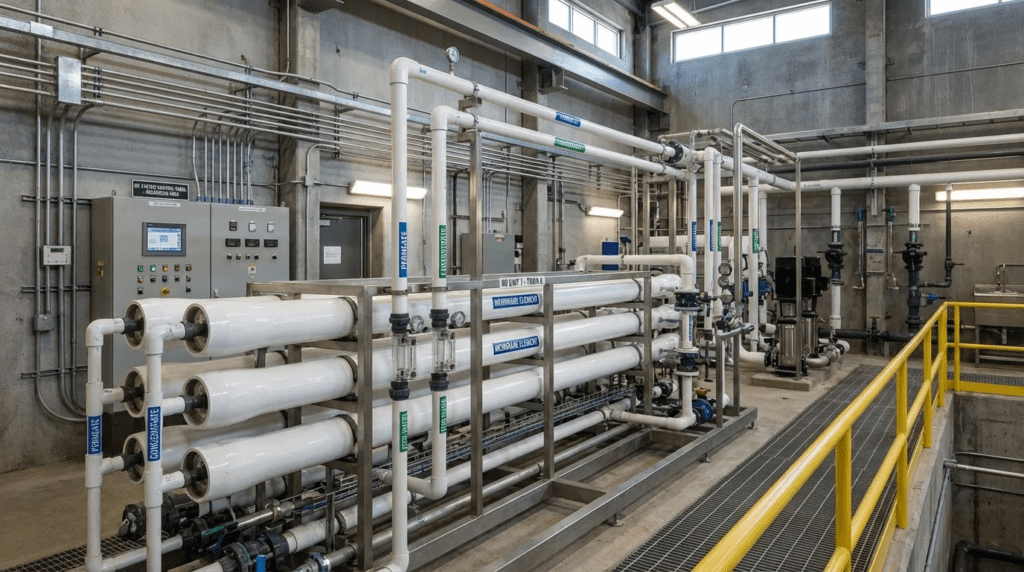
INTRODUCTION
One of the most frequent engineering failures in advanced water treatment does not stem from membrane chemistry, but from flawed execution during deployment and operations. A staggering 60% of premature membrane failures in municipal and industrial plants can be traced directly to improper mechanical execution, poor pre-treatment sequencing, or reactive rather than predictive monitoring. To navigate this complex landscape, engineers rely on mastering RO Installation & Maintenance: Complete Guide to Reverse Osmosis. This critical engineering discipline encompasses everything from high-pressure piping tolerances and isobaric energy recovery integration to rigorous data normalization and complex clean-in-place (CIP) protocols.
Whether treating brackish groundwater for municipal drinking water, desalinating seawater, or executing direct potable reuse (DPR) from municipal wastewater, the specific physical and chemical stressors placed on a reverse osmosis (RO) system require distinct operational strategies. A minor deviation in membrane shimming can lead to catastrophic O-ring failure, while a failure to track normalized differential pressure can result in irreversible biological fouling. This RO Installation & Maintenance: Complete Guide to Reverse Osmosis provides public works decision-makers, plant directors, and process engineers with a comprehensive overview of the major subcategories, equipment variants, and process methodologies necessary to ensure optimal lifecycle performance, mechanical reliability, and predictable OPEX.
SUBCATEGORY LANDSCAPE — TYPES, TECHNOLOGIES & APPROACHES
The field of reverse osmosis engineering is highly stratified, requiring specific expertise across mechanical installation, process chemistry, and varying system types. The subcategories below represent the critical branches of RO installation, operational management, and system variants. Engineers must understand how mechanical deployment decisions (like pump alignment and vessel loading) interact with long-term maintenance requirements (like CIP frequencies and foulant mitigation) across different raw water applications.
RO Skid Assembly and Rigging
RO Skid Assembly and Rigging encompasses the foundational mechanical installation of the structural frame, pressure vessel manifolds, and low/high-pressure interconnecting piping. This phase requires rigorous attention to vibration isolation, structural deflections under dynamic loads, and the prevention of piping-induced stress on high-pressure manifolds. Typically executed during the primary construction phase of municipal or industrial plants, precision is paramount; structural deflections exceeding 2-3 mm can misalign grooved end mechanical couplings (e.g., Victaulic), leading to micro-leaks or catastrophic blowout at 1,000+ psi. A key advantage of proper skid assembly is the long-term mitigation of fatigue cracking in duplex stainless steel welds. Engineers must strictly specify epoxy grouting for structural bases and mandate that all high-pressure piping be fully supported independently of the pressure vessel end-caps.
High-Pressure Pump Installation
High-Pressure Pump Installation involves the integration and alignment of the primary motive force for the RO system, typically utilizing multi-stage centrifugal or positive displacement pumps. These systems are utilized in all RO applications, from low-pressure brackish arrays to extreme-pressure seawater desalination. Proper installation requires precision laser alignment of the pump and motor shafts to within 0.002 inches to prevent premature bearing failure and mechanical seal degradation. The primary advantage of rigorous installation practices is minimized vibration (kept strictly below 0.15 in/sec RMS) and extended MTBF (Mean Time Between Failures). Critical specification factors include ensuring adequate Net Positive Suction Head available (NPSHa), incorporating pulsation dampeners for PD pumps, and utilizing appropriately rated Variable Frequency Drives (VFDs) to manage axial thrust during soft start/stop sequences.
Membrane Vessel Loading
Membrane Vessel Loading is the highly precise physical procedure of inserting spiral-wound membrane elements into fiberglass-reinforced plastic (FRP) pressure vessels. This is required during initial commissioning and every 3 to 7 years during membrane replacement cycles. The procedure mandates strict adherence to directional flow indicators to ensure the brine seal is oriented correctly, preventing bypass of feed water into the permeate stream. A critical limitation during loading is the risk of rolling or pinching interconnector O-rings; operators must use approved glycerin lubricants, never petroleum-based greases which degrade EPDM rubber and permanently foul the membrane. Specification considerations dictate precise shimming at the feed end to eliminate axial movement (often allowing less than 5mm of play) which prevents the physical hammering of elements during high-pressure pump startup.
Pre-treatment Equipment Commissioning
Pre-treatment Equipment Commissioning is the vital precursor to RO operation, ensuring that upstream systems like multimedia filters, ultrafiltration (UF), and chemical dosing skids deliver water within strict RO feed specifications. Deployed in 100% of RO applications, this phase is designed to guarantee a feed Silt Density Index (SDI) consistently below 3.0 and a turbidity below 0.1 NTU. The advantage of flawless pre-treatment commissioning is the exponential extension of RO membrane life and the reduction of required CIP intervals. A critical constraint is that RO membranes are highly susceptible to oxidation; therefore, commissioning must explicitly verify the total elimination of free chlorine via ORP (Oxidation-Reduction Potential) monitoring or active sodium metabisulfite (SMBS) dosing interlocks.
Clean-In-Place (CIP) Systems and Procedures
Clean-In-Place (CIP) Systems and Procedures represent the primary maintenance intervention for restoring lost membrane performance due to fouling and scaling. Utilized in virtually all industrial and municipal RO plants, CIP involves recirculating heated, formulated chemical solutions (both acidic and alkaline) through the membrane arrays. Low pH (approx. 2.0) is utilized to dissolve calcium carbonate and iron scales, while high pH (approx. 11.0-12.0) targets organic fouling, biofilms, and silica. The chief advantage of a well-engineered CIP procedure is reversing performance decline; however, the limitation is that aggressive, overly frequent CIPs degrade the polyamide rejection layer, reducing element lifespan. Engineers must size CIP pumps to provide specific scouring velocities (typically 35-40 GPM per 8-inch vessel) and incorporate highly accurate temperature control (up to 35°C maximum) to optimize chemical kinetics without breaching membrane thermal limits.
RO Membrane Autopsy and Replacement
RO Membrane Autopsy and Replacement is an advanced diagnostic and maintenance subcategory utilized when standard CIP procedures fail to restore system performance. Typically performed at specialized off-site laboratories, autopsies involve the destructive teardown of a lead or tail element to perform visual inspection, Fujiwara testing for halogen oxidation, and Scanning Electron Microscopy with Energy Dispersive X-Ray Spectroscopy (SEM/EDX). This process is highly advantageous for definitively diagnosing complex, multi-layered foulants or identifying raw water changes not caught by pre-treatment. The main limitation is the cost and the destructive nature of the test, requiring the sacrifice of an element. Specification guidelines dictate that autopsies should be triggered when normalized differential pressure increases by more than 25% despite targeted CIP efforts, or when sudden, unexplained salt passage occurs.
Foulant Identification and Scaling Mitigation
Foulant Identification and Scaling Mitigation is the proactive operational discipline of predicting, monitoring, and neutralizing the precipitation of sparingly soluble salts and the accumulation of biological matter. Applied continuously during plant operation, this process relies heavily on water chemistry projections (using Langelier Saturation Index or Stiff-Davis Stability Index) to prevent calcium sulfate, barium sulfate, and reactive silica from blinding the membrane surface. The advantage of robust mitigation is maintaining steady permeate production and low feed pressures. Limitations arise when raw water quality fluctuates rapidly, exceeding the mitigation system’s design envelope. Engineers must clearly define the maximum allowable recovery rate based on the solubility limits of the most restrictive precipitant in the specific raw water profile.
Antiscalant and Chemical Dosing Management
Antiscalant and Chemical Dosing Management focuses on the precise injection of polymeric threshold inhibitors and dispersants into the RO feed stream to delay the crystallization of scaling minerals. This is critical in brackish and wastewater applications operating at high recovery rates (75-85%+). The primary advantage is the ability to operate systems well beyond the natural super-saturation limits of the feed water, drastically reducing the volume of concentrate (brine) waste. A key limitation is that over-dosing certain antiscalants can ironically cause chemical fouling, while biological growth can feed on specific antiscalant formulations if not properly managed. Operational engineers must ensure precise pump drawdowns, verify static mixer efficiency, and regularly calibrate dosing pumps to maintain typical injection rates of 2.0 to 5.0 mg/L.
Permeate Flux and Recovery Optimization
Permeate Flux and Recovery Optimization is the hydraulic balancing of the RO system to ensure even water production across all membrane elements, preventing localized rapid fouling. Used during the design and continuous tuning of the plant, engineers manage the Average Flux (expressed in gallons per square foot per day, GFD, or liters per square meter per hour, LMH). The advantage of proper optimization is uniform membrane wear and stable power consumption. A limitation is the physical phenomenon of concentration polarization, where the boundary layer of the membrane experiences exponentially higher salinity than the bulk flow. Design standards dictate that high-fouling wastewater sources should be operated at conservative fluxes (10-14 GFD), while clean well water can sustain aggressive fluxes (14-18 GFD).
Data Normalization and Performance Tracking
Data Normalization and Performance Tracking is the mathematical correction of daily RO operating data against baseline reference conditions (typically startup or day-30 conditions) to account for natural fluctuations in feed temperature, salinity, and pressure. Utilizing standards such as ASTM D4516, this discipline is mandatory for all municipal and industrial installations. The fundamental advantage is the ability to distinguish between natural seasonal changes (e.g., colder water causing lower flow) and actual physical membrane fouling. Without normalization, operators are flying blind, often performing CIPs too late. Engineers must implement automated SCADA tracking of Normalized Permeate Flow (NPF), Normalized Differential Pressure (NdP), and Normalized Salt Passage (NSP) to trigger maintenance exactly when a 10-15% deviation occurs.
Energy Recovery Devices (ERDs)
Energy Recovery Devices (ERDs) are highly specialized mechanical components, such as isobaric pressure exchangers or Pelton turbines, used to capture hydraulic energy from the high-pressure concentrate stream and transfer it back to the feed stream. ERDs are nearly universally applied in modern Seawater Reverse Osmosis (SWRO) Systems due to the massive energy required to overcome seawater osmotic pressure. The distinct advantage is a dramatic reduction in specific energy consumption—often lowering SWRO energy usage from 6.0 kWh/m³ down to 2.5–3.0 kWh/m³. The limitation involves complex maintenance; isobaric chambers require precise clearances and utilize the raw seawater as a hydrodynamic bearing lubricant, making them hyper-sensitive to particulate damage. Engineers must specify ERDs with a volumetric mixing rate of less than 4% to prevent concentrate from excessively increasing feed salinity.
Brackish Water Reverse Osmosis (BWRO) Systems
Brackish Water Reverse Osmosis (BWRO) Systems represent the configuration of RO technology tailored for ground or surface waters with Total Dissolved Solids (TDS) ranging typically from 1,000 to 10,000 mg/L. BWRO relies on multi-stage array configurations (e.g., 2:1 or 3:2:1 pressure vessel staging) to maximize water recovery, commonly achieving 75% to 85% conversion of feed to permeate. The advantage of BWRO is relatively low operating pressure (150-400 psi) and lower CAPEX compared to seawater systems. However, the high recovery rates inherently push scaling limits, making BWRO highly dependent on accurate Antiscalant and Chemical Dosing Management. Specifications must account for robust multi-stage CIP capabilities, allowing operators to clean the highly scaled tail stages independently of the biologically fouled lead stages.
Seawater Reverse Osmosis (SWRO) Systems
Seawater Reverse Osmosis (SWRO) Systems are engineered to process high-salinity feed waters, typically between 35,000 and 45,000 mg/L TDS. Because osmotic pressure scales directly with salinity, SWRO systems operate at extreme pressures ranging from 800 to 1,200 psi. The advantage is the creation of a drought-proof water supply; the limitation is the severe corrosive nature of high-pressure chloride environments. SWRO relies almost exclusively on single-stage designs to keep recovery low (40-50%) to prevent precipitation and massive osmotic pressure spikes at the tail end. Engineers must specify ultra-high-grade metallurgy, typically Super Duplex stainless steels (e.g., SAF 2507) for all high-pressure wetted parts, and rigorously integrate Energy Recovery Devices (ERDs) to make the OPEX financially viable.
Wastewater Reuse RO Systems
Wastewater Reuse RO Systems are configurations deployed specifically for indirect or direct potable reuse (IPR/DPR) or ultra-pure industrial process water, utilizing secondary or tertiary municipal effluent as feed. These systems operate under extreme biological and organic fouling potential. To combat this, they uniquely utilize chloramine chemistry; unlike free chlorine which destroys RO membranes, a carefully maintained chloramine residual can pass through the system to suppress bio-growth without rapid membrane oxidation. The advantage is a highly sustainable water source, while the limitation is an intensive maintenance profile requiring frequent high-pH CIPs. Specifications typically demand wide feed spacer membranes (34-mil or larger) to resist plugging by Extracellular Polymeric Substances (EPS), and conservative flux designs heavily supported by robust Pre-treatment Equipment Commissioning (often utilizing MBR or UF).
SELECTION & SPECIFICATION FRAMEWORK
Selecting the appropriate technologies, operational parameters, and maintenance profiles detailed in RO Installation & Maintenance: Complete Guide to Reverse Osmosis requires a rigorous engineering decision framework balancing CAPEX, OPEX, raw water chemistry, and site operator capabilities.
Decision Framework Logic:
Engineers must first characterize the feed water (salinity, organic load, scaling indices).
* If TDS is < 10,000 mg/L, select Brackish Water Reverse Osmosis (BWRO) Systems focusing heavily on multi-stage recovery and intensive Antiscalant and Chemical Dosing Management.
* If TDS is > 35,000 mg/L, specify Seawater Reverse Osmosis (SWRO) Systems where the critical differentiator is the implementation of Energy Recovery Devices (ERDs) and premium metallurgy.
* If treating effluent, Wastewater Reuse RO Systems are mandatory, dictating lower fluxes and highly robust Clean-In-Place (CIP) Systems and Procedures.
Lifecycle Cost Tradeoffs:
A common pitfall is under-sizing the RO Skid Assembly and Rigging or the pre-treatment trains to save upfront CAPEX. If Pre-treatment Equipment Commissioning is rushed and allows SDI spikes, OPEX will skyrocket due to excessive chemical usage, increased pumping power (to overcome differential pressure), and premature element failure, requiring expensive RO Membrane Autopsy and Replacement. Spending 15% more on VFDs and premium High-Pressure Pump Installation will yield massive OPEX savings in electrical efficiency and reduced mechanical wear over a 20-year lifecycle.
Specification Pitfalls:
Engineers frequently confuse the requirements between SWRO and BWRO CIP parameters. Specifying a generic CIP skid for a high-recovery BWRO plant may result in inadequate heating or flow velocities necessary to clear tail-element silica scale. Furthermore, operator skill level heavily impacts selection; remote plants with basic skill levels should not be specified with complex isobaric Energy Recovery Devices (ERDs) unless comprehensive training and automated Data Normalization and Performance Tracking SCADA systems are heavily integrated.
COMPARISON TABLES
The following tables provide an engineer-focused quick reference map comparing the major subcategories, their primary features, limitations, and operational profiles. Use these matrices to align raw water challenges with the appropriate mechanical and chemical interventions.
Table 1: Subcategory Technology & Process Comparison
| Subcategory / Technology | Key Engineering Features | Best-Fit Applications | Primary Limitations | Maintenance Profile |
|---|---|---|---|---|
| Brackish Water Reverse Osmosis (BWRO) Systems | Multi-stage arrays, 75-85% recovery, moderate pressures (150-400 psi). | Groundwater, surface water, low TDS industrial feeds. | High susceptibility to tail-end scaling. | Moderate; requires diligent antiscalant dosing. |
| Seawater Reverse Osmosis (SWRO) Systems | Single-stage, 40-50% recovery, ultra-high pressure (800-1200 psi), duplex steel. | Coastal desalination, offshore platforms. | Massive energy demand, strict corrosion control needed. | High; critical pump and ERD mechanical maintenance. |
| Wastewater Reuse RO Systems | Wide-spacer elements, chloramine dosing, conservative flux limits. | Direct/Indirect Potable Reuse, heavy industry effluent. | High biological and organic fouling potential. | Very High; frequent high-pH CIPs required. |
| Clean-In-Place (CIP) Systems and Procedures | Heated chemical recirculation (pH 2.0 to 12.0), precise flow velocities. | All RO systems experiencing >15% dP or salt passage increase. | Degrades membrane polyamide layer if overused. | Batch execution; chemical handling safety protocols. |
| Energy Recovery Devices (ERDs) | Isobaric chambers or turbochargers transferring pressure from brine to feed. | SWRO and high-pressure industrial systems. | Highly sensitive to particulates; complex clearances. | High mechanical precision; routine bearing/seal checks. |
| Data Normalization and Performance Tracking | ASTM D4516 mathematical correction of flux and rejection. | Mandatory for proactive OPEX management across all RO. | Requires high-quality, calibrated SCADA instrumentation. | Continuous automated monitoring; minimal manual labor. |
Table 2: Application Fit & Design Constraints Matrix
| Application Scenario | Best Fit Subcategory Focus | Key Design Constraints | Operator Skill Impact | Relative Lifecycle Cost |
|---|---|---|---|---|
| High Silica Groundwater (Municipal) | Brackish Water Reverse Osmosis (BWRO) Systems & Antiscalant and Chemical Dosing Management | Recovery limited by silica solubility (<120 mg/L in concentrate without specialized inhibitors). | Moderate: Operators must monitor dosing pump drawdowns daily. | Moderate CAPEX / Low OPEX |
| Coastal SWRO Desalination | Seawater Reverse Osmosis (SWRO) Systems & Energy Recovery Devices (ERDs) | Metallurgical limits (PREN > 40); Boron rejection requirements. | High: Advanced mechanical training for ERDs and ultra-high pressure pumps. | High CAPEX / High OPEX |
| Tertiary Effluent to Ultrapure Water | Wastewater Reuse RO Systems & Foulant Identification and Scaling Mitigation | Strict bio-control needed; max flux typically limited to 10-12 GFD. | Very High: Demands precise chloramine residual management and frequent CIPs. | High CAPEX / Moderate OPEX |
| Chronic Unexplained Permeate Decline | RO Membrane Autopsy and Replacement & Data Normalization and Performance Tracking | Requires sacrificing a membrane element for destructive lab testing. | Low internal labor; relies on specialized third-party lab diagnostics. | Variable (depends on replacement rate) |
ENGINEER & OPERATOR FIELD NOTES
Successfully executing RO Installation & Maintenance: Complete Guide to Reverse Osmosis requires translating theoretical design into robust field execution. The differences between system variants dictate drastically different commissioning and maintenance profiles.
Commissioning Considerations by Subcategory
During startup, the differences between systems become immediately apparent. For Brackish Water Reverse Osmosis (BWRO) Systems, commissioning focuses on hydraulic balancing across multiple stages, ensuring interstage pressure does not exceed structural limits. Conversely, commissioning Seawater Reverse Osmosis (SWRO) Systems requires meticulous attention to the High-Pressure Pump Installation and the Energy Recovery Devices (ERDs), ensuring air is completely bled from isobaric chambers to prevent catastrophic “water hammer” equivalent destruction of the ceramic rotors. Across all variants, Pre-treatment Equipment Commissioning must be validated over a continuous 72-hour run before raw water is ever allowed to contact the newly loaded RO membranes.
During Membrane Vessel Loading, never use silicone-based or petroleum-based lubricants on O-rings or brine seals. These compounds permanently blind the membrane surface. Use only non-surfactant, water-soluble glycerin. Ensure brine seals always face the high-pressure feed (upstream) direction.
Common Specification Mistakes
A prevalent engineering error is undersizing the Clean-In-Place (CIP) Systems and Procedures. Engineers often size the CIP tank based purely on the void volume of the pressure vessels, failing to account for the necessary volume required to maintain steady temperatures during the exothermic/endothermic chemical reactions, or failing to provide enough flow to properly scour 8-inch elements (minimum 35 GPM/vessel required). Another mistake is specifying Antiscalant and Chemical Dosing Management systems without static mixers, relying purely on pipe turbulence, which leads to localized concentration polarization and severe lead-element scaling.
O&M Comparison Across Subcategories
The daily operator burden shifts dramatically depending on the selected subcategory:
- Operator Attention: Wastewater Reuse RO Systems demand the highest daily attention, requiring constant monitoring of chloramine residuals and organics. Conversely, clean-source Brackish Water Reverse Osmosis (BWRO) Systems with well-tuned Data Normalization and Performance Tracking can often run “hands-off” for weeks, provided antiscalant tanks are filled.
- Maintenance Intervals: Clean-In-Place (CIP) Systems and Procedures are typically executed every 3-6 months for BWRO, but may be required every 3-4 weeks in wastewater reuse applications. Membrane Vessel Loading (replacements) typically occur every 5-7 years for BWRO, but 3-5 years for harsh industrial or SWRO applications.
- Consumables: SWRO systems consume vast amounts of electrical power and require strict cartridge filter replacements (often 5-micron absolute) to protect high-pressure components. Wastewater systems consume significantly higher volumes of CIP chemicals (acid and caustic) and proprietary biocides.
- Training: Managing Energy Recovery Devices (ERDs) and High-Pressure Pump Installation requires advanced mechanical millwright skills and specialized vibrational analysis training. Managing Foulant Identification and Scaling Mitigation requires strong process chemistry acumen.
- Spares Inventory: SWRO demands expensive, long-lead-time spares (duplex steel pump impellers, mechanical seals). All systems require strict inventory of interconnectors, O-rings, and specialized antiscalants.
Troubleshooting Overview
When analyzing normalized data, distinct patterns indicate specific failures. Rapid increases in lead-stage differential pressure typically indicate particulate fouling or biofouling, necessitating verification of Pre-treatment Equipment Commissioning (e.g., failed UF integrity). A rapid increase in tail-stage differential pressure with a concurrent drop in salt rejection strongly indicates mineral scaling, pointing to a failure in Antiscalant and Chemical Dosing Management. If CIPs fail to resolve these issues, a formal RO Membrane Autopsy and Replacement procedure must be initiated to identify the exact elemental makeup of the foulant via EDX.
Operators frequently trigger aggressive Clean-In-Place (CIP) Systems and Procedures simply because the permeate flow dropped. If the feed water temperature dropped by 5°C, permeate flow will naturally drop by ~15% due to increased water viscosity. Always base maintenance solely on Data Normalization and Performance Tracking.
DESIGN DETAILS & STANDARDS
Proper RO design relies on adhering to strict hydraulic and chemical boundaries. While membrane manufacturers provide proprietary projection software (like WAVE, ROSA, or IMSDesign), engineers must understand the underlying physics.
Sizing Methodology Overview
Across all system types, sizing begins with defining the required permeate capacity and raw water chemistry. Engineers establish the maximum acceptable Average Flux to dictate the total active membrane area required. The formula Q_permeate = Flux × Active Area drives the vessel count. From there, the recovery rate dictates the staging. However, Permeate Flux and Recovery Optimization is constrained by osmotic pressure (π). The net driving pressure (NDP) must overcome both the osmotic pressure and the hydraulic resistance of the membrane: NDP = Feed Pressure – Osmotic Pressure – Permeate Pressure – (dP/2).
Key Design Parameters by Subcategory
The selection of the subcategory radically alters sizing parameters:
- Seawater Reverse Osmosis (SWRO) Systems: Osmotic pressure can exceed 400 psi. To maintain NDP, feed pressures must approach 800-1000 psi. Recovery is physically limited to ~45% before the concentrate osmotic pressure exceeds standard pump capabilities.
- Brackish Water Reverse Osmosis (BWRO) Systems: Osmotic pressure is minimal. Staging (e.g., 40 vessels feeding 20 vessels) is required to maintain minimum crossflow velocities in the tail elements, preventing concentration polarization and scaling.
- Wastewater Reuse RO Systems: Sizing relies heavily on lowering the average flux to 10-12 GFD to manage the high silt and organic load, often resulting in larger physical footprints than BWRO systems of the same capacity.
Applicable Standards & Compliance
Engineers must draft specifications adhering to recognized standards:
AWWA B110: Standard for Membrane Systems, detailing required performance testing and warranty conditions.
ASTM D4516: Standard Practice for Standardizing Reverse Osmosis Performance Data, critical for Data Normalization and Performance Tracking.
NSF/ANSI 61: Mandatory for all wetted components and chemicals (like Antiscalant and Chemical Dosing Management) in municipal drinking water applications.
Specification Checklist
- Verify high-pressure pipe metallurgy (316L for BWRO, SAF 2205/2507 for SWRO).
- Mandate automated Data Normalization and Performance Tracking embedded in plant SCADA.
- Specify adequate CIP velocities (35-40 gpm per 8″ vessel) and heating capacity within Clean-In-Place (CIP) Systems and Procedures.
- Define maximum acceptable SDI (<3.0) during Pre-treatment Equipment Commissioning.
- Include distinct testing parameters for RO Skid Assembly and Rigging vibration and alignment limits.
FAQ SECTION
What are the different types of RO Installation & Maintenance subcategories?
The RO engineering landscape involves mechanical installation variants like RO Skid Assembly and Rigging, High-Pressure Pump Installation, and Membrane Vessel Loading. Operational disciplines include Pre-treatment Equipment Commissioning, Data Normalization and Performance Tracking, and Permeate Flux and Recovery Optimization. Maintenance centers on Clean-In-Place (CIP) Systems and Procedures, Foulant Identification and Scaling Mitigation, Antiscalant and Chemical Dosing Management, and RO Membrane Autopsy and Replacement. System variants include Brackish Water Reverse Osmosis (BWRO) Systems, Seawater Reverse Osmosis (SWRO) Systems, Wastewater Reuse RO Systems, and their associated Energy Recovery Devices (ERDs).
How do you choose between BWRO and SWRO systems?
Selection is dictated entirely by raw water salinity. Choose Brackish Water Reverse Osmosis (BWRO) Systems for feed waters generally below 10,000 mg/L TDS, allowing for lower pressure operation (150-400 psi) and high recovery multi-stage configurations. Choose Seawater Reverse Osmosis (SWRO) Systems for high salinity feeds (35,000+ mg/L TDS). SWRO requires ultra-high pressures (800-1200 psi), single-stage configurations to limit osmotic pressure, and the mandatory inclusion of Energy Recovery Devices (ERDs) to manage lifecycle power costs.
What is the most critical maintenance procedure to prevent RO membrane failure?
The most critical procedure is proactive Data Normalization and Performance Tracking. By mathematically correcting for temperature and pressure, operators can track true membrane fouling. This ensures Clean-In-Place (CIP) Systems and Procedures are executed precisely when a 10-15% performance decline occurs. Waiting for a 20-30% decline often results in irreversible fouling, bypassing standard CIP effectiveness and forcing costly RO Membrane Autopsy and Replacement.
Why is antiscalant required in high-recovery RO applications?
As water passes through the RO, salts are rejected and concentrated in the brine stream. In high-recovery arrays, this concentration easily exceeds the natural solubility limits of minerals like calcium carbonate, calcium sulfate, and silica. Antiscalant and Chemical Dosing Management introduces threshold inhibitors that artificially delay this crystallization, preventing physical scaling of the tail-end membranes. This discipline is tightly integrated with overall Foulant Identification and Scaling Mitigation strategies.
How do you troubleshoot a sudden increase in differential pressure (dP)?
A sudden dP increase must first be isolated by stage. If lead-stage dP increases rapidly, suspect particulate, colloidal, or biological fouling, indicating a failure in Pre-treatment Equipment Commissioning or operation (e.g., media filter breakthrough). If tail-stage dP spikes alongside an increase in salt passage, suspect mineral scaling due to a failure in Antiscalant and Chemical Dosing Management or exceeding safe Permeate Flux and Recovery Optimization limits.
What is the role of an ERD in RO plant design?
Energy Recovery Devices (ERDs) capture the massive hydraulic energy locked in the high-pressure concentrate stream (brine) and transfer it directly to the incoming raw feed stream. Used almost exclusively in Seawater Reverse Osmosis (SWRO) Systems, they can reduce specific power consumption by up to 60%. ERDs allow modern desalination to be economically viable by recycling pressure that would otherwise be wasted across a pressure-reducing valve.
CONCLUSION
KEY TAKEAWAYS: RO Engineering & Decision Framework
- System Selection: Salinity dictates the choice between Brackish Water Reverse Osmosis (BWRO) Systems and Seawater Reverse Osmosis (SWRO) Systems, which fundamentally alters the mechanical limits and staging of the design.
- Mechanical Integrity: Flawless execution of RO Skid Assembly and Rigging and precise High-Pressure Pump Installation are non-negotiable for preventing catastrophic high-pressure mechanical failures.
- Maintenance Triggers: Never base maintenance on raw data. Strict adherence to Data Normalization and Performance Tracking dictates when to trigger Clean-In-Place (CIP) Systems and Procedures.
- Chemical Optimization: Maximize recovery only to the limits defined by reliable Antiscalant and Chemical Dosing Management and comprehensive Foulant Identification and Scaling Mitigation.
- Pre-treatment is Paramount: The majority of RO failures stem from upstream faults; robust Pre-treatment Equipment Commissioning is the ultimate defense for extending membrane lifespans.
Mastering RO Installation & Maintenance: Complete Guide to Reverse Osmosis is an ongoing engineering commitment that balances complex hydraulic design with precise chemical execution. As detailed throughout this guide, the successful deployment of any RO facility requires understanding that the subcategories are deeply interconnected. A decision made during Permeate Flux and Recovery Optimization will directly dictate the frequency and severity of Clean-In-Place (CIP) Systems and Procedures. Similarly, substituting lower-grade materials during High-Pressure Pump Installation on harsh Wastewater Reuse RO Systems will rapidly erode lifecycle OPEX budgets.
For municipal public works decision-makers and industrial plant directors, the key to minimizing total cost of ownership lies in proactive specification and predictive maintenance. Involving process specialists early to accurately characterize feed water will ensure the proper alignment of Pre-treatment Equipment Commissioning, correct array staging, and the appropriate utilization of technologies like Energy Recovery Devices (ERDs). Ultimately, balancing initial CAPEX with long-term reliability ensures that the RO system functions efficiently as a critical, drought-proof infrastructure asset for decades.