
pH Sensors and Testing for Water Treatment: Types and Applications
Introduction
In municipal and industrial water treatment, few parameters are as universally critical—or as frequently misunderstood—as pH. The precise control of hydrogen-ion activity governs the efficacy of coagulation and flocculation, regulates the toxicity of ammonia and heavy metals, prevents corrosive degradation of infrastructure, and dictates the metabolic health of biological nutrient removal (BNR) processes. Understanding pH Sensors and Testing for Water Treatment: Types and Applications is foundational to plant optimization. A specification error here does not merely result in a failed sensor; sluggish or drifting pH measurement can cause chemical dosing overshoots of 20% to 30%, costing facilities tens of thousands of dollars annually in wasted caustic or acid, while simultaneously risking effluent compliance violations.
The landscape of pH Sensors and Testing for Water Treatment: Types and Applications encompasses a vast array of technologies, from traditional glass electrodes and advanced differential sensors to solid-state ISFET devices and portable analytical instruments. Selecting the correct measurement technology requires engineers to navigate complex fluid dynamics, varying chemical compositions, potential electrode poisoning, and diverse installation constraints. There is no universal “best” pH sensor; a high-purity reverse osmosis (RO) system demands an entirely different approach than a heavy-grease primary clarifier effluent line.
This pillar page provides a comprehensive, engineering-focused breakdown of the entire pH measurement ecosystem. It explores every major sensor technology, reference junction type, physical configuration, and offline testing method. By detailing the underlying physics, lifecycle costs, and operational profiles of these subcategories, this guide equips process engineers, plant managers, and I&C designers with the technical framework required to specify, install, and maintain highly reliable pH monitoring and control systems.
Subcategory Landscape — Types, Technologies & Approaches
The field of pH measurement is highly segmented. To specify a system correctly, an engineer must select the primary measuring electrode technology, the reference cell design, the physical installation hardware, the signal transmission method, and the supplementary offline testing equipment. This section categorizes and details the primary branches within the discipline.
Primary Measurement Electrode Technologies
Glass bulb pH sensors represent the industry standard and most widely utilized technology for continuous pH measurement. They operate based on the Nernst equation, generating a millivolt potential proportional to the hydrogen ion concentration across a specialized, hydrated lithium-ion glass membrane. These sensors are highly accurate, offer a linear response from 0 to 14 pH, and are relatively inexpensive. However, the glass is inherently fragile, subject to breakage from high fluid velocities or particulate impact, and can suffer from alkaline error at extremely high pH levels (pH > 12). Engineers typically specify these for general municipal water, clean industrial effluents, and chemical feed monitoring where process fluids do not contain hydrofluoric acid (which dissolves glass).
ISFET non-glass pH sensors (Ion-Selective Field Effect Transistors) utilize a solid-state silicon chip instead of a glass bulb to measure pH. The hydrogen ions in the process fluid interact with the gate of the transistor, modulating the electrical current flowing through the sensor. Because they are completely glass-free, they are mandated in food and beverage applications to prevent glass contamination and are highly durable against physical shocks. They can be stored dry, unlike glass sensors which must remain hydrated. Limitations include a narrower temperature tolerance, susceptibility to static electricity, and generally higher CAPEX. They are strictly specified where glass breakage poses a catastrophic safety or production risk.
Differential pH sensors utilize three distinct electrodes (a process measurement electrode, an internal reference electrode suspended in a known buffer, and a process ground electrode) to virtually eliminate reference poisoning and ground loop issues. Because the reference electrode is protected behind a replaceable salt bridge and surrounded by a large volume of buffer solution, heavy metals, sulfides, and organics cannot easily reach and poison the silver/silver chloride (Ag/AgCl) element. They offer significantly longer operational lifespans in highly aggressive wastewater, anaerobic digesters, and industrial plating effluents. While the initial capital cost is higher, the OPEX is drastically reduced in dirty applications due to lower replacement frequencies.
Antimony pH sensors utilize a metallic antimony ring or pellet rather than glass to generate a pH-dependent galvanic potential. They are highly specialized instruments deployed almost exclusively in applications containing hydrofluoric acid (HF), which rapidly dissolves standard glass electrodes. Antimony sensors are rugged and mechanically robust, but they suffer from distinct limitations: they offer lower accuracy (typically ±0.5 pH), have a restricted measurement range (usually 2 to 11 pH), and require frequent mechanical cleaning to remove oxidation layers. Engineers specify these only when the chemical matrix absolutely precludes the use of glass or ISFET alternatives.
Reference Cell Technologies
Single junction pH sensors feature a single porous barrier (frit) separating the internal reference wire (typically Ag/AgCl) and its electrolyte from the process fluid. They are the simplest and most economical reference design. However, process fluids containing sulfides, cyanides, or heavy metals can easily diffuse through the single junction, reacting with the silver to form insoluble precipitates (like Silver Sulfide) that clog the junction and blind the sensor. They are strictly limited to clean water applications, such as drinking water distribution, cooling tower make-up, and light industrial process water.
Double junction pH sensors introduce a second, internal physical barrier and an additional electrolyte chamber, effectively creating a labyrinth that process contaminants must navigate before they can poison the primary reference wire. The outer chamber typically contains a potassium chloride (KCl) gel without silver, protecting the inner silver-bearing chamber. This design dramatically extends sensor life in applications containing moderate contaminants, proteins, or heavy metals. They are the default specification for municipal wastewater secondary treatment, general chemical processing, and applications where single junction sensors fail prematurely.
Solid polymer reference pH sensors replace the traditional liquid or gel electrolyte with a solid conductive polymer matrix. Because there is no liquid electrolyte to be depleted or forced out by process pressure fluctuations, these sensors are highly resistant to “pumping” effects in pipelines with rapidly changing pressures. The solid polymer also inherently resists poisoning as contaminants cannot easily diffuse into the solid matrix. They are ideal for high-pressure industrial lines, agitated tanks, and environments where minimal maintenance is demanded, though they generally exhibit a slower response time than liquid/gel references.
Flowing reference junction pH sensors utilize a pressurized external reservoir of liquid KCl electrolyte that constantly weeps outward through the porous junction into the process fluid. This continuous positive outward flow physically prevents any process contaminants from entering the reference cell, making it immune to poisoning. Furthermore, the liquid electrolyte provides the lowest possible electrical impedance. These are critical for High-purity water pH monitoring (like RO permeate or boiler feedwater), where the lack of ions in the water makes standard sensors erratic, and for extremely heavily fouled streams where constant junction flushing is necessary.
Physical Configurations and Installations
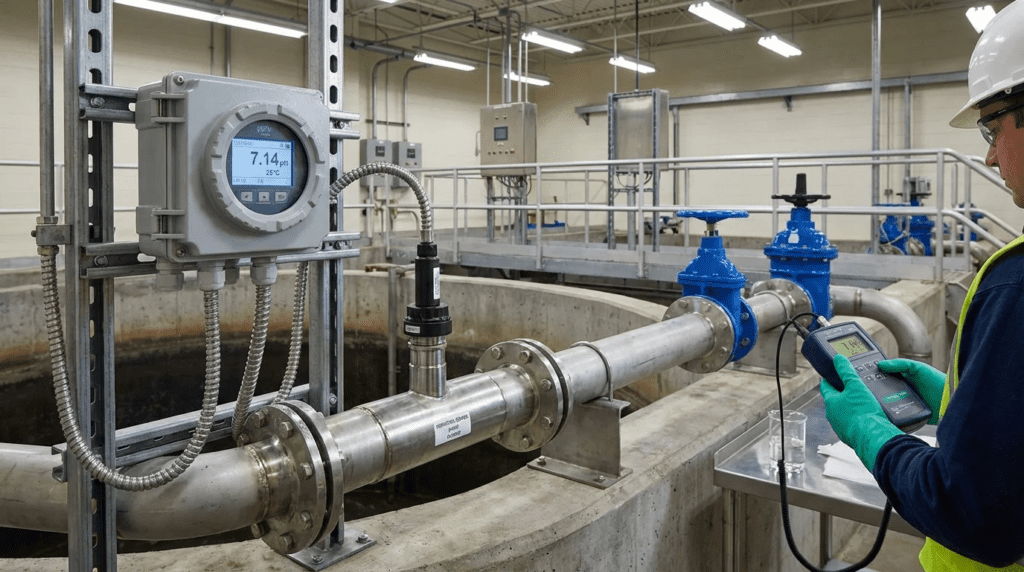
Inline insertion pH sensors are threaded directly into a pipe tee or welded boss, placing the measuring tip directly in the process flow. This provides real-time, zero-lag measurement critical for rapid chemical dosing control loops (like in-pipe static mixer coagulation). Engineers must carefully calculate fluid velocity; typical specifications aim for 1.5 to 3.0 ft/sec to ensure the sensor face is swept clean of debris without subjecting the glass bulb to excessive sheer forces or cavitation. Isolation valves are highly recommended to allow for sensor removal without shutting down the main process line.
Submersion drop-in pH sensors are attached to the end of a standpipe or suspended by a specialized cable directly into open tanks, basins, clarifiers, or flumes. They are universally used in municipal aeration basins, neutralization pits, and effluent channels. The critical engineering consideration here is the waterproofing of the cable-to-sensor transition; failure often occurs due to moisture wicking up the cable or capillary action. Standpipes should be securely bracketed to prevent the sensor from swinging into concrete walls due to mixer-induced turbulence.
Retractable pH sensor assemblies feature a mechanical mechanism (manual ball-valve type or pneumatically automated) that allows the sensor to be withdrawn from a pressurized pipe into an isolation chamber, serviced, and reinserted without interrupting the process flow. These are mandatory in continuous industrial processes, large-diameter municipal force mains, and hazardous chemical lines where process shutdown is economically or operationally unfeasible. While they add significant mechanical complexity and CAPEX, they drastically improve operator safety and maintenance compliance.
Flow-through bypass pH sensors route a small sample stream from the main process line through a dedicated measurement block or flow cell before discharging it to drain or returning it to the process. This allows for precise control of pressure and velocity across the sensor face, independent of main line fluctuations. They are the standard configuration for multi-parameter water quality panels and high-purity applications, though they introduce a slight measurement lag time (transport delay) that engineers must account for in PID tuning.
Offline Testing and Calibration Equipment
Benchtop laboratory pH meters are highly accurate, multi-point calibration instruments used in centralized plant laboratories for compliance reporting and QA/QC validation. They feature advanced temperature compensation, high-resolution displays (down to 0.001 pH), and sophisticated electrode diagnostics. They are not intended for field use. Plant managers rely on benchtop meters as the “source of truth” to verify the accuracy of continuous online process sensors via grab sample comparison.
Portable handheld pH meters are rugged, battery-operated devices used by operators for field spot-checks, troubleshooting, and in-situ validation. Modern units are IP67 waterproof rated and often feature integrated data logging. They bridge the gap between lab precision and field ruggedness. Engineers and operators use these during commissioning to verify online sensor readings before engaging automated chemical dosing pumps, ensuring loop integrity.
Colorimetric pH test kits (including liquid drop kits and wide-range indicator strips) rely on chemical reactions that change color based on the pH of the sample, which is then visually compared to a reference chart. While lacking the precision of electronic meters (typically only accurate to ±0.5 to 1.0 pH), they are immune to electrical interference, do not require calibration, and have no fragile glass components. They are primarily used for rough estimations, backup verification during severe power/instrumentation failures, and basic residential/commercial water conditioning.
Electronics, Transmitters & Maintenance Systems
Smart digital pH sensors house the high-impedance analog-to-digital converter and microprocessor directly within the sensor head. The signal transmitted to the controller is a robust digital signal (such as Modbus RS-485 or proprietary digital protocols) rather than a fragile millivolt analog signal. This prevents signal degradation over long cable runs, eliminates ground loop interference, and allows the sensor to store its own calibration data. Operators can calibrate smart sensors in the lab and hot-swap them into the field, minimizing process downtime.
Analog 2-wire pH transmitters output a standard 4-20mA signal proportional to the pH range. In traditional analog setups, the fragile, high-impedance millivolt signal from the glass bulb must travel through specialized coaxial cables to the transmitter. These cables are highly susceptible to moisture, electromagnetic interference (EMI) from VFDs, and signal degradation over distances exceeding 50 feet. While older and requiring more careful installation, they remain in widespread use due to their simplicity and compatibility with legacy PLC/DCS architectures.
Automated cleaning pH systems integrate pneumatic or hydraulic mechanisms to automatically clean the sensor face at programmed intervals. Options include compressed air blasts, pressurized water jets, or chemical (acid/base) washes. They are heavily specified in raw Wastewater effluent pH monitoring, primary clarifiers, and industrial lime slurry dosing where sensors would otherwise blind over with fats, oils, grease (FOG), or scaling within hours. These systems trade higher initial capital and mechanical complexity for drastically reduced daily maintenance labor.
Selection & Specification Framework
Selecting the optimal equipment from the pH Sensors and Testing for Water Treatment: Types and Applications landscape requires a systematic evaluation of process conditions. A sensor that performs flawlessly in drinking water will fail catastrophically in a heavy metals precipitation process.
Decision Tree Logic:
- Chemical Matrix: Does the fluid contain Hydrofluoric Acid (HF) or heavy caustics (>14 pH)? If HF is present, specify Antimony pH sensors. If strict glass-free requirements exist (food/bev), use ISFET non-glass pH sensors. For general aqueous solutions, proceed with Glass bulb pH sensors.
- Contaminant Profile: Is the fluid clean water, or does it contain sulfides, proteins, heavy metals, or high organics? For clean water, Single junction pH sensors are acceptable. For moderate contaminants, mandate Double junction pH sensors. For aggressive, poisoning environments (digesters, industrial waste), specify Differential pH sensors.
- Conductivity/Purity: Is it RO permeate, DI water, or boiler feed (<50 µS/cm)? Standard junctions will drift and fail. Specify Flowing reference junction pH sensors and install them in Flow-through bypass pH sensors configurations to manage flow perfectly.
- Fouling Potential: Will the sensor coat with scaling, FOG, or biological growth rapidly? If yes, integrate Automated cleaning pH systems and prioritize flat-glass sensor profiles over traditional domed bulbs, which are harder to sweep clean.
- Installation Location: Can the process be shut down for maintenance? If not, specify Retractable pH sensor assemblies. Is it an open basin? Use Submersion drop-in pH sensors.
Lifecycle Cost Trade-offs (CAPEX vs OPEX):
Engineers frequently make the mistake of specifying low-CAPEX standard double-junction sensors for harsh industrial wastewater. While the initial sensor might cost $150, its lifespan in an aggressive chemical matrix might be three weeks. The associated OPEX—maintenance labor, frequent replacement, calibration time, and process upset costs—rapidly eclipses the initial savings. Conversely, a differential pH sensor might cost $800 to $1,200 (high CAPEX) but can last 18–24 months with only minor salt bridge replacements (low OPEX), proving vastly superior in lifecycle cost analysis.
Common Specification Pitfalls:
- Specifying submersion sensors without detailing the waterproofing/potting requirements of the cable back-end, leading to premature electronics failure via moisture wicking.
- Failing to specify integral temperature sensors (PT100/PT1000). pH is highly temperature-dependent; without automatic temperature compensation (ATC), readings will be highly inaccurate as process temperatures fluctuate.
- Running high-impedance analog pH cables in the same conduit as VFD motor leads, causing massive electromagnetic interference and erratic controller behavior. Always use Smart digital pH sensors or local transmitters if distance exceeds 30 feet.
Comparison Tables
The following tables provide an engineering quick-reference to compare the technical capabilities, applications, and lifecycle profiles of the primary subcategories discussed above.
Table 1: Primary pH Sensor Technology Comparison
| Type / Technology | Key Engineering Features | Best-Fit Applications | Critical Limitations | Relative CAPEX |
|---|---|---|---|---|
| Glass bulb pH sensors (Double Junction) | Standard Nernstian glass, labyrinth reference protection. | General municipal WW, drinking water, standard chemical feed. | Fragile glass, prone to poisoning over long periods. | Low to Moderate ($) |
| Differential pH sensors | Three electrodes, enclosed buffer, replaceable salt bridge, ground loop immune. | Aggressive industrial effluent, anaerobic digesters, high organics. | Larger physical footprint, slower thermal response. | High ($$$) |
| ISFET non-glass pH sensors | Solid-state silicon chip, shatter-proof, dry-storable. | Food & Beverage WW, pharmaceutical, high-breakage risk areas. | Narrower temp range, sensitive to static and stray currents. | High ($$$) |
| Flowing reference junction pH sensors | Positive pressurized electrolyte outflow, lowest impedance. | High-purity water pH monitoring (RO/DI), heavily scaling fluids. | Requires external pressurized reservoir, highest maintenance. | Moderate to High ($$) |
| Antimony pH sensors | Galvanic metal measurement, heavily robust. | Streams containing Hydrofluoric Acid (HF). | Low accuracy (±0.5 pH), narrow range (2-11), high drift. | Moderate ($$) |
Table 2: Application Fit and Constraint Matrix
| Application Scenario | Optimal Subcategory Choice | Key Design Constraints | Operator Maintenance Impact |
|---|---|---|---|
| RO Permeate / Boiler Feed | Flowing reference junction pH sensors + Flow-through cell | Must control flow rate precisely; avoid air bubbles which cause erratic readings. | High. Requires routine refilling of KCl reservoirs. |
| Coagulation pH control systems | Inline insertion pH sensors (Flat Glass) | Fast response required. Pipeline velocity must be 1.5-3.0 ft/sec. | Low/Moderate. Flat glass offers self-cleaning via fluid velocity. |
| Aeration Basins (BNR) | Differential pH sensors + Submersion mounting | Sensor must be securely mounted to resist mixer turbulence and avoid wall strikes. | Moderate. Requires periodic wiping of biological fouling. |
| Industrial Neutralization Tanks | Retractable pH sensor assemblies | Vessel must have sufficient clearance for full probe retraction under pressure. | Moderate. Allows safe cleaning without process downtime. |
Engineer & Operator Field Notes
Successful deployment of pH monitoring systems extends beyond correct specification; it requires rigorous adherence to installation, commissioning, and maintenance best practices. The following field notes highlight critical variations across the subcategories.
Commissioning Considerations
Commissioning protocols vary heavily depending on the sensor type. Glass bulb pH sensors must be properly hydrated. If they arrive dry or the protective boot leaks during shipping, they must be soaked in pH 4 buffer or KCl solution for at least 24 hours prior to calibration; otherwise, they will exhibit massive drift. In contrast, ISFET non-glass pH sensors can be commissioned immediately from dry storage. For Smart digital pH sensors, commissioning is largely software-driven; the primary task is assigning the correct network node ID (e.g., Modbus address) and ensuring the controller recognizes the digital handshake. Always perform a 2-point calibration (typically pH 4 and 7, or 7 and 10, bracketing the expected process range) prior to placing any sensor into service.
During commissioning, verify the sensor’s millivolt output in a pH 7.00 buffer. A perfect glass sensor generates 0 mV at pH 7. Acceptable variance is typically ±30 mV. If a sensor generates >45 mV in pH 7, the reference cell is compromised, and calibration attempts will only mask a failing probe.
Common Specification Mistakes
One of the most frequent errors in I&C design is failing to account for Ground Loop potentials. In plastic tanks or pipes with heavy pump activity, stray electrical currents seek ground through the process fluid. If standard single or double junction sensors are used, this stray current travels through the reference junction, resulting in wildly erratic readings (e.g., pH jumping from 6 to 9 randomly). Engineers must either specify grounding rings/rods in the pipeline or use Differential pH sensors, which feature a built-in titanium or stainless steel ground electrode to shunt stray currents away from the measuring circuit.
O&M Comparison Across Subcategories
Maintenance burden is perhaps the biggest differentiator across the pH Sensors and Testing for Water Treatment: Types and Applications landscape.
- Daily/Weekly Attention: Flowing reference junction pH sensors require the highest routine operator involvement to monitor and refill pressurized electrolyte reservoirs. Antimony pH sensors also require frequent mechanical brushing to remove oxidation.
- Monthly/Quarterly Attention: Standard Glass bulb pH sensors in wastewater require manual removal, cleaning with mild acid/detergent, and recalibration roughly every 2 to 4 weeks, demanding 30-45 minutes of labor per loop.
- Hands-Off / Low Maintenance: Systems equipped with Automated cleaning pH systems (using air blasts or water) extend manual cleaning intervals from weeks to months. Differential pH sensors generally require the least sensor replacement; operators only replace the inexpensive salt bridge and buffer solution every 6 to 12 months.
- Consumable Costs: Standard glass sensors are fully consumable items ($150-$300) replaced 1-3 times annually in dirty water. Differential sensors represent a higher capital cost but have very low consumable costs (salt bridges cost ~$25). Colorimetric pH test kits require ongoing reagent purchases which can add up for high-frequency testing.
- Skill Level Required: Calibrating Analog 2-wire pH transmitters requires an operator capable of interacting with complex transmitter menus in the field, often in inclement weather. Smart digital pH sensors allow lower-skilled operators to simply swap a pre-calibrated sensor from the lab into the field with plug-and-play ease.
Troubleshooting Overview
Different technologies exhibit distinct failure symptoms.
- Sluggish Response / Span Error: In glass sensors, this indicates coating of the glass bulb (requires cleaning) or aging of the glass matrix (requires replacement). Verify using Portable handheld pH meters.
- Erratic / Jumping Readings: In analog systems, this points to moisture in the cable connections or ground loop interference. If using Flow-through bypass pH sensors, check for air bubbles trapped in the flow cell, which break the electrical continuity.
- Reading Stuck at Constant Value (e.g., ~pH 7): A broken glass bulb will cause the internal buffer to short to the reference, driving the output to 0 mV (pH 7). Visually inspect the sensor.
Operators frequently wipe glass bulb sensors dry with rags or paper towels. This creates a massive static charge on the glass that can take hours to dissipate, causing erratic readings. It can also scratch the delicate hydration gel layer. Always rinse with water and dab lightly if necessary.
Design Details & Standards
Integrating pH measurement into facility design requires adherence to specific fluid dynamic and electrical criteria. While there is no “sizing” a pH sensor in the traditional pump or valve sense, the environment around the sensor must be sized and designed appropriately.
Sizing Methodology and Fluid Dynamics
For Inline insertion pH sensors, the pipeline diameter must be sized to maintain an optimal fluid velocity of 1.5 to 3.0 ft/sec (0.5 to 0.9 m/s).
- Velocity < 1.5 ft/sec: Suspended solids will settle out, burying the sensor. FOG will adhere to the glass bulb, blinding the measurement.
- Velocity > 3.0 ft/sec: Induces excessive sheer force, risking glass breakage, stripping the protective gel layer off the glass, and accelerating the depletion of reference ions in Single junction pH sensors.
If the main pipeline velocity is outside this range, the designer must utilize Flow-through bypass pH sensors. A 1/2″ or 3/4″ sample line is drawn from the main pipe, passed through a flow cell with a rotameter or pressure-reducing valve to regulate flow to optimal parameters, and then returned to the process.
Key Design Parameters by Subcategory
The choice of subcategory alters the physical design of the P&ID and piping. If Retractable pH sensor assemblies are specified, the piping designer must ensure adequate spatial clearance (often 24 to 36 inches) perpendicular to the pipe for the full stroke of the retraction mechanism. If Automated cleaning pH systems are utilized, the design must include a dedicated 80-100 psi instrument air line or potable water feed to the sensor location, complete with solenoid valves tied to the PLC or local transmitter wash relays.
Applicable Standards & Compliance
Engineers must ensure equipment complies with relevant industry standards:
AWWA / EPA: For municipal compliance monitoring, the EPA broadly recognizes standard electrometric methods (e.g., Standard Methods 4500-H+ B) utilizing glass electrodes.
NEMA / IEC: Transmitters and field electronics should carry a minimum of NEMA 4X (IP66/IP67) ratings for washdown resistance in wastewater plants.
Hazardous Locations: In environments with explosive gas (e.g., near anaerobic digesters), sensors and transmitters must be specified as Intrinsically Safe (IS) or Explosion-Proof, carrying ATEX or UL Class I, Div 1/2 certifications. Analog sensors are easier to make intrinsically safe than complex digital sensor heads.
Specification Checklist
When writing procurement specifications, ensure the following are clearly defined:
- Primary measurement technology (Glass, ISFET, Antimony, Differential).
- Reference junction type and electrolyte details.
- Integral temperature compensation (PT100/PT1000) requirement.
- Cable length and signal type (Analog millivolt, 4-20mA, Modbus).
- Mounting hardware materials (e.g., CPVC, 316SS, Titanium) compatible with process fluids.
FAQ Section
What are the different types of pH sensors used in water treatment?
The primary types based on measurement technology include traditional Glass bulb pH sensors, heavy-duty Differential pH sensors for dirty water, solid-state ISFET non-glass pH sensors for food/beverage or high-breakage environments, and specialized Antimony pH sensors for hydrofluoric acid applications. These can be deployed in various configurations like Inline insertion pH sensors or Submersion drop-in pH sensors.
How do you choose between single junction and double junction pH sensors?
Single junction pH sensors are only appropriate for clean, non-aggressive fluids (like drinking water) where there are no heavy metals or sulfides to poison the internal reference. Double junction pH sensors should be selected for wastewater, industrial effluents, and processes with organics, as the secondary barrier significantly extends the sensor’s life by protecting against chemical poisoning.
What is the most cost-effective pH sensor for a small wastewater plant?
For municipal wastewater, standard Double junction pH sensors paired with flat-glass profiles are generally the most cost-effective in terms of initial CAPEX. However, if the plant struggles with heavy grease or rapid fouling, investing in Differential pH sensors or Automated cleaning pH systems will yield a lower lifecycle cost by drastically reducing daily maintenance labor and sensor replacement rates.
Why is my pH sensor reading erratic or jumping randomly?
Erratic readings are typically caused by three issues: Ground loop interference (stray electrical currents in the fluid), moisture intrusion in the analog cables or transmitter connections, or an air bubble trapped against the glass bulb in Flow-through bypass pH sensors. Switching to Smart digital pH sensors or ensuring proper grounding eliminates most electrical interference issues.
How often should online pH sensors be calibrated?
Calibration frequency depends heavily on the application. In clean High-purity water pH monitoring, sensors may hold calibration for 1 to 3 months. In raw wastewater or heavy industrial chemical feed, calibration may be required weekly or bi-weekly. Operators should establish a baseline by comparing online readings to Portable handheld pH meters or Benchtop laboratory pH meters via grab samples to determine the specific drift rate.
Can I use portable pH testing instead of online continuous monitoring?
Offline testing using Portable handheld pH meters or Colorimetric pH test kits is excellent for spot-checking, manual batch neutralization, or verifying online sensors. However, manual testing cannot be used for dynamic processes like Coagulation pH control systems, where chemical dosing pumps require instantaneous, continuous feedback (4-20mA) to maintain tight setpoints and prevent chemical waste.
Conclusion
Key Takeaways: Specifying pH Sensors
- Chemical compatibility is paramount: General water utilizes Glass bulb pH sensors, HF environments require Antimony pH sensors, and glass-free mandates dictate ISFET non-glass pH sensors.
- Protect the reference: Specify Double junction pH sensors or Differential pH sensors in wastewater to prevent reference poisoning and drastically lower OPEX.
- Manage flow: Keep inline fluid velocities between 1.5 and 3.0 ft/sec. Use Flow-through bypass pH sensors if main line velocities cannot be controlled.
- Upgrade signaling: Utilize Smart digital pH sensors over analog signals to eliminate ground loops, moisture vulnerability, and long-cable signal degradation.
- Match maintenance to technology: High-fouling environments require Automated cleaning pH systems to prevent excessive operator burden and ensure reliable chemical dosing control.
The vast spectrum of pH Sensors and Testing for Water Treatment: Types and Applications ensures that there is a precise technological fit for virtually every process environment, from ultra-pure boiler feed to heavy industrial sludge. However, achieving reliable pH measurement is rarely just about buying the most expensive sensor; it requires a holistic engineering approach. The designer must evaluate the fluid chemistry to select the right primary electrode, analyze the contaminant profile to choose adequate reference protection, and understand the physical installation constraints to determine the optimal form factor.
By balancing initial capital expenditure against the realities of operational maintenance, consumable costs, and the severe financial penalties of poor chemical dosing, engineers can design robust pH control loops. While a standard glass sensor might suffice for clean water, navigating complex or harsh environments demands leveraging differential technologies, automated cleaning mechanisms, and digital signaling. Ultimately, well-specified pH instrumentation protects infrastructure, ensures regulatory compliance, and acts as the foundation for optimized, cost-effective water and wastewater treatment.