
Activated Sludge Parameters: MLSS MLVSS F/M Ratio Guide
INTRODUCTION
One of the most frequent causes of secondary clarifier failure, effluent permit violations, and excessive aeration energy costs in biological wastewater treatment is the mismanagement of bioreactor mass balances. Engineers and operators must continuously balance organic loading against biological mass. For wastewater professionals, an Activated Sludge Parameters: MLSS MLVSS F/M Ratio Guide is not merely an academic reference—it is the foundational framework for sizing aeration basins, specifying blower capacities, and maintaining plant stability under varying seasonal and diurnal loads.
The activated sludge process is a dynamic ecosystem. By controlling specific operational parameters, engineers dictate the growth rate, settling characteristics, and metabolic efficiency of the microbial population. Miscalculating these parameters during the design phase leads to undersized clarifiers, overloaded aeration systems, or chronic solids washout. During operation, ignoring shifts in these parameters results in catastrophic biomass loss or filamentous bulking.
This pillar page provides a comprehensive overview of the entire activated sludge parameter landscape. It covers the primary kinetic and physical parameters, the analytical measurement technologies used to track them, the process configurations that dictate their target ranges, and the operational adjustments required to keep them in equilibrium. By understanding the interconnected nature of these variables, engineers and facility directors can optimize plant performance, lower lifecycle costs, and ensure strict regulatory compliance.
SUBCATEGORY LANDSCAPE — TYPES, TECHNOLOGIES & APPROACHES
The landscape of activated sludge parameters can be divided into four distinct dimensions: the core mass and loading parameters, the operational control levers, the process configurations that define the acceptable ranges, and the measurement technologies used to gather the data. Understanding how these subcategories interact is critical. A change in organic loading directly impacts the F/M ratio, which must be countered by adjusting WAS rates to alter the MLSS, thereby shifting the SRT. The following sections detail each of these critical subcategories.
Core Process Parameters
Mixed Liquor Suspended Solids (MLSS)
Mixed Liquor Suspended Solids (MLSS) represents the total concentration of suspended solids in the aeration basin, measured in milligrams per liter (mg/L). It includes active microorganisms, dead cells, inert organic matter, and inorganic debris. MLSS is the primary indicator of total inventory in the bioreactor and is used to calculate solids loading to the secondary clarifiers. Typical conventional plants maintain MLSS between 1,500 and 3,000 mg/L. Operating at too high an MLSS increases aeration demands and risks overloading the clarifier, while too low an MLSS can lead to poor treatment efficiency and an inability to handle shock loads. Selecting the target MLSS directly dictates the required volume of the aeration tanks during the design phase.
Mixed Liquor Volatile Suspended Solids (MLVSS)
While MLSS measures all solids, Mixed Liquor Volatile Suspended Solids (MLVSS) isolates the organic, volatile fraction—serving as a proxy for the active biological mass (the microorganisms actually consuming the waste). It is determined by igniting the dried MLSS sample at 550°C. In typical municipal wastewater, MLVSS is approximately 70% to 80% of the MLSS. In industrial applications with high inorganic influent, this ratio can drop significantly. Engineers must use MLVSS, rather than MLSS, when calculating metabolic rates and sizing biological nutrient removal (BNR) processes, as only the volatile fraction is responsible for BOD reduction and nitrification.
Food-to-Microorganism (F/M) Ratio
The Food-to-Microorganism (F/M) Ratio is the fundamental loading parameter that defines how much organic food (BOD or COD) is provided daily per unit of active microorganism mass (MLVSS). Expressed as kg BOD5 / kg MLVSS / day, it determines the metabolic state of the biomass. A high F/M ratio (e.g., >0.5) puts bacteria in a log-growth phase, leading to dispersed, poorly settling sludge. A low F/M ratio (e.g., <0.1) forces endogenous respiration, ideal for extended aeration and minimizing sludge yield, but can lead to pin floc. Maintaining the correct F/M ratio is critical for developing a dense, rapidly settling biological floc in the clarifier.
Sludge Retention Time (SRT)
Also known as Mean Cell Residence Time (MCRT), Sludge Retention Time (SRT) is the average number of days a microorganism remains in the treatment system before being wasted. It is arguably the most critical design parameter for modern activated sludge systems. Standard BOD removal requires an SRT of 3 to 5 days, while nitrification (ammonia removal) requires slower-growing autotrophic bacteria, necessitating an SRT of 8 to 15 days or more, depending on temperature. The SRT is inversely proportional to the specific growth rate of the bacteria and is the primary parameter operators adjust (via wasting) to accommodate seasonal temperature changes.
Sludge Volume Index (SVI)
The Sludge Volume Index (SVI) is an empirical measurement of the settling characteristics of the mixed liquor, expressed in mL/g. It is calculated by measuring the volume occupied by 1 gram of sludge after 30 minutes of settling in a 1-liter graduated cylinder. An SVI between 80 and 120 mL/g indicates excellent settling floc. SVI values above 150 mL/g suggest filamentous bulking or viscous bulking, warning operators of impending clarifier failure. Engineers use historical SVI data to properly size the surface area and depth of secondary clarifiers, ensuring the downward velocity of settling solids exceeds the upward velocity of the effluent.
Operational Control Levers
Dissolved Oxygen (DO) Control
Dissolved Oxygen (DO) Control refers to the management of aeration to provide sufficient oxygen for bacterial respiration and mixing. Typical aerobic basins target a DO concentration of 1.5 to 2.0 mg/L. Nitrification demands higher DO (2.0 to 3.0 mg/L) due to the oxygen-intensive nature of ammonia oxidation. Maintaining excess DO wastes significant energy—often representing 50-60% of a plant’s entire power draw—while insufficient DO causes process failure and promotes the growth of low-DO filamentous bacteria like Sphaerotilus natans.
Return Activated Sludge (RAS) Pumping
Return Activated Sludge (RAS) Pumping is the continuous recirculation of settled biomass from the bottom of the secondary clarifier back to the head of the aeration basin. This maintains the MLSS concentration required for treatment. RAS rates are typically expressed as a percentage of the influent flow (Q), ranging from 50% to 150% in conventional systems. Proper RAS control manages the sludge blanket depth in the clarifier; pumping too slowly allows the blanket to rise and potentially wash out, while pumping too quickly dilutes the returned sludge and increases clarifier hydraulic loading.
Waste Activated Sludge (WAS) Control
Waste Activated Sludge (WAS) Control is the intentional removal of biomass from the system to maintain a constant SRT and MLSS concentration. Because bacteria constantly reproduce by consuming BOD, excess mass must be removed to prevent system overloading. WAS is typically pulled from the RAS line or directly from the aeration basin. The daily WAS volume is the primary mathematical variable operators use to dictate the plant’s F/M ratio and SRT. Errors in WAS calculation lead directly to unstable plant operation.
Process Configurations Dictating Parameter Ranges
Conventional Activated Sludge (CAS) Systems
Conventional Activated Sludge (CAS) Systems are the traditional plug-flow or complete-mix basins utilizing secondary clarifiers. They operate at moderate parameters: MLSS of 1,500-3,000 mg/L, F/M of 0.2-0.4, and an SRT of 5-10 days. CAS provides a reliable balance between footprint, energy consumption, and effluent quality for municipal applications, though it requires significant clarifier surface area compared to advanced alternatives.
Extended Aeration Processes
Extended Aeration Processes (such as oxidation ditches and many package plants) operate at very low F/M ratios (<0.1) and very long SRTs (20-40 days). The MLSS is typically higher (3,000-5,000 mg/L). This design forces the biomass into endogenous respiration, where bacteria consume their own cellular mass. The advantage is significantly reduced WAS production and a highly stabilized, easily handled sludge. The limitation is a larger required tank volume and higher aeration energy per pound of BOD removed.
Membrane Bioreactors (MBR)
Membrane Bioreactors (MBR) replace gravity clarifiers with ultrafiltration or microfiltration membranes. This physical barrier allows the system to operate at extremely high MLSS concentrations (8,000-12,000 mg/L) and very long SRTs without the risk of solids washout. The F/M ratio can be very low, and the system footprint is highly compressed. MBRs are ideal for water reuse applications and tight urban footprints, but they carry high capital costs and significant membrane scouring energy OPEX.
Sequencing Batch Reactors (SBR)
Sequencing Batch Reactors (SBR) perform all treatment steps (fill, react, settle, decant, idle) sequentially in a single tank, rather than in separate spatial zones. SBR parameters fluctuate throughout the cycle; F/M is high during fill and drops to near zero before settling. MLSS must be carefully controlled to ensure settling occurs quickly during the dedicated settle phase. SBRs are highly flexible and excel in batch industrial flows or smaller municipalities, but require sophisticated automation and valving.
Measurement & Analytical Approaches
Gravimetric Solids Testing
Gravimetric Solids Testing is the laboratory benchmark for determining MLSS and MLVSS. It involves filtering a known volume of mixed liquor through a pre-weighed glass-fiber filter, drying it at 103-105°C to determine TSS, and then combusting it at 550°C in a muffle furnace to determine VSS. While highly accurate and required for compliance reporting, gravimetric testing provides historical data (delayed by hours) rather than real-time operational feedback.
Optical Suspended Solids Sensors
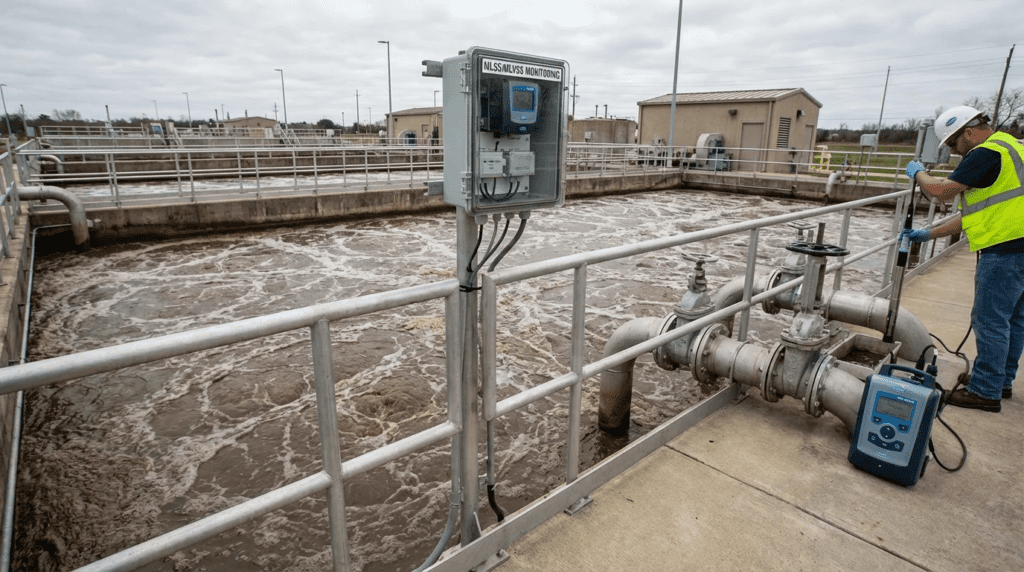
Optical Suspended Solids Sensors use near-infrared light scattering or microwave phase-shift technology to provide continuous, real-time measurement of MLSS in the aeration basin or RAS lines. When integrated with SCADA systems, these sensors allow for automated WAS pacing to maintain precise SRT control. While they reduce laboratory burden, optical sensors require frequent cleaning and must be routinely calibrated against gravimetric laboratory grab samples to ensure accuracy.
SELECTION & SPECIFICATION FRAMEWORK
Selecting the appropriate activated sludge configuration—and establishing the target parameters (MLSS, MLVSS, F/M, and SRT)—requires a methodical decision framework. Engineers must balance influent characteristics, effluent limits, available footprint, and lifecycle costs.
Decision Logic: Matching Configuration to Parameters
The selection process typically follows this decision tree:
- Determine Effluent Requirements: If strict total nitrogen (TN) or total phosphorus (TP) limits apply, a higher SRT is required to support slow-growing nitrifying bacteria. If effluent TSS limits are extremely strict (e.g., < 3 mg/L for reuse), physical separation via Membrane Bioreactors (MBR) is often required over gravity settling.
- Assess Footprint Constraints: The required aeration tank volume is inversely proportional to the design MLSS. If land is constrained, engineers must select a process capable of high MLSS operation (MBR at 10,000 mg/L or IFAS/MBBR augmentations). If land is plentiful, Extended Aeration Processes (like oxidation ditches) operating at 3,000-4,000 mg/L MLSS offer excellent stability and lower mechanical complexity.
- Evaluate Sludge Handling Capabilities: High F/M processes generate large volumes of waste biological sludge that must be dewatered and disposed of. Low F/M, long-SRT processes (Extended Aeration) minimize sludge yield and produce a stabilized sludge, reducing downstream solids handling OPEX.
CAPEX vs. OPEX Tradeoffs
There is a direct tradeoff between capital costs (CAPEX) and operational costs (OPEX) governed by these parameters. Operating at a high MLSS (e.g., MBR) drastically reduces the CAPEX of concrete tankage because the required volume is smaller. However, higher MLSS exponentially increases the viscosity of the fluid, degrading the alpha factor (oxygen transfer efficiency). This results in larger blower sizing and significantly higher aeration OPEX over the life of the facility. Conversely, low MLSS systems have excellent oxygen transfer efficiency but require massive concrete basins and clarifiers.
Common Specification Pitfalls
Engineers often confuse the requirements between subcategories when specifying systems. A common pitfall is sizing an aeration basin volume based on an assumed high MLSS (e.g., 4,500 mg/L to save space) but specifying standard secondary clarifier surface overflow rates. In reality, a high MLSS leads to high solids loading rates (SLR) on the clarifier; without adjusting the clarifier size or selecting an MBR, the clarifier will fail under peak flow events. Furthermore, engineers must ensure specifications explicitly separate MLSS and MLVSS; utilizing MLSS values for kinetic growth calculations (instead of MLVSS) will result in undersized aeration basins that fail to meet BOD removal targets.
COMPARISON TABLES
The following tables provide a quick-reference guide for evaluating how activated sludge parameters shift based on the process configuration, and how to match these systems to specific application constraints.
Table 1: Process Configuration & Parameter Comparison
| Process / Technology | Typical MLSS (mg/L) | Typical F/M Ratio (kg/kg·d) | Typical SRT (days) | Primary Advantage | Limitation / Maintenance |
|---|---|---|---|---|---|
| Conventional Activated Sludge (CAS) Systems | 1,500 – 3,000 | 0.2 – 0.4 | 3 – 10 | Balanced energy & footprint; highly proven. | Vulnerable to shock loads; requires large clarifiers. |
| Extended Aeration Processes | 3,000 – 5,000 | 0.05 – 0.15 | 20 – 40 | Low sludge yield; excellent stability. | Large tank footprint; higher energy per lb BOD. |
| Membrane Bioreactors (MBR) | 8,000 – 12,000 | 0.05 – 0.2 | 15 – 30+ | Absolute barrier to TSS; very compact footprint. | High OPEX; membrane fouling and replacement costs. |
| Sequencing Batch Reactors (SBR) | 2,000 – 4,000 | 0.1 – 0.3 | 10 – 20 | No separate clarifier needed; flexible batch control. | Complex automation; high peak flow constraints. |
Table 2: Application Fit Matrix
| Application Scenario | Best-Fit Process Subcategory | Parameter Constraints | Operator Skill Impact | Relative Lifecycle Cost |
|---|---|---|---|---|
| Medium Municipal (Plentiful Land) | Extended Aeration Processes | Low F/M prevents upset; long SRT ensures nitrification. | Low to Moderate | Moderate CAPEX / Low OPEX |
| Urban Municipal / Water Reuse | Membrane Bioreactors (MBR) | Must maintain extreme MLSS to minimize volume. | High (Membrane CIP) | High CAPEX / High OPEX |
| Industrial Variable Batch Flow | Sequencing Batch Reactors (SBR) | SVI must be kept < 100 for rapid batch settling. | High (Automation) | Low CAPEX / Moderate OPEX |
| Standard Large Municipal | Conventional Activated Sludge (CAS) Systems | Strict control of SRT and WAS rate required. | Moderate | Moderate CAPEX / Moderate OPEX |
ENGINEER & OPERATOR FIELD NOTES
Translating academic parameters into real-world performance requires practical field adjustments. Requirements and operational burdens differ significantly based on the chosen subcategory.
Commissioning Considerations
Commissioning an activated sludge plant requires building the MLSS inventory from zero. During startup, the F/M ratio is artificially infinite (plenty of food, zero bugs). Operators must “seed” the plant with imported sludge from a nearby facility or carefully step-feed influent while preventing clarifier washout. For Conventional Activated Sludge (CAS) Systems, seeding to a minimum MLSS of 500-1,000 mg/L is recommended before applying full flow. For Membrane Bioreactors (MBR), commissioning requires extreme care; membranes can foul irreversibly if exposed to high concentrations of raw, unacclimated organic polymers before a mature MLVSS floc develops.
O&M Comparison Across Subcategories
The daily operational burden shifts heavily depending on the process configuration and parameter control philosophy:
- Daily Lab Burden vs. Automation: Systems relying on Gravimetric Solids Testing require daily grab sampling, drying, weighing, and math. Conversely, plants heavily utilizing Optical Suspended Solids Sensors reduce lab time but transfer O&M burden to sensor cleaning, wiping, and monthly calibration checks.
- Wasting Schedules: Conventional Activated Sludge (CAS) Systems usually require continuous or daily scheduled wasting via Waste Activated Sludge (WAS) Control. Extended Aeration Processes are much more forgiving, often requiring wasting only a few times per week.
- Consumables and Replacements: Membrane Bioreactors (MBR) require significant chemical inventories (sodium hypochlorite, citric acid) for regular clean-in-place (CIP) operations, and flat-sheet or hollow-fiber membranes must be replaced every 7 to 10 years. Traditional clarifier systems require minimal consumables.
- Operator Training: Maintaining precise SRT in a BNR plant requires advanced process control knowledge. Sequencing Batch Reactors (SBR) require operators skilled in PLC troubleshooting, as a single failed valve can ruin an entire batch.
Common Specification Mistakes
Engineers frequently specify a single SRT value (e.g., 10 days) for plant design. Biological growth rates follow the Arrhenius equation—they halve for roughly every 10°C drop in temperature. If an engineer designs aeration volume based on a 10-day summer SRT, the plant will fail to nitrify in winter. Basin volume must be sized for the maximum winter SRT, while blowers must be sized for the minimum summer SRT (highest metabolic oxygen demand).
Troubleshooting Disturbances by Subcategory
When mass balance parameters drift, process disturbances manifest physically in the secondary clarifiers.
Filamentous Bulking Control
When the F/M ratio drops too low, or DO is insufficient for the organic load, filamentous bacteria outcompete floc-forming bacteria. These long strands bridge between flocs, preventing compaction. The Sludge Volume Index (SVI) skyrockets above 150 mL/g. Symptom: Clear supernatant but a sludge blanket that won’t settle and washes over clarifier weirs. Fix: Increase DO, adjust WAS to raise F/M ratio, or apply a controlled dose of chlorine to the RAS line to selectively kill external filaments.
Pin Floc Management
Conversely, a chronically low F/M ratio in Extended Aeration Processes can lead to an over-oxidized, older sludge where the polysaccharide slime layer degrades. The sludge settles rapidly, but leaves behind tiny, distinct particles known as pin floc. Symptom: Low SVI (< 80 mL/g) but high effluent turbidity (cloudy water). Fix: Increase wasting (WAS) to lower the SRT, bringing in younger, healthier bacteria.
You cannot control both F/M and SRT independently. Because F/M relies on MLVSS and SRT relies on MLSS, adjusting the WAS rate changes the mass inventory, shifting both parameters simultaneously. In modern automated plants, it is best practice to control by SRT, as it is a more stable, mathematically reliable target than chasing fluctuating daily BOD loads for F/M control.
DESIGN DETAILS & STANDARDS
Standardizing the sizing and specification of activated sludge systems ensures regulatory compliance and predictable performance across various engineering disciplines.
Sizing Methodology Overview
Modern bioreactor design predominantly utilizes the SRT-based design methodology (often executing steady-state models or dynamic modeling via software like BioWin or GPS-X). The general progression is:
- Determine required SRT based on growth rate of slowest target organism (e.g., nitrifiers) at the lowest anticipated winter temperature.
- Calculate biomass production (yield) based on influent BOD and expected decay rates.
- Select a target Mixed Liquor Suspended Solids (MLSS) based on the chosen process configuration (e.g., 2,500 mg/L for CAS).
- Calculate required bioreactor volume (V) using the equation: Volume = (SRT × Yield) / Target MLSS.
Parameter Variances by Subcategory
Design parameters differ substantially depending on the subcategory selected. For example, the Return Activated Sludge (RAS) Pumping capacity must be specified differently. A CAS system typically requires RAS pumps sized for 50-100% of the design average flow (Q). In contrast, Membrane Bioreactors (MBR) require massive internal mixed liquor recirculation rates—often 300% to 500% of Q—to sweep solids away from the membrane surfaces and prevent polarization.
Applicable Standards & Compliance
- Ten States Standards (GLUMRB): Provides the baseline acceptable design parameters for municipal activated sludge plants in North America, detailing required aeration volumes, clarifier SLR/SOR limits based on F/M ratio, and minimum DO capacities.
- WEF MOP 8 (Design of Municipal Wastewater Treatment Plants): The definitive manual of practice detailing the kinetic equations and acceptable ranges for MLSS, F/M, and SRT for all process variants.
- Metcalf & Eddy (Wastewater Engineering): The academic benchmark for biological mass balance calculations and clarifier flux theory.
Specification Checklist
When drafting specifications for biological process equipment, engineers must include:
- Design Average and Peak F/M Ratios.
- Minimum, Average, and Maximum expected MLSS and MLVSS concentrations.
- Minimum required SRT at lowest design temperature.
- Required capacity and turndown ratios for Dissolved Oxygen (DO) Control (blowers and diffusers) and Waste Activated Sludge (WAS) Control pumps.
FAQ SECTION
What are the different types of activated sludge process configurations?
The primary subcategories defined by their operating parameters include Conventional Activated Sludge (CAS) Systems (moderate MLSS and F/M), Extended Aeration Processes (high MLSS, very low F/M, long SRT), Membrane Bioreactors (MBR) (extreme MLSS, ultra-low footprint), and Sequencing Batch Reactors (SBR) (single-tank, fluctuating parameters).
How do you choose between CAS and Extended Aeration?
Choosing between Conventional Activated Sludge (CAS) Systems and Extended Aeration Processes depends primarily on footprint and sludge handling capability. CAS requires less tankage and less aeration energy per pound of BOD but generates more sludge. Extended aeration requires roughly double the tank volume but produces a highly stabilized sludge, making it cost-effective for smaller municipalities lacking advanced dewatering infrastructure.
What is the difference between MLSS and MLVSS?
Mixed Liquor Suspended Solids (MLSS) is the total mass of suspended solids in the aeration tank (organic and inorganic). Mixed Liquor Volatile Suspended Solids (MLVSS) is only the combustible, organic portion of the MLSS. MLVSS is used by engineers as the proxy for the active live biomass when calculating the Food-to-Microorganism (F/M) Ratio.
Why is my Sludge Volume Index (SVI) so high, and how do I fix it?
A high Sludge Volume Index (SVI) (e.g., >150 mL/g) typically indicates Filamentous Bulking Control issues. This is often caused by a low F/M ratio, low DO, or nutrient deficiency. Operators should troubleshoot by checking DO levels, increasing the wasting rate to raise the F/M ratio, or applying a temporary dose of chlorine to the Return Activated Sludge (RAS) Pumping line.
How is Waste Activated Sludge (WAS) calculated to maintain SRT?
Waste Activated Sludge (WAS) Control is calculated using the mass of solids in the system. The WAS volume per day equals the total mass of MLSS in the aeration basin divided by the target Sludge Retention Time (SRT), minus the mass of solids lost unintentionally in the effluent. Wasting is critical for preventing clarifier overloading.
Are optical sensors reliable enough to replace laboratory gravimetric testing?
Optical Suspended Solids Sensors are highly reliable for real-time trending and automated control, but they cannot entirely replace Gravimetric Solids Testing. Regulatory agencies require gravimetric testing for compliance reporting. Sensors drift over time due to biofouling and must be cleaned and calibrated regularly against laboratory grab samples.
CONCLUSION
KEY TAKEAWAYS: Parameter Management
- Process Balance: The goal of activated sludge parameter control is maintaining the balance between food (organic loading) and mass (MLVSS) to promote a healthy, fast-settling floc.
- Control Variable: The most effective operational control lever is adjusting Waste Activated Sludge (WAS) Control to target a specific Sludge Retention Time (SRT).
- Temperature Dependency: Winter operations require a longer SRT and higher MLSS to maintain biological reaction rates, while summer operations require faster wasting to prevent excess oxygen demand.
- Configuration Fit: Specify Membrane Bioreactors (MBR) for tight urban footprints and reuse requirements; rely on Extended Aeration Processes when sludge handling capabilities are limited.
- Common Pitfall: Failing to differentiate between total solids (MLSS) and active mass (MLVSS) during the design phase will result in undersized aeration basins.
Mastering the relationships between MLSS, MLVSS, F/M ratio, and SRT is fundamental to the successful design and operation of biological wastewater treatment facilities. These parameters are not isolated metrics; they represent an interconnected, dynamic system. Adjusting the WAS rate alters the MLSS inventory, which directly impacts both the F/M ratio and the SRT. Selecting the appropriate baseline for these parameters dictates the physical size of the tanks, the required capacity of the aeration blowers, and the ultimate health of the secondary clarifiers.
Engineers must carefully evaluate the influent conditions and effluent objectives before selecting a process configuration. While advanced technologies allow for extreme parameter ranges—such as the massive MLSS capacity of an MBR—these choices carry significant lifecycle cost implications in terms of energy and maintenance. By thoroughly understanding this parameter landscape, water professionals can confidently design robust, compliant, and highly efficient activated sludge systems that withstand the rigors of municipal and industrial waste streams.