
Top MBBR & IFAS Manufacturers for Wastewater Treatment
1) Introduction
One of the most persistent challenges in biological wastewater engineering is increasing plant treatment capacity or meeting stricter effluent limits within an existing footprint. Expanding clarifiers or building new aeration basins is highly capital-intensive and often physically impossible due to land constraints. This constraint has driven the widespread adoption of fixed-film biological processes. Navigating the landscape of the Top MBBR & IFAS Manufacturers for Wastewater Treatment is a critical task for consulting engineers and plant directors seeking to leverage these high-rate, compact treatment technologies.
Equipment selection presumes the process is already settled. Before comparing vendors, the design team should be confident the MBBR wastewater treatment process is the right answer to the plant’s actual constraint — that the limitation is basin volume or clarifier solids capacity rather than aeration capacity, hydraulics, or sludge handling. Fixed-film is a poor remedy for problems it does not address, and a media system dropped into a plant whose real bottleneck lies elsewhere adds capital cost and operating complexity without moving the binding constraint.
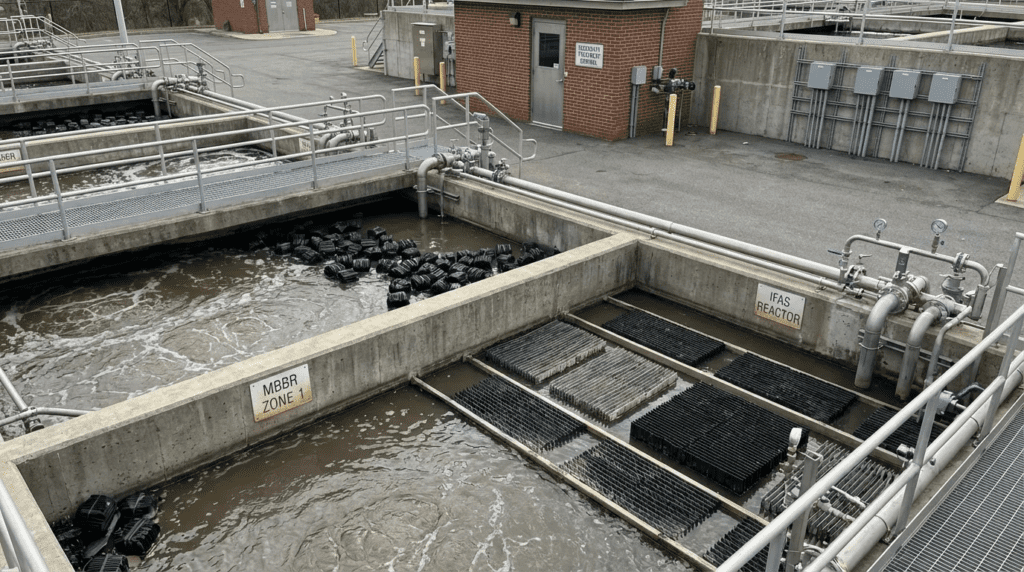
Moving Bed Biofilm Reactor (MBBR) and Integrated Fixed-Film Activated Sludge (IFAS) systems fundamentally alter the limits of biological treatment. By introducing engineered carrier media into the aeration basin, plants can cultivate massive inventories of attached-growth biomass. This decouples the Solid Retention Time (SRT) from the Hydraulic Retention Time (HRT), allowing for enhanced nitrification, denitrification, and high-strength biochemical oxygen demand (BOD) removal without overloading secondary clarifiers with suspended solids.
However, specifying these systems is far from a commoditized process. The market consists of diverse proprietary technologies, distinct media geometries, fixed versus moving media, and highly specific aeration and retention requirements. Understanding the differences among the Top MBBR & IFAS Manufacturers for Wastewater Treatment—as well as the specific process variants, media types, and operational applications they support—is essential for avoiding severe process failures, such as media washout, screen blinding, or inadequate biomass development. This pillar page serves as a comprehensive engineering hub, breaking down the major manufacturers, technology variants, component types, and critical specification frameworks required to successfully deploy MBBR and IFAS systems.
2) Subcategory Landscape — Types, Technologies & Approaches
The landscape of fixed-film technologies encompasses distinct process configurations, unique proprietary designs from major original equipment manufacturers (OEMs), and highly specialized internal components. Engineers must evaluate these options holistically, recognizing that the choice of manufacturer dictates the media geometry, which in turn drives the aeration grid design, screen sizing, and overall process kinetics. The following subsections detail the major categories spanning OEMs, process applications, and critical physical components.
Leading Manufacturer Ecosystems
Veolia (AnoxKaldnes) MBBR Systems represent the genesis of moving bed technology. Developed in Norway in the late 1980s, AnoxKaldnes (now under Veolia Water Technologies) holds deep institutional knowledge and extensive empirical data on biomass development across their proprietary K-series (e.g., K1, K3, K5) and advanced Z-MBBR media. These systems are highly standardized, heavily utilized in both massive municipal plants and complex industrial effluents, and rely on robust HDPE media with tightly controlled protected surface areas. Their key advantage is unmatched field-proven longevity and highly accurate kinetic modeling tools, though the premium engineering and proprietary nature can represent higher initial CAPEX compared to generalized alternatives.
Evoqua (Xylem) IFAS Technologies focus heavily on retrofitting existing conventional activated sludge (CAS) basins for enhanced municipal performance. Following multiple acquisitions, this portfolio integrates seamlessly with broader plant headworks and clarification technologies. Their systems are typically deployed when a plant requires year-round nitrification but cannot expand secondary clarifiers. Engineers frequently specify these IFAS setups due to the manufacturer’s deep integration capabilities and robust lifecycle support, although careful attention must be paid to matching their specific media buoyancy with the existing basin geometry and mixer configurations.
Headworks BIO ActiveCell Systems specialize in high-efficiency, high-surface-area carrier media designed to maximize treatment per cubic meter of basin volume. Utilizing their proprietary ActiveCell media, these systems are highly favored in industrial applications (such as food and beverage, pulp and paper, and petrochemicals) where footprint is extremely constrained and shock organic loading is common. The primary advantage is the exceptionally high protected surface area, which allows for lower overall media fill fractions (typically under 45%), reducing pumping and mixing energy costs. Proper screen sizing is critical here due to the aggressive aeration required for high-strength industrial mixing.
Aqwise Biomass Recovery Systems utilize a unique approach to media geometry, moving away from standard cylindrical wheels toward open, fully integrated matrices designed for optimized hydrodynamics. Their AGAR (Attached Growth Airlift Reactor) process emphasizes superior oxygen transfer efficiency and reduced headloss across the media bed. These systems are typically specified in applications prone to severe scaling or heavy suspended solids, as the open geometry resists plugging better than traditional high-density media. The tradeoff is that the effective surface area per volume may require slightly larger basin allocations compared to ultra-dense chip media.
World Water Works Ideal MBBR systems are widely recognized for their robust, prefabricated package plants and tight integration with Dissolved Air Flotation (DAF) technology. This manufacturer excels in industrial wastewater treatment, particularly in the food processing and dairy sectors, where pre-treatment (Fats, Oils, and Grease removal) via DAF is coupled seamlessly with a roughing MBBR. Their advantage lies in rapid deployment, skid-mounted engineering, and single-source responsibility for the entire biological and clarification process, making them ideal for decentralized or fast-track industrial capacity expansions.
Entex Technologies Webitat and BioWeb represent an alternative approach within the fixed-film ecosystem. Rather than utilizing free-floating moving bed media, Entex provides integrated fixed-media IFAS systems (BioWeb) and specialized moving media systems (Webitat). The fixed-media approach drops modular, textile-like webs into existing aeration basins. This is frequently used when operators want the benefits of IFAS (increased SRT) without the risk of media washout or the CAPEX burden of installing wedge wire retention screens. The limitation is that fixed media cannot slough biomass as aggressively via physical collision, requiring careful aeration management to prevent excessive biological growth and anaerobic bridging.
Brentwood Industries Fixed Media IFAS similarly focuses on structured, stationary PVC or polypropylene modules installed within the aeration basin (e.g., AccuFAS). Because the media is fixed, it requires zero specialized retention screens and generates very predictable hydraulic flow paths. It is typically specified in deep municipal aeration basins where moving media mixing would require excessive energy. Engineers favor these systems for their low hydraulic headloss and minimal operational complexity, though they typically offer lower active surface area per cubic meter than highly dense moving bed configurations.
SSI Aeration MBBR Diffuser Systems are a critical sub-segment of the market, focusing not on the media itself, but on the specialized aeration equipment required to make moving beds function. Standard fine-bubble diffusers are easily damaged by the constant scouring of moving HDPE media. SSI specializes in robust, coarse-bubble aeration grids and heavy-duty fine-bubble variants engineered specifically to withstand media abrasion while providing the vigorous mixing energy required to keep high fill fractions (up to 70%) in suspension. Specifying dedicated MBBR aeration systems is an absolute requirement to prevent premature catastrophic failure of the air distribution network.
Process Applications & Configurations
Municipal IFAS Upgrades involve adding carrier media to the aerobic zones of a conventional activated sludge plant. By maintaining a suspended growth inventory (MLSS) alongside the attached fixed-film biomass, the plant achieves massive treatment capacity in the same volume. This is specifically utilized to achieve cold-weather nitrification (ammonia removal) without increasing the solids loading rate on the secondary clarifiers. Engineers must carefully design the return activated sludge (RAS) routing and ensure the diffusers can handle the combined oxygen demand of both the MLSS and the fixed biofilm.
Industrial Roughing MBBRs are utilized as high-rate pre-treatment steps before existing biological systems or municipal sewer discharges. Operated at exceptionally high Surface Area Loading Rates (SALR), these systems target rapid, bulk BOD removal (often 60-80% reduction) from high-strength industrial streams (e.g., breweries, dairies). They are favored for their incredible resilience to toxic shocks, pH swings, and temperature variations. Because they operate at a high F/M (Food to Microorganism) ratio, the resulting sludge is highly active and requires careful downstream solids separation, often utilizing DAF rather than gravity clarifiers.
Post-Denitrification MBBRs are specialized anoxic reactors placed after the main aerobic treatment process to remove total nitrogen (nitrate) to ultra-low levels. Because the upstream processes have consumed all the readily biodegradable carbon (BOD), these systems require the continuous dosing of an external carbon source, such as methanol or glycerin. They rely on mechanical mixers, rather than aeration, to keep the media in suspension. Proper mixer specification is critical to prevent media from stacking at the surface or accumulating in dead zones.
Anammox MBBR Processes (Anaerobic Ammonium Oxidation) represent the cutting edge of biological nitrogen removal, typically applied to high-strength, warm, ammonia-rich streams like anaerobic digester centrate (sidestream treatment). This process utilizes specialized red Anammox bacteria growing on carrier media to convert ammonia and nitrite directly into nitrogen gas, bypassing the full nitrification/denitrification cycle. This saves up to 60% of aeration energy and eliminates the need for supplemental carbon. However, the bacteria are extremely slow-growing, requiring specialized media with high protected surface areas and exact DO/pH control to maintain stability.
Core System Components
HDPE Carrier Media is the industry standard for moving bed processes. Engineered from high-density polyethylene, these small, wheel-like or cylindrical elements have a density slightly lower than water (typically 0.95 to 0.98 g/cm³). The internal structure features complex fins or cross-bars that provide a “protected surface area” where biofilms can grow without being sheared off by collisions with other media. Specification requires careful consideration of the protected surface area (500-1,200 m²/m³ bulk volume), as higher surface area media allows for smaller reactor volumes but requires finer screens that are more prone to blinding.
Sponge and Chip-Style Media represent advanced alternatives to traditional HDPE shapes. Made from polyurethane foam or ultra-thin polyethylene chips, these media types offer exponentially higher surface areas (often exceeding 3,000 m²/m³). Sponge media is highly absorptive and excellent for retaining specialized, slow-growing bacteria, making it ideal for toxic or recalcitrant industrial wastewater. However, sponge media absorbs water and biomass, drastically altering its buoyancy over time, which requires specialized aeration and mixing strategies to prevent the media from sinking to the basin floor.
Media Retention Screens are stainless steel barriers installed at the effluent (and sometimes influent) of MBBR/IFAS basins to keep the media inside the reactor while allowing treated water and sloughed solids to pass. They typically utilize wedge-wire or heavy-duty perforated plate designs. Properly designing screens is arguably the most critical physical engineering task in an MBBR project. Engineers must strictly adhere to maximum approach velocities (typically < 6 to 8 mm/s) to prevent hydraulic blinding, media pinning, and catastrophic tank overflows. They must also be integrated with dedicated air-sparge systems to continuously scour media away from the screen face.
Coarse Bubble Aeration Grids are the lungs and muscles of the moving bed reactor. Unlike conventional fine bubble diffusers used solely for oxygen transfer, coarse bubble grids in MBBRs must provide massive turbulent kinetic energy to circulate the buoyant media bed effectively. Constructed of heavy-wall stainless steel to resist physical wear, these grids represent a significant portion of the system CAPEX. When specifying these systems, engineers must balance the high mixing energy required by the media with the lower Standard Aeration Efficiency (SAE) inherent to coarse bubbles compared to fine bubble diffusers.
3) OEM Comparison Resources
The ecosystem profiles above establish who competes in this market. Converting that into a defensible shortlist requires ranked market overviews and direct head-to-head analysis of the specific vendors likely to bid a given project. The resources below cover both layers.
Ranked OEM Overviews
A survey of the top OEMs for MBBR and IFAS systems gives the market-position view — technology breadth, typical project scale, and geographic reach across the field. Use it as a screening tool rather than a selection basis. In fixed-film specifically, market share correlates poorly with fitness for a particular duty, because the technology is heavily segmented: a manufacturer dominant in large municipal IFAS retrofits may have little relevant experience in high-strength industrial roughing, and the reverse is equally common. The screening question is which manufacturers can credibly bid this application at this scale, not which is largest overall.
Evoqua vs Xylem
The head-to-head between Evoqua and Xylem for MBBR/IFAS equipment matters more than a straightforward vendor comparison would suggest, because consolidation has repeatedly reshuffled which brands carry which technologies. Engineers working from older reference projects or legacy specifications frequently find that the product line they intended to specify now sits under different ownership, with different service arrangements and sometimes different media. Verify current product ownership and regional support before writing a brand into a specification — a document naming a line that has moved can produce bids that are not comparable to each other.
SUEZ vs Ovivo
The comparison of SUEZ and Ovivo for MBBR/IFAS equipment covers two suppliers with meaningfully different delivery models. One brings large-scale municipal process capability across a broad treatment portfolio; the other operates with a stronger focus on package and retrofit delivery. That distinction shapes which is the better fit more than any media specification does: a utility executing a single large basin conversion values deep process engineering and modelling support, while one fast-tracking a modular capacity addition values delivery speed and single-source scope. Evaluate the delivery model against project constraints before comparing carrier geometries.
4) Selection & Specification Framework
Selecting the correct technology among the Top MBBR & IFAS Manufacturers for Wastewater Treatment requires a structured decision-making framework. Engineers must first decide between pure MBBR, moving media IFAS, and fixed media IFAS before shortlisting OEMs.
1. The Baseline Decision: MBBR vs. IFAS
The fundamental divergence in the specification tree is whether to utilize suspended growth (MLSS) in conjunction with fixed-film.
- Choose pure MBBR if the plant is a greenfield build, an industrial roughing application, or if secondary clarifier capacity is severely limited. MBBR requires no RAS line, operates strictly as a once-through system, and relies on distinct stages for BOD removal and nitrification.
- Choose IFAS for municipal retrofits where clarifiers can handle standard MLSS loads, but the basin requires an artificially extended SRT to achieve cold-weather nitrification. IFAS seamlessly integrates into existing CAS footprints.
Engineers unfamiliar with the underlying process distinction should establish it firmly before proceeding. Foundational coverage of what MBBR is in wastewater treatment explains the attached-growth mechanism and why decoupling SRT from HRT produces the capacity gain that justifies the equipment, while broader guidance on MBBR wastewater treatment applications covers where the technology has proven itself and where it has not. The most consequential specification errors in this field originate in a shaky grasp of the process rather than in vendor selection.
2. Moving Media vs. Fixed Media
Once IFAS is selected, engineers must choose between moving media (e.g., Evoqua (Xylem) IFAS Technologies) or fixed media (e.g., Brentwood Industries Fixed Media IFAS). Moving media provides higher treatment capacity per unit volume due to intense continuous shearing, which keeps the biofilm thin and highly active. However, it requires costly wedge-wire screens and powerful aeration/mixing. Fixed media presents a lower CAPEX, virtually zero risk of media washout, and lower headloss, but operates with thicker, potentially less efficient biofilms.
3. Lifecycle Cost Considerations (CAPEX vs OPEX)
When comparing HDPE Carrier Media from high-end OEMs versus commodity suppliers, evaluate the OPEX implications of aeration. An OEM offering ultra-high surface area media (e.g., Headworks BIO ActiveCell Systems) might allow for a 35% fill fraction compared to a competitor requiring a 60% fill fraction. The lower fill fraction dramatically reduces the aeration energy (OPEX) required strictly for media mixing, often paying for the premium media cost within 3 to 5 years. However, higher surface area media typically implies smaller internal voids, which may plug if treating high-Fats/Oils/Grease (FOG) influents.
4. Common Specification Pitfalls
The most prevalent specification error is confusing Total Surface Area with Protected Surface Area. When evaluating OEMs, always normalize comparisons using the protected (or effective) surface area per bulk volume of media (m²/m³). External surface area is subject to constant collision and shear in a moving bed, preventing stable biofilm formation. Specifications must explicitly define the required Protected Surface Area Loading Rate (SALR) to ensure an apples-to-apples bid process.
Another pitfall is under-sizing the aeration grid for mixing. Even if biological oxygen demand is low, the diffusers must supply a minimum mixing energy (typically 5 to 10 W/m³ depending on fill fraction and basin geometry) to prevent the buoyant media from stratification. Failure to specify a mixing-limited air requirement leads to dead zones, odor generation, and process failure.
Worked Example — Sizing Media Volume for Winter Nitrification
A 5 MGD (18,925 m³/d) plant must nitrify at 12°C. Influent ammonia is 28 mg/L, effluent limit 1.5 mg/L, so 26.5 mg/L must be oxidized. Media offering 600 m²/m³ protected surface area is under consideration, with a design SALR of 0.75 g NH₃-N/m²·d at that temperature.
- Ammonia load to remove: 18,925 × 26.5 ÷ 1,000 = 501.5 kg/d, or 501,500 g/d
- Protected surface area required: 501,500 ÷ 0.75 = 668,667 m²
- Media bulk volume required: 668,667 ÷ 600 = 1,114 m³
- Basin volume at 50% fill fraction: 1,114 ÷ 0.50 = 2,228 m³ (about 589,000 gallons)
Now test the sensitivity that decides the project. Media at 1,000 m²/m³ instead of 600 cuts the bulk volume to 669 m³, and at a 60% fill fraction the required basin drops to 1,115 m³ — half the original. That halving is what makes premium media worth its price where basin volume is genuinely fixed. But it comes with two costs the arithmetic hides: the finer screens that denser media demands are more prone to blinding, and the higher fill fraction raises the mixing energy needed to keep the bed circulating.
The SALR assumption deserves equal scrutiny, because it carries more risk than the media specification. Nitrification rates fall sharply with temperature, and an SALR taken from a vendor’s summer pilot will substantially undersize a basin that must perform in February. Require the design SALR to be stated at the minimum sustained winter temperature, supported by pilot or reference-plant data at comparable temperature — not extrapolated from warmer conditions by correlation.
5) Comparison Tables
The following tables provide an engineer-level quick reference mapping out the distinct attributes of major manufacturers, technologies, and system components discussed in Section 2, alongside a targeted application fit matrix.
Table 1: Subcategory & Manufacturer Comparison Matrix
| Manufacturer / Technology | Primary Differentiator | Best-Fit Applications | Key Limitations / Constraints | Relative CAPEX |
|---|---|---|---|---|
| Veolia (AnoxKaldnes) MBBR Systems | Inventors of technology; massive empirical dataset, Z-MBBR media. | Large municipal; complex industrial; greenfield builds. | Premium pricing; proprietary replacement parts. | High |
| Headworks BIO ActiveCell Systems | Ultra-high protected surface area media designs. | Industrial shock-loading; severe footprint constraints. | Requires highly precise screen sizing to avoid plugging. | Medium-High |
| World Water Works Ideal MBBR | Skid-mounted packages; heavy DAF integration. | Food & Beverage, Dairy, decentralized plants. | Less optimized for massive >50 MGD municipal flows. | Medium |
| Entex Technologies Webitat and BioWeb | Stationary, flexible web-based fixed-media. | Municipal IFAS retrofits avoiding screen installs. | Lower active surface area vs moving media; risk of anaerobic bridging. | Low-Medium |
| Anammox MBBR Processes | Sidestream nitrogen removal shortcut (deammonification). | Centrate/filtrate from anaerobic digesters. | Requires strict temp/DO control; extremely slow startup. | High |
| Sponge and Chip-Style Media | Unmatched surface area; high absorbance. | Toxic/recalcitrant industrial waste; Anammox. | Alters buoyancy as it absorbs water/biomass; sinking risk. | High |
Table 2: Application Fit Matrix
| Application Scenario | Optimal Technology/Variant | Primary Engineering Consideration | Operator Skill Demand |
|---|---|---|---|
| Municipal CAS Retrofit for Winter Nitrification | Evoqua (Xylem) IFAS Technologies or Brentwood Industries Fixed Media IFAS | Match basin hydrodynamics; RAS routing modifications. | Medium |
| Brewery/Dairy High-BOD Pre-Treatment | Industrial Roughing MBBRs (e.g., WWW or Headworks) | Pre-MBBR FOG removal (DAF) is mandatory. | Low (highly resilient) |
| Stringent Total Nitrogen Effluent Limits (<3 mg/L) | Post-Denitrification MBBRs | Carbon dosing controls; mechanical mixing without aeration. | High |
| Highly Corrosive / Abrasive Basins | SSI Aeration MBBR Diffuser Systems | Heavy-wall stainless grids; strictly avoid EPDM fine-bubble. | Low |
6) Engineer & Operator Field Notes
The operational reality of MBBR and IFAS systems heavily depends on which subcategories are specified. Practical field considerations spanning installation, maintenance, and troubleshooting differ greatly between fixed structures and moving media configurations.
Commissioning Considerations
Commissioning an MBBR is not an immediate process; biology takes time to acclimate. When deploying new HDPE Carrier Media, the pristine plastic is inherently hydrophobic and highly buoyant. During the first 2-4 weeks, the media will frequently stack near the surface of the basin until a preliminary biofilm layer develops, altering its specific gravity to near-neutral. Operators must resist the urge to drastically increase aeration energy during this phase to force mixing, as over-aeration can physically strip the delicate, nascent biofilm before it matures. For systems utilizing Sponge and Chip-Style Media, pre-soaking or mechanical degassing is often required to ensure initial submergence.
Common Specification Mistakes
One of the most dangerous errors in MBBR design is neglecting the interaction between the media geometry and the Media Retention Screens. If an engineer specifies a small, high-surface-area carrier (e.g., 10mm diameter) but utilizes a standard 12mm wedge wire screen, total media loss is guaranteed. Conversely, if a 5mm screen gap is chosen to hold back 10mm media, the open area of the screen drastically drops, pushing approach velocities well above the 6-8 mm/s threshold. This leads to media “pinning” against the screen face, hydraulically blinding the reactor, and causing tank overflows.
Always specify continuous, coarse-bubble air sparging directly beneath Media Retention Screens. This rising curtain of air physically scours media away from the screen face, preventing pinning. Size the screens for peak hourly wet weather flow (PHWWF) assuming at least a 30% reduction in open screen area due to partial blinding.
O&M Comparison Across Subcategories
Operational and Maintenance (O&M) burdens vary drastically based on the selected configuration:
- Daily Operator Attention: Pure MBBR configurations (e.g., Veolia (AnoxKaldnes) MBBR Systems) require remarkably little daily oversight. Because there is no return sludge (RAS) to manage, operators do not have to perform daily MLSS settling tests (SVI) or adjust sludge wasting rates for the fixed-film portion. Conversely, Municipal IFAS Upgrades require highly skilled operators who must balance the MLSS inventory against the attached biofilm performance.
- Maintenance Intervals & Labor: Brentwood Industries Fixed Media IFAS requires practically zero mechanical maintenance within the basin. Moving bed systems, however, subject the Coarse Bubble Aeration Grids to continuous abrasive wear. Diffuser grids should be inspected every 3-5 years, which requires draining the basin and vac-trucking the media out—a highly labor-intensive process requiring confined space entry protocols.
- Consumables: Post-Denitrification MBBRs require continuous bulk chemical delivery (methanol, glycerin, or MicroC) to drive the anoxic reaction, representing a major ongoing OPEX. Media replacement itself is rarely a consumable; high-quality HDPE Carrier Media is designed for a 15-20 year lifespan, assuming proper screen maintenance prevents washout.
- Training Demands: Anammox MBBR Processes demand the highest level of operator sophistication. The sensitive Anammox bacteria require tight pH, alkalinity, and DO windows (often sub-1.0 mg/L DO). A failure in SCADA controls can wash out the extremely slow-growing bacteria, leading to months of lost treatment capability.
Troubleshooting Overview
- Symptom: Severe Foaming during Startup. Root Cause: Extracellular Polymeric Substances (EPS) release from new biomass colonizing the media. Resolution: Temporary application of defoamers; typically resolves naturally in 14-21 days as the biofilm matures.
- Symptom: Poor Nitrification in IFAS. Root Cause: The MLSS concentration is too high, out-competing the fixed-film for dissolved oxygen. Resolution: Increase sludge wasting to lower MLSS, allowing DO to penetrate deeper into the fixed media biofilm.
- Symptom: Media Piling in Tank Corners. Root Cause: Inadequate mixing energy or plugged Coarse Bubble Aeration Grids. Resolution: Conduct an airflow balance check; localized diffuser fouling prevents even energy distribution, allowing media to drop out of suspension.
7) Design Details & Standards
Sizing Methodology Overview
Across all Top MBBR & IFAS Manufacturers for Wastewater Treatment, biological sizing is fundamentally driven by the Surface Area Loading Rate (SALR), expressed as grams of substrate per square meter of protected media surface area per day (g/m²·d).
SALR = (Q × ΔC) / (Vmedia × Aprotected)
Where:
- Q = Flow rate (m³/d)
- ΔC = Substrate removed (BOD or NH₃-N) (g/m³)
- Vmedia = Bulk volume of media in the reactor (m³)
- Aprotected = Protected surface area of the specific media (m²/m³)
Key Design Parameters by Subcategory
The SALR design assumptions change dramatically based on the application variant:
- Industrial Roughing MBBRs: Designed for high-rate BOD removal. Typical SALR ranges from 15 to 30 g BOD/m²·d. The resulting biofilm is thick and sloughs heavily.
- Municipal IFAS Upgrades (Nitrification): Designed for ammonia oxidation. Nitrifying bacteria are slow-growing and require thin biofilms. Typical SALR ranges from 0.5 to 1.5 g NH₃-N/m²·d.
- Anammox MBBR Processes: Highly specialized. Nitrogen removal rates typically range from 1.0 to 2.5 g N/m²·d, highly dependent on media geometry and operating temperature.
Furthermore, Media Fill Fraction must be specified carefully. Most OEMs restrict maximum fill fractions to 65-70% of the active water volume. Exceeding 70% drastically increases the likelihood of mechanical locking, where media physically binds together, halting circulation entirely.
Applicable Standards & Compliance
Engineers must ensure designs align with established industry guidelines:
WEF MOP 8 (Water Environment Federation, Manual of Practice No. 8): Provides baseline guidance for aeration requirements, mixing energy baselines (e.g., ensuring DO minimums of 2.0 – 3.0 mg/L for pure BOD removal, and 4.0 – 5.0 mg/L for IFAS nitrification), and structural considerations for retaining screens.
Facility design criteria additionally follow the Recommended Standards for Wastewater Facilities (Ten States Standards, GLUMRB) or the equivalent state criteria, which set redundancy and minimum aeration provisions. Process design practice draws on WEF MOP 35 for biofilm reactors specifically, and on ASCE Manual of Practice No. 76. Analytical procedures for BOD, ammonia, and solids follow Standard Methods, with compliance monitoring under EPA-approved procedures at 40 CFR Part 136, and effluent limits set by the facility’s NPDES permit under 40 CFR Parts 122 and 125. Fabricated stainless components follow ASME Boiler and Pressure Vessel Code Section IX for welding qualification and ASTM A240 for plate material.
Furthermore, structural components like Media Retention Screens must comply with ANSI/ASME standards for stainless steel welding (typically 304L or 316L minimum due to the corrosive wastewater environment). Aeration blower selections to drive the SSI Aeration MBBR Diffuser Systems must meet standard IEC/NEMA motor efficiency protocols.
Specification Checklist
When drafting bid documents for these systems, ensure the following are explicitly defined:
- Required Protected Surface Area (m²/m³) — DO NOT accept total surface area.
- Maximum allowable fill fraction at design capacity (leaves room for future expansion).
- Minimum mixing energy requirement (W/m³) regardless of biological air demand.
- Maximum acceptable approach velocity for all retention screens (< 6 mm/s at peak flow).
- Material certification for HDPE Carrier Media (must include UV stabilizers if basins are uncovered).
- Design SALR stated at the minimum sustained winter temperature, supported by pilot or reference-plant data at comparable temperature rather than extrapolated from warmer conditions.
- Current product ownership and regional service coverage confirmed in writing, since brand consolidation has repeatedly moved these product lines between corporate parents.
- Media sample retention — a sealed reference sample of the delivered carrier held by the owner, so future deliveries can be verified against what was actually specified and tested.
Never mix media types or brands from different OEMs in the same basin during an expansion. A mix of Veolia (AnoxKaldnes) MBBR Systems media with generic third-party chips will result in differential buoyancies, causing immediate stratification, poor mixing, and unequal treatment loading.
8) FAQ Section
What are the different types of MBBR and IFAS configurations?
The main configurations include pure moving bed setups like Veolia (AnoxKaldnes) MBBR Systems (no return sludge), and hybrid suspended-growth setups like Evoqua (Xylem) IFAS Technologies. Within these, you have functional variants: Industrial Roughing MBBRs for high-BOD loads, Municipal IFAS Upgrades for enhanced nitrification, Post-Denitrification MBBRs for anoxic nitrogen removal, and highly specialized Anammox MBBR Processes. Components also vary widely, from moving HDPE Carrier Media and Sponge and Chip-Style Media to stationary Brentwood Industries Fixed Media IFAS grids.
How do you choose between moving bed IFAS and fixed media IFAS?
Moving bed systems, like those using Headworks BIO ActiveCell Systems, provide higher active surface area and intense self-cleaning sheer, making them ideal for high-load applications, but they require robust Coarse Bubble Aeration Grids and expensive Media Retention Screens. Fixed systems like Entex Technologies Webitat and BioWeb have lower CAPEX, zero risk of media washout, and lower energy profiles, but require larger basin footprints due to lower effective surface areas and thicker biofilms.
What is the most cost-effective MBBR solution for small or decentralized plants?
For small-scale or rapid-deployment industrial sites, World Water Works Ideal MBBR packaged systems are highly cost-effective. They integrate the biological reactor and downstream solids separation (often DAF) into a single, skid-mounted unit, vastly reducing site civil work and engineering costs compared to custom concrete basin construction.
How much maintenance do MBBR media retention screens require?
Properly designed Media Retention Screens require minimal manual maintenance if the automated air-sparge system is functioning correctly. However, if the screen approach velocity exceeds 8 mm/s or the sparge air fails, the screens will blind rapidly. Operators typically perform visual inspections weekly and may require a localized pressure wash during the annual basin drain-down cycle.
Why is my MBBR media piling up or floating on the surface?
Floating or piling media is usually caused by two factors. In newly commissioned plants, virgin HDPE Carrier Media is hydrophobic and buoyant; it requires 2-4 weeks of biofilm growth to weigh it down. In established plants, media piling indicates a failure in the mixing system—often fouled diffusers within the SSI Aeration MBBR Diffuser Systems or inadequate airflow volumes failing to provide the physical kinetic energy needed to keep the bed circulating.
How much media should be specified beyond the current design load?
Provide the basin volume and the screen and aeration capacity for future media, but do not buy the media itself up front. Fill fraction is the cheapest capacity lever in fixed-film treatment: a basin designed for 65% fill but commissioned at 45% can absorb a substantial load increase later by adding carrier alone, with no civil work and no equipment replacement — provided the screens and aeration grid were sized for the ultimate fill from the start. That is where the money should go during design, because retrofitting a larger screen or a heavier aeration grid into a live basin costs several times what specifying it correctly would have.
Buying the media early is the opposite trade. Carrier represents a significant share of system cost, it degrades slowly in dry storage under UV exposure, and the eventual load increase may never arrive on the projected schedule. Specify the ultimate fill fraction, size the ancillaries to it, install the media required for present conditions, and confirm in the bid documents that the same carrier will remain available — mixing media types in a later expansion causes exactly the stratification problem described above.
9) Conclusion
Key Takeaways: Specifying MBBR & IFAS
- Process Fit: Use Industrial Roughing MBBRs for shock BOD loads, and Municipal IFAS Upgrades when secondary clarifiers cannot handle more solids but nitrification is required.
- Media Matters: Base all biological sizing on Protected Surface Area Loading Rate (SALR), not total volume. Compare HDPE Carrier Media density and geometry carefully.
- Avoid Washouts: Cap Media Retention Screens approach velocities at < 6-8 mm/s to prevent fatal hydraulic blinding.
- Aeration Design: Coarse Bubble Aeration Grids must be sized for mixing energy first, biological oxygen demand second.
- OEM Profiling: Leverage Veolia (AnoxKaldnes) MBBR Systems for deep empirical reliability, World Water Works Ideal MBBR for DAF-integrated packages, and Brentwood Industries Fixed Media IFAS for low-energy fixed structural solutions.
- State SALR at Winter Temperature: Nitrification rates fall sharply as temperature drops. A design SALR extrapolated from a summer pilot will undersize the basin for the season that actually governs compliance.
- Buy Capacity, Not Carrier: Size screens and aeration for the ultimate fill fraction but install only the media present conditions require. Fill fraction is the cheapest future capacity lever available.
The successful deployment of high-rate fixed-film systems fundamentally requires aligning the application’s biochemical needs with the physical reality of the manufacturer’s equipment. Navigating the Top MBBR & IFAS Manufacturers for Wastewater Treatment is not merely a purchasing decision, but a deeply integrated engineering task. A pure moving bed reactor removes the complexities of sludge age management, operating flawlessly as a robust, flow-through biological engine, making it a cornerstone for industrial high-strength treatment. Conversely, carefully engineered IFAS retrofits breathe new life into land-locked municipal facilities struggling with winter ammonia limits.
By understanding the nuances across proprietary media geometries, sizing kinetics, and critical physical infrastructure like retention screens and specialized aeration grids, engineers can design systems that balance initial CAPEX with decades of stable OPEX. Ultimately, leveraging the specific strengths of each subcategory—from Anammox sidestream processes to structured fixed-media webs—ensures that capacity expansions are achieved safely, reliably, and within the rigorous compliance standards of modern wastewater treatment.