
Aeration Maintenance Planning: Parts
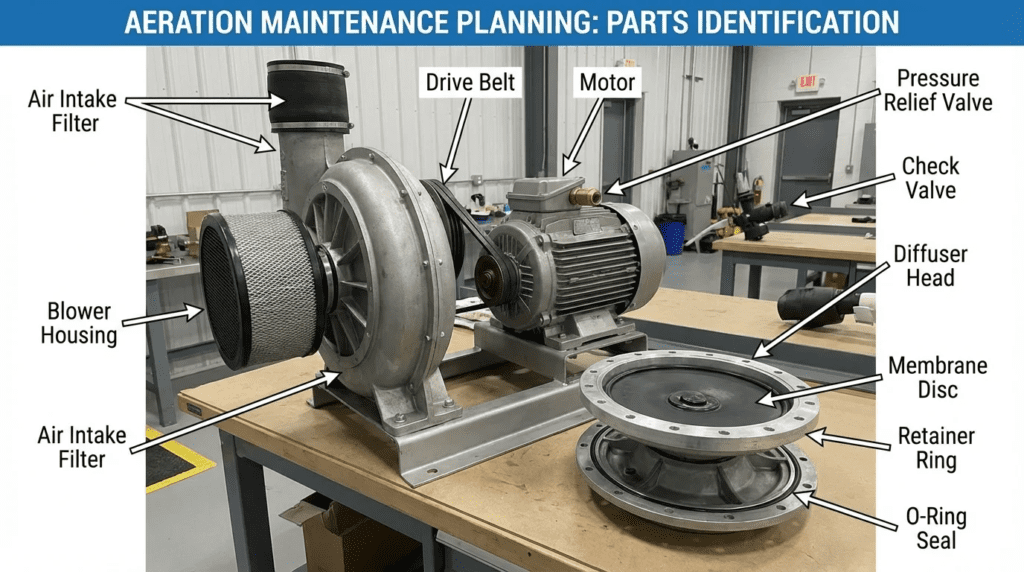
INTRODUCTION
In municipal and industrial wastewater treatment, aeration typically accounts for 50% to 60% of a plant’s total electrical consumption. Despite the massive energy footprint, the gradual degradation of aeration efficiency is a slow-moving crisis that many plant directors and utility engineers fail to notice until operating costs have severely ballooned. The culprit is rarely a catastrophic blower failure; rather, it is the invisible, incremental fouling of diffuser membranes, the gradual slip in blower clearances, and the hardening of flexible elements. Effective Aeration Maintenance Planning: Parts is frequently the missing link in a facility’s asset management strategy, often overlooked in favor of major capital equipment upgrades.
A surprising and costly industry trend is the reactive approach to aeration system maintenance. Many utilities operate diffusers well past their 5-to-10-year design life, accepting a 1-to-2 psi increase in dynamic wet pressure (DWP) due to severe scaling and biofilm accumulation. In a 10 MGD plant, a mere 1 psi increase in discharge pressure requirement can result in tens of thousands of dollars in wasted electrical costs annually, far exceeding the capital cost of replacement parts. Engineers frequently specify premium blowers and diffusers during the design phase but fail to properly outline the lifecycle parts replacement strategy, leading to underfunded O&M budgets and degraded process performance.
Aeration systems—comprising positive displacement (PD) or centrifugal blowers, air distribution manifolds, control valves, down-comers, and bottom-grid diffusers—operate in highly aggressive environments. They are subjected to continuous mechanical stress, thermal cycling from compressed air, chemical attack from mixed liquor, and biological fouling. Selecting and stocking the correct spare parts is not merely an exercise in inventory management; it is a critical process engineering requirement.
This article provides a comprehensive, unbiased engineering framework for aeration system component management. It will guide consulting engineers, plant superintendents, and operators through the technical nuances of evaluating membrane materials, establishing blower wear-part replacement intervals, understanding hydraulic pressure creep, and developing a specification-safe approach to asset reliability. By applying these principles, decision-makers can ensure real-world performance aligns with baseline design expectations, minimizing lifecycle costs and preventing catastrophic process failures.
HOW TO SELECT / SPECIFY
Proper specification of aeration parts requires a deep understanding of the operating environment, hydraulic characteristics, and the physical limitations of the materials involved. When evaluating components for repair, replacement, or preventative stocking, engineers must address the following criteria.
Duty Conditions & Operating Envelope
The operating envelope of an aeration system dictates the physical stress placed on its consumable parts. Engineers must evaluate current and future duty conditions when specifying replacement parts, as original design conditions often drift over a plant’s lifecycle.
- Airflow Rates and Flux: Diffuser membranes are rated for specific airflow ranges (typically expressed in standard cubic feet per minute per diffuser, scfm/diffuser). Operating consistently at the high end of the flux range accelerates plasticizer leaching in EPDM membranes and increases headloss. Specifying parts requires matching the membrane punch pattern to the actual operational flux.
- Operating Temperatures: Compressed air temperatures at the blower discharge can easily exceed 200°F (93°C) depending on ambient conditions and discharge pressure. Replacement PVC piping, expansion joints, and the first few feet of the drop pipe must be rated for these extreme temperatures to prevent catastrophic thermal deformation.
- Operating Modes: Continuous aeration places different stresses on parts compared to intermittent aeration. Systems running intermittent cycles (e.g., Sequencing Batch Reactors) require robust check-valve components in the diffusers to prevent mixed liquor from backing up into the air laterals during blower shutdown.
Materials & Compatibility
The selection of wetted and non-wetted parts must account for the specific biological and chemical makeup of the wastewater, as well as the ambient environmental conditions.
- Diffuser Membrane Materials:
- EPDM (Ethylene Propylene Diene Monomer): The standard for typical domestic wastewater. However, specifying EPDM requires attention to plasticizer content (typically 15-30%). In high-temperature or high-solvent industrial applications, plasticizers leach out rapidly, causing the membrane to harden, shrink, and tear.
- PTFE-Coated EPDM: Provides a non-stick surface that reduces scaling and extracellular polymeric substance (EPS) adhesion, extending the time between mechanical or acid cleanings.
- Silicone: Essential for industrial applications containing heavy oils, greases, or solvents that would rapidly degrade EPDM. Silicone has lower tensile strength but superior chemical and temperature resistance.
- Polyurethane and Ceramic: Used in highly specific industrial applications or ultra-fine bubble requirements where polymer degradation is a critical concern.
- Piping and Hardware Compatibility: Stainless steel (typically 304SS or 316SS) is preferred for drop pipes and manifolds. When specifying replacement hardware (saddles, retainer rings, threaded rods), ensure galvanic isolation is maintained between dissimilar metals to prevent localized corrosion in the mixed liquor.
Hydraulics & Process Performance
The hydraulic performance of aeration components dictates the required blower discharge pressure and, consequently, the power draw.
- Dynamic Wet Pressure (DWP): When specifying replacement diffusers, request headloss curves across the entire operational airflow range. The replacement parts should match or improve upon the original DWP to prevent pushing blowers out of their efficient operating ranges or risking surge in centrifugal blowers.
- Standard Oxygen Transfer Efficiency (SOTE): Different membrane punch configurations yield varying bubble sizes. Finer bubbles increase SOTE but generally result in higher headloss and faster fouling. The selection of replacement membranes must balance transfer efficiency with maintenance intervals.
- Valve Headloss: Replacement air control valves (e.g., butterfly or globe valves) must be selected with precise Cv (flow coefficient) values to ensure accurate dissolved oxygen (DO) control without introducing excessive parasitic pressure drops.
Installation Environment & Constructability
Replacing aeration parts in existing basins poses unique logistical challenges that must be addressed in the specification phase.
- Grid Leveling Tolerances: Aeration efficiency relies heavily on uniform air distribution, which requires a perfectly level manifold grid (typically ±1/4 inch across the entire basin). Replacement saddles and adjustable pipe supports must offer sufficient vertical adjustment to compensate for uneven basin floors.
- Constructability Constraints: In deep tanks or covered basins, moving heavy 316SS manifolds or large diffusers requires significant rigging. Specifying modular replacement components (e.g., individual drop-in panels or easily assembled tube diffusers) reduces confined space entry time and labor costs.
- Curing and Adhesives: If replacement involves PVC or ABS piping, ambient temperature and humidity during the typical winter maintenance window will heavily impact solvent cement curing times. Specifications must account for environmental controls or alternative joint methods (e.g., mechanical couplings) during installation.
Reliability, Redundancy & Failure Modes
Understanding how and why aeration parts fail is central to specifying robust replacements and developing stocking requirements.
- Common Diffuser Failure Modes: Membrane hardening, orifice tearing, check valve failure (leading to mudding of the laterals), and retainer ring cracking due to over-torquing.
- Blower Wear Parts: For PD blowers, common wear items include timing gears, bearings, labyrinth seals, and drive belts. Centrifugal blowers require periodic replacement of inlet filters, blow-off valve actuators, and cooling system components. Operating with partially clogged inlet filters starves the blower and shifts the operating point closer to the surge line.
- Critical Spare Parts Strategy: Specifications should mandate that vendors supply a predefined percentage of consumable parts (e.g., 5% extra diffuser membranes, 2% extra saddles, two sets of blower filters and belts) as part of the initial capital delivery to ensure immediate availability during the first 3-5 years of operation.
Controls & Automation Interfaces
Aeration optimization relies on accurate feedback from field instrumentation. Maintenance parts planning must include these critical sensory components.
- Dissolved Oxygen (DO) Sensors: Optical (luminescent) DO probes require periodic replacement of sensor caps (typically every 1-2 years), while galvanic probes require electrolyte and membrane replacements. Failure to stock these parts leads to manual overrides and over-aeration.
- Thermal Mass Flow Meters: Used for air flow measurement, these sensors are sensitive to moisture and particulate matter in the compressed air stream. Replacement sensor elements or specialized cleaning kits should be part of the inventory.
- Actuator Components: Modulating valves for air header control frequently experience wear on positioning cards, diaphragms, or motor brushes due to constant micro-adjustments required by PID control loops.
Maintainability, Safety & Access
The safety and ergonomics of part replacement dictate how often and how well maintenance is performed.
- Basin Access: Replacing bottom-grid diffusers requires draining the tank, washing down the biological slime, and performing confined space entry. Specify components like purge valves and moisture blow-off lines that can be operated from the walkway to extend the time between total basin drain-downs.
- Retrievable Systems: For facilities with single-basin setups where draining is impossible, floating or hoist-retrievable aeration grids must be specified. The mechanical winches, stainless steel lifting cables, and flexible air hoses on these systems are critical wear parts that require strict preventative maintenance.
- Tooling Requirements: Standardize hardware to minimize the tooling required inside the basin. Specifying proprietary anti-seize compounds on all stainless-steel threaded connections is mandatory to prevent galling during future maintenance evolutions.
Lifecycle Cost Drivers for Aeration Maintenance Planning: Parts
A Total Cost of Ownership (TCO) analysis is mandatory when evaluating aeration components. The cheapest replacement part often yields the highest lifecycle cost.
- Energy Penalty vs. Part Cost: The energy wasted by pushing air through fouled, hardened membranes for one year frequently exceeds the total cost of a complete basin membrane replacement. TCO models must incorporate power cost projections based on anticipated DWP degradation.
- Labor Arbitrage: Tube diffusers might be slightly more expensive than disc diffusers in terms of unit cost, but the labor required to replace 500 tubes is significantly less than replacing 2,000 discs. Engineers must factor local labor rates and confined space entry permit costs into the evaluation.
- Cleaning vs. Replacement: Specifications should evaluate whether the facility will benefit from an automated acid gas cleaning system. While this adds capital cost and requires handling hazardous materials (e.g., anhydrous HCl), it extends the useful life of EPDM parts by dissolving calcium carbonate scaling, fundamentally altering the maintenance timeline.
COMPARISON TABLES
The following tables provide an engineer-focused framework for evaluating aeration replacement parts and strategies. Table 1 details the comparative characteristics of common diffuser membrane materials, while Table 2 provides a maintenance matrix to assist in identifying the correct preventative strategies based on application constraints.
| Material Type | Primary Strengths | Typical Applications | Limitations / Considerations | Typical Maintenance Life |
|---|---|---|---|---|
| Standard EPDM | High tensile strength, excellent elastic recovery, cost-effective | Domestic municipal wastewater, low industrial loads | Vulnerable to solvents, hydrocarbons, and high operating temps; plasticizer leaches over time | 5 to 8 years |
| PTFE-Coated EPDM | Resists scaling and biological fouling, maintains lower DWP longer | High hardness water, calcium-rich industrial waste, energy optimization projects | Higher initial unit cost; coating can be damaged by abrasive mechanical cleaning | 7 to 10+ years |
| Silicone | Exceptional chemical, oil, and heat resistance; contains no leachable plasticizers | Refineries, food/beverage processing, pulp & paper, high-temperature aeration | Lower tear strength than EPDM; requires careful installation to avoid puncture; higher cost | 5 to 10 years (application dependent) |
| Ceramic / Porous Plastic | Rigid structure, highly uniform ultra-fine bubbles, extreme longevity | Deep tanks, highly aggressive chemicals, ozone contactors | Prone to severe scaling; non-elastic (check valves required); heavy; requires robust gas cleaning | 10 to 20 years (with routine acid washing) |
| Component Group | Key Spare Parts | Inspection Interval | Typical Replacement Interval | Primary Failure Indicators |
|---|---|---|---|---|
| PD Blower Mechanics | Belts, air filters, lubricating oil, pressure relief valves | Monthly | Filters: 3-6 mos; Belts: 12-24 mos | Belt squeal, elevated discharge temps, high differential pressure across intake |
| Turbo/Centrifugal Blowers | Cooling fan filters, blow-off valve seals, VFD cabinet filters | Weekly/Monthly | Filters: 3-6 mos; Actuator rebuilds: 3-5 years | VFD overtemp alarms, failure to reach target pressure, surge warnings |
| Diffuser Grids | Membranes, retainer rings, saddles, orifice plugs, check valves | Semi-annually (DWP track) | 5 to 10 years (based on DWP threshold) | DWP increases >1.5 psi above baseline, uneven bubble patterns, “boiling” at surface |
| Instrumentation | DO optical caps, flow meter sensors, air control valve internals | Weekly/Monthly | Optical caps: 1-2 years; Sensors: 3-5 years | Erratic DO readings, failure to calibrate, hunting control valves |
ENGINEER & OPERATOR FIELD NOTES
Translating design specifications into field reality is where the bulk of aeration failures occur. Theoretical headloss calculations must survive the realities of basin installations, contractor tolerances, and operator constraints.
Commissioning & Acceptance Testing
The baseline data gathered during the acceptance phase forms the absolute foundation for all future maintenance planning.
- Clean Water Headloss Testing: Before seeding the basin with biology, operators must record the clean water dynamic wet pressure across the entire operating range of the blowers. This is the “Day Zero” benchmark. Any future maintenance decisions regarding membrane replacement will be compared against this baseline.
- Bubble Pattern Testing: With the tank filled with clean water (typically just covering the diffusers by 2-3 feet), operate the blowers at minimum air flux. Operators should look for “dead zones” indicating unleveled pipe grids or missing orifice plugs, as well as localized “boiling” indicating torn membranes or poorly seated retainer rings.
- Moisture Purge Verification: Condensation accumulates naturally in air headers due to temperature drops. Verify that the continuous or intermittent moisture purge systems function correctly. Failure here leads to water hammer in the air lateral, which can shatter PVC manifolds and blow off diffusers.
- Blower Vibration and Thermal Baselining: Record bearing temperatures and vibration signatures (velocity in in/sec or mm/sec) at the Factory Acceptance Test (FAT) and duplicate them at the Site Acceptance Test (SAT) to ensure piping strain is not translating to the blower casing.
Common Specification Mistakes
Engineers often inadvertently induce maintenance headaches through ambiguous or overly rigid specifications.
- Under-Specifying Pipe Supports: Assuming standard spacing for stainless steel pipe supports based on static loads ignores the dynamic thrust forces of compressed air and water hammer. Supports must be specified to withstand buoyant forces and lateral thrust, with neoprene or EPDM isolation pads to prevent chafing.
- Ignoring Expansion Joints: PVC and stainless steel have different coefficients of thermal expansion. Air headers stretching under 200°F heat will bow, altering diffuser elevations and causing uneven air distribution. Proper bellows-style or slip-style expansion joints are critical wear parts that must be strategically placed and inspected.
- Ambiguous Membrane Specs: Specifying “EPDM diffusers” is insufficient. Engineers must specify the plasticizer content limit (e.g., maximum 30%), the required tensile strength, and the specific gravity. Inferior membranes with high filler content look identical to premium parts but will fail years earlier.
O&M Burden & Strategy
An effective strategy for Aeration Maintenance Planning: Parts relies on moving from reactive repairs to predictive maintenance intervals.
- Inventory Strategy: Aeration Maintenance Planning: Parts Operators should adhere to the “10% Rule” for diffusers: always keep 10% of a single basin’s total diffuser count (membranes, retainer rings, and gaskets) in climate-controlled storage on-site. EPDM membranes have a shelf life and must be stored away from direct sunlight, ozone sources (like large electric motors), and extreme heat to prevent premature degradation.
- Cleaning Regimens: Bumping the air—running the blowers at maximum capacity for 20-30 minutes—flexes the membranes and sheds loose biological floc. This should be a weekly routine. If DWP remains high, bumping can be followed by an in-situ acid gas cleaning (introducing atomized HCl into the air stream) or physical basin drain-down and pressure washing.
- Labor Hour Estimates: A typical 1,000-disc basin replacement requires approximately 80 to 120 man-hours for draining, cleaning, part removal, re-installation, and leak testing. Maintenance schedules must account for this significant labor block.
Troubleshooting Guide
When system performance deviates, operators must diagnose the failure quickly to protect capital equipment.
- Symptom: Gradual Increase in Blower Discharge Pressure.
Root Cause: Membrane fouling (scaling or biological), or plasticizer loss leading to membrane shrinkage and hardening.
Action: Attempt an air bump or acid clean. If unsuccessful, prepare for membrane replacement. - Symptom: Sudden Drop in Discharge Pressure / Localized Surface Boiling.
Root Cause: A blown off diffuser, ruptured membrane, or broken manifold.
Action: Immediately isolate the affected grid to prevent massive air loss and subsequent mixed liquor backflow into the piping network. Drain the basin to identify and replace the damaged parts. - Symptom: Water in the Blower or Air Header.
Root Cause: Failed diffuser check valves combined with a blower shutdown, or a failed moisture purge system allowing condensation to pool.
Action: Clear the laterals using the air-purge system. Inspect and replace check valves or membranes that lack integrated check-valve functionality.
DESIGN DETAILS / CALCULATIONS
The engineering physics behind aeration systems dictates the economic viability of part replacement. Properly sizing replacement parts and calculating pressure creep is essential.
Sizing Logic & Methodology
Evaluating the need for part replacement typically comes down to calculating the cost of elevated Dynamic Wet Pressure (DWP).
The power drawn by a positive displacement or centrifugal blower can be roughly modeled using the adiabatic compression formula. As parts foul, the differential pressure ($Delta P$) increases.
Rule of Thumb: In a typical 15-foot deep aeration basin operating at standard pressures (approx. 7 to 8 psig), every 1 psi of additional pressure drop caused by fouled membranes or clogged filters increases the blower power requirement by approximately 10% to 15%.
Worked Example: Consider a 200-horsepower (HP) blower running continuously.
Current Power Draw = 150 kW
Electricity Cost = $0.10/kWh
Annual Energy Cost = 150 kW × 8,760 hours × $0.10 = $131,400.
If fouled diffuser parts cause a 1.5 psi increase in backpressure, the energy penalty might be an additional 15%, or approximately $19,710 per year. If the replacement membranes for that basin cost $15,000, the simple payback period for swapping the parts is less than 10 months. Delaying maintenance is economically irrational.
Specification Checklist for Aeration Maintenance Planning: Parts
When drafting procurement documents for aeration spares, engineers must include the following critical items:
- Performance Guarantees: Require the vendor to provide certified SOTE and headloss curves for the specific replacement membrane at the facility’s exact depth and airflow flux.
- Material Test Reports (MTRs): Demand MTRs for all 316SS components to verify chromium and nickel content, protecting against cheap, low-grade imported steel that will pit in chloride-rich environments.
- Physical Properties of Polymers: For EPDM, specify a minimum tensile strength (e.g., >1200 psi), ultimate elongation (e.g., >400%), and a maximum extractable oil/plasticizer limit (e.g., <25%).
- Interchangeability: Specify that replacement membranes must fit perfectly on existing OEM bases and saddles without the use of adapters, sealants, or non-standard retainer rings.
Standards & Compliance
Ensure that all supplied parts and replacement protocols adhere to the relevant industry standards.
- ASCE/EWRI 2-06: The standard for measuring oxygen transfer in clean water. Essential for verifying the SOTE of new diffuser parts.
- ASCE/EWRI 18-96 (or latest revision): Standard guidelines for in-process oxygen transfer testing.
- ISO/TC 118: Standards covering compressors, pneumatic tools, and pneumatic machines, relevant for blower testing and wear part specifications.
- NSF/ANSI Standard 61: If the aeration system is used in a potable water application (e.g., water treatment plant aeration basins), all wetted parts—including membranes and PVC glues—must be NSF 61 certified.
FAQ SECTION
What are the critical components of an aeration system that require routine replacement?
The primary consumable parts include diffuser membranes (EPDM, silicone, or PTFE), blower inlet filters, drive belts, lubrication fluids, and optical dissolved oxygen (DO) sensor caps. Ancillary wear parts include check valves, retainer rings, expansion joints, and manifold moisture purge valves. These parts are constantly subjected to stress, heat, and biological fouling.
How do you determine when it is time to replace diffuser membranes?
Replacement is typically dictated by tracking Dynamic Wet Pressure (DWP). If the DWP increases by 1.0 to 1.5 psi above the clean-water baseline (after accounting for static water depth and airflow rates), and cleaning procedures (air bumping, acid washing) fail to reduce the pressure, the membranes have likely hardened or permanently fouled and must be replaced to prevent excessive blower energy consumption.
What is the difference between EPDM and Silicone diffuser parts?
EPDM is highly elastic, durable, and cost-effective, making it the standard for domestic wastewater. However, it relies on plasticizers that can leach out in the presence of industrial solvents or high temperatures. Silicone contains no plasticizers, offering superior resistance to heavy oils, greases, and elevated temperatures (often seen in industrial plants), though it generally has lower tear resistance and a higher upfront cost than EPDM.
How much inventory should a plant hold for aeration maintenance?
Best practices for Aeration Maintenance Planning: Parts suggest holding a minimum of 10% of a single basin’s total diffuser count (membranes, gaskets, and rings) in climate-controlled storage. Additionally, plants should stock two full sets of blower consumables (filters, belts, specialized lubricants) and at least one spare DO sensor or replacement cap per aeration zone.
Can fouled diffusers cause blower failure?
Yes. Fouled diffusers create significant backpressure. In positive displacement blowers, this increases bearing loads and discharge temperatures, potentially causing thermal overload or mechanical failure. For centrifugal blowers, increased backpressure pushes the operating point leftward on the performance curve, moving it dangerously close to the surge line, which can cause catastrophic mechanical damage to the impellers.
What are the typical labor requirements for aeration basin maintenance?
Replacing a standard grid of 1,000 fine bubble disc diffusers usually requires draining the basin, cleaning the floor, and roughly 80 to 120 man-hours of direct mechanical labor to remove old parts, install new membranes, torque retainer rings, and conduct a clean-water bubble distribution test before putting the basin back into service.
Is it better to clean or replace fine bubble diffusers?
This depends on the lifecycle stage and foulant type. If the diffusers are 2-4 years old and fouled by calcium carbonate scaling, acid gas cleaning is highly effective and economical. However, if the membranes are 7-10 years old and have hardened due to plasticizer leaching (loss of elasticity), cleaning will not restore performance. At that point, full membrane replacement is required.
CONCLUSION
KEY TAKEAWAYS
- Energy vs. Capital Trade-off: The cost of wasted electricity from pushing air through fouled, 10-year-old membranes almost always exceeds the cost of purchasing and installing new replacement parts.
- Track DWP Religiously: Establishing a clean-water baseline at commissioning and continuously tracking Dynamic Wet Pressure is the only accurate way to predict when maintenance intervention is economically justified.
- Material Selection Matters: Do not default to EPDM if your facility treats industrial waste, high-temperature influent, or high fats/oils/greases (FOG). Evaluate silicone or PTFE-coated parts based on chemical compatibility.
- Inventory 10%: Maintain a climate-controlled stock of at least 10% of one basin’s diffuser count to enable rapid response to localized failures and prevent panic ordering during supply chain disruptions.
- Address the Blower Envelope: Degraded aeration parts fundamentally alter the hydraulic curve of the system, risking catastrophic surge in centrifugal blowers and overheating in PD blowers.
Approaching the design, operation, and lifecycle management of biological treatment systems requires a fundamental shift away from reactive fixes. A comprehensive strategy for Aeration Maintenance Planning: Parts must be integrated into the initial facility design and rigorously enforced through the O&M budget. Consulting engineers must write specifications that demand baseline testing, high-quality material test reports, and precise operational ranges, while utility managers must prioritize the tracking of dynamic wet pressure and standard oxygen transfer efficiency as key performance indicators.
When selecting parts, decision-makers must balance the upfront capital expenditure of premium materials—such as PTFE-coated EPDM or silicone—against the massive operational expenditures tied to blower electrical draw and the heavy labor burden of confined space basin entries. In many scenarios, investing in slightly more expensive components and stocking adequate preventative spares mitigates the risk of catastrophic biological failure and keeps the plant operating safely within its discharge permit limits.
Ultimately, aeration system components are consumables operating in one of the most mechanically and chemically abusive environments possible. Acknowledging this reality, specifying parts with exact engineering rigor, and replacing them based on hydraulic data rather than failure alone will yield the lowest Total Cost of Ownership and ensure long-term process reliability.